Prestige Awards Best Tech Platform Ireland 25/26 winner

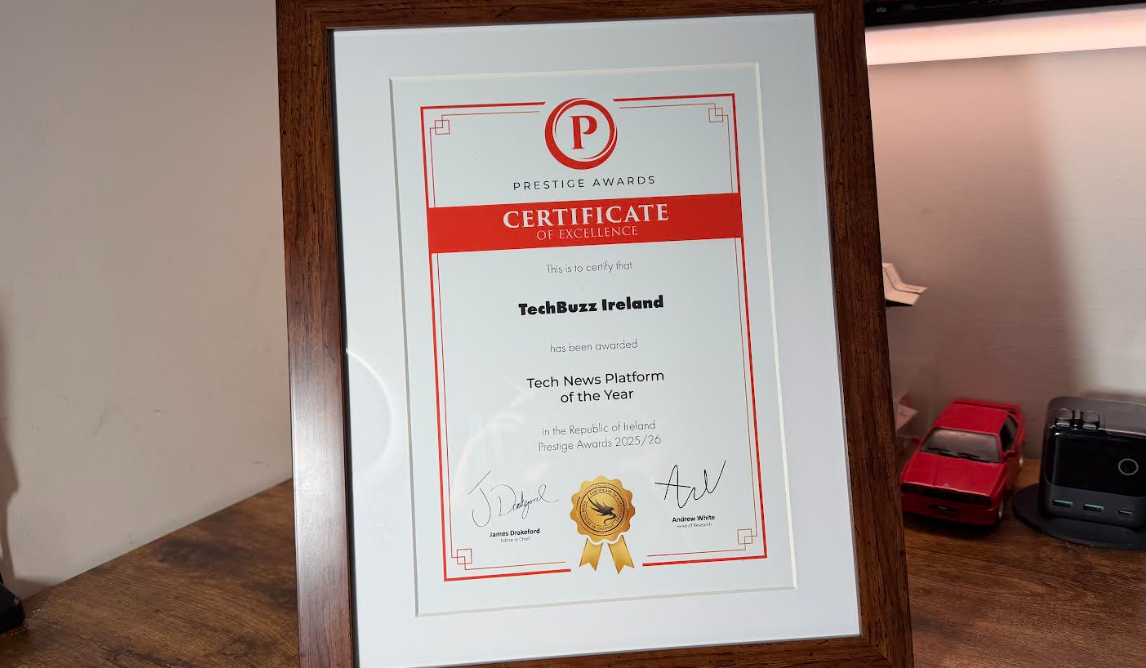
Just a small announcement to thank the guys at Prestige Awards to say thanks for awarding us best tech platform winner of 2025/2026 which came as a surprise to us.

At techbuzzireland we strive to bring real hands on reviews with context real images and videos and the best tech news suited to us and over the years it has been hard work from starting out till where we are now today getting your news and reviews seen all around the world and we hope to keep going for several more years yet and brining more exciting products which of course we have some in right now, March is a huge tech month for new products and we cant wait to show you.

Stay tuned and also check out our YouTube for more and a big thanks from the team past and present.

Is the new GoMo Fibre Broadband a good deal

GoMo, Ireland’s first digital mobile brand, has today announced the launch of Ireland’s first and only fibre broadband offering with a guaranteed ‘price for life’, marking a major expansion of the digital-first brand into home broadband.
Best known for disrupting the Irish mobile market with its original price for life mobile plan, GoMo is now bringing the same approach to broadband. GoMo Fibre Broadband delivers the speed and reliability of fibre‑to‑the‑home broadband for just €29.99 per month, for life.
Broadband is essential to everyday life, and future‑proofed fibre technology delivers the speed and reliability modern family homes depend on. Available to the first 10,000 customers, GoMo Fibre Broadband offers one simple, fixed monthly price, with no price hikes, no long‑term contracts and a fully digital experience.
The plan includes:
  • One guaranteed price for life
  • No price hikes or in-contract price increases… ever!
  • 30‑day rolling contract, allowing customers to leave at any time
  • A fully digital customer experience

Below is not what is not told up front regarding speed though and buried in the terms and conditions however like Ryanair GoMo is no frills, no shops and you have to deal with issues online which in todays world is an annoying and often spending hours on the phone useless chatbots and often fruitless results 

Launched in 2019, GoMo built its position in the Irish mobile market with a focus on customer needs, transparency and simplicity. Broadband is essential for work, streaming and everyday life, yet many consumers continue to face rising costs and bill uncertainty. GoMo Fibre Broadband directly addresses this by locking in one guaranteed price for life, giving customers peace of mind and protection from future increases.
GoMo Brand Lead Caroline Lynch said“When we launched GoMo Mobile, we set out to challenge traditional pricing models in Ireland. With GoMo Fibre Broadband, we’re applying that same thinking. This is about giving customers clarity and certainty in a category that is often seen as complex and unpredictable. A genuine price for life promise, with no surprises and no longterm contracts. It is broadband done differently, built entirely around what customers want.”
GoMo Fibre Broadband offers a simple, digital broadband experience with straightforward pricing and no complicated contracts. Available exclusively to GoMo mobile customers, it forms part of a bundled GoMo mobile and fibre package, delivering long‑term value and certainty.
GoMo Fibre Broadband is available from 6th May 2026, subject to location and network availability. A once-off activation fee of €49.99 applies. Full terms and conditions are available at GoMo.ie.

Shelly expands smart automation portfolio with new solutions for modern installations

Shelly Group has expanded its portfolio of smart automation solutions with the launch of three new products designed to support key use cases across modern installations.

The latest additions focus on access control, lighting management, and simple upgrades for existing electrical systems — helping installers and integrators deliver smarter, more efficient environments.

The new products include the BLU Door/Window ZB sensor, featuring both Zigbee and Bluetooth connectivity; the Dimmer 0/1–10V PM Gen4, enabling precise lighting control with integrated energy monitoring; and the Smart Light Bundle, developed in partnership with V-TAC.

The BLU Door/ Window ZB is a compact, multi-functional sensor that combines a magnetic reed sensor with an integrated G-sensor, enabling highly accurate detection of door and window opening and closing.

In addition to contact sensing, the device measures ambient light levels and tilt angle, allowing for more advanced automations

based on brightness or partially opened windows. This enables greater control and flexibility across a wide range of smart building scenarios.

The device supports both Bluetooth 5.0 and Zigbee connectivity. Bluetooth offers a range of up to 10 metres indoors and up to 30 metres outdoors (depending on environmental conditions), while Zigbee enables mesh networking for extended coverage and improved reliability. Communication is secured using AES-128 encryption, and its energy-efficient design delivers up to five years of battery life under typical usage.

Designed for both residential and professional environments — including multi-dwelling units (MDUs), hotels, and office spaces — the BLU Door/Window ZB supports centralised access monitoring and automation.

In practice, the sensor can trigger a range of smart actions, such as turning off heating when a window is opened, activating lighting upon entry, or sending alerts in the event of unexpected access.

When operating via Bluetooth, a gateway is required for remote access and cloud integration. This functionality is supported by a wide range of Shelly devices, including those from the Plus, Gen3, and Gen4 series. Alternatively, Zigbee connectivity allows seamless integration with existing Zigbee hubs across many smart home platforms.

Dimmer 0/1-10V PM Gen4 is an intelligent lighting controller designed for compatibility with both 0–10V and 1–10V drivers, making it suitable for a wide range of LED luminaires, LED strips, as well as motor control and ventilation applications.

Powered by the ESP32-C6 processor, the device supports multi-protocol connectivity — including Wi-Fi 6, Bluetooth 5.0, Zigbee, and Matter — enabling seamless integration into smart home and building automation systems, often without the need for an additional gateway.

Alongside smooth and precise dimming, the device features built-in, real-time power monitoring, measuring voltage, current, and energy consumption to support improved energy efficiency and cost control.

The Dimmer 0/1–10V PM Gen4 can be operated using existing wall switches (single or double button), while also supporting advanced functionality such as schedules, scenes, scripting, and Night Mode — automatically reducing lighting levels during predefined hours.

With support for KNXnet/IP, the device can be integrated into professional building management systems across offices, hotels, and retail environments. Combined with local control capabilities and compatibility with Matter ecosystems, it ensures reliable operation even without an internet connection — an important advantage for scalable, resilient automation systems.

The Smart Light Bundle offers an accessible entry point into smart lighting, providing a simple, effective way to transform standard lighting into an intelligent system.

Developed in partnership with V-TAC, the kit includes three A60 LED bulbs (4000K) and the compact Shelly 1 Mini Gen4 relay. The relay enables smart control of existing lighting circuits, adding connectivity and automation without the need to replace full installations.

Supporting loads of up to 8A (240V AC) / 5A (30V DC), the Shelly 1 Mini Gen4 operates via Wi-Fi and Bluetooth, with Matter compatibility enabling seamless integration across major smart home ecosystems — all without requiring an additional hub in many setups.

Using the Shelly Smart Control app, users can create schedules, scenes, and automations, as well as control lighting remotely or via voice assistants such as Amazon Alexa, Google Home, and Apple Home.

Suitable both as a first step into smart home technology and as an easy extension to existing systems, the bundle combines affordability, flexibility, and quick installation.

More broadly, these latest solutions from Shelly Group are designed with real-world applications in mind — from automatically switching off heating when a window is opened, to intelligent lighting based on time of day, through to centralised lighting control across offices, hotels, and commercial spaces.

With multi-protocol connectivity spanning Wi-Fi, Bluetooth, Zigbee, and Matter, the products can be easily integrated into both existing smart home environments and new installations, typically without the need for major infrastructure changes or additional hubs.

All products are available in the UK and Ireland on Shelly.com, as well as via authorised resellers a full list of resellers can be found here

See our home security reviews


BLU Door/ Window ZB | MRSP £13.78 | 17.84

Dimmer 0/1-10V PM Gen4 | MRSP £23.09 | 29.89

Smart Light Bundle | MRSP £20.81 | 26.94

Esri Ireland conference maps future of Ireland’s critical infrastructure

Esri Ireland, the market leader in Geographic Information Systems (GIS), recently welcomed geospatial specialists, industry leaders, and key stakeholders, alongside Minister of State for Public Procurement, Digitalisation and eGovernment, Frank Feighan TD, to its ‘Building a Stronger Future’ conference in Dublin. The conference took place in The Round Room at The Mansion House, with 450 delegates in attendance, all of whom are shaping the infrastructure that keeps Ireland moving.

The event, reflecting the start of a defining decade in infrastructure investment, showcased how location, place, and geography is transforming the way housing, education, transport, clean energy, water, gas, electricity, and high-speed connectivity infrastructure is planned, built, managed, and protected across the island of Ireland. Opening the conference as keynote speaker, Minister Feighan highlighted the critical role that location intelligence is already playing in the development of Ireland’s national infrastructure.

Attendees on the day learned how Dublin Airport, ESB, Fibrus, Northern Ireland Water, and the Department of Housing are implementing geospatial systems to drive innovation, growth, and policy within their organisations. In addition, industry experts debated the future of infrastructure planning and development in Ireland, particularly with the proliferation of artificial intelligence. Meanwhile, Esri Ireland’s specialists led immersive sessions on new and exciting geospatial tools and technologies.

Delegates came away with fresh outlooks, real-world examples, and actionable insights on enabling smarter decision-making with location intelligence.

Minister of State Frank Feighan TD said: “Geospatial technology is becoming a cornerstone of how we plan, deliver and maintain critical infrastructure across Ireland. By harnessing accurate, real-time location data, we can make smarter, more efficient decisions that support sustainable growth, strengthen public services, and improve quality of life for our citizens.”

Paul Synnott, Managing Director, Esri Ireland, said: “Our Building a Stronger Future conference was a landmark moment for Esri Ireland and our customers, and a powerful reflection of the strength of Ireland’s geospatial community. Bringing together customers, partners, public sector leaders and industry experts to explore and showcase how we build a stronger future was both inspiring and energising. We were especially honoured to welcome Minister of State Frank Feighan, whose opening address clearly articulated the vital role geospatial technology will play in supporting Ireland’s infrastructure development over the coming decade. I am deeply grateful to everyone who contributed to making the day such a success.”

Custom CRM Development Company: Why Growing Businesses Eventually Leave Generic CRM Tools Behind

Most companies don’t wake up thinking they need a custom CRM development company. That realization usually arrives later, when customer information stops behaving like something you can trust and starts feeling like scattered fragments across different tools.

Sales has its own version of truth. Marketing has another. Support is working with something completely different. And leadership is stuck trying to make decisions using reports that never fully agree with each other.

It doesn’t look like a crisis at first.

Just a few missing updates here, a delayed report there. But over time, those small gaps turn into a system where nobody is fully confident in what the data is actually saying.

That’s the point where CRM stops being a tool and starts becoming a limitation.

Why Do Standard CRM Systems Slowly Lose Their Real Value?

At the beginning, most CRM platforms feel like the perfect answer. Clean dashboards. Simple pipelines. Easy onboarding. Everything looks organized.

But they are built on a quiet assumption: that customer journeys stay predictable.

That assumption breaks faster than most teams expect.

A lead may originate on social media, vanish for several weeks, emerge via email, and eventually convert following numerous conversations through various channels. That type of conduct is frequently difficult for standard CRM systems to meaningfully depict.

So teams adjust the system manually.

Notes get added outside workflows. Data is duplicated across tools. Sales pipelines are forced into stages that don’t really reflect reality anymore.

Nothing breaks suddenly.

It just becomes slightly inaccurate everywhere.

And inaccurate data is more dangerous than missing data because it still looks believable.

What Actually Changes When a CRM Becomes Custom-Built?

A custom CRM is not just a different version of the same software. It is a different way of thinking about customer information altogether.

The system is developed around how the business actually runs, rather than trying to fit business operations into pre-made architecture.

This covers the progression of leads, the initiation of follow-ups, internal team communication, and the preservation of customer history throughout all interactions.

A custom CRM development company typically starts by mapping real workflows first, not software features. Because the problem is rarely about missing functionality. It is almost always about misaligned structure.

Once that structure is corrected, everything else starts to feel more connected.

Why Do Businesses Stop Trusting Their CRM Data?

Trust doesn’t disappear in one moment. It fades gradually through repeated inconsistencies.

A sales manager sees one number in the dashboard and something different in the spreadsheet. Marketing tracks conversions that don’t match actual closed deals. Support records issues that sales never sees in context.

Each department begins building its own interpretation of reality.

At that stage, the CRM is still technically “working,” but it is no longer acting as a single source of truth.

Salesforce research has repeatedly shown that fragmented customer data directly impacts retention, response quality, and customer experience, especially in businesses where multiple touchpoints influence purchasing decisions.

The issue is not lack of data.

It is disconnected context.

How Custom CRM Systems Restore Customer Visibility Across Departments

The real strength of a custom CRM system is not data storage. It is data connection.

A unique system links leads, customers, and support tickets into a continuous timeline of interaction rather than treating them as distinct things.

Sales thereby recognizes the source of a lead as soon as marketing generates it. Support is given all background information when sales closes a contract. Marketing can modify targeting based on actual behavior patterns after support fixes a problem.

Everything stays aligned.

Businesses working with a custom crm development company often discover something unexpected during this process: their biggest challenge was never lead generation. It was internal clarity.

Once that clarity is restored, decision-making becomes noticeably faster because teams stop reconciling conflicting data sources.

Why Do CRM Systems Fail Even After Successful Deployment?

Most CRM failures don’t happen during development or installation.

They happen after launch, when real users begin interacting with the system daily.

If the system feels slower than existing habits, people quietly start avoiding it. They go back to spreadsheets. They keep personal notes. They maintain unofficial tracking systems that feel faster and more reliable.

Over time, a second shadow system emerges inside the company.

And once that happens, CRM data loses completeness again.

Gartner’s studies on enterprise software adoption consistently highlight a simple pattern: technical success does not guarantee usage success. If users don’t trust or enjoy the system, they eventually stop relying on it.

That’s why usability is not a design detail.

It is a structural requirement.

What Industries Experience CRM Limitations the Fastest?

Some businesses feel CRM limitations earlier than others because of how their customer journeys behave.

SaaS providers handle product usage tracking, churn trends, and subscription cycles. Long negotiation schedules involving numerous parties are managed by real estate companies. Service-based firms handle recurrent interactions over extended time periods rather than single transactions.

Healthcare-related services often deal with privacy-sensitive interactions that require careful history tracking and structured communication flow.

In all these cases, customer relationships are not linear.

They evolve over time, across multiple touchpoints, often without a clear “start and end” moment.

Generic CRM systems struggle to represent that level of complexity accurately.

What Drives the Real Cost of Custom CRM Development?

The cost of CRM development is rarely about company size. It is about system complexity.

A business with a simple sales pipeline may need minimal customization. Another business with multi-layer approvals, automation logic, external integrations, and advanced reporting may require significantly more engineering effort.

Several factors influence development scope:

Factor Why It Increases Complexity
Integration depth More connected tools require stronger backend logic
Workflow complexity Conditional processes need custom architecture
Data modeling Customer history structures affect system design
Automation rules Event-based triggers require careful engineering
Reporting systems Advanced analytics demand structured datasets

One thing often underestimated is how systems evolve after launch.

A CRM is not a one-time project. It is a long-term operational system that changes as the business changes.

Why Do Employees Resist Using CRM Systems in Practice?

Resistance rarely comes from dislike of technology.

It comes from friction.

If a system adds more steps than the previous workflow, employees naturally try to bypass it. They use shortcuts. They rely on memory. They keep external notes.

Not because they are avoiding the system, but because they are trying to stay efficient.

Over time, that behavior reduces data quality inside the CRM.

McKinsey research on digital transformation consistently shows that adoption failure is one of the strongest reasons digital systems fail to deliver expected value, even when the technology itself is fully functional.

That means system design has to consider human behavior, not just technical requirements.

What Features Actually Matter in Modern CRM Systems?

Modern CRM systems are no longer simple contact databases.

They are decision support systems.

Key capabilities usually include:

Feature Operational Impact
Customer journey tracking Full visibility across interactions
Workflow automation Reduced manual repetition
API integrations Unified business ecosystem
Real-time dashboards Faster decision cycles
Role-based permissions Controlled data access
Behavioral analytics Better understanding of customer patterns

Companies investing in a custom CRM development company often prioritize integration and workflow clarity over visual design because disconnected systems are the real source of operational inefficiency.

How Long Does CRM Development Usually Take?

Timelines vary widely depending on how complex internal processes are.

In a comparatively short amount of time, a smaller CRM system can be delivered. The design, testing, and refining processes of larger business systems with several departments, integrations, and automation layers take more time.

However, the slowest aspect is rarely growth itself.

The real delay usually comes from alignment.

When departments define “lead stages,” “conversion,” or “qualified customer” differently, those definitions must be unified before development can proceed correctly.

Without that alignment, even the best technical execution becomes unstable.

Cloud-Based CRM vs Traditional Deployment Models

Cloud CRM systems have become the default choice for most organizations.

They reduce infrastructure complexity, support remote access, and simplify updates. Scaling becomes easier, especially for businesses with distributed teams.

However, not every business moves to cloud systems fully.

Industries with strict compliance requirements sometimes adopt hybrid structures where sensitive data remains controlled under specific conditions.

So the decision is less about technology preference and more about operational risk management.

What Actually Defines a Good CRM Development Partner?

Technical skill is only part of the requirement.

A strong CRM development partner understands how businesses actually operate under real conditions.

They look beyond feature lists and start asking operational questions:

Where does customer data become inconsistent?
Why do deals slow down at specific stages?
Which departments duplicate information?
Where does communication break between teams?

Those answers define system structure far more than any UI design or feature catalog.

Without that understanding, CRM systems often end up technically correct but operationally misaligned.

Conclusion

Most companies only realize they need a custom CRM development company when customer data stops behaving like a single system and starts feeling like disconnected fragments across multiple tools.

At that point, software features are no longer the problem.

Clarity, congruence, and confidence in the data used to make decisions are crucial.

All of that is brought back together by a well-designed CRM, which transforms dispersed interactions into a cohesive system that truly mirrors how the company runs in real life.

Why Custom ERP Software Development Services Matter More Than Most Businesses Realize

Most businesses don’t start searching for ERP solutions because they love software. They start searching because operations slowly become messy.

Finance uses one platform. Inventory lives somewhere else. HR tracks information manually. Customer support keeps asking for data that already exists but nobody can find quickly. At first, teams work around those problems. Later, those workarounds become daily friction.

That’s usually the point where companies begin looking into custom ERP software development services.

And honestly, this is where many businesses make a costly mistake.

They buy a popular ERP platform assuming popularity automatically means compatibility. It doesn’t. A system built for thousands of companies rarely fits the exact operational behavior of one company that has its own reporting structure, approval process, compliance rules, and internal workflows.

The software may technically function. Employees may still hate using it.

Why Do Businesses Move Away From Generic ERP Platforms?

Because operations stop fitting inside rigid templates.

A manufacturing company may need inventory forecasting connected directly to supplier delivery patterns. A healthcare provider may require patient records tied to insurance workflows and compliance reporting. A logistics firm might depend on real-time vehicle coordination across multiple cities.

Generic ERP systems usually handle broad business functions reasonably well. Problems appear once operations become more specialized.

That’s the part many sales teams avoid discussing.

In reality, companies frequently spend months modifying off-the-shelf ERP systems only to find that the system still is not able to support how their teams really operate. In the end, the business must pay for additional licenses, third-party connectors, plugins, and manual fixes simply to enable simple processes to communicate with one another.

A custom-built ERP system approaches the problem differently.

Instead of forcing operations to adapt to software limitations, the software is designed around operational reality.

What Does A Custom ERP System Usually Include?

That depends heavily on the business model.

Some businesses merely require centralized inventory control and finance. Others need intricately linked ecosystems that concurrently manage procurement, HR, analytics, compliance, customer management, reporting, mobile access, and process automation. Healthcare institutions are an excellent illustration. 

Patient data, staff scheduling, billing, insurance verification, reporting obligations, and electronic health systems are frequently managed concurrently by hospitals and clinics. Removing fragmentation across various operational layers is typically the goal of teams looking for custom ERP software development services.

When systems stop communicating properly, small delays turn into operational bottlenecks.

Staff wastes time switching between platforms. Reporting becomes inconsistent. Decision-making slows down because nobody fully trusts the data anymore.

That operational uncertainty spreads quickly across departments.

Which Industries Usually Benefit Most From ERP Customization?

Not every business needs a heavily customized ERP environment.

A smaller company with straightforward operations can often manage perfectly well using lightweight SaaS tools for several years.

Things change once workflows become more complex.

Manufacturing businesses frequently need production visibility connected to procurement timelines and warehouse tracking. Construction firms often require project cost management tied directly to labor allocation and material usage. Retail brands operating across multiple locations need centralized inventory accuracy that updates in real time.

Healthcare remains one of the strongest examples because operational systems inside medical organizations are rarely simple.

Compliance requirements alone create technical complexity that generic ERP templates struggle to support properly.

That’s why companies investing in custom systems usually care less about “extra features” and more about operational alignment.

The goal is not flashy dashboards.

The goal is reducing friction.

How Expensive Is Custom ERP Development?

There isn’t one universal price.

A relatively small ERP platform with limited modules may cost far less than a multi-department enterprise system involving automation, analytics, integrations, security architecture, and mobile infrastructure.

What increases development cost most is complexity.

Not company size. A smaller healthcare provider with strict compliance workflows may require more engineering work than a much larger retailer operating with simpler processes.

Several factors influence ERP pricing:

Factor Why It Changes Cost
Integrations Connecting existing platforms increases engineering work
Compliance requirements Security and reporting rules require additional architecture
Automation depth Complex workflows take longer to build and test
Reporting systems Advanced analytics increase backend complexity
User permissions Multi-role environments need stronger access controls
Mobile functionality Cross-device support adds development time

One thing businesses consistently underestimate is maintenance planning.

Building software is only part of the equation.

ERP systems evolve continuously because operations evolve continuously.

Why Do Some ERP Implementations Fail?

Usually because companies rush into software decisions before understanding their own operational problems.

That sounds simple. It happens constantly.

Leadership teams often focus heavily on feature lists while ignoring workflow behavior inside departments. Employees may already rely on manual shortcuts because existing processes are inefficient. If those inefficiencies get transferred directly into new software, the ERP system simply digitizes confusion instead of fixing it.

The strongest ERP projects spend significant time on operational discovery before development starts.

That includes analyzing:

  • approval chains
  • reporting bottlenecks
  • data duplication
  • communication delays
  • department dependencies
  • compliance exposure

What people miss about ERP adoption is that employees decide success long before executives do.

If teams feel the system slows them down, adoption drops quietly.

And once employees stop trusting an ERP platform, recovery becomes difficult.

What Features Matter Most In Modern ERP Systems?

Businesses sometimes get distracted by trends.

AI dashboards sound impressive in presentations. Predictive automation sounds exciting during demos. Yet many organizations still struggle with basic reporting consistency and workflow coordination.

Strong ERP systems usually focus on operational clarity first.

Several features consistently matter across industries:

ERP Capability Operational Benefit
Real-time reporting Faster decision-making
Workflow automation Reduced manual tasks
API integrations Better platform communication
Role-based access Stronger security control
Cloud infrastructure Easier remote accessibility
Audit tracking Improved compliance visibility

Businesses evaluating custom erp software development services increasingly prioritize interoperability because disconnected systems create reporting delays that affect finance, operations, and customer support at the same time.

That fragmentation becomes expensive surprisingly fast.

How Long Does ERP Development Usually Take?

Longer than most businesses expect.

A smaller ERP implementation may require several months. It frequently takes a lot longer to implement enterprise-grade systems that involve numerous departments, data migration, automation logic, connectors, and testing.

Clarity in decision-making is critical to development pace.

Projects slow down when needs frequently change or when internal stakeholders disagree on operational objectives.

Complications are also caused by legacy systems.

Old databases, irregular reporting formats, and antiquated procedures typically require cleansing before transfer can proceed safely.

Businesses that devote time to preparation typically steer clear of the worst implementation mishaps down the road.

Rushed ERP projects often create fragile systems that require expensive fixes after launch.

Is Cloud ERP Better Than On-Premise Infrastructure?

For many businesses, cloud-based environments make more sense today.

Remote accessibility improves. Maintenance becomes easier. Scaling infrastructure generally costs less compared to maintaining physical servers internally.

Still, certain industries continue using hybrid or on-premise environments because compliance obligations remain strict.

Healthcare organizations, financial institutions, and government-connected operations sometimes maintain tighter internal control over infrastructure depending on regulatory requirements.

There is no perfect deployment model for every business.

Operational goals matter more than trends.

What Should Businesses Look For In An ERP Development Partner?

Technical experience matters.

Operational understanding matters even more.

A development team may build technically functional software while still creating a system employees dislike using daily. Strong ERP partners spend time understanding how departments actually communicate before discussing interfaces or dashboards.

The right development company usually asks difficult operational questions early:

Why do reporting inconsistencies happen?

Where does communication break down between departments?

Why are manual spreadsheets still being used?

Which approvals create delays?

Those questions often reveal deeper operational problems long before development starts.

And honestly, that stage matters more than flashy sales presentations.

A well-designed ERP system should eventually feel almost invisible.

Employees stop fighting workflows. Reporting becomes easier to trust. Departments coordinate faster without constantly checking three different platforms for the same information.

That operational clarity is usually what businesses were searching for all along.

Conclusion

Most businesses don’t realize they’ve outgrown their systems until everyday work starts feeling slower than it should. Reports conflict. Teams duplicate tasks. Decisions take longer because nobody fully trusts the data anymore.

That’s usually the real reason companies invest in custom ERP software development services.

Not for trend-driven digital transformation language. Not for flashy dashboards.

SIVGA Introduces the M260 HiFi Wired Earbuds

SIVGA is pleased to announce the launch of the all-new M260 HiFi Wired Earbuds, a stylish and affordable wired solution designed for music lovers, commuters and gamers alike. Combining a nostalgic, retro-inspired aesthetic with modern driver technology, the M260 delivers balanced, high-quality sound at an accessible price point.
Available from 8th May from Amazon and selected retailers worldwide, the SIVGA M260 will be available in two versions:
3.5mm – £39.90 / $39.90 / €45.00
USB-C – £45.00 / $45.00 / €50.00

Retro Design. Modern Sound.

Drawing inspiration from the golden era of portable audio, the M260 features a classic earbud form factor reminiscent of vintage cassette players and early portable CD systems. The metallic finish and exposed grille design give the M260 a distinctive retro character, while its lightweight construction ensures comfort for extended listening sessions.
Whether paired with a modern smartphone, laptop or handheld gaming device, the M260 bridges generations of audio design – offering a timeless look with contemporary performance.

14.2mm Dynamic Driver with Copper-Ring Composite Bio-Diaphragm

At the heart of the M260 is a 14.2mm dynamic driver, engineered to provide an expansive soundstage and impressive clarity. The copper-ring composite bio-diaphragm enhances diaphragm control, reducing distortion and improving overall tonal balance.
This results in a balanced tuning with smooth, non-fatiguing sound and natural vocal presentation, ideal for everything from streaming playlists and podcasts to immersive gaming sessions. Subtle in-game cues, dialogue clarity and layered soundtracks are reproduced with precision, giving gamers and everyday listeners alike a reliable wired performance free from latency.

High-Performance Driver System

To further optimise performance, SIVGA has implemented a lightweight CCAW (Copper-Clad Aluminium Wire) voice coil for faster transient response and improved clarity. A N50 neodymium magnet provides powerful drive and precise control across the frequency range, contributing to the M260’s dynamic yet controlled presentation.
With a frequency response of 20Hz–20kHz, 118dB sensitivity and 16Ω impedance, the M260 is easy to drive directly from smartphones, computers and laptops and handheld gaming consoles.

Detachable MMCX Cable for Flexibility and Longevity

The M260 features an MMCX detachable cable system, allowing users to swap cables easily for flexible sound customisation. The included 4N silver-plated OFC cable ensures clean and detailed signal transmission while enhancing durability.
For added convenience and device compatibility, the M260 is available in two plug configurations:
• 3.5mm L-shaped plug – designed to reduce cable strain and improve durability
• USB-C straight plug with integrated DAC and microphone
The USB-C version includes a built-in Realtek ALC5686 DAC supporting up to 32-bit/384kHz Hi-Res audio. The high-sensitivity microphone features multi-function controls for calls, music playback and volume, making it an excellent companion for gaming, video calls and everyday communication.

Designed for Everyday Use

Lightweight and supplied with four pairs of ear tips and a protective Oxford fabric carry case, the M260 is built for portability. Its 1.2m cable length offers flexibility whether at a desk, commuting or gaming on the move.
By combining retro-inspired styling, modern driver engineering and consumer-friendly pricing, SIVGA has created a wired earbud that delivers dependable performance without compromise.

Greenvolt Next Delivers 2.2MWp Solar Farm at Astellas Dublin

Greenvolt Next, part of the Greenvolt Group, a leading specialist in renewable energy solutions for the commercial and industrial sector, today announces the completion of a 2.2MWp ground-mounted solar farm at the Astellas Damastown facility in Dublin.

Greenvolt Next delivered a high-impact renewable energy solution in just four months, a timeframe that is increasingly critical to support energy security in today’s volatile energy landscape. Managing every stage of the project, from concept/design to installation and commissioning, Greenvolt Next continues to support Astellas Dublin’s site with ongoing maintenance and performance reviews.

The solar farm which is now live features 3,192 solar panels and five inverters, supplying 27% of the site’s electricity needs and reducing Scope 2 CO₂ emissions by 310 tonnes annually. It marks a significant milestone in Astellas Dublin’s sustainability journey, strengthening operational resilience, lowering environmental impact while maintaining operational excellence.

Designed with future growth in mind, the system can accommodate additional inverters and battery storage integration, allowing the facility to expand its renewable energy capacity as operational needs evolve. This is part of Astellas ongoing commitment to contribute to the sustainability of society through its business activities.

Throughout the project, sustainability considerations extended beyond energy generation. At each stage, careful attention was given to protecting and enhancing site biodiversity. Large bug hotels were constructed using reclaimed tree stumps, multiple bat boxes were installed, and a significant number of native Irish trees were planted to promote local ecology and support long-term biodiversity on the site. The solar farm is also visible along the site’s 1.1km riverwalk, offering employees and visitors a clear view of the facility’s commitment to renewable energy and environmental stewardship.

Owen Power, CEO of Greenvolt Next Ireland, commented: “This solar farm is an impressive feat with our resourceful team completing the design, installation and delivery of over 3,000 solar panels in just four months. The turnaround time for a project of this scale is meaningful and shows how quickly we can implement change – change that gives Astellas more control and more reliability in terms of its energy needs both today and in the future. Making renewable energy easy not only benefits the organisation but also its customers and the environment as a whole, particularly at a time when these factors are becoming increasingly critical amid ongoing volatility and uncertainty in energy markets.”

Leon Burns, Capital Projects Lead, Astellas Ireland, commented: “At Astellas, we know that time is of the essence when it comes to taking action. As well as doing the best for patients, we are also committed to doing the best for the world around us – that includes supporting a greener future. In just four months, Greenvolt Next has delivered a solar farm which boosts our sustainability credentials and offers scalability. Underpinned by their resources and expertise, this installation is already making a tangible difference to our business operations.”

SUPCASE – UB Pro Mag Series Google Pixel 10A Protective Case with Stand Review

The SUPCASE – UB Pro Mag Series Google Pixel 10A Protective Case with Stand is a one stop solution for your decive and one you should be looking at right now.

The case offers extra grip on all sides bumpers on the corners, tactile buttons and a built in screen protector, not only that it also has a belt clip and this also can turn 360 degrees.

The case itself is built like a tank and no doubt will protect your Google PIxel 10a from any angle it may drop on, the camera area on the rear is fully protected all you ports and the screen all vital parts of your phone.

This also works with MagSafe accessories with N52 magnets which are the best in the game here and they are strong, the case itself is made with TPU and PC layers and gives great shock absorbtion all round the phone and still allows you to charge your device wirelessly which is excellent.

The built in kickstand also allows you to watch media on the device without the need to remove the case which is another bonus and overall this case is one you should be loking at if you are a but clumsy or work in a hard industry where accidents a bound to happen. Check the video review below for more.


– Key Features:

  • Built-in Screen Protector: The front frame features a built-in 0.2 mm HD PET screen protector with ≥95% light transmittance. Easy to install, it provides a bubble-free fit that helps protect against scratches while maintaining HD clarity and touch sensitivity.
  • MagSafe Feature: Equipped with an N52 high-strength magnet, delivering up to 1800 g of magnetic force for stable compatibility with MagSafe accessories. Note: A magnetic case is required for MagSafe accessories and wireless charging.
  • Military-Grade Drop Protection: TPU + PC structure featuring a hard back and shock-absorbing edges. The four-corner airbag design helps absorb impact from drops. Tested up to 20 ft and certified to MIL-STD-810H-516.8 standards.
  • Kickstand Feature: Built-in stand supports hands-free viewing in both portrait and landscape modes. Perfect for watching videos, live streams, and FaceTime calls.
  • Rotatable Belt-Clip Holster: Includes a detachable, rotating belt clip holster for convenient hands-free carrying. Suitable for everyday use and outdoor activities.

BUY

Other Pixel 10a case reviews 

Video Review

Dell’s new mouse and keyboard delivers ‘full day use’ with a 5-second charge

Dell Technologies has introduced a keyboard and mouse combo that charges in five seconds and delivers a full day of use.

The new Dell Pro 7 Rechargeable Compact Keyboard and Mouse rely on supercapacitor technology rather than traditional lithium-ion batteries.

The Dell Pro 7 Rechargeable Compact Keyboard and Mouse replace traditional lithium-ion batteries with supercapacitor technology, significantly reducing charging times while maintaining extended usage.

Part of Dell’s latest accessories portfolio, the new devices are designed to support users across Ireland with faster charging and reliable day-to-day performance.

A five-second charge provides up to a full day of use, while a full charge takes less than five minutes. Once fully charged, the keyboard delivers up to three months of use, and the mouse up to six weeks. Dell also describes the mouse as the world’s lightest non-lithium-ion rechargeable model.

The launch forms part of Dell’s broader commercial portfolio update, including new PCs, accessories and productivity tools aimed at hybrid working environments. The shift to supercapacitor technology reflects the company’s focus on alternative energy storage solutions for low-power devices.

Unlike conventional batteries, supercapacitors charge and discharge rapidly and can withstand significantly higher charge cycles, though they store less total energy. Dell notes that the lower power requirements of peripherals such as keyboards and mice make them well suited to this approach.

The Pro 7 keyboard and mouse support both Windows and Mac devices. Dell says the engineering effort focused on managing voltage drop during discharge, using efficient power management to ensure consistent performance.

Both devices follow the design principles of the wider Dell Pro 7 range, with quiet typing, comfortable key travel and a compact form factor suited to everyday use.

See our keyboard and mouse reviews