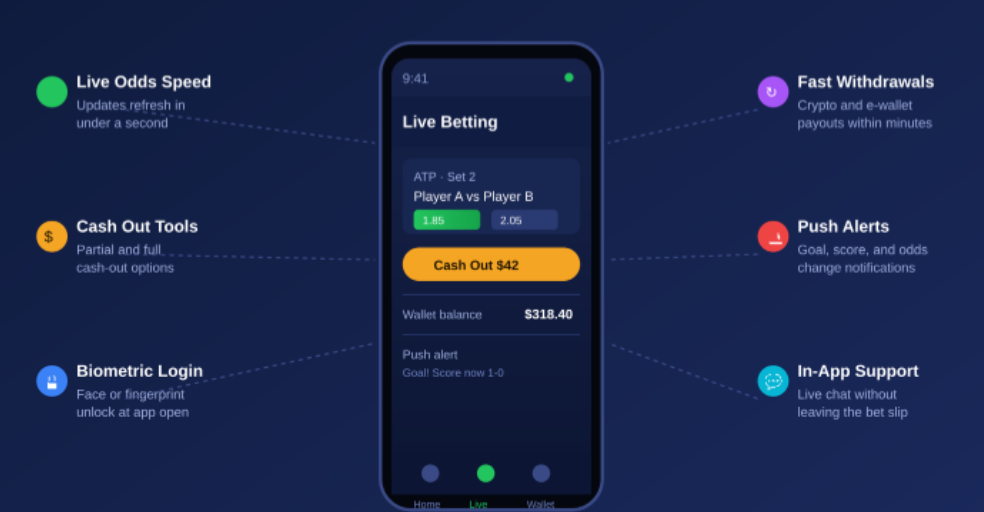
Every app in this space markets itself the same way — fastest, smoothest, built for people who take betting seriously. Put two or three of them on the same table, though, and the marketing copy stops mattering. What actually shows up on top platforms, like those operating via soft2bet-se.net, is how fast a price updates once the match is live, how many screens stand between you and cashing out, and whether the app bothers to tell you something useful just happened or leaves you to notice on your own. None of that shows up in a store listing. You only really see it once you’re using the thing under pressure, mid-match, trying to act before a price moves.
Checking a Bizbet promo code is usually where that relationship starts, well before anyone opens the live betting screen for the first time — and it’s not a bad place to start comparing what an app offers once the promotional banners are out of the way.
Quick Feature Comparison
| Feature | Industry Standard (Average App) | Top-Tier Performance (Modern App) |
| Odds Refresh Speed | 2–3 seconds delay | Under 1 second + visual indicators |
| Cash Out Options | Full cash out only | Full, partial, and auto-cash out with smart nudges |
| Withdrawal Time | Several business days (bank transfers) | Minutes (optimized e-wallets & crypto) |
| Live Notifications | Drowns user in generic promo spam | Highly tailored alerts (goals, cards, odds shifts) |
| Customer Support | Redirects to external browser or email | Frictionless, in-app live chat directly on the bet slip |
How Fast the Odds Actually Move
Start here, because it matters more than anything else on this list and gets discussed the least. A feed running two or three seconds behind the real match can quietly cost a bettor a price that’s already gone by the time it shows up on screen. Faster apps update in well under a second and make a point of flagging the shift itself, not just the new number sitting there unexplained. The lag rarely shows up when a match is calm — it’s the swings, the sudden turns, where a slow app finally gives itself away.
What Cash Out Actually Lets You Do
Full cash out — locking in a result before the event finishes — barely counts as a differentiator anymore, since almost every app has it now. Partial cash out is the real split point: pulling out half your stake and letting the rest keep running is a genuinely different tool, not a scaled-down version of the same idea. A handful of apps go one step further and nudge you the moment your bet’s value shifts hard enough to matter, instead of leaving you to spot it yourself in the middle of everything else happening on screen.
Payments: Deposits Are Easy, Withdrawals Aren’t
Depositing rarely trips anyone up — every app makes sure of that, deliberately. Withdrawals are where the real gap opens up. A bank transfer can sit for several business days no matter whose app you’re using, while e-wallets and crypto payouts have started landing in minutes rather than days on the apps that have actually invested in this part of the experience. That single difference does more to separate a modern app from a dated one than almost any other feature on this list.
Security That Only Matters Once
Face or fingerprint unlock is close to standard now, not a selling point anymore. The real differences sit underneath that: how quickly a session times out, whether logging in from an unfamiliar device triggers any kind of alert, whether a withdrawal specifically asks for a second confirmation instead of relying on the login alone. None of it reads as exciting on a features page. It’s exactly the sort of thing nobody thinks about — right up until the one time it’s needed, and by then it’s already too late to wish it had been there.
Notifications Worth Keeping On
A well-tuned alert system surfaces the things that actually matter — a goal, a card, a real move in the odds on something you’re following — without drowning it in updates for every minor event across every sport the app happens to cover. Get that balance wrong and most people just mute everything within the first week, which quietly kills the entire point of having live alerts in the first place.
Getting Help Without Leaving the App
Getting kicked out to an email form or a separate browser tab mid-match, just to ask a simple question, is a rough experience — and it’s happening less often for good reason. In-app chat that doesn’t force you off the bet slip, paired with a help center that actually surfaces the right answer instead of a generic list of articles, tends to be the clearest sign an app was built around how people actually use it, not bolted together afterward.
Core Checklist for Testing a New App
Before settling on a single platform, consider running a multi-app test and monitoring these key technical behaviors:
- Load Stability under Peak Traffic: Check if the app lags or freezes during major events like tournament finals or local derbies.
- Bet Slip Friction: Count how many taps or screens it takes to lock in a live wager.
- Session Longevity: Ensure the app doesn’t log you out right in the middle of analyzing an active match.
- Contextual Help Integration: Verify if you can access support FAQs without losing your current live screen view.
For anyone running that kind of test, the Bizbet нэвтрэх page is a reasonable starting point — logging in and actually poking around the live screen tells you more in five minutes than any feature comparison chart will.
Actually Comparing Two Apps
None of this shows up from a screenshot or a store description, which is exactly why comparing on paper only gets you so far. Running two or three apps side by side for a week or two, with the same small stakes and the same kinds of bets, tells you far more — pay attention to which one actually removes friction once a match goes live, not which one has the nicer-looking home screen.
One thing that doesn’t get mentioned very often is how an app behaves when everyone is trying to use it at the same time. Big tournament finals, local derbies, or title-deciding matches can put a lot of pressure on any platform. Some apps stay quick and responsive even during those busy periods, while others start slowing down just when live betting becomes most interesting. That’s something you only notice after using an app for a while.
In the end, there usually isn’t one feature that makes the decision for you. It’s the combination of dozens of small things — how quickly odds refresh, how simple withdrawals are, whether notifications are actually useful, and how stable the app feels during live events. Those details don’t make bets any more likely to win, but they can make the overall experience far less frustrating.