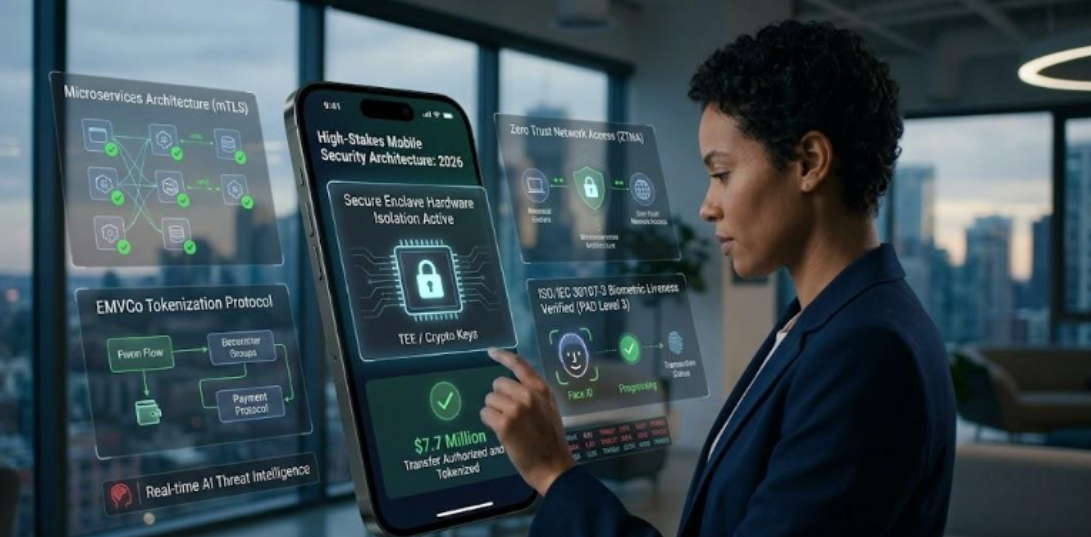
Over the last five years, the architecture of mobile financial platforms underwent a brutal stress test. We are no longer talking about simple peer-to-peer transfers or splitting a dinner bill. That casual habit of checking a bank balance on a morning commute is ancient history. Today, consumer-grade smartphones act as literal high-stakes digital vaults. Payouts that alter human lives require real-time regulatory compliance right on the device. This digital transformation of wealth management and state-regulated wagering forces modern security systems to operate on one core assumption. The host device is already compromised.
Traditional perimeter walls melt the second they face modern adversaries. We do not worry about human hackers manually typing scripts anymore. Syndicates now unleash autonomous AI agents instead. These digital hounds—relentless and perfectly optimized—never stop probing Application Programming Interfaces (APIs) for the tiniest crack. The reality is that generative synthetic identities easily bypass legacy onboarding checks. With stolen personally identifiable information (PII) at their disposal, fraudsters generate synthetic biometrics entirely out of thin air. Application developers ripped out their old models long ago to counter this industrialization of cybercrime. This new standard relies heavily on Zero Trust architectures and aggressive runtime shielding.
Monoliths are Buried: The “Trust Nothing” Microservice Mandate
To isolate these systemic risks, high-stakes platforms fundamentally restructured their cloud infrastructure. Monolithic backends are dead and buried. A highly distributed microservices architecture handles the heavy lifting today. Take an app processing sensitive transactions as an example. It separates the user authentication service completely from the payment gateway. Across the entire network, this separation guarantees strict fault isolation. When a severe logic flaw hits the user management node, the blast radius stops at that specific boundary line. Financial ledgers remain isolated, dark, and completely disconnected from the active compromise.

You also gain massive operational elasticity with this setup. During peak transaction periods—like the frenzy before a massive jackpot draw—specific components scale seamlessly without crashing the broader infrastructure. Zero Trust Network Access (ZTNA) governs every interaction within this environment. At all times, the core principle requires absolute verification. Look closer, and you will realize no entity receives implicit trust based on physical or logical network location. Mutual Transport Layer Security (mTLS) handles all communication between microservices. The catch? The protocol demands undeniable cryptographic proof of identity before a single payload shifts between nodes. Ephemeral access tokens replace persistent privileges completely.
Value Extraction: Stripping the Payload via Tokenization
Move away from basic encryption models immediately. When millions of dollars fly across the wire, standard cryptography fails. Engineers secure resting databases through the Advanced Encryption Standard with 256-bit keys (AES-256) out of absolute necessity. The protocol gets even stricter for payloads in motion. We mandate Transport Layer Security (TLS) version 1.3 to lock in Perfect Forward Secrecy (PFS) across all active connections. A future compromised key cannot crypt past session communications under any circumstances.
Compliance with the Payment Card Industry Data Security Standard (PCI DSS) v4.0 dictates the rigorous use of EMVCo Tokenization. By design, this process strips the actual financial data out of the mobile ecosystem entirely. The app passes the personal account number (PAN) to a highly regulated Token Service Provider (TSP) when a user links a payment method. What the application gets in return is a mathematically meaningless substitute. Payment networks like Visa and Mastercard act as the regulated custodians in this exchange. Prior to token issuance, these entities verify the user’s identity. Basic encryption transforms data into ciphertext—something a stolen key can eventually unlock—but tokens possess zero extrinsic value. Consequently, a breach of the application database yields absolutely nothing of value to a threat actor. The central Token Vault acts as a highly defended single source of truth, effectively shifting the burden of storage away from the developer.
Flesh and Silicon: Beating the Hyper-Realistic Deepfake
Passwords and PINs are fundamentally broken authentication models. Today, the industry relies exclusively on advanced hardware-backed biometric authentication. Regulatory bodies do not leave this to chance. The National Institute of Standards and Technology (NIST) strictly dictates compliance through Special Publication 800-63B. Consequently, high-stakes environments must hit Authenticator Assurance Level 3 (AAL3). You lock down that compliance by deploying Fast Identity Online (FIDO2) passkeys.
Absolute hardware isolation forms the backbone of this defense. Look inside a smartphone’s Secure Enclave or Trusted Execution Environment (TEE); that specific physical chip buries the private cryptographic keys and biometric templates far away from the cloud. Raw biological data never sees the primary operating system. Under no circumstances can state-sponsored malware extract the private key from a compromised device.
Strong cryptography forces adversaries to pivot toward presentation attacks. They will use 3D silicone masks or inject deepfake videos directly into the camera stream. ISO/IEC 30107-3 standards force platforms to integrate certified Biometric Presentation Attack Detection (PAD) systems to block these physical artifacts. Nobody wants active livens checks anymore; forcing a user to smile or blink ruins the entire consumer experience. Instead, passive systems operate silently in the background while the user simply looks at the screen. Sub-dermal blood flow and involuntary micro-expressions are analyzed to reject high-fidelity artifacts instantly. On the horizon, emerging research introduces neuro-inspired hybrid Multi-Factor Authentication (MFA). This technology builds a behavioral profile based on the user’s neuromotor pathways.
Hostile Territory: Shielding the Runtime and Locking the Grid
Developers have zero control over the security posture of an end-user’s device. Periodically, you must remember that you cannot trust the host OS. Innocent consumers download malware constantly. Every single day, sketchy public ii-fi networks subject devices to ARP spoofing. Factor in the individuals who actively jailbreak their phones for custom software, and you realize the native OS sandbox offers zero actual protection. Organizations embed Runtime Application Self-Protection (RASP) directly into the mobile binary because surviving this hostile territory requires an internal shield.
Behind the scenes, memory allocation and execution flow are monitored actively by this RASP layer. The software flags and restricts jailbroken hardware the millisecond it connects. Reverse engineers constantly attempt to run these apps inside emulators to analyze the code step-by-step. RASP detects these generic hardware signatures and instantly crashes the app. Malicious tools built for dynamic binary instrumentation (DBI)—think Frida—hit an absolute brick wall. Brutal SSL certificate pinning stops Man-in-the-Middle network interception in its tracks.
State-level gaming regulations and the federal Wire Act completely ignore cryptographic boundaries; they care exclusively about hyper-accurate geolocation compliance. The GLI-33 standard dictates the technical requirements for these location frameworks. As a baseline, platforms aggressively neutralize fake GPS masking tools before a session even begins.
The Multi-Million Dollar Custodian Problem
The synthesis of these advanced controls is clearly visible in specific high-risk consumer sectors. Let’s be real about what this looks like in practice. For a prime example, take your average digital lottery app. These platforms aren’t just selling colorful pixels on a screen. In reality, they act as highly regulated custodians for multi-million dollar bearer instruments. Stringent Know Your Customer (KYC) checks are mandatory before a user can even fund an account on one of these platforms. Simultaneously, biometric livens verification prevents underage access and identity theft. Credit card information is instantly tokenized to maintain strict PCI DSS compliance.
For every high-stakes payout, explicit authorization via the device’s Secure Enclave is required. The system verifies latitude and longitude against GLI-certified geofencing tools. Across state lines, this ensures absolute zero margin for error.
The problem? Security engineering never actually stops. Right now, the integration of agentic AI into consumer workflows demands robust domain-oriented guardrails. We must prevent autonomous data exfiltration at all costs. Out in the wild, adversaries probing these networks are already testing post-quantum decryption scripts. We just have to hope the math holds up long enough for the industry to rotate the keys.