Salesforce ODBC Connectivity: Best Drivers for Reliable Data Access

Companies use Salesforce ODBC drivers to connect Salesforce data directly to BI, reporting, ETL, and analytics tools. ODBC eliminates the need to write custom API integrations and allows Salesforce objects to be queried using SQL from standard data platforms.

In practice, ODBC drivers enable teams to:

  • Connect Salesforce to Power BI, Tableau, Qlik, Excel, and ETL platforms 
  • Run SQL-based reporting on Salesforce objects 
  • Automate scheduled data exports and incremental refreshes 
  • Join Salesforce data with on-premise or cloud databases 
  • Centralize analytics without building custom middleware 

For analytics teams, ODBC drivers convert Salesforce’s API-based model into a relational-style interface that standard BI tools understand. For IT teams, they provide a managed, repeatable connectivity layer with defined authentication and configuration options. For data engineers, they reduce integration complexity while preserving control over refresh behavior, security, and performance parameters.

Reliable connectivity matters because Salesforce is often a core CRM system feeding dashboards, executive reports, finance models, and operational pipelines. A driver is not just a connector—it becomes part of the data infrastructure stack.

Salesforce ODBC Drivers Compared

Below are four established commercial drivers frequently used in BI and enterprise data environments.

1. Devart ODBC Driver for Salesforce

Positioning: Balanced SQL coverage + cross-platform + bulk-oriented workloads

Devart focuses on delivering extended SQL support over Salesforce objects while maintaining OAuth-based secure connectivity. It supports Windows, macOS, and Linux, making it suitable for mixed desktop and server environments.

Key characteristics:

  • OAuth authentication over HTTPS 
  • Extended SQL support (joins, grouping, filtering) 
  • Cross-platform (Windows/macOS/Linux) 
  • Batch updates for handling larger data modifications 
  • Broad compatibility with BI and ETL tools 

Devart is typically positioned for teams that need strong SQL ergonomics and flexible deployment across different operating systems while maintaining performance during larger refresh jobs.

  1. Progress DataDirect ODBC Driver for Salesforce

Positioning: Enterprise-scale performance and bulk operations

Progress DataDirect emphasizes high-performance connectivity and large-volume data processing. It is often selected in environments where Salesforce data refreshes are heavy and SLA-driven.

Key characteristics:

  • Focus on performance optimization 
  • Transparent bulk operations 
  • Enterprise multi-platform support 
  • Designed for high-volume data movement 
  • Common in centralized IT deployments 

This driver is typically associated with organizations running large, scheduled refreshes and centralized BI environments where performance under concurrency is critical.


  1. Easysoft ODBC-Salesforce Driver

Positioning: SQL and SOQL flexibility + Windows-heavy deployments

Easysoft provides both SQL-oriented and SOQL-oriented driver options, which is a structural difference compared to most competitors.

Key characteristics:

  • Separate SQL and SOQL driver modes 
  • OAuth support (Windows) 
  • Strong compatibility with Office-based reporting tools 
  • Integration scenarios involving local databases 

Easysoft can be relevant where teams require SOQL-like behavior or primarily operate in Windows reporting environments.

  1. Simba Salesforce ODBC Driver (insightsoftware / Magnitude)

Positioning: Standardized ODBC connectivity across data ecosystems

Simba drivers are widely embedded or referenced in many analytics platforms. The Salesforce driver is known for conventional ODBC configuration patterns and documented OAuth connection string support.

Key characteristics:

  • OAuth 2.0 connection string configuration 
  • TLS-secured communication 
  • Commonly referenced in BI tool documentation 
  • Structured DSN and DSN-less deployment options 

Simba is frequently selected where standardized ODBC configuration and documentation alignment with analytics platforms are priorities.


Structural Differences Between the Drivers

Instead of feature checklists, the real differences appear in architecture and operational focus.

Driver Core Strength Architectural Focus Deployment Style Volume Handling
Devart Extended SQL + cross-platform flexibility SQL translation depth Desktop + server mixed Batch updates, balanced performance
DataDirect Enterprise performance Bulk optimization engine Centralized enterprise IT Strong at large-scale extracts
Easysoft SQL vs SOQL dual model Query-mode flexibility Windows-heavy Moderate workloads
Simba Standardized ODBC implementation Conventional ODBC architecture BI ecosystem alignment Standard analytics loads


Summary: Differences That Matter

All four drivers provide commercial, production-ready Salesforce connectivity via ODBC. The differences lie in architectural emphasis rather than basic capability.

  • Devart emphasizes SQL flexibility, cross-platform availability, and balanced bulk handling. 
  • Progress DataDirect emphasizes enterprise-grade performance and large-scale bulk optimization. 
  • Easysoft differentiates with dual SQL/SOQL driver models and Windows-focused reporting compatibility. 
  • Simba emphasizes standardized ODBC configuration widely documented across analytics platforms. 

Salesforce ODBC connectivity is not a commodity layer when analytics pipelines, scheduled refreshes, and reporting environments depend on it daily. The practical differences between drivers emerge in performance under load, SQL behavior, authentication management, and deployment environments.

Each of these tools serves a distinct operational profile. The right choice depends on infrastructure structure, query patterns, security policies, and expected data volume—not on marketing claims.


AI BDRs: How Artificial Intelligence Is Transforming Sales Outreach

Sales has always been a numbers game, but the rules of the game are changing fast. Traditional outreach methods—cold calls, mass email blasts, and scripted pitches—are giving way to intelligent, data-driven strategies. At the center of this revolution is the AI BDR (Artificial Intelligence Business Development Representative), a solution designed to automate lead qualification, personalize communication, and scale outreach efforts like never before.

What Exactly Is an AI BDR?

In simple terms, an AI BDR is a digital agent that uses artificial intelligence to handle the repetitive but essential tasks of a human sales development representative. Instead of spending hours prospecting, qualifying leads, and following up manually, sales teams can let AI handle the heavy lifting.

The key difference is intelligence. Unlike old automated dialers or email systems, modern AI BDRs use natural language processing (NLP), machine learning, and conversational AI to adapt to real human interactions. They don’t just deliver a message; they respond, learn, and guide prospects toward meaningful conversations with live sales reps.

Core Benefits of AI BDRs

  1. Scalability – An AI BDR can reach hundreds of leads at once, without fatigue or time limitations.
  2. Consistency – Every prospect receives the same level of attention and follow-up, eliminating human inconsistency.
  3. Personalization – By analyzing CRM data, past interactions, and buyer behavior, AI BDRs can craft messages that feel tailored, not generic.
  4. Faster Qualification – Unqualified leads are filtered out automatically, so sales reps spend time only on prospects with real potential.

From my experience, one of the greatest advantages is simply time. Sales teams that adopt AI BDRs often find they can shorten the sales cycle and close deals faster because their pipeline is better managed from the very start.

Real-World Applications

  • Voice AI Agents: AI BDRs powered by voice AI can hold natural conversations with prospects, answer basic questions, and set up meetings.
  • Email Outreach: Instead of static drip campaigns, AI systems analyze open rates, response tone, and engagement to send dynamic follow-ups.
  • CRM Integration: AI BDRs can plug into Salesforce, HubSpot, or custom CRMs to enrich profiles and provide reps with updated insights before calls.

Some companies even use AI BDRs as the first line of contact for inbound leads—qualifying interest, asking screening questions, and scheduling demos automatically.

Challenges to Consider

AI BDRs are not perfect. There are still hurdles that organizations must keep in mind:

  • Human Touch: Prospects dealing with high-value or complex solutions still want to speak with a real person at some stage.
  • Bias and Accuracy: AI systems are only as good as the data they are trained on. Poor data leads to poor outcomes.
  • Adoption Resistance: Sales reps may initially see AI as a threat rather than an ally, making training and change management critical.

The best implementations combine the speed and scalability of AI with the creativity and empathy of human sales teams.

The Future of Sales Outreach with AI

The trend is clear: sales organizations that embrace AI BDRs will have a competitive edge. Future developments will likely include:

  • Emotion Recognition: AI agents detecting frustration, excitement, or hesitation in a prospect’s tone.
  • Deeper Personalization: Outreach customized at an individual level, powered by richer behavioral data.
  • 24/7 Global Outreach: AI BDRs engaging with leads across time zones, ensuring no opportunity slips through.

Sales is evolving into a hybrid model where AI handles repetitive engagement while humans focus on closing and building relationships. That synergy, rather than competition, is what will define the next generation of sales success.

Final Thoughts

AI BDRs are more than a trend—they represent a fundamental shift in how sales teams operate. By combining automation, intelligence, and personalization, they transform outreach from a numbers-driven grind into a smart, scalable process that maximizes results.

And while sales teams explore AI to improve lead generation and qualification, other industries are finding creative applications too. For example, digital entertainment platforms show how AI-powered interactive experiences can redefine how people engage with content—a direction explored by projects on Yanina Games. It’s another reminder that AI isn’t just reshaping business—it’s reshaping how humans connect, learn, and play.

92% of Developers Report AI Agents Will Help Advance Their Career

More than 9 in 10 developers are excited about AI’s impact on their careers, and an overwhelming 96% expect it to change the developer experience for the better. Salesforce’s latest State of IT survey of software development leaders‌ also reveals that 86% believe AI agents will become as essential to app development as traditional software tools.

The large global study of more than 2,000 software development leaders, including 50 from Ireland, highlights near unanimous excitement about agentic AI. Developers are not only looking to agents to unlock greater efficiency and productivity, but 92% believe agentic AI will help them advance in their careers. Some developers, however, believe that they, as well as their organisations, need more training and resources to build and deploy a digital workforce of AI agents.

Why it matters: Developers have often been painted as wary of AI, but new research reveals developers are enthusiastic about the industry’s shift to AI agents. The arrival of agentic AI provides developers with the opportunity to focus less on tasks like writing code and debugging and grow into more strategic, high-impact work. And with developers increasingly using agents powered by low-code/no-code tools, development is becoming faster, easier, and more efficient than ever — regardless of developers’ coding abilities.

Salesforce perspective: “AI agents are revolutionising the way developers work, making software development faster, more efficient, and more enjoyable. This powerful digital workforce streamlines development by assisting with writing, reviewing, and optimising code — unlocking new levels of productivity. By automating tedious tasks like data cleaning, integration, and basic testing, AI agents free developers to shift their focus from manual coding to high-value problem-solving, architecture, and strategic decision-making.” – Alice Steinglass, EVP & GM, Platform, Integration and Automation


By the numbers:

Developers are enthusiastic about agentic AI and its impact on their career

Respondents are excited for agents to take on simple, repetitive tasks, freeing them up to focus on high-impact projects that contribute to larger business goals.

  • 96% of developers are enthusiastic about AI agents’ impact on the developer experience.
  • Developers are most eager to use AI agents for debugging and error resolution, then for generating test cases and building repetitive code.

https://public.tableau.com/views/DevelopersExpectedImprovementsfromAIAgents/Embed1?:language=en-US&publish=yes&:sid=&:redirect=auth&:display_count=n&:origin=viz_share_link

  • The arrival of agentic AI comes at a time where 92% of developers are looking to measure their productivity based on impact over output.
  • With the help of AI agents, developers believe they’ll focus more on high-impact projects like AI oversight and architecting complex systems.

https://public.tableau.com/views/DevelopersExpectedFocusAreaswithAIAgents/Embed2?:language=en-US&:sid=&:redirect=auth&:display_count=n&:origin=viz_share_link

Low-code/no-code tools help developers unlock greater productivity, regardless of coding skills

With agents powered by low-code/no-code tools, developers of all levels can now build and deploy agents. Respondents believe these tools will help democratise and scale AI development for the better.

80% of developers using agentic AI currently use low-code/no-code tools.
78% of developers say that low-code/no-code tools can help democratise AI development.
90% of developers say that the use of low-code/no-code app development tools can help scale AI development.

The customer view: Secret Escapes offers discounted luxury travel hotels and luxury across the globe and is using Agentforce to deliver more efficient customer support to unique and last-minute requests from its travellers. With Salesforce’s low-code Agent Builder tools, the Secret Escapes developer team was able to build, test, and launch their AI agent in just two weeks, compared to the six months it had previously taken the company to build and train a bot.

Developers are eager for more resources to build AI agents

Developers say updated infrastructure and more testing capabilities and skilling opportunities are critical as they transition to building and deploying AI agents.

  • Infrastructure Needs: Many developers (84%) believe their organisation needs to update their infrastructure to build/deploy AI agents.
    • 42% of developers say their data quality and accuracy isn’t sufficient for the successful development and implementation of agentic AI.
  • Testing Capabilities: Nearly half (46%) of developers say their testing processes aren’t fully prepared to build and deploy AI agents.
  • Skills and Knowledge: Almost 7 in 10 (68%) developers believe AI knowledge will soon be a baseline skill for their profession, but over half (54%) don’t feel their skillsets are fully prepared for the agentic era.
    • Survey respondents identified training on technical AI skills and redefining current roles as the most important areas for employers to provide support.

 Go deeper:

Data is sourced from a software development leader segment of a double-anonymous survey of IT decision-makers conducted from December 24, 2024 through February 3, 2025. Respondents represent Australia, Belgium, Brazil. Canada, Denmark, Finland, France, Germany, India, Indonesia, Ireland, Israel, Italy, Japan, Mexico, the Netherlands, New Zealand, Norway, Portugal, Singapore, South Korea, Spain, Sweden, Switzerland, Thailand, the United Arab Emirates, the United Kingdom, and the United States.

Additional data was collected among nearly 250 frontline developers, in partnership with YouGov, in the United States from February 14 through February 21, 2025.

74% of Irish Workers Trust an Autonomous AI Future, and Humans Critical to Getting There

Today’s Irish workers already trust AI to do almost half of their work tasks, according to new Salesforce research. While workers feel most comfortable when AI and humans work together, they are also beginning to trust AI to complete time-saving tasks autonomously, like writing code, uncovering data insights, and drafting written communications.

Workers aren’t ready to trust everything to AI just yet. The research shows that workers prefer tasks like onboarding, training, and keeping data safe to be overseen by humans. But this may not be for long. The data also suggests that investing in knowledge and education builds trust in an autonomous AI future.

Why it matters: As technology advances, people are getting a glimpse into a future in which AI can operate entirely on its own. The Salesforce research, which surveyed 253 people across Ireland, revealed that workers are excited about an AI-powered future. They also stressed the importance of a human touch as they build trust, knowledge, and experience with AI tools. Responses formed part of a survey of nearly 6,000 respondents around the world.

The research found:

Irish workers are offloading tasks to AI and beginning to trust an autonomous future 

  • Workers today trust AI to do roughly 40% of their work tasks, indicating a shift among workers to offloading tasks to AI.
  • 74% of Irish workers will eventually trust AI to operate autonomously. This number includes:
    • 7% of workers who trust AI to operate autonomously today
    • 20% of workers who will trust AI to operate autonomously in less than three years
    • 47% of  workers who will trust AI to operate autonomously in three or more years

While Irish workers prefer AI-human collaboration, they’re starting to trust AI for certain tasks

https://public.tableau.com/app/profile/salesforce.newsroom1206/viz/WouldyoutrustAIhumansorbothtodothefollowingwork/Dashboard1

  • Today, Irish workers trust humans and AI to do most tasks together:
    • 61% trust humans and AI to uncover data insights together
    • 59% trust humans and AI to write code together
    • 55% trust them to develop internal and external communications together

  • When asked if these workers trusted AI to do any of these same tasks autonomously, the answer, for a small group, was some. Tasks they felt comfortable with offloading to autonomous AI included:
    • 15% trust AI to write code autonomously
    • 13% trust AI to uncover data insights on its own
    • 11% trust AI to develop internal and external communications without a human
    • 14% trust autonomous AI to act as their personal assistant

  • Other tasks, according to respondents, require having a human involved right now. Irish workers are most likely to trust humans alone to do the following:
    • 47X% trust humans alone to be inclusive
    • 47% trust humans alone to onboard and train employees
    • 43% trust humans alone to keep data safe

Autonomous AI is on the horizon, but human enablement and involvement are needed to get there

  • Human involvement is needed to build trust in AI:
    • 66% of Irish workers say more human involvement would build their trust in AI
  • Concerns about AI may come from a lack of understanding:
    • 46% of Irish workers say they do not know how AI is implemented or governed in their workplace

According to the global data, workers who are knowledgeable about how AI is implemented and governed in their workplace are 5x more likely to say they will trust AI to operate autonomously within the next two years than those who are not knowledgeable.

  • Training may be another key to trusted autonomy:
    • 58% of Irish workers say more skill-building and training opportunities would build their trust in AI

Salesforce perspective: “Workers are excited about an AI-powered future and the research shows us that human engagement can help us get there. By empowering humans at the helm of today’s AI systems, we can build trust and drive adoption – enabling workers to unlock all that AI has to offer.” – Paula Goldman, Chief Ethical and Humane Use Officer 

Go deeper:

Salesforce Research: Improving technology use is Irish marketers’ No. 1 Priority

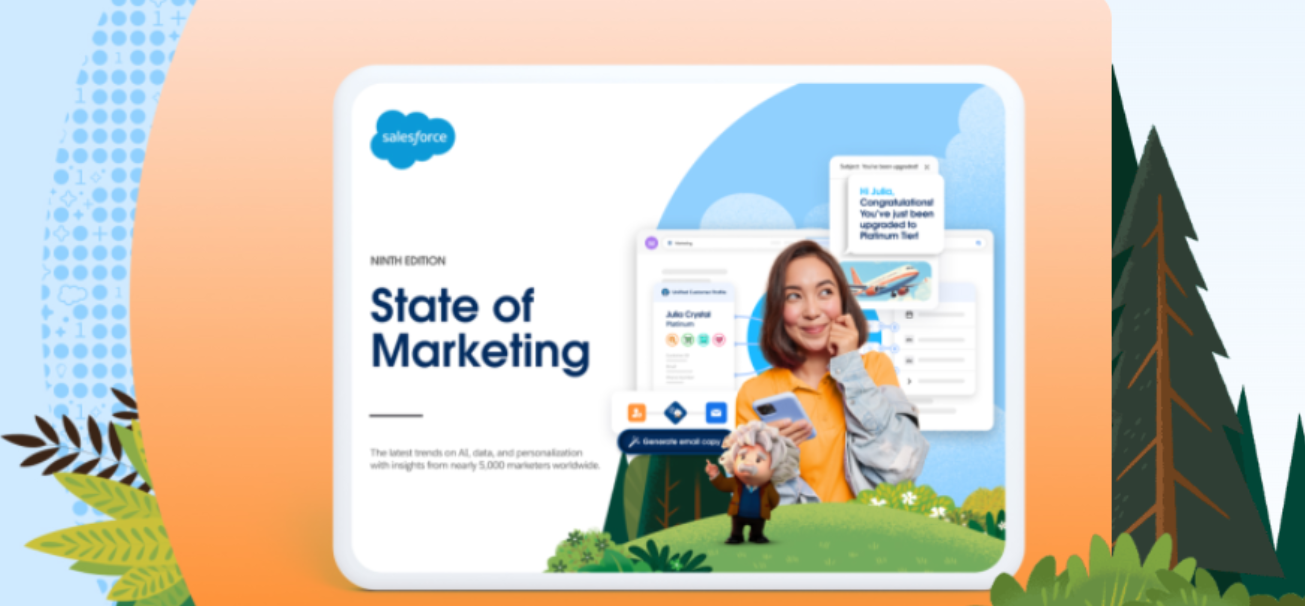
Salesforce, the global leader in CRM, has just released the new State of Marketing report, sharing insights from over 4,800 marketing leaders across 29 countries — including 100 from Ireland.

The report covers the latest trends on how marketers are evaluating and implementing AI into their operations; approaching data acquisition, maintenance, and application strategies; and ensuring customer trust and security as vulnerabilities increase.

Key insights from the research include:

  • Priorities for a new marketing era. Marketers are evolving their practices in a highly competitive landscape. They’re looking to AI — both generative and predictive — to help personalise at scale and boost efficiency.
    • Locally, improving our use of tools and technologies is Salesforce Ireland marketers’ No. 1 priority, while outdated tools and technologies/ creating a cohesive customer journey is their No. 1 challenge.
  • Marketers shore up their data foundations. Businesses have long struggled to connect disparate data points to create consistent, personalised experiences across customer journeys. Yet as third-party cookies are depreciated and AI proliferates, that quest is only becoming more critical — and challenging.
    • 23% of marketers in Ireland are fully satisfied with their ability to unify customer data sources.
    • 66% of marketers in Ireland have access to real-time data to execute a campaign. 67% need the IT department’s help to do so.
    • Marketers in Ireland use a median of 10 different tactics to collect data, with customer service data being the most common.

  • Marketers embrace AI with an eye on trust. Marketers are intent on successfully applying AI in their operations with the right data, but are concerned about security.
    • 75% of marketers in Ireland are already experimenting with or have fully implemented AI into their workflows.
    • AI implementation is also a point of differentiation: high performing marketing teams are 2.6x more likely than underperformers to have fully implemented AI within their operations.
    • The three most popular AI use cases among marketers in Ireland are: Automate data integration, generate content, and improve customer segmentation/lookalike audience modelling.

  • Full personalisation remains a work in progress. To meet rising customer expectations around personalisation, marketers are graduating beyond broad audience segmentations, like location or age, to more specific identifiers like individual preferences or past interactions. There’s also a difference between how the highest- and lowest-performing marketing teams adapt.
    • High performers in Ireland fully personalise across an average of 6 channels, compared with underperformers who fully personalised across 3.5.
  • Marketers seek unified analytics. There is no shortage of data sources, but putting that data to work is a challenge — especially when it demands a holistic or long-term view of data.
    • 58% of marketers in Ireland track customer lifetime value (CTV).
    • 90% of marketers in Ireland say they have a clear view into marketing’s impact on revenue.

  • Deeper relationships emerge with account-based marketing (ABM) and loyalty programs. Companies are increasingly turning to strategies like ABM and loyalty programs for better acquisition and retention. Yet many of these programs’ information sources remain disjointed, as does the customer experience.
    • Only 69% of marketers in Ireland say loyalty data is fully integrated across all touchpoints.
    • 45% of marketers in Ireland say loyalty program functionalities are accessible across all touchpoints.
    • 59% of B2B marketers in Ireland use ABM for customer acquisition with a similar number 56% using it for upselling however just 38% for cross selling.

Comments on the news:

“Marketers have been quick to embrace the new era of AI and are already seeing it revolutionise how they connect with their customers. They also recognise the challenge, as the potential benefits from AI hinge on managing data efficiently and safely, with maintaining customer trust never being more important.” — Gareth Kelly, Head of Marketing, Salesforce Ireland

Methodology

Salesforce conducted a double-anonymous survey of 4,850 marketers between February 5 to March 12, 2024. Respondents were sourced from 29 countries across North America, Latin America, Asia-Pacific, Europe, and the Middle East. Additional methodology and survey demographic details can be found in the report. Cultural bias impacts country-level survey results.

For more information:

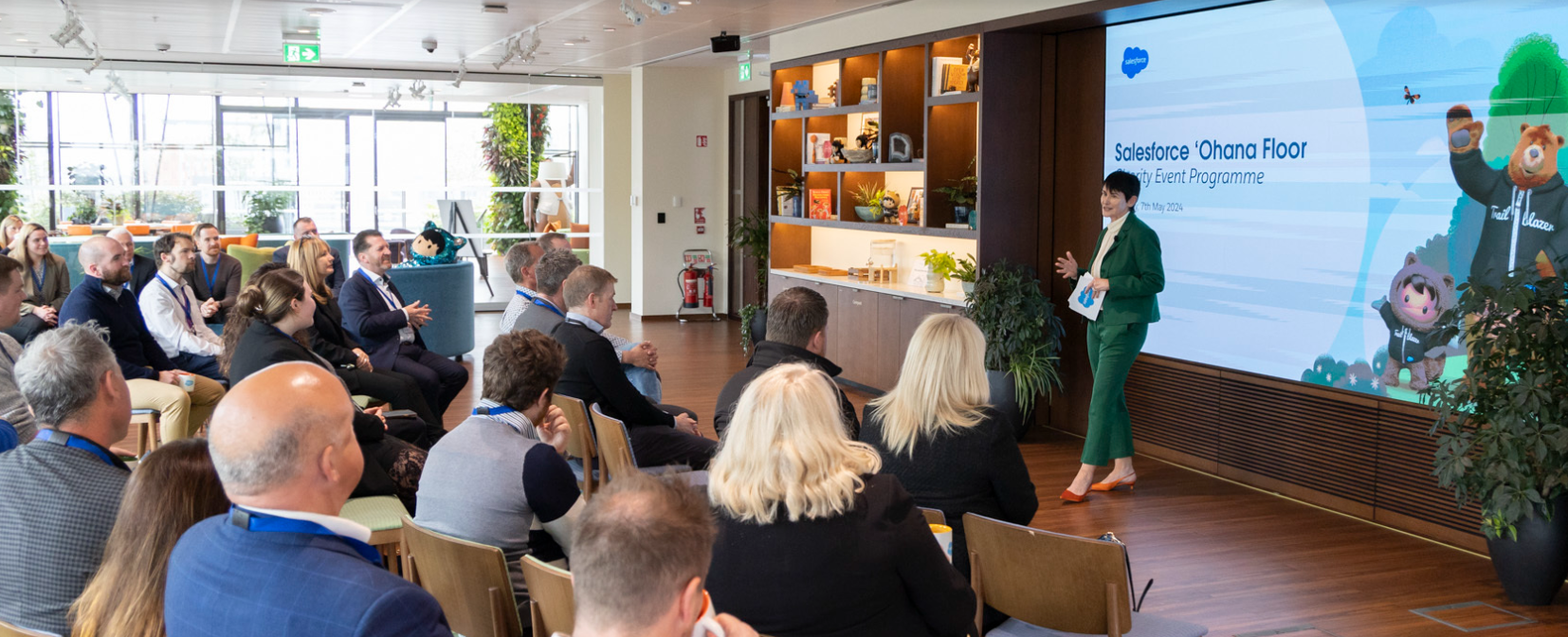
Salesforce Tower Dublin ‘Ohana Floors Open To The Community

Salesforce Tower Dublin hosted Irish nonprofits, education groups, and foundations to mark the one-year anniversary of its official opening. Lord Mayor of Dublin, Councillor Daithí de Róiste and as well as Carolan Lennon, Salesforce Ireland Country Leader were in attendance and led the celebration.

The ‘Ohana Floors in Dublin form part of a global initiative offering event spaces at the top of Salesforce towers to nonprofits and foundations aligned with the company’s culture of giving back. To date, events on our global ‘Ohana Floors have raised over $111 million for non-profit organisations. Community members can submit a request to use the space for free to host charitable fundraisers, receptions, and special events that have a focus on humanitarian, social, educational, or environmental causes.

Located on the 7th and 8th floors of Salesforce Tower Dublin, the ‘Ohana floors are a flexible, open space used during the day by Salesforce employees, customers and partners to collaborate and connect with each other. Guests can enjoy the barista bar, chef’s table, and stunning views of Dublin’s River Liffey and skyline.

“Salesforce has been contributing to the innovation, economic growth and social impact in Dublin for many years,” said Lord Mayor of Dublin, Councillor Daithí de Róiste. “The ‘Ohana Floor in Salesforce Tower and what it offers is another example of how the company continues to invest in the community. We’re delighted to have this beautiful space available to our city.”

“We believe that business can be the greatest platform for change and our impact goes further with collective action. Salesforce Dublin Tower is a beautiful space designed to foster collaboration, innovation, and giving back to the community,” said Carolan Lennon, Salesforce Ireland Country Leader. “The ‘Ohana Floors are designed to welcome local charities and organisations to use the space and we support them to use this resource to its fullest potential, further strengthening our community connection.”

One of the first organisations to use the facilities included Special Olympics Ireland. The tower hosted a reunion for volunteers who travelled to Berlin in June 2023 to offer their time in support of Team Ireland’s journey to the Special Olympics World Summer Games. The event focused on recognising and celebrating these volunteers who gave up their time to support Team Ireland.

“The ‘Ohana Floor facilities offered at Salesforce Tower Dublin provide a wonderful space for community and collaboration,” said Matt English, CEO of Special Olympics Ireland. “Volunteers play such a vital role in Special Olympics and we’re proud we had the opportunity to be one of the first organisations to host an event here to celebrate those individuals.”

Giving back has been part of the DNA of Salesforce since the company was founded 25 years ago. Since opening in Ireland in 2001 Irish employees have volunteered over 325,000 hours, and last week hosted the company’s largest ever Volunteering Time Off (VTO) activity, bringing over 1,100 employees together to walk, run, cycle or hike to raise money for local charities Breakthrough Cancer ResearchSpecial Olympics Ireland, and Difference Days.

Salesforce Report: 95% of service professionals in Ireland using AI say it saves them time

Salesforce, the global leader in CRM, today released the new State of Service report, sharing insights from over 5,500 service professionals across 30 countries — including 100 from Ireland.

The report covers the priorities, challenges, and strategies shaping customer service, including how service teams are tapping AI and data to increase revenue, efficiency, and customer satisfaction amid rising customer expectations.

Key insights from the research include:

  • Organisations Lean into AI to Boost Efficiencies. To scale service without sacrificing quality, organisations are increasingly turning to AI.
    • 95% of service professionals in Ireland using AI say it saves them time
    • 73% of service organisations in Ireland are using or evaluating AI
    • 85% of service organisations in Ireland plan to increase AI investments this year
    • Top 3 service use cases for AI in Ireland: Customer-facing intelligent assistants, agent-facing intelligent assistants and service responses.

  • Service Organisations Double-Down on Revenue Generation. The trend of viewing service as a revenue driver instead of a cost centre is accelerating, and service teams are making investments to scale.
    • 83% of organisations in Ireland expect service to contribute more revenue this year
    • 68% of service organisations in Ireland expect more budget this year
    • 75% of service organisations in Ireland expect more headcount this year

  • Escalating Demands Pressure Service Teams. As customer expectations rise, service agents are feeling the squeeze.
    • Service agents in Ireland spend an average of just 33% of their time helping customers
    • 78% of service organisations in Ireland expect higher case volume next year
    • 90% of service professionals in Ireland say customers are more demanding than they used to be

  • Service Boosts Its Data Capabilities. Service organisations are ramping up their data integration efforts to fuel human agents and AI systems.
    • 93% of service professionals in Ireland say better access to data from other teams would improve support
    • 84% of service organisations in Ireland are increasing investment in data integration this year

“The power of data and AI, is enabling Irish service and field service teams to be more proactive and productive,“ said Paul O’ Sullivan, SVP Solution Engineering and CTO Salesforce UKI.

“We’re seeing a strategic shift within businesses, with teams deflecting more issues with smarter self-service, and devoting more time and energy to generating revenue.”

Methodology
Salesforce conducted a double-anonymous survey of over 5,500 service professionals between December 8, 2023, and January 22, 2024. Respondents were sourced from 30 countries and roles including service operations, service agents, mobile workers, service managers/directors, and service leadership/head of service.

Additional methodology and survey demographic details can be found in the report.

For more information:

Salesforce Products Now Available in AWS Marketplace in Ireland

Salesforce announced today that select Salesforce products are now available for purchase in Ireland via the AWS Marketplace, a digital catalog with thousands of software listings from independent software vendors that make it easy to find, test, buy and deploy software that runs on Amazon Web Services (AWS) in Ireland. This expansion is in addition to recent availability in the UK, the US and Europe, including Germany, Italy, the Netherlands, and Spain.

Available products via AWS Marketplace include Data CloudService CloudSales CloudIndustry CloudsTableauMuleSoftPlatform, and Heroku, making it even easier for AWS customers to subscribe to and manage Salesforce offerings. Customers will benefit from a single view across their information technology (IT) spend, simplified procurement processes, and flexible options like private pricing and consolidated billing through AWS, providing a seamless way to leverage pre-approved budgets and increase business performance.

AWS and Salesforce have been global strategic partners since 2016, with deep product integrations across data and AI, making it easier for customers to seamlessly and securely manage their data across Salesforce and AWS, and safely and responsibly infuse the latest generative artificial intelligence (AI) technologies into their applications and workflows.

“Today is a significant moment in our strategic partnership with AWS. With our combined offering and expertise, we’re enabling Irish customers to accelerate deployment of Salesforce products and generative AI technologies through seamless buying and billing experiences,” said Paul O’Sullivan, UKI CTO and SVP Solution Engineering, Salesforce.

“The expansion of our partnership will respond to customer demand in an AI-first digital economy, offering enhanced access to new opportunities to innovate and experiment, in turn driving better outcomes and faster time to value,” added O’Sullivan.

AWS customers in Ireland can now conveniently purchase select Salesforce products in AWS Marketplace. For more information on the availability of products and to get access to Salesforce products on the AWS Marketplace, get in touch here.

Aer Lingus Chooses Salesforce to Digitally Transform Customer Journeys

Salesforce today announced that Aer Lingus, the Irish flag carrier, is using Service Cloud and Marketing Cloud to transform its customer experiences.

Why it’s important: 96% of customers say excellent customer service builds trust, according to Salesforce research.

With Salesforce, Aer Lingus will digitally transform to deliver personalisation and seamless customer experiences at scale. This includes introducing a centralised management capability and omni-channel approach across all marketing, transactional, post purchase/travel, loyalty, support and disruption communications.

Creating a customer-first approach across all touchpoints will remove friction, optimise the right message at the right time, and also help Aer Lingus consolidate its technology stack.

  • With Service Cloud, Aer Lingus will allow customer service teams to respond to customers more efficiently through data, automation, UI and guided workflows.  average case handling time and increase agent productivity through guided workflows. This will enable teams to respond to customers more effectively and quickly during peak travel periods.
  • Marketing Cloud will streamline all customer communications, increasing the quality of communications through richer, more relevant data and increased consistency.


Susanne Carberry, Aer Lingus Chief Customer Officer, said: “At Aer Lingus, we are constantly striving to enhance our customers’ journey with us. Salesforce will allow us to understand our customers better and offer them a personalised, digital led experience. As we grow our airline, this will become an integral part of how we ensure we are giving customers the dedicated care that they expect from Aer Lingus.

“We’re delighted to be working with Salesforce as we use their game-changing technology as part of our ongoing digital transformation.”

Carolan Lennon, Salesforce Ireland Country Leader, said: “The airline industry is increasingly competitive, and how brands communicate with passengers will continue to be a key differentiator. From booking travel to receiving notifications of new routes, Aer Lingus recognises the power of personalised customer journeys in the air and in their digital offer. Enhancing personalisation and reducing friction experiences are key ingredients driving success with Aer Lingus. We’re excited to help Ireland’s flag carrier to unlock the opportunities that digital transformation has to offer.”