What Should a Small Business Expect from IT Support?

IT support is essential for all sorts of businesses, especially since we are ever more reliant on technology in the workplace. You can read the article, to understand how It will help to maintain your systems and implement upgrades whenever required. This guarantees the company optimum performance.

This guarantees the company optimum performance. Large companies and corporations are usually able to hire in-house tech support teams, but smaller businesses may not have the financial capacity to hire such professionals full-time. For this reason, they often outsource their IT support services. In this piece, we will find out what a small business should expect from IT support.

What Exactly Does IT Support do?

If you are planning to hire an IT support company, it is essential to understand what they do. Otherwise, you are bound to get frustrated when you realize that they can’t complete certain tasks. At the same time, failing to understand what they do can prevent you from getting your money’s worth.

Different forms of IT companies offer different services, but some of the common things you can expect include:

  • Back up and data recovery planning
  • Cloud services like migration
  • Mobile integration of your services
  • Desktop and server support
  • Email backup
  • Onsite and remote labour

Companies like ITAIA are also able to provide support throughout the week. At the very least, your chosen IT support provider should be available during regular working hours. It should also have a team that is specifically dedicated to your systems. Companies that don’t offer proactive monitoring of IT assets may not be worth the money as small bugs can end up affecting your business significantly.

Some of the best IT support teams offer tailored services that meet your individual needs. As seen at https://ctinc.com whether you are running a law firm or a healthcare business, a good IT support team should be able to provide services that cater to your specific industry. They should also have experts who can help with specialized tasks like ensuring compliance with industry-specific regulations.

IT support agents will usually offer unlimited hotline and remote maintenance services. They will also call you to offer advice and follow up on certain issues. However, you should be careful when dealing with IT support calls as this is a common tactic of scammers. It isn’t necessary to give IT support callers remote access to your device, and you should also not make payments for individual phone support sessions.

What IT Support Doesn’t Do

There are a few things that IT support will simply not be able to do. First, you shouldn’t expect the company to engage in graphic design or website creation. While they may have the skills necessary to complete these tasks, they simply don’t fall under the category of IT support. Also, they don’t offer content marketing services or social media management services. Lots of sketchy IT support companies offer a wide range of services in order to entice small businesses, but such services usually end up being poor in quality.

The Cost

Generally, spending more on IT support will give you access to more services. While outsourcing IT support is often considered a cost-cutting measure, you should remember to make accurate financial plans. A recent study discovered that 42% of companies end up spending more on outsourced IT support than originally planned. 16% of these claimed that the costs were a lot higher than initially expected. It is worth noting that these statistics don’t necessarily indicate that hiring IT companies is more expensive than training an in-house team.

Conclusion

Small businesses need IT support as it ensures that their systems run effectively at all times. Also, IT support ensures that the systems are secure and up to date with the latest software. A reputable support team will offer proactive monitoring of your systems to ensure that issues are sorted out before they cause significant damage to your business. It is important to budget accurately for these services as they can end up costing more than you expect.


Fibre overtakes cable as the primary fixed broadband technology in OECD countries

High-speed fibre internet has for the first time overtaken cable to become the primary fixed broadband technology across the OECD’s 38 member countries with 34.9% of fixed broadband subscriptions, according to the latest data.

The latest update of the OECD broadband portal shows that fibre subscriptions increased by 18.6% over the year to December 2021 to move ahead of cable, now at 32.4% of fixed broadband subscriptions, and DSL at 27% and declining. This is good news for the delivery of data-intense services and applications, given the symmetrical capacity that fibre offers. The biggest growth was in Costa Rica, Israel, Greece and Belgium which all increased fibre connections by more than 80% in 2021. The share of fibre in total broadband is now at 50% or above in 13 OECD countries, standing above 50% in Chile, Finland, Luxembourg, New Zealand, Norway, and Portugal, and above 70% in Iceland, Japan, Korea, Latvia, Lithuania, Spain and Sweden.

Fixed broadband subscriptions by technology 2009-2021

Download the data in Excel

Fixed broadband subscriptions continue to grow in almost all OECD countries, increasing by 3.9% across the OECD area in 2021 to total 472 million, up from 454 million in December 2020, to average 34.4 subscriptions per 100 inhabitants in the OECD. Switzerland led the pack with a penetration rate of 48.4 subscriptions per 100 people, followed by France (46%), Norway (45%), and Denmark (45%).

Mobile data usage per subscription rose by 15% in 2021, less than in 2020, but still making a rise of 79% over the three years to end-2021. The amount of data consumed averages 8.4 GB per OECD subscription per month but varies greatly by country. Finland leads the way with 36.7 GB per month per subscription, followed by Latvia (29.7 GB) and Austria (26.4 GB) while monthly averages in Mexico and the Slovak Republic are just below 4 GB.

Despite the very high penetration of mobile broadband subscriptions, 2021 still saw significant growth of 5.5%. Mobile broadband penetration is highest in Japan, Estonia, the United States and Finland, with subscriptions per 100 inhabitants at 191%, 180%, 169% and 157%, respectively.

Iceland is by far the leader in machine-to-machine (M2M) communications with 317 M2M SIM cards per 100 inhabitants. The high number is driven by Vodafone Iceland’s provision of M2M subscriptions to help international pharmaceutical companies distribute COVID-19 vaccines. Sweden, Austria, Norway, and Germany also rank highly in terms of M2M SIM cards per head. Sweden’s 191 M2M SIM cards per 100 inhabitants is boosted by the use of these SIM cards in other countries by a Swedish operator. Overall, M2M/integrated mobile cellular subscriptions have increased by more than 16% (58 million new subscriptions) over the past year in the countries for which data were available.

Download broadband data, charts and penetration maps by country at http://oe.cd/broadband

Tech Review – Instax mini link 2 smartphone printer

Instax is a popular brand when it comes to their retro cameras and are popular with family and friends here when they come to visit not only that they have got  good views on our site and Youtube channel over the years too and it is fair to say they are a bit more than a niche product and garner much attention.

The product will look familiar however from before and has two new visible features which is a button up top and LED light on the side, the front is as before with the logo in center that can change colours and you can also set the tone here. The build quality is the same and it is a robust kit with a textured finish which will not slip out of your hand if you happen to have a few on your night out and so on, I did drop mine here at home on a tile floor with no beers on board and it still works fine so I can stand testament to the build quality and that is a good thing, it did not spring open and components  jump all around the place like some tech can and has done.

We have pretty much the same as before here and the new instaxAiR which allows users to add graphics to their prints, via the free downloadable instax mini Link App 1, including bubbles, petals, neon, spray paint, or a glitter look by simply holding the instax mini Link 2, pressing the feature button on top, whilst aiming the side LED to start drawing in the air. What is drawn in the air will then appear on the print preview in-app and once the user is happy with the look, the graphics will appear on the print itself. Users of the instaxAiR feature can even record a video of the drawing and share the moment as a printable QR code that appears on the print. The QR code can be scanned to view the video, download it, or share it on social media. Not something for me but it will be for others being honest I am just the kind that will take photos, edit if required and print them as is but there is plenty of editing options asides this within the app that allows you get creative.

Perhaps me and my age might be a factor here in trying to enhance the natural effects I have always been one to moot airbrushed photos and so on and say to people just be yourself and with how things are today with filters AI and beauty. So beside this and what is available in the app there is plenty to toy around with and get a more personalised finished product as we will see in the video review below where we look at all the options at hand, including the app and more.

Overall this is a neat gadget and given it may not be for the masses it is something you should try anyway and have it there to print photos there and then even at home or at a party or family occasion, who these days actually remembers photos or would rather plaster their lives on social media then complain about data and ads.,. I know what I prefer and that is having photos in the hand in my house and be able to share them via this nifty little smartphone printer.

BUY

Video Link


Digital first and simplicity for customers of home and motor insurance

A new survey by Deloitte Ireland shows an overwhelming preference towards purchasing home and motor insurance through digital channels.

When asked what their preferred channel to purchase home insurance was, 60% of respondents showed a preference for online, via mobile (23%) or computer (37%). These results were echoed when respondents were prompted to give their preference for purchasing motor insurance, with 57% stating online channels as their top preference, via mobile (22%) or computer (35%). In addition to online channels, phone remains a popular choice with 31% of respondents citing it as their first choice when purchasing home insurance, and 29% for motor insurance.

Digital is table stakes but concerns around personal data remain

Irish customers have a somewhat conservative view in relation to the level to which they are willing to share more sensitive personal data with insurers to enable value adding or other data-based services, even if there is a potential cost reduction involved. In terms of data types, respondents were most reluctant to share data associated with their social media history (20%) and previous spending patterns (24%).  The survey of 516 participants carried out found that this resistance was less obvious for information such as insurance history (61%), car (56%) and home usage (46%).

Commenting on the survey results, Ciara Regan, Partner and Insurance, Deloitte Ireland said: “Clearly, insurance companies must continue to offer the channels most favoured by their customers, and ensure the services are tailored and personalised. While digital is now table stakes, it can’t be at the expense of customer relationships.  Almost a third of consumers across all age groups prefer to buy home insurance over the phone. Possible reasons for this could include an appreciation for personalised customer service and experience, as well as the belief that negotiating over the phone can yield a better price.

“While the research does demonstrate a clear preference for digital interactions, some methods of communications such as ‘online account notifications’ are of little interest – with only 5% favouring them. This shows how cognisant insurance companies need to be about how they engage through digital channels. The survey shows that younger people (18-24) are more averse to sharing personal data with motor insurers than their older counterparts” continued Regan. “This could be because younger consumers are more aware of the dangers of data and identity theft. Whatever the case may be, the survey results suggest that insurers face a steep hill to climb if they are targeting data-dependent features at the younger market.”


Customers want simplicity, flexibility, and transparency

Customers want products that are simple, easy to purchase and use, respondents favouring the “basic” product as it is “convenient, cost effective and easy to engage with”. Customers also demonstrated a preference towards having the ability to adjust their insurance as their financial and life circumstances change, respondents stating that “paying according to your needs and affordability”, is a key driver in their preference towards the “self-controlled & adjustable” product. Another product you could try out too is Agile Rates.

This is unsurprising, given that 50% of respondents stated they have been working from home since the outbreak of the Covid 19 pandemic, as well as 60% of respondents stating that they have driven their vehicle less in the last two years.

“It is therefore important that insurers strike the right balance when designing and delivering new products and propositions to their customers,” said Regan.

“They need to meet customer expectations in terms of offering them new and interesting features that differentiate them in the market but these need to be underpinned by clear and tailored messaging as well as seamless experiences that customers find easy to engage with.”

 Value and ease of purchase ranks higher than brand

The way consumers are purchasing their insurance is changing, and as a result reduced levels of brand recognition were evidenced across both home and motor products. Insurers need to have a clear strategy with the right capabilities to deliver differentiated experiences.  A previous Central Bank of Ireland survey showed that 79% of respondents cited price as their top purchasing decision factor, followed by cover/ benefits (53%) and ease of purchase (33%); brand and reputation of the insurance provider rated among the lowest in terms of primary consideration for consumers.[1] From a home perspective, when asked to identify their insurance provider, 60% of home insurance policy holders stated the name of their insurance company, with 22% stating the name of a retail intermediary such as their bank. 18% of respondents did not recall the name of their home insurance provider when prompted.

These results are echoed from a motor insurance perspective, although better recognition was observed for some of the leading brands, with 73% of respondents naming their insurance provider, 21% referencing a retail intermediary and the remaining 6% not naming any provider.


Open to new purchasing channels

When asked the level of desirability towards different purchasing options, respondents showed they were open to new purchasing channels through point-of-sale models such as car manufacturers, motor dealers as well as through mortgage lenders.  Almost four in ten (39%) of those surveyed would consider buying home insurance through their mortgage lender while almost two thirds agreed it was either – extremely (11%), very (25%) or somewhat (31%) – desirable to be able to purchase motor insurance through their car dealer.

“Insurers must have a clear strategy of who they want to target, leveraging the right data insights to deliver relevant value propositions to their chosen segments as and when they need them,” Regan said. Those that are winning the market are differentiating themselves by maximising the touchpoints they have with customers, creating new and more meaningful opportunities to drive engagement while enabling end to end experiences, underpinned by digital.”

Smart Buildings and IoT: Applying the Internet of Things (IoT) to Create Smarter Buildings

As the world population grows, the majority of the population will be concentrated in urban areas. The cities will become more congested, creating challenges in managing crime, traffic, sanitation, and sustainability.

Smart buildings are one of the best solutions for the challenges with a growing population. Virtually any kind of building can be “smart,” employing automation to control security, lighting, heating, ventilation, and air conditioning to become more efficient and comfortable.

Find out how the Internet of Things (IoT) is integral to the smart buildings of the future.

What Is a Smart Building?

Smart buildings are buildings with IoT-enabled devices that use sensors to monitor different aspects, analyze the data, and provide insights to optimize operations. These buildings have a central management system that brings together different processes to make the oversight and responses more efficient. According to Conerney estate agents and letting agents in Dublin, the smart buildings sector is going to grow immensely in the near future.

Some common aspects of smart buildings include real-time data transfer, two-way communication, and automation. 

Key Components of a Smart Building

The fundamental component of a smart building is the ability to connect to a wireless network and collect, share, and analyze data in real-time to develop actionable insights. All smart buildings rely on this technology, along with an intuitive interface that can be used by technical and non-technical users alike.

Wireless Communications

Wireless communications allow the devices in smart buildings to “talk” to each other. Without the ability to share information, the devices wouldn’t be useful.

Real-Time Data Analytics

Real-time data analytics are necessary to provide decision-makers with information to understand the behaviors of the residents and identify patterns to minimize risk and optimize processes for better security and efficiency.

User Interface

If smart buildings are intended for widespread use, it’s important for the interface to be understandable and functional for non-technical users. They will be using and interpreting data differently.

Most smart buildings feature central data collection, reporting and management, and analytics in one streamlined dashboard, which is connected to the cloud. Decision-makers can connect from anywhere, at any time, to respond faster.

Advantages of Smart Buildings

Smart buildings are similar to living organisms. They take in the information from the surrounding environment, communicate with others, and make informed decisions based on what they experience. A smart building does the same by bridging the gap between the digital and physical environments.

Sustainability

Population growth creates considerable challenges with impact and sustainability. With social and regulatory pressures to lower carbon footprints and generate efficient, clean power, the best solution is for decision-makers to have access to detailed usage information and energy monitoring to optimize use.

For example, automated and centralized environmental controls can be optimized for efficiency, such as heating, air conditioning, and lights that only operate when there are residents in a room.

Efficiency

Closely tied to sustainability, smart buildings can improve efficiency by using automation to replace humans for mundane tasks. Smart buildings are quick and efficient to get set up as well, and they require fewer resources throughout their lifecycle.

Reporting

Smart building systems collect data on sustainability and compliance to generate reports. This not only helps to address the growing social and regulatory pressure to become more efficient and sustainable, but it saves decision-makers time in gathering the necessary information.

Personalization

Smart buildings are tailored to the user’s preferences. As more data is collected and analyzed, smart buildings adapt to the preferences of the users and provide personalized resources and efficiency. On the building-wide level, the decision-makers take measures to protect the health and safety of the residents.

Better Customer Experience

Though smart buildings maximize efficiency building-wide and adapt to user preferences, they also provide personalization and an improved customer experience. Devices adapt to the needs of users automatically, but they retain control over certain aspects like climate control or lighting in their personal space.

Health and Safety

Smart buildings offer a lot of advantages for safety. For example, devices can monitor and evaluate the building space to identify risks, such as gas leaks or electrical hazards, and address them quickly.

Space Optimization

IoT devices offer insights into how buildings can be designed and structured to optimize space to adapt to the needs of users, the weather patterns, and more, which maximizes efficiency.

Smart Building Use Cases

Smart buildings have practically no limit to what they can be. Each building can be customized to the specific needs of the organization, but these are common use cases for smart buildings and how they use data to optimize their processes.

Health and Safety

Smart buildings promote safety and health for both users and employees. Following the COVID-19 pandemic, a huge focus is on workplace health and safety. Smart buildings can monitor air quality, optimize cleaning schedules, and adapt ventilation as needed.

Optimization

The devices in smart buildings monitor and control the environment and optimize it with automated responses, such as air quality monitoring or fire equipment testing. Lighting can also be set to adjust to occupancy to reduce energy consumption and make the space safer and more inviting.

Security

Smart technology improves safety in a number of ways. Sensors can be used to track and control power, water shutoff, leak detection, motion sensors, and fire safety. It protects from both environmental risks and crime risks, as well as cybersecurity risks.

User Experience

Over time, smart buildings can store user behaviors and patterns to offer the most current information for the future. For example, devices can monitor the ideal temperature and lighting and adjust it to the ideal levels to ensure both environmental comfort and a well-lit, welcoming space.

Asset Management

Any organization needs visibility of the business processes and assets to provide the best service to their customers. IoT smart tags help decision-makers track their tools and resources. If anything is out of place or stolen, they’ll get an alert.

The Future Is Smarter

IoT adoption is increasing in virtually every industry, and smart buildings are the next big wave as we address the ongoing challenges of population growth and congestion in urban environments. Smart buildings offer numerous advantages, including sustainability, user-friendliness, comfort, safety, and security. 

Author Bio:
Xavier DUPONT

Xavier DUPONT

Xavier Dupont is the Senior Director Product Line, at Lantronix, a global provider of turnkey solutions and engineering services for the internet of things (IoT). Xavier’s and Lantronix’s goal is to enable IoT and their clients digital transformation by providing technology block from sensing, to data collection and visualization.

Internal Job Cover Letter: How To Express Interest

Many job seekers applying for a new position inside the company think that their reputation is all that matters. Sure, feedback from your current supervisor is important, and it’ll definitely affect your prospects. But so is your job application, including your resume and especially your cover letter. So here are a few tips that’ll help you write a top-notch internal job cover letter

#1 Communicate Your Commitment to the Company

One of the reasons why companies often start with internal hiring is that they’re looking for a person who is well-familiar with the organization and has a nice track record within it. That’s why it’s critical that a professional cover letter for internal position clearly communicates your commitment to continuing to grow with the company.

When a hiring manager or prospective boss is reading applications for internal job opportunities, they want to see what you’ve already achieved while working at the company as well as what you’re hoping to achieve going forward. So your most important tasks are to highlight your accomplishments and express genuine dedication to the employer.

Don’t go overboard, though. Job seekers who claim that they’d like to stay with the company “for the rest of their professional life” when applying for a job risk coming across as insincere. It’s better to leave one’s long-term goals for the interview. For now, simply make sure that the recruiter or the person in charge of hiring decisions knows you’re not looking for a temporary job. A place you can also try is advertising resume writers from resumeperk 

#2 Tell Why You’re Interested in the Position

But it’s not enough to show your commitment. If you want to land an interview and hopefully get hired, include why exactly you’re interested in the position you’re applying for. Be honest, but not too honest. If the number one reason is money, don’t mention it in your cover letter. The Human Resources Team won’t appreciate it.

Instead, focus on the responsibilities the new position implies and the opportunities for professional growth it opens. Perhaps, it’s something that you’ve had a chance to try in your current role and really enjoyed (say, mentoring or assisting in talent acquisition). Then, you can write that you’ve realized you’re good at it and would like to do it more.

Alternatively, a time-tested and believable response to the question of why you’d like to change your job is that you’ve reached the ceiling in your current position. It’s not uncommon for candidates with years of work experience to feel like there’s no more room for them to grow. It’s okay to admit this.

#3 Make Sure to Explain What You Bring to the Table

Next, any internal job cover letter (or any cover letter, for that matter) should include the reasons why a candidate thinks they’re a good fit for the position. All employers are looking for competence and an impressive qualification. As an applicant, you’re supposed to assure them that you have a lot to offer.

Dedicate a paragraph or two to addressing the job requirements of the position you’re applying for and how you’re capable of meeting them. Show that you’ve read the job description thoroughly and understand how the department you’d like to work in operates. Then write about how your education and current job have prepared you for what’s (hopefully) to come.

#4 If You Think It’s Appropriate, Add a Couple of Positive Changes You’d Implement If Hired

Specificity is what a lot of cover letters lack. So if you want to impress the recruiter or even your future supervisor, make yours as specific as possible. A good way to do so is to write a paragraph or two about what you’ll do in the new role if hired. For example, if you’re applying for a position of an onboarding specialist, here are a few things you might propose in the cover letter:

  1. Beginning the onboarding process in advance by sending study materials to the new hires.
  2. Pairing every new employee with an experienced mentor for at least two weeks.
  3. Organizing informal events to organically familiarize new employees with the company culture.
  4. Involving new employees in brainstorming from the first day to make them feel welcomed and valued.

#5 Don’t Think the Job Is Yours to Lose Just Because It’s an Internal Promotion

Finally, no matter how outstanding of a track record you have within the company, don’t think that you’re guaranteed the job just because they’re looking for an internal candidate. First, you never know—a colleague of yours might submit a much stronger job application. Second, your prospective boss might be looking for a specific person, and your work experience might not be as relevant as you think.

Remember that the quality of the job application, including the cover letter, matters a lot. If you feel like you lack the writing skills to compose a winning cover letter, it might be the right step to get professional help here top resume writing service. After all, your goal is to get employed. If you need to invest in your career a bit more to achieve it, do so.

An Afterword

A cover letter is possibly the most important part of the internal job application process. For it to get you the job, you must clearly state your commitment to the company, reasons for your interest in the new position, and original ideas you’re bringing to the table. So don’t just write a few paragraphs half-heartedly, hoping your resume is enough. Make an effort.

Tech Review – Snakehive Metro Leather Case and Magsafe Cardholder

Need some new ideas to spruce things up on your Galaxy S22 Ultra or iPhone Snakehive has some options for you tp try out and they are really good quality built products, We have the Metro case for the Galaxy S22 Ultra and the Metro Magsafe Cardholder here to check out.

Starting with the case it is a two tone affair with premium leather and it also has a metal kickstand to consume media so no need to take the device out of the case at all, it also works with wireless charging too and it does look the part and you can also customize them too which is an added bonus, this case also add additional grip and can be placed either face or rear down and be safe from getting the screen damaged and the camera array is also protected on the rear too and overall it does look really premium and is no my main case for said phone. Check the video for a full hands on review below..

Features

  • Soft-touch silicone phone holder with a genuine leather outer lip. Hugs your phone twice as hard as other cases.
  • A two-way kickstand for Family video-calls and binge-watching TV.
  • Fully Wireless Charging compatible for clever charging.
  • Made to measure with easy access to buttons and ports.

BUY

Metro Magsafe cardholder

Another nice product sent to us was this really cool cardholder one that is not made with plastic or metal but again premium leather, it sit nicely on the back of your device too and can hold up to three cards comfortably too, this is one of the thinnest cardholders I have tested out and again has that two tone effect which looks really well and does not just drop off easily like some can, see the video below for more on this, unfortunately I have moved on my iPhone but we can still get an idea what it looks like and will look well on my iPhone Pro later this year. It is compatible with iPhone 12, iPhone 12 Pro, iPhone 12 Pro Max, iPhone 13, iPhone 13 Mini, iPhone 13 Pro & iPhone 13 Pro Max.

Features

  • Your MagSafe cardholder is instantly attached to the back of your case via a strong magnet.
  • Designed in the UK, it has all the sleekness of a leather wallet without the bulky back pocket.
  • Handcrafted using rustic cowhide leather with a durable handstitched finish, it looks the part and lasts.
  • The spring function prevents your cards from spilling out, so you’ll always be able to settle the bill.
  • With a quick-access corner and handy thumb slider, you can slide out your credit card of choice.

BUY 

Video review


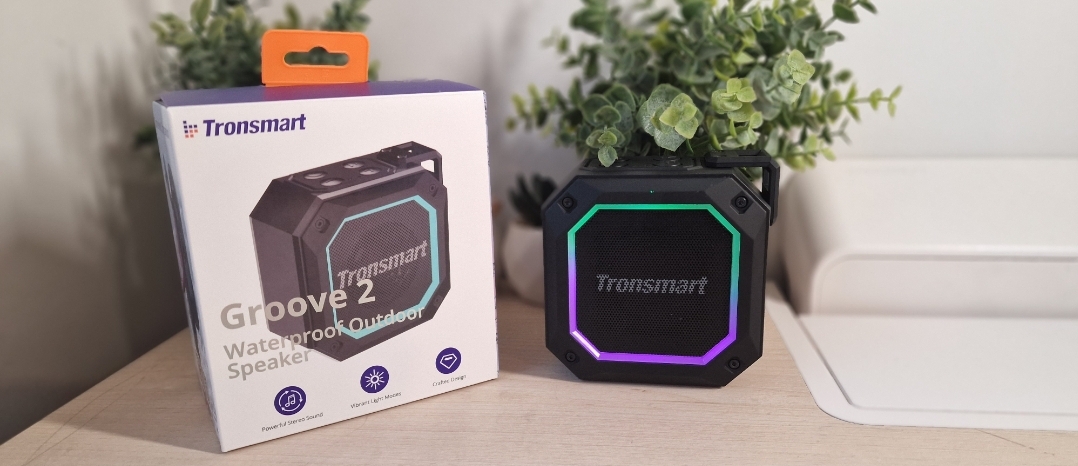
Tech Review – Tronsmart Groove 2 Waterproof Outdoor Bluetooth Speaker

It is well into the Summer season now and from what we can see is people are now travelling again going to concerts, camping, going on holidays or doing a staycation so for this you will need a decent affordable speaker to blast those tunes out and the new Groove 3 from Tronsmart might be up your street, we are no stranger her to tech from Tronsmart and are big fans and their latest speaker gives you more than good sound from their latest speaker which is small and portable.

The Groove 2 speaker is also IPX7 rated so this means it can go to your camping site, the beach a picnic or more and it is also very robust too with a nice finish on it, it also has the option to hang it from anywhere with the carabiner clip built in so it does not have to lay on a flat surface, either way you will enjoy the sound coming from this speaker given its size.

It has got a super sturdy build quality and housing wrapped with rubber edges and buttons up top that are raised and control the functions really easy, there is also a trip mount on the underside so it makes the speaker super portable, But there is more, we have RGB lights thrown into the mix to and this gives it some additional flair and makes it not boring like some portable speakers can be and they light effects look really well too.

When it comes to sound it does pack a punch and it has some bass, there is no app access here which would have been nice so hopefully they start adding their speakers to their app later on as their app is actually one of the better ones out there today and would be a real sweetener for the consumer but all is not bad regardless, the speaker is loud it is punchy it has bass and plays music quite well and easily fills a large room anyway.

The controls on top are simple to use and you can also use our phone too, there is also the option to put a micro sd card in which is really cool and now a common feature with Tronsmart and their speakers.

Tronsmart Groove 2 techbuzzireland

The sound though is what everyone wants to know about in these reviews and it is good, check out the unboxing and video samples below and you be the judge, the speaker packs a punch in a large room, even better in a smaller room and you will be surprised by the punch it packs and the light effects make it an excellent speaker to have at your disposal and let people be surprised by the sound that pops from it alongside the lights which is a thing these days and people will be impressed. Check the video review and audio samples for more and you be the judge.

Features

  • Captivating Bass.
  • Diverse Light Modes.
  • Convenient Carabiner.
  • IPX7 Waterproof.
  • True Wireless Stereo Pairing.
  • Dual EQ Modes.

BUY

Video Review

valid8Me eyes expansion with €12.5m investment with Grant Thornton

Launched in 2021, valid8Me, the digital identity SAAS platform today announces that Grant Thornton Ireland are investing 12.5million euros in the company. Valid8Me allows both individuals and corporations to securely store, share and manage their key Know-Your-Customer related data.

Valid8Me pioneered and champions reusable digital identity, helping businesses streamline proof of identity and onboarding processes with simplicity, certainty and control.

Customer onboarding has become a significant pain-point for customers and businesses alike in recent years, with a lack of joined up thinking resulting in businesses spending a disproportionate amount of budget and time on manually validating, updating and storing documents. The average bank, for example, spends 60 million dollars per year on Know-Your-Customer compliance.

Valid8Me’s platform offers a significantly enhanced proof of identity and onboarding experience:

  • Valid8Me is confident that it is the only platform that reduces customer onboarding costs by up-to 50% and onboarding times by up to 90%, by using reusable digital identity vaults that simplifies the burden of sourcing, maintaining and updating Know-Your-Customer documents for businesses.

  • Valid8Me reduces risk and exposure for businesses around data privacy by removing the overhead of handling sensitive data via its reusable digital identity vault model.

  • Once set up with a profile on valid8Me, customers have a reusable identity that can be instantly verified across any business or industry.

  • Digital onboarding reduces the likelihood of fraudulent documents and financial crime occurring.

  • The platform supports over 10,000 different document templates from 248 different countries and territories.

Patrick Horgan, CEO of valid8Me; “The idea that consumers repeatedly share their most  sensitive data, often through insecure channels, to prove their identity is archaic. Valid8Me is fundamentally different, we empower consumers to maintain a reusable digital identity that can be used universally across all industries. Our platform addresses an enormous challenge for  businesses by enabling enhanced AML compliance in a radically future proof and cost-effective way, whilst offering their clients a more secure and convenient experience

Adding, “This investment from Grant Thornton Ireland, combined with their global reach and multisector expertise,  will act as a transformational partner in accelerating valid8Me’s ambitious high-growth strategy. Grant Thornton truly understands valid8Me’s vision to become the universal defacto standard for digital identity  globally.”

Speaking about the investment, Mick McAteer, Managing Partner of Grant Thornton Ireland said “We view the valid8Me platform as complementary to a number of our service lines and specifically  addresses the needs of our clients across a number of sectors including financial services, legal,  accounting, wealth management and real estate among others. We are excited to build our product  and service offering in these sectors and bring real innovative solutions to our clients.”

Steve Tennant, Head of Financial Services Advisory at Grant Thornton Ireland said; “KYC and the  process by which businesses look to on-board and verify client identities is broken. We deal with an  increasing number of clients who are extremely challenged by the resource overhead in complying with AML & KYC regulatory obligations. Valid8Me offers a ground-breaking approach to solving this  problem and importantly optimising the customer and client experience. We use valid8Me ourselves  and have first-hand experience of how it has transformed our client onboarding processes.”