More than a third of Irish consumers would put off saving to buy a house in favour of more immediate satisfaction

Research in conjunction with Revolut, the global financial app with more than 45 million customers worldwide, and over 2.8 million in Ireland, has found that more than a third (36%) of consumers in Ireland would put off saving to buy a house in favour of medium to short-term satisfaction.

Asked what big spending projects they would consider putting off in favour of instant gratification, consumers across Ireland also claimed that both their own wedding (17%) and having children (14%) could also fall by the wayside in favour of more immediate satisfaction.

The survey, conducted by market research company Dynata, asked a random sample of 1,000 consumers across Ireland, with the findings representative of people from every county.

These revelations come as 11% of Irish savers also pointed to low interest rates as the main challenge facing them when trying to put aside money. Meanwhile, just short of one in five Irish consumers (19%) claim inflation is stifling their savings.

12% of respondents believe they will never be able to consistently save enough to fund these kinds of big life projects, and therefore prefer to enjoy medium to short-term satisfaction.

Revolut launched its Instant Access Savings accounts in Ireland at the end of May, offering customers competitive interest rates across all its different plans, with interest paid out daily.

Maurice Murphy, General Manager at Revolut Bank UAB – Ireland Branch, said: “Every bank’s mission should be to give its customers the opportunity to build their own financial wealth. With Revolut, consumers all across Ireland can get a good return on their deposits to ensure that they don’t need to miss out on or put off those big life moments such as buying a home, having children, or getting married. Revolut savers on all of our plans benefit from really competitive interest paid out to them daily, as well as immediate access to their money.”

Revolut Bank UAB (Irish Branch) was recently recognised by financial comparison site Bonkers.ie as ‘Ireland’s Best Consumer Business’ and ‘provider of the Best Current Account’, while the company ranked 9th as part of the Ireland RepTrak® 2024 study earlier this year.

For more information, visit: www.revolut.com/en-IE

Only half of employees trust AI in the workplace

HRLocker, a leading provider of HR solutions based in Co. Clare, today revealed that only half of employees trust the use of AI in their workplace, illustrating the significant hurdles organisations must overcome to integrate AI effectively and responsibly. The survey of 200 SME owners and 500 employees across Ireland also highlights the need for transparency and robust AI governance to leverage AI’s transformative potential without compromising trust.

AI trust gap in the workplace

The research indicates a notable lack of trust in the responsible development and deployment of AI among both business leaders and their workforces. Despite recognising AI’s potential for business transformation, scepticism about its responsible use persists. Key findings include:

  • Only 64% of business leaders and 50% of employees welcome AI in their organisations.

  • 25% of employees and 20% of leaders are not confident that their organisation prioritises employee interests when implementing AI.

  • A significant 68% of business leaders believe AI should be developed with human review and intervention, yet 40% of employees feel their companies lack clarity on which systems should be automated versus those requiring human oversight.

  • Furthermore, 72% of employees report that their organisations are not collaborating on AI regulation, and 78% indicate a lack of shared guidelines on responsible AI use.

Impact on business practices

Despite the trust issues, AI is recognised for its ability to enhance various business functions, particularly in SMEs. Key statistics from HRLocker’s survey include:

  • 62% of small business employees believe AI can help increase or retain headcount, with 55% reporting a positive impact on customer experience.

  • 58% of business owners believe that AI has the potential to streamline operations and reduce costs, but only 45% of employees share this optimistic view.

  • 65% of employees who are supportive of AI believe it can help them with routine tasks, allowing them to focus on more strategic activities.

  • Conversely, 30% of employees are concerned that AI could lead to job displacement, highlighting the need for clear communication and reassurances from employers.

Employee concerns and recommendations

The survey also highlights significant concerns among employees regarding AI’s role in HR processes. Almost two-thirds (62%) of employees are uncomfortable with HR teams using AI, fearing potential biases and a lack of transparency, with 48% of employees worrying that AI could lead to unfair treatment or bias in performance evaluations.

Additionally, 44% of employees believe that AI might compromise the confidentiality of their personal data and 58% feel that there is insufficient communication from management about how AI will be used and its impact on their roles.

“Ensuring robust governance and clear guidelines for AI use in the workplace is not just a best practice; it’s a necessity,” states Adam Coleman, CEO at HRLocker. “Without prioritising transparency and responsibility, we risk alienating employees and undermining the very trust that is fundamental to successful AI integration. Our research highlights a pressing need for businesses to address these governance issues head-on to fully realise AI’s potential in a way that benefits businesses and their people.”

35% of gamers in Ireland say that online gaming is good for their mental health

Pure Telecom, the Irish high-speed broadband company, today announces the results of a survey, which found that 35% of gamers in Ireland believe that online gaming benefits their mental health by providing an outlet for stress relief. The research also found that male gamers are spending almost an hour more on their hobby per day than female gamers.

The survey of 1,006 adults in Ireland was conducted by Censuswide on behalf of Pure Telecom as part of its Connected Lives study. The survey explored the proliferation of online gaming in Ireland and its impact on people’s lives, spending and mental health. It found that 50% of Irish adults identify as online gamers – in other words, those who play video games that require an internet connection. This rises to 75% for those aged 18 to 24.

The survey revealed that the average gamer in Ireland spends €180.30 per year on online gaming. That includes money spent on new games, add-ons, in-game purchases and consoles. Again, this increases significantly for 18- to 24-year-olds, who spend an average of €291.50 per year. The research found that male gamers are also more likely to dig deep to fund their online gaming hobby than female gamers are, spending €260 versus €132.50 per year.

This theme continues with regard to the amount of time being spent on online gaming. On the average day, male gamers spend two hours and 20 minutes playing online games, compared to one hour 26 minutes for female gamers. The average among the entire online gaming community is one hour and 47 minutes per day – a stark increase from the average one hour 10 minutes per day in Pure Telecom’s 2022 survey findings.

Pure Telecom’s research also provided insights into why online gaming has such widespread appeal – and why adults are dedicating significant proportions of their days to it. In addition to the perceived mental health benefits, the survey found that 21% of gamers enjoy the social aspect of online gaming, while 19% believe it enhances their problem-solving skills. Despite these merits, gamers who say online gaming is their main hobby are in the minority, with just 16% saying this is the case.

Paul Connell, CEO, Pure Telecom, said: “The findings from our research demonstrate the significant and multifaceted impact that online gaming is having on our society. Online gaming is not only an outlet for entertainment, but also provides a space for people to build connections, have a chat with other gamers and look after their mental wellbeing. These findings are consistent with recent research* which shows that gamers can perform better and faster at cognitive challenges.

“Many of the most popular video games being played today rely on an internet connection. We see the effects of this in Pure Telecom, with download volumes spiking on days when there are big gaming releases. Knowing the growing popularity of online gaming, we are dedicated to providing the fastest broadband speeds available in Ireland so our customers can enjoy the multitude of benefits they experience from online gaming – uninterrupted.”

PayPal study: SME owners in Ireland are prioritising tech investments to drive growth

Small and medium-sized enterprises (SMEs) in Ireland that sell online appear to be experiencing a growth period, with 96 per cent seeing an increase in online sales over the past 12 months. A similar proportion (95%) are feeling optimistic about the growth of their business over the next year.

PayPal’s 2024 ‘Business of Change Report’* revealed that on average, SMEs selling their products or services in international markets generated €240,605 in the last 12 months. Those surveyed that don’t currently sell internationally, but are planning to do so in the future, estimated that the move would generate €122,728 annually for their business.

Cross border trade a catalyst for growth

Further exploration into the prevalence of international commerce uncovered that half (50%) of SMEs in Ireland are presently engaged in international sales, with an additional 30 per cent intending to do so within the next year. Among those already selling internationally, 77 per cent have experienced a surge in international sales volume over the past three years.

The primary impetus behind international expansion is the belief that Ireland is strategically positioned to seize opportunities in global markets (41%). However, a significant 31 per cent of those surveyed indicated that their survival hinges on international expansion.

Not surprisingly, 34 per cent of SME owners prioritise delivering an improved customer experience as a crucial factor for business expansion—second only to providing high-quality products or services, which garnered 38 per cent. Rounding out the top five priorities were adopting emerging technologies, utilising online marketplaces, and ensuring affordability of products or services, each at 32 per cent.

Concerns and challenges

While there is a general feeling of optimism, almost a quarter of SME owners (23%) cited poor purchasing processes for customers as a top barrier to future business growth. Meanwhile, more than a fifth (22%) identified that they lack the skills or resources to fully leverage online platforms.

 As well as internal factors, external trends most impacting SMEs in Ireland that sell online are:

  • A rising demand for more payment methods (such as buy now pay later and digital wallets like PayPal) – 40%
  • More people wanting discounts, promotions and deals – 38%
  • Customers wanting more convenience (such as click and collect, and package tracking) – 37%
  • Three in 10 (30%) are concerned with the trend that fewer people are converting at checkout – more browsers than buyers.

SMEs prioritise tech investments for future growth, eyeing AI, VR experiences

Looking forward, the vast majority (92%) of SME owners prioritise technology investment for their business’s future growth. Nearly a quarter (23%) desire to allocate resources to Artificial Intelligence or Machine Learning, while 21 per cent plan to invest in Virtual Reality experiences.

Regarding specific areas earmarked for investment within the next year to bolster expansion, 38 per cent plan to prioritise enhancing their online presence. Following closely are investments in marketing (33%), additional shipping/delivery capabilities (32%), team expansion (32%), and social commerce (31%).

Moreover, 27 per cent intend to invest in ecommerce capabilities, with secure payment methods and international sales processes on the agenda for 26 per cent of SME owners surveyed.

Jonas Breding, General Manager, PayPal Northern Europe shared, “For over twenty years, we’ve been a trusted partner for Irish entrepreneurs and ecommerce businesses. We recently launched PayPal Complete Payments, our most advanced offering in the market. Our comprehensive solution fosters growth, provides advanced fraud protection, and streamlines cross-border trade, empowering entrepreneurs to thrive.”

For more information, visit https://www.paypal.comhttps://about.pypl.com/ and https://investor.pypl.com/.

HP Study: Business and government leaders believe technology is key to expanding economic opportunity

HP Inc. unveiled a new study with Oxford Economics revealing enthusiasm among global leaders to use technology including AI to advance key impact goals.

The study of business executives and government officials in 10 countries found 3 out of 4 leaders believe technology is key to expanding economic opportunity (76%) and that AI will help drive progress towards sustainability and social impact goals (76%).

Further, business leaders are either already using AI or plan to in the next 1-2 years for goals such as increasing access to digital education (90%), workforce development (89%), and workforce diversity (86%).

AI’s reach holds great promise to help HP accelerate our sustainable and social impact goals,” said Val Gabriel, Managing Director at HP Ireland. “From how we responsibly build AI PCs for first-time users to data scientists who use our workstations to help local farmers build more resilient businesses, this is the technology that can move businesses and our communities forward.”

Accelerating digital equity for 150 million people by 2030

About one-third of the global population remains offline, costing the world billions of dollars in lost GDP each year. The digital divide has been growing since the advent of technology, and AI could exacerbate these disparities if intentional action isn’t taken.

Everyone deserves an opportunity to access the tools needed to thrive in the digital economy,” said Gabriel. “We know technology can be a great equaliser and a powerful tool to drive progress. Yet, to truly narrow the digital divide in our rapidly evolving world, we must also equip individuals with the skills to use technology.”

In its latest Sustainable Impact report released today, HP announced it has accelerated digital equity for more than 45 million people since 2021, bringing the organisation nearly a third of the way to its goal of reaching 150 million people by 2030.

The rapid progress is a result of innovative partnerships with key organisations that create tailored solutions for communities. HP pursues impactful programs, strategic investments and partnerships that prioritise those mostly likely to experience the digital divide.

In 2023, HP:

  • Supported digital equity solutions developed by ten organisations in Malaysia, South Africa and Mexico with the Digital Equity Accelerator, such as improvements in digital literacy to access employment, access to educational hardware and software in schools and development of digital platforms to support improved health outcomes. In total, the Accelerator reached 6.4 million people in 2023.
  • Launched more than 100 Digital Hubs in partnership with World YMCA to support digital programming and literacy. For example, the West Orem Digital Hub, provided by YMCA Houston in Texas aims to increase community access to educational, economic, and social opportunities for young people, support services for families, and digital literacy courses for aging members of the community. More than 500,000 individuals were reached globally in 2023.
  • Opened two NABU HP Creative Labs in the U.S. and the Philippines, equipping artists and authors with technology to write and illustrate hundreds of books for children in local languages each year. The free books have helped 1.9 million children in 2023 build confidence, connection to culture and literacy skills, a key building block to participation in the digital economy.

Building skills amid the rise of AI

Both business and government officials report lack of skills as a top barrier to meeting key organisational goals, only economic volatility ranked higher.

Skills-building is a core piece of HP’s digital equity approach. As a result, HP is expanding its goal to enrol 2.75 million users in the free skills-building program HP LIFE. The program from the HP Foundation has already enrolled and enabled more than 1.2 million users to access economic opportunities or start businesses.

HP is undertaking new initiatives to expand responsible access and use of AI, the top reported investment area of businesses today:

  • Expand our free HP LIFE Digital Business Skills courses by releasing a new course on AI skills later this year.
  • Kick-off the HP AI in Social Impact Award, in collaboration with MIT Solve, which provides technology designed for building and running AI applications to social entrepreneurs and organisations that use AI to advance education, healthcare, and economic opportunities in communities globally.
  • Debut commercial and consumer Next-Gen AI PCs to market this month, a new category of devices crafted for work and creation.

HP aspires to be the most sustainable and just technology company. HP is committed to continually examining its progress and evaluating further actions to achieve a more equitable and sustainable future.

86% of Executives have already deployed Artificial Intelligence to enhance revenue, reveals TCS Global AI Study

A new study by Tata Consultancy Services (TCS), a global leader in IT services, consulting, and business solutions, reveals that more than eight out of 10 (86%) of senior business leaders have already deployed artificial intelligence (AI) to enhance existing revenue streams or create new ones. This compares to a staggering 93% of surveyed executives from Ireland and the United Kingdom (UK) region, who currently have AI projects aimed at growing revenue.

The ‘TCS AI for Business Study’, a comprehensive report on the state of AI adoption and its impact on businesses, also finds that 69% of businesses are more focused on using AI to spur innovation and increase revenue than on productivity improvement and cost optimisation. For respondents from Ireland and the UK, this figure was significantly lower at 59%.

Executives are generally positive about the impact of AI, with 57% globally reporting excitement or optimism about the potential impact of AI on businesses. This figure is slightly lower in Ireland and UK at 50%.

Among all respondents in the study, 45% expect up to half their employees will need to use generative AI capabilities to do their job in three years’ time — and another 41% think even more will do so. Most (65%) believe AI will augment and enhance human capabilities, enabling people to focus on higher-value activities that require creativity and strategic thinking.

Gerard Grant, Director of Strategic Initiatives at TCS Ireland, said, “2023 was a year of exuberance, with every enterprise experimenting with AI/GenAI use cases. We are now entering an era of wide-and-deep enterprise AI adoption. Enterprises, however, are realising that the path to production for AI solutions is not easy, and that building an AI-mature enterprise is a marathon, not a sprint. Our AI study has confirmed this sentiment; it has also highlighted that enterprises feel underprepared to deploy AI solutions at scale as well as to manage the profound shifts in the roles of people and ways of working resulting from such deployments.”

Business leaders are less certain about the path to transformation. Only 4% of global respondents use AI in a way that has transformed their business, this figure is slightly higher in Ireland and UK at 5%. Nearly a quarter (24%) of global respondent say they haven’t even moved beyond the initial exploratory phase; this is even less among Ireland and UK respondents at 15%.

The report finds that top barriers to business success include current corporate IT infrastructures and customer expectations. Organisations also recognise the need to move beyond existing metrics to measure the success of AI implementations; nearly three-fourths (72%) of global respondents and over three-fourths (77%) of Ireland and UK respondents say they don’t have the right metrics. The survey also highlights the need for businesses to take a strategic approach to AI adoption and develop the right performance indicators to measure the impact of the technology on their business.

TCS was one of the first organisations in the industry to bring together the capabilities of cloud computing and artificial intelligence under its AI.Cloud unit to cater to the emerging needs of customers. The unit drives TCS’ multi-layered AI architecture to help strategise AI deployment for customers across their value chains, enable deployment and govern thereafter.

The TCS Thought Leadership Institute surveyed nearly 1,300 CEOs and other senior executives with P&L responsibilities, across 12 industries and 24 countries. The survey included 111 respondents from businesses across the United Kingdom and Ireland. About half the companies had $1 billion to $5 billion in annual revenue and the other half had over $5 billion in revenue. Other key results from the global report, which can be found at on.tcs.com/2024-global-AI-study, include:

  • Executives believe the impact of AI will be greater than or equal to that of the internet (54%) and smartphones (59%)
  • Corporate functions with the most completed AI projects: Finance/comptroller (completion rate of 29%); HR (completion rate of 28%); Marketing (completion rate of 28%)
  • 65% of senior executives say their competitive advantage will still come from humans — with their creativity, intuition, and strategic thinking unleashed by AI’s augment and assist capabilities
  • 40% of executives say that in the future they have a lot of changes to make to their business before they can take full advantage of AI
  • Over half (55%) said they were actively making changes right now to their business or operating models, or to their products and services, due to the potential benefits and risks of AI
  • 81% of executives highlight the need for global AI standards and regulations
  • 93% of executives surveyed in the Ireland  & United Kingdom said they have AI projects aimed at growing revenue. Executives in other regions are equally enthusiastic with 89% in North America, 88% in APAC, 83% in Continental Europe, and 80% in Latin America
  • Nearly two-thirds of BFSI (64%) and manufacturing (63%) industry executives surveyed say they are excited or optimistic about the impact of AI on businesses

“Since our inception in 1968, TCS has always been leading change in embracing new technologies, helping decipher the opportunities behind them and execute transformational projects for our clients to rapidly unlock business value. Through our TCS Thought Leadership Institute, we have brought in new insights on every key technology development and how various industries and personas (CEOs, CFOs, CIOs etc.) are leveraging them. Through this new, data-driven and unique global AI study, we hope to further deepen the dialogue and perspectives on how AI can be used to build stronger, more sustainable and adaptable businesses for the future,” said Abhinav Kumar, Chief Marketing Officer, TCS.

PayPal study shows a quarter (25%) of gamers in Ireland earned money through gaming in 2023

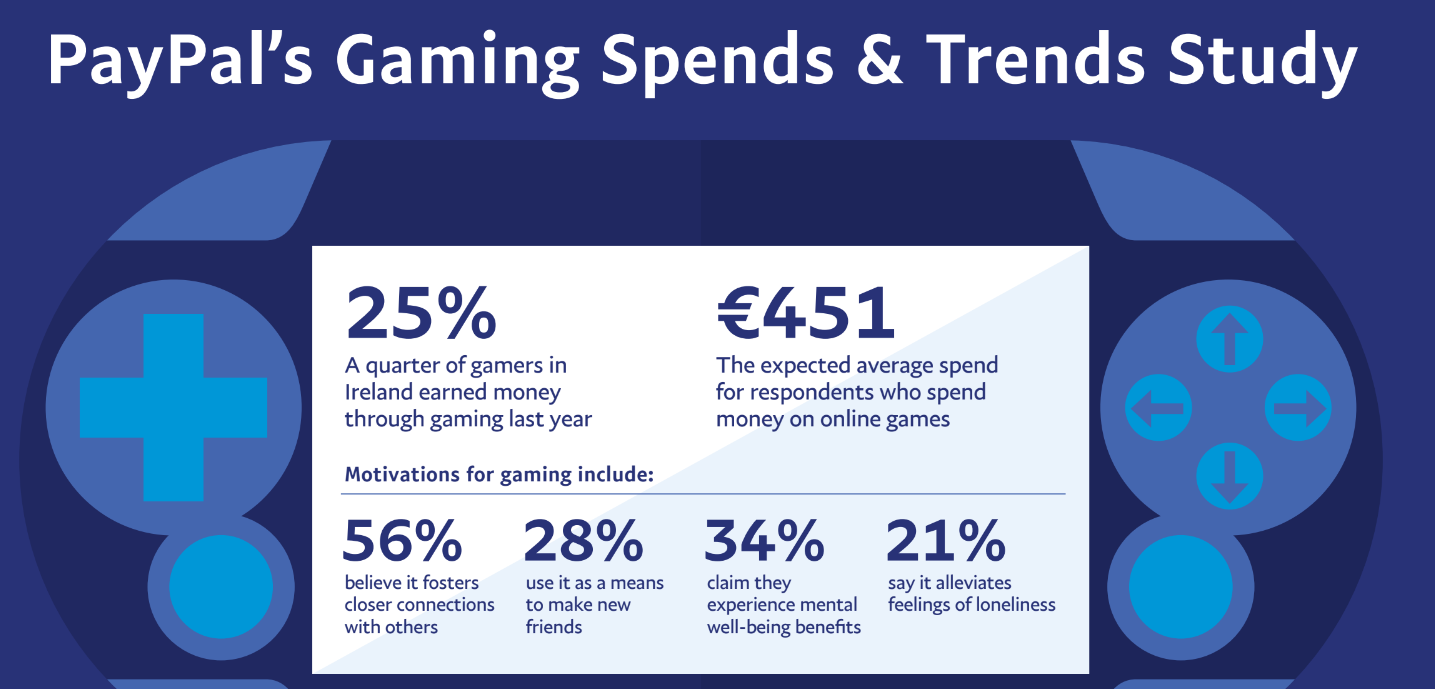
Ireland has emerged as a strong contender in the global gaming industry, drawing the attention of enthusiasts and game developers. To dig deeper, PayPal commissioned a study conducted by Censuswide in November 2023 that polled 1,000 consumers who play online games to unveil latest behaviour and trends. PayPal’s gaming insights revealed that a quarter (25%) of gamers surveyed in Ireland started or continued earning money via gaming in 2023, with a further 22 per cent of those who will spend more money on games in 2024 considering it as an additional way to generate income.

Turning play into pay

The most popular ways of making money through gaming for respondents who started/ continued to earn money via gaming in the past 12 months were revealed as taking surveys (38%), ads (26%), and time playing or Mistplay (24%).

Going forward, some 31 per cent of gamers plan to increase their spend on games over the next 12 months – with the expected average spend expected to be €451 for respondents who spend money on online games. Using gaming to generate additional income through streaming was a driving factor for increased budgets among 22 per cent of respondents.

 Gaming can form connections

As an industry, gaming has witnessed remarkable growth in recent years, and has become a leading form of entertainment in Ireland especially those in the age group of 25-34 years of age. Entertainment was the top motivation cited by 53 per cent of respondents followed by stress relief (47%) and escaping reality (37%).

A significant proportion of respondents who will spend more on games in 2024 revealed that gaming is their favourite hobby (37%) and a way for them to make friends (28%) and are some of the reasons why they plan to spend more on gaming in 2024. Over half (56%) of gamers in Ireland say playing games brings them closer to other people.

PayPal infographic

Gaming can also be beneficial for mental wellbeing with 34 per cent of those who will spend more on games in 2024 identifying it as their source of motivation. Twenty-one per cent turned to gaming to alleviate loneliness, while 25 per cent use games to socialise and connect with others. More than a quarter of gamers who will spend more on games in 2024 (28%) have fostered online friendships through gaming, and 27 per cent view it as a means to connect with friends and family.

Speaking about the findings, Jonas Breding, General Manager for PayPal Northern Europe, commented: “Our research highlights that there is a dynamic gaming community in Ireland, where gaming means more than just entertainment. For some, it serves as a tool for relieving stress and making connections. For others, they are transforming their passion for gaming into an income stream. We understand that safety is always a concern and provide gamers a more secure way to pay with PayPal for games and accessories.”

 Cost and safety concerns

The research found that certain factors would stop respondents gaming or spending money on it. More than two thirds (69%) identified high living costs and inflation as a potential deterrent, while concerns about fraud (34%) and the unavailability of payment options (29%) were also noted as being game-changers in this regard. PayPal was the most popular payment method used by 35 per cent of   gamers surveyed in Ireland who spend money on online games.

Safety is a priority for 64 per cent when buying or playing games. Furthermore, 67 per cent per cent are giving more consideration to safety when it comes to choosing a gaming platform and a similar proportion (69%) said safety increases their loyalty towards a game.

This is understandable given that 30 per cent of gamers have encountered safety concerns while gaming during the past year and more than a third (36%) have previously felt unsafe when completing a game purchase.

The most prominent safety concerns respondents have encountered while gaming in the last 12 months were revealed as abuse on gaming platforms (31%), loss of money or gaming funds (29%), bullying (28%), hacked gaming accounts (26%), and falling victim to fraud (22%).

Nearly 7 in 10 (69%) of respondents say that their loyalty towards a game increases when they experience safety. This is also the case for selecting a gaming platform.

PayPal study reveals that 71 per cent of people in Ireland establish a budget for the holiday season

New research from PayPal unwraps consumer expectations and beliefs relating to Christmas shopping and spending during the festive season.

PayPal’s 2023 Festive Spending Snapshot – conducted by Censuswide and polling more than 1,000 consumers who celebrate the holiday season across Ireland revealed that 71 per cent of people actively establish a budget for the holiday season. However, despite their best intentions, 74 per cent of these budget-setters often overspend during the holiday season.

Budgeting plans for the holidays

Perhaps unsurprisingly, more than half (57%) of people get stressed when it comes to planning their Christmas budgets and 37 per cent would like better control over their holiday expenses.

Popular tips and trends among Christmas shoppers across Ireland included:

  • Ringing the bells for budgets – Out of the shoppers who actively establish a budget for the holiday season, 36 per cent allocate budgets per person that they need to buy for. Just under a third (32%) say that having a budget makes them less stressed/more relaxed and some 26 per cent set one to prevent them from dipping into their savings.
  • Jingling rather than mingling – A quarter (25%) of people in Ireland are forgoing their work Christmas parties to make their budgets stretch further this Christmas. Furthermore, attending New Year’s Eve parties are off the list of 24 per cent of consumers to reduce costs.
  • Sleighing with saving – Thirty-two per cent of consumers plan to pay for goods using loyalty points or rewards, while 28 per cent will compare prices using apps to cut back on spending this year. Moreover, 21 per cent will use a digital wallet (like PayPal) to track online purchases and 18 per cent will shop online this year.

Festive shopping habits

When it comes to online shopping, respondents cited main benefits which included saving time (48%), helps them to avoid crowds (44%), better offers (36%), more competitive prices (33%), greater variety (31%) and it enables them to complete their shopping earlier (27%).

On timing, 57 per cent of consumers expect to have their Christmas shopping finished by the 12th of December. On the other hand, the county with the highest proportion of last-minute shoppers – those that wait until after 20th December – is Monaghan (50%). This was followed by Offaly (29%), Kerry (28%) and Carlow (27%).

Looking beyond Christmas, 60 per cent of survey respondents usually shop in the January sales, with just over a third (34%) picking up presents for the following year. The expected average spend in the coming January sales is €248.

Are Irish people rationalising spending?

The study revealed people’s concerns when buying Christmas presents. These included delivery/arrival times (62%), overspending (61%) being scammed (57%), shopping on unfamiliar websites (49%) and filling in financial details when making purchases (46%).

However, despite the concern around excessive expense when Christmas shopping, more than three quarters (77%) of people have justified spending over their budget. About a quarter (28%) agree that ‘buying one and getting one free’ means they can treat themselves to the free item.

Meanwhile, 27 per cent typically spend enough to get free delivery so that they don’t lose money and 23 per cent believe that getting something for half price means they can make their budget go further.

The leading reasons for rationalising spending during this time of year were found to be that it is a means of relaxation (27%), gift-giving fosters emotional connections (25%) and it makes people feel less guilty (23%).

As for what’s driving this spending over their budget among consumers, more than a third (36%) cited much higher prices this year.

Speaking about the findings, Maeve Dorman, Senior Vice President, PayPal, commented: “It’s clear that people in Ireland are conscious of the cost associated with Christmas, with many justifying the expense and others overspending. But this is where “festive maths” comes in. It means planning and sticking to a budget, while being smart with spending. From tracking transactions and using Honey for discounts or using PayPal at Checkout, festive maths enables people to take better control of their finances and enjoy the holiday season.”

Refer to the PayPal website for more information on easy budgeting solutions for the festive season.

One-in-six admit to feeling awkward about giving gratitude in work

Workhuman®, the company revolutionising the way employees celebrate, connect with and appreciate each other in the workplace, today, on World Gratitude Day, announces the results of its latest Human Workplace Index. The new research found that almost one-in-six full-time employees admit to feeling awkward about giving gratitude, while 15% say they don’t always know how to show it.

The survey of 555 full-time employees in Ireland was commissioned by Workhuman and conducted by Pollfish to gain insights into gratitude in the workplace. The research, conducted in September 2023, found that 49% of workplaces are celebrating World Gratitude Day today and 71% of employees say they work in an environment where showing gratitude is highly valued.

Workhuman’s survey found that it is employees’ peers, rather than managers, who are most likely to dish out kudos. In fact, some 20% of employees say that they have not been thanked by their boss in a month or more. Workhuman’s research found that 41% of employees say they are most likely to receive gratitude from their peers, while 29% say their boss is the most likely person to show appreciation. Just 10% of employees say members of the C-Suite show the most gratitude at work.

When asked why they themselves might avoid showing gratitude to someone else in their workplace, 25% of employees say that for gratitude to be meaningful, it shouldn’t be given too frequently. However, Workhuman’s research indicates that gratitude is highly valued by employees and 23% of full-time employees (479,320 people*) admit to having left a job due to a lack of gratitude. Meanwhile, 33% would be willing to leave a current or future role if gratitude wasn’t shown.

The Human Workplace Index found that being shown appreciation at work has many positive impacts on employees’ attitudes to their job. Among the positive impacts, 59% said it makes them more likely to go the extra mile for colleagues, 57% say it makes them more eager to work in-person with their colleagues, and 49% say it makes them want to show gratitude to others.

In recognition of the positive impact of appreciation, the majority of employees say that monetary and non-monetary rewards have either increased or stayed the same in their workplace. Monetary rewards, such as salary raises and bonuses, have increased for 32% of employees and stayed the same for 55%. Similarly, non-monetary rewards, such as shout-outs and verbal praise, have increased for 29% of employees and stayed the same for 58%.

Workhuman’s survey found that workplaces in Ireland are more likely to celebrate World Gratitude than those in the US, with just 27% of workplaces celebrating it there, versus 49% in Ireland. In fact, employees in Ireland are so keen to celebrate World Gratitude Day in their workplace that 35% would ditch Valentine’s Day workplace celebrations over it, 31% would do away with Halloween and 30% would even scrap Christmas.

Niamh Graham, SVP Global Human Experience, Workhuman, said: “We all dedicate a huge proportion of our lives to work, so we want to be treated like it means something. It is encouraging to see that the majority of organisations value the power of appreciation and that World Gratitude Day is being celebrated by so many today.

“Gratitude brings people together and it is evidently something that is cherished by employees. This World Gratitude Day, I encourage business leaders to reflect on your workplace culture and ensure that you are creating an environment that makes saying ‘thank you’ easy and second nature to your employees. After all, where would we be without the humans in our workplaces – they cultivate and nurture culture and workplace experience, and showing them gratitude should be a key practice throughout your organisation.”