Tag: #data
OECD – Growth of mobile data usage continues – but at a slower pace
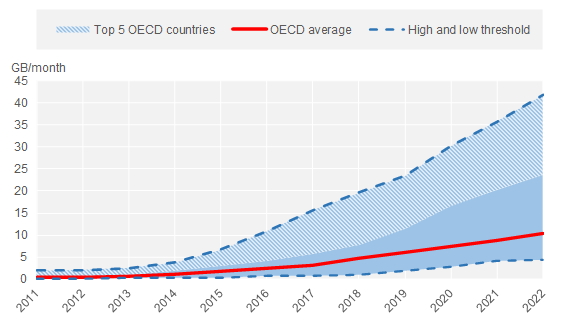
Mobile data usage continues to grow, but at a slower pace, according to new OECD broadband portal data released on 13 July. Data usage per mobile broadband subscription in OECD countries grew 17% in 2022, compared to an average annual growth rate of 29% between 2017 and 2021. Nonetheless, the volume of mobile data usage overall per subscription has doubled in four years, from 4.7 gigabytes per month to 10.4 GB in 2022.
Of note is the range of mobile data consumption volumes registered across OECD countries, spanning from 4.3 GB per user per month to 42 GB – a 10-fold difference between the lowest and highest volumes observed. The five countries with the highest data usage levels – Latvia (42 GB per month), Finland (40 GB), Austria (30 GB), Lithuania (28 GB) and Iceland (24 GB) – consume three times more data than the OECD average. This gap, between the leading countries and the OECD average, has continued to widen year on year.
Range of mobile data usage per month in OECD countries, 2022
In the fixed broadband segment, fibre is now firmly established as the leading connection technology, accounting for 38% of all fixed subscriptions at the end of 2022, up from 28% in December 2019, shortly before the start of the COVID-19 pandemic.
Belgium, Costa Rica, Austria and Israel increased their fibre connections by more than 40% in 2022. Fibre as a share of all fixed broadband now exceeds 80% in Iceland, Japan, Korea, Spain and Sweden, and is greater than 50% in a further 10 OECD countries (Chile, Finland, France, Latvia, Lithuania, Luxembourg, New Zealand, Norway, Portugal and Slovenia). By contrast, the DSL share of total fixed subscriptions has continued to fall, from 40% five years ago to 24% today, while cable has maintained a steady share over the last five years of around 33%.
Overall, fixed broadband subscriptions are still growing in almost all OECD countries, reaching a total of 481.6 million in December 2022 and averaging 35 subscriptions per 100 inhabitants. This compares to 433 million at the end of 2019 – an increase of 48.6 million, or 11.2%, in three years. Switzerland had the highest penetration rate of 48 subscriptions per 100 people, followed by France (47), Norway (46) and Korea (45).
Mobile broadband subscriptions also continue to expand, despite very high penetration rates, growing by 13% between 2019 and 2022. Total subscriptions reached 1.76 billion in December 2022, up from 1.56 billion three years earlier. Estonia and Japan top the ranking for mobile broadband penetration, with 204 and 197 subscriptions per 100 inhabitants, respectively. The United States and Finland, with 176 and 160, respectively, are not far behind.
The rollout of 5G continues apace. As of July 2023, it was available in 37 out of 38 OECD countries. For the 20 OECD countries able to provide relevant data, the share of 5G in total mobile broadband subscriptions averaged 21%, with the highest share in Denmark (54%), Korea (45%) and Japan (26%).
Machine-to-machine (M2M) SIM cards are once again experiencing the highest growth rates of all indicators, with a 14% increase in one year. The two leading countries are Sweden (222 M2M SIM cards per 100 inhabitants) and Iceland (191), followed by Austria (128), the Netherlands (86) and Norway (72). The issuing and registration of M2M SIM cards by national operators for international usage in Sweden and Iceland accounts for their elevated numbers.
Download broadband data, charts and penetration maps by country at http://oe.cd/broadband.
Understanding Data Integration: A Comprehensive Guide
Data integration is a key component of virtually any modern business, as it enables companies to easily manage their data and utilize it for various purposes. By understanding the process of data integration, businesses can ensure their success in an ever-changing landscape. This comprehensive guide outlines all aspects of data integration, from what it entails to its importance for modern organizations so that anyone can learn how to get the most out of their systems and processes.
What is Data Integration and Why is it Important
In today’s digital age, businesses are generating large amounts of data from various sources. But what does it take to make sense of this data and extract valuable insights that can inform important business decisions? This is where data integration comes into play. Data integration refers to the process of combining data from multiple sources and condensing it into a unified view. Essentially, it connects the dots between different datasets, allowing businesses to gain a holistic understanding of their operations. Data integration is crucial because it enables organizations to make informed decisions based on accurate and comprehensive data. By integrating data from various sources, businesses can uncover hidden patterns and trends, which can help improve efficiency, reduce costs, and ultimately drive growth. As companies continue to invest in digital technologies and data-driven strategies, data integration will become an increasingly critical capability and something to keep in mind when developing your data architecture strategy. Learn more at https://voltrondata.com/codex
The Various Types of Data Integration Processes
There are several types of data integration processes, each with its own set of benefits and drawbacks. Firstly, you have application-level data integration, which involves integrating specific applications to share data across various platforms. Secondly, you have database-level data integration, which involves merging multiple databases to provide a comprehensive view of all data sources. Finally, there is business-level data integration, which harmonizes all data sources to create a single, unified version of the truth. Also, reading a guide to data transformation can help you better understand the various data integration processes. Understanding the different types of data integration processes is vital to maximizing the potential of your business.
Common Challenges with Data Integration
Data integration is an essential process for businesses in today’s world that rely heavily on technology. With the ever-growing amount of data generated by various applications and systems, integrating them and making them work seamlessly has become a challenging task for many organizations. Some of the common challenges with data integration include maintaining data quality, dealing with diverse data sources, and ensuring compatibility across different systems. The sheer volume of data and the differing formats can make the integration process cumbersome and time-consuming. Addressing these challenges requires a comprehensive approach that involves identifying the sources and types of data, assessing its quality, establishing clear processes and workflows, and using the right tools and technologies for seamless integration. Businesses that overcome these challenges can leverage the power of integrated data to drive growth, enhance customer experience, and gain a competitive edge in the market.
Tips for a Successful Data Integration Project
Embarking on a data integration project can be a daunting task. It involves bringing together data from multiple sources and ensuring that it is accurate, consistent, and up-to-date. However, with the right approach, it is possible to achieve success. Here are some tips to keep in mind: Firstly, define your goals and what data you need to integrate. It’s essential to have a clear understanding of what you want to achieve and how the data will be used. Secondly, choose the right tools and technology. Consider the types of data you’re working with and the systems involved. Thirdly, prioritize data security. When integrating different data sources, it is essential to ensure that sensitive information is protected. Finally, test and validate your data. Make sure that the integrated data is accurate, complete, and up-to-date before deploying it in your systems. By following these tips, you’ll be able to manage your data integration project successfully and reap the benefits of richer, more insightful data.
The Benefits of Automated Data Integration Solutions
When it comes to data integration, automated solutions can provide a wealth of benefits for companies of all sizes. Not only do these solutions streamline integration processes, but they also reduce the risk of errors and improve overall efficiency. With automated data integration, businesses can save valuable time and resources that would otherwise be spent on manual processes. Furthermore, automated solutions can help organizations leverage data insights in real time, making it easier to stay competitive and make informed decisions. So whether you’re a small startup or a large enterprise, embracing automated data integration can help take your business to the next level.
Overall, data integration lets organizations maximize the value of every existing and new piece of data. With the right approach, any company can leverage data integration to drive efficiency gains within their organization. Although challenging at first, successful implementation of data integration solutions leads to increased organizational efficiency and improved profitability in many cases.
Test Data Management: Boosting Quality and Efficiency in Software Testing
Test data management guarantees the accuracy, dependability, and alignment of test data with end-user needs. TDM encompasses three primary categories of data, namely control data, reference data, and the test data itself, ensuring comprehensive management of all relevant data types. Control data serves as the main dataset against which other data is compared, while reference data is used to test specific software functions. Test data refers to the actual data used in the testing process, which can be derived from control or reference data or created specifically for testing purposes. Implementing effective test data management tools brings several benefits that enhance the efficiency and reliability of software testing. Let’s explore some of these advantages:
Enhanced Compliance and Security Measures
Test data often contain sensitive and confidential information. TDM ensures compliance with data protection regulations and security best practices. By encrypting and securing sensitive data, TDM safeguards it from unauthorized access, reducing the risk of data breaches and ensuring regulatory compliance.
Data Provisioning for Various Types of Testing
TDM ensures the provisioning of appropriate data for different types of tests. It prevents the usage of production data for unit tests, which could yield inaccurate results. Similarly, it avoids relying on sample data for performance tests, ensuring a realistic assessment of system performance under real-world conditions. By provisioning the right data for each testing type, TDM enhances the accuracy of test results.
Enhanced Data Reusability
Efficient TDM promotes the reusability of test data. After generating accurate and dependable test data, it can be securely stored in a repository for subsequent utilization. The ability to reuse test data not only saves valuable time and effort but also enables testing teams to dedicate their focus to other essential tasks, thereby expediting the overall testing process.
Eliminating Data Redundancy
In projects involving multiple teams, redundant copies of production data can be created, resulting in wasted storage space. TDM tools provide a centralized repository that eliminates data redundancy. All teams can access and utilize the same data, optimizing storage capacity and reducing data duplication.
Enhanced Performance of Application
The ultimate benefit of TDM lies in its ability to deliver high-quality data. By ensuring accurate and reliable test data, TDM enables the early detection of bugs and flaws during the testing phase. As a result, the development of robust and superior applications is facilitated, with a reduced number of issues during the production phase. This ultimately leads to an improved user experience and heightened customer satisfaction.
Conclusion
Test data management plays a vital role in testing automation software by guaranteeing the quality, precision, and dependability of test data. By implementing effective TDM practices, businesses can achieve optimal test coverage, reduce costs through early bug detection, and maintain data compliance and security. Opkey offers a comprehensive TDM solution that incorporates test mining technology to autonomously extract test data from clients’ environments in the required format. Opkey’s solution includes mining master data details such as Employees, Orders to Cash, Items, and more, reducing the data collection efforts of QA teams by up to 40%. This TDM solution proves highly effective during enterprise resource planning (ERP) migrations or regression testing for periodic updates. By leveraging Opkey’s TDM solution, companies can save time and resources, ensuring their test data is readily available for Oracle testing.
Cpl Adapts Faster to Talent Trends and Unlocks Efficiencies with Salesforce
Talent and recruitment specialist Cpl is using Salesforce technology to unlock efficiencies and fast-track growth.
Why it’s important: Recruitment is a volatile market with global events and economies constantly impacting the demand for talent. It can be very complicated, too, particularly in specialist and regulated sectors such as healthcare.
With more than 20 brands and 40 offices across 18 countries, Dublin-headquartered Cpl every month sources over 35,000 applications locally and internationally.
Combining AI, data and CRM, the group is unlocking ways to reduce the time to hire for their clients, deliver better candidate experiences, and expand into new markets efficiently.
The Salesforce Platform is at the heart of Cpl’s business, Cpl has developed custom workflows that automate repetitive tasks, accelerating recruitment and onboarding timings by 75% by simplifying data capture and candidate evaluation processes.
Integrated with over 90 internal and external sources, including job websites, finance tools, and applicant tracking systems, has created a single source of truth of client and candidate information and delivered business value worth around €1M within 18 months.
Cpl is continually adding new features to personalise the recruitment lifecycle, including creating their own candidate shortlists and sending tailored newsletters to clients to showcase new talent.
The Salesforce solution:
- With Experience Cloud, Cpl has created personalised recruitment portals for clients and to provide candidates with more self-service options.
- With Sales Cloud Cpl can connect new business leads and insights across its global operations, creating a group-wide view of sales pipeline and performance.
- Customising Salesforce workflows with Trailhead, Cpl can capture and analyse data at every step of the recruitment journey and identify trends shaping the future of work which helps clients compete more effectively for the best talent.
- Migrating to Hyperforce has enabled the group to scale more easily into new markets whilst strengthening data security and regulatory compliance.
Lorna Conn, CEO at Cpl said: “Today, being able to source the right talent at the right time requires the ability for everyone involved – clients and candidates – to move fast and maximise productivity. With Salesforce, being able to support multiple teams and brands on a single platform has enabled us to simplify our processes and unlock greater efficiency.
“Shifting our recruitment strategy from reactive to proactive and transforming the insights we extract from our data is enabling more informed conversations with our clients and scaling our processes and teams quickly and cost-effectively.”
Carolan Lennon, Country Leader, Salesforce Ireland said: “Today, helping organisations access the talent they need to thrive, tackling the skills gap while strengthening your own processes to work smarter and faster is no easy feat.
“By bringing multiple teams and brands onto a single platform Cpl shows the power that data, AI and CRM can have in helping companies adapt to new business realities and unlock growth opportunities.”
Offaly in the Irish Midlands ready to rival Europe’s key cities as green data centre hub
Offaly in the Midlands of Ireland is well-placed to become a new global hub for data centres with the potential to create thousands of green jobs, according to a new report by technology company Siemens.
The study, commissioned by Offaly County Council, explores how Offaly in the Irish Midlands region could rival Dublin, Frankfurt, London, Amsterdam and Paris in being an anchor for data centres powered by renewable energy.
Siemens outlined that data centre operators will consider the region, because of the simple access to reliable, renewable energy, the abundance of land for development, the moderate climate and strong supply of talent. Sites such as Rhode Green Energy Park in Offaly have been identified as potential opportunities for data centres.
The business says that the continued growth of Europe’s data centre capitals is becoming increasingly impacted by costs and concerns about energy. Power grid constraints in Dublin, for example, which is home to the majority of Ireland’s 75 data centres may take up to 10 years to resolve. However, the spread of data centres in the remainder of Ireland is currently limited.
Joe Walsh, General Manager at Siemens Ireland, said: “The data centre industry is looking for new locations away from its traditional hubs and the Midlands of Ireland has huge potential.
“Through local investment to provide the right level of connectivity, and through collaboration in the industry’s supply chain, the region can provide the reliable, low-carbon sources of power generation required for data centre operators to meet their sustainability targets.
“This has the potential to create thousands of jobs, generate millions of Euros of investment to the region, all based on clean, green power, and catalyse Ireland’s transition to net zero.”
The Council aims for the report to help attract a data centre anchor tenant in the vicinity of Offaly’s Rhode Green Energy Park, which would be the first step in creating a thriving data centre sector. A large facility will typically create 250 permanent and 1,200 temporary jobs during construction and act as a catalyst for investment, according to the report.
Data centres could be, in part, powered by wind, solar or even green hydrogen from renewable sources, and any waste heat that is generated could be used to heat local homes, businesses, local industry and community buildings, according to the study. There are also opportunities for data centres to anchor investment by being lead tenants of eco-industrial parks alongside green energy enterprises.
Anna-Marie Delaney, Chief Executive of Offaly County Council, said: “It’s clear there is significant potential to create a new data centre cluster here in the Irish Midlands.
“This report provides us with the foundations we need to attract operators from across the globe, deliver a business case to invest in our local infrastructure and create a more sustainable economy.
“I’m looking forward to working with our partners to investigate how we can make this a reality to create high-value jobs for local people and attract new local investment.“
The study was co-funded by the EU Just Transition Fund and North Offaly Development Fund (NODF). The North Offaly Development Fund is a community group with Rhode Green Energy Park as its flagship project.
Eugene Mulligan, Chair of NODF, said: “This report provides us with key insights and a strong evident based roadmap supporting economic diversification way from peat through green energy enterprise, leveraging the many emerging renewable energy projects emerging in Offaly.”
Researchers from Siemens interviewed leaders from the data centre sector, renewable energy infrastructure developers and government bodies to inform the report.
It lays out an action plan to attract investors, including promoting Offaly and the Midlands as ‘open for data centre business’ with regional strengths such as local renewable power sources that support increased sustainability.
For more information, visit: https://new.siemens.com/global/en/company/topic-areas/smart-infrastructure.html
Mempool Visualization and Analysis: Insights into Network Activity
The Ethereum network is one of the most widely used blockchain networks in the world, and its mempool is a crucial component for the network’s health. The mempool is a data structure that stores all unconfirmed transactions on the network, waiting for miners to validate them and add them to the blockchain. The eth mempool is a valuable source of information for understanding the network’s activity, congestion, and transaction patterns. In this article, we will explore the benefits of mempool visualization and analysis, and how it can provide valuable insights into network activity.
Visualizing Mempool Data for Transaction Patterns and Trends
Mempool visualization is a powerful tool for understanding transaction patterns and trends on the Ethereum network. By visualizing the data stored in the mempool, users can get a real-time view of the network’s activity and identify bottlenecks and congestion points. Visualization tools like mempool.space and Etherscan provide users with real-time data on the number of transactions waiting to be confirmed, the gas price of each transaction, and the estimated wait time for each transaction to be validated.
Mempool visualization can also provide insight into transaction patterns and trends. By analyzing the size and frequency of transactions, users can identify specific use cases for the Ethereum network, such as DeFi transactions, gaming transactions, and NFT trades. Additionally, mempool visualization can help users identify spam transactions and other anomalies, which can impact network performance and transaction validation times.
Analyzing Mempool Metrics for Network Health Assessment
Mempool metrics provide a wealth of information about the health of the Ethereum network. By analyzing metrics like the number of transactions in the mempool, the gas price of each transaction, and the average confirmation time, users can gain insight into the network’s congestion and performance. Mempool metrics can also help users identify specific issues that may be impacting network performance, such as high gas prices, low transaction throughput, or network congestion.
Analyzing mempool metrics can also help users make informed decisions about transaction fees. By monitoring the gas price of transactions in the mempool, users can adjust their gas fees to ensure their transactions are confirmed quickly and efficiently. Additionally, mempool metrics can help users estimate the wait time for their transactions to be confirmed, allowing them to make informed decisions about when to send transactions and how much gas to include.
Transaction Backlogs and Mempool Congestion Analysis
Transaction backlogs and mempool congestion can have a significant impact on the performance of the Ethereum network. When the number of transactions waiting to be confirmed exceeds the network’s capacity, transaction validation times can increase significantly, leading to higher transaction fees and slower transaction throughput. Analyzing transaction backlogs and mempool congestion can help users identify specific issues that may be impacting network performance and take action to address them.
One approach to addressing transaction backlogs and mempool congestion is to increase the network’s capacity by upgrading its infrastructure. This can include increasing the block size, optimizing the validation process, and improving network nodes’ performance. Additionally, users can adjust their gas prices and transaction fees to encourage miners to prioritize their transactions, improving the confirmation times and reducing the wait time for transactions to be validated.
Predictive Models and Forecasting Techniques for Mempool Behavior
Predictive models and forecasting techniques can help users anticipate mempool behavior and make informed decisions about transaction fees and gas prices. By analyzing historical mempool data, users can identify patterns and trends that may impact network performance and transaction validation times. Additionally, predictive models can help users estimate the wait time for their transactions to be confirmed and adjust their gas fees accordingly.
One approach to predictive modeling and forecasting is to use machine learning techniques to analyze historical mempool data. By training machine learning models on past mempool data, users can predict future network activity and identify specific issues that may impact network performance. Additionally, machine learning models can help users estimate the wait time for their transactions to be confirmed and adjust their gas fees accordingly, reducing the wait time for transactions to be validated.
Conclusion
Mempool visualization and analysis can provide valuable insights into network activity, congestion, and transaction patterns. By visualizing mempool data, analyzing mempool metrics, and using predictive models and forecasting techniques, users can make informed decisions about transaction fees and gas prices, ensuring their transactions are confirmed quickly and efficiently. As the Ethereum network continues to grow and evolve, mempool visualization and analysis will become an increasingly critical tool for maintaining network health and performance.
Businesses urged to update analytics before June deadline
Carlow-based design studio, Stratticus, is urging businesses to update their Google Analytics before the looming June 30th deadline.
Google has announced that starting on July 1st 2023, the standard Universal Analytics will stop working. This means that businesses using Google Analytics will have to make the switch to GA4 before June 30th to continue measuring their website traffic accurately.
As the deadline for the transition to Google Analytics 4 (GA4) approaches, Stratticus reminds businesses of the potential impact on their website data if they fail to implement the change thoroughly. The Bagenalstown digital studio advises businesses to prioritise this update to avoid losing valuable data and insights.
John Foy, Creative Director and former Carlow IT Lecturer in Digital Marketing explains,
“From July 1st onwards users of Google Analytics will no longer have access to critical historical data which will affect certain aspects of their business like bidding for ads, audiences or conversion data in Google Ads or on third-party integrations like Facebook.
This is a great update from Google with some valuable new features. Having said that, it’s not adequate to simply click on the Google reminder email to update your analytics as there is a high potential of missing integration of key third-party apps like Salesforce, Calendly and Hubspot. The fix is relatively simple however we recommend contacting your website developers or hosting company to ensure that the transition is smooth.”
GA4 offers a more comprehensive approach to website analytics, providing businesses with deeper insights into user behaviour and preferences. This change is part of Google’s ongoing efforts to improve user privacy and data protection.
Stratticus is reminding businesses, particularly eCommerce businesses and those relying on historical data for Pay per Click (PPC) advertising to make the transition to GA4 as soon as possible to avoid any potential disruptions to their analytics data.
By taking action now, Irish businesses can ensure a smooth transition to Google Universal Analytics and capitalise on the benefits of the updated data. For more information on this update and how to ensure your website is ready, contact Stratticus today.
Digital Transformation in Irish Trading: How Technology is Shaping the Future of Business
In today’s rapidly evolving business landscape, digital transformation has become a vital catalyst for growth and innovation. Irish trading firms are increasingly embracing technology to enhance their operations, improve efficiency, and gain a competitive edge in the global market. With advancements in automation, data analytics, and artificial intelligence, technology is reshaping the future of business in Ireland. In this article, we’ll take a look at the key technologies shaping the digital Irish trading transformation.
Automation Revolutionizing Trading Processes
One of the key areas where technology is revolutionizing Irish trading is through automation. Trading platforms and software solutions are streamlining manual processes, reducing human error, and enhancing efficiency. Automated trading systems, powered by algorithms, can execute trades at high speeds and respond to market conditions in real time. These systems use sophisticated algorithms to analyze vast amounts of data, identify trading opportunities, and execute trades with precision.
Additionally, automation extends beyond trade execution. Back-office functions such as settlement, reconciliation, and reporting can be automated, freeing up valuable time for traders and enabling them to focus on strategic decision-making. Traders can optimize their operations further by leveraging tools like the US economic calendar, which provides real-time updates on economic indicators that will have an effect across the world. With access to upcoming market events in various countries, traders can proactively adjust their trading strategies based on the latest information. The calendar ensures they stay informed about important economic events, whether they are scheduled for today, tomorrow, this week, or hold high importance.
Data Analytics Driving Informed Decision-Making
In the era of big data, the ability to extract meaningful insights from vast amounts of information is crucial for successful trading. Irish trading firms are harnessing the power of data analytics to gain a competitive advantage. By analyzing historical and real-time market data, traders can identify patterns, trends, and correlations that inform their investment strategies.
Data analytics tools not only help traders identify patterns and trends but also enable them to monitor market sentiment and assess risk. By analyzing historical and real-time market data, Irish trading firms can make data-driven predictions and adjust their strategies accordingly. These insights, combined with comprehensive information on economic events such as key indicators, government reports, and central bank announcements, empower traders to make informed decisions and stay ahead in the competitive trading landscape.
Artificial Intelligence Enhancing Trading Strategies
Artificial intelligence (AI) is increasingly making its presence felt in Irish trading, enhancing trading strategies and improving overall performance. AI-powered algorithms can analyze vast amounts of data with speed and accuracy, identifying trading patterns and opportunities that may not be apparent to human traders. Machine learning algorithms can adapt and improve over time, continuously refining trading strategies based on market conditions.
Moreover, AI technologies such as natural language processing enable traders to analyze news sentiment and social media data, providing valuable insights into market trends and investor sentiment. By leveraging the power of AI-driven sentiment analysis, traders can quickly gauge the overall sentiment surrounding a particular asset or market, helping them make more informed trading decisions.
Digital transformation is reshaping the future of Irish trading by leveraging technology to enhance operational efficiency, drive better decision-making, and optimize trading strategies. Automation, data analytics, and artificial intelligence are revolutionizing how Irish trading firms operate and compete in the global market. Embracing technology and leveraging tools like the US economic calendar will be crucial for Irish trading firms to thrive in the digital age.