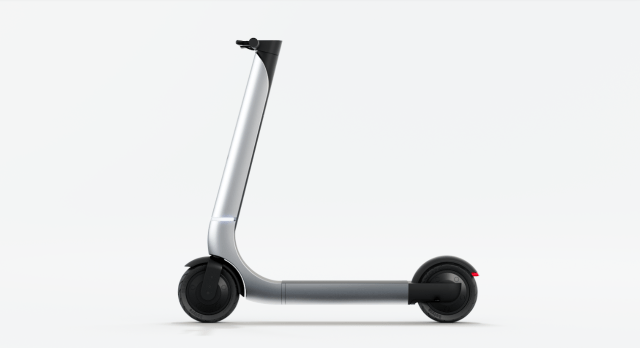
Bolt upcycles retired scooters to create first jewellery collection

Bolt has partnered with award-winning Estonian designer Tanel Veenre to upcycle its old scooter models into earrings, bracelets and pendants.

The collection, called Hardwear, includes over 100 hand-crafted pieces that have been made from the same ultra-lightweight, ultra-durable aircraft-grade aluminium used in Bolt’s fleet of over 230,000 scooters.

The collection includes pieces that have been finished with reflective coating for extra visibility at night, keeping wearers safe as they move around their city at night during the darker hours.

Bolt’s creative lead on the project, Kerttu Keermaa, said: “The Hardwear collection is built on the same guiding principles as Bolt scooters: sustainability and safety. The upcycling process follows a zero-waste approach, with any leftover material undergoing our regular recycling process. We believe that road safety is a shared responsibility and wearing reflective items can make pedestrians and cyclists more visible at night.”

Bolt currently operates in 500 cities across 45 countries in Europe and Africa, including Dublin. The European mobility champion operates ride hailing services in Dublin and Cork, as well as electric bike schemes in Sligo and Kilkenny.

The jewellery has been created in collaboration with award-winning Estonian designer Tanel Veenre. Tanel’s signature whimsical style has been exhibited in over 300 solo and group exhibitions around the world. He has been awarded at London Fashion Week and is the recipient of the several international and local design contests including the Estonian Cultural Awards.

To create each piece, Tanel began by removing the distinctive green paint from Bolt scooters before cutting and shaping the metal and anodizing and painting the jewellery by hand.

Following this first collection, Tanel will continue to create jewellery from Bolt’s old scooter models. These will be available for sale on his website from Thursday 27th October.

Designer Tanel Veenre said: “Scooters are becoming increasingly popular across Europe and as newer generations are created older models become outdated. These old models are always recycled but it was great to use the quality materials that make up a Bolt scooter for this unique project. It was something completely out of the ordinary for me and I learned so much about working with aluminum – something I’d never done – and worked with geometric forms which is unusual for me.” 

Bolt operates scooters and e-bikes in more than 230 cities across 25 countries in Europe. It is the largest scooter provider on the continent with over 230,000 scooters in operation

Äike Launches World-First Smart-Lock Feature for e-scooters

Newly founded sustainable e-scooter startup Äike, has today launched the world’s first smart-lock system for e-scooters. The feature is available for the company’s newest model, the Äike T, and adds to a string of other industry shake-ups launched by the company, including introducing USB-C charging capabilities, and designing, manufacturing and assembling the first e-scooters entirely in Europe using renewable energy. The company’s latest product update allows Äike T owners to benefit from its remote unlocking system, a function that has become increasingly popular across the electric vehicle (EV) industry and allows you to start riding simply by standing near your device.

The smart-lock feature, integrated into the Äike mobile app, makes riding easier than ever before by letting Äike T owners unlock their e-scooter without even taking their phone out of their pocket. Using authenticated Bluetooth connections, users’ phones automatically connect to the e-scooter when the owner is in range, allowing them to simply hop on and ride. When they hop off, the e-scooter also locks itself, making securing your e-scooter easier and quicker.

Public key authentication guarantees that smart-lock is only triggered when the owner is using it, and the new feature is integrated into the scooters’ existing IoT module (provided by Comodule) which is encrypted to take commands only from the phone of its owner (or devices the owner has shared permissions to). Opening the Äike app automatically establishes a Bluetooth or GSM connection with the scooter, which allows the scooter to be locked or unlocked by pressing the allocated button.

The Äike T is a vertically integrated product, and the manufacturers have full control over its hardware, firmware and software, making it one of the most secure e-scooters on the market. Äike engineers can kill the IoT connectivity at any point, rendering theft a useless endeavour. Kristjan Maruste, CEO of Kõu Mobility Group and CEO & Head of Product for Äike, commented:

“Releasing this smart-lock feature is simply another example of the benefits of operating in a locally based and vertically integrated company. As we manufacture our own electronics, hardware and software, we can from the ideation to release phase in a matter of weeks. Our aim is to make Äike scooters the most user-friendly e-vehicles in the world.”

Äike is paving the way for a new era of micro-mobility making e-scooters and zero emission commuting accessible to the masses. The company actively seeks materials from responsible local recycled suppliers, ensuring a supply and distribution chain that is free from conflict, child labour, and excess landfills, while ensuring 92% of the materials used to produce its  e-scooters are recyclable.  On top of GPS protection, each e-scooter comes with Comodule’s own IoT device and passport that allows exclusive access to the Äike app and enables remote customer support, instant firmware updates, and e-scooter performance monitoring, offering users a unique connected riding experience.

Zipp Mobility Statement on e-Scooter Legislation Developments in Ireland

Last night the Road Traffic and Roads Bill 2021 passed the Report Stage and Final Stage in Dáil Éireann and the Bill now moves to Seanad Éireann.

Charlie Gleeson, CEO and Founder of Zipp Mobility, Ireland’s leading micromobility provider said, “Last night’s approval by Dáil Éireann of the Road Traffic and Roads Bill 2021 was a significant milestone on the journey to legalising the use of Powered Personal Transporters, or e-scooters, in Ireland.”

“It is a development which Zipp Mobility, as Ireland’s leading shared e-scooter provider, warmly welcomes and we would like to acknowledge Minister for Transport, Eamon Ryan TD and Minister of State Hildegarde Naughton TD, for steering the legislation through the Dáil. We now look forward to the legislation speedily passing through all stages in the Seanad before being signed into law.”

“Once this has taken place, we look forward to introducing shared e-scooter service in cities across Ireland. Our approach which we describe as ‘mobility done right’ prioritises sustainability, safety and community-centric design above all else. We hope to use this approach to help assist Ireland in its fight against climate change.”

Zipp Mobility, which has raised over €8 million in funding, was established by Charlie Gleeson in 2019 and is headquartered at NovaUCD in Dublin. The company is already a significant player in the European micromobility sharing market, having launched e-scooter and e-bike operations in nine cities in Ireland, the UK and Poland.

The company plans to launch in several Irish cities including Dublin, Cork, Limerick, Galway and Waterford once the Road Traffic and Roads Bill 2021 is passed into law. The company is also planning to expand its European operations in the next 12 months.

Äike Launches First European Assembled E-Scooter with USB-C Charging

Newly founded sustainable e-scooter startup Äike, launches the first electric scooter designed and assembled entirely in Europe using solely renewable energy. Developed in partnership with leading IoT company, Comodule, their newest model Äike T, is also the only e-scooter to have USB-C charging capabilities.

With e-scooter trials proving immensely popular in the UK and 180,000 people taking over half a million trips in London alone from June 2021 – February 2022, the market for sustainable travel is booming. In its highly anticipated Transport Bill, the UK Government intends to acknowledge this appetite for e-scooters and other low-speed, zero-emission vehicles (LZEV) amongst the public by recognising them in new legislation later this year.


Äike is committed to making e-scooters and zero-emission commuting accessible to everyone by being regionally compliant with all legislation and integrating unrivalled safety, stability and durability into its product range. The company actively seeks materials from responsible local recycled suppliers, ensuring a supply and distribution chain that is as close to the manufacturing facility as possible, free of conflict and fully reliable/traceable while ensuring 92% of the materials used to produce its e-scooters are recyclable.

Kristjan Maruste, Co-founder of Comodule and now CEO and Head of Product for Äike, commented: “Äike is a true passion project of mine as I feel we are filling a huge gap in the micro mobility market. After 7 years in the industry, I find it crazy how the e-bike boom in Europe has brought us to around 5 million e-bikes sold per year with more than 50% made in Europe, whereas with over a million e-scooters being bought annually, virtually no one manufactures in Europe. This has left e-scooters in the background as the vast majority of them are not sustainable, comfortable or safe at all. Äike is here to change that. There obviously is a demand, and we are here to meet that with a sustainable, durable, inclusive, IoT-connected, safe and genuinely best version of what they are looking for. We’re currently still in our launch phase, but we are very well positioned to grow fast as we control the full process in-house from design to production to delivery.”

Äike’s e-scooters are built for all metropolitan streets. The Äike T is weatherproof, durable and can be ridden smoothly over potholes and curbs without compromising on important motor power and speed safety regulations across cities worldwide. On one full charge, the Äike T has a 40km range. When needed to charge again, Äike has made its removable battery compatible with any port using a USB-C laptop charger, which eliminates excess charger waste. While Äike’s e-scooters are designed to be easily transportable indoors, they can be safely left on the street thanks to the IoT-integrated threefold anti-theft GPS lock protection system provided by Comodule.


Äike is paving the way for a new era of micro-mobility by offering a fully connected experience. On top of GPS protection, each e-scooter comes with Comodule’s own IoT device and passport that allows exclusive access to the Äike app and enables remote customer support, instant firmware updates, and e-scooter performance monitoring, offering commuters a unique connected riding experience.

The Äike e-scooter is available for pre-order from July 6th for a €69 deposit. Final prices start from €999.

Video

Reshaping the e-scooter – introducing bo

Today, UK micromobility startup bo announces its first product, the bo M. bo M is a radical rethink and total redesign of the e-scooter, introducing the single biggest innovation leap in scooter technology: Safesteer™.

With electric scooters traditionally seen as unsafe and unreliable, bo exists to set new standards in safety, comfort and design. bo M is the world’s first electric scooter focused on empowering people to transition out from their cars.

“We spent 3 years developing the bo M for everyone who can see the potential of the e-scooter, but who finds today’s scooters too unsafe, impractical for daily use, or simply not well designed” says Oscar Morgan, bo CEO. “Our mission has been to develop game-changing features and safety enhancements such as Safesteer, whilst using our experience in automotive design to build a scooter people feel proud to own and ride. 

Grounded in safety, bo M features Safesteer™ riding stabilisation alongside the 360 degree Light Halo system. For unrivalled comfort the bo M uses Airdeck and refined vehicle geometry with a generous wheelbase, optimised steerer angle and wide handlebars. Finally, challenging traditional scooter design, the unique bo Monocurve chassis and seamless feature integration combine to deliver an exceptional commuting experience.

The new safety standard  | SafesteerTM    

A world first in electric scooters, bo is introducing active riding stabilisation with SafesteerTM  technology, setting the benchmark for control and confidence.

The technology stabilises and smoothes the steering across bumps, dips and potholes to keep the rider in perfect control.
This fundamental shift in vehicle dynamics means the single greatest concern of new and experienced e-scooter riders is eliminated.

Light Signature  | 360 Light Halo
360 degree Light Halo and high power headlight for forward visibility

bo’s distinctive Daytime Running Light (DRL) wraps around the Monocurve chassis to create Light Halo, a world first in the sector: 360 degree light visibility. This signature design dramatically increases road presence and awareness from other road users.

Alongside Light Halo, a powerful secondary headlight illuminates the road ahead, while a wide-angle high-lumen rear light keeps you seen from behind, flashing brightly when users brake.

Comfort | Airdeck

Searching for an optimised solution to ride comfort led to bo M’s engineered elastomer Airdeck, based on the same material technology found in high performance running trainers. The lightweight deck panel is tuned to remove road vibrations – removing the need for complex and ineffective suspension systems.

With 50km of range, all day riding comfort is the priority: Airdeck, plus wide pneumatic tyres keep the road bumps out. Additionally, the bo M geometry is optimised for stability and ergonomics, including wider handlebar at 580mm, a generous 930mm wheelbase for more standing room, and a 76 degree steering angle for naturally controlled dynamics.

Punctures are a common commuter concern, so the bo M is specified with high quality tubeless pneumatic tyres – eliminating pinch punctures and maximising grip on the road.

The shape of things to come | Monocurve chassis

Reshaping the electric scooter with bo’s unique Monocurve chassis represents a foundational shift in vehicle design and engineering – the single greatest sector advancement since electric scooters arrived in our cities.

Alongside strength and reliability, bo M’s aluminium chassis has been designed to enable every innovation, from Safesteer to Lock and Load, Light Halo to Airdeck, without adding complexity for the user.

The unbroken Monocurve chassis is the first structure in this sector designed to true automotive principles, seamlessly combining function with design

Harry Wills, bo CTO added, “Aware that to some it is controversial, we made a conscious decision to eliminate the fold, launching bo M with an unbroken Monocurve chassis.

“bo M is designed for commuters travelling home to work who value exceptional ride, safety and reliability above all else. Creating this new category, between a traditional e-scooter and an e-bike, our research discovered that the majority of people seldom or never use the fold. It represented a point of weakness, so that directed us to this final design”

Bags of potential | Lock and Load

E-scooter riders no longer have to be restricted to a backpack. The bo Monocurve chassis does not twist as you steer, keeping luggage hooked on the two secure load hooks stable and swing-free while you ride.

The hidden, built-in steel dual mount system doubles as a locking point – making it simple to secure the bo M with confidence using a standard D-lock. For full peace of mind should the owner lose sight of their bo M, the bosecure system of GPS tracking, motor locking, loud anti-tamper alarms and mobile notifications kick in.

The bo M is available for pre-order from bo.world. RRP £1,995 or £69 p/m. Shipping Spring ‘23

Irish Micromobility Operator Closes €6.1 million Funding Round Led by Fasanara Capital

Zipp Mobility (www.zippmobility.com), Ireland’s leading micromobility operator, today announced that it has closed a €6.1 million funding round led by Fasanara Capital, a UK-based asset manager, and follow-on investment from a number of existing investors.

The funding, a mixture of equity and debt, will be used by the company to expand its e-scooter and e-bike operations in Ireland, UK and in mainland Europe in the coming months and to expand the Zipp growth and operations team.

Zipp Mobility, established by Charlie Gleeson in 2019 and headquartered at NovaUCD in Dublin, is already a significant player in the European micromobility sharing market, having launched e-scooter and e-bike operations in nine (9) cities in the UK, Ireland and Poland.

Charlie Gleeson, CEO and founder, Zipp Mobility, said, “We are delighted to have secured this significant investment and backing from the Fasanara Capital team and existing investors. Its great to have so many investors who believe in our long-term vision of “mobility done right”. This funding will help us bring this approach to more cities and provide more people in Ireland, the UK and mainland Europe with sustainable, safe and community-centric micromobility solutions.”

Francesco Filia, CEO, Fasanara Capital, said “We were attracted to investing in Zipp by their differentiated market position and unique value proposition to local government partners. Zipp are an evolved player in the mobility space with a proven track record, sophisticated tech infrastructure and a quality-driven approach and we believe these factors will continue to drive the company’s success in this fast-growing market.”

Previous to this latest funding round Zipp Mobility, an Enterprise Ireland high potential start-up, had secured a total of €2.1 million from a number private and angel investors including, former Irish rugby international Brian O’Driscoll and Barry Maloney of Balderton Capital, Enterprise Ireland, and through a crowdfunding campaign on the Spark Crowdfunding platform.

Davy Corporate Finance acted as financial adviser to Zipp Mobility on the transaction.

Bird and Drinkaware Team Up To Prevent ‘Drink Riding’ #escooters

Bird, a leader in micro-mobility, and Drinkaware, the national charity working to prevent alcohol misuse in Ireland, today announced plans to roll out  a public awareness campaign as soon e-scooters are legalised for use on public roads by the Road Traffic and Roads Bill 2021. The Bill is currently making its way through the Oireachtas, and according to the Government’s recent Sustainable Mobility Strategy*, will be in place by the end of this year. The campaign will aim to encourage the Irish public to adopt a safety-first approach to riding e-bikes and e-scooters, and will complement the draft legislation, which sets out fines of up to €2,000 for the consumption of alcohol while using such vehicles.

Campaign imagery encouraging safe riding will soon be visible in cities and towns across Ireland. In conjunction with this, Bird plans to roll-out its Safe Start feature as soon as it launches services in Ireland. This in-app ‘checkpoint’ is designed to discourage people from riding under the influence and is already used by its riders all over the world. Between the hours of 10pm and 4am, riders attempting to unlock a Bird e-scooter or e-bike will be asked to verify that they can safely handle the vehicle by correctly entering a keyword into the app. 

International data attests to the popularity and safety of e-scooters and e-bikes, and continues to  show that cars remain the biggest threat to Irish road users, with a documented incident rate of 1 in 20,000 trips. Bikes, e-bikes and e-scooters have a documented incident rate involving medical treatment of less than 1 in 50,000 trips*, but research shows that up to 30% of all cyclist accidents involve alcohol.* Bird and Drinkaware will therefore be campaigning to ensure that the public understands the dangers of using any form of micro-mobility while under the influence of alcohol. 

In the meantime, Bird and Drinkaware are urging e-bike riders to avoid riding while under the influence this May Bank Holiday. Any alcohol impairs judgement, making users physically unsteady and impeding their reaction times. 

Victoria Springthorpe, Head of Ireland and UK Public Policy at Bird: “Safety is always our no.1 priority and so we’re thrilled to partner with Drinkaware, a leading voice on road safety in Ireland, to educate and prepare people ahead of the legalisation of e-scooters. Sometimes it’s just a case of simply reminding people of the risks, to prevent an unsafe situation.” 

Sheena Horgan, CEO of Drinkaware: “Drinkaware welcomes the opportunity to partner with Bird on a campaign that ensures public safety and an understanding of the risks of drink riding. From our interactions with the public we know that there is high demand for information on drink driving, and our webpage on drink driving is consistently in the top 5 pages viewed on drinkaware.ie. New forms of transport are entering our country and we need to ensure that the public are aware of how to use these forms of transport safely and responsibly. The Department of Transport’s draft legislation sets out fines of up to €2,000 for the consumption of alcohol while using e-bikes and e-scooters.  As with other policies regarding other modes of transport, the efficacy of the legislation can be boosted by a supportive public education campaign.” 

This is the second safety initiative launched by Bird this year, after the company announced a partnership in January with the Irish School of Excellence, Ireland’s largest driver education programme, to establish Ireland’s first E-scooter Safety course. This course is set to be rolled out across Ireland when the Roads Traffic and Roads Bill 2021 becomes law. Covering almost 80% of schools nationally, it will have a wide reach and provide pupils with an overview of the law governing e-scooters; a guide on how to ensure pedestrian safety while using e-scooters; tuition on starting and moving off safely, as well as a tutorial on how to park safely.

Zipp Mobility Opening Statement – Joint Committee on Transport and Communications

I dtús báire ba mhaith liom buíochas a ghabháil leat a Chathaoirleach agus Baill an Choiste ar  son Zipp Mobility as cuireadh a thabhairt dom teacht anseo inniu agus roinnt libh ár dtuairimí  ar an mBille um Thrácht ar Bhóithre agus um Bóithre 2021 go háirithe maidir le cúrsaí scútar  leictreach. 

Our company, Zipp Mobility, is Ireland’s leading shared micromobility provider, and we  strongly support the efforts being made to legislate for the use of e-scooters in Ireland. We  currently provide shared e-scooter and e-bike solutions to cities and towns across Ireland, the  UK and mainland Europe. We are an Enterprise Ireland client company and have been awarded  High Potential Startup status. Since our founding in 2019, we have grown to a team of 25 people and hope to create 50 more high-paying, skilled jobs in Ireland over the next 18  months. At Zipp we believe in “mobility done right”. This means it is our mission to do  everything we can to help decarbonize transport, but it must be done in a principled way that  respects the needs of the entire community. 

Before we discuss electric scooters, I think it would be worth giving context to this conversation  by reviewing Ireland’s transport-related greenhouse gas emissions. Transport is the second  largest contributor to Ireland’s greenhouse gas emissions. In addition to this, the transport  sector has been Ireland’s fastest growing source of greenhouse gas emissions since 1990, with  transport emissions doubling in that time. And when you break this down further, it is clear  that private car usage is the leading cause of transport emissions, contributing to nearly 50%  of total transport emissions in some years and consistently being over twice the size of the  next largest emissions category. 

Ireland has set the ambitious goal of reducing its emissions by 51% by 2030 and getting to  net zero by 2050. This means we need a 7% reduction in emissions per annum for the next 8  years. In 2020, despite Covid restrictions and an economic slowdown our emissions only went  down by 3.6%. I believe this illustrates how great of a task we have at hand here. We must  achieve twice the reduction brought on by a global pandemic and repeat that year-on-year  for eight consecutive years while also trying to grow our economy and fix the housing crisis,  among other policy goals. 


To achieve this, it is vital that we consider every solution possible, and therefore e-scooters  must be a part of the conversation when it comes to decarbonizing transport. We need to  make it easier for people to make more sustainable transport choices. This can start with our  urban areas where over 60% of our population lives. By giving people safe and sustainable  transport options like e-scooters we can achieve these goals. E-scooters could be  transformational for reducing our reliance on private cars. If you’re a young person and you  can’t afford a car then getting an e-scooter could be a safe, sustainable and affordable  alternative. Scooters could also vastly increase the number of people who use public transport. If you’d like to use public transport more but you live too far away from the nearest bus or  train link then shared e-scooters could solve that problem because that 30 minute walk  becomes an 8 minute scooter journey and suddenly using public transport becomes a lot more  attractive. It is also important to remember that shared e-scooters are not just restricted to  cities like Cork and Dublin. We operate a shared e-scooter service in the English village of  Princes Risborough with a population of less than 10,000 people. This mode can work for  suburban and rural communities too. 

Other countries’ experience with e-scooters shows that e-scooters can be legislated for in a  way that achieves the dual goals of safety and sustainability. There is a balance that is required  here. On the one hand you want to reduce the barriers of entry for someone using an e-scooter  to maximize modal shift away from less sustainable modes of transport. However, the vehicles  must also meet rigorous safety standards and users must obey the rules of the road. As one  of the last developed countries in the world to enact e-scooter legislation, we can take this as  an opportunity to cherry-pick best practices from other jurisdictions and create a world-class  legislative framework for e-scooters that works for everyone. 

Shared e-scooter services give cities and towns a great deal of control over how these vehicles  interact with the public realm. Local authorities get a say in what types of vehicles are  introduced on the streets, how the operators must interact with the community and they can  enforce operating restrictions as they see fit. This control gives us the ability to introduce  scooters to cities and towns in a community-centric way, in order to build consensus around  their introduction. Zipp actively consults with members of the visually impaired and disabled  communities and their representative bodies and we are committed to ensuring that when our  service rolls out in Ireland, it is one that respects the needs of this community. We will engage  groups such as the NCBI, the IWA and the Guide Dogs, pre-launch and post-launch of our  service in a way that gives them a meaningful say in the operations of Ireland’s shared e scooter services. We can address their concerns through targeted speed reductions in certain  areas, enforcing mandatory parking zones, providing effective safety communications and by  taking a tough stance on misuse, among other initiatives. 

Chair and members of the committee, I would like to thank you once again for inviting me  here today to speak with you. I hope to give you our views on e-scooters as a representative from the shared micromobility industry, but also as a young Irish person, I hope to  communicate to you how passionate we are about ensuring Ireland becomes a world leader  in climate action. Legislating for e-scooters may seem like a small step but with a task this big  ahead of us, it is not about the silver bullet solutions, it will be about the myriad of small steps  that we take as a nation, together, in our quest to conquer the greatest problem of our age — climate change. 

Oireachtas press release: https://www.oireachtas.ie/en/press-centre/press-releases/20220301-joint-committee-on-transport-and-communications-to-continue-engagement-on-road-traffic-and-roads-bill-2021/

Joint Committee on Transport and Communications: https://www.oireachtas.ie/en/committees/33/transport-and-communications/

Statement by Zipp Mobility on Government Approval of Amendments to the Road Traffic and Roads Bill

The Government has today approved a number of amendments to the Road Traffic and Roads Bill 2021 put forward by Minister for Transport, Eamon Ryan TD and Minister of State Hildegarde Naughton TD.

The Road Traffic and Roads Bill 2021 was published in October 2021 and completed its second Dáil stage last November. The amendments approved by Government will be presented at committee stage of the Bill.

Charlie Gleeson, CEO and Founder of Zipp Mobility, the Irish micromobility operator headquartered at NovaUCD said, “The ability to adapt the maximum levels of speed, weight and power of Powered Personal Transporters, i.e. e-scooters, will be critical to ensure that regulations stay up to date with this rapidly advancing area of technology. Zipp welcomes the decision to amend the Bill so that the weight, speed, and power output in the definition may be varied in future through regulations.”

“As Ireland’s leading shared e-scooter operator, it is great to see the government setting such innovative policy through these amendments, including the establishment of an Office of Low Emission Vehicles to support the objective of achieving one million electric vehicles on our roads by 2030.”

“We hope that today’s approval by the Government of a number of amendments to the Road Traffic and Roads Bill 2021 will now accelerate the passage of this legislation through the Dáil. We currently operate scooter-sharing services in the UK and on mainland Europe and we can’t wait to introduce our ‘mobility done right’ e-scooter service in cities across Ireland in the very near future and help to reduce our nation’s carbon footprint.”

Since its establishment in 2019, Zipp has raised €2.1 million in funding and become a significant player in the European scooter-sharing market with operations in the UK and Poland.

The company plans to launch in several Irish cities including Dublin, Cork, Limerick, Galway and Waterford once the Road Traffic and Roads Bill 2021 is passed into law and the company is also planning to begin operations in Portugal and Spain later this year.