
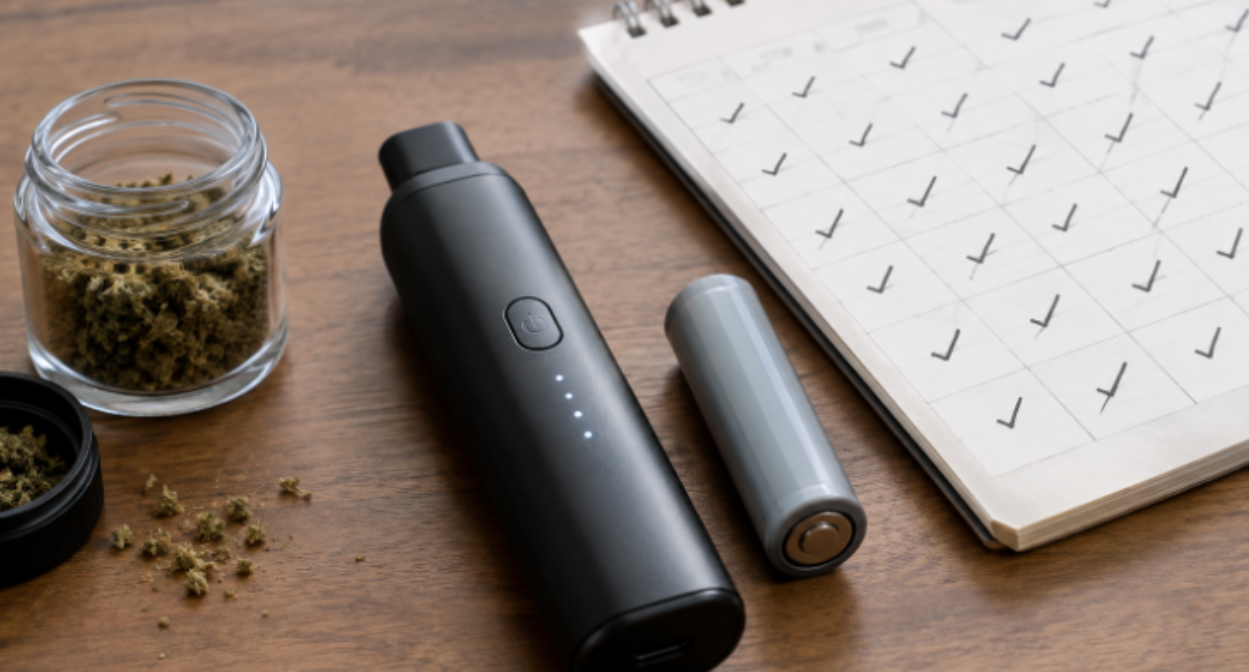
All makers of portable dry herb vaporizers make glowing claims on the box. They claim fast-heating times, easy draw resistance, and long-lasting batteries. However, reading a spec sheet in a showroom is quite different than using a portable vape device in your pocket for thirty days straight. And if you are an avid vape enthusiast, you are more than aware of this.
During the last month, tests reveal a bunch of popular portable devices, from budget-friendly ceramic heating vapes to top-tier dual battery vapes, under the most rigorous battery tests we have ever done. Tests reveal how well the batteries charged, how much power the battery uses when heating up, pass-through performance, and even cold temperatures’ effect on battery performance.
And here is the truth we found out about portable vaporizer battery life during four weeks of continuous use.
How the 30-Day Battery Test runs
To get accurate numbers rather than manufacturer estimates, used each unit as a primary daily device for a full week. Every test session followed a standardized routine:
- Session Length: Exactly five minutes per session at a target temperature of 190°C (374°F).
- Load Size: Packed loosely with 0.15g to 0.20g of medium-ground dry herb.
- Ambient Temperature: Standard room temperature (20°C) for indoors, with controlled outdoor testing at 5°C to measure cold-weather drain.
- Charging Method: Stock USB-C cables plugged into a standard wall adapter.
Instead of testing until the battery completely died in one marathon afternoon, sessions were spread out naturally across the morning, late afternoon, and evening. This simulated real-world heat-up cycles, which place far more strain on a lithium-ion cell than keeping a chamber warm continuously.
The Real Cost of Fast Heat-Up Times
One of the biggest takeaways from thirty days of testing is that rapid heating comes at a steep battery cost.
Modern portables that reach full temperature in under 20 seconds rely on high-wattage heater spikes. While skipping a long wait time is convenient when you are walking outdoors, it drains the battery significantly faster than slower conduction ovens.
The duration it took devices with conduction heating to heat up to 190°C was between 45 and 60 seconds, but each charge was good for about 9 to 11 sessions. The more robust hybrid heating devices, which heated up within less than 20 seconds, could do 6 to 8 sessions per charge.
When researching hardware specs across independent tech outlets and community platforms, reading thorough portable vaporizer reviews helps set realistic expectations regarding trade-offs. You are usually choosing between instant session readiness or extra battery life away from a wall outlet.
Built-In USB-C vs. Removable 18650 Batteries
After four weeks of daily use, the debate between integrated internal batteries and swappable 18650 or 21700 batteries became very clear.
Units with sealed internal batteries are convenient out of the box. USB-C charging means you can top them up using a power bank, a laptop charger, or a car port. However, if you forget to plug the device in overnight, you are stuck waiting 45 to 90 minutes for it to gain enough juice for a session. Pass-through charging (using the device while plugged in) helps, but doing so continuously generates noticeable thermal strain, making the outer shell uncomfortably warm.
In the case of high-frequency users, it was evident that the devices with removable batteries were significantly better than others. Two charged 18650 batteries kept inside a silicon case meant that there was a 100% battery level with just 10 seconds of switching.
Cold Weather Drain and Long-Term Degradation
If you intend to operate the portable unit outdoors in the fall or winter season, then you should take into account the effect of environmental temperatures on your regular routine.
All devices we tested in outdoor conditions when the temperature was 5°C experienced losses in their total session capacities amounting to about 15 to 20 percent. It is due to the fact that cold temperature decreases the outer body temperature and causes the internal heating unit to consume additional energy from the battery to keep the same temperature inside the oven of 190°C.
Furthermore, daily charging over thirty days showed slight thermal wear on budget units that lack heat-shielding around the battery bay. Keeping the battery isolated from the heating chamber is vital for preventing cell degradation over months of heavy use.
The Verdict: What to Look for Before Buying
After one month of testing these vaporizers out in the real world, here is what really counts when judging battery life:
- Be Realistic About Your Routine: If you only take two short sessions an evening at home, an integrated USB-C device is lightweight and easy. If you spend long days outdoors, opt for removable batteries.
- Don’t Rely Solely on Rated mAh: A 3500mAh rating sounds impressive, but if the heater draws massive wattage for convection airflow, it might deplete faster than a 2600mAh conduction unit.
- Prioritize Pass-Through Safety: Ensure any internal battery unit you pick has proper pass-through circuitry so you can safely use it while wired to a power bank without overheating the hardware.
What has your experience been using a portable vaporizer for a month? Has the battery life matched your expectations or not? Let us know.