
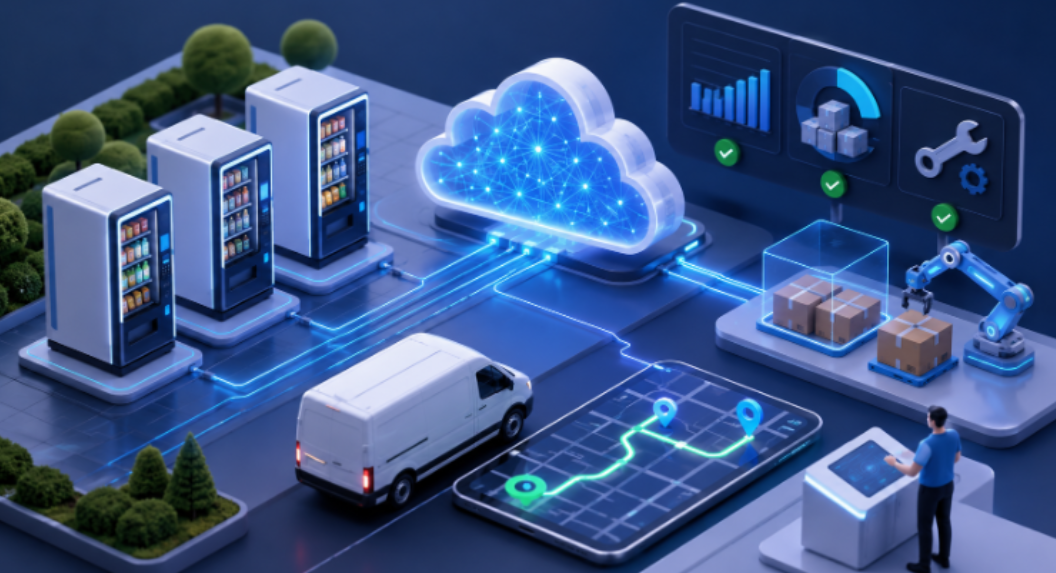
Vending is a volume business with thin margins, and a large share of operating costs goes on visits to machines that did not require service. Convenience services revenue reached $40.04 billion in 2025, an 18.3% increase, and more than 70% of operators added locations. Both figures come from Automatic Merchandiser’s 2026 State of the Industry report. Growth at that scale exposes the limits of fixed routes and static planograms. This article looks at where traditional vending loses margin and what an AI vending machine changes in the daily work of an operator.
Why Traditional Vending Is Struggling
Traditional vending is under pressure from four directions at once. All four are operational, and each one shows up in the margin well before it shows up in the sales figures.
Manual Inventory Management
A fixed restocking schedule commits an operator to service intervals that were set long before the machine’s current sales pattern emerged. As demand moves across the year, the calendar stays where it was.
- Fixed restocking rounds: Routes repeat on a set calendar and take no account of recent sales.
- Wasted service visits: Drivers open machines that are still two-thirds full.
- Stockouts between visits: Best-selling selections empty early in the cycle and stay empty until the next scheduled visit.
The last of the three costs the most, and it also stays invisible in operator reporting, since an empty selection generates no transaction to record.
High Operational Costs
Distribution is the expensive part of vending, since fuel and driver hours are charged against a basket of products priced at a few euro each.
Each unnecessary stop therefore carries a double cost: Fuel for the visit, and driver time that an empty machine elsewhere did not receive. Fixed routing makes the waste structural, because the same avoidable stop repeats every week.
Limited Data and Customer Insights
A traditional machine transmits no data between service visits. As a result, sales are reconstructed afterwards from cash counts and remaining stock, which documents past performance without indicating future demand. In practice, product decisions then rest on the route driver’s recollection, which is manageable across ten locations and unreliable across two hundred.
Changing Customer Expectations
Payment habits moved first, and Grand View Research put cashless payments at 74.86% of North American retail vending revenue in 2024. As a result, customers carrying no cash pass a coin-only machine without attempting a purchase. A queue during a 15-minute break costs the operator that sale outright. Meanwhile, personalised offers and loyalty pricing are now standard in the other channels where the same customers buy snacks.
How AI Can Transform Traditional Vending

The gain shows up across five parts of the operation, from stock levels at the individual coil to the payment terminal on the front panel.
1. AI-Powered Inventory Management
An AI powered vending machine reports each sale as it happens. Telemetry reads the DEX/UCS audit file from the machine controller. MDB, in turn, records the value of each cashless transaction against the product and the time it sold. From that feed the platform builds sales velocity per coil, at machine level and by weekday.
Forecasting then produces a picking list. Par levels sit at selection level, so any coil whose days of supply runs short of the next visit is flagged automatically. Prekitting follows: The van is loaded machine by machine, which removes the on-site sorting that eats service time.
2. Smarter Route Optimization
Once the platform knows what every machine holds, the route can be rebuilt each morning. A machine joins the day’s list when a threshold is breached, e.g. a coil at zero or 20% of capacity remaining. As a result, two numbers move in the operator’s favour: Stops per van per day, and cases delivered per stop.
3. Predictive Maintenance
DEX audit records carry temperature and machine events alongside sales totals. A cooling unit drifting above setpoint is therefore visible hours before the stock has to be condemned. Likewise, a rising rejection rate on the note validator appears in the error counters while customers are still buying. Technicians are then dispatched to confirmed faults, which lifts first-time fix rate.
4. Better Product Selection and Planograms
Sales data by location ranks selections on weekly vends and on contribution per slot. From that ranking, slow movers become apparent within weeks. The same reporting exposes products that perform strongly in one building while underperforming in another two streets away.
Category demand is also shifting. In the 2026 State of the Industry survey, protein-led products dominated the better-for-you rankings, with jerky at 27% and protein bars at 18%. Even so, traditional sweet snacks still accounted for more than a third of vending and smart cooler sales. A planogram built on one assumption alone will therefore underperform.
5. Smarter Customer Experiences
Cashless and mobile payments are the baseline, handled over MDB by a contactless reader. Beyond that, a screen and a linked customer account allow promotions and loyalty pricing at the point of sale. Grab-and-go formats remove the selection step entirely. In that model, the customer opens a door, computer vision records what leaves the shelf, and the card on file is charged on exit.
How Do AI Vending Machines Work?
Three layers explain how AI vending machines work. A smart AI vending machine collects the data, a platform analyses it, and the output reaches the operator as a task.
Data Collection
Four data streams feed the platform, and all of them come off equipment the operator already owns.
- Sales data: Every vend, with time, price, and payment type.
- Inventory data: Current stock by selection, updated continuously.
- Sensors and machine status: Temperature, door events, and component faults.
- Customer interaction data: Screen taps, abandoned selections, and app activity.
AI Analysis
The platform analyses that stream for patterns. It forecasts demand per machine and per selection, and it recognises the weekday and seasonal shapes in the sales curve. Fault signals are then separated from normal variation, and the same models produce product recommendations for each location.
Automated Actions
The output reaches the operator as work instructions for the day.
- Restocking alerts: Which machines need a visit, and what to load.
- Route recommendations: The order and the day, updated before the driver leaves.
- Pricing and promotion suggestions: Based on what moves at that site.
- Maintenance alerts: Sent with the fault code and the part likely involved.
AI Vending Machine vs Traditional Vending Machine

Set an AI vending machine against a traditional vending machine and the differences are operational. The table below puts the two side by side on the points that decide daily performance.
| Feature | Traditional Vending | AI-Powered Vending |
| Inventory | Manual / scheduled | Real-time + predictive |
| Route planning | Fixed | Dynamic |
| Analytics | Limited | Advanced |
| Maintenance | Reactive | Predictive |
| Payments | Cash/card | Cashless/mobile/grab-and-go |
| Customer insights | Limited | Data-driven |
| Product optimization | Manual | AI-assisted |
The same shift has occurred in other operational disciplines, where AI project management replaced fixed plans with rolling ones. In both cases the schedule ceases to be a fixed document and becomes an output that updates as conditions change.
Can Traditional Vending Operators Upgrade with AI?
Fleet replacement is not the entry point. Instead, most AI vending solutions start with telemetry devices fitted to existing equipment. Such a retrofit connects a coin-operated machine from 2015 to a cloud platform for a modest hardware cost per unit. New AI vending machines, by contrast, arrive with cameras and telemetry built in.
A workable sequence looks like this:
- Start with monitoring: Real-time stock levels and sales by machine.
- Add route optimization: Dynamic lists built from those stock levels.
- Then layer on analytics: Planogram changes and pricing tests by location.
- Adopt new formats when the numbers justify it: Computer vision, smart coolers, and autonomous checkout.
The final step is already well underway. Smart coolers accounted for 33.5% of the equipment operators deployed in the 2026 survey, close to traditional glass-front machines. For that reason, operators weighing an AI smart vending machine for sale against a retrofit should price both across the same route. Most of the saving comes from the data the platform collects, whichever cabinet holds it.
Final Thoughts
The operators with most to gain are those carrying the largest number of redundant stops. Where half the visits are precautionary and best sellers empty mid-cycle, the first month of live inventory data can cover the hardware cost. A single route is enough for a trial, provided it runs alongside the existing schedule for comparison. Two figures then settle the question: Stockout hours per machine, and stops per full van.