
Foldable screen flatness has moved from being a secondary refinement to one of the clearest technology battlegrounds in foldable smartphones, according to Counterpoint Research’s Foldable Display Shipment and Technology Report. A center crease can interrupt reflected light, bend text and images, create tactile unevenness and raise questions about how a premium display will age. Samsung’s newly launched Flex Titanium architecture, OPPO’s Zero-Feel Crease positioning and crease-focused demonstrations from major panel makers show that the pursuit for durable and visually seamless foldable screens has become a key focus point.
Furthermore, foldable smartphone panel demand is expected to rebound. Counterpoint Research forecasts shipments in 2026 to increase 24% YoY to reach 27.5 million units and revenue to jump 48% YoY to $4.4 billion. The report’s technology section provides detailed foldable OLED stack profiles covering the materials and structural choices behind durability and crease control.
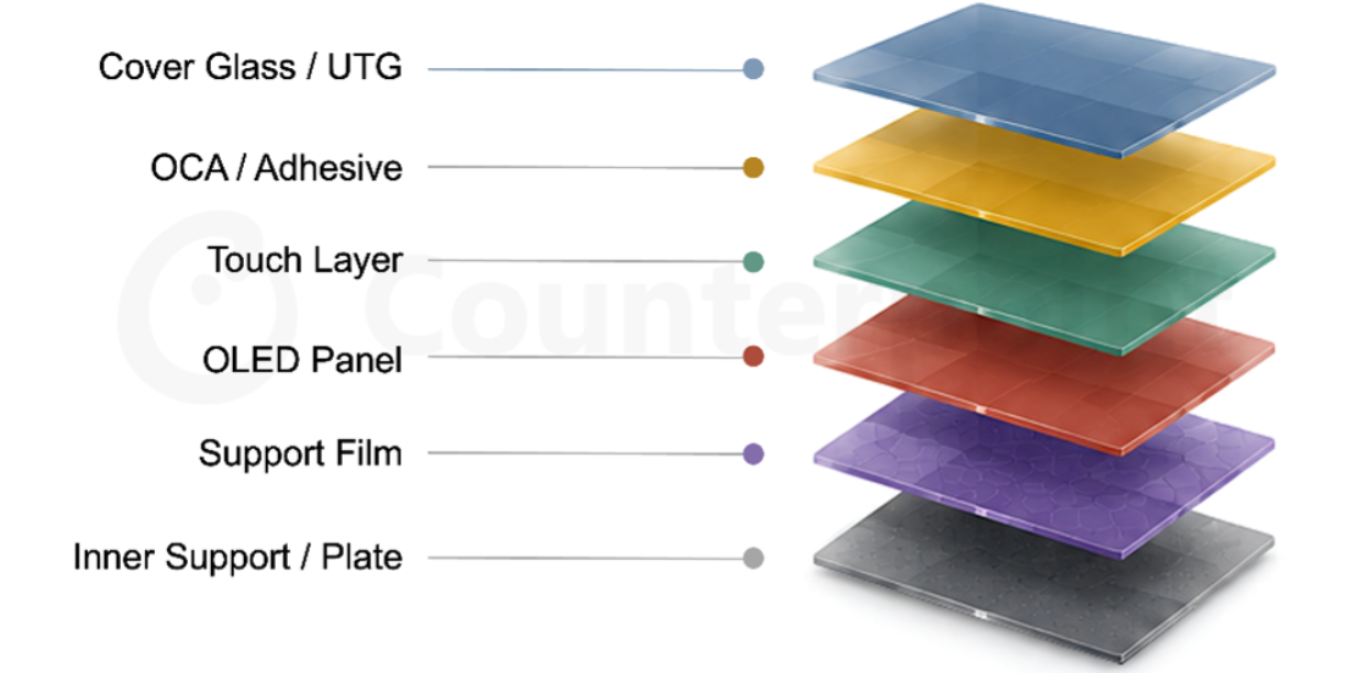
A foldable OLED is not just a single flexible sheet. It is a laminated structure of cover glass, optically clear adhesives, touch and OLED layers, support films and an inner support mechanism. During folding, these layers experience different tensile, compressive and shear loads. The resulting crease depends on where neutral planes form, how stress is distributed, and how the thickness and modulus of each layer interact.

Samsung’s recently released Flex Titanium structure uses a thin titanium-alloy layer and an updated support plate beneath the OLED. The combination is intended to reinforce the display while preserving flexibility, helping the fold area remain flatter over time. It illustrates a broader shift toward engineering the layers below the panel for both durability and crease control. Counterpoint Research’s report examines these stack-level changes in greater detail.
Industry development is moving toward thinner modules, thicker Ultra-Thin Glass (UTG) and optimized support structures, including multi-layer UTG, selectively etched Ultra-Thin Flexible Glass (UFG), high-strength back films and rigidity-gradient layers. OCA is also critical: its controlled viscoelasticity and crosslinking-density gradient redistribute strain, maintain interfacial integrity and improve recovery across temperatures and repeated folding, suppressing creases without compromising optical performance.
Foldable displays are therefore entering a new phase. The leaders will not be defined by a single hinge name, a single material or the largest fold-cycle number. They will be defined by how well glass, adhesives, support structures, hinge mechanics and manufacturing precision work together, and by whether the screen still feels continuous after months and years of use. The clearest sign of maturity will be simple: users open the device and stop thinking about the fact that the display was ever folded.