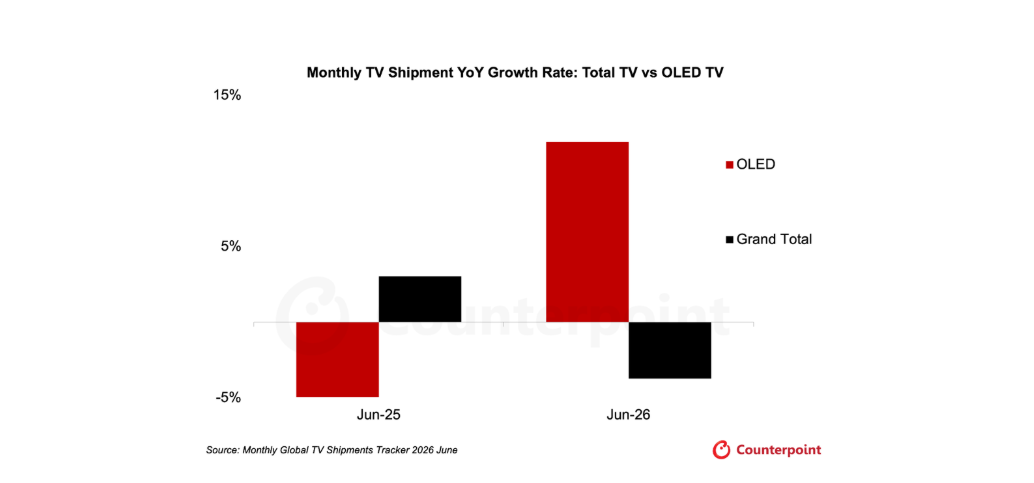
Global TV shipments declined 4% YoY in June 2026, according to Counterpoint Research’s Monthly Global TV Tracker 2026 June. This brought Q2 2026 to -0.4% YoY, ending the quarter on a relatively flat note.
June’s weakness appears to reflect a shift in timing rather than a genuine contraction in demand. World Cup promotions pulled demand forward into April 2026, and the resulting payback weighed on June shipments. By brand level, AOC, Samsung and TCL grew shipments, while most other brands — including Hisense, Huawei and Changhong — declined.
In the LCD TV segment, Samsung and TCL remain locked in a tight race. Samsung has significantly broadened its lineup with the S95H and R95H alongside its new MiniLED series, the M80H and M70H, while TCL is leading with its SQD (Super Quantum Dot) MiniLED TVs spanning the X11L, C8L and C7L. The two brands now compete head-to-head across virtually every price tier — from entry-level to ultra-premium — in MiniLED and RGB MiniLED TVs. As of June 2026, their LCD TV shipment shares stood at 13.7% for Samsung and 13.8% for TCL, a gap of just 0.1pp.
Notably, the two are pursuing divergent technology paths. Samsung is extending RGB-backlight-based TVs from its flagship down into more accessible tiers, whereas TCL has confined RGB MiniLED (RM9L) to large-format premium models and positioned SQD-MiniLED at the top of its technology stack. The result is direct competition at comparable price points with different underlying technologies.
The OLED TV market maintained clear momentum. OLED TV shipments grew 12% YoY in June 2026, closing Q2 with 20% YoY growth. LGE led this expansion, holding an overwhelming number one position with more than half of the OLED TV market in both June and Q2.
The key variable ahead is WOLED’s cost structure. LG Display’s large panel division is currently focused on lowering the price of WOLED for TVs. The company has already launched WOLED SE, which removes the polarizer to reduce cost, and is now developing a 2-stack tandem structure that maintains or improves quality while simplifying the stack.
This goes beyond incremental cost reduction; it points to an attempt to lower the entry price of OLED TVs themselves. Whether this WOLED strategy can meaningfully broaden the OLED TV market will be the point to watch going forward.
“In recent years, OLED TVs have lost ground in the super-premium market to less-expensive MiniLED TVs,” said Bob O’Brien, Research Director of Counterpoint Research. “Consumers compared large-screen MiniLED TVs to smaller sized OLED TVs at similar price points, and many consumers chose MiniLED. LG Display is fighting that trend with the introduction of lower-cost OLED TV panels, with a good chance to win some of those customers back.”