Coimisiún na Meán awards over half a million euro for Media Sector training initiatives

Coimisiún na Meán has today (06.03.2025) awarded €550,000 to deliver training and development initiatives for the Media Sector in Ireland.

Coimisiún na Meán’s Sectoral Learning and Development Programme assists organisations to undertake training, learning and development activities that support the broadcasting and audiovisual industries, and helps realise An Coimisiún’s aim of ensuring a thriving, diverse, safe, creative and trusted media landscape.

Coimisiún na Meán’s Media Development Commissioner Rónán Ó Domhnaill said: “Coimisiún na Meán is committed to ensuring a media landscape that is sustainable, pluralistic and participative, and that reflects and shapes who we are as a society. The Sectoral Learning and Development Programme underpins our work as it delivers training and development opportunities to those working in the media. By funding these initiatives, we can continue to support sector sustainability and capacity, and the ability of media workers to create content that reflects diverse voices and viewpoints in contemporary Ireland.”

During this round of funding, Coimisiún na Meán received 38 applications seeking a total of €1.2 million. The successful 29 applicants include organisations representing commercial and community media; industry specific groups such as producers, animators, and journalists; and advocacy organisations for gender, equality and inclusion, and promotion of the Irish language. The provision of funding to these organisations enables them to undertake of range of training and development activities, for example workshops, masterclasses, training programmes, seminars, and networking events.

Among the successful applicants awarded funding for 2025 are:

  • Craol – funding to support skills qualifications for trainers, workshops on mobile journalism and media production, the annual community radio féile, and other operational activities.
  • Ecoscope Limited – funding to support a sustainability demonstration day for electrical departments in film productions.
  • Storyhouse – funding to support a script and screen writing programme, and a panel discussion on Irish language film-making as part of the 2025 Storyhouse festival.
  • GORM Media – funding to run a training course for early- to mid-career media makers from under-represented, and to deliver bite-sized workshops for local communities.
  • Mediastrong – funding for a pilot initiative to equip newsroom staff with essential skills to recognise and manage trauma effectively.
  • Women in Film and Television – funding to support representation at Berlinale: Power to transform – Global Forum for Women; the Canne Film Festival; and the Greater Later Summit
  • Oireachtas na Gaeilge – funding for Gradaim Chumarsáide an Oireachtais, and other Irish language development work.
  • Learning Waves Journalism Graduate Programme – funding for internships in commercial radio stations for journalism graduates

A list of successful Sectoral Learning and Development funding recipients for 2025 can be found on their website.

Coimisiún na Meán supports the development of a thriving media sector in Ireland through funding schemes including the Sectoral Learning and Development Programme, Sponsorship Scheme, Sound & Vision Scheme, and through its Journalism Schemes, covering Local Democracy and Courts Reporting.

In 2024, Coimisiún na Meán published the first Gender, Equality, Diversity and Inclusion (GEDI) Strategy for Ireland’s audio and audiovisual media sector, to enhance the diversity of the media sector in Ireland.

New research highlights crucial cybersecurity gaps in education sector

New research highlights the need for ongoing concern for the UK education sector’s cybersecurity posture in the light of a growing threat landscape. ESET ‘s findings reveal that nearly three-quarters (73%) of institutions surveyed have experienced at least one cyber-attack or breach in the past five years, with a fifth reporting three or more incidents. This aligns with government data from 2024, which found that 77% of education organisations had experienced a breach or attack in the previous year – far higher than the 50% of UK businesses overall that had been targeted.
Despite being a key target for cyber threats, one-third of education institutions surveyed still lack fundamental protections, such as antivirus software (33%) and strong password policies (35%2). Additionally, the majority (79%) have not adopted advanced measures like managed detection and response.
Another key but often overlooked safeguard is cyber insurance, which, according to government data, under half of primary schools (44%) and even fewer secondary schools (36%) report having in place. In fact, the ESET findings reveal that 7% of institutions operate without an annual cybersecurity budget at all.
This cybersecurity shortfall not only jeopardises organisational data but puts sensitive student information at risk. As cybercriminals increasingly target educational institutions, students’ personal and academic data remain highly vulnerable to theft or misuse. Compounding the issue, one in five (21%) education organisations surveyed admit they feel unprepared / not confident to tackle the rising tide of AI-driven cyber threats.
When asked about the main reasons why they wouldn’t take out a cyber insurance policy, many stated that they prefer to prioritise the budgets they have for cybersecurity measures (37%). Others cited concerns about payout reliability (33%) and complex or unclear policy terms (32%). Meanwhile, 28% believe cyber insurance is too expensive, while 18% revealed they simply don’t understand its value.
Top threats persist
These revelations all come at a time when education organisations continue to battle familiar foes, with data breaches (61%), malware (55%) and phishing (43%) topping their list of concerns. While three-quarters (76%) of education organisations surveyed believe their staff have excellent or good knowledge and awareness of cyber security best practices and online safety, over  half still plan to prioritise increasing staff awareness and training and expanding their cyber security tools or software over the next 12 months (55% and 51% respectively).
The case for managed support
Over three-quarters (77%) believe their institutions would benefit from enhanced cyber security measures with managed support from an external, specialist cyber security provider. However, nearly half (47%) of education organisations surveyed said they would need evidence of a cyber-attack’s potential detrimental and financial impact on their institution to help convince their finance department to approve a larger cybersecurity budget.
Jake Moore, Global Cybersecurity Advisor at ESET, commented: “Education organisations are sitting on a ticking time bomb. While it’s clear that the sector recognises the critical importance of cybersecurity, there is a huge disconnect between budget allocation, lack of insurance and its misconceptions, and inadequate measures, which is leaving institutions highly vulnerable. A comprehensive strategy that includes both cutting-edge security tools, like managed detection and response, and appropriate insurance coverage, is essential to protect against potentially devastating financial and operational impacts.
“These findings underscore the urgent need for education organisations to adopt a more robust and integrated approach to cybersecurity. Institutions can better safeguard their operations, staff and students, by increasing investment, educating stakeholders, implementing advanced solutions, enhancing training, and collaborating with specialised providers.”

Trinity and CKDelta take AI approach to tackle key challenges of utilities sector

Researchers from Trinity College Dublin are partnering with CKDelta to take an AI-driven approach to tackling some key efficiency and sustainability challenges faced by the utilities sector.

CKDelta is an AI software business within CKI Innovations Opportunities Development (CKH IOD), a member of CK Hutchison Holdings, leveraging data, expertise and intellectual property to drive improved business performance. Headquartered in Dublin, CKDelta is providing €865,000 in funding  to support the appointment of a postdoctoral researcher and a number of PhD students, who will work on a range of research projects under the supervision of Professor Gregory O’Hare, Professor of Artificial Intelligence and Head of Trinity’s School of Computer Science and Statistics.

The research projects will fall under two main umbrellas: predictive maintenance and early warning systems.

Predictive maintenance is a data-driven approach that uses AI to monitor the condition and performance of assets and predict when they need servicing or replacement. As a consequence maintenance can be scheduled at the optimal time, avoiding unnecessary downtime, reducing operational expenses, and improving safety and reliability.

The research collaboration will seek to deliver predictive maintenance models that provide better insights for informed decision making, with maintenance currently often driven on the foot of customer complaints and logs of issues as they arise.

Early warning systems represent a set of tools and methods that aim to detect, monitor, and forecast potential threats or disruptions to utility companies. In the case of the water industry they provide benefits in cases such as leaks, bursts, floods, sewerage overflows and blockages.

The research programme also seeks to enhance an early warning system to improve the efficiency, reliability, and resilience of the water network, reduce operational and maintenance costs, enhance customer satisfaction and trust, and protect public health and the environment. It also aims to develop an anomaly detection system to identify near real time differences from expected behaviours, which may be reusable/adaptable to other situations.

In addition to the funding, experts from CKDelta will be providing the platforms in which the Trinity researchers can investigate the data, as well as offering data engineering and data science support.

Prof. Gregory O’Hare, Trinity, said: “We are very grateful to CKDelta for their support and look forward to pooling our expertise as we seek to address some of the most pressing challenges affecting the utilities sector. The scale of the challenges means there is also a significant opportunity to improve sustainability and efficiency, and we believe our data- and AI-driven approach offers great potential in taking a tangible leap forwards.

“We hope that this collaboration will form the basis of a sustained, trusted and mutually beneficial relationship. This will be centred around a co-laboratory where the shared expertise of both Trinity and CKDelta will help with the effective, informed and judicious adoption and deployment of appropriate cutting edge AI technologies within the CKDelta utilities client portfolio and beyond.”

Joe Parker, CEO of CKH IOD, said:  “This collaboration combines two complementary forces in AI: the frontier research capabilities of Trinity College Dublin—and its ability to experiment, innovate and test new ideas without restriction, in a way that few commercial organisations can; with CK Delta’s unique capacity to apply innovation directly to real-world commercial challenges, to help businesses thrive in an increasingly data-driven economy.

“Throughout the next four years, the partnership will generate new streams of knowledge transfer, with cross-pollination of skills, perspectives and specialisms that may otherwise be impossible.”

Fexco’s PACE and Trovio form a strategic partnership to develop ‘SAF Connect’, a trading platform for the aviation sector.

PACEFexco’s sustainability data and analytics division and Trovio Operating Pty Ltd (Trovio) have announced they have entered into a strategic partnership to develop a new platform, ‘SAF Connect’. 

The partnership will explore opportunities for an inventory management system with Scope 1 & Scope 3 SAF certificate issuance where counterparties can transact, settle, and digitally execute offtake agreements. 

The platform will leverage Fexco’s heritage in sustainability, treasury management, FX and payments, and incorporate Trovio’s leading energy transition technology, CorTenX.

SAF Connect will offer complete transparency, and auditable transaction history, ensuring a scalable solution for all market participants handling SAF and related assets.

“This is a further milestone for us as we continue to build on our market growth. Trovio brings exceptional energy transition technology to this partnership,” said Cathal Foley, CEO of PACE. “Together, we will deliver a unique platform that enhances the efficiency and transparency of the SAF market, driving the aviation industry towards a more sustainable future.”

“Trovio is delighted to partner with Fexco,” said Jon Deane, CEO of Trovio. “Fexco’s PACE is a company that aligns with our vision and values. We believe SAF Connect will provide an innovative solution to support the rapid growth and development of sustainable aviation fuel. By leveraging both Fexco’s and Trovio’s collective expertise, we are building a platform designed specifically for the complexity of this market.”

To find out more, visit the PACE website.

ABLIC Seeks to Reinforce Its Position in the European Automotive Sector with New Focus on High-Value-Added Products

Analog semiconductor manufacturer ABLIC Inc. embarked on a new start under a new company name in 2018, against the backdrop of a rich history spanning over 50 years. In June 2023, five years later, Seiji Tanaka took office as the new president. While focusing on planning and development capabilities as well as high-value-added products, Tanaka is also strengthening initiatives in the European market.

In November 2023, ABLIC obtained development process certification for the most stringent level ASIL-D under the automotive functional safety standard ISO 26262. Furthermore, by acquiring VDA6.3, which is an important process audit standard for German automotive-related companies, ABLIC has established a comprehensive setup. The company is now capable of handling numerous customer audits, which helps to steadily strengthen its foundation in the automotive market.

ABLIC’s Representative Director and President, Seiji Tanaka is an accomplished professional leader who has accumulated over 35 years of experience in the semiconductor industry, engaging directly with customers around the world and building experience in sales and management. Before joining Seiko Instruments Inc. (of which ABLIC was a division of) in 2012, Tanaka was in charge of sales at the semiconductor division of Japan Motorola and served as the head of sales at Freescale Semiconductor Japan Ltd. Tanaka became an executive officer of ABLIC in 2018 when it became an independent analog semiconductor manufacturer. Furthermore, since June 2021, Tanaka has been serving as Business Officer of Semiconductor & Electronics HQ at MinebeaMitsumi Inc., following ABLIC’s business integration into the company.

Since President Tanaka has taken office, he has been proactive in releasing new products. Presently, the company has been focusing on products for the automotive market, including automotive step-down switching regulators that are housed in the industry’s smallest package, window voltage detectors that realize advanced functional safety with the industry’s top-class high-speed detection, and high-withstand voltage LDO regulators that achieve the industry’s highest PSRR and the fastest transient response.

Tanaka has a clear vision for ABLIC’s future direction, stating,

“We will focus on developing high-value-added products that can functionally differentiate us from other companies. In 2023, we also integrated with Samurai Semiconductor Corporation (SSC), a collective of experts who have been expanding semiconductor designs in the global market. SSC is a group of engineers with abundant experience in both digital and analog engineering skills regarding semiconductors, as well as front-end and back-end processes. In addition to strengthening our engineering resources, we have appointed a Chief Product Officer (CPO) with an extensive background in leading semiconductor planning and development in the medical device field. In the European automotive market, we place a high priority on clear communication with the engineers, from the early planning stages to the final development of high-value-added products.”

For over half a century, ABLIC has developed products based on its corporate vision of ‘Small, Smart, Simple’. The company plans to continue under this adage, which stands for miniaturization and low power consumption, shifting from single-function products to multi-function products while focusing on development that closely meets customer needs. In addition, ABLIC is working towards realizing a more proactive support system by providing simulation data to solve customer problems.

As part of its high-value-added products, ABLIC offers automotive products that perform with high accuracy across a wide temperature range, such as those compatible with AEC-Q100 Grade 0, and high-function products that consolidate multiple features into a single chip. These products also contribute to enhancing the safety of ADAS and AD systems with industry-leading features.

ABLIC is also working on the development of medical ultrasound imaging ICs for medical equipment, which are already being used in ultrasound diagnostic equipment by major Western medical device manufacturers. Furthermore, ABLIC’s flagship technology, CLEAN-Boost®️, stores energy generated from minimal moisture or electrically generating bacteria, boosts voltage from that energy, and converts it into electricity to enable wireless communication. This technology holds infinite possibilities for IoT development and is expected to contribute to the SDGs. In Japan, this technology is already being utilized in ‘battery-less water leak sensors’ within several buildings and factories, with plans to expand this technology overseas.

ABLIC has established a comprehensive network utilizing online distributors, and a robust support system of Field Application Engineers (FAEs), which are now present in the European market. ABLIC’s products have been adopted by major Tier 1 suppliers in the automotive field in Europe, which support vehicle, medical, consumer, and industrial applications worldwide. ABLIC is actively preparing to introduce renewable energy in their effort towards achieving carbon neutrality by 2050.

ABLIC plays an important role in the analog semiconductor business within the MinebeaMitsumi Group, which has set an ambitious target to increase its sales to 300 billion yen by 2030. ABLIC is taking steady steps towards achieving this goal.

Not just a man’s world – the transformation in the machinery sector

Mechanical engineering, industry, construction, and workshops: These are environments typically associated with men – at least according to the prevailing view in society. This is because women are supposedly not interested in technology and machinery. However, this perspective is outdated, as confirmed by four women in key roles at the industrial auction house Surplex.

The industry and mechanical engineering sectors, long considered male-dominated fields, are on the cusp of significant changes. For decades shaped by traditional gender roles and distributions, the rigid boundaries that hinder women’s access to technical professions and leadership positions are increasingly being broken down. Statistics paint an encouraging picture: The proportion of women in these fields is growing. This development, especially highlighted on International Women’s Day on 08 March, underscores the growing recognition of the importance of diversity in the workplace. Yet, there are still many challenges women often face.

New perspectives: women in technical professions

Surplex, an industrial auction house for used machinery in metalworking, woodworking, and construction, is also a typically male-dominated company. This is reflected not only in the industry but also in the professions: The Surplex project managers and sales managers, often with technical training, are responsible for acquiring machinery and conducting individual auctions, serving as direct contacts for predominantly male providers. Therefore, it is not surprising that two-thirds of Surplex’s employees are male.

However, Karin Schneider, Head of HR at Surplex, sees a positive change in the proportion of women at Surplex. A major problem, however, is the applicants’ experience. “The trend for more women to take up ‘typically male professions’ is still relatively new, so unfortunately, the depth of experience of most female applicants for higher positions is often not sufficient.“

The Surplex management team consists of three people, one of whom is a woman: Ghislaine Duijmelings. “It has been proven that diverse teams lead to better results. Therefore, it is crucial to consciously steer in this direction. In terms of internal labour mobility, we want to directly address women about new opportunities.“ Schneider also adds, “For us, gender is less important than a person’s qualifications. Such attributes should actually be irrelevant in a modern society.“ Despite the suitable working environment, why are there still fewer women in this industry?

Overcoming challenges, reducing self-doubt

“I think it’s due to cultural aspects such as stereotypical gender images, the way education is structured, and there are fewer female role models in these sectors. Also, the image of these sectors as a man’s world can deter women,“ says Duijmelings, echoing Schneider’s argument: How modern is our society today?

The fact that there are few women in this industry is not because they are excluded by men, as Nancy Castañeda, Project Manager for Surplex in Spain, and Kristina Voosholz, Acquisition and Purchasing, know from their own experience. “Of course, there was the occasional remark ‘Do you even know anything about machines?’, but you have to rise above that and charmingly convince the conversational partner otherwise,“ says Voosholz about her experience in the used machinery trade. Her long-standing expertise in the business has given her enough confidence to face sceptical business partners. And Nancy Castañeda feels the same: “Sometimes I felt like I wasn’t in the right place because I was surrounded by men, but I was confident that my work was good enough and I believed in myself.“ Sceptics were quickly convinced, and today she has many very good relationships with her business partners. Both women have not experienced outright rejection during their time at Surplex.

Balancing career and family: a management task

The combination of family and her role as CEO is not always easy, but for Duijmelings, it’s no obstacle. “It’s important to be flexible. I don’t stress when unforeseen circumstances arise. Taking responsibility also means setting priorities.“ And even though her children will always come first, it’s important to her to demonstrate that it’s important to be independent and to fulfil oneself.

Castañeda shares similar challenges between career and family. As a mother, she finds the time away from family the most challenging, an experience she shares with her male colleagues. “But the truth is, I have the support of my husband.“

So, flexibility is key for mothers – not just in technical professions. Surplex actively strives as an employer to create an environment where all employees can combine family and work. Whether through flexible working hours, part-time offers, workation (work & location, i.e. working in a different country than usual), or home office.

Diversity as the key to success

Women bring a new perspective to the market. Studies show that teams with a mix of different cultures, genders, and age groups are the most successful. It sounds like a cliché: Especially a balanced gender distribution leads to better decisions because it balances the extreme risk-taking of men and the excessive caution of women. The most important thing, therefore, is to encourage women to dare to enter technical fields.

For all women considering whether they are cut out for the machinery market or whether they should opt for a different career, Ghislaine Duijmelings has a tip: “My advice to other women: You are exactly right the way you are. Just take your position as a woman! Don’t be intimidated by what you don’t know.“

Cyber Ireland unveils ambitious roadmap to drive Cyber Security sector growth by 2030

Cyber Ireland, the leading national cyber security cluster organisation, has today launched a comprehensive strategy aimed at driving the growth of Ireland’s cyber security sector by 2030. With a proven track record since its establishment in 2019, Cyber Ireland has evolved into a national representative body, uniting over 160 member organisations, including start-ups, SMEs, multinational corporations, and educational institutions.

Originally conceived to address cyber security skills shortage as an initiative at Munster Technological University, Cyber Ireland has grown into a recognised industry force, hosting activities across four strategic workstreams and also responsible for organising the annual Cyber Ireland National Conference (CINC), the premier cyber security conference which attracts leading cyber security experts from across Ireland and the globe.

According to the State of the Cyber Security Sector 2022 report the cyber security sector in Ireland employs over 7,300 professionals working across nearly 500 companies contributing €1.1 billion annually to the economy. Ireland requires a strong domestic cyber security sector with companies of scale that can deliver high value services to provide cyber resilience for the country and compete internationally. This can build on existing strengths as the island of Ireland grows into an international hub in Europe for cyber security multinational operations and further increase FDI in cybersecurity.

There has been strong demand for cyber security skills over the past four years with a trebling of job roles advertised between 2019 and 2022, from 2,000 jobs advertised to 6,700 open roles. On a growth trajectory of 10%, the sector anticipates the creation of 10,000 additional jobs by 2030, totalling 17,000 in the sector, contributing €2.5 billion per annum to the economy. How this demand is met given the existing skills shortages and skills gaps will be central in making Ireland a leader for cyber security talent globally.

Pat Larkin, Chairperson of Cyber Ireland and President, Ekco Security, said, “There is an incredible opportunity in front of us. Analysts quantify the current Cyber Security market opportunity in or around 200-250BN USD with a 15% growth rate. A recent consultancy report estimates that the current vended market spend may be 10 times under penetrated and thus the addressable market may be between 1.5 and 2 trillion USD.”

“No matter how you look at it, we cannot capture or service even a small percentage of that addressable market currently as individual entities. By working together as an industry sector we have a massive opportunity to capture a greater share of this market from Ireland, through Cyber Ireland,” Larkin added.

Eoin Byrne, Cluster Manager Cyber Ireland, said, “We have established the cyber security cluster as the representative body and coordinator of industry in Ireland, and are now recognised in Europe with our Cluster Management Excellence Award. We have quantified for the first time the size, scale and contribution that the cyber security sector makes to Ireland inc. and its potential for growth.

We now need to take Cyber Ireland, and the cyber security sector, to the next level by working with the wider ecosystem across industry, government, academia, training providers, research, investors and industry associations to drive business growth and position Ireland as a global leader,” Byrne said.

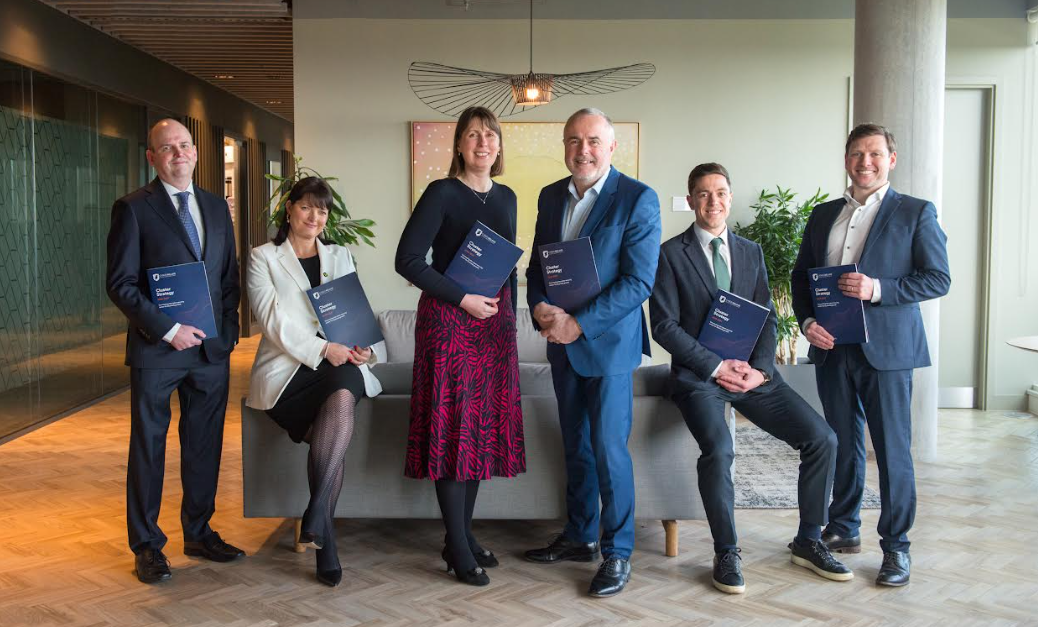
The opportunity now exists for Ireland to capitalise on its cyber security strengths and competitive advantages to develop a leading cyber security sector in Europe, and globally, providing resilience domestically and competing internationally. Cyber Ireland aims to be the driving force to deliver on Ireland’s cyber potential through the implementation of its new cluster strategy 2024 – 2027. The new strategy has four Focus Areas across Building the Community, Driving Business Growth, Developing the Workforce, and Advocacy and Promotion.

The cluster has recently been accredited with the European Cluster Excellence Initiative (ECEI) Bronze Label for “Striving for Cluster Excellence” by improving its management capabilities and performance levels. Cyber Ireland joins over 1,000 cluster organisations from 45 countries that have been benchmarked and received the award. The recognition will create additional opportunities for the cluster to promote the sector and engage with European organisations and clusters, and secure European funding.

Aon’s M&A report reveals technology and telecoms sector most actively considering M&A activity

Aon plc, a leading global professional services firm, today published its latest report about the attitudes and actions regarding mergers and acquisitions (M&A) among senior business leaders in Ireland.

Aon’s M&A in Ireland 2023 Report surveyed 281 businesses across Ireland between June and July 2023.

Results show that 11 percent of all businesses are actively considering engaging in a merger or acquisition in the next 12 months. Businesses in the Technology, Media, and Telecom sector (TMT) are the most active for M&A, with 26 percent considering dealmaking in the next year. 17 percent of financial and professional services firms are also considering engaging in M&A activity in the next 12 months.

For firms considering M&A activity, the top reasons include accessing skilled talent (31 percent), increasing business efficiencies (30 percent), and building innovation capacity for the future (28 percent). The top motivator for TMT businesses was expansion into new jurisdictions (46 percent) while 37 percent of financial and professional services firms indicated that expansion into new business areas was a key driver.

Nearly 2 in 3 firms (62 percent) that engaged in M&A over the past 12 months said the deals had achieved their strategic objectives, indicating that M&A activity may increase should economic conditions improve.

Evolving risk landscape

The risk landscape for Irish firms has shifted considerably over the past 12 months. Rising inflation (56 percent) remains the top risk to M&A for Irish businesses, although it has fallen by 13 percent since last year, indicating businesses are at a turning point in managing its impact on their M&A strategy. Lack of sustainable investment options (44%) and high valuations (43%) make up the remaining spots within the top three risks identified by business leaders in Ireland considering M&A activity.

Cyber and ESG due diligence rise

Cyber security and Environmental, Social and Governance (ESG) factors continue to rise up the due diligence agenda for Irish firms.

The majority (62%) of Irish businesses consider cyber security and technology risks before concluding an M&A deal – a 7 percent increase on last year’s report. There are differences in the treatment of cyber risk among organisations of different sizes, with 41 percent of large businesses considering cyber security due diligence on every deal. In contrast, 31 percent of mid-sized businesses, do not consider cyber security at all in relation to M&A, suggesting smaller companies may not have the capabilities in place to effectively evaluate these risks.

35% of organisations in Ireland say ESG standards are extremely important pre-transaction, a modest gain (2 percent) on last year’s results. 43 percent of businesses have not considered ESG factors at all up until now. Irish firms are still significantly behind their global counterparts in their assessment of the importance of ESG risk. According to Aon’s Global M&A Risk in Review survey 72 percent of businesses expect ESG to be the most significant risk facing their organisations in the next 12 months.

The availability of sustainable investment (21 percent) is the top ESG factor for Irish firms when assessing a potential merger or acquisition, followed by the impact of the business on climate (19 percent) and diversity on company boards (19 percent).

Importance of human capital and taxation

Aon’s research shows other key factors considered by business leaders in due diligence include financials, legal, human capital, and taxation. Human capital was identified as a main area of focus for due diligence when considering M&A by 42 percent of businesses, reflecting the importance of talent in a labour market with unemployment near a historic low.

Taxation is cited by 42 percent of businesses as a key concern in determining whether to conduct an M&A transaction. 1 in 4 businesses stated that the tax rate that will apply to future profits following an acquisition or merger is their key tax concern, indicating the impact of continuing uncertainty regarding the OECD’s global minimum tax rate proposals.

Karl Curran, Head of M&A and Transaction Solutions at Aon Ireland, said: “Despite growth in the domestic economy, organisations continue to navigate a challenging business environment from a tight labour market, to rising operating costs and increasing levels of cyber-attacks.

 “Aon’s latest M&A in Ireland Report shows that these challenges are creating uncertainty among businesses, with almost 90% of businesses either less likely or unsure of whether they will engage in M&A activity in the coming year. However, when broken down by sectors, there is stronger appetite for M&A activity among firms in the Technology, Media, and Telecom sector and the Financial and Professional Services sector.

“The risk landscape for Irish businesses continues to evolve at pace. Addressing emerging areas of risk such as cyber security will be critical to long-term success. The impact of potential cyber-attacks can be deeply damaging. According to the 2023 Aon Cyber Resilience Report, major cyber incidents typically result in a 9% decrease in shareholder value for businesses in the 12 months following an attack. In this context, we welcome the findings from today’s report that more firms in Ireland are prioritising cyber risk as part of M&A due diligence. However, with a significant number of businesses still not screening for cyber risk at all, many firms need to urgently put these capabilities in place.

“With firms in Ireland facing a growing set of new and evolving risks, the insights from Aon’s M&A in Ireland Report help shine a spotlight on the trends in this area but critically highlight the risks and due diligence that companies should be considering as part of any M&A activity. We hope that the data will be a useful tool in helping to guide Ireland’s business leaders towards making better-informed decisions to meet the challenges of an increasingly complex M&A environment.”

Newry Testing Company Pioneering the Way in Space Sector

WITH the spotlight firmly shining on Northern Ireland ahead of the UK Space Conference in November, and the recent UK Space Strategy’s explicit understanding of the need to “grow and level up our space economy”, it is an exciting time for many companies working within the growing industry.

One Newry based SME, Resonate Testing, is showcasing its testing capabilities within the space sector to a global audience, thanks to its work on some of the most high-profile projects the sector has seen in recent times, including the launch vehicle for the James Webb Space Telescope, Ariane 6 and Vega-C, as well as the upcoming European Space Agency (ESA) Lunar Pathfinder Spacecraft launch.

The company has also become the latest member of the UKspace Trade Association, which is the official trade association of the UK Space Industry. The group represents and promotes space to government and other key stakeholders, both nationally and internationally, and maximises collaboration and investment opportunities for companies working within the sector.

As a member, Resonate Testing will have the opportunity to network with influential people and companies within the vibrant industry, as well as seeking out business development opportunities, learn, influence markets and stakeholders, and keep up to date with current, related developments with the sector.

Managing Director of Resonate Testing, Tom Mallon, spoke about the company’s affiliation with UKspace, saying: “In recent years, our work within the space sector has accelerated thanks to our ability to offer bespoke testing services that replicate the complex environment of space. We see ourselves as not just a test facility, but as a test facilitator – we will do whatever our customers need to ensure a rigorous and thorough testing process”.

“We are always looking for ways that we can enhance our offering to our customers, and by becoming a member of the space associations and groups such as the Catapult Centre at Harwell, including our most recent membership of UKspace Trade Association, we will achieve this. It also enables us to continue to grow our support to the sector and deliver expertise to the companies that need it. We look forward to the opportunities that will arise from our membership with the UKspace Trade Association.”

The demand for services within the UK Space sector has grown exponentially in recent years, with figures revealed by the UK Space Agency showing that the sector generated £17.5bn in 2021, up £1bn from £16.5bn the previous year.

The opportunities for SMEs in both upstream (hardware) and downstream services (application of data derived from space) are increasing rapidly and with Belfast hosting this year’s UK Space Conference, taking place at the ICC Belfast from 21st to 23rd November, Northern Ireland companies will have the ability to showcase their expertise to an expected 3000 people, including astronauts, global space agencies and the wider space community. Resonate Testing will be exhibiting on stand B6 at the conference.

Part of The Nacelle Group, Resonate Testing is one of the leading commercial test houses for high quality testing and certification services across all industrials sectors on the island of Ireland, with testing services including space, battery abuse testing, fire, environmental, vibration, shock, packaging and ingress protection.