Ireland’s ‘RoboÉireann’ Robot Soccer Team wins international RoboCup Challenge Shield

Ireland’s Robot Soccer team, RoboÉireann from Maynooth University, are Challenge Shield winners in the RoboCup 2023 Standard Platform League, an international robotics competition held in Bordeaux, France.

Scoring 67-2 across nine matches, RoboÉireann overcame teams from Germany, the Netherlands, Canada, USA, Australia, and Brazil to secure victory.  (35 second clip of RoboCup Semi-Final RoboÉireann V Dutch Nao below. 

RoboCup is an international research initiative to advance intelligent autonomous robotics into the middle of the 21st century.

Robot soccer is played by teams of five or seven robots each comprising a goalie and outfield players. There are human referees and just like real soccer there is a kick-off, goals, fouls, a sin-bin and eventual send-offs for persistent fouls, and penalty kicks.

The winning team comprises staff and students from the Departments of Electronic Engineering and Computer Science at Maynooth University and competes in an innovative game where all competitors use identical humanoid robot hardware but develop software so that the robots play soccer autonomously. RoboÉireann have competed in European and International RoboCup events since 2009.

To achieve this level of autonomy, teams must develop software, create advanced machine learning and AI and efficient real-time systems, so that the robots can understand their surroundings, make decisions, and collaborate in dynamic environments without human intervention or remote control.

Students gain industry-ready skills in robotics, AI, software, and teamwork with applications in autonomous robotics, assistive technologies for independent living, manufacturing, agriculture, and emergency/disaster area operations, amongst others.

Commenting on the team’s success, Dr Rudi Villing, team coach and lecturer in the Department of Electronic Engineering, said: “RoboCup is an invaluable practical environment for students to learn about the challenges of creating intelligent humanoid robots, to research and develop solutions, and to develop industrially relevant skills. The competitive element is a key motivator for them and is unlike anything else. Our great result in this competition builds on our Open Challenge win in the RoboCup 2011 world championship and third place finish in the RoboCup German Open Replacement Event 2022.”

Team RoboÉireann are Aidan Colgan, Shauna Recto, James Petri, Heather Bruen, Andy Lee Mitchell, Dr Ralf Bierig and Dr Rudi Villing.

The New Breed of Robotics is Here – Petoi introduces Bittle X – the voice-controlled robot dog companion

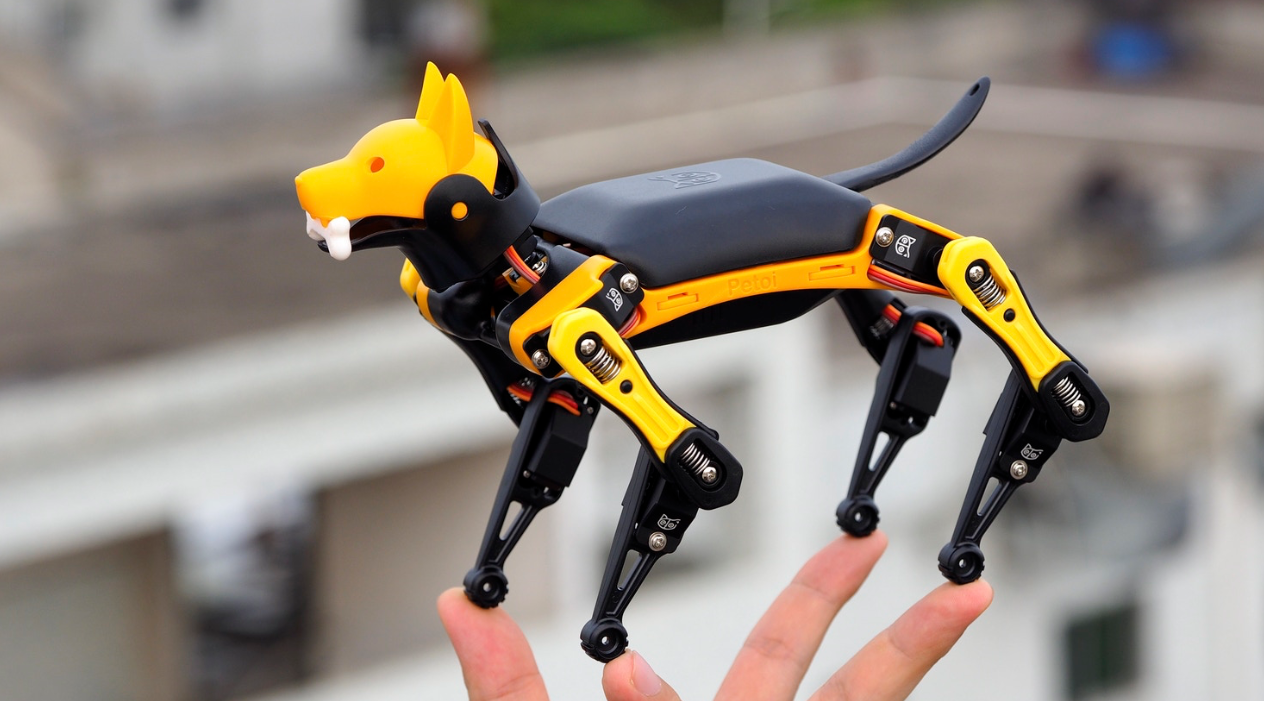
Petoi, the maker of futuristic robotic pets, has expanded its Bittle robot dog lineup with the introduction of Bittle X, a palm-sized, open-source programmable robot dog, designed for STEM and robotics education. More advanced than previous versions, the small but mighty Bittle X can respond to voice commands, performing over 35 predefined actions such as sit, play dead and backflip with high performance, lifelike movements. Bittle X’s dynamic maneuverability and behaviors are features typically seen on luxury robots, but Petoi’s technology is now making it accessible to everyone.

Bittle X users can choose from two different options based on their ability.  For those just starting out with STEM and younger users, a pre-assembled robot dog is ready for action.  The advanced users can select the kit option where they assemble its puzzle-like frame themselves and build the robot.

Bittle X operates on OpenCat, Petoi’s open-source quadrupled robot platform that offers endless programming and customization possibilities. Its bionic construction of legs rather than wheels means that it is able to move more freely over unstructured terrain.

Bittle X comes with 35+ built-in voice commands allowing users to interact with their robot pet as they would with a real dog. It responds quickly and in a lifelike way to voice commands such as scratch, dig, jump and high five. Users can also program an additional 10 voice commands if they want Bittle X to learn new tricks and play games.  Additionally, Bittle X can be easily configured and controlled using Petoi’s official mobile app or the included remote control.  Users can use the free Petoi Desktop App to design new robotics skills in a visual way.

Bittle X is the first robot powered by Petoi’s latest quadruped robot controller Biboard, a customized ESP32 board with larger programming space and faster CPU resulting in better performance.   BiBoard coordinates all instinctive and sophisticated movements. Users are able to attach various smart sensors to Bittle X to inject perception and artificial intelligence capabilities. The optional Petoi intelligent camera module and the newly released Petoi sensor pack, for example, enables Bittle X to recognize objects and patterns and sense of light, touch, gesture and movement, so users can program it to react and play games accordingly.

Perfect for STEM/coding beginners and those learning STEM at school, Bittle X comes with Petoi Coding Blocks, a Scratch-like, block-based programming environment for all ages. It also supports C++/Python programming for more advanced users such as software developers, IoT/robotics/AI application developers and researchers.   To empower educators, Petoi offers the introduction to quadruped robotics curricula for free.  They are available in block-based programming and C++ programming.

Bittle X is ideal for tech enthusiasts, young and old, who have an interest in or want to learn about robotics and coding. It’s also perfect for those who just want to have fun and play with a robot pet companion. The Bittle X is available from www.Petoi.com from £221 (RRP) / $279 USD. Bittle X will also be available on Amazon UK from late July 2023.

For more information, please visit https://www.petoi.com.

Xiaomi expands Smart Life ecosystem by bringing a wide range of AIoT products to its European markets

TechBuzzIreland was present at the Discover Xiaomi 2023′ European launch event, held today in Milan, the company announced new AIoT products to enhance the smart experience indoors and outdoos. Among the novelties presented are four new vacuum products, Xiaomi Robot Vacuum E12 (E10 in Ireland), S12 (S10 in Ireland), S10+, X10 and X10+; Xiaomi Electric Scooter 4 and 4 Lite, which expand the range of products dedicated to smart mobility; and Xiaomi Pad 6, the all-in-one, powerful and versatile tablet ideal for work and leisure. We had a chance to take a look at pretty much everything what the company has to offer and there is some really cool tech building an excellent ecosystem.

“Xiaomi has always placed its users at the core by providing devices that aim to improve their daily lives, offering the best technology and an increasingly easy and engaging experience. With these new products, we renew our commitment to bring innovation and quality to the industry as we continue to expand our offering and optimise our product portfolio across Western Europe markets” – says Ou Wen, General Manager Xiaomi Western Europe.

When it comes to household chores, an ever increasing number of people are looking for products that can clean quickly, with the option of controlling the parameters via their smartphone. Today, Xiaomi brings four new products to European markets to meet every need, not only in terms of efficiency, but also in terms of price. From entry level to premium devices to give users the widest possible choice.

New Xiaomi Robot Vacuum: increasingly smart, increasingly easy

Xiaomi Robot Vacuum X10, the latest in Xiaomi’s line of robot vacuum cleaners, is designed to simplify cleaning while ensuring top performance. Equipped with a 5200mAh battery, it provides 180 minutes1 of autonomy on a single charge at maximum suction power.

Combined with its intelligent base station, this versatile cleaning device is also specifically adapted to clean all types of floors thanks to a suction power of 4,000Pa. It is a perfect ally for thorough house cleaning, allowing users to enjoy some free time after a long working day.

Xiaomi Robot Vacuum S10+ and Xiaomi Robot Vacuum S12 (Xiaomi Robot Vacuum S10 in Ireland) which expand the S-series and like all S-series and X-series products are equipped with LDS technology for planning an efficient cleaning path, regardless of the size and layout of the home. For those looking for a product with an ultra-slim design, but without sacrificing high suction power, there is Xiaomi Robot Vacuum E12 (Xiaomi Robot Vacuum E10 in Ireland) which allows easy access even under the sofa or bed.

All new models are certified by TÜV Rheinland, guaranteeing the privacy protection for every user.

Prices and availability:

The recommended retail price for Xiaomi Robot Vacuum E12 with accessories (Xiaomi Robot Vacuum E10 in Ireland) is 307.95 Euros and 249.99 Euros for vacuum only. The early bird price will be available from May 22nd to May 28th at 249.99 Euros including accessories.

The recommended retail price for Xiaomi Robot Vacuum S12 with accessories (Xiaomi Robot Vacuum S10 in Ireland)  is 417.94 Euro and 349.99 Euros for vacuum only. The early bird price will be available from May 22nd to May 28th at 349.99 Euros including accessories.

The recommended retail price for Xiaomi Robot Vacuum S10+ is 499.99 Euros for vacuum only.

The recommended retail price for Xiaomi Robot Vacuum X10 is 549.99 Euros for vacuum only.

All vacuums will be launching in Ireland, with Harvey Norman, DID and Euronics

Xiaomi also reveals new scooters and the Xiaomi Pad 6 and again we had some hands on with these at the event and cast your mind back to the first e-scooter the brand launched which flew off the shelves and i have had one myself.

Xiaomi Electric Scooter 4 and 4 Lite: Ride in comfort

Xiaomi Electric Scooter 4 line-up expands with two new models, Xiaomi Electric Scooter 4 and 4 Lite, respectively equipped with a 600W and 300W motor capable of reaching a maximum speed of 20km/h2 . With a capacity of 7,650mAh, Xiaomi Electric Scooter 4 is able to cover distances of up to 35 km on a single charge, easily overcoming gradients of up to 16%. The capacity of 4 Lite version, on the other hand, is 5,200mAh, providing a range of 20km.

The drum brake on the rear wheel of Xiaomi Electric Scooter 4 Lite, together with the E-ABS system on the front wheel, reduce the braking distance, thus ensuring greater safety. Xiaomi Electric Scooter 4, on the other hand, features an improved dual-action disc brake on the rear wheel for optimised control efficiency; together with the E-ABS system on the front wheel, the braking distance will be much shorter.

Both products can be connected to the Xiaomi Home app via Bluetooth to check speed and charge in real time, update firmware and monitor driving data.

Xiaomi Pad 6: Built for work, designed for ease

Xiaomi Pad 6 features a thinner and lighter unibody design compared to the previous version and an elegant metal finish. The device is powered by Snapdragon 870 Mobile Platform and is equipped with an 11″ LTPS LCD screen with WQHD+ resolution, up to 144Hz refresh rate, 309 ppi, Dolby Vision® and HDR10 support.

Xiaomi Pad 6 features a 13MP main camera and an 8MP front camera, and is equipped with quad speakers for immersive stereo sound thanks to Dolby Atmos, which guarantees the best experience. The battery has a capacity of 8,840mAh (typ), providing up to 16 hours of video playback, and supports 33W fast charging. Furthermore, thanks to the USB 3.2 Gen 1 supporting speeds of up to 5Gbps and 4K video output at 60fps with DP interface, transferring files to your laptop will be even easier and faster.

Thanks to MIUI Pad 14, the software of the device is optimised to offer the best connectivity and new ‘conference tools’5 such as noise cancellation or the ability to keep faces centred during video conferences by following their movements thanks to the FocusFrame function. Xiaomi Pad 6 is therefore a very versatile device and thanks to the Xiaomi Smart Pen (2nd generation) and Xiaomi Pad 6 Keyboard, the experience can be even smarter! Comfortable then for working, watching videos or movies on the go, but also taking notes in university or drawing outdoors.

The Xiaomi Pad 6 will be available on the European market in three colour variants – Champagne, Gravity Gray and Mist Blue. Prices and availability will be unveiled when sales start as of now the device is not scheduled to release in Ireland

Check the video below for hands on demos images and videos 


Fish sensory organ key to improving navigational skills of underwater robots

Scientists, led by University of Bristol, have been studying a fish sensory organ to understand cues for collective behaviour which could be employed on underwater robots.

This work was centred around the lateral line sensing organ in African cichlid fish, but found in almost all fish species, that enables them to sense and interpret water pressures around them with enough acuity to detect external influences such as neighbouring fish, changes in water flow, predators and obstacles.

The lateral line system as a whole is distributed over the head, trunk and tail of the fish. It is comprised of mechanoreceptors (neuromasts) that are either within subdermal channels or on the surface of the skin.

Lead author Elliott Scott of the University of Bristol’s Department of Engineering Mathematics  explained: “We were attempting to find out if the different areas of the lateral line – the lateral line on the head versus the lateral line on the body, or the different types of lateral line sensory units such as those on the skin, versus those under it, play different roles in how the fish is able to sense its environment through environmental pressure readings.

“We did this in a novel way, by using hybrid fish, that allowed for the natural generation of variation.”


They discovered the lateral line system around the head has the most important influence on how well fish are able to swim in a shoal, Meanwhile, the presence of more lateral line sensory units, neuromasts, that are found under the skin result in fish swimming closer together, while a greater presence of neuromasts on the skin tend to result in fish swimming further apart.

In simulation, the researchers were able to show how the mechanisms behind the lateral line work are applicable at not just the tiny scales found in actual fish, but at larger scales too. This could inspire a novel type of easily-manufactured pressure sensor for underwater robotics, particularly swarm robotics, where cost is a large factor.

Elliott said: “These findings provide a better understanding of how the lateral line informs shoaling behaviour in fish, while also contributing a novel design of inexpensive pressure sensor that could be useful on underwater robots that have to navigate in dark or murky environments.”

The team now plan to develop the sensor further and integrate it into a robotic platform to help a robot navigate underwater and demonstrate its effectiveness.

The research for this paper was funded by Engineering and Physical Sciences Research Council (EPSRC), Biotechnology and Biological Sciences Research Council (BBSRC) and the Human Frontier Science Program (HFSP).

Paper: ‘Lateral line morphology, sensory perception and collective behaviour in African cichlid fish’ by Elliott Scott et al in Open Science.

Featured Image: Yellow blaze African cichlid


Petoi launches Bittle STEM kit – learn to code with the world’s first palm-sized robot dog

Petoi, the maker of futuristic robotic pets, today launches the Bittle STEM kit, a lower cost version of its palm sized robot dog that can help teach tech enthusiasts, young and old, about robotics and coding. Small but agile, Bittle can be programmed to walk, do tricks and roll around just like a real dog. Differing slightly from Bittle V1, the STEM kit contains plastic-gear servos instead of metal making it lighter and more flexible with different movements.

The Bittle STEM kit is available at www.Petoi.com from £223 ($269, RRP), but in the run up to Christmas, it will be available at a promotional price of £180 ($214). The Bittle STEM kit will also launch on Amazon UK mid-December.

The Petoi Bittle STEM kit is ideal for kids and adults with an interest in STEM, coding and robotics. It’s also perfect for those who just want to have fun and play with a robot pet companion. Bittle operates on OpenCat, an open-source quadrupled robot platform that offers endless programming and customisation possibilities. Educational, users can learn coding as they teach Bittle to run, jump, roll over, sit and lay down, just like a real dog.

Users bring the Bittle STEM kit to life by assembling its puzzle-like frame which is made up of plastic 3D interlocking components. The bionic construction of legs rather than wheels means that Bittle is able to move more freely over unstructured terrain. With a simple and beautiful design, Bittle can be easily configured and controlled using Petoi’s official mobile app, the included remote control or a number of different programming options. Users can also program Bittle to do tricks with Petoi Desktop App’s Skill Composer.  Petoi plans to release a free C++ four-legged robot curriculum by mid December.  Bittle is a great STEM learning tool and perfect for anyone interested in robotics and programming.

Evolving with an open-source gene, Bittle is built on Petoi’s OpenCat open-source platform which was first launched in 2018 by Petoi’s founder Professor Rongzhong Li specifically for quadrupled robots. Bittle’s dynamic manoeuvrability and behaviours are features typically seen on luxury robots but Petoi’s technology is now making it accessible to everyone.

With a customised Arduino board coordinating all instinctive and sophisticated movements, users are able to clip various smart sensors onto Bittle or mount a Raspberry Pi or other AI chips through wired/wireless connections to inject perception and artificial intelligence capabilities.

Features include:


  • OpenCat framework

  • Arduino compatible motion controller & wireless connectivity

  • Impressive running speed and agility

  • Interlocking plastic frame

  • Shock reduction joints

  • Programmable gaits and behaviours

For more information, please visit https://www.petoi.com.

Akara robot enabling more medical procedures in UK trial

An Irish robot that decontaminates air is being trialled in a major NHS hospital in Cornwall, UK – with early results suggesting it could reduce room downtime in critical parts of the hospital by more than 60%.

The robot, made by Akara who are based at The Digital Hub, has been on the ground at the Royal Cornwall Hospitals NHS Foundation Trust (RCHT) since June 2022 where it has been used in parts of the hospital where the air has a higher chance of contamination.

The idea was born out of COVID-19 pressures, where thorough cleaning of air was paramount to avoid infection spread. The robot is designed to eliminate COVID-19 as well as other viruses, including flu.

Dr Conor McGinn, co-founder and CEO of Akara explained the project’s potential: “We need technology to disinfect the air because it’s simply not a job that people can do. While ventilation helps, the cost and time needed to upgrade rooms to the levels needed is rarely practical. Our disinfection robots are mobile, allowing them to be rapidly deployed in minutes to the regions that need it most while their sensors and AI enable them to dynamically respond to the environment in ways that aren’t possible with static purification units.”

Already being utilised by staff, the robot is being trialled in the endoscopy department and is showing promising results in its ability to disinfect the air. Following certain medical Following certain medical examinations where aerosol generating procedures are performed, rooms needed to be left vacant for periods of more than 25 minutes in order to allow the air in the room to be replenished by clean air from the ventilation system. With the Akara robot, the process of air replenishment can be greatly accelerated, cutting the downtime to just 10 minutes. These findings will be presented at the Infection Prevention Society (IPS) Conference in Bournemouth on Oct. 17-19.

Joanne Taylor, Consultant Nurse and Deputy Director of Infection Prevention and Control at RCHT, commented: “The robot has definitely improved things for patients as the reduced downtime means we can get more patients seen in a day, while maintaining the highest standards in environmental cleanliness. Based on time savings made during the trial period, we estimate that its use could enable as many as 2,400 additional procedures a year which would have a very significant effect on reducing the waiting lists.”

Lynsey Farrell, Endoscopy Unit Lead at RCHT, said: “The robot has had a really positive impact on the department. Staff are concerned about the increased risk of COVID-19 for patients due to aerosol-generating procedures, and also for themselves, so they’re very keen to work with new technologies offering the potential to make the environment safer for everyone.”

The trial has been carried out in collaboration with the University of Plymouth and DIH Hero, a European innovation hub with a goal to accelerate innovation in robotics for healthcare European Union’s Horizon 2020 research and innovation programme under grant agreement No 825003.

Robot helps reveal how ants pass on knowledge

Scientists have developed a small robot to understand how ants teach one another.

The team built the robot to mimic the behaviour of rock ants that use one-to-one tuition, in which an ant that has discovered a much better new nest can teach the route there to another individual.

The findings, published in the Journal of Experimental Biology today, confirm that most of the important elements of teaching in these ants are now understood because the teaching ant can be replaced by a machine.

Key to this process of teaching is tandem running where one ant literally leads another ant quite slowly along a route to the new nest. The pupil ant learns the route sufficiently well that it can find its own way back home and then lead a tandem-run with another ant to the new nest, and so on.


Prof Nigel Franks of Bristol’s School of Biological Sciences said: “Teaching is so important in our own lives that we spend a great deal of time either instructing others or being taught ourselves. This should cause us to wonder whether teaching actually occurs among non-human animals. And, in fact, the first case in which teaching was demonstrated rigorously in any other animal was in an ant.” The team wanted to determine what was necessary and sufficient in such teaching. If they could build a robot that successfully replaced the teacher, this should show that they largely understood all the essential elements in this process.

The researchers built a large arena so there was an appreciable distance between the ants’ old nest, which was deliberately made to be of low quality, and a new much better one that ants could be led to by a robot. A gantry was placed atop the arena to move back and forth with a small sliding robot attached to it, so that the scientists could direct the robot to move along either straight or wavy routes. Attractive scent glands, from a worker ant, were attached to the robot to give it the pheromones of an ant teacher.

Prof Franks explained: “We waited for an ant to leave the old nest and put the robot pin, adorned with attractive pheromones, directly ahead of it. The pinhead was programmed to move towards the new nest either on a straight path or on a beautifully sinuous one. We had to allow for the robot to be interrupted in its journey, by us, so that we could wait for the following ant to catch up after it had looked around to learn landmarks.”

“When the follower ant had been led by the robot to the new nest, we allowed it to examine the new nest and then, in its own time, begin its homeward journey. We then used the gantry automatically to track the path of the returning ant.”

The team found that the robot had indeed taught the route successfully to the apprentice ant. The ants knew their way back to the old nest whether they had taken a winding path or a straight one.

Prof Franks explained: “A straight path might be quicker but a winding path would provide more time in which the following ant could better learn landmarks so that it could find its way home as efficiently as if it had been on a straight path.

“Crucially, we could compare the performance of the ants that the robot had taught with ones that we carried to the site of the new nest and that had not had an opportunity to learn the route. The taught ants found their way home much more quickly and successfully.”

The experiments were conducted by undergraduates Jacob Podesta, who is now a PhD student at York, and Edward Jarvis, who was also a Masters student at Professor Nigel Franks’s Lab. The gantry programming was accomplished by Dr. Alan Worley and all the statistical analyses were driven by Dr. Ana Sendova-Franks.

Their approach should make it possible to interrogate further exactly what is involved in successful teaching.

Paper:

‘Robotic communication with ants’ by Nigel R. Franks, Jacob A. Podesta, Edward C. Jarvis, Alan Worley and Ana B. Sendova-Franks in the Journal of Experimental Biology.

Featured image credit – Prof Norasmah Basari and Nigel R Franks

Petoi unleashes 20% off Bittle robot dog for Amazon Prime Day

To celebrate Amazon Prime Day (12th & 13th July 2022), Petoi, the maker of futuristic robotic pets, is offering 20% off its palm-sized, bionic robot dog – Bittle. Available from Amazon UK here, Bittle will be reduced from £299.99 to £239.99, a saving of £60. Petoi will also be offering 20% off Bittle accessories including the Additional Battery Pack (was £39.99, now £31.99) and the Intelligent Camera Module (was £59.99, now £47.99).

Small but agile, Bittle is a powerful robot that can be programmed to walk, do tricks and roll around just like a real dog. Bittle operates on OpenCat, an open-source quadrupled robot platform that offers endless programming and customisation possibilities. It is an ideal tool for teaching, researching and learning about STEM and robotics.

Users bring Bittle to life by assembling its puzzle-like frame which is made up of 3D interlocking components, eliminating the need for screws. The bionic construction of legs rather than wheels means that Bittle is able to move more freely over unstructured terrain. With a simple and beautiful design, Bittle can be configured and controlled using Petoi’s official mobile app.

Evolving with an open-source gene, Bittle is built on Petoi’s OpenCat open-source platform which was first launched in 2018 by Petoi’s founder Dr. Rongzhong Li specifically for quadrupled robots. Bittle’s dynamic maneuverability and behaviours are features typically seen on luxury robots but Petoi’s technology is now making it accessible to more consumers.

With a customised Arduino board coordinating all instinctive and sophisticated movements, users are able to clip various smart sensors onto Bittle or mount a Raspberry Pi or other AI chips through wired/wireless connections to inject perception and artificial intelligence capabilities.

Features include:

  • OpenCat framework
  • Arduino compatible motion controller & wireless connectivity
  • Interlocking plastic frame
  • Shock reduction joints
  • Programmable gaits and behaviours
  • 9 x fast, powerful digital metal servos

For more information, please visit https://www.petoi.com.