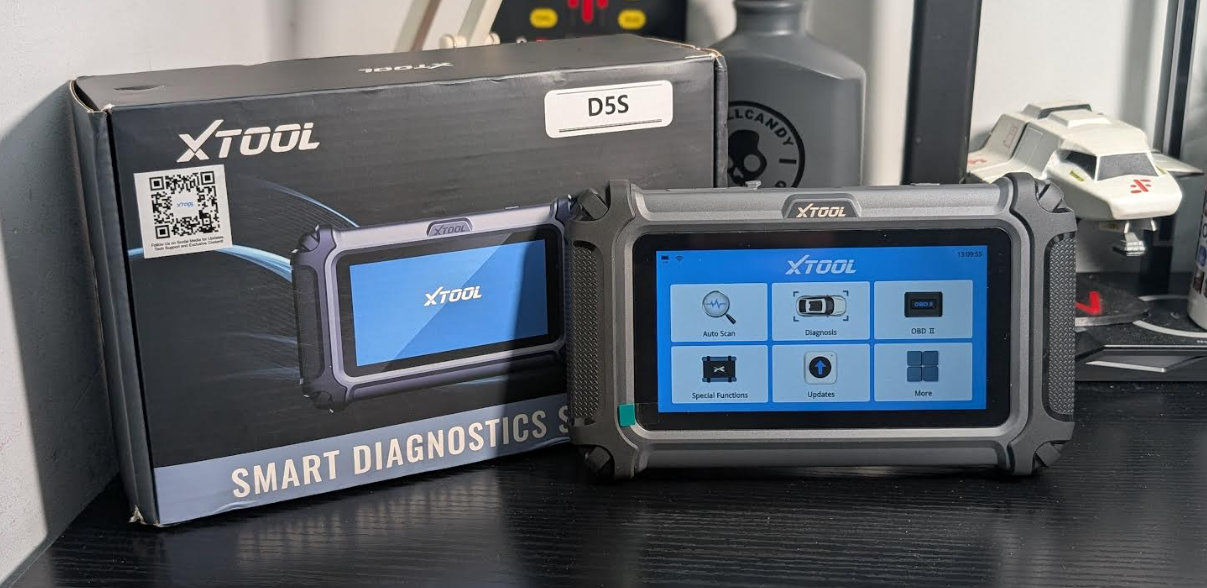
The XTOOL D5S diagnostic tool is an ideal piece of kit for motorists which come with a complete package for those want more other than their typical plug in OBD, this comes with sought after options such as Oil Light Reset, EPB, SAS, DPF, BMS Reset, Throttle, TPMS Reset, ABS Bleeding, Injector Coding, Gearbox Matching, Suspension, Window Initialization, Headlight, EGR Relearn, and Gear Learning.
There is plenty of such tools now available on the cheap and even in your local petrol station these days but they do not cut it and the cost reflects this, these just remove warning lights and they then return later on when it suits or if it is a persistent problem you will be doing it daily like I was on one of my vehicles until this product came along and fixed a well known error in my vehicle by activating a feature to clear the issue not just clear the issue with cheap OBD readers.
This is a well built product with plenty of other features on deck with live testing results too which is excellent and other parameters not seen on cheaper products which do not cut it.
There is a simple to use interface too which makes it simple and additional storage for other files you could run through the system.
It is built like a tank and will certainly take many falls from any height with a rubberised rugged finish it is the ideal tool to have if you are a mechanic or even a car enthusiast that will last a lifetime. See the video below for more.
Features
4 Systems, 1 Comprehensive Solution
For DIY enthusiasts tackling common automotive issues like engine, transmission, ABS, and SRS, the XTOOL D5S vehicle scanner offers specialized diagnostic capabilities. It efficiently identifies and clears fault codes, analyzes data streams, and ensures timely problem detection
Enhanced Hardware Support
Enjoy improved performance with the upgraded D5S diagnostic tool, featuring a dual-core 1.2GHz CPU, 128MB RAM, 32GB expandable ROM, and a user-friendly Linux operating system. The 3150mAh 3.6V battery ensures longer usage between charges.
15 Essential Maintenance Functions
The XTOOL D5S comes equipped with 15 of the most sought-after maintenance services (with free lifetime updates), including: Oil Light Reset, EPB, SAS, DPF, BMS Reset, Throttle, TPMS Reset, ABS Bleeding, Injector Coding, Gearbox Matching, Suspension, Window Initialization, Headlight, EGR Relearn, and Gear Learning
Graphical Live Data Stream
The D5S allows you to view up to 4 data streams simultaneously on a single interface, displaying them graphically. This feature helps users compare data and make informed, precise decisions.
Free Lifetime Updates
Stay ahead with free lifetime updates that keep you up-to-date with the latest parameters, vehicle models, and functions—no annual software fees required!
Purchasing a car, whether new or used, is a significant investment. It’s not just about finding a vehicle that suits your style or budget; it’s about ensuring that your choice is reliable and safe. This guide will walk you through a comprehensive process to check a car before making that all-important purchase.
Initial Visual Inspection
The first impression often sets the tone for the rest of the inspection. Begin by taking a good look at the car’s exterior. Look for any obvious signs of damage, such as dents, scratches, or rust. These might seem minor, but they can indicate how well the car has been maintained.
Pay attention to the alignment of the body panels. Uneven gaps between panels can suggest previous accidents or repairs. Check the condition of the paintwork; mismatched colours can be a giveaway of patchwork repairs.
Inspect the tires for wear and tear. Uneven wear can indicate alignment issues or suspension problems. Ensure that all tyres, including the spare, have sufficient tread depth and are in good condition.
Under the Bonnet
Once you’re satisfied with the exterior, it’s time to pop the bonnet. This might seem daunting if you’re not mechanically inclined, but a few basic checks can tell you a lot about the car’s health.
Start with the engine oil. Pull out the dipstick, wipe it clean, and then reinsert it. When you pull it out again, the oil level should be between the minimum and maximum marks. The oil should be a golden brown colour; black oil can indicate that it hasn’t been changed in a while.
Check the coolant level in the reservoir. It should be between the minimum and maximum lines. Low coolant can be a sign of leaks or overheating issues. Inspect the battery for any corrosion or leaks, and ensure that the terminals are secure.
Interior Examination
The interior of the car is where you’ll spend most of your time, so it needs to be comfortable and functional. Start by checking the seats for any signs of wear or damage. Ensure that all seat adjustments work properly.
Test all the electronics, including the lights, indicators, horn, and infotainment system. Make sure the air conditioning and heating systems are functioning correctly. Check the condition of the seatbelts and ensure they fasten securely.
Take a moment to sniff the air inside the car. A musty smell can indicate water damage, which could lead to mould growth.
Test Drive
A test drive is perhaps the most crucial part of the car inspection process. It gives you a feel for how the car handles and can reveal potential mechanical issues.
Start the engine and listen for any unusual noises. A smooth start is a good sign, but rattling or knocking sounds can indicate problems. Pay attention to how the car idles; it should be smooth and steady.
While driving, test the brakes by applying them gently and then more firmly. The car should stop smoothly without pulling to one side. Listen for any squeaking or grinding noises, which can indicate worn brake pads.
Check the steering for responsiveness and ensure there is no excessive play. Test the suspension by driving over bumps; the car should absorb them without excessive bouncing.
Paperwork and History
Before making a final decision, it’s essential to review the car’s paperwork. This includes the V5C registration document, which proves ownership. Ensure that the details match the seller’s information and the car’s VIN number.
Request the car’s service history. Regular maintenance records are a good sign that the car has been well cared for. Look for any major repairs or recurring issues that might be a red flag.
Consider obtaining a vehicle history report and a salvage check. This can reveal if the car has been in any accidents, if it’s been written off, or if there are any outstanding finance agreements.
Professional Inspection
Even if you’re confident in your inspection skills, it’s wise to have a professional mechanic take a look. They can provide a more detailed assessment and identify issues that might not be apparent to the untrained eye.
A professional inspection might come with a fee, but it’s a small price to pay for peace of mind. They can also provide an estimate for any necessary repairs, which can be useful for negotiating the price.
Negotiating the Price
Armed with all the information from your inspection, you’re in a strong position to negotiate the price. Be honest about any issues you’ve found and use them as leverage to get a better deal.
Remember, it’s not just about lowering the price. You might negotiate for the seller to fix certain issues before purchase or include additional items like a warranty or service package.
Final Thoughts
Buying a car is a big decision, but with a thorough inspection process, you can make it with confidence. Take your time, be thorough, and don’t be afraid to walk away if something doesn’t feel right.
The right car is out there, and with these steps, you’ll be well-equipped to find it. Happy car hunting!
The latest in from JMBricklayer is their 1:10 Red F1 61123 and you can also win one right here thanks to JMBricklayer which we will lay out what you need to do which is simple.
Again this was another timely build this time something closer to my liking being car related as most men and teenagers are these days and with Formula One being popular now more than ever what is there not to like with making the car up yourself getting away from all the distractions around you at your kitchen table or private games room.
If you are not a fan of such this also makes an ideal gift for someone in your life and perhaps give them a new project or idea in life to do and get some headspace away from it all.
Now who wants to win one of these? And also note this competition is also worldwide.
Follow @jmbricklayer on all their social media.
Share the post and use the hashtags #BrickItHappen and #JMBrickFest
【Cool Race Car】JMBricklayer race car body with streamlined design and shock absorbing design, is very cool, and the overall color matching makes it more dynamic. The front and tail of the car model can be flipped up and down, and the simulation steering wheel is linked to the wheel steering. The cool rear wing, exquisite and realistic front end, simulated tires, and beautiful decals will make you feel like you are in a fierce racing competition.
【Fun Game Experience】This race car model is made up of 1200 quality building blocks. The race car toy has an exquisite detail design and perfectly reproduces the f1 car, giving a more realistic experience for lovers of car texture and technology, allowing you to experience a challenging building process. And it can be upgraded to a remote control version of the car (need to purchase additional power components), able to achieve more play, very interesting.
【Display & Collection】The cars stand out among the car models with their bright red color, they will be beautiful scenery in the room and office, perfect for a delicate display in your showcase. And with its outstanding design, these Formula 1 cars have a place in the collection of car lovers. Whether it’s the overall texture of the f1 model or the beauty of the design of these race cars, it will make a statement.
【Ideal Car Gift】Our car model measures 19.69in(L)x8.66in(W)x3.54in(H) when assembled, and comes with detailed instructions for easy building and understanding. This race car set is the perfect gift for car lovers and the ideal racing model for many boys. You can give it to your family and friends on their birthdays and other special holidays, and it will be an amazing gift for boys, teens, and adults.
【Quality Service】After you receive the JMBricklayer racing car kit, if you find any problem with the product, please contact us and we will try our best to solve it for you. In addition, in order to ensure the integrity of the parts in the product, our blocks are sent out after multiple checks by the machine, however, if you find that there are still pieces missing after you receive the product, please contact us and we will send you the missing pieces for free.
The ever-evolving automotive industry is no stranger to the revolutionary designs and eco-conscious vision of Tesla. However, owners are concerned about the safety and convenience of electric vehicles, particularly older users who are less tech-savvy. Instances of unexpected power outages have left residents trapped, struggling to locate and use the manual door unlock mechanism. While the Tesla app can provide a solution in some cases, it often means shattering a window in others. In such cases, contacting a nearby auto locksmith service may be the only solution. In this article, we will look closer at the recent lock-in problems Tesla users are experiencing.
Recent Tesla Lock-In Incidents
An unfortunate incident highlighting Tesla’s lock-in problem involved a 73-year-old man from Arizona. On a scorching June day with temperatures soaring to 100 degrees, his Tesla car experienced a power failure while he was inside. He found himself trapped within his Model Y. According to the man, the ordeal began in his garage when all the car’s functions, including the glove box and door locks, suddenly ceased to work. With the windows unable to roll down and his unfamiliarity with the car’s manual lock release mechanism, he endured sweltering heat for approximately 20 minutes.
Thankfully, when he reached out to his sister, her Tesla app came to the rescue, allowing the door to be unlocked. Although one of the car’s windows had to be shattered, he escaped just in the nick of time. Being trapped in the car for more than an hour would have been a disastrous ordeal. Only afterward did he realize the Tesla Model Y had experienced a sudden power loss due to its separate 12v battery running out of charge.
In a separate incident, a nine-year-old child and her mother found themselves stranded in a 2018 Tesla Model 3 when it unexpectedly lost all power. However, the mother remembered how to manually engage the safety lock on the car, enabling them to exit the vehicle without further delay.
The Growing Concern
Tesla, synonymous with innovation, has undeniably transformed the automotive landscape. Nevertheless, even within such an impressive brand, unexpected challenges can surface. Tesla owners and prospective buyers share a growing apprehension regarding the reliability of its electrical reserves and the possibility of being stranded.
Tesla proudly emphasizes the safety of its vehicles, boasting coveted 5-star safety certifications. Tesla cars are also equipped with multiple security features to deter car theft and aid in locating stolen vehicles. However, concerns have arisen regarding electric disruptions that result in unresponsiveness, as many owners have reported sudden power failures while driving or in various settings, often without apparent reasons.
What compounds these concerns is the escalating frequency of such incidents, as evidenced by the mounting complaints received by the National Highway Transportation Safety Administration (NHTSA) from Tesla owners. Among the issues at hand is the difficulty locating the manual door release, which is often poorly labeled and frequently overlooked by Tesla owners who may need to consult or read the owner’s manual.
What Does This Mean for Tesla
Lockout incidents are not limited to Tesla vehicles. There have been considerably more reports of comparable or worse incidents with different Electric Vehicle (EV) brands, most of which differ. Tesla will likely face the most criticism because people have high expectations of the highly-rated brand. This does not absolve the corporation of responsibility. Millions of cars that were sold in the US have already been recalled by the manufacturer because of an autopilot issue.
According to a recent poll, many Tesla owners file complaints with the federal vehicle safety inspectors; nonetheless, the agency advises owners of electric vehicles to become familiar with manual safeguards in case of emergency. EV comes with a detailed manual that explains maintenance practices and how to navigate from the car in such instances.
Tesla vehicles have a guidebook explaining how and when to replace the 12v battery and how to use the safety latch. Every Tesla owner should study the instructions thoroughly before driving it for the first time. Tesla and other automotive firms should take the initiative to promote the importance of doing so.
Final Thoughts
The multiple reports of people becoming stuck in Tesla vehicles are unsettling and highlight the need for precautionary measures and having the contact information of a professional auto locksmith readily accessible. Electric vehicles play a significant role in the automotive industry’s technological evolution and environmental efforts. As technology continues to advance, users need to understand the operational aspects of these vehicles, including potential malfunctions and safety measures.
Everrati Automotive Limited (Everrati™), the leading sustainable-luxury technology company specialising in redefining and futureproofing automotive icons through the integration of
cutting-edge electric vehicle (EV) powertrains, today reveals its most driver-focused electrified Porsche yet – a new addition inspired by the Type 964 RSR.
Building on Everrati’s leading portfolio of redefined modern classic Porsches, the new zero emission homage channels the ethos of the Type 964 RSR 3.8, blending a stunning motorsport-inspired hand-built 911, with carbon-fibre body elements and a host of weight-saving measures both inside and out, bringing things up to date with a bespoke, OEM-grade, state-of-the-art EV powertrain.
Launched in 1993, the Type 964 RSR 3.8 is one of the rarest 964 variants with just 51 examples of the race-ready lightweight, rear-drive, turbo wide-bodied competition car ever produced. At the time it revived a famous Porsche motorsport badge which first appeared on the 1973 911 Carrera RSR and has since featured on ultimate track-focused 996, 997, 991 models.
As car custodians and passionate automotive enthusiasts, Everrati is honouring the 964 RSR’s influence and legacy with its redefined model, creating a fully futureproofed example of sustainable luxury in the process, a rolling piece of art, a vehicle that can be enjoyed by generations to come.
Based on an expertly restored 911 (964), which started life as a narrow-bodied car, Everrati’s
RS-inspired edition respects the lightweight, high-performance ethos of the RSR, with its rear seats deleted, a rear roll cage added and lightweight driver and passenger seats installed, clad in the world’s lowest carbon leather from Everrati partner Bridge of Weir Leather.
On the outside, there are lightweight 18-inch wheels from HRE, while the eye-catching carbon-fibre bodywork boasts a completely new aero package, including larger rear spoiler inspired by the legendary 964 RSR, along with a revised front lower splitter.
Under the skin lies an OEM-grade 63kWh battery pack and battery management system. This Gen2 version brings multiple advances over Everrati’s Gen1 system, featuring new and improved cooling and a more refined version of its drive controller and software, enhancing performance and efficiency. With OEM-grade high-performance electric motors delivering electrifying power to the rear wheels via a limited slip differential, the RSR-inspired version enables an emission-free range of more than 200 miles and 3.7 second 0-60mph acceleration.
The RSR homage also features TracTive suspension, a premium, electronically controlled active and adaptive suspension system which offers multiple settings designed to optimize and enhance driving dynamics, comfort and performance, whether on the road or track. Combined with Apple CarPlay and AC and DC Fast charging, the new RSR homage is fully equipped for a short B-road blast or longer touring journey.
Everrati Founder and CEO, Justin Lunny, commented: “This exciting new addition to our range of redefined and electrified 911s is without doubt the most driver-focused yet. Paying homage to a legendary model from three decades ago, our new ‘RSR’ gets pulses racing with a host of lightweight enhancements, resulting in an unrivalled experience that combines the best of classic design with modern, zero-emission, performance.
“Like all our models, it features hand-built craftsmanship, with OEM-grade engineering processes, futureproofed via a state-of-the-art electric powertrain. We are committed to preserving the legacy of iconic vehicles while advancing the transition to sustainable luxury mobility. Our expertise in redefined Porsches positions us as the go-to international creator of redefined 911s and iconic cars.”
The new model, like all 964-based variants in its range, will be built for an international market by Everrati’s production partners, Aria Group, based in Irvine, California, underlining its strategy to forge relationships with the world’s best specialists where appropriate.
Designed and developed at its global headquarters in Oxfordshire, the latest 911 RSR-inspired model will join Everrati’s leading portfolio of redefined automotive icons, which includes electric versions of the Porsche 911 (964) Coupe, Targa, Cabriolet, G-Series based ST-inspired edition, Range Rover Classic, Land Rover Defender, Land Rover Series, GT40, and Mercedes-Benz W113 SL ‘Pagoda’.
The CANYON DVR10GPS is one of many dashcams on offer from the company and the first time for us to test one out, We test many dashcams here and I always say every car should have them fitted as standard but to date it is not the case and leaves plenty of room in the market for you to go pick what suits your pockets and needs.
Setting up takes about ten minutes in total with getting the app downloaded then installing into your vehicle and if you are familiar with dashcams it will be no trouble, the UI on the app is simple to navigate using the keys on the device itself and you will be ready in no time regardless.
Equipped with a powerful Sony Starvis 307 sensor, it captures impeccable footage even in low light. The expansive 140° field of view ensures comprehensive coverage, leaving no detail unseen. Enjoy effortless installation with the magnetic holder – a secure and convenient mount. Powered by a dependable supercapacitor, this device guarantees stable operation even in extreme temperatures and being recently below freezing here it worked with no issues.
There is also an app and of course WiFi to connect to the device with when you are on the go and allowing you to draw down footage when required and this can also be locked on the device so you do not overwrite it which is important. The controls on the unit itself are simple to use as in on the app so you can set up with either. The database is updated weekly too for speed cameras and so on.
1
2
3
4
The built-in GPS module allows you to track the speed and location of your vehicle. Forget about speeding fines – the speed cam function will always let you know about the speed control camera ahead. This recently worked well for me testing another dashcam in the UK not knowing all the roads to well so pay attention to warnings although we differ here with how they operate over there towards here in Ireland. I had no notifications as the previous dashcam which was like a community set-up despite deriving many miles with work.
Overall this is a nice product and simple to use which is important some dashcams can be a bit cumbersome and have a hard to navigate UI whereas this one is simple to use and get around and keep you and your vehicle protected, check out the video review below for more and what you will find in the app and what is on the dashcam itself and all the features.
Car owners who are driving less than 15,000 km a year could be losing out on substantial cost savings, according to a new report from Oliver Wyman, a global leader in management consulting and Bolt, Europe’s largest shared mobility company.
The report has found that while there has been a reduction of 1,700 km per year in the distance travelled by personal cars across Europe over the last decade, the number of vehicles registered per household has stayed the same, suggesting that cars are often sitting idle at home. In Ireland, the number of privately-owned vehicles on the roads rose by 215% between 1985 and 2020. Previous research from Bolt revealed that over one quarter (25.67%) of Irish drivers are likely to give up their car in the next five years if viable alternatives are made available, whilst over half (54.55%) cited the overall expense of running a car as a potential reason for giving up their car.
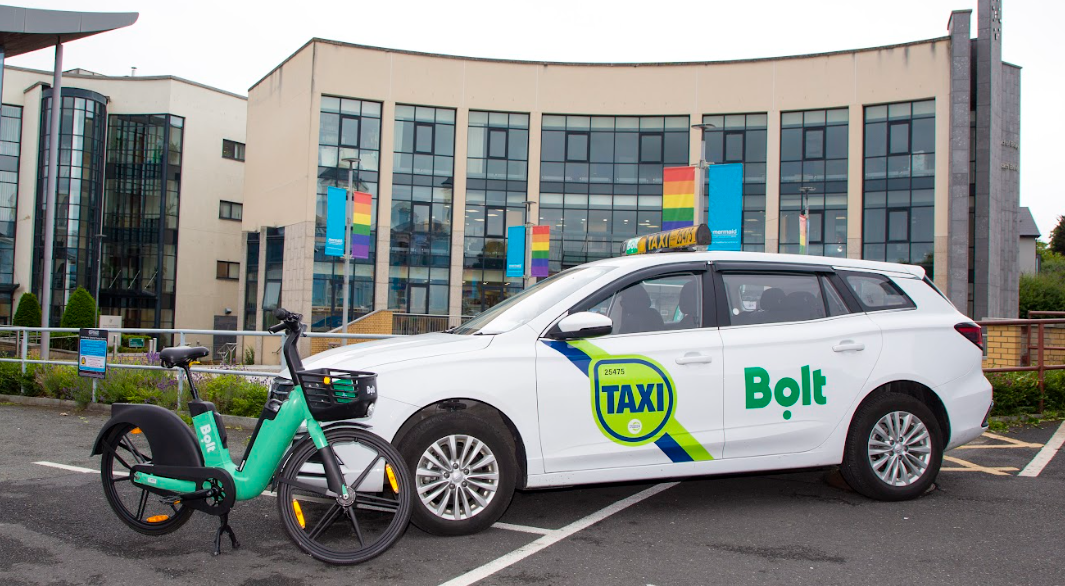
For those car owners driving less than 15,000 km a year, new data shows other modes of transport like ride-hailing, car subscriptions, scooter and e-bike rentals and car-sharing can be more affordable than owning a car.
The report looked at the total cost of ownership (TCO) in price per km for premium, SUV and compact cars, which decrease incrementally the more a car is driven, and compared them to the price per km of different types of shared mobility services, which carry no additional costs to the user, past the initial price.
In Ireland, though petrol and diesel prices dipped by two cents and one cent in October, the price of crude oil remains elevated at approximately $90 per barrel, an increase on the $70 barrels were valued at during the summer.
Car-sharing emerged particularly favourably as a cost effective transport mode, being cheaper than all three car types at an annual mileage of up to 15,000 km. Shared scooters and e-bike services were cheaper than a compact car at an annual mileage of 5,000 km, while even the most expensive shared mobility service, ride-hailing, proved cheaper than a premium car for an annual mileage up to 12,000 km. The analysis was conducted in Germany but applicable to all major European markets.
For those who cannot afford a car, the study also points out how shared mobility is a viable alternative, removing the key financial barrier of purchasing a car, scooter or eBike and connecting into public transport systems to provide better commuting access.
Fortunately for Irish citizens, the government is taking warmly received steps to ensure the country is well-positioned to transition away from a reliance on the private car. The recent Budget included an investment of €360m in cycling and walking infrastructure, as well as confirmation that the 20% fare reduction for all public transport (implemented last year as a temporary cost of living measure) will continue.
Notably, the government has also been taking great strides to enable an alternative transport mode which can ensure the cycling infrastructure is well used: the shared electric scooter. Legislation is expected to be finalised in the next couple of months. Given one third (33.4%) of private car journeys in Dublin are less than two kilometres according to the CSO, and over one fifth (20.9%) are 2 to 4 kilometres in length, the company with Irish headquarters in Dublin expect the two-wheelers to be a hit in towns and cities of varying sizes across the country.
Indeed, Bolt already offers shared electric bikes in Sligo, Kilkenny, Wexford, Bray, Dún Laoghaire-Rathdown, and Carlow. The firm is the largest scooter provider in Europe with scooters and e-bikes in more than 250 cities across 25 countries.
Head of Public Policy for Bolt Ireland, Aisling Dunne, said: “This report comes at a time that has real potential to be a watershed moment for the environment and transport in Ireland. It exposes the poor value for money private cars represent for urban dwellers across the country, just when cities and citizens are understandably assessing how far their euro is going.
“Thankfully a viable alternative is well on its way in the form of the shared electric scooter. We strongly encourage the NTA to continue this positive momentum by evaluating if the supply of taxis – especially in hospitality hotspots like Dublin – is proportionate to the amount of demand from passengers. Many of us will have first-hand experience of struggling to get a taxi.”
Dr Andreas Nienhaus, Head of the Oliver Wyman Mobility Forum, who led the study, said: “The mobility sector has changed dramatically in recent years and in addition to cars there is now a range of different modes of transport available to people. Cars will still be a necessity for some depending on where they live or their job, but what this report shows is that switching away from private car ownership can have significant benefits for many, particularly those living in cities.”
In addition to saving people money, the new report also found that greater usage of services like scooters and e-bikes can have environmental benefits for cities and the people living in them.
An analysis of how people used Bolt scooters in Europe found that around 10% of e-scooter rides directly replaced car journeys. As a result, e-scooters on their own contributed a reduction of up to 120 million car kilometres travelled, helping to alleviate traffic congestion and air pollution in cities and to reduce car-related emissions by an estimated 23,000 tons CO2e across Europe. The study also highlights the potential for aligned multimodal approaches between operators and Cities to cut personal car usage by 20% in Cities like Berlin.
The ongoing transformation of Lotus to a truly global performance business and brand has reached its most significant milestone yet – the arrival of the Eletre hyper-SUV and you can configure yours right here.
The Lotus Eletre is a striking and progressive new model, the first of a new breed of pure electric performance SUVs. It takes the core principles and Lotus DNA from 75 years of sports car design and engineering, evolving them into a desirable all-new lifestyle vehicle.
It’s aimed at a new generation of Lotus customers; those who value the world-class dynamic performance and striking design which have always been part of the Lotus experience, and who also need a practical, versatile and spacious family-focused vehicle – one that’s packed with the latest digital technology to make their driving life safer and more convenient.
The Eletre is a true Lotus. It takes the heart and soul of the latest Lotus sports car – the Emira – and the revolutionary aerodynamics of the all-electric Evija hypercar, and reinterprets them as a hyper-SUV. It delivers class-leading ride and handling, steering and aero performance – areas of automotive design and engineering where Lotus has both pioneered and dominated throughout its 75-year history, on road cars and race cars. It is also the epitome of beautiful design, efficient and elegant engineering solutions, embracing technology, the best craftsmanship, advanced materials, innovation and ingenuity, and pushing new boundaries. These are the very things which made Lotus great in the first place.
The Eletre is the latest in a long line of Lotus road cars whose name begins with the letter E, and it means ‘Coming to Life’ in some Eastern European languages. It’s an appropriate link as the Eletre marks the start of a new chapter in the history of Lotus – the first accessible EV and the first SUV.
The Eletre is ‘Born British, Raised Globally’, a collaboration between highly experienced and dedicated Lotus teams in the UK, Germany and China. They include the product definition and attributes teams at Hethel, the home of Lotus since 1966; the design teams at UK Creative Centre (UKCC) in Coventry; the engineering and dynamics teams at Germany Innovation Centre (GIC) in Raunheim; and the Lotus Tech engineering and manufacturing teams in Wuhan.
Following a world premiere in London in March 2022, thousands of customers around the world have already placed deposits to secure their Eletre. Three different versions of the car are available – Eletre, Eletre S and Eletre R – with the choice of two powertrains.
First customer deliveries started in China in March, and will follow in global markets – including Europe and the UK – later this summer.
Mike Johnstone, Group Vice-President and Chief Commercial Officer, Lotus, commented: “Like every Lotus, the Eletre is first and foremost a car ‘For The Drivers’. Its DNA is 100% Lotus, with exceptional dynamic performance. It’s also the most advanced Lotus ever, blending that performance with comfort, practicality, versatile space, cutting-edge tech and modern luxury design into a vehicle that brings the Lotus experience to a whole new group of customers for the first time.”
Mike added: “We know that two-seater sports cars are not for everyone, but the fantastic experience of driving a Lotus should be. The Eletre, plus the other fully electric lifestyle models that we’ve already announced, are providing customers and fans with a range of highly desirable Lotus cars that can fulfil all their needs at different times of their life. It’s a natural progression for the brand, and a hugely exciting one because Lotus is about delivering the very best performance no matter what segment the car sells in.”
Maximilian Szwaj, Vice-President of Lotus Technology and Managing Director, GIC, commented: “Since its inception exactly 75 years ago, Lotus has always been at the cutting edge of innovation, pioneering advances in aerodynamics, active systems and lightweight construction. Eletre embodies all of those fundamental qualities, and adds state-of-the-art technologies – including deployable LIDAR sensors – backed by future-proofed hardware and software. The world-class customer experience is driven by a stunning 5G-capable infotainment system powered by Lotus Hyper OS which offers best-in-class performance for visual effects and interactive feedback. Quite simply, this is the most advanced Lotus ever made.”
The Eletre’s comprehensive standard specification includes active air suspension, continuous damping control, torque vectoring, Lotus Intelligent Dynamic Chassis Control, 22-inch 10-spoke forged wheels in silver with a diamond-turned finish (20-inch five-spoke in European markets), Matrix LED headlights, Adaptive Cruise Control, Visual Park Assist, four-zone climate control, 12-way electric-adjust front seats, head-up display, wireless Apple Carplay and Android Auto, and a 1,380W 15-speaker KEF Premium Audio system.
The Eletre S is focused on customers seeking luxury. The enhanced specification includes additional features such as soft door close, privacy glass, active rear spoiler, configurable ambient lighting, illuminated side sills, air quality system, 2,160-watt 23-speaker KEF Reference Audio system, and 22-inch 10-spoke forged wheels in grey with a diamond-turned finish.
The flagship Eletre R is all about performance, and benefits from the Lotus Dynamic Handling Pack (comprising Intelligent Active Roll Control and Active Rear Steering), Carbon Pack, Pirelli P Zero performance tyres, and a gloss black finish for the wheels. There’s also a sixth Drive Mode: Track.
Eletre customers have the opportunity to tailor their vehicle to their requirements using the comprehensive list of option packs. These include the Executive Seat Pack, Comfort Seat Pack, Extended Carbon Fibre Pack, Interior Carbon Fibre Pack, Parking Pack and a Highway Assist Pack. Standard on the Eletre R, the Lotus Dynamic Handling Pack and Carbon Packs are also available for the Eletre and Eletre S. A Ceramic Brake Pack is offered on the Eletre R (and Eletre S in European markets).
For even greater customer choice and personalisation, many features from the packs are available as standalone options. There is also a wide range of colours, materials and finishes available on the interior. Available to order now, the Eletre is priced from £89,500 in the UK and €95,990 in Europe. Pricing in other regions will be announced in due course.
A technical tour de force
Lotus has always been one of the most innovative and technology-led automotive brands, and the Eletre is the culmination of 75 years of pioneering achievement in the fields of ride and handling, steering, aerodynamics and active systems. The result of an exhaustive global engineering development programme, the Eletre has been tested over more than one million miles in some of the harshest environments on earth, including on the challenging Nürburgring Nordschleife circuit in Germany. The Eletre fuses the fundamentals of Lotus dynamics DNA with cutting-edge chassis and driving safety technologies, state-of-the-art electric powertrains, plus a luxurious and spacious interior with world-class infotainment to deliver a new type of Lotus for enthusiastic performance car drivers worldwide.
With the Eletre, Lotus is delivering more innovation, more technology, more capability and more appeal than ever before. Offering a range of up to 600km (373 miles), the convenience of fast-charging from 10-80 per cent in just 20 minutes, and acceleration from 0-100km/h (0-62mph) in a breathtaking 2.95 seconds on the flagship R model, the Eletre takes full advantage of all the benefits electrification can offer and uses them to comprehensively enhance the driving experience.
The effortless, instant torque and all-wheel drive traction delivered by the two electric motors, together with active air suspension, also brings a completely new dimension to Lotus ownership: the ability to carry on driving where the road ends, and to tow up to 2,250kg.
A comprehensive suite of advanced driver assistance systems (ADAS) is also part of the Eletre experience: Intelligent Adaptive Cruise Control (ACC); Highway Assist (HWA); Collision Mitigation Support Front (CMSF); Traffic Sign Information (TSI); Door Open Warning (DOW); Rear Cross Traffic Alert (RCTA); Front Cross Traffic Alert (FCTA); Lane Change Assist (LCA); Life Detection and Care (LDC); Lane Keep Aid with Lane Departure Warning / Prevention (LKA+); Parking Emergency Brake (PEB); Collision Mitigation Support Rear (CMSR); and Emergency Rescue Call (E-Call). Each is designed to make every journey safer and more relaxing.
There’s also a 29-inch head-up display with semi-augmented reality that can overlay contextual graphics on to the view ahead to help the driver keep their eyes on the road. A remote parking function in the smartphone app enables the Eletre owner to manoeuvre the car into a tight parking space while outside the vehicle, making it possible to fit into spaces which would otherwise be unsuitable. The suite of state-of-the-art sensors is also future-proofed to deliver further advances in automated driving capability via over-the-air (OTA) updates.
Eletre customers in Europe benefit from a five-year / 150,000km vehicle warranty with an eight-year / 200,000km battery warranty. In the UK, customers receive a five-year / 100,000-mile vehicle warranty with an eight-year / 150,000-mile battery warranty. All customers get five years of pan-European roadside assistance.
Chassis Technology and Vehicle Dynamics: A new benchmark in the SUV segment
Every Lotus has to deliver the ideal balance of agility, handling and comfort: this is fundamental to the brand’s DNA and to the unrivalled driver appeal each model offers. Through a combination of its light, stiff platform, sophisticated suspension systems and intelligent all-wheel drive, the Eletre engineering team had the ideal starting point for vehicle dynamics development. Adding even further capability are technologies such as active anti-roll control, torque vectoring by braking, and active rear-wheel steering. Networking all of these advanced technologies together so that they interact seamlessly as one, the result is an SUV that steers, corners and rides like only a Lotus can.
The Eletre features sophisticated multi-link suspension systems front and rear, with components made from lightweight aluminium. The design of each enables effective decoupling of lateral and longitudinal loads, delivering superb ride quality together with outstanding responsiveness without one attribute compromising the other.
The innovative dual-chamber air springs, fitted as standard across the Eletre range, enable independent control of ride height and stiffness. In addition to comfort and refinement, the active air suspension also provides speed-dependent lowering of the car by up to 25mm to reduce drag and therefore improve range. It can also increase ride height by between 15mm and 25mm to enhance off-highway capability.
The electronically-controlled damping system – CDC – continuously measures the loads coming into the suspension at a rate of 1,000 times per second, and adapts the damping rate 500 times per second, for improved body control without any harshness. It means the Eletre ‘breathes’ with the road, as every Lotus should.
The Eletre is the first Lotus to use electromechanical power steering. The system has been meticulously tuned to deliver the pure, truly connected feel, feedback and intuitive response to the driver’s inputs that’s a hallmark of every Lotus and for which Eletre also sets the class benchmark. And, at only 2.5 turns lock-to-lock, the steering is sports-car quick as well. With the rack-mounted motor only consuming power on-demand, the system offers greater energy efficiency than those relying on hydraulics to provide the assistance.
The active rear-wheel-steering system makes the Eletre even more agile and is another Lotus first. The technology is offered, together with Intelligent Active Roll Control (IARC), as part of the Lotus Dynamic Handling Pack that’s fitted as standard to the Eletre R and optional on Eletre and Eletre S. Actuators mounted on the rear subframe connected to the toe control arm can rotate the rear suspension knuckle by up to 3.5º. At low speeds, the rear wheels turn in the opposite direction to the fronts, effectively reducing the wheelbase and therefore reducing the turning circle by up to 0.8 metres to enhance manoeuvrability. At high speeds, the rear wheels turn in the same direction as the fronts, improving stability.
IARC is a third-generation 48-volt system featuring powerful and fast-acting electromechanical actuators. Taking their input from the body displacement sensors, their required output torque is calculated in only two milliseconds, delivering precision control of the required roll stiffness, resulting in even more neutral cornering and improved composure. When driving on smooth, flat roads, IARC effectively decouples the anti-roll bars, benefiting ride comfort.
Managing the interaction of all of these systems is Lotus’ incredible new 6D Integrated Chassis Control (ICC) system. ICC seamlessly integrates the response of each component – together with the all-wheel drive system’s torque distribution and the active aerodynamics – to perfectly balance control and comfort in every driving scenario by continuously analysing the vehicle’s behaviour across multiple dimensions: vertical, lateral and longitudinal motion, plus pitch, roll and yaw. This technology, developed in-house by Lotus, significantly expands the Eletre’s dynamic capability and delivers an even more rewarding, engaging driving experience for the customer.
Drivers can also tailor the Eletre’s character to their individual taste by selecting one of the different Drive Modes, either through the central touchscreen or using the shift paddles behind the steering wheel. Each Mode subtly alters the vehicle’s settings to deliver a range of different benefits:
Tour Mode is the default mode, and balances driving comfort and energy consumption
Range Mode reduces the energy consumption of systems such as climate control, optimises front and rear torque distribution and offers a more progressive accelerator pedal response to increase range
Sport Mode sharpens the powertrain and chassis response, enhancing drivability and handling
Off-Road Mode can be used to enhance traction on low-friction surfaces to remove the risk of wheelspin
Individual Mode allows the driver to choose specific settings for powertrain, suspension and steering
Track Mode (Eletre R only) reduces ride height and powertrain response compared to Sport Mode, and also raises the threshold for the electronic stability control system’s intervention, giving the driver more influence over the vehicle’s cornering behaviour, making it ideal for spirited driving on a circuit
Comprehensive development work on the tyres and brakes has also taken place. Working in partnership with Pirelli, Lotus has engineered a range of high-performance 22 and 23-inch P Zero and ultra-high performance 22-inch P Zero Corsa tyres specifically for the Eletre. Each delivers an ideal balance of wet and dry grip, especially under the high loads resulting from the instant torque from the electric motors.
The braking system developed for the Eletre stands out for its six-piston front calipers and two-piece Brembo discs, comprising steel rotors and aluminium mounting bells. Joined together by a special casting process, these discs offer weight savings compared to conventional one-piece cast discs, and improved thermal management at high temperatures for improved braking performance – characteristics proven during the demanding testing programme at the legendary Nürburgring Nordschleife.
A carbon ceramic braking system is available as an option on the Eletre R (and Eletre S in European markets). This features AP Racing’s 10-piston ‘Radi-Cal’ calipers on the front axle: the highly optimised, asymmetric form of the forged aluminium components means they are the same weight as the six-piston calipers but offer 60 per cent more pressure area for even higher performance. They clamp Brembo’s carbon ceramic discs, which are less than half the weight of the six-piston system’s discs, and can operate at extreme temperatures exceeding 1,000ºC, offering outstanding fade resistance. They also offer a service life which is typically double that of steel discs. Calipers are available in a choice of six colours, depending on the spec chosen.
Bespoke, multi-material EV architecture: light, stiff, strong
Ensuring that the Eletre would deliver the benchmark ride, handling and agility expected of a Lotus, it was developed from day one on the all-new Electric Premium Architecture (EPA). This highly flexible, modular platform is bespoke to Lotus, and will be at the core of a range of new premium lifestyle performance EVs which will be developed over the next few years.
Engineered to maximise the benefits of electrification, including packaging the battery between the axles and beneath the floor to lower the centre of gravity and maximise cabin space, EPA features an intelligent mix of advanced materials to deliver the high torsional stiffness and light weight that are fundamental to Lotus dynamics DNA. This approach delivers an overall weight saving of 10 per cent on the complete body structure.
Aluminium high-pressure die-castings feature in key components such as the damper mounting points – the two front castings alone save 6kg compared to steel parts – together with aluminium extrusions and for the sills and stampings for the body panels. The three-piece bonnet assembly is 8kg lighter because of its aluminium construction, while the frameless aluminium doors save a further 6kg.
In all, advanced aluminium alloys account for 43 per cent of the platform itself, and 50.7 per cent of the complete body structure. They are combined with high and ultra-high strength steels, together with hot-formed steels to reinforce the A and B-pillars and enhance crash protection. A lightweight composite is used to form part of the rear floor. A total of 16 different advanced joining technologies are used throughout, including structural adhesives, self-piercing rivets, flow-drilled screws, spot welding and laser welding.
Together with the state-of-the-art suspension systems, this light, stiff body structure is key to the Eletre’s exceptional balance of dynamic capability, comfort and refinement, whether on road, track or off-road. It is also engineered to meet or exceed the requirements of the world’s most stringent legislative and consumer safety regulations.
Dual-motor all-electric powertrain: power, performance and efficiency
Befitting its status as a hyper-SUV, Eletre’s propulsion system technology delivers the searing performance expected of a truly rewarding, engaging, driver-focused machine, together with the energy efficiency essential for long range and day-to-day usability.
Packaged beneath the vehicle floor is a state-of-the-art, 800-volt, 112kWh Lithium-ion battery pack. Compared to conventional 400-volt systems, the 800-volt architecture reduces the operating current by half for the same power output. The benefits for the customer are threefold: less weight because smaller diameter cables can be used in the wiring harnesses; enhanced power efficiency and improved thermal management as less heat is generated; and much faster charging.
The configuration of the battery pack is innovative too. Instead of being packaged first within a number of separate modules, the prismatic cells are arranged directly within the battery’s structural casing. This has the advantages of reducing weight, and improving packaging as more cells can be housed within a given volume. The result is enhanced energy density – more than 175Wh/kg – which translates into longer range for the driver.
The battery pack’s sophisticated thermal management system and battery control module deliver the ideal operating conditions crucial to both range and durability. Precise control of heating and cooling ensures uniform heat distribution across all of the cells and ensures optimal temperatures under extremes such as high-power charging at up to 350kW, driving in sub-zero conditions or sustained high-speed cruising.
Integrating light and compact electric motors into the front and rear axles provides incredible performance and also makes Eletre the first all-wheel drive Lotus road car – a significant milestone in the brand’s evolution. The permanent magnet, synchronous motors are housed together with the transmissions and inverters inside a single, cast housing for optimum packaging efficiency. All models feature a single-speed transmission on the front axle. While the same is true for the rear axle of the Eletre and Eletre S, the Eletre R features a two-speed design: first gear has a ratio of 13.65:1, and second gear is 7.16:1. For the customer, this creates the ideal balance of superb launch performance and acceleration, together with enhanced efficiency – and therefore range – at high speeds.
Shifts are automatic, and utilise friction plate clutches for smoothness. Weighing only 156kg, the Eletre R’s rear drive unit is some 14kg lighter than comparable two-speed designs. The inverters feature state-of-the-art silicon carbide material to deliver the highest possible energy efficiency.
These highly advanced electric drive units deliver astonishing and exploitable new levels of performance to the SUV segment, together with remarkable efficiency. With 603hp and 710Nm of instant torque, the Eletre and Eletre S can accelerate from 0-100km/h (0-62mph) in only 4.5 seconds and go on to a maximum speed of 258km/h (160mph). Both can achieve a WLTP Combined range of up to 600km (373 miles)4. With an incredible 905hp and 985Nm, the Eletre R covers the benchmark sprint in just 2.95 seconds and can reach 265km/h (165mph). WLTP Combine range is 490km (304 miles).
The electric drive units also greatly enhance real-world range. Unlike a combustion engine vehicle which converts kinetic energy to heat during braking, the Eletre can recuperate a significant proportion of this because the motors act as generators during deceleration, with the energy then recharging the battery. The driver can select from two levels of regenerative braking using the two tactile paddles on the steering wheel, their intricate shapes enabled by using a metal injection moulding manufacturing process. To ensure drivers receive consistent, progressive pedal feel under all conditions, friction braking and regenerative braking are seamlessly blended together.
Another attribute that the Eletre’s effortless torque and outstanding all-wheel drive traction underpin – and one which adds another dimension to its performance – is towing capacity. Selected models are rated at 2,250kg (with braked trailer), and cars with 22-inch wheels can be specified with the optional deployable electric tow bar which shows neatly away when not in use. An additional 90kg can be carried on the roof bars, which, together with 688-litre rear (five-seat version) and 46-litre front luggage compartments, gives the Eletre the versatility and practicality to match its luxury and performance
Charging: fast, simple, convenient
To enhance the ownership experience and make driving the Eletre even more enjoyable, it offers charging to match its range and performance. All models feature a 22kW on-board AC charger as standard: customers with a 22kW wallbox at home will be able to fully replenish the battery from 0-100 per cent in less than six hours – ideal for overnight charging.
Customers can also fully control how much to charge using the Lotus smartphone app. The app enables them to set the pre-conditioning function: while the vehicle is plugged-in, it uses mains electricity to heat or cool the battery to the ideal operating temperature, and brings the cabin temperature to the customer’s desired setting. This is far more efficient than drawing power directly from the battery and, as well as enhancing occupant comfort, pre-conditioning also enhances range, particularly in winter conditions when you need it the most.
When using the rapidly-growing network of public charging stations worldwide, Eletre customers benefit from the convenience of rapid 350kW DC charging. Perfect for topping-up the battery on long journeys when stopping for a break, just 20 minutes is enough to recharge from 10-80 per cent, and more than 120km (74 miles) of range can be added in only five minutes. Finding charging stations along the route is easy, thanks to the intelligent navigation system which not only highlights where they are, but also if they’re available or not.
Form and function: active aerodynamics
Eletre’s dramatic, cab-forward design evolves the iconic design language of the mid-engine Lotus sports car into a hyper-SUV. The ‘carved by air’ design ethos as seen in the Evija hypercar and Emira sports car is much more than skin deep, and seamlessly integrates a raft of active aerodynamic technologies which together enhance efficiency, performance and dynamics, and contribute to a drag coefficient of just 0.26.
One of the most significant features is the active front grille. An integral part of the Emira and Evija-inspired front end design, this comprises a row of seven individual apertures, each one featuring six triangular petals. These petals smoothly open and close on demand to meet the Eletre’s requirements for cooling airflow to the powertrain’s e-motors and radiators, and to the brakes. Crucially, in colder markets, they can stay closed to retain heat. Unique to the Eletre R, if the driver selects Track Mode, the grille is always fully open, helping to ensure the vehicle can deliver sustained, high-performance driving and braking.
The Electric Reverse Mirror Displays (ERMD)1, which use high-definition cameras to stream the view behind the vehicle to six-inch displays in the front doors, have a much smaller frontal area than traditional rear-view mirrors. As well as enhanced vision, the ERMD technology can reduce the wind resistance coefficient by up to 1.5 per cent, further improving aero performance and useable range.
Delivering the same benefit is the deployable, state-of-the-art LIDAR sensor mounted at the top of the windscreen and front wheel arches. These remain hidden when not in use by the Eletre’s comprehensive suite of advanced driver assistance systems.
Another innovation is the Eletre’s active rear spoiler, packaged neatly into the tailgate. Working in combination with the distinctive split floating roof spoiler above, it automatically adjusts between three positions, depending on vehicle speed, acceleration, braking and Drive Mode setting.
When deployed at an angle of 18º, the spoiler can reduce the drag coefficient by up to 1.8%, while also increasing downforce by up to 60kg; moving to 32º increases the drag coefficient slightly, by 1.8%, but more than doubles downforce to 112.5kg. Fully deployed to 34º delivers maximum deceleration to assist maximum braking effort.
Eletre inside: the digital cockpit
The Eletre has an interior like no Lotus before it. The luxurious, spacious cabin effortlessly fuses a performance-orientated, technical design with world-class infotainment and connectivity and a curated selection of the very finest materials and finishes which convey luxury, exclusivity and precision craftsmanship – with an equal focus on sustainability.
The Eletre’s intelligent ‘Digital Cockpit’ uses cutting-edge technology to enhance the driving experience by combining beautifully rendered graphics, super-fast responses and intuitive operation. Lotus Hyper OS – an all-new operating system making its debut in Eletre – provides a seamless interactive experience that offers best-in-class performance and interactive feedback, putting the user – driver or passenger – in complete control.
The specification includes dual Qualcomm 8155 Snapdragon chips for exceptional processing power, together with 12GB of RAM and 128GB of storage. Use of ‘Unreal Engine’ technology from the world of computer gaming enables real-time 3D animations and experiences. The best possible connectivity is ensured by 5G compatibility. Software-over-the-air capability ensures the Eletre’s Digital Cockpit is always up to date, and continuously improves over time as new functionality becomes available.
Another innovation is a virtual personal assistant so that customers can interact with the vehicle just by speaking: simply say “Hi Lotus, I’m cold”, for example, and the cabin temperature is adjusted accordingly, enabling drivers to keep their hands on the steering wheel and eyes on the road.
The central touchscreen is a slimline, deployable, 15.1-inch HD OLED design that’s only 10mm thick. Able to display beautifully crisp, clear images using over 16 million colours, it offers exceptional clarity and a truly immersive experience for the driver. Navigation functionality, developed with HERE Technologies (for UK and European markets), includes EV Routing, EV Range Assistant and Predictive Routing. Beneath the touchscreen in the centre console is a wireless device charger to complement wireless Apple CarPlay and Android Auto2.
The front seat passenger has a high-definition touchscreen of their own, enabling them to control media playback and see information corresponding to voice control commands or receive prompts such as fasten seatbelt. In the rear, passengers can control climate control settings, seat adjustments, ambient lighting and media playback through a further HD touchscreen – an eight-inch or nine-inch deployable display for five-seat or four-seat configurations respectively.
The 12.6-inch HD OLED instrument cluster behind the steering wheel is paired with a 29-inch head-up display (HUD) with semi-augmented reality to help the driver keep their eyes on the road. By projecting graphics which help to convey key information such as navigation or advanced driver assistance system alerts over corresponding objects up ahead, the HUD can make it quicker and easier for the driver to understand what’s happening around them, reducing distraction and enhancing safety.
Ensuring that every occupant can enjoy an unrivalled music experience, the Eletre offers two audio systems developed with KEF. KEF Premium is a 1,380-watt, 15-speaker, surround sound system, while KEF Reference is a 2,160-watt 23-speaker system featuring 3D surround sound and space-saving Uni-Core™ technology, and the Eletre is the first vehicle to offer it. To enhance depth, precision and clarity, both systems are combined with Dolby Atmos, and the pairing of this technology together with KEF Audio is another first.
A smartphone app developed for the Eletre enables customers to interact with the vehicle wherever they are. As well as using the app to control charging and pre-conditioning, it allows them to change climate control settings, purify the cabin air, remotely lock or unlock the vehicle, or just check information such as available range. Drivers can even use the app to remotely park the vehicle, for example, in tight spaces: they can watch their Eletre manoeuvre itself into parallel, perpendicular or diagonal spaces which would otherwise be too small if the occupants had to open the doors to get out.
Digital technology has even been applied to the panoramic glass roof3: it offers 10 different settings for the amount of light transmitted into the cabin. And, compared to conventional designs which use a separate sunblind, it offers better heat insulation, helping to reduce the energy consumption of the climate control system.
The Eletre is equipped with a full suite of advanced driver assistance systems (ADAS), all designed to enhance safety and make journeys more relaxing. To deliver this, a full complement of state-of-the-art sensors are used: 34 in total, including the four deployable LIDAR, six radar, seven 8MP HD cameras and 12 ultrasonic sensors. All together, they give the vehicle a true 360º view of the world around it.
To manage real-time processing of this wealth of data are two NVIDIA Orin-X chips, which provide a computing power capability of 500 TOPS – a phenomenal 500 trillion operations per second – and provide a fail-safe system architecture for enhanced functional safety. This level of technology, together with software and feature updates over-the-air, ensures that the Eletre not only provides the very latest ADAS functionality but is also able to deliver Level 4 autonomous driving capability as market regulations allow.
Eletre customers will be able to benefit from Highway Assist, which is designed to make long distance motorway driving more comfortable. Available from 30-150km/h, this builds on the Adaptive Cruise Control system’s management of speed and distance to vehicles in front by also automatically keeping the vehicle centred in its lane – even in bends.
Tiredness and driver distraction are among the main causes of road accidents, so Lotus has developed a Driver Monitoring System (DMS) which can help and support the driver if it determines that they’re not focused on the road ahead. Inside the cabin, near-infrared light is sent out which is reflected by the driver’s eyes and picked up by a camera: this determines, through filtering and complex calculations, where the driver is looking. Combined with other inputs such as the rate and duration of every blink, how the mouth is closed or open, and the way in which the vehicle is being driven, DMS can determine if there is a risk of them falling asleep or not paying attention to the road ahead. If these scenarios occur, visual and audible warnings are triggered, encouraging the driver to stop and take a break.
Another innovation is Life Detection and Care – a system designed to protect children or pets inadvertently left inside a locked vehicle. Should this occur, CPD will initiate three levels of warning: within 10 seconds of the vehicle being locked, the Eletre’s horn will sound and the lights will flash, and a notification will be sent to the driver. If the driver doesn’t act, the signals from the horn and lights will continue for five minutes. If no action is taken after five minutes and the temperature inside the cabin exceeds 35ºC, an emergency call will be made to the authorities to alert them to the potential risk, the windows will be lowered and a new notification will be sent to the driver.
Exterior design: daring and dramatic
Embracing the creative freedom which comes from the absence of a petrol engine, the Eletre’s dramatic form interprets 75 years of Lotus sports car design DNA into a stunning new theme befitting the brand’s first all-electric hyper-SUV. It is characterised by a cab-forward stance, long wheelbase and very short overhangs front and rear. Overall, there’s a visual lightness to the vehicle, creating the impression of a high-riding sports car rather than an SUV.
A signature element of the design is its ‘porosity’ – the aerodynamic principle of air flowing through the vehicle as well as under, over and around it. Porosity was at the heart of the Lotus Evija’s design, is integral to the Emira, and has provided clear inspiration for the Eletre. It is most obvious where air is channelled under the leading edge of the vehicle, emerging through two exit vents in the bonnet.
There are other examples of porosity ahead of and behind the front wheel arches, behind the rear wheels, and even at the top of the D-pillar. For the driver, the benefits are clear: the reductions in aerodynamic drag that they deliver improve both performance and range.
At the front of the Eletre, the very sharp and crisp leading edge reveals a clear lineage with the Emira and Evija. It draws a distinct line across the very striking and contemporary design treatment below. There are further echoes of Evija in the layering of the surfaces, the creation of space and the optimised, streamlined performance.
Just above the leading edge are the super-slim, technical light clusters which house the Daytime Running Lights and scrolling directional indicators. The full LED headlights, which use Matrix technology to permit constant high beam use without dazzling the vehicle in front, or oncoming traffic, are housed below, recessed and partially hidden. The headlights also feature an industry-first High Beam Spot Module with an incorporated active cornering light to increase visibility on dark, twisty roads. The module is light, compact and simple – a true Lotus story, combining two features in one design. Lower down is the Eletre’s active front grille, a further example of the vehicle’s porosity.
Overall there is a unique sense of flow and a kinetic quality to the Eletre’s front end, the purity of which is enhanced by the deployable LIDAR sensor mounted at the top of the windscreen, which remains in its lowered position when not in use. The bold leading edge of the bonnet continues round into the front fenders, wheel arches and, ultimately, the length of the vehicle as a feature line. The taut and muscular lines are dominant above it, with the aerodynamic elements below.
In profile, the muscular haunches dominate. The air outlet immediately behind the front wheels defines the sculpted shape of the doors, which also feature deployable technology for the handles, allowing the surfacing to flow smoothly along the bodyside.
The aggressive rake of the windscreen – a sports car-like 27º – is clearly visible in profile, with the roofline tapering away dramatically at the rear, leading to a unique floating D-pillar that features an innovative ‘air blade’ which aids drag reduction. Another example of porosity, it’s an aerodynamic performance enhancement taken directly from the front bumper of the Emira.
At the rear, the full-width ribbon light strip picks up the feature line from the profile. Situated just above the Lotus wordmark, it is red when the vehicle is moving and includes a scrolling directional indicator at each end, where it curves gently into the air outlets from the wheel arches – another design cue which echoes both the Emira and Evija. The light can appear in four colours, playing a role in the car’s theatrical unlocking sequence and also indicating the battery’s charge status. The unique cantilevered carbon fibre ‘floating’ split roof spoiler is a motorsport-inspired design feature that evokes race car winglets. The central section is removed to reduce weight – a very Lotus concept – and allows the LIDAR sensor to be integrated at the top of the glass.
Interior design: luxurious, spacious
The Eletre takes Lotus interiors to an unprecedented new level. The performance-oriented and technical design is visually lightweight, using ultra-premium materials to deliver an exceptional customer experience, whether in the standard five-seat configuration or the optional four-seat layout. Above, a fixed panoramic roof2 floods the interior with natural light, adding to the bright and spacious feeling inside.
The driver-focused cockpit and high centre console are inspired by the Lotus Emira and Evija, creating a cossetted feeling. The layering of materials and textures creates a truly premium feel, augmented by a triangular theme – seen externally on the car’s active front grille – and replicated in multiple locations around the cabin.
The Lotus philosophy of lightweighting – removing material wherever it’s not needed – is clearly illustrated in the instrument panel. The floating wing’s central section has been taken out, echoing the design of the rear spoiler.
There is a wealth of practical storage space in the Eletre’s cabin. The centre console includes a storage tray with wireless phone charging functionality, as well as twin cupholders which remain flush to the surface until they’re needed. The beautifully sculpted door design includes storage which can accommodate a one litre bottle. Occupants in the rear of the four-seat configuration also have a wireless charging mat, and when the middle rear seat of the five-seat configuration isn’t being used, it can be folded to become an armrest, also with two deployable cupholders.
Sustainability is also a key theme of the interior. A Lotus innovation which makes its debut in the Eletre is the Re-Fibre. A premium textile made from waste fabric from the fashion industry, this material has the softness of cotton, the lustre of silk and the smoothness of hemp, offering a new vision of sustainable luxury. Enhancing comfort, it also offers better air permeability than pure cotton. Offering a weight saving compared to leather, it also reduces consumption of raw materials and reduces CO2.
Customers can also choose Ultrafabric polyurethane seats. This material offers a technical finish and is half the weight of leather, which is perfectly aligned to the Lotus ethos of lightweighting. There’s also Alcantara: this microfibre material has been carbon neutral since 2009, and the material offered in the Eletre has been offset to zero carbon footprint. Carpets are made from Econyl – a material made from 100% post-consumer waste which is also fully recyclable.
Lotus Eletre: a milestone car for a milestone moment
With the Emira confirmed as the final combustion engine Lotus sports car, the Eletre’s significance as the first all-electric Lotus hyper-SUV is made all the more significant: it is a key milestone in the brand’s dramatic transformation as it embraces a bold new electrified era. Lotus has always used technical innovation, advanced aerodynamics and lightweighting to create vehicles which set the class benchmark for performance, rideand handling. The Eletre proudly continues this tradition, but with a step-change in versatility and usability, ensuring that the Lotus brand appeals to driving enthusiasts around the world like never before.
1 – Eletre is fitted with standard mirrors in markets where local regulations do not allow ERMD
2 – Not available in China
3 – Panoramic glass roof is optional in markets outside China
4 – With 20-inch wheel
Lotus Eletre: Technical Specification
Powertrain and performance:
Eletre
Eletre S
Eletre R
Powertrain configuration
Full-time all-wheel drive with
Lotus ICC intelligent torque distribution
Electric motor front / rear
Permanent magnet / Permanent magnet
Transmission front / rear
Single speed
Single speed
Single speed/ Two-speed
Max power (kW / hp)
450 / 603
450 / 603
675 / 905
Max torque (Nm)
710
710
985
Top speed (mph / km/h)
160 / 258
160 / 258
165 / 265
0-62 mph / 0-100 km/h (secs)
4.5
4.5
2.95
80-120 km/h (secs)
< 2.0
< 2.0
< 1.9
Battery capacity (kWh)
112
112
112
Battery type
Lithium-ion
Lithium-ion
Lithium-ion
Battery voltage
800
800
800
Charging time 10-80% (mins) via 350kW DC rapid charger
20
20
20
Charging time 0-100% (hours) via 22kW AC wallbox
5.8
5.8
5.8
WLTP Combined range (km / miles)
600 / 373*
600 / 373*
490 / 304
* Using 20-inch wheel, available as a no-cost option in the UK
A number of Future Mobility Campus Ireland partner companies are showcasing live demonstrations of their technologies on a testbed vehicle at the ADAS & Autonomous Vehicle Technology Expo in Stuttgart, Germany, June 13-15.
The Jaguar Land Rover vehicle, part of a fleet at FMCI’s Shannon Facility, showcases class leading ADAS solutions developed by AEye, Klas and Provizio.
AEye Lidar Features
Featuring Continental’s HRL131 Long Range Lidar, based on AEye’s patented 4Sight™ architecture, the integrated forward facing Lidar combines long range and high resolution performance over a wide field of view, with situational software reconfigurability for critical safety use cases. The product can adapt to any application – including high speed highway environments, low speed traffic jams, and congested urban settings – using software enabled performance modes. Also, the HRL131 enables OEMs to deliver new ADAS features over-the-air, future-proofing safety development and enabling additional revenue streams.
Klas Rugged Edge Technology for ADAS/AD Development
Klas develops and delivers rugged edge communications infrastructure alongside edge computing server solutions to securely extend the cloud to the harshest environments on Earth. Incorporated in the testbed is the TRX range of modules for ADAS/AD development from Klas, which includes vehicle data logging, networking, and connectivity, packaged up as a RAVEN (Rugged Autonomous Vehicle Network) platform with in-built power distribution powered by the vehicle’s 12VDC supply.
The TRX D8 data logging solution from Klas captures, processes, and stores data from vehicle vision systems, which is vital for further advancing safer driving experiences. The TRX R2, a compute cellular gateway, feeds GPS coordinates into the test platform and facilitates secure remote access to the vehicle over multiple mobile network connections.
Provizio 5D Perception® driving platform
Provizio’s 5D Perception® driving platform offers OEMs the fastest and most reliable path to Level 5 automation as part of the company’s mission to eliminate all road accidents and deliver a safe path to Autonomy. The platform offers the fastest, lowest cost and most reliable path to perception delivering vehicle safety and ubiquitous autonomy.
The patented technology developed by Provizio utilises a five-dimensional perception system that can continually see, track and interpret road conditions and hazards, giving every vehicle 360-degree insight into all weather conditions, far beyond human abilities.
The proprietary Software Defined Radar delivers 30x resolution and 3x range of next-gen incumbent Radar sensors – without additional expensive radar channels. Software-defined sensors use integrated edge processors to make instant decisions on the chip, slashing response times.
Speaking at ADAS Stuttgart, Andreas Prinz – AEye Technical Sales Director, Europe
“As automakers make the shift toward electrification, automation, and service-based business models, they will increasingly look to software-definable sensing solutions with the ability to update and adapt depending on the needs of the system.”
“Smart sensors like the Continental – AEye HRL131 adaptive lidar and Provizio’s high definition radar can achieve high performance metrics in a wide variety of real world environments and use cases, and will be key to enabling autonomous mobility” adds Prinz.
AEye, Provizio and Klas have been working together at Future Mobility Campus Ireland (FMCI), an open collaborative testbed in the Shannon Free Zone. FMCI provides the facilities and expertise to harness valuable sensor data in a variety of road environments and traffic scenarios for new technologies.
The FMCI test facility includes a road network that is retro-fitted with inter-connected, state-of-the-art sensing and telecommunication technologies. Fully-accessible and controlled via a dedicated control centre, FMCI facilitates the test and validation of mobility innovations so that everyone involved, from researchers to multi-national corporations, can trial, test and innovate solutions in a ‘laboratory with real life conditions’
Speaking on the reveal, Frank Murray, CTO at Klas
“Building out a toolchain to validate the performance of the next generation of Level 2+ ADAS functionality and sensors is cumbersome and time-consuming,” said Frank Murray, CTO of Klas. “The case in point of this initiative demonstrates the ease our partners could build out the validation and verification toolchain in-vehicle. Further proof of why to adopt a modular approach to in-vehicle toolchains is adaptability. Here, the team can quickly adapt the platform to only log data or to also include secure mobile connectivity, which simplifies the integration of the testbed with the end customer’s software development environment.”
Live demo’s of the integrated platform will be ongoing throughout ADAS Stuttgart (June 13-15). Should you wish to take part in a live demonstration please respond for arrangement. Visit the Klas booth (#6628) at the event to find out more.