Top 7 Data Visualization and Tableau Courses to Build Analytical Leadership Skills in 2026

According to a 2026 report by Mordor Intelligence, the Business Intelligence market adoption has hit 82%, yet a severe training gap remains. 

Research from BCG indicates that 70% of digital transformations fail due to poor data literacy and visualization. 

In this article, you will discover the top data visualization courses designed to bridge that gap and drive real analytical leadership.

How Have We Selected These Best Tableau & Power BI Training Courses?

  • Curriculum relevance to the 2026 data-driven corporate ecosystem.
  • Institutional prestige & the professional caliber of the certifying body.
  • Focus on analytical architecture (e.g., Power Query, DAX, AI Copilot integration) rather than mere data entry.
  • Flexibility of delivery modes suited for high-level executive schedules.
  • Direct applicability of outcomes to enterprise-scale problem-solving & financial modeling.

Overview: Best Tableau & Power BI Courses for 2026

# Program Provider Primary Focus Delivery Ideal For
1 Advanced Data Viz (Power BI) Great Learning Executive Dashboarding Online/Self-Paced Senior Leaders
2 Data Analysis & Viz (Power BI) Coursera (MS) Technical Modeling Online/Self-Paced Career Switchers
3 Data Visualization in Power BI DataCamp Interactive Exploration In-Browser Hands-on Managers
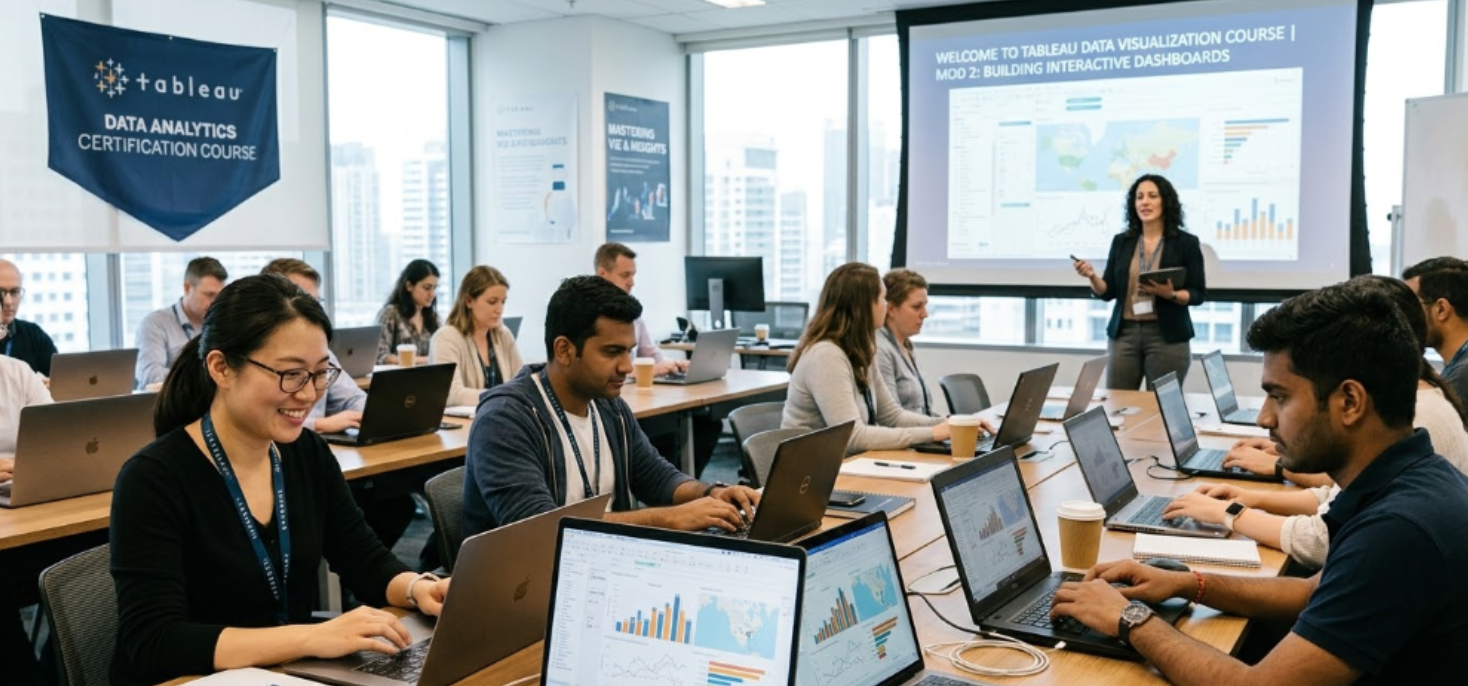
4 Tableau Essentials Great Learning Visual Storytelling Online/Self-Paced Technical VPs
5 Power BI (PL-300) ONLC Certification & Governance Live Virtual Compliance Officers
6 Power BI for Data Analysis Data for Dev Humanitarian Impact Online Workshop Non-Profit Leaders
7 Power BI Nanodegree Udacity Project-Based Mastery Online/Mentored C-Suite Finance

Best Power BI Training and Tableau Courses in 2026

1. Advanced Data Visualization using Power BI — Great Learning

This Power BI Training course by Great Learning is designed for professionals who need to go beyond basic reporting to build robust, executive-level data pipelines. 


It provides an in-depth dive into hierarchical charts, clustering, and complex What-If analyses. 


Enrolling in this GLA Pro+, learners gain access to 500+ courses, AI-powered career tools, guided projects, and recognized certifications from Microsoft and AWS to strengthen their career prospects.

 By the end of this course, leaders can extract actionable insights from real-world business scenarios.


  • Delivery & Duration: Online, 11 hours, self-paced with 1 major guided project (FIFA Player Analysis).
  • Credentials: Certificate of completion (Great Learning and Microsoft recognized).
  • Instructional Quality & Design: Faculty-led video modules featuring enterprise case studies and interactive labs.
  • Support: 24-hour AI assistance, AI resume builder, and personalized mock interviews.


Key Outcomes / Strengths:

  • Architect data modeling workflows utilizing advanced visualizations and cross-filtering.
  • Formulate dynamic parameters to execute high-stakes What-If scenario analyses.
  • Synthesize complex datasets through clustering to identify market outliers.
  • Evaluate operational bottlenecks through interactive dashboards to drive profitability.

2. Data Analysis and Visualization with Power BI — Coursera

Developed directly by Microsoft, this program focuses on the technical end-to-end process of preparing and modeling data. 


It is the gold standard for those seeking a software-authorized path to the PL-300 certification. 


The curriculum emphasizes data cleaning with Power Query and the implementation of scalable relational models.


  • Delivery & Duration: Online, flexible schedule; approximately 30 hours of instructional material.
  • Credentials: Shareable Professional Certificate from Microsoft and Coursera.
  • Instructional Quality & Design: Video lectures from Microsoft experts combined with hands-on labs.
  • Support: Peer discussion forums and automated grading with instant technical feedback.


Key Outcomes / Strengths:

  • Deconstruct enterprise databases into functional datasets using Power Query.
  • Implement robust dimensional data models using star schemas for reporting accuracy.
  • Translate business requirements into clear visual narratives using advanced features.
  • Apply best practices in data governance within the Power BI Service environment.

3. Data Visualization in Power BI — DataCamp

This interactive course serves as a strategic entry point for managers who value efficiency.


 It utilizes an in-browser sandbox to teach the essentials of data visualization software, requiring no local installation. 


The focus is on rapid drag-and-drop dashboarding and immediate data exploration.


  • Delivery & Duration: Online interactive platform; 6 hours of modular, skill-focused learning.
  • Credentials: Statement of Accomplishment upon track completion.
  • Instructional Quality & Design: 60 interactive exercises offering immediate coding and design feedback.
  • Support: Community-led help center and downloadable coding cheatsheets.


Key Outcomes / Strengths:

  • Navigate the Power BI interface to connect to local and cloud-based datasets.
  • Construct foundational visualizations, including interactive bar charts and geographic maps.
  • Evaluate sorting and filtering techniques to drill down into specific data points.
  • Implement basic DAX measures to calculate essential performance indicators.

4. Tableau Data Visualization Essentials — Great Learning

This Tableau course by Great Learning helps professionals move past spreadsheets to build robust, executive-level data stories. 


It provides an in-depth dive into visual analytics, data structuring, and parameterized reporting. The focus is on “visual logic,” ensuring that dashboards solve specific business problems rather than just presenting raw numbers.


Enrolling in this GLA Pro+, learners gain access to 500+ courses, AI-powered career tools, guided projects, and recognized certifications from Microsoft and AWS to strengthen their career prospects.

  • Delivery & Duration: Online, 8 hours of video content with 1 major guided project.
  • Credentials: Verified Certificate of Completion in Tableau.
  • Instructional Quality & Design: Faculty-led modules focusing on storytelling and dashboard blueprinting.
  • Support: Access to a network of 5 million+ learners and dedicated AI mentorship.


Key Outcomes / Strengths:

  • Architect dynamic dashboards utilizing heat maps, tree maps, and Pareto charts.
  • Formulate complex calculations and parameters to allow end-user interaction.
  • Synthesize clear data-driven stories using Tableau’s unique storyboarding features.
  • Apply data blending techniques to merge disparate sources into a unified visual truth.

5. Microsoft Power BI Data Analyst (PL-300) — ONLC

For professionals focused on corporate compliance and official standards, this program offers an exam-aligned curriculum. 


It emphasizes the governance and administrative aspects of a Power BI deployment. It is specifically tailored for those who will oversee an organization’s entire BI infrastructure and security protocols.


  • Delivery & Duration: Live virtual classes (4 days) or self-paced on-demand options.
  • Credentials: Prepares students for the Microsoft PL-300 certification exam.
  • Instructional Quality & Design: Instructor-led labs that replicate real-world enterprise IT environments.
  • Support: Direct interaction with certified instructors and post-training resources.


Key Outcomes / Strengths:

  • Architect secure data environments by applying Role Level Security (RLS).
  • Manage the full lifecycle of a report from initial query to final publication.
  • Optimize report performance by identifying bottlenecks in the data model.
  • Standardize metric definitions across the organization using shared datasets.

6. Power BI for Data Analysis Workshop — Data for Dev

This specialized workshop is ideal for leaders in the non-profit sector. It frames Power BI within the context of monitoring, evaluation, and impact reporting. 


The course focuses on using data to tell a compelling story to donors and stakeholders, using humanitarian-specific datasets.


  • Delivery & Duration: Online workshop; 10 hours of intensive, project-focused training.
  • Credentials: Certificate of Participation in Data Analysis for Development.
  • Instructional Quality & Design: Case-study driven learning using real humanitarian datasets.
  • Support: Access to a peer community of development professionals.


Key Outcomes / Strengths:

  • Build specialized impact dashboards that track project indicators and donor requirements.
  • Automate the cleaning of multi-source field data for immediate visual analysis.
  • Formulate interactive maps to visualize project reach and resource distribution.
  • Cultivate transparent data environments that facilitate trust with global stakeholders.

7. Data Analysis and Visualization with Power BI — Udacity

The Udacity Nanodegree offers an intensive, real-world analytical blueprint for professionals seeking mastery. 


It moves from basic navigation to complex DAX iterators and time-intelligence functions. It is the most comprehensive option for those seeking a deep career pivot into professional data engineering or C-suite analytics.


  • Delivery & Duration: Online; approximately 4 months at 10 hours per week; mentored.
  • Credentials: Professional Nanodegree Certificate.
  • Instructional Quality & Design: Project-centric curriculum reviewed by human experts for industry-grade quality.
  • Support: Technical mentor support, career coaching, and portfolio reviews.


Key Outcomes / Strengths:

  • Synthesize advanced relational data models (Star and Snowflake schemas).
  • Build dynamic time-intelligence tools and apply complex DAX measures.
  • Design custom scenario analyses utilizing advanced conditional formatting.
  • Execute professional-grade data storytelling that bridges the gap for C-suite decisions.

Conclusion

In 2026, the distinction between a “manager” and a “data analyst” is rapidly disappearing. The ability to command data visualization tools at an advanced level is no longer just about generating simple charts; it is about engineering the architecture of business intelligence. 


Selecting the right online free courses with certificate today is the most significant step toward mastering data visualization and analytical leadership in 2026.


Qualcom invests €500K to launch new AI practice

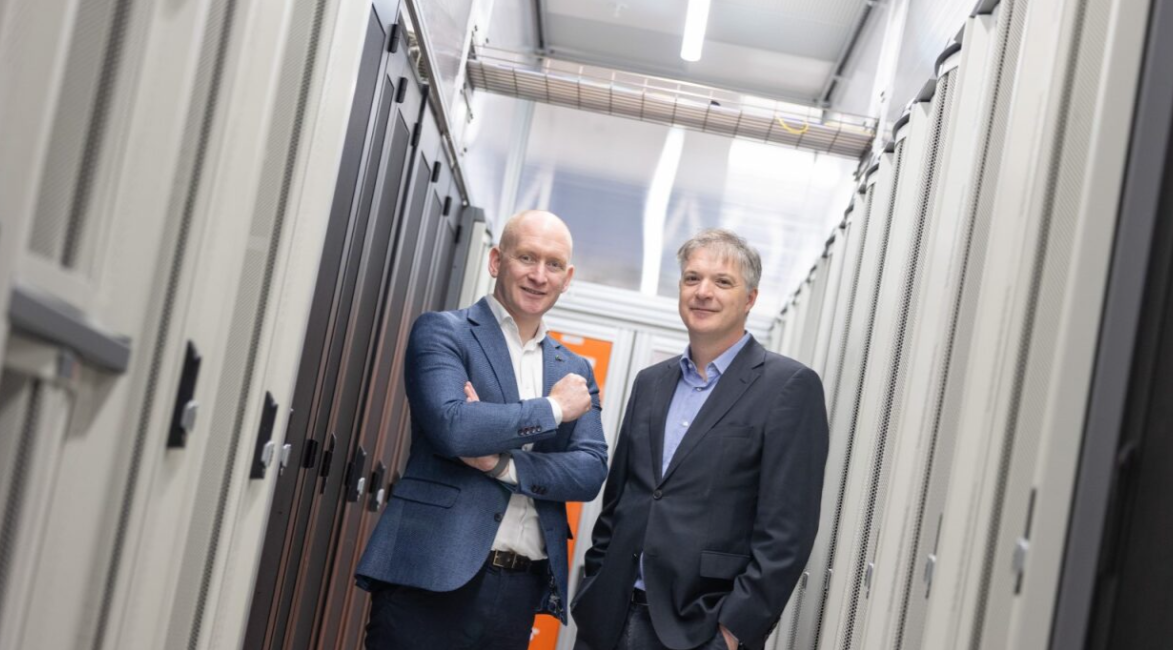
Qualcom, a leading Irish provider of IT and cybersecurity services, today announces that it is investing €500,000 to launch its new artificial intelligence (AI) practice. This investment will span three years and, in the continued expansion of its team, Qualcom plans to hire four AI specialists within this timeframe.

The new practice will support secure AI adoption for Irish organisations and enable them to align with evolving regulatory requirements. The investment includes a new partnership with AI infrastructure provider NROC and, as part of this, Qualcom will provide a full wraparound service to secure and manage customers’ AI environments, using NROC’s technology. The funding also includes the training and upskilling of new team members, as well as AI training for Qualcom’s existing managed services and infosec teams.

In turn, the new practice will further enable Qualcom to deliver AI-powered solutions that will secure customers’ Microsoft data, and to provide ultra-secure managed services to businesses. Qualcom has also developed a comprehensive AI policy framework designed to help organisations to incorporate AI tools such as Microsoft Copilot and ChatGPT into their daily operations, while safeguarding sensitive data and ensuring compliance,

The company is launching the new dedicated practice in response to heightened demand among customers for AI solutions, services, and capabilities to drive business growth and remain competitive.

This investment comes as Qualcom celebrated 30 years in business in 2025. The company recently announced that it has boosted the headcount within its support centre by 33%, and enhanced facilities at its Dublin headquarters to equip the business for continued growth.

David Kinsella, Technical Director, Qualcom, said: “This investment in our people, platforms, and capabilities reflects our commitment to supporting customers as they navigate both the opportunities and risks of AI. As we look ahead to the next three years, there’s no doubt that the use and applications of AI will continue to grow exponentially. The launch of the new practice will enable us to adapt quickly in line with industry demand, delivering right first-time services that are fully compliant and maximise IT uptime for businesses in Ireland. We’re looking forward to working closely with customers as we support the secure rollout of AI tools to help them to keep pace with their competitors.”

Microsoft achieves 100% renewable energy match for global electricity use

Microsoft today announced it has achieved a key sustainability milestone: matching 100% of its annual global electricity consumption with renewable energy as of 2025.

The milestone marks significant progress in Microsoft’s 2020 commitment to become carbon negative by 2030 and reflects more than a decade of investment in renewable energy infrastructure worldwide.

Since announcing its carbon negative ambition, Microsoft has contracted 40 gigawatts (GW) of new renewable energy capacity across 26 countries, working with more than 95 utilities and energy developers through 400+ contracts.

This milestone positions Microsoft among the largest corporate purchasers of renewable energy globally and reinforces the company’s leadership in driving market investment in carbon-free energy systems. According to Microsoft Ireland’s most recent economic and social impact report, the company has made an investment in 1GW of renewable energy capacity in Ireland.

In 2020, Microsoft announced a moonshot commitment to become carbon negative by 2030, accelerating work across our company to advance the partnerships and technologies needed to advance sustainability for our businesses, our customers and the world,” said Microsoft’s Chief Sustainability Officer, Melanie Nakagawa and President of Cloud Operations + Innovation at Microsoft, Noelle Walsh“A key milestone on this journey was our aim to match 100% of our annual global electricity consumption with renewable energy by 2025. Today, we are pleased to share that Microsoft has achieved this milestone. This progress helps drive investment into the power systems where we operate, expand clean energy supply and advance broader energy innovation.”

Driving global clean energy investment

Microsoft’s renewable energy journey began in 2013 with a single 110 MW power purchase agreement in Texas. Since then, its portfolio has expanded into one of the world’s largest corporate clean energy programmes, with partnerships with over 95 global energy suppliers.

The company has also pioneered innovative procurement models, helping scale repeatable and bankable clean energy frameworks across multiple markets, including first-of-their-kind corporate Power Purchase Agreement (PPAs) in Japan and hybrid renewable agreements in India.

Supporting communities and infrastructure

Microsoft’s renewable energy agreements have mobilised billions of dollars in private investment, supported thousands of jobs and embedded community-focused benefits including workforce training, local grants and infrastructure development. The company continues to work closely with energy developers and community partners to ensure clean energy projects deliver local economic and social value alongside environmental benefits.

Looking ahead: expanding carbon-free energy technologies

As global electricity demand accelerates – driven by electrification, AI and digital infrastructure – Microsoft says achieving 100% renewable energy matching is a milestone, not the endpoint.

Microsoft’s Climate Innovation Fund has allocated $806 million to 67 climate-focused investees, with 38% directed toward energy systems innovation.

The company is also deploying AI-driven tools to accelerate power system design, permitting and grid optimisation.

Why Irish Tech Companies Are Invisible to AI Search (And Losing Customers Without Knowing It)

A Growing Number of Business Decisions Now Start With an AI Query – Not a Google Search

Something fundamental has shifted in how businesses and consumers find service providers. When a procurement manager needs to shortlist software vendors, when a marketing director researches agency options, when a business owner looks for specialist expertise – increasingly, the first question goes to an AI assistant rather than a search engine.

ChatGPT, Google’s AI Overviews, Perplexity, Microsoft Copilot – these tools now handle a growing proportion of “who should I hire?” and “which company should I use?” queries. The businesses appearing in those AI-generated answers get considered. Those invisible to AI don’t even know they’ve been excluded from the conversation.

ProfileTree, the Belfast-based digital agency that works with tech companies across Ireland and the UK, has been tracking this shift since AI search tools gained mainstream adoption. The pattern emerging is clear: Irish tech companies with strong products and genuine expertise are losing visibility to competitors who’ve adapted their digital presence for how AI systems evaluate and recommend businesses.

This isn’t a distant future concern. It’s happening now, and most Irish tech companies haven’t recognised the shift – let alone responded to it.

The Shift from Rankings to Recommendations

Traditional search worked on a simple model: optimise your website, build backlinks, rank higher, get more clicks. Companies invested in SEO, achieved good rankings for target keywords, and generated steady organic traffic. This model still functions – but it’s no longer the complete picture.

AI recommendation operates differently. When someone asks an AI assistant “Who are the best cybersecurity firms in Ireland?” or “Which agencies handle B2B tech PR in Dublin?”, the AI doesn’t return a list of ten blue links to evaluate. It synthesises information from across the web and recommends two or three companies it deems most credible – often explaining its reasoning.

The implications are significant. In traditional search, appearing on page one meant visibility alongside nine competitors. In AI recommendation, appearing at all often means being one of just a handful of mentioned options. And not appearing means complete exclusion – prospects never learn your company exists.

Gartner and other analyst firms have projected that up to 25% of organic search traffic could migrate to AI-powered interfaces in the coming years. For B2B tech companies, where purchase decisions often begin with research queries, the shift may be more pronounced.

Why Strong SEO Doesn’t Guarantee AI Visibility

Irish tech companies that invested heavily in SEO over the past decade often assume those efforts protect them. They rank well for target keywords, generate steady organic traffic, and see their brand appear in traditional search results. This creates dangerous complacency.

AI recommendation rewards different signals than traditional SEO. Search engine optimisation focuses on technical factors, backlink profiles, and keyword targeting. AI recommendation focuses on clarity, consistency, credibility signals, and the breadth of your digital footprint across multiple sources.

A company might rank first on Google for “Dublin fintech development” through solid SEO work, yet never appear when someone asks ChatGPT the same question. The AI isn’t simply replicating Google’s rankings – it’s forming its own assessment of which companies are credible enough to recommend based on information synthesised from across the web.

This explains an emerging pattern: established players with strong SEO being overlooked while smaller competitors with clearer digital positioning appear in AI recommendations. The smaller company might have inferior backlink profiles but superior clarity – consistent descriptions everywhere, reviews on multiple platforms, clear statements of expertise. AI systems find them easier to understand and trust.

The pattern parallels other marketing blind spots in Irish tech. As explored in TechBuzz Ireland’s analysis of why Irish tech companies are failing at sustainability marketing, the sector repeatedly demonstrates strong operational capabilities but poor communication of those capabilities. AI visibility is the latest manifestation: companies doing excellent work that AI systems can’t identify or recommend because the digital signals are missing or muddled.

What AI Systems Actually Look For

Understanding what AI assistants evaluate when recommending businesses reveals why many Irish tech companies fail the test.

Clarity of identity and offering. AI systems need to understand precisely what a company does, who it serves, and where it operates. Vague descriptions like “innovative technology solutions” or “digital transformation partner” give AI nothing concrete to work with. Specific statements – “enterprise software development for financial services companies across Ireland and the UK” – are far more useful for AI trying to match queries to recommendations.

Consistency across sources. AI cross-references multiple sources when assessing a business. If your website describes you as a “software development agency,” your LinkedIn says “technology consultancy,” and your Google Business Profile lists “IT services,” the inconsistency reduces AI confidence. Companies with identical core descriptions across every platform signal reliability.

Third-party validation. AI systems weight independent sources heavily. Review profiles on platforms like Trustpilot, Google, Clutch, and industry platforms create external validation AI can reference. Press coverage, industry awards, directory listings, and professional body memberships all contribute. Companies relying solely on their own website claims lack the corroborating evidence AI needs to recommend with confidence.

Breadth of digital presence. Appearing across multiple credible platforms – industry directories, review sites, professional networks, local business listings – creates the distributed footprint AI trusts. A company with strong presence only on their own website appears less established than one appearing consistently across relevant platforms.

Specificity of proof. AI favours concrete, verifiable information over vague claims. Statements like “12 years in operation,” “worked with over 1,000 clients,” or “5-star rating across 450 reviews” give AI something to reference confidently. “Extensive experience” and “trusted by many clients” cannot be verified or cited.

ProfileTree, for example, has built the kind of distributed digital presence AI systems can assess: founded in 2011, over 450 five-star reviews on Google, 60+ five-star reviews on Trustpilot, presence on industry platforms, and consistent service descriptions across sources. These signals create the clarity AI needs when recommending digital agencies for Belfast and Northern Ireland queries.

The Sectors Facing Greatest Risk

Certain Irish tech sectors face disproportionate exposure to AI invisibility.

B2B SaaS companies depend on being discovered during research phases of purchasing decisions. When procurement teams and department heads increasingly use AI assistants for initial research, companies invisible to AI miss the shortlist entirely. Unlike consumer products where existing brand awareness might carry through, B2B tech purchases often begin with open-ended queries where AI invisibility can be fatal.

Professional services firms – consultancies, development agencies, managed service providers – compete in categories where AI recommendations carry particular weight. Queries like “best IT consultancies in Dublin” or “top software development agencies in Ireland” produce AI answers that directly influence which companies get contacted.

Emerging technology specialists in AI, cybersecurity, fintech, and medtech face intense competition where differentiation matters. These sectors attract new entrants constantly, and AI systems may recommend newer companies with clearer digital positioning over established players with stronger track records but weaker digital signals.

Regional tech companies outside Dublin face compounded challenges. AI systems drawing on web-wide data may default to Dublin-centric recommendations unless companies in Cork, Galway, Limerick, and elsewhere have explicitly clear geographic signals. A Galway software company with ambiguous location information might never appear in “tech companies in the West of Ireland” queries.

The Measurement Problem

Most Irish tech companies can’t quantify their AI visibility because they’ve never measured it. Traditional analytics track website visits, keyword rankings, and conversion rates – none of which capture whether you’re being recommended by AI assistants.

This measurement gap allows the problem to grow undetected. Companies continue investing in SEO and paid advertising while a growing channel – AI recommendation – delivers enquiries to competitors. Without tracking, the lost opportunities remain invisible.

Basic measurement requires regularly testing how AI systems respond to queries your customers might ask. What happens when you ask ChatGPT, Perplexity, or Google’s AI Overview “Who are the best [your category] companies in Ireland?” Does your company appear? How is it described? Which competitors show up instead?

Companies that conduct these audits often discover uncomfortable gaps between their perceived market position and their AI visibility. Testing takes minutes and costs nothing – yet most companies have never done it.

What’s Actually Required

Fixing AI invisibility isn’t about gaming algorithms or implementing quick tricks. It requires fundamental clarity about how you present your business across the digital landscape.

Audit your current state. Test AI responses to relevant queries. Document where you appear and where you don’t. Identify competitors who appear when you don’t and analyse what makes their digital presence more AI-friendly.

Establish consistent identity. Ensure your business name, description, location, and service offerings are identical across your website, Google Business Profile, LinkedIn, industry directories, and every other platform where you appear. Eliminate variations that create confusion.

Build distributed credibility. Develop presence across relevant platforms beyond your website. Industry directories, review sites, professional networks, local business listings, and sector-specific platforms all contribute to the breadth of footprint AI systems evaluate.

Accumulate third-party validation. Systematically build reviews across multiple platforms – not just Google. Pursue press coverage, industry recognition, and directory inclusions that create independent corroboration of your credibility.

Create AI-friendly content. Ensure your website contains clear, specific, factual statements about your expertise, experience, and credentials. AI systems need quotable information they can reference with confidence. Marketing language designed to sound impressive but say little gives AI nothing useful to work with.

Maintain and update. AI systems favour current information. Outdated content, old team information, and stale descriptions signal neglect. Regular updates demonstrate active, credible operation.

The Window of Opportunity

The current period represents an unusual opportunity for Irish tech companies willing to adapt quickly. AI search is growing but hasn’t yet become universal. Most competitors haven’t recognised the shift or taken action. Companies that establish strong AI visibility now build advantage before the market catches up.

This mirrors patterns from early SEO adoption. Companies that invested in search optimisation in the early 2000s built positions that later entrants struggled to displace. AI visibility may follow similar dynamics – early movers establishing presence that becomes difficult for latecomers to challenge.

The risk of inaction compounds over time. As AI assistants become more prevalent, the proportion of opportunities influenced by AI recommendations grows. Companies invisible to AI today lose a small percentage of potential business; the same companies invisible to AI in two years may lose dramatically more.

Ciaran Connolly, founder of ProfileTree, puts it directly: “Irish tech companies have spent years building products, expertise, and reputations that genuinely deserve recognition. The frustration is watching them miss opportunities because AI systems can’t find or understand them. AI visibility isn’t about being the best – it’s about being clear enough that AI can see what you offer.”

The Broader Context

AI invisibility connects to broader challenges in how Irish tech companies communicate their value. Strong operational capabilities paired with weak external communication is a recurring pattern – evident in sustainability marketing challenges, employer branding struggles, and now AI search visibility.

The common thread is a gap between what companies actually do and what the outside world – including AI systems – can perceive and understand. Closing that gap requires treating external communication with the same rigour applied to product development and operations.

For Irish tech companies, the immediate priority is clear: assess your current AI visibility, identify gaps, and begin building the digital presence that AI systems can understand and trust. The companies taking action now will capture opportunities; those waiting will wonder why enquiries are going elsewhere.

Frequently Asked Questions

How do I check if my company appears in AI recommendations?

Test the AI assistants your customers might use – ChatGPT, Google’s AI Overview, Perplexity, Microsoft Copilot. Ask questions like “Who are the best [your service] companies in Ireland?” or “Which [your category] providers should I consider in [your city]?” Note whether you appear, how you’re described, and which competitors are recommended instead. Repeat monthly to track changes.

Does Google ranking still matter if AI is becoming important?

Traditional Google rankings still matter significantly – AI hasn’t replaced conventional search, and won’t entirely. However, AI recommendation is growing as an additional channel. Companies need both: strong SEO for traditional search visibility and clear digital presence for AI recommendation. The clarity that helps AI visibility often improves traditional SEO performance too.

How long does it take to improve AI visibility?

Meaningful improvement typically takes three to six months of consistent effort. Some elements – fixing inconsistencies, updating content – can be addressed quickly. Others – building reviews, accumulating press coverage, establishing directory presence – require sustained activity over time.

Is this relevant for smaller companies or mainly large enterprises?

AI visibility may actually benefit smaller companies more than large ones. AI systems don’t automatically favour market leaders – they favour clarity and credibility signals. A focused smaller company with clear positioning, strong reviews, and consistent presence can appear in AI recommendations ahead of larger competitors with muddled digital footprints.

What’s the single most important thing to fix first?

Consistency. Ensure your business description, services, and location are identical across your website, Google Business Profile, LinkedIn, and any directories where you appear. Inconsistencies are a common reason AI systems lack confidence to recommend businesses. This fix requires no budget – just attention to detail across platforms you already control.

ProfileTree is a Belfast-based digital agency working with tech companies across Ireland and the UK on web design, SEO, content strategy, and AI visibility. The agency holds 60+ five-star reviews on Trustpilot and over 450 five-star reviews on Google, demonstrating the distributed review presence that influences AI recommendation.

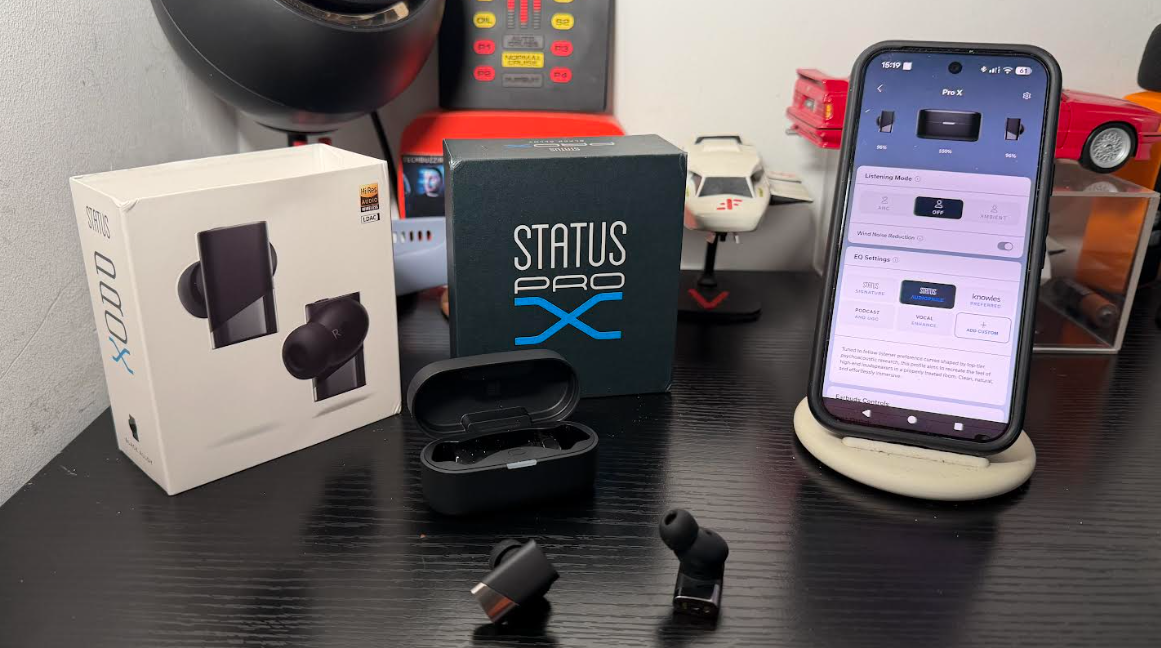
Status Pro X Earbuds Review

The Status Audio Pro X earbuds are the company’s latest flagship release, aimed squarely at listeners who prioritize exceptional audio quality above all else. Building on the foundation of their previous models (like the Between 3ANC), the Pro X delivers a technically impressive and immersive listening experience, not tested the previous models and can see no reason to need to do so after testing these out.

The single biggest selling point of the Pro X is its internal hardware: a hybrid triple-driver system in each earbud. This setup includes a large 12mm dynamic driver for powerful, controlled bass, and two Knowles balanced armature drivers dedicated to handling the mid-range and high frequencies.

  • Detail and Clarity: This multi-driver approach pays off immediately. The audio fidelity is fantastic, offering outstanding clarity and resolution. You can pick up nuances, instrumental separation, and vocal textures that often get lost in single-driver earbuds.
  • Tuning: Out of the box, the sound signature is dynamic and engaging, featuring deep, tight bass that doesn’t overwhelm the clear mids and crisp, detailed highs. For those who like to customize, the companion app offers an 8-band equalizer (EQ) and presets, including the well-regarded “Knowles Preferred” curve.
  • Hi-Res Audio: The inclusion of advanced Bluetooth codecs like LDAC (for Android users) and the future-proof LC3 means the Pro X can stream high-resolution audio (up to 24-bit/96 kHz), truly utilizing the capability of the triple drivers.

Status has refined the design, making the Pro X significantly smaller and lighter (about 20% smaller) than its predecessors.

  • Fit: They maintain the unique, stemmed, elliptical design but sit more snugly in the ear. While they no longer use the silicone “fitwings,” the ergonomic shape, combined with the multiple included eartips, ensures a secure and comfortable fit for most users, even during long listening sessions and always check for the best tips the ones on might not be the best for everyone.
  • Build: They are rated IP55 for water and dust resistance, making them durable enough for gym use and everyday weather.
  • Controls: The touch controls are reliable and responsive and no issues after some time using them like any other earbuds it is all about the thumb memory.

The Pro X offers hybrid Active Noise Cancellation (ANC) that is a massive improvement over previous Status models.

  • ANC Performance: The ANC is highly effective, especially at canceling out consistent low-frequency noises like airplane engines or office hums, reaching up to -52dB of reduction. It’s solid for daily commutes and focusing, overall decent especially in low noise enironments where you can get the best experience.
  • Transparency Mode: The ambient/transparency mode is functional but can sound a bit “artificial” compared to industry leaders.
  • Call Quality: Call clarity is excellent thanks to six beam-forming microphones and Voiceloom AI speech enhancement technology, which effectively suppresses background noise during calls.
  • Connectivity: Features like Multipoint connectivity (allowing simultaneous connection to two devices), Google Fast Pair, and Microsoft Swift Pair work flawlessly and are great for hybrid work. They use the latest Bluetooth 5.3 standard.
  • Battery Life: Status claims up to 8 hours of playback per charge, with 24 hours total from the case. This will vary per user and their setting as with any earbuds or headphones ANC does impede greatly on any.
  • Charging: The case supports both USB-C charging and wireless (Qi) charging ideal for those like me who has adopted this all over my house and office.

The Status Audio Pro X earbuds are designed for the audio enthusiast— A person who can tell the difference between a high-bitrate stream and a standard one. As having the biggest range of earbuds reviewed in Ireland I can confirm these are the dogs, you know what.

Check the video below for a look at the app and more.

Status Hub App


Features

Hybrid Active Noise Cancelling
Block out distractions with over 52db of powerful noise reduction.

Optical Wearing Sensor
Auto-detects when they’re in your ears.

Voiceloom AI Speech Enhancement
Clear calls, even in noisy environments.

Six Beam-Forming Microphones
Radically improved ANC, Transparency Mode, and Call Quality.

Bluetooth® 5.3 with Advanced Codecs
SBC, AAC, and LDAC — delivering 24-bit/96 kHz audio at bitrates up to 990 kbps.

Bluetooth LE Audio and Auracast Support
Future-proofed for the next generation of Bluetooth, with LC3 codec support.

Triple Driver Acoustic System
12mm Dynamic Driver + Dual Knowles Balanced Armature Drivers.

Transparency Mode

Let in ambient sound with a click. Stay aware, stay connected.

IP55 Water & Dust Resistance
Handles sweat, splashes, and dirt.

Long-Lasting Battery Life
8 hours per charge, 24 hours total with the included charging case.

Status Hub App
Fine-tune your sound, manage your earbuds, and more in the Status Hub app for iOS & Android.

Superior Connectivity
Multipoint Connectivity. Android Fast Pair. Microsoft Swift Pair.

Wireless Charging
The Pro X support Qi Wireless Charging.

Sidetone Feature
External mics amplify your own voice during phone calls, so you don’t have to yell.

Find Lost Earbuds
GPS Tracking of lost earbuds with sound notifications.

BUY

Other earbud reviews

Video Review

Core42 Establishes European Headquarters in Dublin

Core42, a G42 company specializing in sovereign cloud and AI infrastructure, today announced the establishment of its European headquarters in Dublin, Ireland. The news was shared at Investopia, the UAE’s global investment platform, which is hosting its global dialogue series in Dublin this week. The new headquarters strengthens Core42’s ability to serve European enterprises and governments seeking secure, high-performance infrastructure to scale AI adoption.

Core42 was founded in 2023 by G42 to build globally relevant infrastructure for large-scale AI. The company focuses on sovereign cloud, advanced compute platforms, and hyperscale AI environments that support production-grade AI across sectors. Core42 partners with Microsoft, NVIDIA, AMD, Cerebras, and other global ecosystem leaders to ensure customers have access to the latest accelerators, models, and architectures.

Through its AI Cloud platform, Core42 provides fast, self-service access to high-performance compute for training, inference, and large-scale experimentation. Its services portfolio, managed delivery functions, and AI solutioning capabilities support customers through cloud modernization, data readiness, and the full AI adoption lifecycle.

Since 2024, Core42 has expanded its European presence through a series of large-scale sovereign compute initiatives. In France, Core42 partnered with Data One and Oreus to deliver a national-scale AI infrastructure deployment in Grenoble that supports high-performance enterprise and public sector workloads. In Italy, the company collaborated with Domyn to build Europe’s largest AI compute cluster, creating a strong foundation for an AI-first economy and accelerating the region’s ability to scale advanced AI solutions.

Establishing the European headquarters in Dublin marks the next phase of this expansion. The office will act as the regional hub for customer delivery, engineering leadership, regulatory engagement, and ecosystem partnerships. It positions Core42 to work more closely with European institutions and industry leaders as demand for scalable AI infrastructure accelerates across key sectors.

Commenting on the milestone, Talal M. Al Kaissi, Interim CEO of Core42, said: “Europe is a central part of Core42’s global expansion strategy. Establishing our headquarters in Dublin gives us the operational base to support growing demand for high-performance AI infrastructure and to work more closely with customers and partners as they scale production-grade AI across key sectors.”

Also at Investopia, Core42 together with Emerging Markets Intelligence and Research (EMIR), released a report that explores the infrastructure, policy, and investment conditions required for Europe to accelerate its AI capabilities. The report draws on comparative insights from the rapid AI scale-up in the UAE and provides practical guidance for governments, investors, and enterprises developing sovereign-aligned AI ecosystems. To download the report, click here.

Core42 will begin formal operations in Dublin in early 2026, with plans to expand engineering, customer success, and partner ecosystem teams throughout the year.

Dell Technologies and Microsoft redefine Hybrid Cloud with Azure local integration

Dell Technologies today announced a major advancement in hybrid cloud innovation through the integration of Microsoft Azure Local with Dell Private Cloud and Dell PowerStore. This collaboration marks a significant step forward in simplifying IT operations for enterprises, delivering a unified approach to managing diverse workloads across hybrid and multicloud environments.

The conversation around enterprise IT has shifted dramatically. Businesses are no longer faced with a binary choice between public cloud and on-premises infrastructure, nor is it simply about running traditional versus modern workloads. The real challenge lies in managing these varied environments consistently and efficiently. Dell Technologies, in partnership with Microsoft, is addressing this challenge head-on by introducing Azure Local support for Dell Private Cloud and Dell PowerStore, creating a seamless experience for organisations seeking flexibility, performance, and enterprise-grade resilience.

Dell Private Cloud represents the first Azure Local offering to deliver a full-stack solution encompassing compute, external storage, and networking from a single vendor, backed by end-to-end solution-level support. This integrated approach simplifies the complexity of hybrid and multicloud management, enabling businesses to focus on innovation rather than infrastructure. With automated lifecycle management, independent scaling of compute and storage, and a future-ready disaggregated architecture, Dell Private Cloud empowers organisations to adapt to evolving demands without disruption.

Complementing this is Dell PowerStore, Dell’s flagship enterprise all-flash storage platform. PowerStore brings advanced data efficiency, flexible scalability, and robust security to Azure Local environments, ensuring critical workloads remain protected while delivering exceptional performance. Its ability to handle both traditional and modern workloads makes PowerStore the ideal partner for businesses modernising their IT operations without compromise.

Caitlin Gordon, Vice President of Product Management for Private Cloud and AI Solutions at Dell Technologies, said: “The conversation around enterprise IT is changing. It’s no longer about choosing between public cloud and on-premises infrastructure. Nor is it a simple decision between running traditional or modern workloads. Today, the real challenge is how to manage all of these different environments and application types together, simply and consistently. By bringing Microsoft Azure Local to Dell Private Cloud and PowerStore, we’re helping customers simplify their IT operations and unlock the full potential of their hybrid cloud strategies.”

This integration is more than a technical milestone; it reflects Dell Technologies’ commitment to helping customers navigate the complexities of modern IT. Together with Microsoft, Dell is delivering solutions that meet the evolving needs of businesses, from hybrid cloud to edge computing and beyond. Early access for this combined offering is expected to launch in spring 2026, paving the way for organisations to embrace a future-ready infrastructure that drives innovation and growth.

Ergo named Microsoft Ireland Azure Partner of the Year

Ergo, Ireland’s leading IT solutions provider, has been named Microsoft Ireland Azure Partner of the Year 2025. Ergo received this prestigious award for its consistent excellence in leveraging Microsoft Azure technologies to drive transformative results for organisations.

This recognition highlights Ergo’s leadership in cloud migration and digital transformation, emphasising the company’s exceptional Azure expertise and its ability to deliver innovative and impactful cloud solutions. Ergo was distinguished by its ability to lead large-scale Azure migrations and deliver Azure AI solutions that address complex business challenges while prioritising security, cost efficiency, and agility.

Microsoft commended Ergo’s technical depth and its year-on-year growth with a strong focus on helping customers modernise their IT environments. The company’s track record of supporting organisations in migrating to the cloud and leveraging technology to improve efficiency and resilience was also highlighted.

Commenting on the announcement, Steve Blanche, CTO at Ergo, said:

“We are immensely proud to be named Microsoft Ireland Azure Partner of the Year once again. This award is a testament to the expertise and commitment of our people, who go above and beyond to deliver genuine value for our customers every day. Over the past three decades, we have built a strong and lasting partnership with Microsoft, one that continues to develop as technology advances. Together, we are helping organisations in Ireland to adapt, innovate, and maximise their investment in the cloud.”

Clare Hillis, Enterprise Partner Lead at Microsoft Ireland, extended her congratulations and added:

“Ergo has excelled at delivering impactful transformation for our customers, successfully managing some of the largest and most complex cloud migrations this year. Throughout this period, we have seen Ergo and our customers working in strategic partnership and going from strength to strength. I’m absolutely delighted to congratulate Ergo on this recognition, as there is no partner over the last 12 months that has deserved this award more.”

This latest award highlights the depth of expertise and collaboration between Ergo and Microsoft, reinforcing their shared commitment to support organisations in Ireland on their digital transformation journeys.

Ergo has also renewed its certification as a Microsoft Azure Expert Managed Service Provider. Having first achieved this elite accreditation in 2021, Ergo has successfully passed a rigorous independent audit of its IT service management capabilities across people, process, and technology. This certification confirms Ergo’s ability to deliver consistent, repeatable, innovative managed services on Azure, meeting the highest standards set by Microsoft for technical capability, customer service, and operational excellence.

Together, these achievements reinforce Ergo’s recognition as Azure Partner of the Year 2025 and reaffirm its position as one of Ireland’s leading Azure partners.

You can find more information on Ergo’s cloud migration and AI capabilities here.

Dell and Microsoft roll out integrated file storage for AI-era workloads

Businesses in Ireland can now leverage Dell PowerScale for Microsoft Azure, a scalable, high-performance enterprise-class file storage solution, integrated with Azure to support modern AI workloads.

Co-developed with Microsoft as an Azure Native Integration, Dell PowerScale provides a fully managed cloud-native deployment of PowerScale software on Azure infrastructure. The solution aims to accelerate AI initiatives, manage media production, and ensure business continuity, empowering organizations to achieve their next breakthrough.

“In today’s fast-paced digital landscape, enterprises need more than just storage, they need a platform that drives innovation, scales effortlessly, and adapts to their most demanding workloads. Dell PowerScale for Microsoft Azure is purpose-built to meet these needs,” said David Noy, Vice President of Product Management at Dell Technologies. “Co-developed with Microsoft, this enterprise-class file storage solution delivers high performance, robust security, and seamless integration, empowering organisations to achieve their next breakthrough. From accelerating AI and managing media production to ensuring business continuity, PowerScale for Azure is the foundation for success in the data-driven era.”

Built on a proven foundation, Dell PowerScale for Microsoft Azure is an Azure Native integration co-developed with Microsoft and built on a legacy of storage leadership. This is enterprise-class file storage, purpose-built for today’s most demanding workloads and managed by the experts at Dell. With NVRAM-enabled custom compute SKUs engineered exclusively for Dell, PowerScale for Azure delivers blazing-fast performance up to four times greater than the closest competitor.

The solution has been designed to offer ultra-low latency and optimized to handle even the most data-intensive applications with ease. PowerScale for Azure allows organisations to scale out rapidly and efficiently, supporting up to 8.4PB of storage in a single namespace. It also supports NFS, SMB, and S3 protocols running simultaneously, so teams can support a broad range of applications and avoid the limits of single-purpose solutions or vendor lock-in.

The familiar, unified PowerScale interface ensures operational simplicity and a consistent user experience whether data is on-premises or in Azure. Fully managed by Dell experts, PowerScale handles deployment, upgrades, monitoring, and support, delivering robust, proactive management every step of the way. With zero-trust architecture, always-on encryption, continuous backup, and built-in ransomware recovery, organisations can face threats with a hardened defence posture.

PowerScale supports production workloads across every industry vertical. Media & Entertainment companies can handle massive video files, real-time editing, and tight production timelines with high-speed hybrid data environments. Production teams can scale up for big releases, scale down when projects close, and focus on creativity, while robust security protects critical media assets. Electronic design automation produces massive datasets and demands fast, collaborative workflows.

PowerScale accelerates simulation, modelling, and design workflows, enabling global design teams to work together, handle simulation spikes, and move products to market faster. Life Sciences organisations can analyse large datasets, run simulations, and drive discoveries with high-performance access and secure, compliant storage. PowerScale allows scaling as clinical projects advance without service disruption.

Downtime and data loss aren’t options. PowerScale for Azure streamlines disaster recovery by enabling asynchronous replication into Azure with SyncIQ, extending data protection across environments to ensure compliance and rapid recovery in the event of disaster.