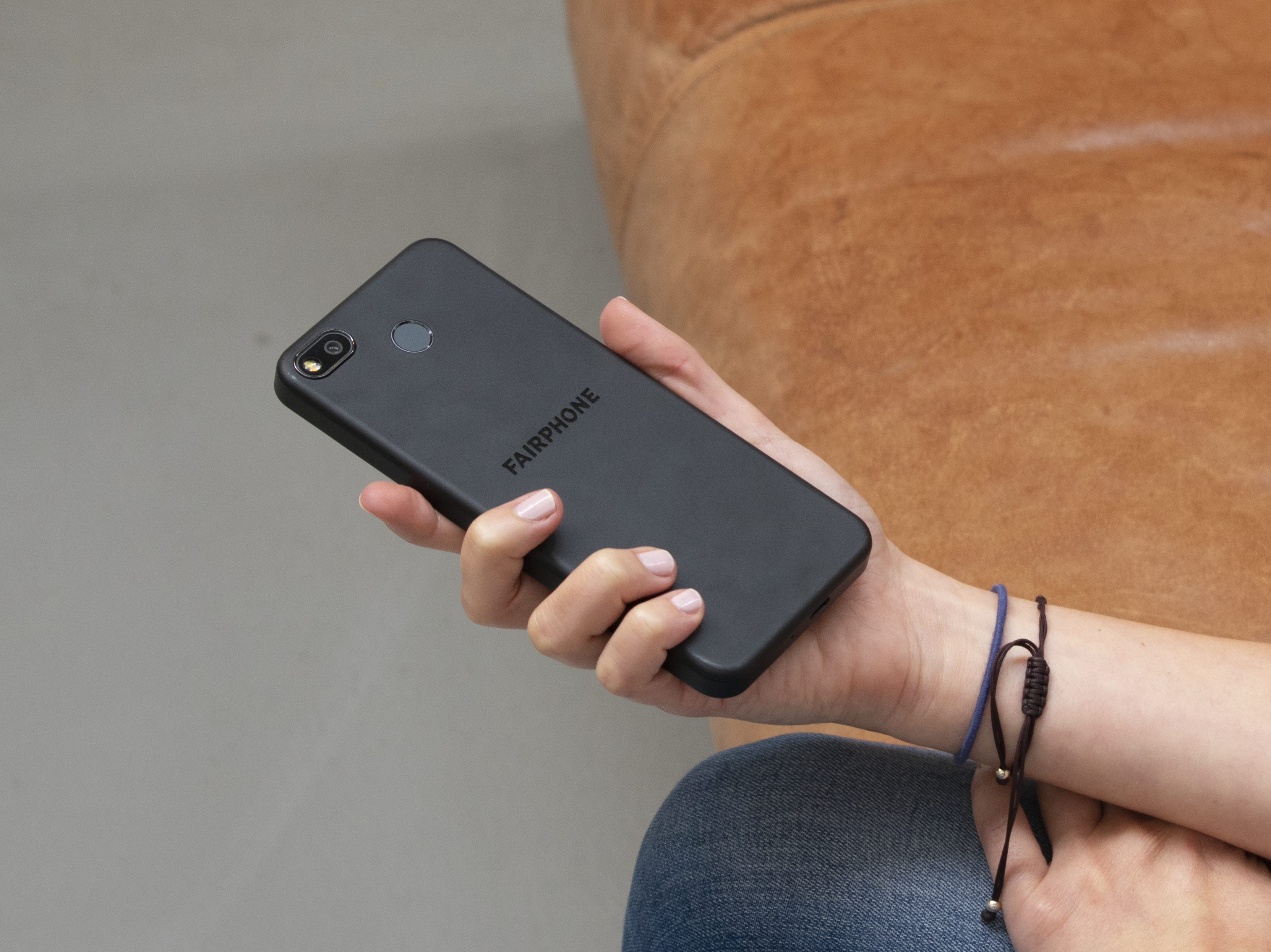
Fairphone 4 now available with /e/OS software

Fairphone, the Dutch social enterprise building a market for ethical phones and motivating the industry to act more responsibly and /e/OS, the privacy by design operating system that focuses on protecting user data, have announced /e/OS for Fairphone 4.

/e/OS and Fairphone have partnered to provide Fairphone users with a privacy by design operating system since Fairphone 3. Fairphone has always valued open source software as a way of reaching its goal of bringing more fairness to software. The collaboration between Fairphone and /e/OS is the first of its kind, providing users with the first 5G privacy conscious and sustainable smartphone. With /e/OS, Fairphone continues to provide its users with options when it comes to privacy, allowing them to choose from the standard Android OS and /e/OS, for those who value the protection of their personal data.

Similar to previous Fairphones, Fairphone 4 is built to last. Thanks to the modular construction and spare parts, anyone can make repairs with a standard screwdriver. Fairphone has also introduced a 5-year warranty, ensuring that the phones keep running smoothly (and securely) for years to come and lowering their environmental footprint. The device was given the highest iFixit score on the market – 10/10 – and has received a 9.3 in the French Repairability Index. Fairphone 4 is also the first modular phone with an IP rating. It has a rating of IP54, meaning that the device is protected from dust-ingress and protected from rain.

Fairphone 4 offers a step up in tech specifications. It has up-to-date specs such as three high-quality cameras, a future-proof 5G with dual SIM, a powerful processor, and a fast-charging battery. The camera comes with a pair of premium lenses — a 48MP main camera for all the details and a 48MP ultrawide camera for the bigger picture — and to top it off, a 25MP selfie camera. The device is also the only smartphone on the market with the Blue Angel certificate and the first smartphone certified according to TCO Certified, a third-party sustainability certification for IT products.

Eva Gouwens, Fairphone’s CEO comments: “We’re happy to be able to provide the users of our latest device, Fairphone 4, with the option of using privacy by design software like /e/OS. At Fairphone, we work to provide our users with alternative options for not only sustainability but also privacy conscious software.”

Gaël Duval, /e/OS founder states: “We are extremely happy to take our partnership with Fairphone one step further towards a more sustainable smartphone that cares about your data and is built to last. This combination of a modular design and built-in data privacy makes this phone a unique proposition on the market”.

The Murena Fairphone 4 is available to purchase on the Murena online shop for RRP 629,90€ across Europe.

Fairphone raises the standard for a fair circular economy with 14 materials. #Fairphone

Fairphone, the Dutch social enterprise building a market for ethical smartphones, has announced a shortlist of 14 materials that show high usage in the electronics industry and offer the greatest potential for supply chain improvement. These are aluminium, cobalt, copper, gold, indium, lithium, magnesium, nickel, plastics, rare earth, silver, tin, tungsten and zinc. Fairphone analysed over 50 materials found in smartphones, resulting in a selection that will guide its responsible sourcing efforts in the coming years. Fairphone makes the most of the materials used in its products and is moving towards a circular economy by using materials from more responsible sources, while emphasizing reuse and recycling and designing phones to last as long as possible.

The evaluation used a range of criteria including:

  • Market demand growth expected in the coming decades and availability of recycled supply
  • The share of the electronics industry in the worldwide demand for the material
  • Whether the material is critical to smartphone functionality
  • Whether it will be present in future Fairphone products and accessories
  • If there are serious social and environmental issues related to the material’s extraction or recycling

While many of the materials analyzed had serious issues to consider, these 14 materials provide Fairphone with the most potential to make a significant impact and show the most urgent need for intervention.

The global electronics industry is a fast growing sector with a complex supply chain. Minerals found in common consumer electronics, such as smartphones, are mined, traded and refined into usable material to manufacture components. Unfortunately, the working environment in the mines can be unsafe with issues of child labour, environmental degradation, and hazardous working conditions recorded. As a result, the electronics industry tends to shy away from it, placing more emphasis on recycling as the solution for the industry’s sourcing issues. Yet, millions of people around the world – particularly in developing economies – rely on the sector for their livelihoods. Artisanal and small-scale mining (ASM) is an especially critical source of income for millions of people and as a result, Fairphone is focussing on ASM to make improvements in the sector.

Although Fairphone envisions a world that is truly circular, it’s still far away from becoming reality. Mining will remain a key supplier in the coming years, as the idea that recycling alone will be able to meet humanity’s growing demand is a fairytale. In the coming decades, the population growth and economic development around the world are expected to lead to a sharp increase in demand for metals and non-metallic minerals that are key for the green energy transition. A report by World Bank Group found that demand for some minerals will increase nearly 500% by 2050. Yet, of all electronic waste generated, only 5% of materials are estimated to be recovered for reuse.

Since mining will be a source of materials in the coming decades, the electronics industry must work to improve the mining supply chain as well as increase the recycled material supply. Fairphone’s aim is not to avoid hotspots where social and environmental challenges exist, such as conflict and high-risk areas, instead Fairphone works towards lasting improvements in those areas. It sources where the majority of electronics manufacturing and mining takes place in order to drive improvements for the sector overall. Fairphone’s mission is to set the example across its own supply chain and products, using its market demand as a catalyst for continuous improvement that creates a positive impact for people and planet, and engage with the wider consumer electronics industry to scale its impact.

Tirza Voss, Sustainable Materials & Mining Manager at Fairphone states“At Fairphone our vision is clear: we want to foster a fair transition to a more circular economy. This is a transition in which investment is not only made in increasing the recycled supply but also to ensure that for the materials where the mining sector remains a key supplier in the coming years, the sector operates more sustainably and drives a lasting and diversified development in emerging economies. Responsible sourcing means tackling issues in the supply chain and driving opportunities for change, rather than avoiding risk. We want to inspire the rest of our industry to follow our approach to fair material sourcing.”

 Boukje Theeuwes, Head of Policy Influencing at Solidaridad Europe responds: “With 44 million small-scale miners supplying numerous industries with essential raw materials, the idea of a sudden and complete shift to recycled materials is a fairytale. Today, two thirds of all gold supplied is newly mined. We fully support the move towards circularity in supply chains, but in the long interim period that remains, it is crucial that we invest in the development of responsible ASM mining practices. The recycled material of tomorrow is being mined today. We need a dual approach that encourages recycling while ensuring, through investment and engagement, that the materials being mined right now are extracted responsibly. This means that when we achieve a truly circular supply, it won’t have come at the cost of miners, their communities and the environment.”

Fairphone launches Fairphone 3+ with updated camera modules. #Fairphone3 #Tech

With the launch of two new camera modules, Dutch social enterprise Fairphone has once again taken an innovative approach to smartphone longevity and sustainability. Starting today, the camera modules will be available separately, for current users, or in the upgraded version of the Fairphone 3 for new users: the Fairphone 3+. This achievement is the company’s latest step in their journey to create fairer, long-lasting, high-quality devices.


In the electronics industry, rapid technological advances have led consumers to believe that the next big thing is always just around the corner. However, in reality, the latest gadget is rarely life changing, and smartphones are becoming more similar than ever before, with only incremental improvements from one model to the next.


The current consumer (and industry) mindset means that 1.4 billion mobile phones are sold every year – often replacing a device that still works just fine. Today, people only keep their phones on average for 2.7 years, and less than 5% of the materials used can be recovered for reuse. This behavior contributes to the issue of electronic waste (e-waste), which is the fastest growing waste stream worldwide. Excessive consumption also puts a strain on natural resources, and contributes to the ongoing social and environmental issues in every part of the supply chain, from the mines to the factories.


One of the ways to positively impact all of these problems is to use phones for as long as possible. This is exactly what Fairphone is enabling with the launch of the Fairphone 3+. The latest phone – an upgraded version of the Fairphone 3 – contains new camera modules to significantly improve the photo and video quality, as well as improved audio with louder, crisper sound. The refresh upgrades the rear camera from 12 megapixels to 48 megapixels, and the front camera from 8 megapixels to 16 megapixels – giving users sharper selfies and clearer video calls.

The cameras also feature enhanced object tracking, faster autofocus and image stabilization for more reliable shots. In addition, software optimization provides an outstanding user experience. Besides technical improvements, the Fairphone 3+ contains 40% recycled plastics, the equivalent of one 33cl plastic bottle, which is a much higher percentage than Fairphone 3 (9%).


However, this improved experience isn’t only available to new Fairphone buyers – because the camera modules are sold separately, current Fairphone 3 users can upgrade their devices for as little as €70 until the end of September and €94.90 as of 1 October. This encourages users to keep their phones longer, while easily accessing the latest functionality at the same time. Fairphone’s recent life cycle assessment found that keeping the Fairphone 3 or other mobile devices for five to seven years – one of Fairphone’s key ambitions – could reduce the phone’s CO2 footprint by 28-42%. However, many industry-wide barriers to smartphone longevity remain, including continued software support and ensuring long-term availability of spare parts.


The rest of the technical specifications of the Fairphone 3+ are similar to the Fairphone 3, such as a Qualcomm 632 processor, 64GB memory (expandable to 400GB with a MicroSD card), a replaceable 3000mAh capacity battery and sturdy Gorilla® Glass 5. As with previous models, it also contains replaceable modules to encourage easy repairs, further supporting Fairphone’s goal of creating sustainable, long-lasting phones. The Fairphone 3+ comes pre-installed with Android 10, which will also be available for the current Fairphone 3 users starting in the first half of September.

On top of all this, what sets Fairphone apart is what the company refers to as “fair specs”. With every new phone it develops, Fairphone is expanding on existing projects and introducing new initiatives to make its supply chain fairer for all those involved. Sales of the Fairphone 3+ and the upgraded camera modules will contribute to:

  • Collecting e-waste in Europe and abroad, plus sourcing Fairtrade gold, fair cobalt and conflict-free tin and tungsten from high risk areas, as well as recycled copper.

  • Improving conditions in small-scale cobalt mines in the Democratic Republic of the Congo and gold mines in Uganda.

  • Launching the Circular Module Program for Fairphone 3 and Fairphone 3+, encouraging customers to send back their old or broken modules free of charge to give them a second life. The program is currently being launched in Germany with iFixit, and in France with our repair partner, Cordon. Other countries will be added in the near future.

  • Employee satisfaction programs and living wage bonuses for factory workers in China.


Fairphone CEO Eva Gouwens sums up the company’s goals for the camera upgrades and  Fairphone 3+, commenting:


“We believe that we must make the most of the materials used in consumer electronics. We’re moving one step closer to a circular economy by encouraging the reuse and repair of our phones, plus making it easier for users to keep their devices for longer. The launch of the new camera modules and the Fairphone 3+ is a concrete example of how we’re making this possible. By showing that it is commercially viable to care for people and the planet , we want to motivate the electronics industry to act more responsibly.”

From Now, the Fairphone 3+ will be available for presale on Fairphone’s website and via partners for a suggested retail price of €469. The device will be released on 14 September and will be available across Europe from selected (online) retailers and operators.