FREE NOW goes electric in Cork, Galway and Limerick

New Eco booking option allows more passengers across Ireland to book hybrid or electric taxi on FREE NOW app at no extra cost.

Ireland’s leading multi-mobility app FREE NOW, today announced the expansion of its Eco booking service in Cork, Galway and Limerick. From today passengers in these cities can choose more sustainable transport options by selecting a hybrid or electric taxi on the app at no extra cost. Today’s announcement forms part of FREE NOW’s sustainability strategy – Move to Net-Zero programme – which includes immediate offsetting and long-term Net-Zero efforts with the goal of achieving 50% fully electric vehicle rides by 2025 and 100% zero emissions by 2030.

The national expansion of the new Eco booking service into major cities across Ireland coincides with European Mobility Week 2021 which takes place from the 16th-22nd September to support sustainable transport across Ireland. Following the initial launch of its Eco booking option in Dublin last year, FREE NOW has experienced a huge demand from the public for environmentally friendly transport choices with eco trips in Dublin soaring by 146% between September 2020 and July 2021.

According to new research conducted by FREE NOW, 87% of passengers are worried about climate change and 60% would like to have sustainable transport as a default booking option on the app. Furthermore, 58% believe that there are too many private cars on the road, and 17% stress that private vehicle dependency is one of the main transport difficulties in their area. The vast majority (97%) also think that businesses should make it easier for consumers to adopt greener habits through their services.

Niall Carson, General Manager at FREE NOW Ireland: “We are delighted to announce the launch of Eco bookings for drivers and passengers across Cork, Galway and Limerick. Supporting the national effort to develop a more sustainable transport system across Ireland is a crucial part of our sustainability strategy, and the expansion of our electric offering is a key milestone in reaching our target of a 50% EV fleet by 2025, and 100% net zero emissions by 2030.

The demand from our passengers for more environmentally friendly transport is extremely positive with 84% saying they would choose a sustainable booking option if it was available, so we are delighted to make this a reality at no extra charge for people as we continue to expand our electric offering. 

It is crucial that our drivers are also enabled to make the switch to an EV vehicle in order to support our national expansion. We have developed a dedicated EV expert team which provides our drivers with ongoing advice, webinars and support throughout their switch. We have also invested 6 million euro this year to help taxi drivers across the country purchase home chargers for EVs – making charging easier and encouraging more drivers to go electric.

A smart and sustainable transport infrastructure will play a vital role in our journey to reach the government’s target of carbon neutrality by 2050, and we hope to build on today’s Eco booking launch in Cork, Galway and Limerick in the coming months with continued expansion nationwide.” 

FREE NOW sustainability commitment across Europe

FREE NOW has integrated almost 130,000 new electric vehicles in the app in order to widen its green mobility offer and become the mobility platform with the biggest vehicle choice in Europe. By the end of 2021, FREE NOW expects to complete 4 million rides with multi mobility partners such as TIER & VOI (Scooters , EMMY & Cooltra (Mopeds), Miles & ShareNow (car sharing) on the app.

FREE NOW is also working with ClimatePartner to develop offset projects to compensate for the current output of CO2 emissions produced by both the company and its services.

In total, FREE NOW is offsetting 173,000 tons of CO2 emissions with three projects in Madre de Dios, Peru (dedicated to protecting a threatened piece of the Amazon); in Indonesia (extending wind energy in the region and developing rural areas); and in Europe (supporting the afforestation and the change of local forests by regional tree planting).

How Do Electric Cars Work?

Electric cars, as the name suggests, run on electricity. Their rechargeable batteries power the electric motor that turns the wheels. Due to the increased acceleration in the wheels, the vehicles tend to be faster and lighter than traditional cars. If you’re in the market for one, Carplus will help you understand how it works and find you the ideal car if you need one. Let’s find out what makes the electric car the possible future of car travel.

Batteries

The placement of a car battery helps to maintain the center of gravity low, thereby keeping the car from oversteering off the path in corners. For this reason, the battery in an electric car is usually placed low down in the car or, in some cases, run along the floor. Since the entire machine now runs on electric power, these cars have an auxiliary battery to cover the smaller electronics like the lights, windows, and so on. This way, the car will still work even if the main battery stack runs out.Electric vehicles are more than just a car. With Dcbel bidirectional power flow charger implemented in home solar system EV’s battery becomes a very powerful energy storage system on wheels.

Despite their sustainable nature, electric cars are heavier than their petrol or diesel counterparts are and can weigh as much as 2000 kilograms.

Electric Motor

Just as the use of batteries is compartmentalized, there are different electric engines used for different purposes too. The smaller electronics, like the windshield wipers, use direct current motors. However, a DC motor is not sufficient to drive the vehicle, for which an alternating current motor is used. 

There are two types of AC motors used to create traction for an electric vehicle:

  • Asynchronous motors, also known as induction motors, have a stator that creates a rotating magnetic field. This further pulls the rotor into the spin. Since the rotor is trying to catch up to the spin of the stator, the engine provides high power output and is a commonly found motor in electric vehicles. 
  • Synchronous motors, on the other hand, do not have the rotors trying to catch up with the stator and, in fact, turn at the same speeds. The presence of this engine makes it an ideal vehicle for urban drivers due to the high torque it produces even at a low speed and its compact and low weight. 

Charging

Electric or hybrid cars have a charge port and need to be plugged in to recharge. This could be done from a domestic socket, the same ones used to charge laptops, or from a fast charger available at your closest motorway or parking. Note that weather changes will affect the performance of your car, while warmer temperatures allow farther travel, colder temperatures tend to require an extra charge to travel the same distance. 

Fuel Cell Vehicle

These electric vehicles are classified as zero-emission vehicles as their only outputs are water and heat. An FCV uses fuel cells, commonly in combination with a small battery or a supercapacitor, in order to power an onboard electric motor. Electricity is generated from the oxygen in the air and compressed hydrogen, leaving byproducts, water, and heat. 

Fuel cells are made up of three parts, an electrolyte, an anode, and a cathode. Despite the lack of hydrogen filling stations, the fuel cells are used in large machines like the forklift and submarines.

Control Unit

Control units are the decision-making centers of the machine. They are used to decide the amount of power to send to the electric motors from the batteries. Don’t think of the control unit like a switch that only goes on or off, though. If it did that, you would not be able to drive at all. Instead, the control unit feeds power to the motors a few thousand times per second depending on the acceleration you provide, thereby emulating the feeling of being in an actual car. 

Don’t be fooled, though – electric cars can accelerate like a beast. This is because all the torque is right there at your service as soon as you push the pedals down, you can also check this page on car starter parts

Regenerative Braking

When you brake, your car loses some of the energy guiding it forward. This is a very normal thing. However, electric cars have a feature called regenerative braking. Every time you brake, the mini electric car saves some of the energy it would otherwise lose in braking and channels it right back to the main battery. While this gives the sensation of the car slowing down, what this does is increase your range with every brake. 

There will be settings, of course, for you to control just how strong you want this effect to be. Overall, though, it makes the driving experience better and safer all around. In fact, you can drive some electric cars out there with just one pedal!

Conclusion

Hopefully, this article helps you understand some of the inner workings of an electric car and what makes its components different. Even better, more advanced electric cars are waiting across the horizon, so it is exciting to see what the future holds for this industry.

Formula 1 Champ Fernando Alonso’s Apparel/Eyewear Brand Merges w/ E-Mobility Retailer SimplyEV.

Kimoa – the sports-inspired eyewear and apparel brand created by two-time Formula 1 champion, Fernando Alonso – has been acquired by the parent company of SimplyEV – the premier one-stop-shop for stylish, eco-conscious mobility and lifestyle accessories. SimplyEV is the preferred retailer to carry the international star’s marque in the U.S. – available through its rapidly expanding network of storefronts and an unrivaled direct-to-consumer online shopping experience.

“We’re thrilled to be joining forces with an international superstar in Fernando Alonso and his Kimoa brand – reflecting our shared vision to elevate and promote an environmentally-conscious and vibrant lifestyle through e-mobility and fashionable, sustainable eyewear and gear. It’s an honor to be the preferred U.S. retailer for Kimoa and we look forward to growing both brands together as we expand to 50 retail locations across North America in the next couple of years. EVs and an F1 icon make for a winning combination.” – SimplyEV President, Mauricio Diaz

Under the agreement, Alonso will retain 25 percent interest in Madrid-based Kimoa and will continue to serve as the global ambassador for the brand as it expands its presence across the continent.

“We created Kimoa with a sustainable soul and a ‘never surrender’ spirit inspired by sports/motorsports and an active, green lifestyle. I’m excited to be partnering with SimplyEV as a sister company to elevate our story across North America – highlighting organic materials across our product line, advanced eyewear technology and the superior quality of our textile products made in Spain and Portugal. It’s an honor to continue carrying the Kimoa banner, building the brand and welcoming everyone that shares our unique vision to the family.” – Fernando Alonso, Kimoa founder and global ambassador


FREE NOW and Pinergy partner in drive to help facilitate more electric rides by 2030 #evs #Pinergy #FREENOW

Pinergy, the smart energy provider of clean electricity, has today announced a new energy partnership with FREE NOW, Ireland’s leading ride-hailing app, which will see Pinergy provide expert support to FREE NOW drivers who want to make the transition to electric vehicles. The initiative supports FREE NOW’s goal of having 100% zero emission rides in all key FREE NOW markets across Europe by 2030 with plans to have at least 50% fully electric vehicle rides by 2025.
As part of this new partnership, Pinergy will provide advice and services to FREE NOW partner drivers, including the installation of electric vehicle (EV) home charging points and guidance. Pinergy’s newly launched smart energy ‘Lifestyle’ plans will also be available, with exclusive benefits for FREE NOW drivers to make the most of Pinergy’s smart tariffs.
Today’s announcement supports FREE NOW’s Green Pledge for 100% of trips to be zero emission by 2030 in all key European cities. As part of this, FREE NOW is investing €6million in an effort to encourage more drivers to switch to electric vehicles (EVs), by enabling them to install home chargers. FREE NOW has also recently launched its brand new EV expert team, which is dedicated to helping drivers make the move to an electric vehicle and avail of the generous grants now available. In addition, FREE NOW last year launched its ‘Eco’ booking option, which enables passengers to choose electric or hybrid taxis to support Ireland’s drive to reduce carbon emissions and contribute to better air quality.
FREE NOW offers every driver who successfully avails of the SEAI (Sustainable Energy Authority of Ireland) Home Charging Grant Scheme an opportunity to save an additional €600 through the FREE NOW EV Home Charger Grant Match. As part of this partnership Pinergy can supply and install the home EV charger at drivers’ homes while also advising and consulting drivers to help them manage their energy supply efficiently and in a cost-effective manner. FREE NOW drivers that have already made the switch to electric report saving up to as much as €5,000 a year on running costs on top of the savings made by taking advantage of the various grants available.
Jon Jerromes, Head of Sales at Pinergy commenting on the partnership, said: “We at Pinergy are always excited to partner with forward thinking and innovative companies like FREE NOW who share our vision of an electric future and are committed to taking positive action in playing their part for a sustainable energy future. FREE NOW is leading the way in the electrification of Ireland’s taxi fleet and today’s announcement marks another important step towards the rollout of greener vehicles and achieving their zero emission rates targets.”
Niall Carson, Irish Country Manager at FREE NOW said: “Making the decision to partner with Pinergy to help FREE NOW partner drivers that want to transition to electric vehicles was an easy decision. At FREE NOW we’re excited to help and incentivise our drivers to move to electric vehicles as part of our Green Pledge commitments to push further the drive towards a greener, zero-carbon community. It is great to receive Pinergy’s knowledge and support to help our partner drivers, amplifying FREE NOW’s efforts to be a greener company.”
Pinergy’s recently announced Lifestyle Plans, designed around smart meter technology and its award-winning app, will also be available to FREE NOW drivers as part of the exclusive energy partnership deal between the two companies. Pinergy’s Lifestyle Plans are comprised of a choice of different discounted time-of-use tariffs to suit the particular lifestyle needs of energy consumers and include a “Work from Home” plan, a “Family Time” plan and a “Drive Time” plan for those families looking to charge their electric vehicles overnight, when energy supply is typically at its cheapest rates. Further information about Pinergy Lifestyle is available online at: https://pinergy.ie/home-electricity/fixed-price-plans/

The best electric SUVs. #Motoring #SUVs

There are more electric cars than ever on British and Irish roads, so there are plenty of choices if you want an EV (electric vehicle) as your next car. One of the most popular types of car is the SUV, and there are many electric SUVs to choose from now.

SUVs are stylish and practical, which is why they’re so popular, and with electric power they’re also cheap to run. They tend to be big and heavy, so they won’t have as much range as an equivalent hatchback, but figures are always improving and many of the models below have a very impressive amount of all-electric driving capability.

Below you’ll find a list of the best electric SUVs according to the valuations experts Parkers. There’s something for everyone here, from cheap and cheerful to premium and luxurious.

Switch from fossil fuel to electric SUVs

Best cheap electric SUV: MG ZS EV

Okay, so there aren’t any cheap electric SUVs – but it’s a relative term, and the MG ZS EV is one of the most affordable electric cars around while also happening to be an SUV. It’s certainly the cheapest model on this list.

It has an official range of about 163 miles, and thanks to the roomy interior and decent amount of standard equipment, it looks like a good buy. Where has the money been saved? It’s clearly the interior, as it seems cheap inside and it’s not all that good to drive either.

Best hi-tech electric SUV: Tesla Model X

At the opposite end of the scale to the MG, you’ve got the Tesla Model X. It’s one of the most expensive cars around, and only the richest will be able to afford one. Thanks to the impressive touchscreen display packed with features, upward-opening rear doors and huge electric range, it’s a great EV overall if you can afford it.

Its range on a single charge is about 314 miles, which is one of the longer ranges available for an electric SUV. Plus, you get access to the rapid Supercharger charging network at service stations for quick top-ups on long trips.

Best premium electric SUV:  Mercedes-Benz EQC

The Mercedes EQC might look like any other large SUV but it hides an impressive electric powertrain with a 259-mile range and punchy performance. It also boasts a fantastic, upmarket interior with plush seats and lots of hi-tech kit.

The EQC isn’t mega-expensive, but it’s still one of the more premium options. It’s comfortable to drive, fast and feels high-quality, so is a great choice overall.

Best small electric SUV:  DS 3 Crossback E-Tense

The DS 3 Crossback E-Tense has a really bold exterior design that you’ll either love or hate, and the same goes for the interior. It’s a unique offering and is comfortable, easy to drive and gets plenty of it. It has an all-electric range of 206 miles and does the 0-62mph sprint in just 8.7 seconds. Perfect for traffic light getaways and nipping through traffic.

Best all-round electric SUV:  Kia e-Niro

The Kia e-Niro’s electric range of 280 miles is really impressive considering it’s one of the more affordable electric SUVs on this list. It’s a fantastic all-rounder, with excellent efficiency, a practical interior and lots of technology.

The e-Niro is a great choice if you’re not sure what you want because it does everything really well. It’s roomy, good quality, easy to drive, comfortable and performance is good too.

Best sporty electric SUV:  Jaguar I-Pace

You could argue that the Jaguar I-Pace isn’t quite an SUV, but it does have adjustable suspension that can be raised up if you need extra ground clearance. It’s the best EV SUV to drive, with great steering, comfortable seats and a powerful electric motor.

The motor allows for a 0-60mph time of 4.5 seconds and the battery is big enough for a range of 292 miles. The Jaguar is smart looking, has a great interior and is fun to drive – it’s one of the best Jaguars for decades.

Best compact electric SUV: Hyundai Kona Electric

The Hyundai Kona Electric is closely related to the Kia e-Niro, so if you prefer the looks of the Hyundai, go for this one instead. It’s available in two versions, a lesser model with 180 miles of range and a longer-range one with 278 miles.

It’s good to drive, practical, comes with plenty of technology in the cabin and is affordable to buy, especially using a finance deal. It’s another great choice for those who want a good all-rounder.

Best high-quality electric SUV:  Audi E-Tron

The Audi E-Tron comes either in standard or Sportback form, and between the various models there’s between 191 and 234 miles of range. The Sportback model looks sleeker than the normal car, with a sloping roofline at the back, and it’s a little bit less practical but is more stylish.

The Audi E-Tron has a fantastic cabin that’s both practical and stylish, and the quality is very good. It’s full of modern tech and looks every bit as premium as the high price tag might suggest.

New fully customisable EV charging network solution – EVerse – offered by Gilbarco Veeder-Root. #Evs #EVerse

Gilbarco Veeder-Root (GVR) announces it is expanding its E-mobility platform with the European launch of EVerse, a new software offering that provides retailers and other businesses an end-to-end solution for hosting and managing electric vehicle charging networks. 

EVerse is designed to provide a customizable solution for customers wanting to offer electric vehicle charging services to consumers and private fleets. The platform provides GVR’s customers with the ability to create their own branded electric vehicle charging network that is tailored to their specific business and market needs. 

EVerse provides the functionality needed to run an EV charging network, including the ability to set pricing structures with multiple payment methods and establish contracts with electric vehicle owners. EVerse also provides a custom-branded app, giving consumers the ability to locate and pay for charging. 

As the number of EVs on the road continues to accelerate, EVerse provides a scalable and flexible solution that grows with demand and is compatible with GVR’s full portfolio of software and hardware products.  Additionally, EVerse is supported by GVR’s service network with usage analytics, remote diagnostics, and in-field support. 

Aaron Saak, President of Gilbarco Veeder-Root “As GVR continues to expand its
E-mobility platform, we are excited to announce this industry-first technology that provides an end-to-end solution enabling our customers to offer their own private-branded EV charging network.“ 

EVerse is the latest development in GVR’s expanding E-mobility portfolio of solutions that include AC and DC chargers, network management software, project installation, and aftermarket services. 

Bird Gears up for Irish Launch with $150m Investment in European Business. #MicroMobility #Escooters #EVS

Leading micro mobility operator Bird has today announced that it plans to operate in Ireland once legislation is passed. The company is investing $150m into its European business, to help cities remain car free as they start to ease restrictions following the pandemic. This investment will be used to open safe, sustainable micro mobility programmes in more than 50 new European locations, including towns and cities throughout Ireland.

The announcement comes as Bird ramps up engagements in Ireland with local councils, businesses and civil society organisations throughout the country. Bird has ambitious plans for Ireland and hopes to be operational not only in larger cities like Dublin, Cork, Limerick and Galway, but also smaller cities and larger towns throughout the country.

Bird is the largest, most experienced and best-funded micro mobility operator yet to signal intentions for operating in Ireland. The planned $150m investment indicates the level of commitment which the company puts on the European region, including Ireland.

The investment will see Bird streamline its offer to local cities and customers, with new market-leading technologies. For example, once launched in Ireland, Bird will be able to provide new mobility products and safety initiatives and implement the next generation of recycling and second life applications for vehicles. The company will also be investing in industry-leading equity programmes and securing partnerships across the region designed to improve transportation for all Europeans, including those in Ireland.

To manage the Irish operations, former EMEA Expansion Lead Charlotte Bailey has been appointed General Manager of Bird UK & Ireland. Speaking about the European investment and Bird’s plans for Ireland, Bailey said: “Everyone at Bird is  really excited about this significant investment we’re making in our European business and the progress Ireland is making towards shared micro mobility. We’ve got big plans for Ireland and hope to operational not only in cities like Dublin, Cork, Limerick and Galway, but also smaller cities and large towns throughout the country”.

As part of its investment, Bird is also introducing new Ride Pass products to give people even more reasons to leave their cars at home. These Ride Pass options, which would be available to Irish customers once launched, include:

  • Daily Unlimited Rides Pass
  • Monthly Unlimited Rides Pass
  • Monthly Unlimited Unlocks Pass
  • 3-Month Unlimited Unlocks Pass

To further push Bird’s European mission Irishman Brendan O’Driscoll has taken up the role of Head of Product, Growth and Data and will oversee Bird’s global product strategy and implementation. Ex-Boston Consulting Group Managing Director Renaud Fages is also taking the reins as Head of Global operations to help cement Bird’s European market leading position. Bird will double its footprint in the region over the spring and summer by launching in more than 50 new cities across Europe and increasing its fleet size in existing ones.

Speaking following the investment and about the Irish launch plans, Brendan O’Driscoll, Global Head of Product at Bird said: “I’ve been excited for years about the prospect of helping to bring Bird and shared micro mobility home to Ireland. Once legislation is passed in Ireland, promoting e-scooter access and encouraging routine micro mobility use will absolutely critical as we slowly lift pandemic restrictions and businesses begin to reopen. By simplifying our Global Ride Pass features and adding new pricing plans based on rider needs, Irish customers would be getting Bird’s very best customer offering.”

The 24 Million Electric Vehicles of 2020, Reveals IDTechEx. #ElectricVehicles #EVs #Motoring

The electric vehicles market across land, sea and air will be 24 million unit sales this year, which represents a decline of roughly 19% year on year from the impact of COVID-19. Urban vehicles such as electric cars and two-wheelers have the highest unit volume, battery demand and motor demand, and, as consumer-driven markets, bear the brunt of the pandemic’s impact. Ireland has a pretty ambitious plan going forward when it comes to EVs however the infrastructure is not there yet, pricing is another factor and range anxiety is still a thing for many also the lack of incentives is another struggle for Irish consumers despite the push towards them the uptake is not really great by any stretch.

Chart represents BEV and PHEV cars, vans, trucks, buses and E2W, and BEV, PHEV and HEV boats, ships and aircraft. Source: “Electric Vehicles: Land, Sea and Air 2021-2041” (www.IDTechEx.com/EV)


The volume of the electric two-wheeler market, which is just over 90% of the 24 million sales, may seem surprising. This volume comes from China, where the market is not growing. In fact, the S- curve is already over: the market peaked at roughly 30 million sales in 2016 after twenty years of growth and has stabilized at a slightly lower level (some 26 million were sold in 2019).


Since consumer purchasing power has surged, China’s urban mobility preference and future growth is now with the car. However, due to the sheer volume of Chinese electric two-wheelers, it will take a while for other motorcycle-dominated regions with a will to electrify (like India) to make a dent in the global market (we predict the 30 million mark will be surpassed again in 2029). Despite making up over 90% of unit sales today, Li-ion battery demand from two-wheelers takes only 11% of the market due to small battery sizes per vehicle and the dominance of lead-acid batteries in Asian micro-mobility segments.


In contrast, electric cars have the second-highest sales volume alongside relatively large battery capacities per vehicle, making up 7% of unit sales but over 70% of the battery demand in the new IDTechEx report “Electric Vehicles: Land, Sea and Air 2021-2041“: a share which increases for the next two decades.


The question is, against the backdrop of COVID-19, how have plug-in electric cars (BEV + PHEV) fared in 2020? The logic is that COVID-19 and a global recession increases consumer price sensitivity, which is a setback for more expensive electric cars. However, due to a backlog of orders from popular models, less price sensitivity from today’s electric car demographic and the continued commitment of governments to emissions targets, sales have shown resiliency in Europe and the US and were mostly flat during national lockdowns. IDTechEx expects H2 to show a modest recovery, but uncertainty remains high against the backdrop of a ‘second wave.’ In contrast, China’s growth has been negative, but this was the trend before the pandemic with purchase subsidy reductions of up to 60% from July 2019: COVID-19 amplified but did not set-off this trend.


Moving to the seas, Li-ion battery adoption on ships has flourished in recent years as start-ups have capitalized on falling battery cell prices from automotive battery suppliers. However, while the industry is used to much longer sales cycles and a decline is less immediately visible, the impact is likely to be less fundamental and isolated to specific subsegments. For example, the cruise sector has seen passenger demand evaporate due to the risk of being confined out at sea with thousands of passengers: IDTechEx has learned of some major orders for hybrid cruises being delayed, whilst other projects have stayed on track.


For more information, the new IDTechEx report “Electric Vehicles: Land, Sea and Air 2021-2041” puts IDTechEx’s core electric vehicle forecasts in one place: unit sales, battery demand, market sizing and more. Each chapter summarizes the main drivers, trends and forecasts for a vehicle subsegment (two-wheelers, cars, vans / LCV, trucks, buses, leisure boats, commercial short and deep-sea ships, manned aircraft) or enabling technology (Li-ion batteries, electric motors).


By providing a clearer understanding of relative market sizes, battery demand and the fastest-growing electric vehicle markets beyond cars, our aim is to give those in the industry the knowledge to make more informed decisions on their investments and focus into the electric vehicle industry.

For more information on this report, please visit www.IDTechEx.com/EV or for the full portfolio of Electric Vehicle research available from IDTechEx please visit www.IDTechEx.com/research/EV.


Electric Cars: The Lifeline of the Auto Industry. #EVs #Motoring #IDTechEx

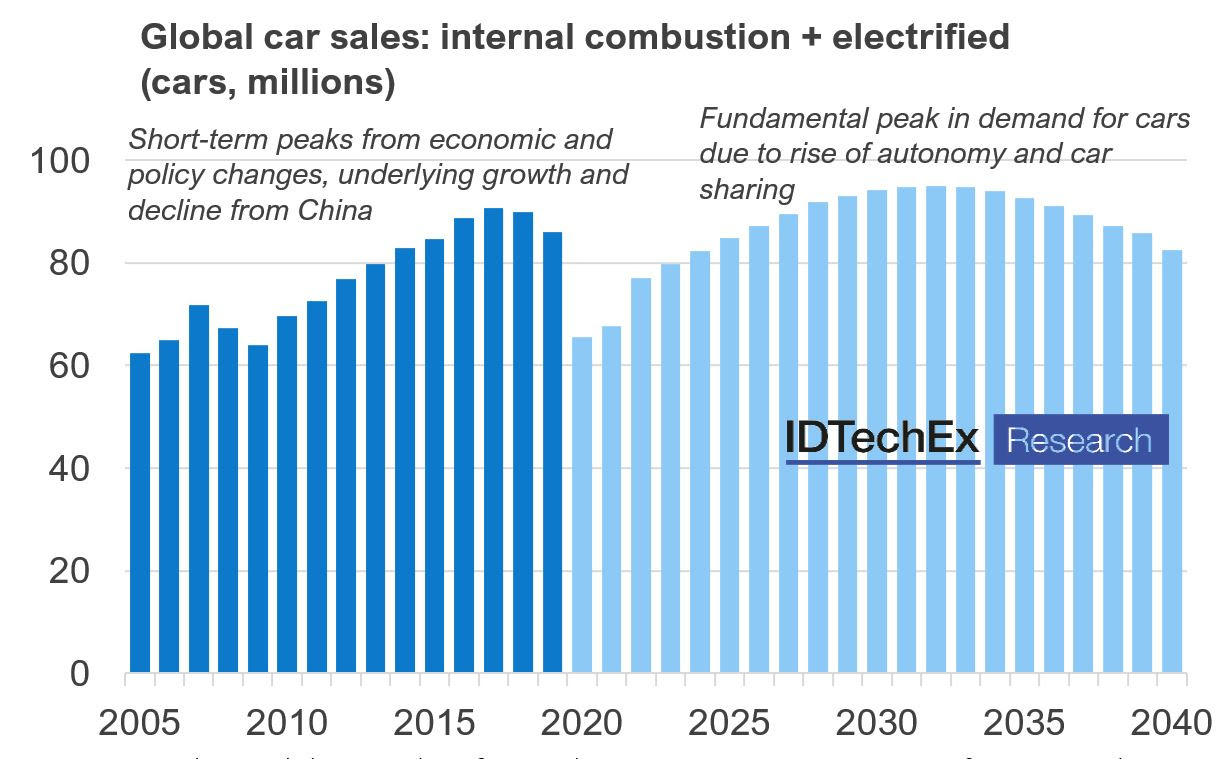
In the past two decades, the car market has declined twice: first due to the 2008 economic crisis, and then due to falling sales in China. Most recently, the lockdowns implemented to combat the coronavirus pandemic, causing auto-production plants to close globally and a loss of consumer spending will lead to an unprecedented 23% decline in 2020 (IDTechEx prediction).

In the following decade (2030 – 2040), things will not improve: the global car market will be blindsided by the rise of autonomous vehicles, which greatly reduces the need for private car ownership. Within this scenario, it is electric cars which will remain a beacon of growth, satisfying both the governmental drive to clean air in cities whilst also working more readily with autonomous vehicle technology.


Source: IDTechEx with historic data from industry associations. For more information, please see the IDTechEx report, “Advanced Electric Cars 2020-2040”.

In their simplest form, an electric car consists of an energy storage device powering one electric traction motor, which spins wheels via a transmission. First invented in the 19th century, electric cars ultimately lost the battle to the internal combustion engine, unable to compete with the energy density of gasoline. Over one hundred years later, the Li-ion battery is enabling their meteoric rise as a solution for reducing local emissions and green-house gases.

Once derided as toys, today electric cars with barely 15 years of development offer cutting-edge automotive technology and performance, from sub 2.5 second 0 – 60 mph acceleration, to autonomous driving functionality and solar bodywork. Battery-electric vehicles (BEV) are the endgame: zero emissions at point of use and the focus of automotive start-ups (and China). On the other hand, Plug-in Hybrid Electric Vehicles (PHEV) provide a short/mid-term solution, soothing initial fears of range anxiety.

The brand new IDTechEx report, “Advanced Electric Cars 2020-2040”, provides a long-term outlook for the car market and enabling technologies in the wake of COVID-19. The key sections are summarized.

Forecasts and COVID-19 Impact

In the report, IDTechEx provide long-term forecasts to 2040 for electric passenger cars by region (China, US, UK, France, Germany, Norway, Netherlands, Denmark, RoW) and by powertrain (battery-electric, plug-in hybrid, fuel-cell). Forecasts are presented in number of vehicles, battery demand (GWh) and market size ($ billion), with historic data back to 2015.

All forecasts are adjusted to reflect the impact of the global COVID-19 pandemic: amid economic uncertainty and unemployment, the auto industry has been one of the hardest hit as car purchases, typically the second largest consumer purchase (the first is a house), are now more difficult to justify ­for millions of consumers worldwide.

Li-ion Batteries

The IDTechEx report identifies and explains trends in Li-ion batteries for electric cars. For example, nickel content is increasing while cobalt content is decreasing: why is this important for automakers and the overall sustainability of the industry? It also provides historic market data on the Li-ion technology mix based on our database of electric cars in top auto markets: China has phased-out LFP from over half its car market to less than 2% today; why will Tesla contradict this and adopt LFP for Model 3 sales in China?

Electric Traction Motors

All electric motors have the same purpose of converting electrical energy to mechanical energy, but there are many types of motors that derive their names from their construction, principles of operation, or even from the control technique employed on them. The IDTechEx report explores why automakers are converging on permanent magnet motors, multiple motors, provide a benchmarking analysis of the different motor types, and finally, an outlook for how IDTechEx expects the motor market to evolve over the next ten years.

Autonomous Vehicle Technology

IDTechEx predicts that the rise of autonomous vehicles will have a profound impact on the global car market as it enables mobility-as-a-service to become cheaper than private-car ownership. The report shows forecasts of autonomous passenger car miles, revealing how this will lead to a fundamental peak-car scenario. IDTechEx appraises the key underlying technologies such as LiDAR and camera-based systems: is the camera-only approach a high-risk gamble or a winning strategy that will be copied?

For more information on this report, please visit www.IDTechEx.com/Cars or for the full portfolio of Electric Vehicles research available from IDTechEx please visit www.IDTechEx.com/Research/EV.