The Backend Revolution: How “API-First” Logistics is Reshaping Global E-commerce

As we navigate through 2026, the e-commerce landscape has stabilized into a high-stakes arena. With Customer Acquisition Costs (CAC) reaching historic highs, the era of “easy wins” through Facebook ads is effectively over. Today, the competitive advantage doesn’t lie in how well you market a product, but in how efficiently you can deliver it.

For SMBs and enterprise managers alike, the bottleneck is no longer traffic—it’s Tech-Enabled Fulfillment. The modern consumer demands Amazon-level speed from independent brands. To meet this standard, merchants are dismantling legacy supply chains and rebuilding them with an “API-First” architecture.

The Shift from “Manual” to “Automated” Supply Chains

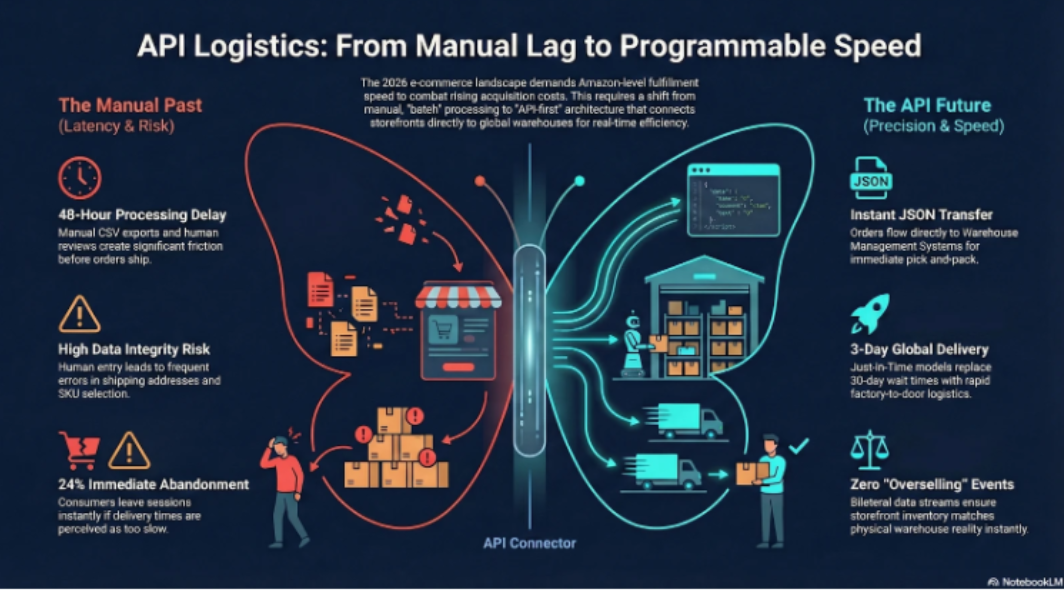
Historically, the dropshipping and remote fulfillment model was plagued by latency. A customer would place an order on Shopify; the merchant would manually export a CSV file or, worse, manually re-order via a supplier like AliExpress. This introduced a delay of 24 to 48 hours before the order was even processed.

In an automated, API-driven ecosystem, this friction is eliminated.

  • Old Way (Manual): Order Received → Human Review → Supplier Notification → Manual Tracking Upload.
  • New Way (API): Order Received → Instant JSON Data Transfer to Warehouse Management System (WMS) → Pick & Pack initiated immediately.

This shift isn’t just about speed; it’s about data integrity. By removing human manual entry, error rates in shipping addresses and SKU selection drop to near zero.

Why API Integration is the Backbone of Modern Logistics

An Application Programming Interface (API) acts as the connective tissue between a storefront (the frontend) and the global supply chain (the backend).

Real-Time Inventory Syncing The nightmare scenario for any scaling brand is “overselling”—selling a unit that doesn’t physically exist in the warehouse. This usually happens when inventory data is updated in batches rather than in real-time. API integrations solve this by establishing a bilateral data stream. When a unit is scanned out of the warehouse, the stock count on the e-commerce platform is deducted instantly.

Automated Tracking Updates Transparency is the new currency of trust. Modern APIs trigger webhooks the moment a shipping label is generated, pushing tracking numbers directly to the customer’s email. This significantly reduces “WISMO” (Where Is My Order) customer support tickets, allowing lean teams to focus on growth rather than damage control.

The Role of “Private Inventory” in Quality Control (QC)

While software connects the dots, it cannot physically inspect a product. Pure software solutions often fail because they lack control over the physical asset. This is where the hybrid model of Tech + Private Warehousing becomes essential.

To mitigate supply chain volatility, sophisticated merchants are moving away from generic shared marketplaces. Instead, they are utilizing dedicated fulfillment partners like SpeedBee Dropship, which combine physical warehousing with app-based integration. By allocating a private storage zone for specific clients, these platforms ensure that the digital inventory count on a Shopify store matches the physical reality in the warehouse, effectively eliminating the risk of selling out-of-stock items.

This “Private Inventory” model also allows for pre-shipment Quality Control (QC), ensuring that the product the customer receives matches the marketing promise perfectly.

Analyzing the “Last-Mile” Efficiency Data

The demand for speed is backed by hard data. Consumer expectations have shifted dramatically regarding the “Last-Mile”—the final leg of delivery.

Consumer expectations have shifted dramatically. According to recent e-commerce statistics from Forbes Advisor, shipping speed remains a critical friction point, with data showing that nearly 24% of consumers will abandon a session immediately if delivery times are too slow. This data underscores why integrating a tech-responsive logistics stack is no longer optional but a survival requirement.

Future Trends: AI and Predictive Stock Planning

The next iteration of API logistics moves from Reactive to Predictive.

By integrating Artificial Intelligence with historical sales data, WMS platforms are beginning to suggest “Pre-stocking” levels. For example, if an algorithm detects a viral trend for a specific SKU in the German market, it can alert the merchant to move inventory to a European fulfillment center before the orders flood in.


Key Takeaways

Area Key Takeaway Impact/Data
Operations Replace manual CSV/reviews with API automation Eliminates 24-48 hour latency
Revenue Risk Delivery speed is the critical friction point 24% abandon if too slow
Inventory Implement real-time bilateral data streams Error/Oversell rates near zero
Support Automate tracking updates via webhooks Drastically reduces “WISMO” tickets
Strategy Hybridize software with private warehousing Enables pre-shipment Quality Control

Conclusion

The revolution in global e-commerce is happening behind the scenes. It is quiet, code-based, and highly efficient. For business owners, the lesson is clear: To scale in 2026, you must stop treating logistics as a manual chore and start treating it as a programmable asset.

How Irish Tech Startups Are Scaling Globally in 2026

Ireland’s startup ecosystem is experiencing its most explosive growth period yet. With over 2,200 tech startups employing approximately 55,000 people and the government committing €1.5 billion from the National Training Fund for digital skills development, 2026 is shaping up to be a breakout year for Irish innovation. From AI-driven fintech to medtech exports, Irish companies are making their mark on the global stage, but success in international markets comes with one persistent challenge: multilingual content localization.

For Irish tech founders preparing to pitch in Paris, launch e-commerce platforms across Europe, or scale SaaS products to Asia, the localization bottleneck remains real. Pitch decks, product pages, investor emails, and technical documentation all need fast, high-quality translations that won’t delay go-to-market timelines or compromise message clarity. And when no one on the team speaks the target language fluently, trust in AI translation output becomes a critical concern.

Ireland’s Tech Boom: The Numbers Behind the Growth

The Irish tech sector’s momentum in 2026 is nothing short of remarkable. The industry now contributes over €48 billion to Ireland’s economy, with AI alone projected to add €250 billion by 2035. Dublin’s “Silicon Docks” hosts tech giants like Google, Microsoft, and Facebook, but it’s the indigenous startups that are making headlines.

In 2024, Irish tech companies raised €400 million across various sectors, with cybersecurity leading at €101 million, fintech at €75 million, and travel-tech at €61 million. Tines became Ireland’s second unicorn of 2025 after raising $125 million in a Series C round, while companies like Wayflyer achieved unicorn status with a valuation of $1.6 billion.

According to Deloitte’s Technology Fast 500 list, 20 Irish companies featured among Europe, the Middle East, and Africa’s fastest-growing tech firms, with companies like Wayflyer and Fibrus achieving growth rates exceeding 3,000% over four years. This explosive growth reflects not just local success but global ambition, and that ambition increasingly means navigating multilingual markets.

Why Do Irish Startups Need Multilingual Content Localization?

As Irish companies expand beyond English-speaking markets into France, Germany, Spain, and beyond, they face a fundamental truth: 76% of consumers prefer to buy products with information in their native language. More striking still, nearly 60% of consumers rarely or never purchase from websites available only in English, a trend noted in a Tomedes blog article.

The localization challenge isn’t just about translation, it’s about trust, compliance, and speed to market. A poorly localized pitch deck can cost a Dublin fintech its Paris funding round. A mistranslated product description can damage a Cork e-commerce brand’s reputation in Munich. And for startups racing against well-funded competitors, every day spent on translation delays is a day lost.

The Traditional Translation Bottleneck

Historically, Irish startups expanding to Europe faced several localization pain points:

  • Time constraints: Traditional translation agencies often require weeks for turnaround, delaying product launches and investor meetings
  • Cost barriers: Professional human translation for multiple languages can drain early-stage budgets, with costs reaching thousands of euros per project
  • Quality concerns: While machine translation has improved dramatically, founders worry about accuracy in critical documents like legal contracts, investor materials, and technical specifications
  • Internal expertise gaps: Most Irish startup teams lack native speakers for target languages, making quality assessment difficult

According to research on startup localization challenges, companies that delay localization often face steeper barriers later, it can take nearly two years to retrofit systems built with single-language assumptions.

How Are Irish Startups Overcoming Localization Barriers?

The translation technology landscape has evolved dramatically. The global machine translation market was valued at USD 1.12 billion in 2025 and is expected to reach USD 2 billion by 2030, growing at a CAGR of 12.30%. Neural machine translation now holds nearly 49% market share, thanks to a transformer-based architecture that delivers contextually accurate results.

But raw AI translation alone isn’t enough. Startups need confidence that their translated content is accurate, especially when dealing with high-stakes materials like investor decks, regulatory documents, and product specifications.

This is where consensus-based translation platforms like MachineTranslation.com are changing the game. Their SMART feature represents a breakthrough in translation confidence for non-linguist teams.

What Makes SMART Different?

Unlike traditional approaches that force users to choose between multiple AI translation engines, SMART automatically aggregates outputs from leading translation engines and selects the most agreed-upon translation for each sentence. Think of it as a “wisdom of the crowds” approach to AI translation, when multiple advanced AI systems agree on a translation, confidence in accuracy increases dramatically.

For Irish startups, this means:

  • Faster decision-making: No more manually comparing outputs from Google Translate, DeepL, and Microsoft Translator
  • Higher confidence: When multiple AI engines agree, teams can trust the output without extensive post-editing
  • Reduced review cycles: Non-linguist team members can approve translations faster, accelerating time-to-market
  • Cost efficiency: Less time spent on review means lower localization costs overall

Real-World Use Case: Localizing a Fintech Pitch for French Investors

Consider a Cork-based fintech startup preparing to pitch to venture capital firms in Paris. The founders have built an impressive product, secured early traction in Ireland and the UK, and identified French VCs as their next funding target. But they’re facing a tight timeline, their Series A pitch meeting is in two weeks.

They need to translate:

  • A 20-slide pitch deck with financial projections and market analysis
  • A 10-page executive summary
  • Product demonstration scripts
  • Email correspondence with potential investors

The Old Approach

Hire a translation agency, wait 5-7 business days, pay €2,000-3,000 for professional translation, then hope the French investors don’t notice any cultural nuances that feel “off.”

The 2026 Approach with SMART: 

Upload documents to MachineTranslation.com, select English → French AI translation, and let SMART aggregate translations from multiple neural engines. Within hours, the team has high-confidence translations for review. Because SMART surfaces consensus translations, the founders can identify which sections multiple AI engines agree on (high confidence) and which might need human review (lower consensus).

Result: 

The pitch deck is ready in 24 hours, the team saves €2,500, and they have time to rehearse their presentation instead of waiting on translations. More importantly, the SMART-powered translations capture financial terminology accurately because multiple specialized AI engines have validated the output.

Scaling Product Pages Across Six European Languages

For e-commerce startups, the localization challenge multiplies with every market entry. An Irish direct-to-consumer brand launching across Europe might need product descriptions in French, German, Spanish, Dutch, Polish, and Italian—potentially thousands of SKUs across multiple languages.

The E-Commerce Localization Challenge

Traditional approaches force startups to choose between:

  • Speed: Use raw machine translation and risk awkward phrasing that hurts conversion rates
  • Quality: Pay for professional translation and blow the marketing budget before the campaign launches
  • Scale: Pick only 1-2 languages instead of fully localizing for all target markets

This compromise leaves money on the table. Research shows that localized content can increase engagement by up to 2,500%, making proper localization a competitive advantage, not just a nice-to-have.

The SMART Solution for E-Commerce

With over 100,000 language pair combinations available on advanced translation platforms, Irish e-commerce brands can now automate product localization at scale. But automation without confidence creates risk—a mistranslated size chart or ingredient list can trigger customer complaints or regulatory issues.

SMART addresses this by:

  1. Processing high volumes quickly: Translate 1,000 product descriptions across 6 languages in hours, not weeks
  2. Flagging uncertainty: When AI engines disagree significantly on a translation, SMART alerts the team to review that specific content
  3. Maintaining consistency: Glossary management ensures brand terms and product names stay consistent across all languages
  4. Reducing post-editing: Because SMART surfaces consensus translations, human reviewers focus only on edge cases rather than validating every sentence

For a growing e-commerce startup, this means launching in Madrid, Milan, and Munich simultaneously instead of rolling out markets sequentially—compressing internationalization timelines from 18 months to 6 months.

Why Consensus Translation Matters in 2026

The fundamental shift in 2026 is this: AI translation is no longer about choosing the “best” engine. It’s about leveraging multiple AI systems to build confidence through consensus.

The Trust Gap in AI Translation

Despite massive improvements in neural machine translation, non-linguist teams still face a trust gap. When a Dublin SaaS founder reviews a German translation of their product documentation, they’re asking:

  • Is this technically accurate?
  • Does it sound natural to native speakers?
  • Will it damage our brand if we ship this?

Without native German speakers on the team, answering these questions traditionally meant:

  • Hiring expensive consultants for spot-checks
  • Sending translations to freelance reviewers and waiting days
  • Simply hoping the AI got it right and dealing with problems later

SMART fills this gap by making AI consensus visible. When 4 out of 5 leading translation engines agree on how to translate a complex technical sentence, confidence increases. When engines disagree, the system flags that sentence for human review.

Beyond Translation: The Broader Localization Context

While translation quality is critical, it’s just one piece of the localization puzzle. Irish startups expanding globally must also consider:

Cultural adaptation

Colors, imagery, and messaging that work in Dublin might not resonate in Tokyo. German B2B buyers expect different proof points than French consumers.

Regulatory compliance

GDPR in Europe, data privacy laws in Asia, and advertising standards vary by country. According to industry research, regulatory missteps can lead to fines that threaten early-stage companies.

Payment localization

Irish startups using Stripe or other payment processors need to offer local payment methods, iDEAL in the Netherlands, Bancontact in Belgium, SEPA transfers in Germany.

Customer support

75% of consumers prefer products available in their native language, and that extends to support channels. Translated FAQs and email templates become essential.

Tools like SMART handle the linguistic foundation, allowing startups to focus resources on these higher-level localization challenges.

How Do Irish Startups Scale Globally Today?

Beyond translation technology, Irish startups benefit from several structural advantages in 2026:

Government Support Infrastructure

  • Enterprise Ireland continues investing heavily in internationalization, with €27.6 million allocated to 157 startups for global expansion support
  • The High Potential Start-Ups (HPSU) programme provides financial incentives and market access support
  • R&D tax credits at 25% encourage continued innovation investment

Strategic Geographic Positioning

Ireland’s location between the US and Europe, combined with its status as the only English-speaking EU member state post-Brexit, makes it an ideal launchpad for European expansion. According to recent insurtech data, 28% of Irish tech firms already report sales into the UK, 15% into Europe, and 14% into the US.

Access to Talent and Capital

The €1.5 billion National Training Fund investment is producing skilled tech talent, while venture capital investment in Ireland surged to $668 million in Q1 2025, up from just $34 million in Q1 2024.

What Types of Content Benefit Most from SMART Translation?

Not all content requires the same translation approach. SMART delivers maximum value for content types where accuracy is critical but full human translation would be cost-prohibitive:

Investor Materials

Pitch decks, executive summaries, and financial projections require precision. A mistranslated revenue projection or market size estimate can undermine investor confidence. SMART’s consensus approach ensures financial terminology and metrics are translated consistently across documents.

Internal Documentation

As Irish startups hire internationally, internal wiki pages, onboarding materials, and process documentation need translation. SMART allows companies to maintain multilingual documentation without dedicated translation budgets.

Legal and Compliance Documents

While final legal contracts should always involve professional legal translators, early drafts, NDA templates, and compliance checklists benefit from high-confidence AI translation. SMART flags legally complex sentences where terminology consensus is low, directing legal review where it matters most.

Product Copy and Marketing Materials

Product descriptions, feature lists, and marketing emails need to be both accurate and persuasive. SMART helps marketing teams localize content quickly while maintaining brand voice consistency through glossary management.

Technical Documentation

API documentation, user guides, and technical specifications contain domain-specific terminology. When multiple AI engines trained on technical corpora agree on translations, development teams can confidently publish localized documentation.

How Does Machine Translation Quality Compare in 2026?

The quality gap between human and machine translation has narrowed dramatically. Neural machine translation models now achieve BLEU scores (a standard quality metric) that approach human parity for common language pairs like English↔French and English↔German.

However, challenges remain for:

  • Low-resource languages: Irish Gaelic, Icelandic, and other smaller languages still benefit from human expertise
  • Creative content: Marketing slogans, brand messaging, and culturally nuanced copy often require transcreation, not just translation
  • Highly regulated content: Pharmaceutical documentation, medical device manuals, and legal contracts still demand human translation and legal review

For the majority of business content, product descriptions, internal communications, investor materials, and technical documentation, AI translation with consensus validation (like SMART) delivers sufficient quality for international operations.

What Challenges Remain for Irish Startups Scaling Globally?

Despite improved translation technology and strong government support, Irish startups still face scaling challenges:

Talent Competition

Dublin’s tech scene faces stiff competition from multinational corporations offering higher salaries. As noted in recent industry analysis, companies like Google, Meta, and Microsoft often poach talent from startups.

Funding Valley

While seed funding is accessible through Enterprise Ireland and local VCs, Series A and B funding remains challenging. Many promising Irish companies stall at the growth stage due to limited growth-focused investment.

Infrastructure Costs

Despite cloud computing reducing hardware expenses, operational costs in Dublin remain high. Startups increasingly establish remote teams or satellite offices in Cork, Galway, and Limerick to manage costs.

Market Understanding

Beyond language, Irish founders must understand local business practices, purchasing behaviors, and competitive dynamics in target markets. A SaaS startup that succeeds in Ireland might need to completely restructure its go-to-market strategy for Germany’s enterprise market.

The Future of Irish Tech Expansion

Looking ahead, several trends will shape how Irish startups scale globally:

AI-First Localization

The AI translation market is projected to reach $4.50 billion by 2033 at a 16.5% CAGR. This growth reflects increasing AI sophistication and startup adoption. Tools like SMART represent the first wave, consensus-based validation. Future iterations will incorporate:

  • Real-time translation for video content and customer support
  • Context-aware translation that understands company-specific terminology
  • Automated cultural adaptation suggestions beyond pure language translation

Hybrid Work and Global Teams

Irish startups increasingly hire globally from day one. A Dublin founder might have developers in Poland, customer success in Spain, and sales in Germany. This necessitates robust multilingual communication infrastructure—not just for customer-facing content but for internal operations.

Regulatory Complexity

As the EU tightens data privacy, AI governance, and digital services regulations, Irish startups must navigate compliance across multiple jurisdictions. Translation of legal documents, privacy policies, and compliance materials will become more critical and more complex.

Vertical-Specific Solutions

Rather than competing as horizontal platforms, successful Irish startups are increasingly focusing on vertical markets, fintech, healthcare, energy management, and cybersecurity. This specialization extends to localization, where domain-specific translation quality matters more than broad language coverage.

Key Takeaways for Irish Founders

As one tech lead at a Dublin-based SaaS startup noted: “Tools like SMART help us scale without a localization team. We don’t just save time—we finally trust what we ship.”

For Irish startups planning international expansion in 2026 and beyond:

Start early

Localization isn’t a late-stage problem. Building internationalization into your product architecture from day one prevents costly retrofitting later.

Leverage technology

Tools like MachineTranslation.com’s SMART feature deliver professional-grade translation quality without professional-grade costs. Use AI translation for the bulk of content, reserving human expertise for creative and legally critical materials.

Focus on priority markets

Don’t try to launch in 10 countries simultaneously. Identify 2-3 key markets, localize thoroughly, learn from initial customers, then expand. Quality localization in fewer markets beats superficial translation in many.

Measure localization ROI

Track conversion rates, support ticket volume, and customer acquisition costs by language. Data-driven localization decisions beat gut instinct.

Build partnerships

Connect with local advisors, marketing agencies, and customer success managers in target markets. Language translation is necessary but not sufficient, cultural understanding drives success.

The barriers to global expansion for Irish startups have never been lower. With Ireland’s startup ecosystem ranking 9th in Western Europe and 16th globally, strong government support, and AI-powered localization tools, 2026 represents a breakthrough year for Irish tech companies ready to scale beyond English-speaking markets.

As the global machine translation market continues its rapid growth trajectory, and as platforms like MachineTranslation.com evolve their consensus-based approaches, the translation bottleneck that once slowed international expansion is becoming a manageable workflow step rather than a strategic barrier.

For Irish founders, the message is clear: the technology, funding, and market conditions are aligned. The time to scale globally is now, and the localization tools to do it efficiently finally exist.


Want to explore how AI is transforming other areas of Irish tech? Check out our coverage of how AI is revolutionizing the financial industry and discover Ireland’s top emerging tech startups in 2025.

How to Choose the Right Fraud Prevention Tools for Your E-commerce Business

In the fast-paced world of online retail, fraud remains a persistent and growing concern for e-commerce businesses. From stolen credit cards to account takeovers and refund fraud, the threats are evolving rapidly. To protect their businesses and customers, online retailers must invest in robust fraud prevention tools. However, with so many options available, choosing the right ecommerce fraud prevention software can be a daunting task. This article provides a step-by-step guide to help you select the best tools tailored to your e-commerce business while ensuring comprehensive protection.

  1. Understand the Types of E-commerce Fraud

Before diving into the selection process, it’s crucial to understand the most common types of e-commerce fraud. This will help you identify the specific threats your business might face and choose tools that address those vulnerabilities. Common fraud types include:

  • Payment fraud: Stolen card details used for unauthorized purchases.
  • Account takeover: Hackers gain access to customer accounts to make fraudulent purchases.
  • Chargeback fraud: Customers make false claims to receive refunds for legitimate purchases.
  • Refund fraud: Fraudsters exploit refund policies to steal money.

By understanding these threats, you can narrow your search to tools that specialize in mitigating the risks associated with each type of fraud.


  1. Identify Your Business Needs

No two e-commerce businesses are exactly alike. A small online store will have different fraud prevention requirements compared to a global retailer. Start by assessing your business size, transaction volume, and the level of risk you face. Key questions to consider include:

  • What is your average order value (AOV)?
  • Do you operate in high-risk industries?
  • How many transactions do you process daily or monthly?
  • Do you sell internationally, and if so, how diverse is your customer base?

Understanding your business needs ensures that you invest in tools that align with your operations and budget.


  1. Look for Real-Time Fraud Detection

One of the most important features in any fraud prevention tool is the ability to detect and prevent fraudulent transactions in real-time. Tools that use artificial intelligence (AI) and machine learning are particularly effective, as they can analyze data patterns and behaviors to identify suspicious activity instantly. Real-time fraud detection helps you stop fraud before it happens, reducing financial losses and protecting your customers.


  1. Evaluate User Authentication Features

Strong user authentication is critical in preventing account takeovers and unauthorized transactions. Look for tools that offer multi-factor authentication (MFA), biometric authentication, and behavioral analysis. These features ensure that only legitimate users can access accounts and complete transactions, adding an extra layer of security.


  1. Ensure Scalability and Flexibility

As your e-commerce business grows, so will the complexity of fraud risks. Choose fraud prevention tools that are scalable and can adapt to your business’s evolving needs. For instance, tools that support cross-border transactions, multiple payment methods, and diverse fraud scenarios are ideal for businesses expanding into new markets.Flexibility is also important. Some fraud prevention tools allow customization, enabling you to set specific rules and thresholds based on your business model. This ensures that the tool is not only effective but also aligned with your unique requirements.


  1. Prioritize Ease of Integration

When selecting fraud prevention tools, consider how easily they can integrate with your existing e-commerce platform, payment gateways, and customer relationship management (CRM) systems. Seamless integration minimizes disruptions to your operations and ensures that the tools work harmoniously with your current technology stack. Many fraud prevention solutions offer pre-built integrations for popular platforms like Shopify, Magento, and WooCommerce.


  1. Analyze Reporting and Analytics Capabilities

Fraud prevention is not just about stopping fraud—it’s also about learning from it. Tools with robust reporting and analytics capabilities allow you to monitor fraud trends, assess the effectiveness of your strategies, and make data-driven decisions. Look for tools that provide detailed dashboards and reports, giving you a clear picture of your fraud landscape.


  1. Compare Costs and ROI

While fraud prevention tools are an investment, it’s essential to evaluate their costs in relation to the potential losses they can help you avoid. Many providers offer tiered pricing based on transaction volume or features, so you can find a solution that fits your budget. Remember, the right fraud prevention tool will not only save you money but also protect your reputation and customer trust.


  1. Check for Customer Support and Reliability

Fraud prevention is a 24/7 concern, so you need tools that come with reliable customer support. In the event of an issue or suspected fraud attack, quick assistance can make all the difference. Look for providers that offer round-the-clock support through multiple channels, such as live chat, email, and phone.


  1. Research Reviews and Case Studies

Before finalizing your decision, research customer reviews and case studies to understand how the fraud prevention tool has performed for other businesses. Pay attention to feedback from businesses similar to yours, as this can provide valuable insights into the tool’s effectiveness and ease of use.


Conclusion

Choosing the right fraud prevention tools for your e-commerce business is a critical step in safeguarding your operations, customers, and reputation. By understanding the types of fraud, identifying your business needs, and prioritizing features like real-time detection, scalability, and user authentication, you can find a solution that offers comprehensive protection.Investing in the right tools is not just about reducing losses—it’s about fostering trust and ensuring a secure shopping experience for your customers. When evaluating options, consider providers that specialize in ecommerce fraud solutions, as they are tailored to meet the unique challenges of online retail. With the right tools in place, you can focus on growing your business while staying one step ahead of fraudsters.

5G and the Next Generation of Mobile Apps: What It Means for Irish Consumers

5G technology has already made its mark in Ireland, transforming how consumers interact with mobile applications and digital services. Over the past few years, Ireland has progressively integrated 5G into its telecommunications infrastructure, providing users with faster speeds, lower latency, and greater reliability. 

This advancement is paving the way for a new generation of mobile applications that leverage real-time connectivity, immersive experiences, and enhanced interactivity.

The Evolution of 5G in Ireland

The journey of 5G in Ireland began in 2019 when major telecommunications providers such as Vodafone, Three, and Eir launched their initial networks in select cities. Over the following years, coverage expanded significantly, bringing high-speed connectivity to urban and rural areas. Today, most major towns and cities across Ireland have access to 5G, and network operators continue to invest in expanding coverage and improving performance.

Government initiatives and private investments have played a crucial role in accelerating the adoption of 5G in Ireland. The country’s National Broadband Plan (NBP) has been instrumental in ensuring that even remote areas benefit from next-generation connectivity. 

Ireland’s strategic position as a European tech hub has encouraged innovation in mobile services, with companies developing applications that leverage 5G’s capabilities to enhance user experiences. Services such as playing live roulette, online gaming, and streaming have greatly improved due to 5G’s ultra-low latency and high-speed data transfer, making these experiences as immersive and seamless as ever before.

How 5G is Transforming the Mobile Experience

With 5G, Irish consumers are witnessing a significant shift in how mobile applications function. Some of the key improvements include:

1. Faster Streaming and Enhanced Entertainment

One of the most noticeable benefits of 5G is the ability to stream high-quality content without buffering. Platforms like Netflix, YouTube, and Disney+ now offer seamless 4K and even 8K video streaming experiences. Additionally, cloud gaming services such as Google Stadia and Xbox Cloud Gaming are more viable in Ireland, allowing users to play high-end games on mobile devices without needing powerful hardware.

2. Real-Time Interactive Applications

Applications that rely on real-time interaction, such as augmented reality (AR) and virtual reality (VR), are becoming more mainstream thanks to 5G. Irish consumers can now enjoy immersive experiences in gaming, shopping, and social media. For example, AR-powered navigation apps provide real-time directions, while VR-based training programs offer interactive learning opportunities.

3. Seamless Remote Work and Communication

Remote work has become a staple in Ireland, especially following the COVID-19 pandemic. 5G ensures that video conferencing apps like Zoom, Microsoft Teams, and Google Meet operate smoothly, even in high-demand situations. Additionally, cloud-based collaboration tools benefit from ultra-fast uploads and downloads, making remote work more efficient and productive.

4. Smarter Cities and IoT Integration

5G is also fueling the growth of smart city initiatives across Ireland. With improved network capacity, cities can deploy IoT (Internet of Things) solutions that optimise traffic management, enhance public safety, and improve energy efficiency. For instance, Dublin has seen the implementation of smart traffic lights and connected CCTV networks that rely on 5G for real-time data processing.

Industries Benefiting the Most from 5G in Ireland

Several industries in Ireland are leveraging 5G to revolutionise their services and enhance consumer experiences. Below are some of the key sectors that stand to gain the most from 5G technology:

1. Telemedicine and Healthcare

5G is revolutionising the healthcare industry in Ireland by enabling telemedicine services that provide remote consultations, real-time patient monitoring, and even robotic-assisted surgeries. With reduced latency and improved reliability, doctors can conduct virtual appointments with high-definition video quality, ensuring accurate diagnoses and better patient outcomes.

Wearable health devices like smartwatches and fitness trackers also benefit from 5G. These devices allow users to track vital signs in real time and instantly share data with healthcare professionals. This development is particularly beneficial for elderly patients and those living in rural areas with limited access to medical facilities.

2. Remote Work and Digital Collaboration

5G connectivity has further facilitated the widespread adoption of remote work in Ireland. Companies can now conduct seamless video meetings, share large files instantly, and access cloud-based applications without interruptions. This shift has increased productivity, improved work-life balance, and new job opportunities in Ireland’s growing digital economy.

Furthermore, 5G enables innovative applications like virtual reality (VR) meetings and remote training programs, making workplace interactions more engaging and effective.

3. Mobile Gaming and Esports

Gaming is another sector experiencing rapid transformation due to 5G. Mobile gamers in Ireland can now enjoy lag-free, high-performance gaming experiences, even in multiplayer settings. Cloud gaming platforms have also gained popularity, allowing users to play console-quality games directly on their smartphones.

5G has bolstered the rise of esports in Ireland, as competitive gamers require low latency and fast response times. This has increased gaming tournaments, streaming events, and a growing community of Irish gamers engaging in global competitions.

4. Retail and E-Commerce

Retailers in Ireland are using 5G to enhance online shopping experiences through AR and VR applications. Customers can now use AR to visualise products in their homes before purchasing, reducing return rates and improving satisfaction. Additionally, real-time analytics powered by 5G enable businesses to personalise shopping experiences based on consumer behaviour and preferences.

5. Transportation and Autonomous Vehicles

While fully autonomous vehicles are still in development, 5G plays a crucial role in enhancing transportation systems in Ireland. 5G powers smart traffic management, connected vehicle technology, and real-time navigation updates, making roads safer and more efficient.

Public transport systems also benefit from improved connectivity, real-time tracking and better communication between passengers and operators. As 5G continues to evolve, we can expect further advancements in transportation technology across Ireland.

Final Words

5G is not just a faster internet connection—it is a transformative force reshaping the digital landscape in Ireland. With its widespread adoption, industries such as healthcare, gaming, remote work, and retail are witnessing remarkable efficiency and user experience improvements. As Ireland continues to lead in digital innovation, consumers can look forward to a future where mobile applications are more powerful, interactive, and immersive than ever before.

How Technology is Transforming Traditional Industries

From online shopping and personal assistants that know you by name, to self-driving cars, technology is revolutionizing industries and the lives of consumers at breathtaking speeds. While startups often steal the spotlight, traditional industries around the world are also riding the technology wave to stay relevant, efficient, and competitive. This blog takes a deep dive into how technology is reshaping these sectors and introduces you to noteworthy examples.

The Digital Overhaul of Traditional Industries

Technology isn’t just enhancing old practices—it’s redefining them. Here’s how traditional industries are welcoming innovation and using it to their advantage.

1. Modernizing Manufacturing with Smart Technology 

Manufacturing is at the heart of our economy, and recent advancements, such as the Internet of Things (IoT – think of a web of all connected devices and Big Data), robotics, and AI, have elevated its efficiency and supercharged productivity. Smart factories equipped with IoT sensors now offer real-time data on equipment health, production rates, and supply chain dynamics. This allows manufacturers to enhance productivity while minimizing delays and costs. 

Consider how AI-powered robots are streamlining assembly lines, reducing chances of human error, and accelerating production timelines—all critical in today’s demand-driven business landscape.

2. Retail Joins the e-Commerce Revolution 

Retail has been one of the most visibly impacted sectors. Once synonymous with physical stores, modern retail has evolved into a digital-first industry. Online platforms like Amazon and Shopify have democratized access, allowing small businesses to thrive globally. 

Technology like augmented reality (AR – think overlaying digital content on the brick and mortar world a la Pokemon Go) is also breaking new ground in an ever-more engaging consumer experience. Imagine buying furniture online and “placing” a virtual couch in your living room through your phone camera. Retailers are using AR to ensure customers make confident purchasing decisions – and improve the effectiveness of their marketing. 

3. Energizing Agriculture with Precision Tech 

The traditional agriculture industry has undergone major technological upgrades. Precision agriculture uses GPS, drones, and AI to monitor crops, optimize irrigation, and predict harvest yields. Farmers can now ensure efficient resource use and achieve higher profitability. 

For example, drones are being deployed to survey acres of farmland in minutes, providing farmers with actionable data on pest infestations and weather impacts. This minimizes waste while boosting yields significantly.

4. Healthcare in the Age of Artificial Intelligence 

Telemedicine, robotic surgeries, and AI-based diagnostics are revolutionizing healthcare. For instance, wearable health devices can now track vitals such as heart rate, oxygen levels, and sleep patterns, empowering individuals to better manage chronic diseases while directing actionable data to healthcare providers. 

AI’s role in diagnostics is another game-changer. Advanced AI-powered tools are being used to detect conditions such as cancer far earlier than traditional methods, significantly improving patient outcomes.

5. Reimagining Entertainment and Gambling 

Technology has transformed how we consume entertainment, including the casino and gambling industry, particularly in places like New Jersey. The state has embraced technology to offer a thriving online casino market, allowing residents and visitors to experience the thrill of gambling from their own devices. 

With features like live dealer games and virtual slot machines now accessible digitally, online casinos offer the same excitement as brick-and-mortar setups—with the added convenience of playing anytime, anywhere. Take FanDuel Casino, for example, which offers a range of traditional casino games like blackjack and roulette along with sports betting options, all on one platform.

6. Optimizing Supply Chain Management 

Finding efficiencies in supply chain operations has always been crucial for industries like logistics, retail, and manufacturing. Technology is making it possible to achieve unprecedented levels of optimization. 

For example, blockchain is helping supply chain managers improve transparency by offering a digital ledger for tracking goods across the supply network. Meanwhile, AI enhances real-time tracking, ensuring that deliveries are on time and that companies avoid bottlenecks.

Out With the Old and in With the New 

Traditional industries are no longer confined to outdated tools and processes. Instead, they’re proving that adaptation is the key to resilience and success. Technology has become not just a tool but a driving force behind this transformation. 

Industries such as manufacturing, agriculture, and even regulated markets like gambling in New Jersey are demonstrating how innovation can unlock new opportunities and efficiencies. Whether investing in IoT, leveraging AI, or redefining customer experiences with virtual tools, these sectors remind us that there is no limit to what technology can achieve.


The Essential Digital Products That Every Business Needs

The digital market has become a haven for business opportunities and the perfect place to further develop and enhance your business. And more and more companies are recognizing the infinite potential of the World Wide Web, making competition fierce and the race to stay ahead of everyone else a true challenge. But there are shortcuts or better said, tools that are being widely used to ease jobs by streamlining whole procedures. That way resources are being saved and further invested in their projects that are more opportunistic, opening businesses to new endeavors and a chance for growth. In the text below, we’ll discuss some essential digital products that you, as a business, need to make sure you’re ahead of the curve and well-engaged in this new and changing digital world.

Managing Projects Like a Pro 

Digital tools that help you keep track of deadlines, how much work each employee has made so far, progress, and an overall overview of long-term goals make every project easier than it is or is supposed to be. These tools provide features such as task assignment, deadline tracking, and progress visualization charts, allowing you to really understand the work you’re doing. 

Customer Service

Your business relies on a loyal base of followers who are recurring and love your brand, services, or products you’re offering. By far the best way to keep your customers coming back is not sales and vouchers but rather excellent customer service that offers a chance to stay in touch and meet the requests and demands of your loyal fans. CRM software is an interesting and innovative way of keeping track of your customers, their purchases, statistics, and retention rates. Why does any of this matter? The key to personalized campaigns for your customers is proper data and this software offers endless information on key factors that greatly contribute to boosted sales and a better reputation. Many of these featured brands can be found online and are offered at retail prices to draw more sales and often you’ll find great package deals, making it easier for everyone. Its simple CRM software helps companies manage interactions with current and potential customers, giving a unique insight into the demands and behaviors. It’s a formula for success.

E-Commerce 

Having an e-commerce platform is as normal today as it is to have your phone in your pocket. Platforms that offer an easy way to open an online store and offer your product to a wider audience can only be beneficial in terms of spreading brand awareness, building a reputation, and boosting your sales.

Security 

With cyber attacks being more casual than bank robbers, protecting your data and the data of your clients is a must if you want to act professionally and stay ahead. Cybersecurity software allows you to keep your integrity and the data of your customers and loyal clients, making sure any breaches are handled and detected ahead of time.

It’s almost impossible to imagine today’s work without making sure you’re able to use all these tools to enhance your business and streamline whole procedures while guaranteeing confidence for you and your clients.


Best 7 Visual CPQ Tools for E-Commerce Sites in the UK

Nowadays, visual CPQ plays an important role in the eCommerce field. It has become a key element of the quotation and selling process,  allowing businesses to offer customized products and instant price quotes, making the shopping experience smoother and more convenient for customers.   

It’s crucial to provide buyers with accurate quotes during the sales cycle. 3D visualization technology has transformed the quoting process completely. With 3D modeling, businesses can provide better customer experience, close deals faster and, most importantly, increase their sales. That’s why so many business owners choose to integrate visual CPQ tools into their e-commerce sites.

Unlike traditional CPQ software with ticking options, visual CPQ introduces an interactive 3D configuration experience. The software creates virtual reality, where consumers can see images of a product and analyze its features carefully. 3D visualization has a positive impact on a client’s purchase decision.        

Visual CPQ software has gained popularity in the United Kingdom. UK-based businesses often choose to use Shopify, Shopwire, Woocommerce, and custom-built platforms to sell their products online. In this blog, we’ll review the 7 best visual CPQ tools for e-commerce sites in the UK, highlighting their features and benefits to help you choose the right solution for your business.

So, let’s get started.         

  1. VividWorks

VividWorks offers a fantastic visual CPQ tool that allows online buyers to configure, visualize and study their products before making a purchase. The software provides a unique and interactive shopping experience. 


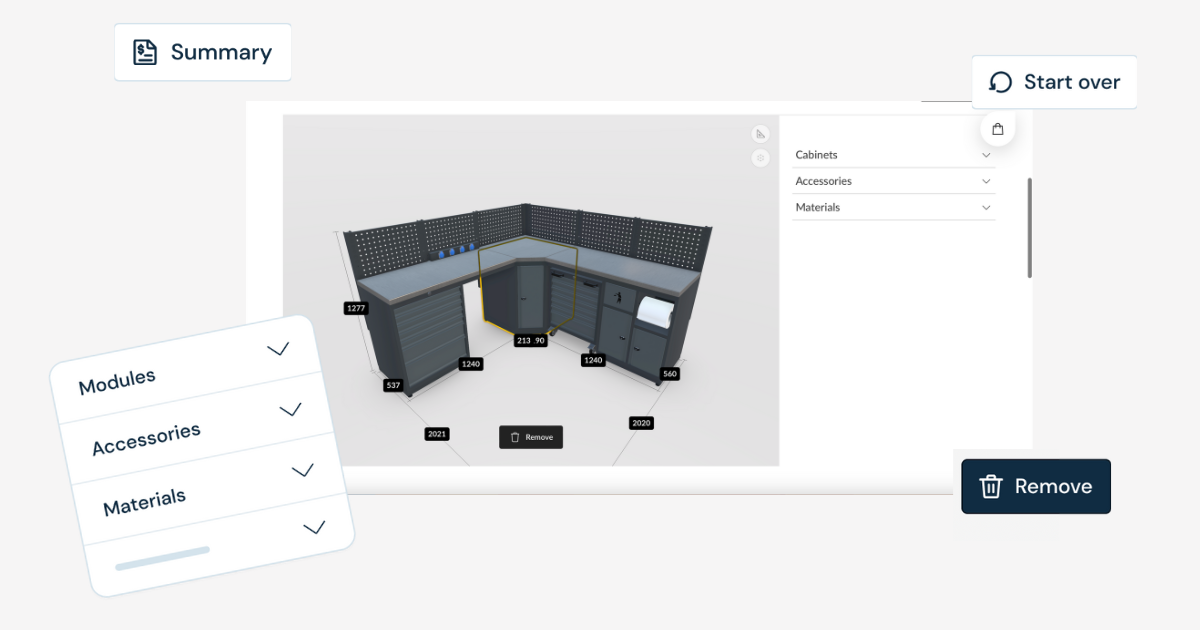
With this rule-based visual CPQ, consumers can configure 3D products in real time. The tool provides a 3D visual presentation of a product corresponding to the consumer’s needs.

Using 3D visualization technology, consumers can assemble a product by selecting its colors, finishes, and features. Most importantly, buyers get a quote for a product. The software provides dynamic pricing and automatically generates accurate product quotes based on client selections. The sales configurator improves customer experience and allows consumers to make well-informed decisions.

VividWorks is a very powerful and feature-rich visual CPQ software. It’s an all-in-one tool that can handle complex modular configurations and provides huge variations. It can configure even the most complex products easily and quickly.   

The software can be successfully integrated with e-commerce systems such as Shopify, Magento, WooCommerce, and Shopwired, and major ERP and CRM software. 

The software is built with retailers and manufacturers in mind. The sales configurator can be used for furniture, building supplies, lighting solutions, construction, etc.  The brand is trusted by 200+ global including top global brands like Sankyo Frontier,     

2. CPQing Solutions

CPQing Solutions has visual CPQ software that impresses with its visualization possibilities and flexibility. This sales configurator makes the sales process simple and helps businesses increase sales on their e-commerce sites. 

The software comes with a 3D visualization product configurator. This tool allows consumers to modify and view the desired product online. It is easy to use and doesn’t require any programming knowledge or skills.

The visual CPQ software can help sellers a lot with the process of making quotes. The software works based on 3D visualization and allows sellers to provide consumers with correct quotes quickly.   

The product configurator can be integrated into an e-commerce platform easily. The implementation process is simple and doesn’t take too much time.        

3. DriveWorks

Visual CPQ software developed by DriveWorks is widely used by manufacturing companies that specialize in configurable products. The software makes it possible for manufacturers to respond to customer inquiries quicker  and speeds up the sale process.   

The main benefit of the software is that it provides guided selling. It’s more than just a product configurator.  The tool provides online shoppers with 2D images and interactive 3D modeling. With this software, businesses will have everything they need to solve customer challenges during the sales cycle and represent their products in the best possible way.   

The software comes with the so-called dynamic pricing feature. So, consumers can configure products on e-commerce sites and get pricing updates in real time. With this tool, consumers don’t need to consult with a seller to get a quote for their product. The software creates sales documents and generates quotes automatically.

4. Kbmax

Kbmax is another good option for those looking for visual CPQ tools. The software allows UK businesses to represent their products, increase sales, and grow successfully. The tool minimizes customer support. If a product configurator is integrated into an e-commerce site, consumers don’t need a sales team to make a purchase.  

The product configurator comes with many great features such as 2D visualization, 3D visualization, AR visualization, etc. The tool gives buyers an opportunity to interact with a product and get different product previews. 

Consumers can change products by selecting different characteristics. It’s possible to change colors, materials and dimensions for a product. As a result, the tool provides customers with finished products that meet their needs and preferences.

5. Zoovu 

Zoovu is one of the suggested visual CPQ solutions for B2B e-commerce sites. The software delivers multiple significant benefits to buyers and sellers. 

Buyers can use the guided configuration to customize products for their needs and preferences in real-time. 3D modeling solutions allow consumers to make purchasing decisions and pick the right products.

The sales configurator allows B2B companies to reduce the cost of sales and grow their businesses successfully.  

Sellers can use a sales configurator to improve shopping experience and provide their customers with fast and accurate quotes. The software automatically generates quotes for configured products.  

With 3D configuration, consumers find it easy to buy products online. They can make the necessary changes to the product and preview their configurations in real-time. The quote for a product is generated instantly. As a result, the sales cycle is shortened and simplified.

6. Threekit

Threekit visual CPQ software offers an advanced visual selling tool that perfectly combines the augmentation reality, 2D and 3D visualization technology. The product configurator allows businesses to transform the sales process and provide clients with a self-service buying experience on their e-commerce sites. 

With this type of software, consumers can customize products on ecommerce sites easily and quickly. The tool creates personalized buying experience and provides consumers with visuals, documentation, pricing and quotes. So, online shoppers have everything they need to make a decision and purchase the right product.      

7. Expivi

Expivi visual CPQ software is built to help businesses simplify the sales and quoting process. This 3D configuration tool offers product visualization and automates the quoting process to help online buyers make the right purchasing decision.     

Implementing this tool into an ecommerce site makes it possible for online buyers to configure complex products via 3D visualization technology and get accurate quotes for configured products.  

The software comes with the pricing tools that take into account various factors such as costs, discounts and other important product and pricing information. After analyzing these factors, the sales configurator generates professional quotes.       

Conclusion

Picking visual CPQ software for an ecommerce site is not always easy. A lot of tools are available, so picking the best one can be challenging. We have described the best 7 visual CPQ tools for ecommerce sites in the UK. Each piece of software is different and has a unique set of features. Take your time to study the visual product configurator and its key features carefully to make the right choice.

4 Reasons Why Your E-Commerce Business May Be Struggling

Running an e-commerce business can be rewarding but also challenging. It is normal to feel the pre-launch jitters when thinking about diving into the e-commerce world. You’ll also make missteps along the way – it’s all part of the journey. However, research shows that 90% of new startups bite the dust, and e-commerce isn’t immune. Many meet the same fate, leaving the success rate hovering around 20%. This statistic doesn’t sound exciting, but it is possible to dodge the “failed e-commerce” bullet. It all starts with knowing the possible challenges that may arise and how to navigate them. Here are four reasons why your e-commerce business may be failing.


  • Product content pitfalls 

So you have an awesome product and have done all the homework. However, how you list your product can make all the difference. From grainy-looking pictures to unengaging copy, not paying attention to the little details when putting your product out there could cost you. Remember, the internet is a big space, and the world is watching, making it essential to execute with excellence. It’s not just about pretty pictures, either. Your product description should be crystal clear and speak to your audience. Sometimes, plain and simple words work better than fancy jargon. Also, remember that your site’s design affects the customer’s vibe, so ensure your interface is attractive and user-friendly.


  • Checkout chaos

 Research reveals that 55% of customers might vanish into thin air without free shipping at the end of the shopping process. And that is just the beginning of checkout troubles, as cart abandonment rates sit at almost 86%, according to 2023 Statista data. But there is hope, so don’t give up just yet. You can offer discounted shipping and streamline your payment process to make life easier for your customers. They’ll love you for it and are more likely to return for round two. Therefore, when developing your payment systems, consider professional options like Paymentshub payment API, which can be your ticket to a smoother and safer e-commerce experience.

You’ll also want to evaluate the tools and technologies supporting your store. Many businesses achieve better performance by switching to more robust platforms for D2C ecommerce, which offer features tailored to direct-to-consumer operations. Selecting the right infrastructure can reduce friction in your checkout flow and improve the overall customer journey.


  • Irritating pop-ups 

Excessive pop-ups can frustrate your customers while they navigate your platform and could cause them to look elsewhere. Today, customers are spoiled with options, so you don’t want to give them an excuse to consider other businesses instead of yours. Although pop-ups have their place, timing is everything. Annoying pop-ups with invisible exit buttons are a big no-no. Keep your website user-friendly, and while you can still integrate pop-ups, keep it away while your potential buyer is still window shopping. It’s better when a pop-up is activated when the user goes ahead to toss an item into their cart. 


  • Lack of SEO optimization


Many online startup founders make the mistake of saving SEO for a rainy day. However, it would help if you avoided that path. Start right out of the gate. Pin down those keywords that matter to your business. At the very least, keep them on your page titles with relevant search terms that show your target market that you have what they need. Go for high-volume, low-competition keywords to ace the search game. If this feels like an unfamiliar territory, search the web for SEO tips or hire an SEO guru. 


Enhancing Reality with AR Development: Innovations and Use Case

Augmented Reality (AR) is a technology that allows users to enjoy an interactive experience by overlaying digital elements in the real world. AR is more commonly associated with the gaming industry, but you can also find it in many other industries nowadays, such as retail, healthcare, and education. By blending the physical and digital worlds, AR draws more attention and provides more desirable results.

In this article, you can read more about how AR development has brought innovation to multiple sectors. 

Innovations in AR Development

For as long as AR has existed, it has been evolving. Through advancements such as real-time object recognition, tracking and localisation, and SLAM technology, AR has provided an increasingly enhanced experience for users, with refined stability and improved interaction.

In addition to the overlay, the hardware has also seen significant enhancements. Many companies have started to invest in the development of optimised AR equipment. Smart glasses and headsets have features that make the AR experience even more unique, such as cameras, a precision current sensor, audio capabilities, motion tracking abilities, and high-resolution displays. 

AR can integrate other relevant and emerging technologies, like Artificial Intelligence and Machine Learning. These technologies have contributed to a quality increase of AR experiences by, for example, enabling accurate and seamless object recognition and tracking, understanding the context of the scene, and interpreting gestures and voice commands. 

Innovation becomes even clearer when looking at mobile apps. AR and the app development industry have gotten very close, which resulted in an interesting combination of mobile apps and AR features. Social media apps like Instagram and Snapchat are immediate examples of this relationship, as they are known to provide filters to add to photos. The retail industry also benefits from AR technology – for instance, IKEA’s app uses AR technology to allow users to try on furniture in their real-life environment.

Use Cases: AR in Different Sectors

AR in Retail and E-commerce

As mentioned previously, AR plays a relevant role in the retail and e-commerce transformation. As people increasingly turn to online shopping, the more necessary it is to find technologies that allow customers to benefit from the advantages of being in a physical store. AR has thus enabled virtual try-ons, which allow shoppers to virtually try on the products before purchasing, from makeup to furniture. 

AR in Education and Training

Thanks to Augmented Reality, education has become more interactive and enjoyable. AR technology can overlay digital elements such as 3D models and animations onto real-life objects, making the experience more interactive, immersive, and memorable, which helps keep students motivated. 

Besides providing a more entertaining learning experience, AR also helps learners acquire skills through simulations of the real world, in which the student can learn and practise in a controlled but realistic environment. This is especially helpful for skills related to aviation and healthcare, for example. 

AR in Healthcare

Augmented Reality can help medical staff perform tasks more safely. For instance, this technology can help surgeons during medical procedures by overlaying a 3D model of the patient’s anatomy onto their field of view, which helps guide them in the surgery, improving precision. Likewise, the same can be applied to students, who can practise performing medical procedures of different levels of difficulty in a realistic environment without the implications and risks of real-life training. 

AR in Manufacturing

AR can also transform the manufacturing industry and make the lives of assembly workers easier by overlaying visual instructions onto their environment, thus guiding them through the most complex assembly processes. Additionally, it can help them detect and reduce errors and display real-time metrics, which increases efficiency and productivity. 

Final Thoughts on the Expansive Realm of AR Development

The future of AR development holds promising advancements, as the realm of AR is constantly evolving. Technological progress makes AR more accessible, immersive, and integrated into our reality. And with the advent of emerging technologies that are bound to be part of our daily lives as well, such as 5G and Artificial Intelligence, Augmented Reality will only continue to grow and provide users with platforms that enhance their learning and skill development processes, their work duties, and their leisure moments.