eir release ‘2022 Year in Data’ highlighting Irish data usage trends for 2022

eir, Ireland’s superfast broadband network, has revealed its ‘2022 Year in Data’, an annual snapshot of home broadband and mobile data usage across its national customer base across the year. Showcasing when, where and how we use our data, the ‘2022 Year in Data’ highlights some interesting trends across the last 12 months including:

Fixed Broadband

  • Total broadband data usage in 2022 dropped slightly versus 2021, with 4,400 PB in 2022 vs 4,500 PB in 2021 as Covid restrictions lifted.
  • For the first five months of the year, data in 2022 was lower than in the same months in 2021 as customers returned to normal post Covid.
  • Fibre-to-the-Home broadband data increased by 37% in 2022 at 1,500 Petabytes (PB), up from 1,100 PB in 2021.
  • On average, each household used just under 6,000 Gigabytes (GB) across the 12-month period, this is equivalent to 8 hours of video per day.
  • The record high in data usage in 2022 so far was 15.9 PB on Sunday 4th December.
  • Lowest data usage for fixed broadband in 2022 was on Wednesday 4th May at 9.3 PB.
  • Surges in eir TV traffic occurred at several moments in the year including the 2022 FIFA World Cup Final on Sunday December 20th, the RTE Late Late Toy Show on Friday 25th, the GAA All Ireland Finals on July 17th and 24th.
  • On average, Sunday was the highest data usage day of the week across 2022.
  • Weather incidents such as Storm Eunice in February saw a surge in usage as households spent more time at home.
  • The total broadband usage across the network (4,400PB) is the equivalent of 220 billion hours gaming, or 13 billion hours of video chat, or 2 billion hours film streaming or 678 billion songs streamed.


Mobile Data

  • 12 million minutes of mobile voice calls were recorded on Christmas Eve, making it the busiest day for mobile conversation as people shared festive wishes with friends and family.
  • Tuesday, December 27th was the busiest day for mobile data usage, as customers streamed video and music services.
  • The equivalent of five million movie downloads took place across the mobile network over the festive period, December 24th – 28th, an increase of over 40% on the same period in 2021 as customers streamed entertainment on the go.
  • Traffic doubled across eir’s 5G network versus the same period in 2021. 5G, is the fifth generation of mobile technology that is up to 100 times faster than 4G, providing faster connectivity speeds, ultra-low latency and greater bandwidth, excellent gaming and video streaming experiences.

Commenting on eir’s ‘2022 Year in Data’, CEO Oliver Loomes: “At eir, we provide our customers with access to world leading technologies and the highest-quality connectivity. The ‘2022 Year in Data’ report provides interesting insights into how our customers use eir’s services, helping us to continuously innovate to ensure that we are constantly delivering what they need, when they need it and helping them connect throughout the year. To this end, eir is investing €250 million per annum in our network to improve speed, coverage and resilience, with 5G already available to over 530 cities and towns and full fibre broadband made available to more than 900,000 homes and businesses across the countryWe are well on our way to our ultimate target of 1.9 million homes and businesses across Ireland connected with full fibre superfast broadband.”

Nokia launches app marketplace for broadband network automation

Nokia has today announced the launch of a marketplace for broadband network automation applications. Seven apps are available at launch, organized under the categories of Network Support, Network Insights and Network Automation. New apps and marketplace features will follow in 2023.

The ‘Altiplano Application Marketplace’ is named after Nokia’s pioneering broadband network controller suite and will include Nokia and third party apps. Alongside the marketplace launch, Nokia is making available an ‘Altiplano Developer Portal’ which provides a software development kit (SDK) and virtual lab environment for developers to build and test apps.

Operators can self-develop and organize their own applications within the marketplace. They can also use the developer portal to customize their network operations tools, personalizing the user interface, customizing APIs, adding service profiles, and building their own network policies and automation workflows.

Geert Heyninck, Nokia’s VP Broadband Networks, said: “No two networks, and likewise no two automation solutions are alike. By opening up the Altiplano platform for developers, partners and customers to create and add applications, we’re pleased to offer exactly the flexibility they need.”

The marketplace will enable users to choose the automation tools from a digital storefront with ready-made applications. Apps will be curated by Nokia under three pillars. Network Support apps will be used by operators to maintain, troubleshoot and protect fixed networks through proactive monitoring, performance analysis and incident management. Network Insights apps will improve quality and service assurance with actionable insights that help operators to better optimize, plan and prevent. Network Automation apps will help automate and optimize the network, provide service and subscriber operations to increase operational efficiency and improve customer experience. All apps currently launched are from Nokia; third party apps will be added in 2023.

Fatima AlDagharDirector Fixed Access Planningdusaid: “We’re committing heavily in SDN to enhance performance, get insights, and improve services. All managed under a single platform in a multi-vendor environment. Nokia’s open App marketplace – the first of its kind – delivers sophisticated apps that address the requirements of marketing, planning, operations, and assures customer satisfaction.”

Alberto PatronCEO of Condor Technologies, Argentinasaid: “Nokia has a strong reputation in SDN. We welcome this new, open marketplace which gives us an important platform to get our apps in front of global operators.”

Resources

Altiplano Marketplace Website: link (includes link to Development Portal)

Launch apps:


  • Network support
    • Automated Troubleshooting Assistant: Create alarm rules and execute corrective actions for resolving network problems
    • SFP Health Monitor: Proactively detect SFP issues, degradation and outliers in optical performance
    • ONT Health Monitor: ONT proactive monitoring and automatic analysis of key performance indicators
  • Network insights
    • Network Trend Analyzer: Anomaly prediction framework using time series analysis to predict network behavior
    • Network Capacity Manager: Monitor PON capacity, utilization and bandwidth bottlenecks on uplink and subscriber
  • Network Automation
    • ONT Easy Start: Automate the ONT activation process to enable first-time-right and user self-install
    • Bandwidth Sharing Optimizer: Dynamic PON bandwidth management for fair peak rate availability to all subscribers

Campaign shot on mobile phones shows real life impact of high-speed fibre broadband for two Irish families

A new National Broadband Ireland (NBI) advertising campaign features two Irish families demonstrating the benefit of Ireland’s National Broadband Plan in their daily lives in videos filmed entirely on their mobile phones. The campaign follows ‘A Day in the Life’ of two Irish families – the Curley family in Co. Galway and the Randall’s Ayle Farm in Co. Tipperary.

The campaign is part of NBI’s commitment to create limitless opportunities through connectivity and access to high-speed fibre broadband for those living in rural communities, where such services are not available commercially. The campaign is running across social, digital and VOD channels including: RTE, Virgin Media and Channel 4.

The videos show the positive impact that high-speed broadband has made for both the Curley family and Randall’s, who have seen massive improvements in internet speeds, and also experience benefits for family’s life, business enterprises and careers.

Peter and Lorraine Randall in Co Tipperary, bought Ayle Farm in 2005 and produce award winning artisan chutneys, granola, and more in small batches. One of the added benefits of the installation of the fast speed solution by NBI, is the security aspect for rural businesses and enterprises. Peter Randall is able to access alerts and live feeds across the farm, “which are things we could never do before”, he says.

Lorraine Randall explained how access to high-speed broadband has meant she could begin working for a global company as one of the conditions was access to “good internet speed so I could work from home”, she remarks. 

In the new post-pandemic era of remote working, The Curley Family in Co. Galway echo this sentiment stating that they are saving almost 2 hours of a commute each day by working remotely – leaving more time for family, activities and the children. On the video we see the Curley family describe that “back in March 2021 our download speed was 1.35Mb and in 2022 our download speed is now 640Mb – we now know what a true internet connect is”.

The Campaign development has been managed by Pauline Broderick, Head of Marketing at National Broadband Ireland, who says:

“NBI is delighted to launch  the first phase of our new advertising campaign, illustrating  the real-life impact of high-speed fibre broadband on the well-being and quality of life of those families involved. The aim of the campaign is to allow NBI’s end users to describe their own experience of gaining access to the fibre network, enabling families throughout Ireland to become multi-device households, and to ensure businesses can make use of new technology and open up economic opportunities in the future. 

Overall, 1.1 million people living and working in almost 560,000 premises, including almost 100,000 businesses and farms, are set to benefit from access to the broadband network being rolled out by NBI under the National Broadband Plan. The videos give a small glimpse into the real-life experiences and upsides, as a result of the high-speed broadband connections.”

NBI is the company rolling out the new high-speed fibre broadband network under the Government’s National Broadband Plan (NBP). To date, a total of 18,592* premises – including homes, schools, businesses and community facilities – are now connected to NBI’s network, meaning that these premises now have guaranteed access to minimum broadband speeds of 500Mb.

The campaign reflects National Broadband Ireland’s strategic approach to transform Ireland’s broadband landscape. The plan is to deliver quality, affordable high-speed broadband throughout Ireland including areas where such services are not available commercially.

Commenting on the campaign, TJ Malone, Chief Executive Officer at National Broadband Ireland said: 

There has never been a more appropriate time to introduce high speed fibre broadband in rural Ireland. During the pandemic, many families were forced to rely on their internet connection to complete daily tasks such as working remotely, home schooling and other daily roles. Remote and hybrid working is still a factor to consider for homes and businesses meaning high-speed fibre broadband is still a requirement in these rural areas. At National Broadband Ireland, we are committed to connecting families, homes and businesses to the network throughout the country.”

Virgin Media expands market reach adding 450,000 premises nationwide in SIRO network deal

Virgin Media has announced a network deal with SIRO whereby Virgin Media will offer a full range of services to over 450,000 currently enabled SIRO premises throughout Ireland.

Virgin Media Ireland already offers 1Gbps (Gigabit per second) broadband speeds to one million premises across Virgin’s own super-fast network.

Virgin Media’s expansion will further drive competition and enable ultrafast digital services by helping businesses and communities connect to Virgin’s broadband and digital TV service in many more locations across Ireland.

CEO of Virgin Media, Tony Hanway said: “At Virgin Media we are always pushing the boundaries of speed and service delivery for our customers. Today’s announcement increases our network reach to 70% of all the premises in Ireland. Our new partnership with SIRO means we will be offering our market-leading ultrafast broadband and TV services to more Irish consumers and businesses than ever before.”

SIRO CEO John Keaney, welcoming the agreement between SIRO and Virgin Media noted: “SIRO is an open access wholesaler rolling out full fibre broadband to 154 towns and 770,000 premises across Ireland. Our objective is to deliver our world class connectivity to communities and businesses across Ireland, while constantly bringing innovation to the broadband market.”

Fibre overtakes cable as the primary fixed broadband technology in OECD countries

High-speed fibre internet has for the first time overtaken cable to become the primary fixed broadband technology across the OECD’s 38 member countries with 34.9% of fixed broadband subscriptions, according to the latest data.

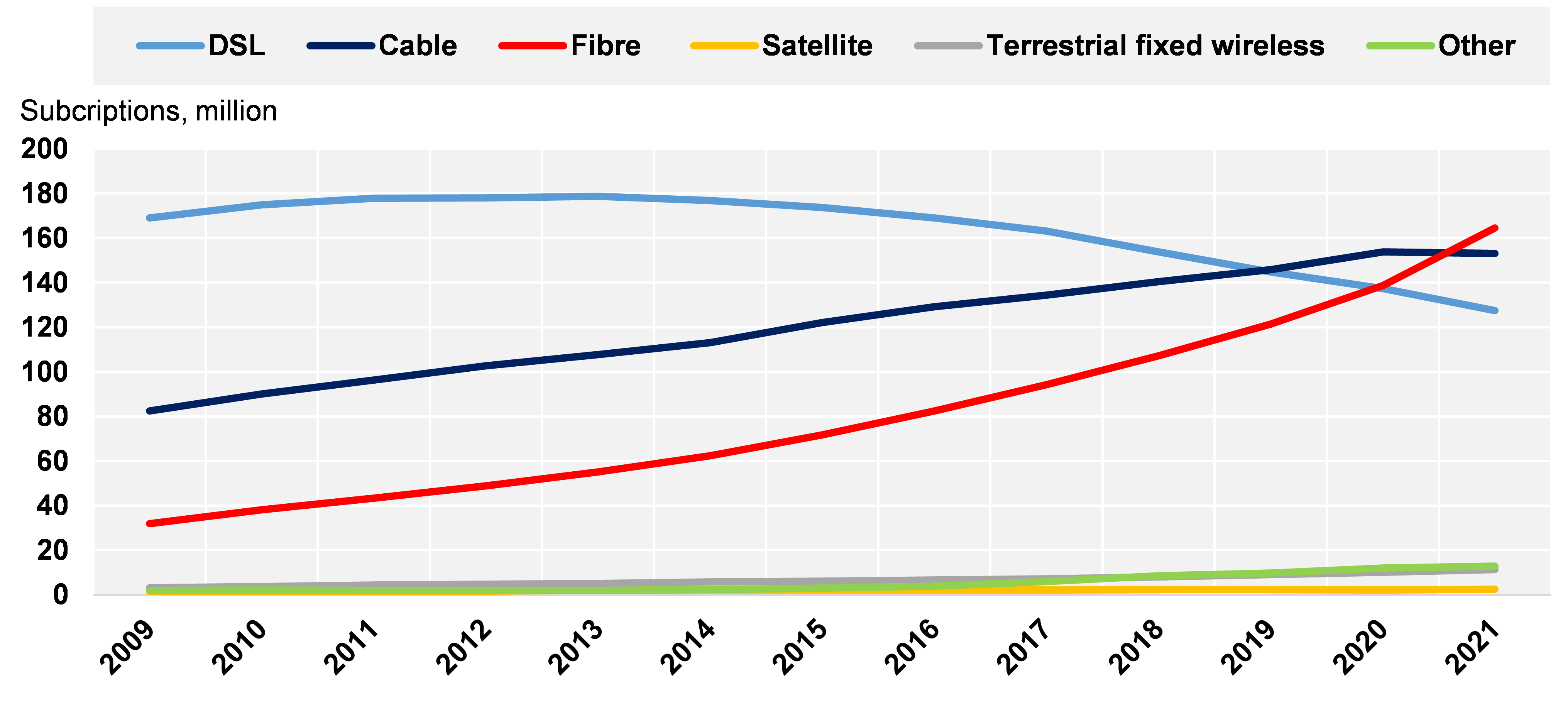
The latest update of the OECD broadband portal shows that fibre subscriptions increased by 18.6% over the year to December 2021 to move ahead of cable, now at 32.4% of fixed broadband subscriptions, and DSL at 27% and declining. This is good news for the delivery of data-intense services and applications, given the symmetrical capacity that fibre offers. The biggest growth was in Costa Rica, Israel, Greece and Belgium which all increased fibre connections by more than 80% in 2021. The share of fibre in total broadband is now at 50% or above in 13 OECD countries, standing above 50% in Chile, Finland, Luxembourg, New Zealand, Norway, and Portugal, and above 70% in Iceland, Japan, Korea, Latvia, Lithuania, Spain and Sweden.

Fixed broadband subscriptions by technology 2009-2021

Download the data in Excel

Fixed broadband subscriptions continue to grow in almost all OECD countries, increasing by 3.9% across the OECD area in 2021 to total 472 million, up from 454 million in December 2020, to average 34.4 subscriptions per 100 inhabitants in the OECD. Switzerland led the pack with a penetration rate of 48.4 subscriptions per 100 people, followed by France (46%), Norway (45%), and Denmark (45%).

Mobile data usage per subscription rose by 15% in 2021, less than in 2020, but still making a rise of 79% over the three years to end-2021. The amount of data consumed averages 8.4 GB per OECD subscription per month but varies greatly by country. Finland leads the way with 36.7 GB per month per subscription, followed by Latvia (29.7 GB) and Austria (26.4 GB) while monthly averages in Mexico and the Slovak Republic are just below 4 GB.

Despite the very high penetration of mobile broadband subscriptions, 2021 still saw significant growth of 5.5%. Mobile broadband penetration is highest in Japan, Estonia, the United States and Finland, with subscriptions per 100 inhabitants at 191%, 180%, 169% and 157%, respectively.

Iceland is by far the leader in machine-to-machine (M2M) communications with 317 M2M SIM cards per 100 inhabitants. The high number is driven by Vodafone Iceland’s provision of M2M subscriptions to help international pharmaceutical companies distribute COVID-19 vaccines. Sweden, Austria, Norway, and Germany also rank highly in terms of M2M SIM cards per head. Sweden’s 191 M2M SIM cards per 100 inhabitants is boosted by the use of these SIM cards in other countries by a Swedish operator. Overall, M2M/integrated mobile cellular subscriptions have increased by more than 16% (58 million new subscriptions) over the past year in the countries for which data were available.

Download broadband data, charts and penetration maps by country at http://oe.cd/broadband

WBA OpenRoaming Enables Dublin’s Smart City Vision with Seamless, Secure, High-Performance Wi-Fi #WorldWiFiday

The Wireless Broadband Alliance (WBA) and City of Dublin today announced a successful proof-of-concept trial of OpenRoaming™ in Dublin, Ireland. Initially deployed at Bernardo Square, Dame Street and the City Council’s Amphitheatre, WBA OpenRoaming enables residents and visitors to log in only once and then maintain seamless connectivity as their smartphones, tablets and other Wi-Fi devices automatically switch between different public Wi-Fi hotspots. The success of the trial will pave the way for a larger city-wide deployment. 

Dublin is a high growth city. It currently has a population in the Greater Dublin Area of around 2.02 million and is anticipated to grow to 2.2 million by 2031. It houses 30% of the country’s working population and attracts over 6.6 million overseas visitors a year.  It is anticipated that OpenRoaming will be initially rolled out on over 150 AP’s across Dublin city. 

Now available at over 1 million hotspots worldwide, WBA OpenRoaming frees users from the need to constantly re-register or re-enter log-in credentials — all while maintaining enterprise-grade security and privacy. The WBA OpenRoaming standard also enables enterprises, device OEMs, service providers and others to provide performance guarantees and — with Wi-Fi 6 and 6E— a carrier-grade experience as users roam between different public Wi-Fi venues.

The trial, initiated by Dublin City Council’s Smart Dublin programme and supported by the WBA and Virgin Media, also involved participation from CommScope and represents a key a milestone toward achieving Dublin’s smart city goals, which include:


  • Providing communities, residents and businesses with seamless access to services online, as well as high-quality connectivity
  • Giving tourists and other visitors free, secure, high-performance Wi-Fi access. Once they arrive and log on to an OpenRoaming-enabled hotspot, their device is automatically authenticated for use every time it switches to another OpenRoaming-enabled hotspot. This convenience makes it easier for them to find what they need, such as restaurant recommendations, transit schedules, directions and more.
  • This seamless, secure experience ensures that they have the broadband connectivity they need for interactive immersive learning, research, hybrid study and more.


Tiago Rodrigues, CEO of the Wireless Broadband Alliance, said: “Wi-Fi is the foundation for smart cities. This successful proof-of-concept trial shows that that the City of Dublin and its residents, businesses and visitors all can depend on the WBA OpenRoaming standard to ensure that they always have convenient access to seamless, secure, carrier-grade Wi-Fi connectivity.” 

Jamie Cudden, Smart City Lead, for the City of Dublin, said: “Dublin is at the forefront of a digital transformation that is serving as a model for other municipalities across Ireland and the world. Collaborations like this are key to the delivery of convenient, reliable and ubiquitous connectivity which is critical for achieving our smart city goals such as closing the digital divide and ensuring that government is responsive to the needs of citizens and businesses. This successful trial of WBA OpenRoaming is a milestone toward achieving all those goals.”

Bart Giordano, SVP Ruckus Networks, CommScope, said: ““As a founding partner in the OpenRoaming framework, we are pleased to announce with the WBA the successful launch of the OpenRoaming initiative and network for the City of Dublin.  OpenRoaming brings the promise of seamless and secure connectivity to users and IoT devices all over the world.  The core elements of OpenRoaming are in line with those of the Ruckus Network portfolio: cloud federation, cybersecurity, policy and automation.  We look forward to expanding the City of Dublin’s network and capabilities and supporting OpenRoaming deployments worldwide. “

Aidan Darcy, VP Business & Wholesale at Virgin Media Ireland said: “It’s fantastic to be working with Dublin City Council on such an important initiative. Given the fact that we are the official provider of both the Wi-Fi and broadband infrastructure, we are able to offer cutting-edge broadband speeds and an exceptional Wi-Fi experience for residents and tourists availing of the new Dublin City Wi-Fi Zones. We’re passionate about connecting communities and, with this new initiative, we really feel we’ll be creating connections for good.”

Launched in May 2020, WBA OpenRoaming is now in Release 3, which will make the business and commercial aspects of roaming easier than ever before and importantly, cut back on hundreds of hours of legal and administrative time when establishing roaming settlement agreements.


World Wi-Fi Day – 20th June 2022

This announcement comes just before World Wi-Fi Day (an annual WBA initiative), a global platform to recognize and celebrate the significant role Wi-Fi is playing in getting cities and communities around the world connected. 

It is a unique opportunity to reflect on how we can reduce digital poverty through innovative projects that will connect the unconnected. 

About the Wireless Broadband Alliance

Wireless Broadband Alliance (WBA) is the global organization that connects people with the latest Wi-Fi initiatives. Founded in 2003, the vision of the Wireless Broadband Alliance (WBA) is to drive seamless, interoperable service experiences via Wi-Fi within the global wireless ecosystem. WBA’s mission is to enable collaboration between service providers, technology companies, cities, regulators and organizations to achieve that vision. WBA’s membership is comprised of major operators, identity providers and leading technology companies across the Wi-Fi ecosystem with the shared vision. 

WBA undertakes programs and activities to address business and technical issues, as well as opportunities, for member companies. WBA work areas include standards development, industry guidelines, trials, certification and advocacy. Its key programs include NextGen Wi-Fi, OpenRoaming, 5G, IoT, Testing & Interoperability and Policy & Regulatory Affairs, with member-led Work Groups dedicated to resolving standards and technical issues to promote end-to-end services and accelerate business opportunities. 

The WBA Board includes Airties, AT&T, Boingo Wireless, Broadcom, BT, Cisco Systems, Comcast, Deutsche Telekom AG, Google, Intel and Viasat.  For the complete list of current WBA members, click here.

Follow Wireless Broadband Alliance: 
www.twitter.com/wballiance 

http://www.facebook.com/WirelessBroadbandAlliance

https://www.linkedin.com/company/2919934/

National Broadband Ireland Progress Update

NBI, the company rolling out the new high-speed fibre broadband network under the Government’s National Broadband Plan (NBP), has today issued a progress update which is showing strong momentum across all 26 counties.

By year end 2022, NBI is on track to deliver:

  • Premises under construction to grow by 43%, to 221,000 homes (40% of the 7-year target)
  • Premises available to order* set to increase by 266% to 128,000 homes
  • Premises passed^ to grow by 219% to 102,000 homes

Specifically on take-up, NBI reports take-up rates of over 30% already in Deployment Areas that have been live for a period of 6 months or more.

David McCourt, Chairman of National Broadband Ireland said: “The leading indicators give us confidence that this ambitious project can and will be delivered on time and on budget. During 2022, 221,000 premises or 40% of the entire Intervention Area will be under construction, up from 28% last year. At the same time, we anticipate that 128,000 premises will be available to order on the NBI Network. Our ability to move premises from the construction phases to the order phase is seriously ramping up which means users can reap the benefits of the transformational network sooner.”

NBI Chief Executive Peter Hendrick said: “Early take-up of services on the NBI network are already exceeding 30% in many of the initial deployment areas and it’s growing all the time, something we see as a really strong indicator of future demand. By comparison with any national or international comparison this is indicative of very high uptake levels, substantially ahead of initial expectations. Ultimately, we are confident of an overall take-up of approximately 85% and already have some 50 broadband providers signed up to sell services on the NBI network. This platform competition is expected to bring significant benefits directly to consumers by ensuring that bundled voice, broadband and TV packages offer real choice at competitive prices.”

High-speed fibre internet continues its strong growth in OECD countries as DSL declines

High-speed fibre subscriptions grew by 15% across OECD countries from June 2020 to June 2021, as living and working under Covid-19 restrictions continued to drive demand for high-quality internet connections with the rapid upload and download speeds that fibre offers.

The latest update to the OECD’s broadband portal shows fibre now makes up 32% of fixed broadband subscriptions across the OECD’s 38 member countries, up from 12% a decade ago, and is by far the fastest-growing broadband technology, outpacing a 4.5% rise in overall fixed broadband subscriptions. While countries use different technology mixes, 23 OECD countries have now a higher share of fibre than copper-wire DSL in their total fixed broadband connections, up from 20 countries a year ago.

Cable showed more modest growth of 4% in the year to June 2021, and is now declining in 15 countries, yet it remains the main fixed broadband technology for nine OECD countries. DSL subscriptions declined by 6% over the same period, with several OECD countries showing sharp declines.


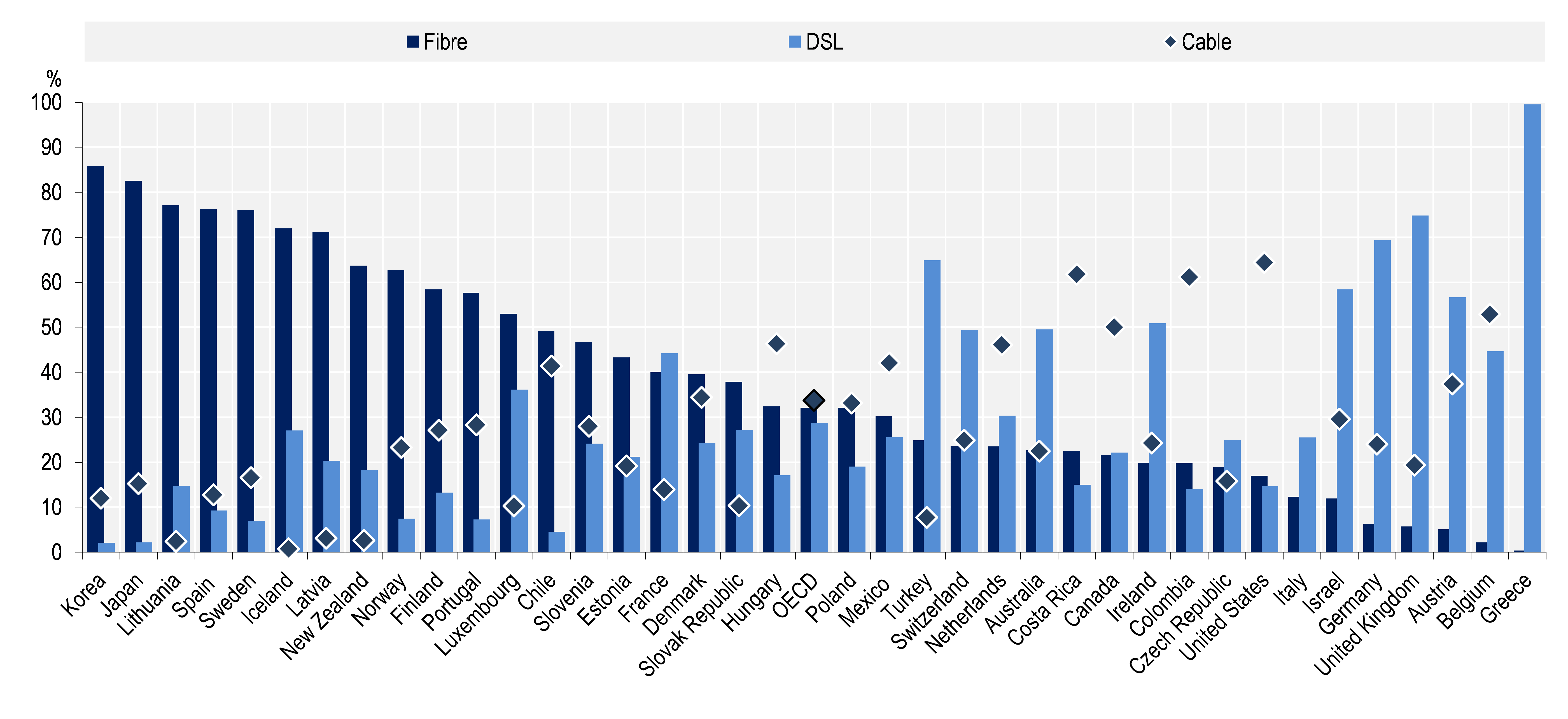
Fibre, DSL and cable subscriptions in total fixed broadband, June 2021

Latin American OECD countries saw significant increases in fibre with growth rates of 74% for Costa Rica, 71% for Chile, 43% for Colombia and 26% for Mexico. Other countries with impressive growth in fibre connections include Israel with 76%, Ireland with 54% and Italy with 53%. Seven countries now have a fibre share of above 70% of their fixed broadband subscriptions: Korea with 86%, Japan with 83%, Lithuania with 77%, Spain with 76%, Sweden with 76%, Iceland with 72% and Latvia with 71%.

Cable remains dominant in North and South America, accounting for 64% of subscriptions in the United States, 62% in Costa Rica, 61% in Colombia, 50% in Canada, 42% in Mexico and 41.4% in Chile, where fibre has overtaken it. In Europe cable is the dominant technology in Belgium (53%), Hungary (46.4%), and The Netherlands (46%).

DSL connections, meanwhile, saw sharp declines of over 30% in Chile (-37%), New Zealand (-32%), Norway (-40%), Spain (-32%), and Sweden (-31%).  Some operators in OECD countries are in the process of shutting down copper connections altogether, for instance in France, Japan, Estonia, Finland, Sweden and Spain.

Mobile broadband continued its inexorable growth with a 6.3% increase in subscriptions in the year to June 2021, a higher rate of growth than in the two previous periods (3.6% in June 2019-June 2020 and 5.8% in June 2018-June 2019.) In contrast, the number of data-only subscriptions declined in 17 out of 38 countries and this category experienced a 0.4% drop in subscriptions. This could be due to greater use of fixed networks at home during Covid-19, which tend to offer a better connection quality for work, education, and leisure.

M2M SIM cards have grown by an impressive 16%, with Sweden, Austria, Iceland and the Netherlands dominating the ranking, having 175.6, 82.5, 82.3 and 50.3 M2M cards respectively per 100 inhabitants.

Overall, fixed broadband subscriptions in OECD countries totalled 462.5 million as of June 2021, up from 443 million a year earlier, to average 33.8 subscriptions per 100 inhabitants. Mobile broadband subscriptions totalled 1.67 billion as of June 2021, up from 1.57 billion a year earlier, and averaged 122 subscriptions per 100 inhabitants.

Download broadband data, charts and penetration maps by country at http://oe.cd/broadband.

National Broadband Ireland launches new 2 Gigabit per second high-speed fibre broadband offering

National Broadband Ireland (NBI), the company rolling out the new high-speed fibre broadband network under the Government’s National Broadband Plan (NBP), has today launched a new 2 Gigabit per second (Gbit/s) offering in partnership with the 34 retail service providers selling services on the NBI network.

The new offering will enable residential customers across Ireland to enjoy 2Gbit/s download speeds with 200Mbit/s upload speeds, while business customers can avail of 2Gbit/s download speeds with 400Mbit/s upload speeds.

This new offering has expanded NBI’s product portfolio to six different high-speed broadband offerings for customers. The entry level offering provided to customers on the NBI network includes 500Mbit/s download with 50Mbit/s upload.

Peter Hendrick, CEO of National Broadband Ireland, said: “We are delighted to facilitate this new offering for customers in partnership with all retail service providers on the NBI network. The comprehensive range of offerings available on the NBI network will empower customers across Ireland with a variety of different requirements in terms of broadband speeds. National Broadband Ireland is working to ensure that every person can realise their ambitions through access to high-speed broadband.”

With the introduction of NBI’s new 2Gbit/s high-speed broadband offering, the company has expanded the portfolio of broadband options available on the NBI networks to six:

Products Download Speed Upload Speed
High-Speed Broadband Consumer Standard 500Mbit/s 50Mbit/s
High-Speed Broadband Consumer Premium 1Gbit/s 100Mbit/s
High-Speed Broadband Consumer Elite 2Gbit/s 200Gbit/s
High-Speed Broadband Business Standard 500Mbit/s 100Mbit/s
High-Speed Broadband Business Premium 1Gbit/s 200Mbit/s
High-Speed Broadband Business Enterprise 2Gbit/s 400Gbit/s

Some 50 retail service providers (RSPs) have already signed up to sell services on the NBI network and 34 are certified as ready to start providing connections today. This is expected to bring significant benefits directly to consumers and businesses.  Competition between RSPs affords choice for end users which will ensure quality bundled packages offer consumers choice around voice, broadband, TV and mobile at competitive prices.

National Broadband Ireland is actively working across the country to design and build the new high-speed, Fibre-to-the-Home network, which will connect over 1.1 million people and over 554,000 premises in the project’s Intervention Area. NBI is encouraging people to keep up to date with Eircode specific updates at /eoi/.