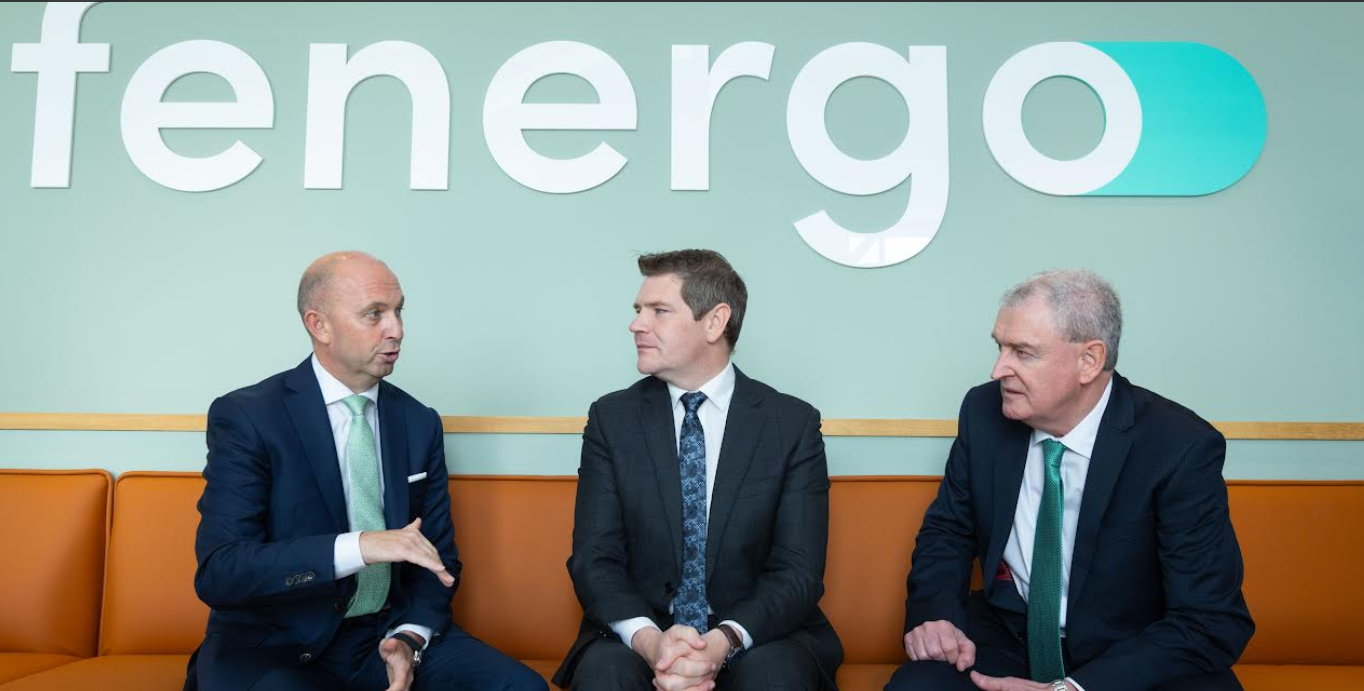
Fenergo creates 300 new jobs in Ireland with €100 million investment

Leading Irish Software as a Service (SaaS) financial technology solutions provider Fenergo, has today announced 300 new jobs at its global HQ in Dublin. This is part of a €100 million Research, Development & Innovation (RD&I) expansion plan supported by Enterprise Ireland. In addition to the new roles in Ireland, which will double the domestic headcount, Fenergo is creating new jobs across its international markets to meet increasing demand for its AI-powered solutions. A total of 500 new positions will be filled by the company globally within the next three years.  

With support from Enterprise Ireland, Fenergo has also invested in a new RD&I Centre of Excellence at its Dublin HQ where the new Irish roles will be based, supporting Fenergo’s innovation strategy. The new roles will enable Fenergo to further deliver on its mission to support financial institutions in fighting financial crime and creating a safer world. Fenergo will continue to build out its intelligent, AI-powered solutions for client lifecycle management (CLM), anti-money laundering (AML) and Know your Customer (KYC). This suite of solutions forms Fenergo’s FinCrime Operating System, which addresses all anti-financial crime events and operations, transforming compliance from a burden into a strategic competitive advantage. 

Recruitment for the new roles is now underway, with candidates being sought for a wide range of mid-level engineering and R&D positions. Fenergo is also rolling out a graduate programme with the intention to appoint up to 30 university graduates. Interested candidates can find more information about the new jobs and submit applications via: Let’s Grow Together | Fenergo. 

Minister for Enterprise, Tourism and Employment Peter Burke TD welcomed the jobs announcement: “The government and Enterprise Ireland are committed to supporting and accelerating the scaling of ambitious, innovation-led Irish companies. Fenergo is a clear example of ambition in action – a company that has expanded at pace since it first launched in 2009, and one which today represents a standout financial technology solutions provider both globally and domestically. Today’s announcement not only represents significant job creation within the Irish market and excellent opportunities for our homegrown talent, but it also reinforces our position as one of the largest and most important tech hubs in Europe. I would like to commend Fenergo on this milestone expansion and their continued investment in Ireland, which I’m confident will underpin further growth for the company while supporting our economy.”  

Marc Murphy, CEO and Founder of Fenergo, said: “I am delighted to announce Fenergo’s significant expansion in Ireland with the creation of 300 jobs at our new RD&I Centre of Excellence, which was made possible with the considerable support and investment we have received from Enterprise Ireland. This investment and growth of our Irish operations reflect our confidence in the excellent talent pool we have in this country, and a market where innovative thinking, entrepreneurship and evolving technology will propel Fenergo to new heights. With AI at the core of our RD&I strategy, we are committed to delivering future-proof solutions for financial institutions in Ireland, across Europe, the UK, America, Middle-East and Asia – supporting them during times of intensifying geopolitical tension and regulatory uncertainty.  

“We are actively recruiting for the new roles already, and I would strongly encourage prospective candidates to consider applying and join our world-class team of change-makers at Fenergo – shaping the future of financial services operations through innovation and AI.” 

Kevin Sherry, Interim CEO, Enterprise Ireland said, “Ambitious companies like Fenergo embody Enterprise Ireland’s mission that Irish owned, globally focused companies will be the primary driver of our economy. Fenergo, announcing 500 new jobs today, is a great example of an innovative Irish company growing customers, adding RD&I to drive forward AI powered solutions and creating an impact in global markets. I’d like to congratulate Marc and the team on this expansion and we look forward to working with them.” 

Due to the continued strength of Fenergo’s export activity, along with a growing portfolio of financial services clients in the Irish market over the past two years, Fenergo delivered a substantial profit in FY25 and is tracking well to deliver strong EBITDA profitability in this financial year, FY26.  Fenergo’s investment in its Irish and international expansion is expected to further bolster its ability to serve international markets while also growing its domestic business. 97% of Fenergo’s revenue in the year ending March 2025 was generated from exported business. 

Enterprise Ireland Export Results 

This expansion announcement was made in conjunction with Enterprise Ireland’s client company export results for 2024. Enterprise Ireland today announced that its clients have achieved record exports of €36.75bn in 2024, up 7% on 2023, with all territories and major sectors recording increases, surpassing the 2022 – 2024 strategy target of €30bn exports.  

Exports to Europe, grew by 8% to €10.63bn representing 29% of total exports. This is the first time that exports to this region have surpassed the UK, making Europe now the largest export territory for Enterprise Ireland’s client base. 

·       Within Europe, the Eurozone, which represents 26% of total exports, continued to perform. Exports increased by 9.6% to €9.42bn in 2024 with growth across the majority of countries, including Germany, the Netherlands and France. 

·       The UK, now the second largest export territory for clients achieved €10.52bn exports in 2024, up 4% on 2023 and surpassing the €10bn mark for the first time.  

·       North America also delivered growth, with exports of €7.30bn in 2024, up 8% on 2023. USA, the main export market had exports of €6.66bn, up 8% on 2023. 


All sectors showed strong export growth. The Food and Sustainability sector reached €16.25bn, up 5% on 2023. Non-food exports surpassed this, achieving €20.5bn, up 8%, with the Industrial and Lifesciences sector recording €11.46bn exports, up 9%. Of this, High Tech Construction exports increased by 20% to €4.66bn. 

The Technology and Services sector also grew, with exports of €9.05bn achieved in 2024, up 7% on 2023. Of this, Digital Tech exports reached €3.16bn in 2024, up 9% on 2023. Fintech, Financial & Business Services also saw an increase, up 5% to €2.90bn in 2024.  

Enterprise Ireland client companies spent €42.65bn in the Irish economy in 2024, including €13bn on payroll.  


Welcoming Enterprise Ireland’s export results, Minister Burke said“The strength of Ireland’s exporting base of companies is reflected in Enterprise Ireland’s strong 2024 export performance results. Despite a more challenging international environment, Irish exporters have made significant gains and continue to grow their influence internationally. These companies are a critical part of the Irish economy, and the government through Enterprise Ireland is committed to supporting this sector to scale further, while preparing for and mitigating against disruption in global trade tariffs.” 


Announcing Enterprise Ireland’s export results today, Kevin Sherry Interim CEO of Enterprise Ireland said: “Despite ongoing challenges in recent years, such as economic headwinds and rising costs our client companies continue to show their agility and resilience as they scale internationally, achieving yet another year of record export growth with €36.75bn in exports in 2024. This robust performance by clients like Fenergo, reflects a strong and resilient exporting base which fuels our economy, delivering sustainable prosperity nationwide.” 


“Our results show that for the first time Europe has surpassed the UK as the number one export territoryThis demonstrates that while our client base continues to grow exports in the UK, there is less reliance and dependency on this one market with many clients broadening their base and winning business in other marketsAmid future geopolitical instability, Irish businesses proven ability to diversify across markets will stand to them when facing challenging and uncertain times. Enterprise Ireland remains committed to supporting companies as they explore potential mitigation and market diversifications strategies to navigate the challenges of export tariffs. added Kevin Sherry.

How to choose a SaaS development company

When it comes to choosing a SaaS development company, there are a few things you need to keep in mind. In this blog post, we will review some of the key factors you need to consider before making your decision.

Whether you are looking for a company to develop a new market platform or simply someone to support your existing platform, these tips will help you choose the right person.

Specify your requirements

When choosing software, it is important to clearly define your needs and establish a budget to a saas application development company. You must take into account the features necessary for your activity and the support systems that will make your team’s life easier.

In addition, depending on the type of product or service you offer, you may need to look for specialized software offers such as customer relationship management (CRM) software.

Setting your budget is also essential to find the right software solution: what are you willing to pay for? Consider not only the initial costs, but also the subscription fees or additional services that may be necessary along the way.

Once you know what features are needed and have set a reasonable budget, you can start reducing the list of available options until you find the best solution for your organization. With a clear orientation and an understanding of the costs associated with different software solutions, decision-making will be much easier.

Do your research for companies that have experience with similar projects

When it comes to choosing a company for your project, doing research can make all the difference. While it is important to find organizations with a good reputation and a history of success, it is equally essential to look for those that have experience with projects similar to yours.

Whether you are launching a SaaS product or developing an on-premises software solution, having a partner who knows the nuances and challenges associated with your type of project can be the key to success.

By conducting extensive research and due diligence, you can find companies ready to help you reduce risks and speed up time when you move from idea to execution. Working with organizations that are familiar with your particular type of project gives you a head start during development and deployment.

So do not skimp on the research phase – take the extra time to make sure you choose the right partner for your project. It will pay off in the long term!

Check the company’s technology stack before choosing a SaaS development company

Choosing the right company to develop and manage your SaaS product is a crucial decision. A key factor to take into account when evaluating companies is their saas technology stack.

This assessment should cover several areas, such as the flexibility and robustness of the architecture, the quality of technology integration, updating the stack against current trends, ease of adaptation to new projects, as well as the knowledge and experience of the developer team.

In addition, it is important to determine the duration of the development cycle – for example, some projects require weeks or months of development with a custom stack, while others only take a few days with a standard technology stack.

In summary, understanding all the components of the company’s technology stack will help you knowingly choose the SaaS development company that will best meet your needs.

Conclusion

When looking for software development services, it is important to start by defining the needs and budget of your project. Once you have a good understanding of what you are looking for, look for companies that have experience in similar projects. Ask for quotes from several companies and ask for references before making your final decision. By following these steps, you can be sure to find the software development company that will meet your specific needs.

Before engaging with a development company, be sure to consult its portfolio and read the online comments of other customers. This will give you a good idea of their previous projects and the degree of satisfaction of their customers.

Common questions to ask your SaaS or cloud-based LMS provider in 2023!

Choosing a learning management system (LMS) or other online training software is thrilling and challenging. The first thing you need to do is persuade upper management that your LMS is a good idea. There is a direct correlation between a fully functional LMS and a rise in ROI because of the positive effects on worker efficiency and output. As a result, it is essential to select a system that works well for your company. Cost and functionality are among essential inquiries for a prospective LMS provider. On the other hand, there are several other inquiries you may wish to make of your vendor before determining whether or not to enter into a lasting business partnership with them. This article will discuss the common questions you must ask your LMS provider to ensure you are choosing the world’s best LMS for entrepreneurs. 

The truth is, there is no one definitive choice when it comes to selecting the best LMS. The best LMS for you is the one that best serves your needs. The following questions will help you find exactly that:

Penetration testing of external applications and networks: do you offer this service?

In other words, the corporation has enlisted the help of testing agencies to “attack” its website and network in search of security flaws. Severe content management systems (CMS) and SaaS providers will perform this at least quarterly, with additional testing performed against any system modifications. You need to request the most recent report and each subsequent report be sent to you.

What kinds of assistance are there, if any?

Due to the nature of open-source software as a do-it-yourself project, technical help is limited. In general, cloud-based LMSs offer superior levels of devoted customer support. However, check their support policy, as every commercial LMS is a mix of several systems. Find out if the LMS provider you’re considering has automated support or human tech support available. How comprehensive is their frequently asked questions section? Do they provide support in languages besides English? How quickly do they react when you bring up a problem? How do they respond when you have a problem or complaint? Is the IT support team, for instance, well-informed and able to explain the problem and its solution in the language you can grasp?

In what way does the report function operate?

Verify that the supplier uses a reliable reporting mechanism. To make more informed decisions, modern dashboards efficiently present data from reports. It is only possible to evaluate the efficiency of a training program with access to reliable reports displaying relevant learning data. These studies are essential for stakeholders, especially those in leadership roles, to stay abreast of the state of online education.

The reports generated by the LMS should be easily accessible 24/7 by managers, instructors, and officials. In addition to the benefits already mentioned, business owners also benefit from the option to modify reports to their own needs. 

Through SSO, learners have access to the LMS without switching platforms. The LMS can schedule reports and notifications to be sent out via Salesforce. These regularly scheduled automated reports are helpful for upper-level management and other decision-makers. As a result, inquire about all these factors from your potential LMS provider.

How Often Do You Release Updated Versions Of The Software?

A limited amount of updates may be included with some LMS. Any additional improvements beyond the maximum price tag will undoubtedly incur additional fees. At the same time, some will demand payment immediately if you want to use a more recent version. It would help if you inquired about the regularity of upgrades and the frequency of new LMS releases. You might have to replace your plug-in device every year. You should know it immediately since you want to be prepared. See if they are up-to-date on the latest developments in LMS technology by inquiring about industry trends and advancements.

How well does the LMS support mLearning?

Your LMS needs to provide a remarkable experience every time an employee logs in, especially since they will want to access their learning materials on demand, sometimes from a smartphone or tablet when they are away from their offices. Is the system able to display information uniformly across all devices, and is it comparable to the “desktop experience”? Ask any potential LMS provider these questions to ensure their platform can accommodate mobile learning. Many companies are adopting remote and hybrid teams, making this a crucial consideration.

Conclusion

When you choose an LMS, you commit to working closely with that company for years to come. Pick a service that will assist you in every step, from initial planning to platform launch. Select a service that meets your needs and has room to expand as your business does. Choose an LMS provider who can deliver on the promise of a platform that makes learning fun and easy.

7 Reasons Why SaaS Development Is So Popular Now

One of the fastest-growing tech products in the market today is software as a service (SaaS). According to Statista, its market size could reach almost $200 billion by 2023.

There’s no better time to get a SaaS application development company onboard than now. You can piggyback on the team’s expertise, experience, and knowledge to build and launch a platform fast without compromising quality, security, and usefulness.

Making a move now also helps you maximize these seven huge SaaS benefits:

1. Cost-Effectiveness

Software as a Service (SaaS) is an attractive business model for many users, due to its cost-effective benefits.


  • No large upfront payment is required, allowing businesses to access quality software at a fraction of the cost of purchasing and hosting IT infrastructure.
  • Software costs are bundled into one low monthly fee, which reduces financial strain compared to making one-off payments.
  • Users can save time when adopting SaaS as it is quick and easy to set up and automatically update programs.

SaaS is also just as cost-effective for the development team. For example, developers don’t have to invest in an on-premise infrastructure. Instead, they can leverage cloud technology to host their applications.

2. Scalability

SaaS can also meet an organization’s or individual’s changing needs as their demand for a particular service or product shifts up or down. They can achieve this level of scalability in various ways:


  • Cloud infrastructure to add resources such as storage and processing power on the fly with no interruption to services
  • Multiple servers that provide the same software resource at different locations around the world
  • Usage charges can be based on consumption alone instead of committing to a flat payment rate.

As businesses become increasingly reliant on digital operations, it is easy to see why scalability within SaaS products is imperative for success.

3. Maintenance

SaaS is a beneficial and easy-to-maintain software model for all involved, from software developers to users.

Developers can create an online platform that allows customers to access their service without needing manual maintenance or installation. This significantly reduces maintenance costs and time due to only needing upgrades once at the system’s back end, rather than pushing out updates to multiple users.

This centralized deployment also drastically improves the scalability of software systems, which provides a great advantage for businesses that wish to save on both cost and effort.

For users, SaaS also benefits them in terms of cost as cloud computing becomes much more efficient for storing and handling large amounts of data without additional maintenance fees.

It also allows for real-time data access, increased accessibility from any location with an Internet connection, and a diminishing need for extensive IT support.

4. Security

This may be an unpopular opinion because the cloud is prone to cybersecurity risks. However, security is not a reason to avoid SaaS application development.

No system can be 100% secure, but there are certain steps that software developers can take to ensure their customer’s data remains safe and private.

Customers can rest assured that the cloud provider they use for SaaS has robust security measures in place, such as data encryption, access control, and identity management.

Furthermore, SaaS providers use a combination of software, hardware, and process-based approaches to ensure the security and privacy of their customer’s data.

5. Accessibility

The great advantage of Software as a Service is its accessibility from any device and at any time via the internet. So users can access their data and services from any location with an internet connection.

This improves collaboration internally and externally, as people are no longer tied to a single device or physical location. It also makes it easier for businesses to track user activity in real time, enabling them to make informed decisions quickly and efficiently.

Compared to on-premise or even cloud applications, which are typically only accessible from authorized devices and locations, SaaS offers a much more convenient solution for businesses looking for an efficient way to access their data.

6. Integration

Another benefit of SaaS applications is the ability to integrate easily with other software services and systems. This makes it easier for businesses to extend their offerings without building custom integrations from scratch or purchasing additional platforms.

It allows developers to create a more comprehensive solution that can be integrated into an existing ecosystem, making it easier for businesses to connect different applications and systems.

7. Collaboration

In the age of remote work and digital nomad lifestyle, SaaS encourages collaboration across teams and locations. It allows team members to share documents, access data from any device, co-edit projects in real time, and stay connected regardless of where they work.

In the process, businesses can manage distributed teams and create an environment that fosters greater collaboration between different departments and teams. SaaS also enables organizations to manage their projects more efficiently. For instance, team members can view changes quickly, eliminating the need for long email threads or tedious meetings.

Overall, the benefits of using SaaS applications are numerous. With its cost-effectiveness, scalability, accessibility, security, integration and collaboration capabilities. It is no wonder why more businesses are turning to it for their application development needs.