Leading real hands on tech review site in Ireland with technology, business news and more. Jim O Brien Tech.
Author: Jim O Brien/CEO
CEO and expert in transport and Mobile tech. A fan 20 years, mobile consultant, Nokia Mobile expert, Former Nokia/Microsoft VIP,Multiple forum tech supporter with worldwide top ranking,Working in the background on mobile technology, Weekly radio show, Featured on the RTE consumer show, Cavan TV and on TRT WORLD. Award winning Technology reviewer and blogger. Security and logisitcs Professional.
While on his honeymoon in Tokyo last year, entrepreneur Ronan Cunningham stumbled across a little-known free-roam virtual reality game called Zero Latency. So impressed by it, Ronan persuaded his wife to cut their honeymoon short and detour to Australia where he convinced the game’s founder to sell him the exclusive rights to Dublin and London. Having already brought FootGolf (footee) to Ireland six years ago, Ronan is now preparing to launch Zero Latency in Dublin in the spring.
Ronan says, “Having experienced Zero Latency first hand while I was in Tokyo on my honeymoon with my wife, I knew instantly that this was a fantastic opportunity to bring a totally new type of business to Ireland and the United Kingdom. Going on your honeymoon and coming back with a business is something that you don’t hear everyday but it certainly adds a special element to the business venture!
I am committed to bringing new experiences to Dublin and feel both privileged and excited to be in a position to do so. In 2013, I introduced FootGolf to Ireland after enrolling in an Innovation and Entrepreneurship course at the UCD Innovation Academy. It’s been amazing seeing FootGolf’s popularity spread throughout Ireland and we cannot wait to see what lies in store for Zero Latency.’
Lenbrook International, maker of high-resolution audio hardware and software solutions, is pleased to announce that a first set of Amazon Alexa Skills for its BluOS Hi-Res Distributed Audio platform, will be available January 15, 2019. Users of BluOS Enabled products from Bluesound, NAD Electronics, and DALI Speakers, will benefit from hands-free control of their music from any Amazon Echo device.
Amazon’s Alexa represents the first platform-wide voice control integration for BluOS in a broader voice control strategy that seeks to offer users a choice in which voice assistant they use. This strategy includes the creation of BluVoice, the voice-control interface that acts as the intermediary between BluOS and a compatible voice assistant. For example, BluOS users can ask their Echo device to deliver music playback commands to their BluOS Enabled device via BluVoice with phrases like, “Alexa, ask BluVoice to play preset 1 in the study,” or “Alexa, ask BluVoice to play new songs on Tidal”.
The strategy also opens up the possibilities of what can be controlled with voice assistants. With the first set of Alexa Skills to be published on January 15, 2019, BluOS users will be able to access popular or user-defined playlists from top music services, favourite radio stations, or adjust volume levels or group players together to sync music throughout the home. Some of these skills, like grouping and ungrouping players, as well as accessing playlists from a local library and not just from a streaming service, are examples of the rich voice control experience that BluOS’s implementation offers over others.
With the addition of voice control, BluOS users now have an even wider array of control options for high-resolution music management and multi-room playback, including from the BluOS Controller app for phones, tablets, and computers, IR remotes, hardware chassis controls, and home control integrations like Crestron, Control 4, and RTI.
Comments Andrew Haines, BluOS Product Manager at Lenbrook International, “Voice control has been on the BluOS roadmap for some time, but we wanted to ensure that we delivered the most flexible approach for all of our customers. Externally integrating an Alexa Skill for BluOS is the first of many collaborations with the major voice platforms, ultimately giving BluOS users unrivalled choice in which voice system they use to control their music.”
The BluOS Alexa Skills deliver a raft of commands through any network-connected Echo device, including play/pause, next/back, shuffle on/off and managing the play queue for most user libraries and music services. Users can use voice commands to switch between inputs on any of their BluOS players, set default music services, preset radio stations or play from their network-connected personal music library. Using the power of the Alexa AI (and depending on the music service being listened to) users can ask what is playing or what track is up next, what album the track is from or the name of the artist. The list of commands will expand as various music services add more voice control functionality.
For more information about voice control in BluOS and enabling Alexa Skills on a BluOS device, visit BluOS.net/BluVoice.
Leading digital agency, AGENT Digital, has created Ireland’s most comprehensive website speed report, surveying the page loading times of more than 1,000 individual Irish websites throughout a wide range of a Ireland’s business sectors.
Ireland’s Website Speed Report—which details Ireland’s fastest & slowest websites by business sector—highlights that the average website loading time in the Irish eCommerce (general) sector was the slowest of all sectors surveyed, with websites taking on average 10.35 seconds to load fully on a mobile device.
AGENT Digital managing director Kevin Meaney declared the research a wake-up call not just for the Irish eCommerce (general) sector but for all Irish businesses online.
“The average load time for Irish websites is more than three times the recommended industry standard of less than 3 seconds. Research shows us 53% of people will leave a mobile page if it takes longer than 3 seconds to load (Google),” Mr Meaney said.
He added: “More than 64% of Irish people are searching and in excess of 16% are purchasing goods and services online through mobile devices every week (Statista). But our data shows that Irish business websites are not fast enough to adequately serve this traffic.”
The AGENT Digital report reveals that the slow page loading time of Ireland’s eCommerce (general) sector is part of a national trend, with the speed across all sectors averaging 7.76 seconds on mobile devices.
Mr Meaney explained that the focus on website speed has been intensifying over the past decade, and urged businesses to act now to align their page loading times to the industry standard of less than 3 seconds. He stated: “Google has for years aimed to load its pages in under a half-second, and regards 2 seconds as the e-commerce threshold. As long ago as 2012, Google was describing loading times of 5 seconds as an eternity in a world where fractions of seconds count (Google). And other research has concluded a delay of just one second can result in 11% fewer page views, a 16% decrease in customer satisfaction and a 7% loss of conversions (Aberdeen Group).”
To bring the issue up to date and into focus for Ireland in 2018, AGENT Digital’s research team created Ireland’s Website Speed Report using Google’s web performance and speed test tools to periodically test the speed of 1,081 individual Irish websites across 29 business sectors over a 12-month period.
Ireland’s Website Speed Report Ireland’s Fastest & Slowest Websites – By Business Sector
The research finds that websites in the Irish Professional Services (Consultancy) sector have the fastest average page-loading time on mobile devices (4.95 seconds), followed by websites in the Energy sector (6.08 seconds), and Financial Services (Insurance), where sites have an average page loading time of 6.45 seconds.
As noted, the research finds Retail eCommerce (General) sites with the slowest average loading time on mobile devices of all sectors, at 10.35 seconds, behind the 9.22 seconds for sites in the Non-Profit sector, and AgriBusiness websites, which have an average loading time on mobile devices of 9.19 seconds.
Just under half (14) of the 29 sectors surveyed have average loading times faster than the national average of 7.76 seconds. Eight of the sectors are in the immediate hinterland of the national average, including Automotive (7.02); Retail-Fashion (7.25); Technology-Sector Total (7.53); Resources (7.58); Food (7.67); Communications (7.73); Media & Marketing (7.85); and Construction 7.88). All sectors have average mobile loading times in excess of the recommended 2-3 seconds threshold.
NEED FOR SPEED: Managing Director AGENT Digital, Kevin Meaney, launched “Ireland’s Website Speed Report” at international race circuit Mondello Park, Co Kildare, with a call for Irish businesses to get their websites on the starting grid for 2019. “The average load time for Irish websites is more than three times the recommended industry standard of less than 3 seconds.” Image Credit: AGENT Digital
In 2018, swift mobile loading times have become critical for two reasons. The first relates to user experience (UX) as it is right now, and how UX and sales are affected by the loading delays. There is a correlation between delays and bounce rate (the percentage of users who leave a website after viewing only one page). Bounce rate increases as page-load times increase, so longer waits are more likely to result in mobile users leaving for other websites (Akamai). In addition, it’s tougher to get mobile users to convert, because their expectations for speed and reliability are higher. While it’s impressive that more than half of overall web traffic is coming from mobile (Google), this is offset by the reality that more than 53% of mobile visitors to a site will abandon a page that takes longer than three seconds to load (Google).
“Based on the industry standard of a 3-second load time, even the quickest sector in Ireland is losing over half of their mobile site visitors. With 3.59-million smartphone users in Ireland this year, and a forecast increase to 4.06-million by 2022 (Statista), this highlights the scale of the issue.” Mr Meaney stated.
He added that the recent rollout of Google’s ‘Speed Update’ had made the issue even more urgent for Irish business website owners. “With the Google ‘Speed Update’ that was rolled out in July this year, page speed is now a ranking factor for mobile searches. Websites that are slow to load will rank lower in Google search results. It is now essentials for Irish businesses to address the problem to ensure their websites are loading as quickly as possible.” (Google)
Ireland’s Website Speed Report found no sector with average loading times of less than the recommended 2-3 seconds. This research is a wake-up call to businesses to face the challenges presented by slow loading times, and their impact on page views and customer satisfaction.
With Retail – eCommerce (General) identified as the sector with the slowest average page loading speed, a glance at the market gives an indication of the potential scale of losses.
In 2018, revenue in the Irish eCommerce market is worth around €3,502m and is expected to grow to €4873m by 2022 (Statista). However, Google and other sources warn that a delay of just 1-second could result in a 7% loss in conversions. Seen in that light, the 7-second delay averaged by Irish websites in the Retail – eCommerce (General) sector becomes a stark signifier of potential losses.
Ireland’s Website Speed Report is part of the AGENT Digital goal of helping 100,000 businesses to grow online by 2030. The report was created to make Irish brands more aware of the importance of website speed, and to help improve their online businesses.
Mr Meaney stated: “It was important for us to create this speed report to highlight the issue to Irish Businesses. Many Irish brands are simply not aware that their websites are too slow. Once the issue is highlighted it can be quickly addressed through effective website speed optimisation techniques.”
As a leading digital agency AGENT Digital specialises in website speed optimisation for leading brands both nationally and internationally. To help Irish businesses, AGENT Digital has 10 pragmatic tips that companies can take to improve their website speed immediately.
The GOXTREME REBEL came in a box with an abundant of accessories, the 2″ (5cm) display on the camera came with an external waterproof closures that seals the camera from water. The housing is waterproof but allows the buttons to be pressed manually. The waterproof closures felt strong and sturdy while a bit fiddle to open and close. The GOXTREME REBEL is designed for water and mud in a body that can be mounted to helmets, bikes, tripods and more. It also comes with a case that is waterproof to 30 metres.
Included Accessories:
Waterproof case
Shield
Bike mount
Helmet mounts
Switch support
Tripod adaptor
Battery
USB Cable
User manual
Note the unit came with no MicroSD card, this is required to be formatted. The Rebel can support microSD cards up to 32GB. The MicroSD card would require to be a class6. Or if using a 4K action cams minimum U3 class10 micro SD cards are required. The Recording times are depending on resolution.
GoXtreme Rebel specs
Display: 2”/5cm
Waterproof case: up to 30m
Video resolution: 1080p 30fps by interpolation, 720p 30fps, WVGA 30fps, VGA 30fps
Still image resolution: 16MP, 12MP, 10MP, 8MP, 5MP, 2MP by interpolation
Memory: micro SD card support up to 32GB, minimum Class 10 (not included)
Wide angle: 140° fixed
Microphone: built-in
Wi-Fi function
Time-lapse video: 1, 2, 5, 10, 30, 60 second intervals
Continuous shot: single photo, 3, 5, 10, 20 second timer
Motion detection
Anti-shaking
Setup:
The setup requires the battery to be fitted and charged via a standard USB cable, the purchased MicroSD card required to be formatted. The camera required fitting into the supplied Waterproof case. The fitting into the case is fiddley requiring concentration and referring to the manual for setup. The Video recordings have a maximum time limit of 22 mins after which time the camera will automatically stop recording. Further recording must then be restarted manually. The Rebel can record 720p high definition or interpolated 1080p Full HD video at 30fps. It can also capture 16-megapixel stills. On the back is a 2-inch display, and there’s also built-in Wi-Fi for using your phone as a remote control. There is no touch screen on the display, nor zoom functions
Note: If intending to use at the theatre, / concert the stewards request Camcorders & GoXtreme not to be used, while those with excellent camera phones continue to record.
GoPlus Cam app:
The free app had installations 500.000+ with a 3.50 out of 3,883 in total, Note the WIFI setup required the manual to be read to setup, setting up on an iPhone 6 resulted in a difficulty in not connecting initially but then worked with this phone. Once the app was set up, the phone could live view the camera and start recording etc as required. The phone had full control of the camera functions and settings.
Conclusion:
The out of box experience was solid with a alot of loose accessories with the potential of easily getting lost. The price range of the product was a surprise with the expectation of hundreds of euro but inexpensive as compared to many other units with a great variety of accessories supplied. The quality is acceptable, but poor when moving quickly or turning dropping from the headline of full HD. The camera picture of 16MP is good, the waterproof closures seals the camera up to 30m which ensures if the camera got a knock or two, it continues to work. The Wi-Fi reduced the need for a touch screen, but this would a nice touch and a zoom option. Overall this is budget action camera but with an abundance of accessories, withstand water and mud with the option to mount to helmets, bikes, tripods etc. This was a excellent surprise in the price range.
If you are on a budget and want something simple or even a gift to buy these are an ideal choice considered the cost which will set you back around €15-20 euro. The Brainwavz Zeta are a simple paired of wired headphones that look good and come with the extras to boot. The sound overall is quite good with all attributes in music reproduced well and are solid overall with performance. The in-line remote is one of simplicity but lacks functionality overall but nonetheless you get one and it can be useful
The quality here is great but not overly loud which is how I like my music. These are a simple plug and play with no app and no fuss and cost effective but the sound as I said is good and much better and clearer than any others I have tried in this price range, These are also comfortable to wear,These will work with and Audio device that sports 3.5mm or if you have an adaptor at hand. Check out the video below and if you have any questions feel free to ask below or on social. For the money here you can’t go wrong.
IVRE Announces Partnerships with Nokia, Intel, Oxford & Shenandoah Universities
Immersive VR Education (IVRE), the Virtual Reality software and technology group based in Waterford, have today announced the official launch of their online virtual social learning and presentation tool ENGAGE, which provides a platform for creating, sharing and delivering proprietary and third-party VR content for educational and corporate training purposes.
ENGAGE is a powerful virtual reality collaboration and creation tool, allowing educators and corporate trainers to host meetings, classes, private tutorials, training sessions and presentations with people from all over the world, participating in a safe, virtual, multi-user environment.
It is designed to either complement and enhance classroom teaching, or for use in a standalone environment, providing distance learners with access and opportunities to connect level with their fellow students.
Speaking of the launch, David Whelan, CEO & Co-founder of IVRE,
“ENGAGE has been in production for over 2 years – it has gone through rigorous development & testing phases and is now fully functional and ready for use around the globe. We have already partnered with Shenandoah University in the U.S. and Nokia to roll out this platform to students and staff. We are also working with leading professors from Oxford University to provide content on the ENGAGE platform, and Intel are currently promoting ENGAGE throughout the US as part of their Tech Learning Lab initiative which will be touring Europe and the UK in the coming months.
It is our mission as a company to be at the forefront of mainstreaming VR technology in education. ENGAGE is at the cutting edge of this technology’s usage in the education sector. It is uniquely placed to do two things. Firstly, help educators visualise how the technology can positively impact their profession and their ability to influence students’ participation and performance and secondly, become synonymous with the application of the technology, through its platform and content, in the ‘learning space’ which can be applied anywhere – whether it is in an interactive museum, a second level school, a university, or a work setting.”
Initial partnerships with Nokia Corporation and Shenandoah University
Both Nokia Corporation, the multinational telecommunications, information technology, and consumer electronics company, and Shenandoah University, the private liberal arts university located in Winchester, Virginia in the United States, have signed up as partners to use the ENGAGE platform for training and education purposes respectively.
Commenting on these partnerships Mr. Whelan,
“The full release of ENGAGE is a transformational moment in our history and is the result of many years of hard work, cutting edge research and innovation.Being aligned to global leaders like these institutions demonstrates the potential and need for the platform.
People today all over the world say let’s SKYPE when talking about online communications and meetings. In the future we want people to say let’s ENGAGE and enter VR to communicate in a more natural way.”
How to ENGAGE?
There is a free version of ENGAGE available to allow users to download and consume content. The paid version of the platform provides users with additional features for content creation and network capabilities. Students can use a VR headset to participate from wherever they are in the world, or can enjoy the platform through the desktop application.
There are just 3 simple steps to registration and set-up and the IVRE team are there to provide guidance on every step of the way.
Users can share their content on the ENGAGE platform for other users to enjoy.
ENGAGE has a selection of virtual presenter screens that allow users to stream in documents and media from OneDrive, Google Docs and Dropbox. They can stream in PowerPoints, Videos, Audio and a range of different documents using a media playback system. ENGAGE also supports YouTube video playback in 2D, 3D and 360 formats.
Using ENGAGE’s virtual objects and virtual environments library, teachers can create specialised lessons which aim to improve learning retention and class interaction. Live lessons can be recorded, then reviewed and shared privately with others in a virtual classroom or uploaded to the ENGAGE platform for anyone to watch anywhere.
For example, why teach Marine Biology in a classroom when you can treat students to a virtual lesson on the seabed? Imagine how much more powerful the learning experience could be when discussing the challenges of planetary environments from the surface of Mars? Stand with a class of students in the middle of the Masai Mara during the migration season to observe the majesty of nature and the importance of protecting our natural world. It really doesn’t have to be complex to remove the very real challenges of remote learning by bringing students virtually together in an ENGAGE meeting room.
Mr. Whelan spoke of their dedication to transforming the delivery methods of education and corporate training by utilising VR technologies to deliver fully immersive virtual learning experiences,
“Our ENGAGE platform aims to fully immerse the user into their learning experience, in order to increase learning retention and engagement. It will allow people to receive the best education, from the best educators from around the world, all from the comfort of their own home using virtual reality.”
Lifesize, a global innovator of video collaboration and meeting productivity solutions, today announced the release of its new global cloud service architecture and Icon 700 conference room solution. The complete video conferencing solution represents the flagship technology in a new line of next-generation Lifesize offerings. Designed with industry-first 4K video conferencing capabilities, the solution offers full-motion 4K content sharing and an unparalleled quality experience.
“Today’s businesses and their employees rely on video conferencing for their mission-critical communications,” said Craig Malloy, CEO of Lifesize. “Our goal with our next generation of Lifesize solutions was to challenge the status quo of ‘good enough’ quality and create a better-than-in-person meeting experience that eliminates the stress, time and money waste associated with commuting to and from meetings. Whether connecting face to face with your customers, making an introductory call with a new client or strengthening your internal global communication culture, these new offerings will help people present their absolute best selves in every conversation.”
The 4K global cloud service architecture and the Icon 700 conference room solutionwith full-motion 4K content sharing, and premium audio clarity, delivers the absolute best video conferencing experience on the market. Priced at $7,499, the Icon 700 offers a future-proof 4K solution for the price of competing 720p solutions. Highlights of the new solution include:
First-ever 4K video conferencing with full-motion content sharing in 4K
Native integration with easy-to-use cloud service designed for live 4K video
Ultra-wideband Opus audio for exceptional audio clarity optimised for human speech
The industry’s highest quality for multiparty calls and recordings
“The company that introduced the first HD-capable video conferencing system is now taking things to the next level,” says Ira M. Weinstein, managing partner at analyst firm Recon Research. “At a time when many solutions are sacrificing quality of experience in favour of cost, Lifesize is taking the opposite tact by providing full-motion 4K video and content sharing. The combination of these latest offerings and the company’s field-proven cloud service will pave the way for new use cases where the combination of ease of use and high resolution are a must.”
For more information about the new line of Lifesize 4K solutions, visit www.lifesize.com.
As 2018 comes to a close, the annual Google Year in Search results provide a telling snapshot of what caught the interest of the Irish over the last 12 months. We are a bunch of nosey and inquisitive fcukers and just like to know what is going on and use Google to do the rest.. Not only for just random search on news but “How to….” is a very interesting topic to and reveals what have been looking for this year.
The FIFA World Cup was Ireland’s top-trending Google search for 2018, despite Ireland’s absence in the tournament, with soccer’s quadrennial competition trending most strongly in our searches for 2018. Staying with sports, the epic Ireland vs New Zealand match last month – which saw us overcome the world’s best team for the first time at home – was our 7th overall top trending search in this year (coming 2nd in sports searches overall). But in terms of quantity, golf tournaments took three of the top 10 spots in sport, horse racing took two spots, and tennis and MMA shared one spot each.
Musical tastes were reflected in the appearance of Avicii as our second top-trending topic for 2018. The electronic dance musician – famous for the song “Wake Me Up” – sadly passed away in April of this year, and his popularity on this island was reflected in our increased Googling of his name at that time. Dolores O’Riordan, the Irish icon and former lead singer of The Cranberries, was another musical notary that also passed too early this year – she was our 5th top-trending Google search in 2018. Finally, the perennial curiosity that is Eurovision was our 6th top-trending musical topic overall, driven no doubt by Ireland’s first inclusion in the final for five years.
Ireland’s ambivalent approach to healthy eating was reflected in our food-related searches this year: searches for healthy “Operation Transformation” recipes were closely followed by our less healthy interest in cake recipes. Perhaps guilty feelings lead to “healthy dinner recipes” coming 3rd in the rankings, before cravings set in again with “bread recipes” occupying 4th spot. Interestingly, “vegan recipes” made their first appearance in Google’s top trending search list, perhaps indicating a move away from an Ireland raised on black pudding and rashers.
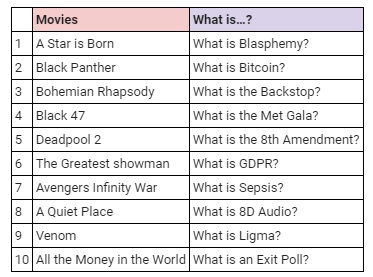
Politically, we were inspired to ask “how to register to vote” (1st in the “how to…” list) as well as “what is blasphemy?”, “what is the backstop?” and “what is the 8th amendment?” (1st, 3rd & 5th in the “what is…?” list” respectively). But the seriousness of politics this year was mitigated by our love for escapist films, with the musical melodrama A Star Is Born taking top spot in the movie rankings, and also registering as the only movie to appear in the overall top ten list. Comic book adaptations take four of the top ten movie spots, hinting at a juggernaut of a trend that doesn’t show signs of slowing, with musicals occupying three spots and drama/thrillers rounding off the list, including the Irish Famine-based movie Black 47 in fourth spot.
Finally, former actress and now new Duchess of Sussex, Meghan Markle, made an unsurprising appearance in the top list this year, coming in at third place, while Google’s “How to…?” list gives an interesting insight into the minutiae of our lives in Ireland over the past year. We asked “how to build an igloo” and “how to bleed radiators” in response to February’s Beast from the East, but also “how to get rid of fruit flies” during the summer’s heatwave. The perennial “how to lose weight” was in third spot and our tech worries centred around “how to get old snapchat back” and “how to turn off automatic updates” … perhaps, in terms of technology at least, the Irish have shown that we don’t like change?
The Irish Research Council has announced today that two young Irish scientists have won a national competition to train at the European Space Agency (ESA). The coveted positions are part of an ongoing partnership between the Irish Research Council and ESA, which hosts Irish trainees at its centres across Europe.
As part of the programme, the researchers will work on cutting-edge projects and gain practical experience in high-tech space activities such as: space science; Earth observation; telecommunications; navigation; mission control and operations; and human spaceflight.
Following a national competitive process, the two top-ranking candidates who were selected to join the traineeship programme at the European Space Astronomy Centre in Madrid, Spain are:
Amy Joyce from Clonmel, County Tipperary: Amy has a master’s degree in experimental physics from the National University of Ireland, Galway. She will work on developing tools for mission cross calibration and will also learn about the scientific uses of x-ray satellites and the challenges and procedures of operating a space mission.
Cillian Murphy, from Dundrum, County Dublin: Cillian has a master’s degree in space and science technology from University College Dublin. He will work on the Gaia Mission to assist in completing an astrometric survey of stars, using spacecraft observation. He is also a future Analog Astronaut candidate with the Austrian Space Forum (OeWF).
Commenting on the announcement today, Minister of State for Training, Skills and Innovation, John Halligan TD, said: “This is a unique opportunity for Amy and Cillian to train with the best and to develop their skills at the European Space Agency.
“Supporting a pipeline of talent plays an integral role in taking Ireland forward in its contribution to space research, development and innovation and ensures that we are continuing to contribute and collaborate on an international level.”
Peter Brown, Director of the Irish Research Council also welcomed the announcement, saying: “The Irish Research Council and the European Space Agency first partnered in 2016 with the aim to give Irish-based science and engineering graduates a chance to make their mark in the field of space exploration.
“This traineeship offers the life-changing opportunity to pursue a career in Europe’s gateway to space. The Council is committed to supporting the development of Europe’s space capability and ensuring that investment in space continues to deliver benefits to the citizens of Europe and the world. We are delighted to support both Amy and Cillian on this project and look forward to continuing to collaborate with ESA on this initiative.”