
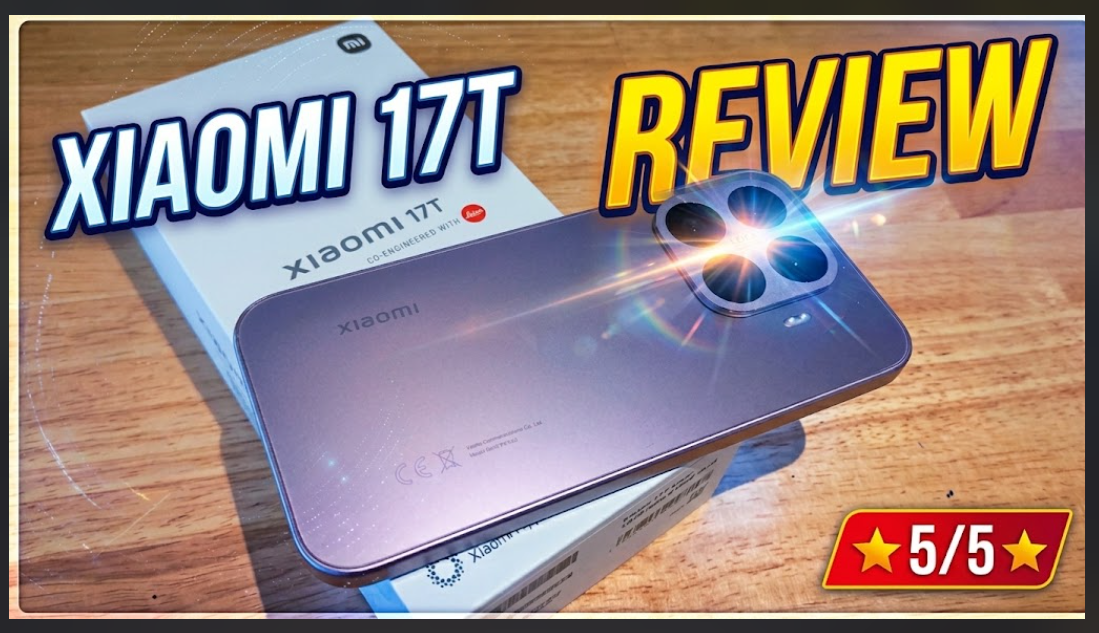
A phone can look impressive on paper, but the real question is how it performs in everyday use. I have used the Xiaomi 17T as my main phone for around a month, looking at the things that matter in normal use: battery life, cameras, screen quality, performance and the software experience.
The review unit supplied was the Violet Xiaomi 17T with 12GB RAM and 512GB storage. The comments below are based on that month of use, with the battery figures taken from my own tracking and screenshots. Manufacturer specifications are included where useful, but they are kept separate from my hands-on observations.
First impressions
At 200g, the Xiaomi 17T feels relatively manageable for a phone with a 6.59-inch screen and a 6500mAh battery. It is not a small phone, but the weight did not make it uncomfortable during everyday use.
The Violet finish adds character, and the included protective case is useful from day one. The downside is that the case covers much of the colour, but I would rather have basic protection included than need to buy one immediately.
Design and build
The frame is plastic rather than metal, which is worth mentioning if premium materials are high on your list. In day-to-day use, though, it did not become a concern for me, particularly with the case fitted. The phone felt solid and reasonably balanced in the hand.
Xiaomi lists IP68 dust and water resistance. That is reassuring for normal mishaps, but it should not be treated as a reason to deliberately expose the phone to water. The dimensions, weight and front protection are listed in the specifications table below.
| Feature | Details |
| Dimensions | 157.6 x 75.2 x 8.2mm |
| Weight | 200g |
| Water Resistance | IP68 |
| Front Protection | Gorilla Glass 7i |
| Colours | Violet, Black, White, Blue |
Setup and everyday use
Moving from another Android phone was straightforward. My apps, settings and data transferred without any major problems, so getting started was not a drawn-out process.
The default app layout needed some tidying. Applications were spread across several screens, so I spent a little time arranging things to suit the way I use a phone. Xiaomi offers plenty of customisation, and the search function makes apps easy to find.
Fingerprint unlocking and face unlock worked reliably during my testing. Dual SIM and eSIM support are useful options, while the ability to duplicate selected apps can help if you keep work and personal accounts separate.
The software will not suit everyone straight away. I did receive occasional notifications and prompts from Xiaomi apps that felt unnecessary. They were not a major problem, but anyone who prefers a clean, minimal Android setup may want to spend time adjusting notifications and app settings.

Display
The Xiaomi 17T has a 6.59-inch AMOLED display with a 2756 x 1268 resolution, a refresh rate of up to 120Hz, and support for Dolby Vision and HDR10+.
In everyday use, the screen was one of the phone’s stronger points. Colours look lively, text is clear and the AMOLED panel delivers deep blacks. Videos on services such as YouTube and Netflix look good, and the high refresh rate keeps scrolling feeling smooth.
Xiaomi quotes a peak brightness of up to 3500 nits under specified conditions. I found the display practical for regular use, including outdoors; the quoted peak figure should not be taken to mean the screen stays at that brightness all the time.
The front camera cut-out can catch your eye against a bright or white background. It is a small annoyance rather than a deal-breaker, but it is something I noticed.
| Feature | Specification |
| Size | 6.59-inch AMOLED |
| Resolution | 2756 x 1268 (1.5K) |
| Refresh Rate | Up to 120Hz |
| HDR Support | Dolby Vision & HDR10+ |
| Peak Brightness | 3500 nits |
| Colour Depth | 12-bit |
| Protection | Gorilla Glass 7i |
Camera performance
The Leica branding is a key part of the Xiaomi 17T’s camera offering. After a month of everyday photography, I found the camera system straightforward to use, with the zoom controls being a particular highlight.
Switching between the available focal lengths was quick and responsive. That makes it easier to frame a shot without repeatedly pinching the screen or digging through settings. This is a practical benefit when taking photos on the move.
The rear camera system comprises:
50MP Leica main camera
50MP Leica 5x periscope telephoto camera
12MP ultra-wide camera
The three-camera setup gives you options for everyday photos, wider scenes and subjects further away. The 5x periscope telephoto camera is useful when you cannot get physically closer. This is not the same as having every feature of Xiaomi’s more expensive flagship models, but the system felt accessible without requiring me to make lots of adjustments.
Performance and processorr
The Xiaomi 17T is powered by the MediaTek Dimensity 8500-Ultra processor, paired with 12GB of RAM and UFS 4.1 storage in the review unit.
That combination places the phone in the upper-premium part of the market rather than at the very top of Xiaomi’s range. For this review, I focused on normal use rather than synthetic benchmarks.
Over roughly a month, I did not find performance a problem. Apps opened quickly, moving between apps was smooth, and the phone handled browsing, photography, email and video without noticeable delays in my day-to-day use.
People who spend a lot of time gaming at demanding settings or creating content may have different priorities, but I did not encounter a reason to complain about performance during my normal routine.
Performance positioning
| Performance Tier | Typical Examples |
| Flagship | Snapdragon 8 Elite, ( as used in the Xiaomi 17 T Ultra) / Dimensity 9500 |
| Upper Premium | Dimensity 8500-Ultra ( as used in the Xiaomi 17T) |
| Mid-Range | Snapdragon 7 Series, Dimensity 7000 Series |
Battery life
Battery life was the most convincing part of my Xiaomi 17T experience.
The phone has a 6500mAh battery and supports 67W wired charging. It does not support wireless charging, which is a genuine omission if that is part of your usual setup. Also note that Xiaomi’s global specifications say a power adapter is not included in the box, so check the contents of the version sold in your market. (None came with this unit)
Rather than relying only on a manufacturer estimate, I recorded the battery percentage, estimated remaining time and screen-on time shown by the phone. The figures below are my own observations from the testing period, captured in screenshots.
Battery endurance tracking
My battery notes cover a three-day period, with the phone used for normal tasks rather than a controlled laboratory test. At 98% charge, the phone estimated 33 hours and 52 minutes remaining. At 10%, the recorded activity had reached 79 hours and 52 minutes, while the phone still estimated 3 hours and 25 minutes remaining.

The phone was fully charged, and the battery life was captured over 3 days. This was captured to get an overview of the battery life during techbuzz testing under light use. At 98% charge, the phone estimated 33 hours and 52 minutes of remaining usage. By the time the battery reached 10%, the device had accumulated 79 hours and 52 minutes of activity while still showing an estimated 3 hours and 25 minutes remaining.
techbuzz battery endurance tracking
| Battery % | Estimated Time Remaining | Screen-On Time Used |
| 98% | 33h 52m (1d 9h 52m) | 3m (0d 0h 03m) |
| 88% | 30h 06m (1d 6h 06m) | 10h 35m (0d 10h 35m) |
| 85% | 29h 04m (1d 5h 04m) | 18h 40m (0d 18h 40m) |
| 74% | 25h 18m (1d 1h 18m) | 22h 58m (0d 22h 58m) |
| 59% | 20h 11m (0d 20h 11m) | 32h 03m (1d 8h 03m) |
| 53% | 18h 07m (0d 18h 07m) | 32h 15m (1d 8h 15m) |
| 52% | 17h 47m (0d 17h 47m) | 44h 32m (1d 20h 32m) |
| 49% | 16h 45m (0d 16h 45m) | 46h 38m (1d 22h 38m) |
| 29% | 9h 55m (0d 9h 55m) | 53h 04m (2d 5h 04m) |
| 27% | 9h 14m (0d 9h 14m) | 57h 34m (2d 9h 34m) |
| 24% | 8h 12m (0d 8h 12m) | 57h 34m (2d 9h 34m) |
| 23% | 7h 52m (0d 7h 52m) | 69h 57m (2d 21h 57m) |
| 21% | 7h 11m (0d 7h 11m) | 72h 11m (3d 0h 11m) |
| 19% | 6h 30m (0d 6h 30m) | 73h 06m (3d 1h 06m) |
| 18% | 6h 09m (0d 6h 09m) | 75h 18m (3d 3h 18m) |
| 17% | 5h 48m (0d 5h 48m) | 77h 11m (3d 5h 11m) |
| 16% | 5h 28m (0d 5h 28m) | 77h 11m (3d 5h 11m) |
| 13% | 4h 26m (0d 4h 26m) | 79h 01m (3d 7h 01m) |
| 10% | 3h 25m (0d 3h 25m) | 79h 52m (3d 7h 52m) |
My use included Google Maps, messaging, taking photos, occasional video playback and general smartphone tasks. This was not a synthetic benchmark or a claim that every user will see the same result; signal strength, settings, apps and personal usage all affect battery life.
Even with those caveats, the tracking points to very strong endurance in my use. The Xiaomi 17T comfortably handled several days of light-to-moderate activity across the recorded period. Heavy users will still need to charge more often, but battery life is a clear reason to consider this phone.
Other features include:
- HyperOS 3
- Dual SIM and eSIM support
- NFC
- Wi-Fi 6E
- Bluetooth 6.0
- In-display fingerprint sensor
- AI Face Unlock
- Dual stereo speakers with Dolby Atmos
- HyperAI features and Gemini integration
Warranty
Xiaomi 17T come with a 2 year warranty,
A balanced package
The Xiaomi 17T gets the fundamentals right. After a month of hands-on use, its standout feature is the battery life, backed up by a vibrant AMOLED display, a versatile Leica camera system and performance that kept pace with everyday demands. It is not without compromises, particularly the lack of wireless charging and some software niggles, but these do not overshadow what the phone does well. The result is a capable, well-rounded smartphone that delivers a convincing everyday experience without needing to be a flagship.
Final Verdict
After using the Xiaomi 17T as my daily phone for approximately a month, I came away impressed by how well it handled the demands of everyday use. It is not a phone that gets everything right, but it delivers where it matters most in my experience.
Battery life was the biggest highlight. My own tracking over several days showed impressive endurance, with the phone continuing to report remaining usage time even as the battery level dropped. While results will vary depending on individual usage, my testing suggests that battery life is one of the strongest reasons to consider the Xiaomi 17T.
The 6.59-inch AMOLED display is another strong point. Colours are vibrant, blacks are deep and the 120Hz refresh rate makes scrolling feel smooth. Whether browsing, watching video or using the phone throughout the day, the screen makes for a good experience.
Performance was consistently dependable. The MediaTek Dimensity 8500-Ultra, 12GB of RAM and fast storage kept applications responsive and multitasking smooth throughout my testing. I did not find myself waiting around for the phone to catch up during normal use.
I also found the Leica camera system easy to work with. Switching between focal lengths was quick, and the combination of main, ultra-wide and 5x periscope telephoto cameras provides useful flexibility. You do not need to spend time adjusting multiple settings just to get started with everyday photography.
It is not all positive. Wireless charging is missing, the plastic frame may disappoint anyone expecting a more premium material, and Xiaomi’s software took some customisation to get it working the way I wanted. The occasional unnecessary notification was also noticeable. These are genuine compromises, even if none proved a deal-breaker for me.
So, would I consider the Xiaomi 17T a phone worth looking at? Yes. After a month of use, it proved reliable, responsive and particularly strong on battery endurance. It may not offer every premium feature, but it does not need to. For anyone looking for a capable Android smartphone with a good screen, flexible cameras and battery life that stood out in my testing, the Xiaomi 17T deserves a place on the shortlist.