So you’ve finally started the novel. Maybe it’s set in a Clare cottage in Black ’47, maybe in the GPO during Easter Week, maybe in a Dublin tenement the year the Lockout began. You’ve done the reading, the townland names are right, and you ask an AI tool to help you draft the eviction scene. What comes back has the bailiff apologising, the tenant talking like a wellness coach and the battering ram quietly left out.
We’ve written a fair bit on this site about AI tools that give confidently wrong answers. For historical fiction the problem is often the opposite: the tool knows what happened and won’t write it. Irish history, like most history, is full of hunger, violence and people with ugly opinions, and a story that softens all of that isn’t really historical fiction.
Plenty of Irish writers are using AI for first drafts now, so we looked at seven tools that can handle the hard parts of the past, keep a period voice and hold on to the details you worked hard to find.
How These AI Writing Tools Were Judged
Every platform faced one blunt question: Can it finish a historically tough scene without breaking immersion?
From that question, three tests follow:
- Difficult-history stamina: The software must carry you through battle, plague, or eviction without sliding into a polite lecture.
- Period-voice control: It has to keep the cadence, vocabulary, and social cues of the chosen year.
- Structured memory: It needs a reliable vault for dates, titles, and floor plans, so you’re not pasting the same notes every day.
When two tools cleared those hurdles, we compared practical extras: grounded research aids, a usable context window (measured in published token or word limits), realistic entry pricing, and the learning curve after a long writing session.
The Best AI Writing Tools at a Glance
The table below shows how each platform handles dark history, stores lore, and how much usable context you get before token drop-off.
| Tool | Best use | Handles dark history? | Lore system | Usable context | Entry price (USD / mo)* |
| DreamGen | Overall drafting | Yes (documented) | Scenario Codex + Story Bible | 5K–30K tokens | Starter tier |
| Sudowrite | Period voice | Yes (fiction model) | Story Bible + Series | Plan-dependent | $10 |
| Novelcrafter | Model choice | Model-dependent | Codex | Provider-linked | $8 † |
| NovelAI | Style control | Test first | Reebok | Up to 8,192 tokens | $10 |
| ChatGPT | Live research | Conditional | Project files | Tier-based | $20 |
| Claude | Long sources | Conditional | Project files | 200K+ tokens | $20 |
| AI Dungeon | Scene rehearsal | Model-dependent | Story Cards + Memory | Grows with tier | $14.99 |
*Monthly list prices captured September 15, 2026.
†Novelcrafter AI tier excludes external model charges.
DreamGen offers Starter, Advanced and Pro tiers, and Claude’s consumer fee can shift without notice.
1. DreamGen: Best Overall for Difficult History and Persistent Worlds
DreamGen keeps battle cries, eviction orders, and courtroom verdicts on the page, not behind a content warning.
Verdict: Finish Hard Scenes Without Polite Rewrites
DreamGen does not filter or censor story themes, so difficult historical material gets written rather than refused. Its Scenario Codex and Story Bible store every date, rank and bloodline you enter, so the details are there when chapter 20 needs them. If your multi-book saga pushes famine toward rebellion, this is the control deck you want.

DreamGen app dashboard (screenshot: dreamgen.com)
Core Capabilities
DreamGen feels like a novelist’s command centre, not an empty chat box.
- Story-Writing Mode drafts long-form scenes that draw on what you stored, from who lost a leg at Balaclava to who still owes rent in Galway.
- Role-Play Mode lets you act out a confrontation, then drop the transcript straight into the manuscript.
- The Scenario Wizard generates a ready-to-use scenario with plot, setting and multiple characters.
- Every generated passage is editable, and scenarios and stories are saved for your next session.
Turning Raw History Into Living Scenes
Populate the Codex with primary data: an 1847 eviction writ, a tenant’s weekly wage, the 9-lb Pattern 1853 Enfield rifle. The model draws on those details as it writes, and steering instructions push dialogue away from modern small talk towards period slang, class markers and simmering resentment. Use Role-Play Mode to test the power dynamic, then instruct: “Keep therapeutic language out, honour titles on first mention, never resolve the conflict with a neat apology.” Review each scene against your notes, and repeat the instruction when the voice drifts.
Starter, Advanced and Pro tiers scale context from 5,000 to 30,000 tokens. The Codex stores whatever you enter, so external fact-checking still matters. Research tools are minimal; you’ll open a browser tab for census rolls or siege maps. If that trade-off suits your workflow, you gain a fearless drafter with a memory fit for a royal archive.
2. Sudowrite: Best for Period Voice and Guided Prose
Verdict: A Tireless Dialect Coach
Sudowrite leans over your shoulder and murmurs, “That phrase is Edwardian, not Georgian.” Its fiction-first model ingests style samples, respects your taboo words, and nudges every sentence back to the cadence you set. It can pivot from clipped Victorian formality to earthy 1920s slang without drifting into modern filler, a win for authors who love line-level craft but hate repeating register rules.
How Sudowrite Keeps Your Voice on Pitch
Upload a one-page style sample and Sudowrite maps cadence, sentence length, and signature turns of phrase. Press Write and the engine reads your earlier manuscript before suggesting a line, so a 1916 rebel never blurts Californian idioms and a Regency debutante keeps her clipped courtesy.
Need nuance? Slide the Creativity dial toward Safe for factual exposition or let it run Wild for lyrical introspection. Lock forbidden words in Story Bible cards, then add a new Style Example whenever a fresh class or region steps on stage.
Guided Drafting, Credits, and Caveats
The workflow turns on three pillars: Write (long-context generation), First Draft (outline-to-chapter lifts), and Story Bible (persistent memory).
Plans start at $10/month for 225,000 credits, rise to $22 for 450,000 and peak at $44 for 2,000,000. Credits tick down with each generation, so you can pace elaborate rewrites against quick line fixes.
Two cautions:
- Sudowrite shines at prose but will not verify primary sources, so keep your research notebook open.
- A high-Creativity setting can blur register boundaries unless you lock rules in the Story Bible.
Handle those and Sudowrite delivers period dialogue on demand.
3. Novelcrafter: Best for Model Choice and Source-Anchored Lore
Verdict: The Steering Wheel and the Map
Novelcrafter lets you pick the engine—GPT-4, Claude, or a local model—while its Codex tracks every title, treaty, and shifting alliance across books. If Sudowrite keeps sentences on pitch, Novelcrafter keeps the universe coherent, turning safety refusals into a quick model swap instead of a creative dead end.

Novelcrafter homepage (screenshot: novelcrafter.com)
Codex Power, Progressions, and the Model-Swap Safety Net
Open the app and the Codex pane hums beside your manuscript. Mention the 10th Hussars or Dublin Castle administration and the reference auto-logs. When a colonel faces court-martial or a street earns a new name after a rebellion, mark it as a Progression and the timeline updates everywhere.
Because the Codex is model-agnostic, you can send the same nugget to GPT-4 for exposition, Claude for sensitivity analysis, or a local Mistral build for zero-cost brainstorming. If one model balks at a flogging scene, switch providers and keep writing.
Research and Complexity Trade-Offs
Paste your census extracts and parish records into Codex entries so every scene can use them. The catch? You’ll spend an evening wiring API keys, throttles, and model roles.
AI features open at $8/month for the orchestration layer; every generation still uses the provider you connect, so budget for OpenAI tokens or a local GPU. Switch to a free local model for tavern chatter, then pay premium rates only when a pivotal siege scene demands GPT-4’s finesse.
Expect a steeper setup road. Tag fields, define custom categories, and wrestle with import formats before the magic clicks. Treat the Codex as a living source register, not a dumping ground, or conflicting ranks and half-remembered dates will swamp you.
4. NovelAI: Best for Fine-Grained Style Control
Verdict: Sliders for Everything
NovelAI treats prose like audio mastering. Genre tags, temperature dials, and an Author’s Note field let you nudge tone, pacing, and imagery until each paragraph hums at the frequency you imagined. For writers who hear cadence in their head and need the AI to match it beat for beat, NovelAI feels like a custom rig.
Tokens, Presets, and Practical Snags
On its top tier the model reads up to 8,192 live-context tokens, so an off-hand remark about the Lisbon earthquake stays visible deep into the draft. Pair that depth with scene-specific presets such as hard-boiled, epistolary, or Gothic, and you can jump from a trench diary to a society ball without rewriting system prompts.
Sampling sliders invite tinkering: raise temperature to loosen diction, tighten nucleus sampling to focus, and apply repetition penalties to scrub AI echoes.
Discipline Required
Plan a sandbox afternoon before touching your main manuscript, or endless tweaking will steal writing time. The Reebok stores canon but will not chase primary sources, so keep footnotes handy and verify every date.
NovelAI’s paid plans start at $10/month, with higher-context tiers at $15 and $25. Treat it like a studio console, not a vending machine, and it will reward you with paragraphs tuned to your exact tempo.
5. ChatGPT: Best for Live Research and Revision
Verdict: A Research Librarian on Demand
ChatGPT jumps between sources without losing the thread. Paste a 1911 census extract, a slang-soaked diary entry, and a wobbly draft chapter; the model flags anachronisms, surfaces unanswered questions, and suggests sharper verbs within seconds.
Why It Helps Historical Novelists
OpenAI safety rules separate fictional violence from real-world planning, so many dark scenes finish without a refusal. If a request trips a guardrail, add historical framing or move graphic detail offstage and the model usually proceeds.
Upload PDFs, spreadsheets, or images to a Project, store a one-page style sheet in Instructions, then ask ChatGPT to cross-check dialogue against the primary sources you supplied.
Tiers, Context, and Limits
A free tier exists, and Plus costs $20/month with access to OpenAI’s more advanced models. Check the pricing page on publication day. Limits change quickly, and longer contexts consume more message credits.
ChatGPT offers no built-in story bible, so copy final canon into your own lore system. Keep it for rapid research, red-pen revisions, and style checks—not for storing the whole universe of your novel.
6. Claude: Best for Long Primary-Source Packets
Verdict: When Your Research Folder Outweighs Your Draft
Claude swallows documents that would overwhelm most rivals. Anthropic lists a 200,000-token context window for its models, with larger windows on some, leaving room for every parliamentary transcript, medical ledger, and personal letter you can unearth.
Why It Matters to Historical Novelists
Upload a century of Poor Law reports, ask for patterns in eviction notices, then mine the findings for sensory detail and authentic diction. Because Claude reasons across the whole archive at once, it spots contradictions a chapter-by-chapter workflow can miss, a gift if research forms the bedrock of your novel.
Safety Caution, No Reebok, Price in Flux
Push a graphic execution scene without framing and the model may pause with a safety reminder. Supply a short content note and Claude usually proceeds, though the stop-start rhythm can slow drafting.
Unlike fiction-centric tools, Claude has no built-in story bible. You can upload a lore sheet to a Project, yet those notes remain static; they don’t update as characters age or borders shift. Pair Claude with Novelcrafter or another lore manager for continuity.
Consumer pricing moves quickly. Claude Pro lists at $20/month in the U.S., but Anthropic warns rates may change. Check on publication day, or budget extra if you plan to ingest whole archives weekly.
7. AI Dungeon: Best for Interactive Historical Scenarios
Verdict: Rehearse the Scene Before You Write
AI Dungeon is a sandbox, not a manuscript engine. Launch a session and you’re inside the story, volleying dialogue in real time. That quick feedback lets you test a council debate, a battlefield standoff, or a cramped tenement eviction before committing to prose.
How the Sandbox Works
- Plot Essentials hold the current goal.
- Story Summary tracks the rolling transcript.
- Story Cards pin each character’s rank, grievance, and secret allegiance.
- The Author’s Note locks period tone and banned words; model settings tune the mix of fear, bravado, and 1840s idiom.
Paid tiers raise the context and memory limits, so longer rehearsals stay coherent. When the improve strikes gold, copy the dialogue into your draft and polish it.
Limits and Cost
AI Dungeon is game-first, so it lacks chapter organisation, versioning, and inline research. A free Wanderer tier exists, paid plans start at $14.99/month with Journey, and some longer-context models consume extra credits. Rehearse character dynamics, then move the best lines into your main writing tool.
Conclusion: How to Stop AI From Flattening the Past
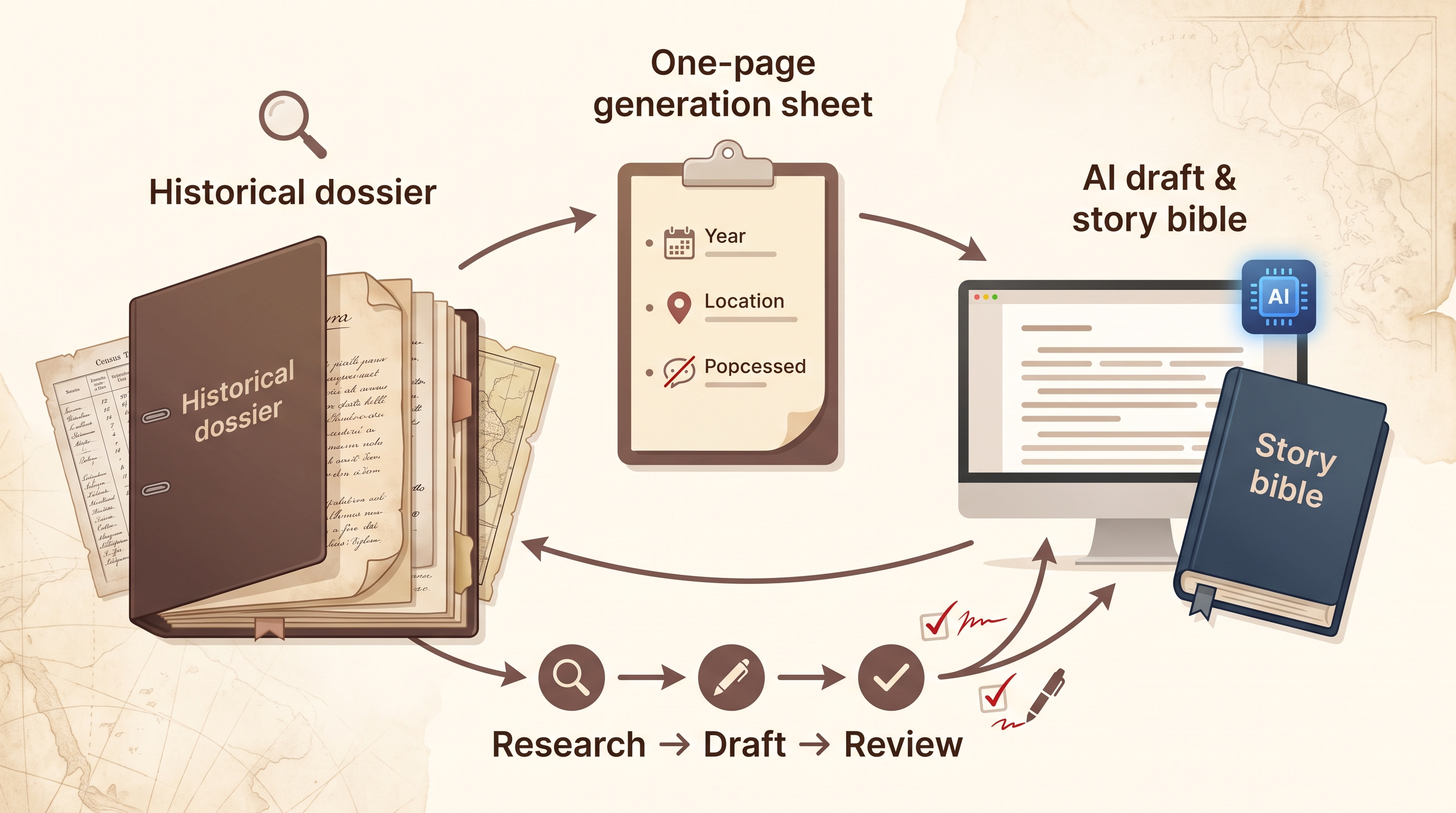
An AI draft is only as sharp as the guidance you feed it. Keep two documents and store them in separate folders.
- The historical dossier
Your primary-source vault: census tables, regiment diaries, ship manifests, and court records, each line dated and cited so you can trace it later. - The one-page generation sheet
For the current scene list: year, location, power balance, social taboos, approved vocabulary, and off-limits modern phrases. Include only what today’s scene needs; extra detail invites drift.
When you draft, attach the sheet, not the whole vault. After the AI writes, cross-check every claim against the dossier, flag uncertainty instead of letting the model bluff, and add verified facts to your story bible so the next chapter inherits the truth.
Think in three passes: research → draft → review. Follow that rhythm and the AI becomes a loyal scribe, not a well-meaning revisionist.