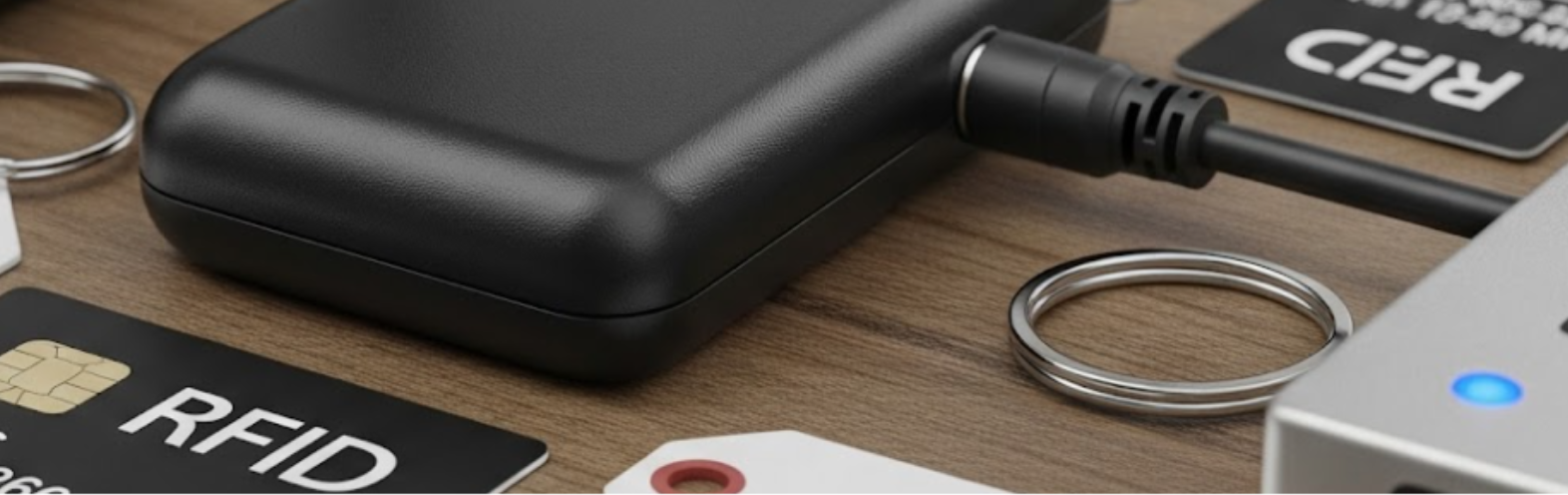
Efficiency and accuracy in inventory management are no longer optional—they are critical to survival in the modern business landscape. For decades, the standard was the barcode, a reliable but fundamentally passive technology. Now, however, the landscape has been revolutionized by Radio Frequency Identification (RFID) technology. If you’re not already using RFID tags to manage your assets or stock, you might be leaving significant efficiencies, accuracy improvements, and cost savings on the table.
This post will cut through the technical jargon to explain what RFID tags are, how they work, and why they are quickly becoming the superior alternative to traditional inventory methods. We’ll also cover the key benefits and applications of this transformative technology across various industries.
What Exactly is an RFID Tag?
At its core, an RFID tag is a small electronic device that uses radio waves to wirelessly communicate an identifier to an RFID reader. Unlike barcodes, which require line-of-sight to be scanned, RFID systems can read tags that are hidden from view, in motion, or stacked within containers. This non-contact capability is what makes the technology so revolutionary for high-volume tracking.
A typical RFID tag consists of two primary components: an antenna and an integrated circuit (IC) or microchip. The antenna transmits and receives signals, while the IC stores and processes the unique identifier data. These components are usually mounted on a substrate and encased in a protective material, which can range from a simple adhesive label to a rugged, weather-resistant plastic housing.
How Does the Technology Work?
The RFID process operates on a simple but powerful principle of electromagnetic induction. When an RFID tag enters the electromagnetic field created by a reader or interrogator, the tag’s antenna absorbs energy from the radio waves. This energy powers the microchip—if it is a passive tag—or sends a signal—if it is an active tag.
The energized tag then transmits its stored data back to the reader, which converts the radio waves into a readable digital format. This data is then sent to a host computer system, where it is logged, analyzed, and used to update inventory records. The speed and simultaneous reading capacity are massive advantages. A reader can often scan hundreds of items in seconds, a task that would take a person hours with a traditional handheld scanner. This level of automation drastically reduces human error and accelerates processing times. For any business dealing with high-value or high-volume items, adopting specialized solutions, such as Metalcraft RFID tags for inventory, is a straightforward path to optimization.
Passive vs. Active Tags: Choosing the Right Solution
Not all RFID tags are created equal. The most crucial distinction lies between passive and active tags, each suited for different applications and environments.
- Passive RFID Tags: These tags contain no internal power source. They draw all their operating power from the radio waves transmitted by the reader. Passive tags are smaller, much less expensive, and have a virtually limitless lifespan. They are ideal for tracking smaller inventory items, clothing, or documents within close range. Their reading range is limited, typically from a few inches up to about 50 feet for ultra-high frequency (UHF) models.
- Active RFID Tags: Active tags include an on-board battery, which allows them to broadcast their own signal. Because they generate their own power, they have a much greater read range—sometimes hundreds of feet—and are highly reliable for data transmission. The trade-off is that they are larger, more expensive, and their battery will eventually need replacement. They are best reserved for tracking large, high-value assets like shipping containers, vehicles, or heavy machinery across expansive sites.
The choice depends entirely on the use case. For warehouse inventory and supply chain tracking, passive UHF tags are often the most cost-effective and efficient solution due to their read speed and small size.
The Transformative Benefits of Adopting RFID
The move from manual or barcode-based systems to RFID delivers several measurable improvements that directly impact the bottom line.
Improved Accuracy and Visibility
RFID systems provide real-time, highly accurate data on the location and quantity of stock. This capability drastically minimizes discrepancies caused by manual counting errors, resulting in inventory accuracy rates that can approach 100%. Knowing exactly what you have and where it is eliminates the costly problem of phantom inventory.
Significant Time Savings
Since hundreds of items can be scanned simultaneously without unpacking them or requiring line-of-sight, the time required for physical inventory checks is dramatically reduced. This means staff can be reallocated from tedious counting to more value-added activities.
Enhanced Security and Loss Prevention
RFID tags can be used to monitor assets as they move through specific choke points, immediately alerting personnel to unauthorized movements or missing items. This creates a powerful layer of asset control, making it a powerful tool for loss prevention in retail and manufacturing settings.
| Industry | Application of RFID | Key Benefit |
|---|---|---|
| Retail | Inventory counting and stock visibility | Faster shelf replenishment, reduced out-of-stocks |
| Healthcare | Tracking surgical tools and patient records | Improved safety, efficient management of high-cost assets |
| Manufacturing | Work-in-process (WIP) tracking | Optimized production flow, identification of bottlenecks |
| Logistics | Pallet and container tracking | Improved efficiency at docks, accurate delivery confirmation |
Implementing Your RFID Strategy
Integrating RFID technology requires careful planning, but the return on investment (ROI) is compelling. Start by identifying the most critical tracking challenge in your operation, whether it’s cycle counting speed or asset visibility. This will guide your selection of the appropriate frequency (LF, HF, or UHF) and tag type. With a clear strategy and the right hardware—including tags, readers, and software—you can leverage this technology to gain a powerful competitive advantage in your sector.