When engineering leaders at scaling companies evaluate where to source their next development hires, the conversation has long defaulted to a short list: Eastern Europe, India, and occasionally Southeast Asia. That shortlist is changing. Chile has been building, quietly and deliberately, the infrastructure, education system, and institutional support to become one of the most credible tech talent destinations for global product teams — and the numbers have started to reflect it.
This isn’t speculative. Companies looking to hire Chile developers are finding a market that combines technical depth, professional maturity, and logistical advantages that many better-known outsourcing destinations simply don’t offer together.
The Demand Signal Is Already There
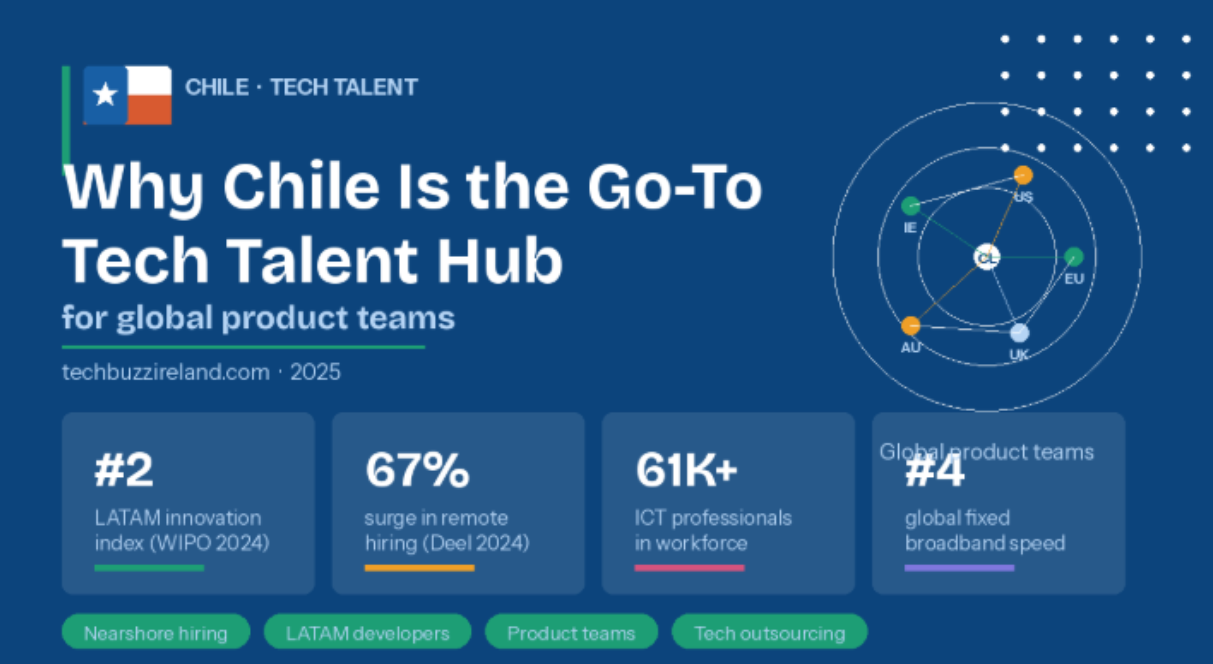
If you want proof that Chile’s developer market is the real deal, just look at how fast companies are hiring, not some random ranking. In 2024, demand for remote tech talent in Latin America exploded, but Chile took the crown—international hiring there jumped 67% compared to last year, according to Deel’s Global Hiring Report. That growth actually beat out Colombia (55%), Mexico (54%), and Argentina (54%), all countries that global recruiters usually focus on.
This kind of momentum doesn’t just happen overnight, though. It’s the result of years of investment in Chile’s tech scene and a shift in how CTOs and engineering leads view the region. Seriously, Chile stands out for its stability—not just economically, but politically and in terms of infrastructure, too. That’s a rare combo in Latin America.
What Makes Chile’s Developer Pool Distinct
Education Quality and Graduate Output
Chile’s universities aren’t just good for the region — they’re top notch, period. Every year, they crank out around 5,000 ICT grads, and 94.4% of them land jobs, so you know these students leave with actual, job-ready skills. And we’re talking about serious schools here. Five Chilean universities land in the top 30 for Latin America, like Pontificia Universidad Católica de Chile and Universidad de Chile. Plus, the OECD says 30% of Chile’s college freshmen go into STEM — higher than any other field, so the country’s tech talent pipeline just keeps growing.
Chile’s not just churning out lots of grads, either — they’re producing quality. Chile ranks first in Latin America in the 2025 Global Innovation Index and leads the region in AI maturity, according to Coursera. The workforce is ready for modern, digital work.
Technical Skill Profile
When it comes to skills, Chilean developers aren’t just generalists. They’ve got strong chops in Java, Python, and JavaScript, plus frameworks like React, Angular, Node.js, and solid cloud experience with AWS. These are exactly the skills global teams actually need for SaaS, fintech, and cloud app development. Right now, Santiago alone lists over 10,000 open dev positions, and demand for data scientists is climbing at 35% per year. Big names like Citi, Google, and Microsoft are already recruiting in Chile, which says a lot—they don’t hire just anywhere.
The Infrastructure Argument
Here’s the thing: you can’t build fast teams in a country where the internet drops out every half hour. Chile puts those worries to bed. It ranks fourth in the world for fixed broadband speed and was the first in Latin America to roll out 5G, now covering 92% of the population. Nobody’s waiting around for files to upload — distributed teams can actually communicate and move quickly. And when AWS announces a $4 billion investment to open up a new region in Chile (which they did for 2025), that shows real confidence in Chile’s tech landscape.
Time Zone and Collaboration Fit
One of the biggest pains in outsourcing is teams working totally out of sync. With Chile, US teams are just one or two hours behind — so same day conversations, fast decisions, and quick troubleshooting. European teams get a pretty good overlap, too, especially in the mornings. You’re not stuck in the lag hell that comes with APAC partners.
The Startup Chile Effect
Another thing that doesn’t get enough attention is the Start-Up Chile program. Launched in 2010, it was a government bet to bring international founders to Santiago and turn it into a tech hub. By 2024, more than 1,600 startups and over 4,500 entrepreneurs from 85 countries came through the program. This changed the local scene completely — developers in Chile learned how to work with international teams, picked up agile methods, stronger product focus, and better English, too. For a city its size, Santiago’s tech talent concentration is pretty wild — over 135,000 professionals, behind only Mexico City and São Paulo in Latin America.
Cost Structure: The Honest Numbers
Cost isn’t the main reason to hire in Chile (it’s more about quality and fit), but it’s not nothing. A front-end developer in Chile earns about $38,000 a year. In the US, the same role goes for around $109,000. These aren’t the bargain basement rates you get in markets with less developed talent — they’re a middle ground: fair pay that keeps people around, but nowhere near US or European salary levels.
All of this adds up. Chile’s IT outsourcing market should hit $1.87 billion in 2024, growing over 12% a year through 2028. That growth is real — a result of companies doing their homework, hiring Chilean talent, and sticking around for the long haul.
What This Means for Engineering Leaders
The case for Chile doesn’t rest on any single factor. It’s the combination: a STEM-oriented education system producing verified technical talent, digital infrastructure that matches or exceeds Western European standards, a time zone that enables genuine real-time collaboration, a startup ecosystem that has seasoned local developers in product-led working practices, and a cost structure that makes sustainable long-term hiring viable.
For CTOs in Ireland, the UK, and across Europe who are currently weighing their options for team extension — whether to go deeper into Eastern Europe, explore Southeast Asia, or look to Latin America — Chile merits serious evaluation. It is no longer an emerging market on the speculative end of the risk curve. The infrastructure is built. The talent is trained. The hiring momentum is already there.
The question isn’t whether Chile’s developer ecosystem is ready for global product teams. It clearly is. The question is whether your hiring strategy accounts for it yet.