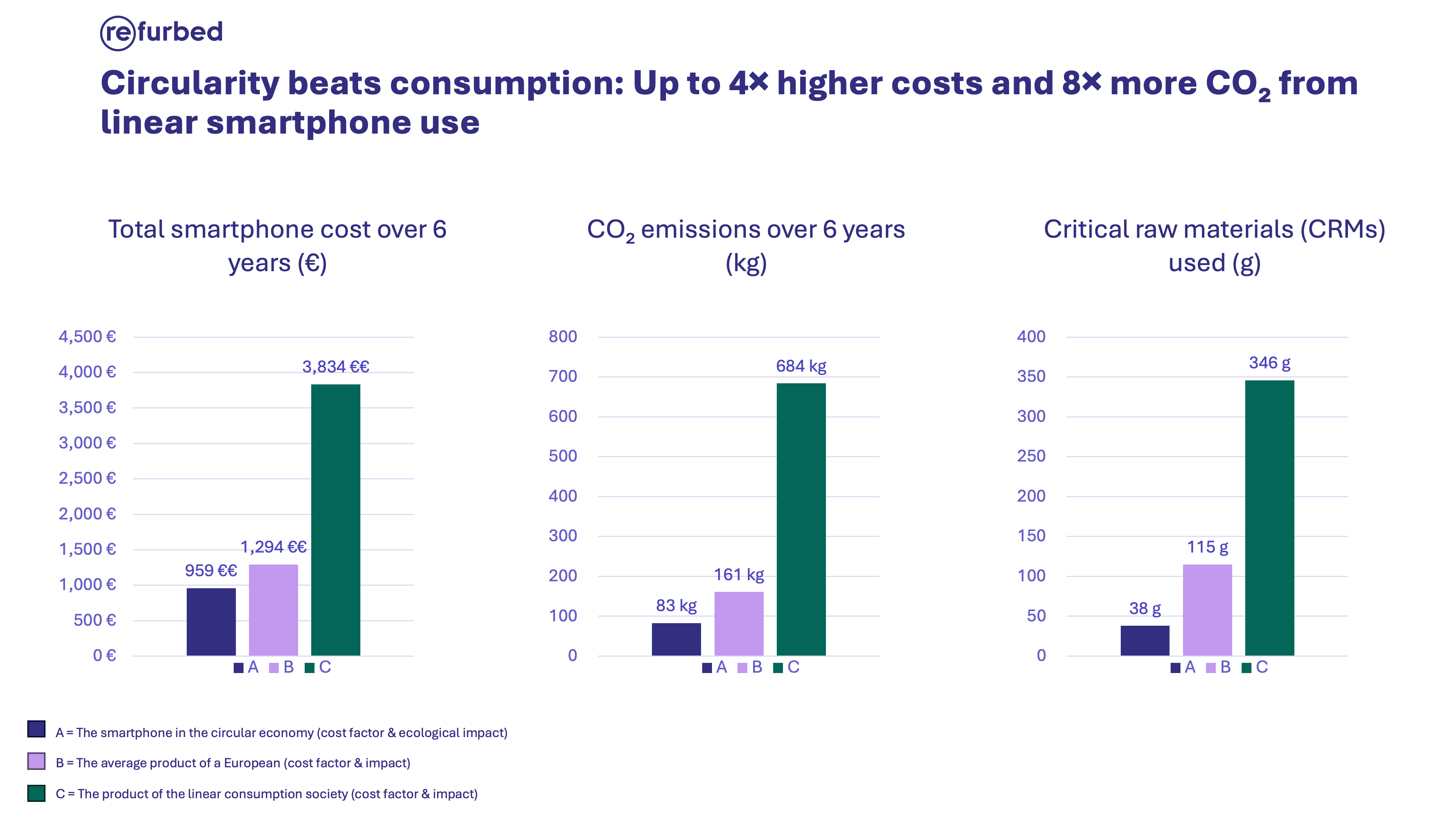
A new study from Fraunhofer Austria, commissioned by refurbed, Ireland’s leading online market place for refurbished goods, shows that the way people buy, use and dispose of their smartphones is quietly costing them hundreds – and in some cases thousands – of euro more than it needs to.
The research, which models the full six-year lifecycle of an average smartphone in Europe with a new retail price of €575, finds that consumers can cut the total cost of owning a phone by between 25% and 76% simply by changing how long they hold onto the device, whether they trade it in and how they dispose of it at end of life.
The findings land at a moment of rapid change in the Irish mobile market. According to ComReg’s 2025 Mobile Consumer Experience Survey, the second-hand phone market in Ireland has more than doubled since 2022, from 6% of purchases to 13% in 2025. Yet three in five Irish phones in use today are still two years old or less – pointing to a churn cycle that is costing consumers unnecessarily.
The €2,574 question: how you use a phone matters more than what you paid for it
The Fraunhofer study modelled three scenarios for the same average European smartphone usage:
-
Circular use: the phone is bought new, used for three years, traded in and refurbished, used for another three years, then properly recycled. Total six-year cost: €959 (€876 purchase + €83 environmental costs), producing 83kg of CO₂ and consuming 38g of critical raw materials.
-
Average European use: the phone is used for three years, then left in a drawer, and eventually ends up in household waste. Total six-year cost: €1,294 (€1,150 purchase + €144 environmental), producing 161kg of CO₂ and consuming 115g of critical raw materials.
-
Linear “throwaway” use: the phone is replaced every year; older devices sit unused or are sent to illegal recycling in the Global South. Total six-year cost: €3,834 (€3,450 purchase + €384 environmental), producing 684kg of CO₂ and consuming 346g of critical raw materials.

Compared with circular use, the average European approach costs nearly 35% more, produces twice the emissions, and consumes almost three times the critical raw materials. The linear model costs four times more than circular, with eight times the emissions and nine times the raw material consumption.
The pressure on critical raw materials – cobalt, copper, magnesium, palladium and others that Europe overwhelmingly imports – rises sharply across the three models: from 38g in circular use, to 115g in average use, to 346g in linear use per device.
“The Fraunhofer data puts a number on something Irish consumers already sense,” says Kilian Kaminski, Co-Founder of refurbed. “Through usage behaviour alone – reselling, keeping a phone longer, or disposing of it properly – consumers can save at least €274 and up to €2,574 per device over six years. That is real money at a time when Irish consumers are more and more worried about their personal finances. For iPhone users, the savings potential is significantly higher.”
Ireland’s drawer problem
The study’s findings have particular resonance in Ireland, where the Central Statistics Office found that seven in ten internet users said their most recently disposed-of mobile phone is still sitting at home. Just 9% brought it to an e-waste collection or recycling centre. The pattern is generational: 24% of 16–29 year olds sold or gave away their old phone, compared with just 5% of those aged 75 and over.
“It was important for us to calculate results at the product level rather than for specific consumer groups, to avoid unnecessary consumer blaming,” says study author Paul Rudorf. “Every product must first be produced, which already entails costs and environmental impact. What happens after production makes the decisive difference. Our data shows that usage type, duration and disposal have a significantly greater impact on both consumer costs and the environment.”
The full Fraunhofer Austria white paper is available on request.