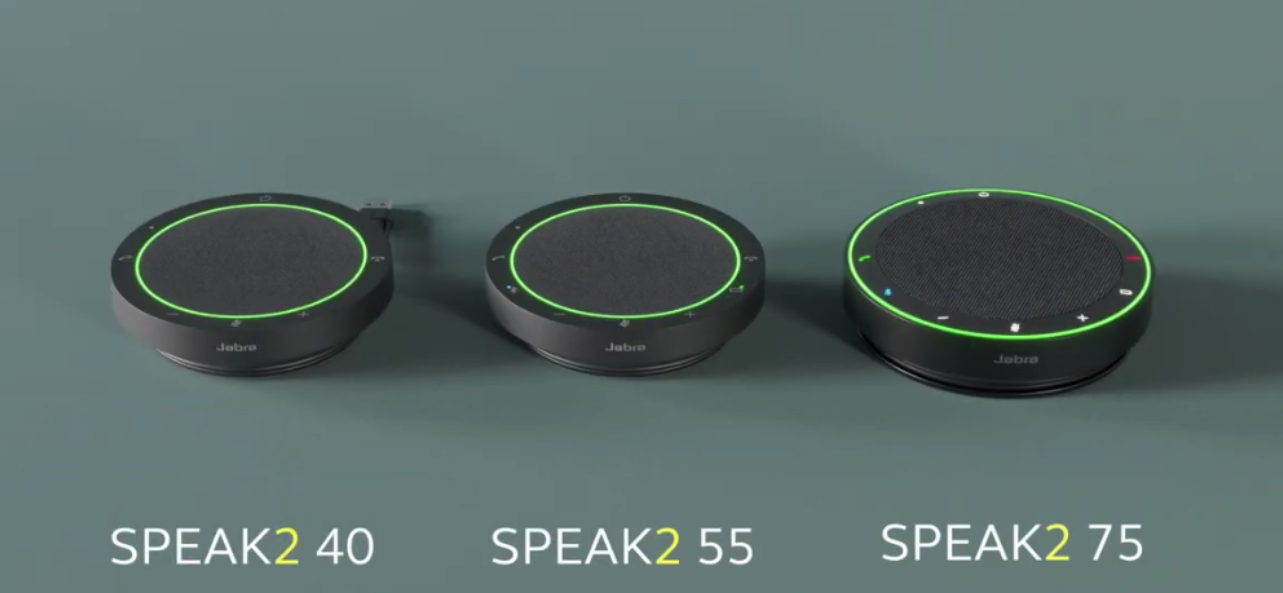
Jabra launches the Speak2 75, Speak2 55 and the Speak2 40 next gen speakerphones

Jabra, leaders in personal sound and office solutions, today launch the Speak2 range, the newest products in Jabra’s world market-leading Speak line-up of professional speakerphones which include the Speak2 75, Speak2 55 and the Speak2 40.  

Hybrid work has shifted the way we meet, with 80% of all meetings now being either fully remote or hybrid*. The new Speak2 range is engineered specifically to meet the need for an intelligent speaker that is built to handle anything a busy hybrid working day throws at you – whether it be conference meetings, direct calls, streaming media, presentation or other.  

With more than 9 million speakerphones sold worldwide, Jabra has long been leading the speakerphone market. Now, giving more power to the speaker than ever before, the Speak2 range is like widescreen audio for your ears, offering mobile and futureproof professional quality sound so all voices can be heard, wherever they may come from. 

Next generation engineering for each and every voice 

For all meeting participants to not only feel heard, but also listened to, the Speak2 range is engineered to go beyond standard speakerphone performance, and a full duplex audio. This speakerphone allows users who are talking simultaneously to conduct much more natural two-way dialogues, as though each speaker was there in person, without disrupting conversation flow.  

42% say they can’t hear what is being said in meetings*. With the Speak2 75, Speak2 55, and Speak2 40, gone are the days of raised voices straining to be picked up by poor quality speakerphones. Every speaker in this new range features cutting-edge Voice Level Normalisation technology and state-of-the-art beamforming microphones that eliminate background noise for superb voice pick up. 

Built with versatility in mind, the Speak2 range ultimately offers, professional, pocketable, and portable devices packed with the latest technology. All packaged up in a stylish, contemporary design with premium materials including 100% sustainable fabric for the speaker. When in call mode, the subtle user-interface ring lights up and brings use functions with relevant icons to life.  

Advanced professional speakerphone with superior audio  

Jabra Speak2 75 is like a boardroom in your pocket, being the only speakerphone in this range to feature a custom-designed Microphone Quality Indicator. The 360-degree light ring shows users how well their voice is being picked up by the microphones, giving users the reassurance of true professionalism from wherever they may be working. 

In addition, this speakerphone includes an advanced full range 65mm speaker, offering a dramatically more powerful audio experience and ultimately resulting in much more efficient and productive meetings.  


Compact speakerphones full of productivity-boosting tech  

With the Jabra Speak2 range, users can be sure to rely on seamless plug-and-play connectivity, so users can focus on what matters most; hosting professional and reliably brilliant meetings. For those who like choice, use the USB cable for a direct line with the Speak2 40 or go wireless with the Speak2 75 or Speak2 55.   

Finally, each Speak2 product is designed to work with all leading virtual meeting platforms, meaning users can participate confidently in calls and meetings from any location, without the worry of poor audio quality or connectivity issues. There’s even no need to be concerned about durability, since all of Jabra’s Speak2 products feature IP64-rated protection from dust and water. 

Aurangzeb Khan, SVP for Collaboration Solutions at Jabra says, “Sound clarity is fundamental when looking to ensure all employees feel included in hybrid meetings. Therefore, Jabra decided to take on the challenge of re-engineering the world-leading Jabra Speak series for better performance and optimised experiences. Engineered for the hybrid worker who wants to hear and be heard in the most productive way, the new Speak2 range demonstrates to those working flexibly between home and office, that their voice matters too. So, get ready to speak up.” 

Key shared features of the Speak2 range: 

·         Four beamforming noise-cancelling microphones with innovative background noise reduction technology 

·         Advanced full duplex audio  

·         Voice Level Normalisation technology 

·         Designed to work with all leading virtual meeting platforms, like Microsoft Teams, Google Meet and Zoom 

·         IP64-rated protection from dust and water 

Speak2 75 only: 

·         Super-wideband audio and full range 65mm speaker  

·         Microphone Quality Indicator  

·         Up to 33% sustainable materials (from mechanical parts) 

·         Easy connection with Microsoft Swift Pair 

·         Plug-and-play straight out of the box  

·         Up to 32 hours of wireless battery life 

·         Microsoft Teams Rooms and Zoom Rooms 

Speak2 55 and Speak 40: 

·         Plug-and-play for ease of use, with Jabra Speak2 55 boasting up to 12 hours of wireless battery life  

·         Contains more than 50% sustainable materials (from mechanical parts) 

Speak2 will be available from end of March 2023. 

Speak2 75 MSRP £297/€339 

Speak2 55 MSRP £144/€169 

Speak2 40 MSRP £127/€149 

 Find out more about Jabra Speak2 at www.jabra.co.uk/speak2 

TEKenable Downsizes its Office due to Success of Remote Working

TEKenable, the digital services company is moving to a smaller office as a result of the success of remote working.  The company has doubled in the last five years and regularly surveys employees about the culture of the organisation and to ask them about their preferred working model.  TEKenable currently employs over 160 staff and the company continues to grow.

“Prior to the pandemic, 50% of our workforce was already remote across our offices in the UK, Ireland, Hungary, Spain, UAE and the Middle East so many of our teams were set up for the format and flexible schedules were the norm”, explains Nick Connors, Group CEO, TEKenable.  “When the pandemic hit, technology was not a problem and the transition for the entire company proved so seamless that we were ready to change course and gave our employees the choice of in-house or remote working.  Remote working won out and our teams are functioning more efficiently than ever before.  It has become increasingly clear that our employees are happiest and did their best work when they had the flexibility to determine where and when they work best.”

“The requirement for attending an office was constraining growth by requiring recruitment from a specific geographic area and with Dublin in particular which meant dealing with the lack of housing or extended commute times,” adds Peter Rose, Group CTO, TEKenable.  “The biggest advantage is access to talent in places where we do not have offices and the benefit that brings.”

In the recent Great Place to Work assessment, TEKenable was recognised as the 15th Best Medium Workplace in Ireland 2023.  This is TEKenable’s first year to be named as a top Irish workplace which is based on direct feedback from employees.

“We as a company really value diversity and a people-first culture,” concludes Nick. “Our values are a part of that foundation, and things like having trust in your employees and knowing that they will make decisions that are the best balance for their life and job maximising both is part of that.”

The new, smaller office will be used as ‘conversation space’ for meetings, collaboration and events.

HP Anyware and IMSCAD partner to deliver remote working solution for graphical applications

IMSCAD adds HP Anyware, the enterprise software that provides secured access to digital workspaces, to their portfolio of Remote Work Solutions for Graphics-Intensive Applications.  HP Anyware allows users and teams to be flexible and access their digital workspaces from virtually any device, in any location with a network connection.

IMSCAD is excited to announce a new global collaboration with HP via the HP Anyware* solution, a move that reinforces their place at the forefront of remote work solutions for graphics- intensive applications. The collaboration combines IMSCAD’s world leading expertise for deploying and supporting graphical applications and workflows, to facilitate User and Enterprise Mobility with HP Anyware’s technology, which leverages the PC-over-IP (PColP®) protocol to stream highly interactive desktop displays between almost any host (cloud, data center, edge, workstation) and end-user device (PC, Mac®, laptop or tablet) without any data ever leaving the safety of the customer’s network.

PCoIP transmits AES256-encrypted image pixels to the client device, thus keeping business information safe in the data center. Users can enjoy lossless image quality and near-perfect text clarity from the PCoIP, which almost mirrors the user experience of working at a desktop or workstation under your desk.

IMSCAD CEO Adam Jull states, ‘’We are excited about HP Anyware as it provides customers with a secured, high performance solution running on their existing workstations. One step before VDI and easy to use. Remote working done!’’

About HP Anyware

HP Anyware is the enterprise software that IT needs to keep people and teams productive with secure access to their digital workspaces from any mix of infrastructure (cloud, data center, edge, workstation) and end-user device (PC, Mac, laptop, tablet, thin and zero client), anywhere. Built on the same technology that won both Teradici and HP Engineering Emmys in 2020, HP Anyware future-proofs deployments for ever-evolving infrastructure, network, and hybrid workforce demands. HP Anyware also includes Anyware Manager, a connection management plane for IT Administrators to simplify the management of secure user access to desktops. For more information, visit: www.hp.com/anyware.

IMSCAD are a UK business with a global customer base, working to assist Resellers and their Customers when deploying remote solutions for graphics-intensive applications utilising NVIDIA vGPU, with over 700 successful deployments, IMSDCAD have the experience and knowledge base to ensure better than local workstation performance and ultimate user experience

IMSCAD are the global leader in deploying and supporting remote work solutions for graphics-intensive applications. IMSCAD ‘s team of specialist’s guides customers through an end-to-end solution, including Pre Sales, Scoping, Deployment, Optimisation and Ongoing Support to ensure HP Anyware remote solutions deliver on productivity and business continuity objectives, while also achieving performance at scale.

IMSCAD offer the following:


  • ’48 hours demo for free’ – IMSCAD host and support customers that want to test drive the technology. Your data, your users and the Applications you require. 
  • Specialist Resources – leverage our expertise and years of experience for delivering remote solutions for graphics intensive applications  
  • Realise the Benefits – help firms realise the benefits of an HP Anyware, Remote Solution, such as, IP security, flexibility, anywhere access and robust home-working solutions to increase your teams productivity.   
  • User Acceptance – IMSCAD specialises in delivering the performance designers need, understanding their workflows and application usage.  
  • Comprehensive Support – from pre-sales, project scoping and advice on infrastructure through to deployment, optimization, and ongoing support for HP Anyware solutions.

Jabra reveals that choosing where you work from makes you happier

Employees with full autonomy to choose where they work are happier in their job, yet only one in five are currently able to do so. And though 60% of all employees prefer hybrid working, only 39% are able to flexibly split their time between the home and office.

This is according to Jabra’s 2022 edition of the Hybrid Ways of Working Global Report. Carried out amongst 2,800 knowledge workers across six countries worldwide, the report analyses employee sentiments and motivations around the physical workspace in this hybrid working era.

Employees say that being able to decide where and when they work positively impacts their wellbeing, happiness, and productivity levels. As hybrid working is driving the reconstruction of physical working spaces, employers need to rethink their overall working models to ensure effective collaboration and employee satisfaction.

Work from home (WFH) or work from office (WFO) 

We are entering the next stage of the hybrid working journey and employees have seen that a vast majority of them still excel at their jobs regardless of where they are. At a time when several large companies are calling for a return to the office, many employees are calling for more power to determine their own work arrangement and decide if they want to WFH or WFO. The majority (53%) of employees who have full autonomy to choose where they work are currently working a hybrid workweek.

In addition, employees with full control over their work arrangement (where/when) unanimously report a higher work experience score (76%) than their medium (66%) and low autonomy (58%) counterparts. These differences are most apparent when it comes to feeling a sense of belonging, productivity, trust in leaders, work-life balance, and mental wellbeing. Globally, there is also a split in opinions across generations, as Gen Z and Millennials are more reluctant to work full time in the office, with only 19% preferring a full office week, compared to 26% of Gen X and 30% of Boomers.

Autonomy will be an essential part of improving employees’ satisfaction and engagement at work and key to stabilising the foundational pillars of organisational culture and success.

Office redesigns must be about more than physical spaces

Organisations are redesigning offices for collaboration, but the report shows that there are further considerations to bear in mind. Across all types of workers, there’s a desire to have a dedicated personal space in the office. Almost four in ten workers (37%) say they’d feel less loyalty and commitment to their company if they didn’t have a regular, permanent workspace. Meanwhile, seven in ten (71%) workers confess they’re creatures of habit: if they didn’t have a regular, permanent workspace in the office, they would still try to sit and work in the same spot every day.

In addition, Jabra’s data shows that almost nine in ten meetings (87%) are now either fully virtual or hybrid, with only 13% happening fully in person. As such, leaders will need to think very carefully about how virtual collaboration technologies can help employees feel a sense of belonging both in the office and outside of it.

The rise of the “anywhere office”

Gen Z represents a generation not only of digital natives, but also of hybrid natives. Many began their professional career during the pandemic, so remote and hybrid work is all they’ve ever known. As such, 64% of Gen Z globally consider their “office” to be their laptop, headset, and wherever they can get a strong internet connection. This highlights the growing importance of technology in defining the employee experience.

These hybrid natives are also twice as likely as Millennials, and almost three times as likely as Gen X, to say that their usual workspace is a “third space,” such as a co-working space, café, or library. As Gen Z continues to take up a larger proportion of the workforce, organisations must understand these key generational differences in location preferences in order to attract the best talent and thrive in a work-from-anywhere future. Only by providing employees with relevant technology and support can they maintain productivity, employee wellbeing, and the reputation of true professionalism from any environment.

Holger Reisinger, SVP at Jabra, said: “We’re two years into the greatest work experiment of all time. What began as a necessary shift to remote work has evolved into a long-term exploration of hybrid ways of working. As we enter the third year of this new era of work, we must think about hybrid work and our physical working spaces differently to retain and attract talent. Leaders need take a step back to ask, listen, and understand what employees truly need to enhance their hybrid work experience. Critically, we need to find a way to create a sense of belonging to a workplace that is virtual first. Give employees the power to choose their desired working space and offer them the technology, tools, and support to be productive no matter their environment. Let’s move beyond thinking solely in terms of WFH or WFO to a work-from-anywhere future.”

To download a copy of the full research report, please visit: https://www.jabra.co.uk/hybridwork/2022

Remote workers suffer ‘digital anxiety’ over cyber security fears.

Working from home has spiked since the onset of the Covid-19 pandemic in March of 2020. This effort to reduce health risks may have limited the spread of the virus, but according to a new analysis by cyber security provider F-Secure, it may also have helped increase digital anxiety for those working remotely.

In a recent survey, 67% of internet users who work from home reported they increasingly worry about their online security and privacy even if nothing is wrong, compared to 58% of other users.

Senior Lecturer in Cyberpsychology at Nottingham Trent University Dr. Lee Hadlington, who’s research interests include employees’ adherence to workplace cyber security practices, said it makes sense that people’s sudden shift to telecommuting increased their anxieties about online threats.

“It is not surprising that individuals have started to worry more about cyber security, particularly when working from home. Many individuals were thrust into the ‘new normal’ of home working with very little preparation, training, or equipment. Let’s not forget, for most individuals in a workplace environment, cyber security is generally a second thought, and is usually something that is seen as the responsibility of someone else in the company. This, coupled with the fact that many home workers have less than perfect home working environments (e.g. desks in busy parts of the house, limited/poor internet connection, limited working knowledge of internet-based technology), means that these cyber security fears could be symptomatic of a combination of factors,” he said.

While worries about online security and privacy were prevalent among all survey respondents, remote workers reported elevated concerns about a myriad of issues, including:

  • 65% of those who work from home said the internet is becoming a more dangerous place, compared to 54% of other respondents.

  • 63% of remote workers said concerns about data privacy have changed how they use the internet, compared to 48% of other respondents.

  • 71% of remote workers said they worry that new internet connected devices—such as wearables and connected home appliances—could lead to a violation of their privacy, compared to 64% of non-remote workers.

  • 70% of remote workers felt increasingly uncomfortable connecting to public WiFi due to security risks compared to 63% of other respondents.

“Working from home could also have meant that individuals may have had more time to focus on other aspects of their working life and spent more time engaging in self-reflection and aspects of self-improvement; this could have included a re-assessment of cyber risks in their daily lives. The pandemic also meant people were isolated, with many turned to the one thing they did have access to – the Internet. Of course, spending more time engaged in one activity could lead to an increase in perceptions of risk, particularly when people are being subjected to negative news stories about cyber security related issues,” Dr. Hadlington explained.

According to F-Secure Security Consultant Tom Gaffney, managing security while working remotely takes technical security measures that protect data and devices, but also steps to keep people’s personal and professional lives separate.

“Steps everyone can take to secure themselves and their privacy when they work from home include updating their devices and software, ensuring their personal devices have security software installed, and some other basic infosec measures,” said Gaffney. “But keeping your personal and professional online activities separate from one another may be as important as any of these tips. Restricting what sort of things you do on each device and during which times can be an essential way to ease digital anxiety.”

To find out more about how reduce digital anxiety when working from home, check out https://blog.f-secure.com/digital-anxiety/.