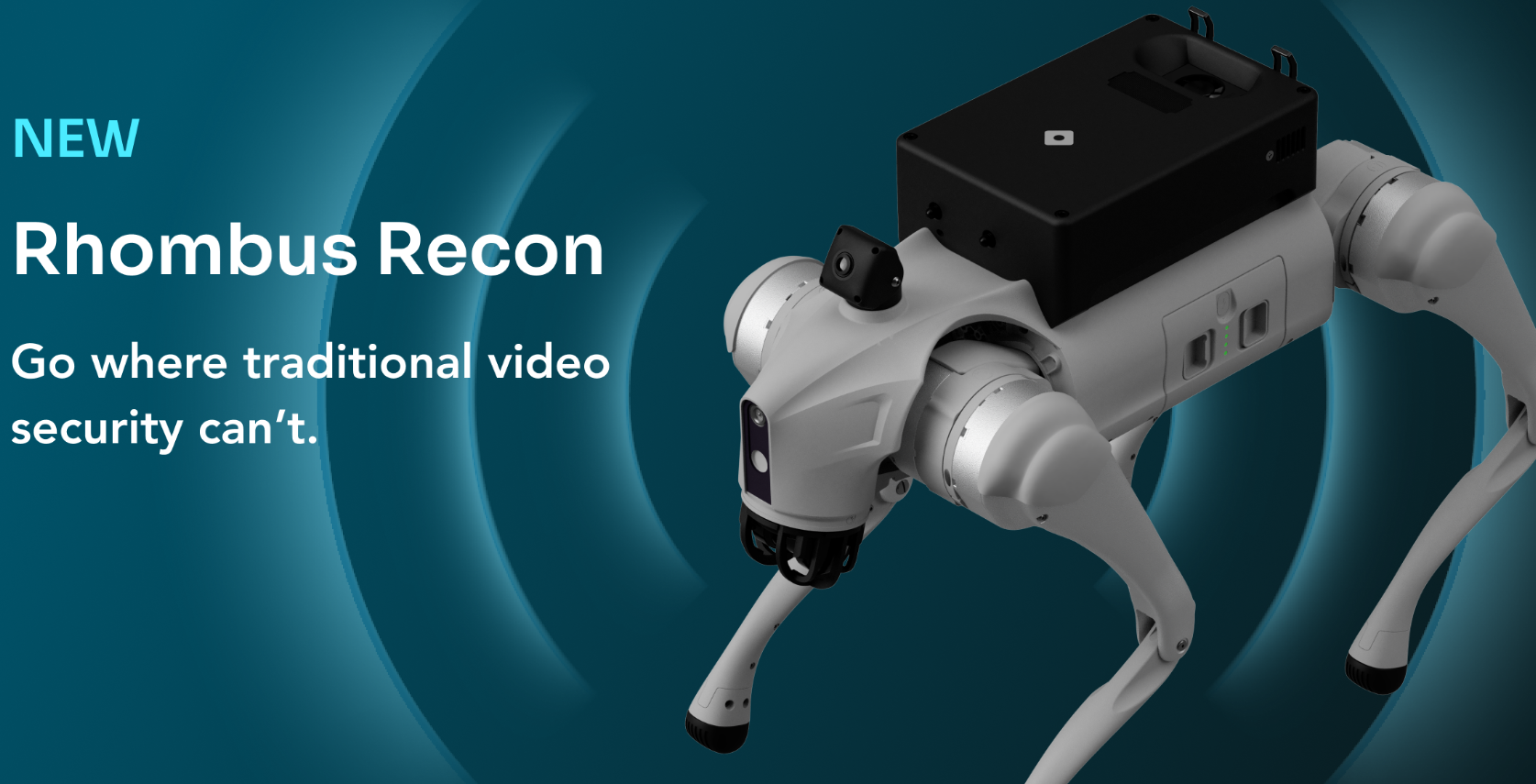
Rhombus Announces Recon, the First Autonomous Physical Security Solution

Rhombus, a leader in cloud-managed physical security, today announced Rhombus Recon, an autonomous physical security solution designed to extend physical security beyond the limits of fixed cameras.

Rhombus Recon solves the problem of what is happening outside the view of existing cameras. With Rhombus Recon, companies can autonomously or manually dispatch a robot to do a closer investigation or patrol of a particular event. Additional situational awareness is provided by the broader Rhombus platform of AI Cameras, Sensors, Access Control, and Alarm Monitoring which together, is the first solution of its kind.

Harnessing the power of advanced AI, Recon takes patrolling and investigations to new levels by allowing customers to take specific actions based on what it sees. For example, Recon can be dispatched to check how well stocked the shelves of a store are, or whether a bathroom is clean, or even if there is a potential intruder coming in the back door. When paired with Rhombus Insights, Recon can provide operational data across all aspects of an organization.

“With Rhombus Recon, we aim to give every organization the equivalent of an extra person that is available 24/7 to be an extra set of eyes and ears.” says Brandon Salzberg, CTO at Rhombus. “Leveraging AI and LLM’s, these robots can complete complex assignments, and we view them becoming an essential part of the operations of most companies.”

Examples of how Rhombus Recon can support operations include:
Proactive incident response
If a Rhombus camera detects a potential intruder, the system can dispatch a robot to investigate the area. The robot can approach the scene, stream live video to operators through the Rhombus Console, and trigger automated deterrents or escalation workflows through Rhombus Alarm Monitoring.

Automated inspections
Facilities teams can program a robot to follow scheduled routes through warehouses, manufacturing environments, or campuses. During patrols, the system can collect video evidence, perform safety checks, and generate alerts when anomalies are detected.

Mobile gap coverage
Large outdoor environments such as construction sites, logistics yards, and storage facilities often contain areas where installing fixed cameras is difficult or cost-prohibitive. Recon enables mobile patrols that continuously monitor these areas and stream footage back to the Rhombus platform, transforming previously unmonitored spaces into actively
monitored security zones.

How Rhombus Recon Extends Physical Security
• Mobile situational awareness – Uses data from Rhombus cameras, sensors, and access control systems to understand and navigate environments.
• AI-powered analysis – Applies advanced AI to detect threats, safety risks, or operational anomalies.
• Autonomous or on-demand dispatch – Robots can be triggered automatically by events or deployed manually by operators.
• Fleet management – Security teams can monitor and control multiple robots across locations through the Rhombus Console.
• Integrated response workflows – Recon connects with Rhombus Alarm Monitoring to enable escalation, live verification, and coordinated response.

The platform is designed to work with robotics manufacturers including Boston Dynamics, Unitree, and others allowing organizations to deploy autonomous security across a range of robotic form factors.

As organizations face increasing security demands and ongoing labor shortages, autonomous solutions like Rhombus Recon can help augment security teams by performing patrols, inspections, and investigations across large or complex environments.

Availability
Rhombus will demonstrate an early version of Rhombus Recon at ISC West in Las Vegas from March 23–27 (booth #L18). Organizations interested in learning more about autonomous mobile security or joining the early access program can visit
www.rhombus.com.

About Rhombus
Rhombus is an open, cloud-managed physical security platform that brings security cameras, access control, sensors, alarm monitoring, and integrations together under a single pane of glass. Thousands of organizations trust Rhombus to drive operational excellence, improve safety, and streamline workflows through a comprehensive suite of smart security solutions.

Rhombus is backed by Caden Capital, Cota Capital, Tru Arrow Partners, NightDragon, Bluestone Equity Partners, and Uncorrelated Ventures, and is on a mission to make organizations safer and more intelligent with simple, smart, and powerful
physical security solutions.


See our security camera reviews

The boundless efficiency: how automated systems transform warehouses

In today’s ever-changing market, warehouse logistics face new challenges that demand increased efficiency and process optimization. Automation represents a key solution capable of radically transforming warehouse operations, speeding up processes, and reducing the likelihood of errors.

Key warehouse automation technologies

Experts from the consulting company Euristiq share with us the secrets of warehouse technology that make automation so attractive in modern business.

Robotic control systems. These systems use robots to perform warehouse tasks such as loading, sorting, and moving goods, reducing processing time, and minimizing errors. Robotic systems, such as Autonomous Mobile Robots (AMRs) and robotic manipulators, transform warehouse operations by offering flexibility and scalability for handling various tasks.

Warehouse management systems. WMS ensures precise inventory management, improving storage organization and optimizing the paths of goods movement in the warehouse. Modern systems provide centralized inventory management, improving data accuracy and transparency, which is crucial for effective warehouse planning and management.

Integration with IoT. The use of the Internet of Things allows warehouses to efficiently track processes and the condition of goods in real-time, increasing transparency and operational management. This makes it easy to collect real-time data on inventory status, equipment, and processes, thereby optimizing warehouse operations and management.

These technologies transform warehouse operations, making them more efficient, cost-effective, and adaptable to changing market demands.

The benefits of automation for warehouse efficiency

Automation in warehouse logistics plays a critical role in enhancing the competitiveness of modern enterprises. Implementing automated systems transforms traditional warehouses, making them more productive, economically efficient, and adaptable to changing market demands.

Increased productivity

Automation introduces technologies such as robotic management systems that significantly accelerate order processing and optimize warehouse operations. The result is increased productivity, allowing for the processing of more orders in less time.

Reduced operational costs

Automation reduces operational costs by decreasing the need for manual labor and minimizing errors. Inventory management systems and integration with the Internet of Things (IoT) provide accurate inventory tracking and management, reducing losses and excess inventory.

Improved accuracy and quality

Automated systems increase the accuracy of inventory and order processing, minimizing the likelihood of errors. Accurate inventory tracking and proper order management enhance overall operational quality.

Flexibility and scalability

Automation provides warehouses with the flexibility and scalability necessary to adapt to changing market conditions and customer requirements. This allows businesses to expand or modify operations without significant costs and restructuring.

Examples of successful automation in practice

Let’s look at specific examples of how companies are transforming their warehouse operations using advanced technologies.

First example: Autonomous Mobile Robots

One of the major retailers implemented robotic systems to manage its warehouse, speeding up the process of picking and delivering goods. With automated systems such as Autonomous Mobile Robots (AMRs), the company was able to significantly increase work productivity, minimize errors, and reduce order fulfillment time.

An efficiency analysis showed that thanks to automation, the cost of fulfilling one order decreased by 30%, and the picking accuracy increased to 99.5%. This led to a noticeable improvement in customer service and overall operational efficiency.

Second example: IoT and WMS integration

Another company specializing in wholesale trade used IoT integration and Warehouse Management Systems (WMS) to improve inventory management. Using IoT sensors and data analytics, the company could track the condition of goods in real time, preventing excess or shortage.

This integration resulted in a significant reduction in losses due to spoilage, improved inventory accuracy, and increased customer satisfaction through faster and more accurate delivery.

The future of warehouse automation

Warehouse automation is constantly evolving, with new technologies emerging each year to make processes more efficient and cost-effective. One important direction that experts at Euristiq company identify is the use of artificial intelligence and machine learning to optimize logistics processes.

Autonomous delivery systems, such as drones and unmanned ground vehicles, promise to revolutionize the delivery process, reducing time and costs. Smart warehouses that integrate AI for automatic sorting and packing can further increase efficiency and reduce the need for manually performed operations.

Augmented Reality (AR) and Virtual Reality (VR) are also beginning to find applications in warehouse logistics, providing innovative solutions for training and supporting staff, improving warehouse navigation, and assisting in high-precision order picking.

Warehouse automation has already proven its value, providing companies with the ability to improve efficiency, reduce costs, and increase customer satisfaction. As technology advances, the prospects for warehouse automation become even more extensive, promising to bring revolutionary changes to warehouse management and logistics as a whole. Companies that invest in automation today will lead tomorrow, ensuring a sustainable and efficient future in warehouse logistics.