Google Ireland Turns 20 What Ireland has been searching for since 2003

2003 was the year that saw the Spire finally get completed on O’Connell street, the Special Olympics take place in Ireland and Google open their first office in Dublin with just five employees. This year Google celebrates twenty years of being in Ireland and to mark the occasion we’ve taken a look back at some of the big trends that have gripped the nation and had people turning to Google Search from 2003 right up to today.

While the weather over the last twenty years has been changeable our search habits haven’t followed suit. Searching on Google to find out what weather to expect in a country that can experience four seasons in one day, is what this weather obsessed nation search for most and nowhere more than in Carrick on Shannon, followed by Tramore and New Ross. This summer is turning out to be a mixed bag for weather but the last time people were pressing search on heatwave in significant numbers was 2018. ‘Heatwave’ was trending and the top related searches were:


  1. How long will the heatwave last?

  2. When will the heatwave end?

  3. Heatwave memes

  4. Met Eireann heatwave

  5. Dublin heatwave

From heatwaves to floods, in 2011 widespread flooding caused chaos around the country and even saw Dundrum Town Centre under water. The places most searched for at the time were:

  1. Dublin floods

  2. Dundrum flooding

  3. Meath flooding

  4. Monaghan floods

  5. Galway City flood


In 2015 Ireland left nameless storms behind as Met Eireann and the UK Met  launched the “Name Our Storms” campaign to much joy as the nation submitted names to be considered for storms for the upcoming year, some wackier than others. Since then Storm Ophelia, the worst storm Ireland had seen in 50 years, has been searched most often, followed by Storm Lorenzo and Storm Callum.


If Irish people aren’t turning to Google to find out about the weather they’re keeping up to date on the latest trending topics in sport. In 2012 Ireland searched for the Olympics more than any other year. The games were searched at nearly twice the rate of 2016 or 2021. In that same year Katie Taylor was the top-searched person in relation to the Olympics in Ireland and “When is Katie Taylor fighting in the Olympics” was the top trending question. In 2016 Annalise Murphy was the top-searched Irish Olympian during the games, while Michael Phelps was the top-searched Olympian overall.

The nation will no doubt be doing plenty of rugby related searches later this year but in 2009 ‘grand slam’ was a breakout search in March of that year after Ireland’s historic Six Nations win. This year Ireland vs. England was the top-searched match-up of the Six Nations tournament in Ireland and “What’s a grand slam in rugby” spiked +700% during the tournament.

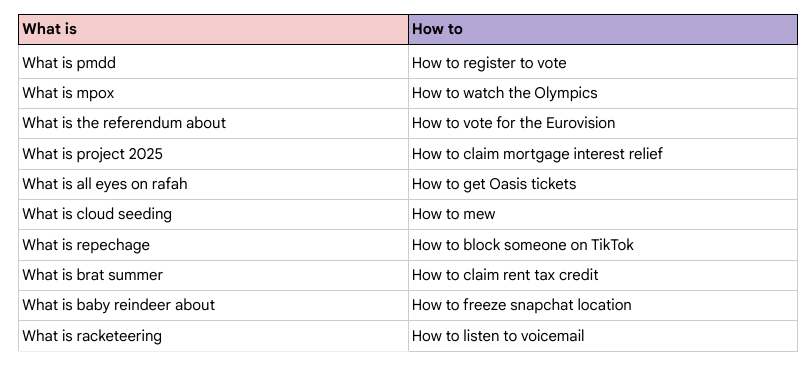
Every day, millions of people turn to Google to ask questions, and looking back at the trending ‘How To’ and ‘What is’ questions since 2003 gives an insight into what the nation was searching for answers for over the last 20 years. Ireland’s  love for pancakes is in no doubt as ‘How to make pancakes’ regularly tops the trending searches. In 2014 ‘How to make loom bands’’ was the most searched question while in 2015 people turned to Google to find out ‘How to use new Snapchat’ .  The most searched ‘What is’ terms brings us back to some recent referenda , in 2008 ‘What is the Lisbon Treaty’ was the most searched ‘what is’ question and ten years later in 2018 it was ‘What is blasphemy’.

Some of the past twenty years’ searches for ‘definition’ give an insight to the cultural moments of the time. In 2013 ‘twerk ’ topped the list, ‘despacito’ was the most searched in 2017 and in 2019, the year impeachment proceedings began for Donald Trump ‘impeachment’ was the most searched definition term in Ireland.

Search can help you find a world of information – and the way people use Search can be a window into the world. Google has 25 years experience devoted to the science and the craft of building a search engine. That dedication has brought completely new ways to explore the world’s information over time — including visual searches with Lens or image-and-text multisearch.

AIMS API Launches Prompt Search – A Music Search Tool That Uses Natural Language

AIMS API, a company specialising in AI-powered music similarity search and music tagging, has launched Prompt Search – a new product that allows exploring music catalogues using natural language, phrases, and descriptions instead of traditional keywords and tags.

Prompt Search is revolutionary in that it makes finding the right tracks for audio-visual projects as simple and enjoyable as taking advice from a musically knowledgeable friend. All the user needs to do is type in a search describing what they are looking for; this could be a scene, location, time period, musical style or even an entire music brief. The AI developed by AIMS will then identify suitable tracks based on the audio only and deliver perfect results in seconds. Even catalogues with no keywords and tags can be searched this way, making it possible to explore entire music catalogues using natural language and discover suitable results that might otherwise stay hidden.

“It’s fast, it’s accurate and it works like magic. Unlike other attempts at this type of music search, ours genuinely works,” says Martin Nedved, CEO and founder of AIMS API. “We are confident that once people try Prompt Search, they will not want to go back. Traditional keyword searches will always have limitations placed upon them by the humans who initially tag the music. Prompt Search removes those limitations and makes searching much more enjoyable and accurate.”

Established in Prague in 2019, and now with representatives in West and East Coast USA, London and Copenhagen, AIMS was developed by music publishing and sync company owners with a deep understanding of the creative industries.

The introduction of Prompt Search takes the future of music search and discoverability to an entirely new level by providing a fast, reliable, and intuitive solution that benefits record labels, publishers, production music catalogues, broadcasters and TV and film companies. It also benefits content creators, playlist curators and music supervisors by maximising music discoverability and minimising the amount of time and effort needed to find the perfect track.

Several proprietary technologies were used in the making of Prompt Search, and its development builds on over five years of research undertaken by AIMS API.

Howie Ross, Music Taxonomy Researcher at AIMS API who played a key role in the creation of Prompt Search, says he was surprised by language AI’s ability to take a natural phrase and turn it into musical suggestions.

“It really is miraculous,” he says. “When I began experimenting with this technology, I typed in the phrase ‘tumbleweed rolling along an empty highway’. The machine immediately understood what I had in mind – a sort of Ry Cooder, Paris Texas vibe – and delivered a list of tracks that were ideal. I was amazed. I didn’t describe any instruments or moods – just scenery – and yet it was able to convert that simple command into something musical. From there I was able to skip through its suggestions until I found a track I liked. I then used Similarity Search to identify even more tracks that fitted my brief.”

AIMS AI Music Similarity Search and AI AutoTagging are now established products that are serving the industry well and allowing people to thoroughly explore music catalogues and discover hidden gems that might otherwise be forgotten,” Martin Nedved adds. “Prompt Search is an evolution of the amazing search tech we already have, with the industry standard similarity search and tagging products. This new way of searching for music will benefit anyone in the creative industries who needs the right music.”

Voice Search Optimization: Preparing Your Website for the Future of SEO

In today’s fast-paced digital world, voice search is revolutionizing the way people find information and interact with technology. With the rise of virtual assistants like Siri, Alexa, and Google Assistant, voice search has become an integral part of our daily lives. 

As a website owner or digital marketer, it is crucial to adapt and optimize your website for voice search to stay ahead of the competition and capture the growing voice search market. 

Understanding Voice Search: The Rise of Conversational Queries

Voice search allows users to speak their queries naturally, using conversational language, instead of typing keywords into a search engine. This shift in search behavior has significant implications for SEO. Voice queries tend to be longer and more conversational, focusing on questions, requests, and specific information. 

Understanding the nuances of voice search is key to optimizing your website and ensuring it aligns with user intent and search engine algorithms.

Optimizing for Featured Snippets: Securing Position Zero

Featured snippets, also known as “position zero,” are concise answers displayed at the top of search engine results pages (SERPs) in response to voice queries. These snippets aim to provide direct answers to user questions without requiring them to click through to a website. Optimizing your content to appear as a featured snippet can significantly increase your visibility and attract voice search traffic. 

Focus on providing clear and concise answers to frequently asked questions related to your industry, utilizing structured data markup, and formatting your content in a way that search engines can easily extract the information.

Long-Tail Keywords and Natural Language: Tailoring Your Content

Voice searches often consist of longer, more specific queries compared to traditional text-based searches. Therefore, optimizing for long-tail keywords and natural language is essential. Conduct keyword research to identify long-tail keywords and phrases that align with your content and target audience. Incorporate these keywords naturally within your website’s content, headings, meta descriptions, and image alt tags. 

Craft your content in a conversational tone, addressing user questions and providing detailed, informative answers that cater to voice search queries.

Mobile-Friendly and Fast-Loading Websites: Ensuring a Seamless Experience

Mobile devices are the primary platform for voice search, so having a mobile-friendly website is paramount. Optimize your website for mobile devices by using responsive design, ensuring easy navigation, and providing a seamless user experience across various screen sizes. 

Additionally, site speed is crucial for voice search optimization, as users expect instant answers – in fact, the initial five seconds of page-load time hold the greatest influence on conversion rates. Compress images, minimize code, and leverage caching techniques to improve your website’s loading speed and provide a smooth user experience.

Structured Data Markup: Enhancing Search Engine Understanding

Structured data markup is a code added to your website’s HTML that helps search engines understand the context and meaning of your content. Implementing structured data markup can enhance your website’s visibility in search results and increase the chances of appearing as a rich snippet. 

Utilize schema markup to provide detailed information about your products, services, events, and other relevant data. This helps search engines present your information more effectively and accurately to voice search users.

Local SEO and Voice Search: Targeting Local Intent

Voice search is heavily utilized for local searches, such as finding nearby businesses, obtaining directions, or seeking local recommendations. 

Optimizing your website for local SEO is essential to capture voice search traffic with local intent. Claim and optimize your Google My Business listing, ensure consistent NAP (name, address, phone number) information across online directories, and include localized keywords in your content. Implementing local SEO strategies improves your website’s chances of appearing in voice search results for local queries.

Natural Language Processing and Conversational AI: Staying Ahead of the Curve

Advancements in natural language processing (NLP) and conversational AI are shaping the future of voice search. Virtual assistants are becoming more sophisticated in understanding user intent and delivering relevant results. 

A majority of consumers, 62% to be exact, express a preference for using a customer service bot over waiting for human agents to respond to their requests.

Consider implementing chatbots or voice-enabled features on your website to provide instant assistance and engage with users in a conversational manner. Staying updated with emerging technologies and incorporating them into your voice search optimization strategy will give you a competitive edge.

User Experience and Intent Optimization: Meeting User Expectations

Voice search is driven by the desire for convenience and efficiency. Users expect quick and accurate responses to their queries. Optimizing your website for user experience and intent is crucial, therefore.

Ensure that your content directly addresses user questions and provides valuable information. Consider creating FAQ pages or dedicated question-and-answer sections to address common voice search queries. Streamline your website’s navigation, improve accessibility, and make it easy for users to find the information they need. And if this seems like a Herculean task, a reputed Nashville SEO Agency can do it all for you.

Ultimately, by prioritizing user experience and aligning your content with user intent, you increase the likelihood of your website being favored by search engines for voice search results.

Voice Search Analytics: Measuring and Iterating for Success

Just like any other SEO strategy, tracking and analyzing the performance of your voice search optimization efforts is crucial. Here’s how to do it:

  • Utilize marketing analytics tools to gather data on voice search traffic, user behavior, and conversion rates. 
  • Pay attention to the specific keywords and phrases that drive voice search traffic to your website. 
  • Use this data to refine your content strategy, identify opportunities for improvement, and make data-driven decisions to optimize your website further for voice search. 
  • Regularly monitor and iterate your approach to ensure ongoing success in this dynamic landscape.

Make Voice Search Optimization Your go-to for Better SERP Rankings

Optimizing your website for voice search is no longer optional but a necessity to stay relevant in the ever-evolving digital landscape. By understanding voice search behavior, optimizing for featured snippets, incorporating long-tail keywords and natural language, ensuring mobile-friendliness and fast-loading speeds, implementing structured data markup, focusing on local SEO, and embracing emerging technologies like NLP and conversational AI, you can prepare your website for the future of SEO. 

By adapting to the voice search revolution, you will enhance your website’s visibility, attract targeted traffic, and remain ahead of the competition in the era of voice-powered search.

/e/OS adds private search engine Mojeek to their list of search options

The latest release of /e/OS, the deGoogled and pro-privacy smartphone operating system (OS) includes the privacy-focused independent search engine Mojeek, offering customers concerned about privacy more options to search online without being tracked.
As two human-centric independent technology products, Mojeek and /e/OS are both excited about the new ways in which this combination can help those looking to leave the surveillance-heavy walled gardens of Silicon Valley far behind.
The founders of these two alternative tech projects, Gaël Duval and Marc Smith (of /e/OS and Mojeek respectively) have built sustainable businesses which are competing with Big Tech and providing people with real choice.
With the coming of the latest update of /e/OS 1.8, Mojeek search engine can now be found among the list of other privacy search options in the /e/OS Browser app.
Individuals with smartphones running /e/OS can change the default search engine, in the Browser app, by clicking on the three-dots button (top right corner) then navigating to Settings > Search engine.
/e/OS is a deGoogled mobile operating system which goes to great lengths to remove all of the unnecessary and privacy-invasive aspects of Google’s long-running mobile platform. Through this work, Gaël and his team have made the move to privacy as simple as possible for the end-user.
Whereas with most similar operating systems you have to have sufficient technological knowledge to unlock and re-flash your previously Android-running device, with their trading arm users can buy Murena smartphones, including Murena One, with the /e/OS operating system already running on them out of the box. On top of this, pre-flashed /e/OS smartphone models include the anti e-waste electronics manufacturer Fairphone, offering an ethical and environmentally-friendly smartphone alternative.
Mojeek is a non-tracking search engine that is truly and transparently independent, unlike most allegedly “alternative” search engines which still continue to source results from either Google or Microsoft’s Bing.
Started in 2004, Mojeek now has a web search index of over 6.5 billion webpages. After becoming the first ever private search engine back in 2006, Mojeek has grown sustainably by leveraging the investments of committed private investors who believe in Mojeek’s aims. Their team has also grown steadily, bringing in individuals that share its values of privacy and support for human rights. This includes experienced tech entrepreneur, Colin Hayhurst, who stepped into the role of CEO in 2020.
Gaël Duval – /e/OS and Murena
“It’s a pleasure to collaborate with Mojeek to bring their pro-privacy search engine to Murena users. It brings a lot of value, and shows that working together, we can build a strong and new proposal for users. Like the organic food market became real in the 2000s, together we are pioneering this emerging and super dynamic ‘fair-IT’ market, that offers a real answer to consumers who are seeking products that offer guarantees for their privacy, and are more sustainable.”
Colin Hayhurst – Mojeek
“People and businesses should be able to search and then navigate the web without having their tracks followed or data harvested. Mojeek search results are provided based on the search query you enter, only on settings you control, and can even be customised without any cookies. To provide that we built our search infrastructure, index and algorithms from the ground-up. Our mobile users want a platform from an entity that practices similar principles, and is an alternative to Big Tech companies like Google, Apple and Huawei. Murena and e/OS/ is the ideal complementary smartphone platform for using Mojeek.

“This release has for the first time combined a web search engine and operating system with both being truly alternative pro-privacy products. With both projects having aspects of their offerings which are environmentally-friendly (Mojeek being a green search engine, /e/OS being available on the Fairphone 3 and 4) and both having been built outside of the assumed home of software, Silicon Valley, this is a completely unique opportunity for people to take back their privacy and support alternatives. After years of domination by US business and venture capital, two dynamic European companies are showing the world that they still have a choice when it comes to their tech.”

Can Anyone Find You Using a People Search Engine?

Nowadays, it’s become very easy to search for people than it was in the past. Information is just a few clicks away, thanks to the internet. One tool that’s proven to be highly efficient in the process is the people search engine. However, many people don’t know how to use people search engines to find someone or if anyone can find them using one.

Social networks like Facebook and Twitter play a crucial role in finding information about people. They can also be used like people search engines. You can look up neighbors, coworkers, a new romantic interest, etc.

The truth is that, yes, anyone can find you if you have a digital footprint. Few people lack one completely. This has its pluses and minuses. On the plus side, you can track down an old friend, an ex you want to get back together with, or a long-lost family member. On the minus side, anyone can find you just as easily. Often, they don’t need more than your name and a few more basic details.

Before moving any further, let’s explain what this search engine is.

Defining “people search engine”

A people search engine lets you find someone’s phone number, address, and any other information that became public at one point in the past. You can check if someone has a criminal background or has been arrested.

You can also use one if you want to buy a real estate property and want to make sure the seller is legitimate. Prospective buyers will run a background check on the seller to probe their records and protect themselves from scams.

What other information can you get?

  • Full name
  • Current mailing address
  • Age
  • Phone numbers
  • Divorces and marriages
  • Resumes and employment history
  • Deaths and other civil records
  • Social media accounts
  • Relatives’ names
  • Mugshot and criminal records
  • Videos and pictures

Are people search engines free?

Some of them claim to be free, but they come with hidden costs. You can do a free search, but you’ll be asked to make a payment to get the results. This can be a one-time fee, or you might be asked to sign up and pay monthly or yearly. If you’re doing lots of people searches, the costs will add up. The list of search engines on Google is practically endless. Many of them have the same owner.

How to keep your data safe

People finders use public records and information from data brokers to get information, which they compile into databases. They also buy information from social media and online shops and scrape the web for data. They can find you based on blog posts, forum posts, comments, etc. They create a profile of you based on the info from any such sources and sell it.

Some people have looked themselves up and found inaccurate information. If it’s harmless, it might even be amusing. If it’s negative and you’re applying for a job, it’s another story.

Ignorance is not bliss

When you consent to the collection of your data by social networks and other websites, they have the right to share it with third parties. This means they can sell your phone number and other information to literally anyone, often for a negligible amount. It can also mean your profile info gets added to these databases, filling information gaps on the people search engine.

Few people grasp this, and some entities are taking advantage of that. Until recently, some social networks asked for users’ real names, claiming it would make them “behave better.” There has never been any evidence of this. Data collection was the only purpose.

Social media are not free

They’re not. They sell their users’ personal data to make money. Data protection regulations have definitely improved, but there’s still a way to go. Facebook would trade or sell personal data without giving the person a share of the profits.

To answer the title question: yes, anyone can find you using a people finder if there is publicly available information about you on the internet. If you want to keep your data safe, do a self-check on one of these sites to see what emerges, and if you don’t like the results, ask the website that published your info to remove it. 

Streamlining Your Job Search: 5 tips

While searching for a job, you normally get tons of advice on what to do, but unfortunately, most of it turns out ineffective. Well, it is no surprise since job searching isn’t just about applying for jobs and hoping to get called for an interview anymore. 

Only some people are able to simply put in an application, get an interview, and land a new job in today’s competitive, network-driven job market. The most successful job seekers utilize a variety of strategies, from establishing a social presence to targeting companies, to help them stand out from the crowd. 

Customize your resume and cover letter

Your resume is the main weapon for your job hunt. It is important to take your time and write a concise resume and cover letter. A resume is used to make a favorable impression on a prospective employer and is often the first impression a potential employer has of you. Without a favorable initial impression, a prospective employer is likely to stop considering you as a suitable candidate for the job on offer and move on to other candidates who have provided better resumes.  

When creating your resume, the purpose is to create a targeted resume or an achievement-oriented resume that highlights your accomplishments that are relevant to the job you are applying for. Ask a friend, family member, coworker, career counselor, or other professional to proofread your resume and cover letter for errors, as well as to offer advice. This will save you the embarrassment of formatting or grammatical mistakes that may go unnoticed to you. 

Customizing your resume to fit the job you want is crucial. If you want to find a job in IT and you already have experience, employers want to see that you work well with others and can manage a team. You might want to reference a time when you collaborated with different departments or led your IT team across different projects. That will show that you have a certain level of expertise and collaborative skills. You should also refer to resume templates online or even resume builders, which will help you customize your resume. 

Know your career goals

Start by identifying what type of career you want. Be clear on what you want, why you want it, and what qualifies you. This is particularly important for people entering the workforce for the first time or those changing careers. Ensure you have a clear, realistic goal, plan how you intend to reach it, and note what qualifies you for that career path. The better you know yourself, the more likely you are to find a new job that provides you with greater satisfaction. 

If you are interested in a future in IT, a great way to impress a potential employer with your goals, motivation, and ability to follow through is if you have recently learned a new skill. Technology is constantly changing, and there are always more things to learn. Get proficient at a new software program, learn about cybersecurity, get to know more about AI, or you could even pick up on data analytics. 

Research your target companies 

As you find job listings that interest you, follow up by researching the hiring companies before you apply. Researching the hiring company will enable you to know if you would want to work with them as it will provide you with information about their company culture, benefits and salary range, products and services, work environment, and more. It will also enable you to tailor and customize your resume and cover letter to meet the demands of the post offered. 

Additionally, if you end up getting an interview for a position, it is always beneficial to be prepared and to already have some knowledge about the company. Being informed helps you make a good impression as well as gives you the opportunity to ask questions.


Two great questions to ask during the interview are:

  • Why is the position available?
  • What determines a good or bad day on the job?

The answers to these questions will provide you with information on the specifics of the vacancy of your potential role and give insight regarding day-to-day expectations.

Your preferred company may look great on paper, but these will provide greater detail.

Use your network

Networking is about establishing and nurturing long-term, mutually beneficial relationships with the people you meet. A large and strong network of contacts results in more job opportunities. Networking – in person and online – is essential to your success in your job search. No matter the age, building connections is still the most prominent means by which people find jobs. In fact, experts agree that the most connected people are often the most successful. 

The right employee referral can increase your chances tenfold of landing the job. If you’re looking to make a career change, your professional network can support you by helping you find connections in the industry you are trying to break into or help you find leads for jobs at specific companies. Lensa’s article on the best job search sites can help determine which sites best suit your desires.

Ace the interview

Cred: @amyhirschi

A job interview, of course, is what will or will not grant you the job offer. Acing the interview should be a priority in your search. Therefore you should take the time to prepare yourself well. Before the interview, develop responses for common interview questions and then practice them – ideally using the mock-interviewing technique with a friend, network contact, or interview coach. The more prepared you are for the interview, the more comfortable you’ll be, and the more likely you’ll succeed. 

Dress smartly during the actual day and wow the interviewer with your skills, experience, confidence, and expertise. It’s also advisable to follow up post-interviews with a thank you note. Use your thank-you note as an opportunity to emphasize why you’re the best candidate for the position. If you flubbed an answer during the interview, you can also use your thank you note to clarify (just ensure it doesn’t come off like you’re making excuses). 

The search for a job may take longer than you expect. In fact, even after you go for interviews, the results will take time before you get them. Patience is, therefore, essential in the long process of job hunting. Understand that it’s a process, and try not to overwhelm yourself. If you have done your research and are prepared, then it’s only a matter of time before you get hired.

Google ‘Year in Search’ results reveal what Ireland searched for in 2022

As 2022 comes to a close, the Google Year in Search results give us a snapshot of what caught the country’s attention over the past year and what daily searches we all had in common.

This year’s top overall search is popular online word-game, Wordle! Wordle (& Heardle & Quordle & Globle & Nerdle & Foclach & Octordle) kept our brains ticking this year and while Wordle topped the overall list the game variations that popped up once the Wordle craze took hold featured on the most searched tech list. Wordle also featured on the How to list, with people turning to Google to find out ‘How to play Wordle’.

The war in Ukraine has also firmly shaped the results this year with Ukraine and Russia sitting in the top 10 overall searches and many people searching for Vladmir Putin. Search facilitated questions like, ‘What is NATO?’, ‘What is an Oligarch?’ and ‘What is the population of Ukraine?’ and provided the nation with answers in its effort to further understand the context of the Russian invasion of Ukraine.

Google Search helped us to get back out to the cinema this year as we searched for top new box office releases like The Batman, Uncharted, the classic film sequel, Top Gun: Maverick and Martin McDonagh’s The Banshees of Inisherin. It’s no surprise that the World Cup has found itself atop the sports-related searches as the tournament continues in Qatar. Ireland also keenly searched for the Australian Open and Ireland vs New Zealand (perhaps something to do with Ireland’s triumphant win against the All Blacks!).

Search also kept us all up to date this year on the latest Hollywood scandals with Johnny Depp and Amber Heard topping the most searched people list followed closely by Will Smith who hit the headlines after a dramatic 2022 Oscars Ceremony. We also looked to Search to stay informed on news cycles happening a bit closer to home as many of us searched for Liz Truss and Matt Hancock.

Every day, millions of people turn to Google to ask questions, and this year Covid related questions still feature in the top trending searches. ‘How to get a covid cert’ was the most searched question this year followed by ‘How to book a PCR’ .  Other questions on the list included ‘How to unblock your nose’ and ‘How to tie a tie’

In spite of the full reopening of bars and restaurants this year, the 2022 results confirmed that Ireland still loves a homemade cocktail with ‘Pornstar Martini Recipe’ topping the recipe list. Search also remained the go-to platform for inspiration for top food recipes like, ‘Mushroom Soup Recipe’, ‘Spaghetti Bolognese Recipe’ and ‘Overnight Oats Recipe’.

Search can help you find a world of information – and the way people use Search can be a window into the world. Take a closer look at this year’s trending lists at Google.com/2022.


Top overall

People

Wordle

Johnny Depp

Ukraine

Amber Heard

Queen Elizabeth

Will Smith

Aisling Murphy

Vladamir Putin

World Cup

Liz Truss

Heardle

Novak Djokovic

The Jeffrey Dahmer Story

Anna Delvey

Johnny Depp

Matt Hancock

Russia

Michael Owen

Anne Heche

Sinead O’Connor


Losses

Sports

Queen Elizabeth

World Cup

Aisling Murphy

Australian Open

Anne Heche

Ireland v New Zealand

Olivia Newton John

Nations League

Betty White

AFCON

Taylor Hawkins

Ireland v South Africa

Ray Liotta

GAA Fixtures

Aaron Carter

Winter Olympics

Shane Warne

Liverpool vs Real Madrid

Bob Saget

Ireland v Ukraine


Movies

Tech

The Batman

Wordle

Uncharted

Heardle

Thor Love & Thunder

Quordle

Top Gun

Globle

Banshees of Inisherin

Nerdle

Encanto

Foclach

Black Adam

Octordle

The Lost Daughter

James Webb Telescope

Don’t Worry Darling

fifa 23 web app

The Good Nurse

iPhone 14


Recipes

How to

Pornstar Martini Recipe

How to get covid cert

Mushroom Soup Recipe

How to book PCR

Spaghetti Bolognese Recipes

How to play Wordle

Overnight Oats Recipes

How to do Antigen

Tomato Soup Recipe

How to solve a rubik’s cube

Baked Oats Recipe

How to tie a tie

Chicken Breast recipes

How to unblock your nose

Beef Bourguignon recipe

How to spell askew

Chocolate Brownie Recipe

How to help ukraine

Raspberry Jam Recipe

How to apply for fuel allowance online


What is

What is NATO?

What is Monkey Pox?

What is Wordle?

What is an Oligarch?

What is an NFT?

What is Aphasia?

What is Hepatitis?

What is the population of Ukraine?

What is Salmonella?

What is the Met Gala?

Why Is Link Building Important For Your Business? Find Out Here

As an entrepreneur, you know that success depends on various factors. One key factor is your ability to build strong links for your business website. There are many different types of links that you can build for your website. The most common types include backlinks, blog comments, directory listings, guest posts, and social media likes or shares. Website owners, bloggers, and other online marketers all rely on link building to help them reach their business goals. You may be wondering why link building is so important. Keep reading to find out more about this essential aspect of online success.

Creates More visibility for your Website

One of the best benefits of link building is that it can help you create more visibility for your website. When you have links across the web pointing back to your site, this can help you to increase your online visibility. More people are likely to discover your website and engage with it. Increased visibility is essential for newer businesses or those without a large marketing budget.

Consumers will notice your website when you invest in link-building strategies that work. There are many different tools and techniques that you can use to build the right types of links for your website. Of course, it is crucial to consider finding quality backlinks relevant to your industry that can provide value to your website visitors. By focusing on link building, you can help your business succeed in today’s competitive online marketplace.

Helps You Improve Your Search Engine Ranking

One of the most important reasons to focus on link building is that it can help you improve your website’s search engine ranking. When you have strong links pointing to your site, this signals to search engines that your site is valuable and worth displaying in search results. As a result, your site is more likely to appear higher up on the results list when potential customers perform a search related to your business.

When your site is ranked high in search engine results, this also means that you are more likely to gain quality traffic. People looking for the products or services you offer will be able to see your site and click on it. This can help you to grow your business quickly and easily.

Builds Trust and Credibility

Another reason to focus on link building is that it can help you build trust and credibility with potential customers. When other websites link to your site, they trust your site and believe it contains high-quality information. This can help you attract more visitors to your site and convert them into paying customers.

This can be especially beneficial if you can get links from authority sites in your industry. Authority sites are those that are well-known and respected by consumers. These links show that you are an authority figure in your industry, which can help you gain the trust of potential customers.

Builds Your Reputation as an Authority in Your Industry

Another critical reason link building is so important is that it helps you build a strong reputation as an authority in your industry. When other sites with high authority link to yours, this tells search engines that your website has valuable content and should be considered an expert resource for anyone researching your industry or niche. As a result, people who visit your site will view you as an expert in your field and be more likely to use your products or services.

This is a critical way to build trust with potential customers and encourage them to do business with you. It can also help you attract more high-quality links in the future, as other websites will want to link to a site considered an authority in its industry.

Generates More Traffic to Your Site

Link building can also generate more traffic to your website. When people see links to your site on other websites, they may be curious about what you have to offer and click on the link to visit your site. This can help you increase the number of visitors to your site quickly and easily.

More traffic can lead to more sales and higher profits for your business. It can also help you build a strong customer base that will continue to do business with you. In addition, if people find your site through a link on another site, they are more likely to remember your URL. Hence, revisit your site in the future. This can help you build a loyal customer base that keeps coming back to your site.

Allows You to Reach New Audiences

Link building allows you to reach new audiences that may be interested in your products or services. When you receive links from other websites related to your industry, this can help you attract customers who are unfamiliar with your business.

As a result, you can grow your customer base and increase sales for your company. Link building is an essential aspect of online marketing and should not be overlooked by any entrepreneur looking to build a successful business website. By focusing on different link-building techniques, you can improve your search engine ranking and generate more traffic to your site. As a result, you can grow your business quickly and easily.

Helps Connect With Other Businesses and Influencers

One of the most important reasons why link building is so crucial for your business is that it allows you to connect with other companies and influencers in your industry. This can help you build valuable relationships that lead to future collaboration opportunities, joint ventures, or sales referrals.

When businesses and influencers link to your site, this can also increase the visibility of your website and help you gain more traffic from potential customers. If these connections lead to sales opportunities down the road, they can be a great way to generate new revenue for your business.

Whether you’re an entrepreneur looking to grow your business, an online marketer trying to build your brand, or simply someone who wants to improve their search engine rankings and visibility, link building is an essential part of success. By focusing on various link-building activities, such as guest posting on other sites or sharing content on social media, you can build strong relationships with other online marketers and improve your search engine ranking and visibility.

How to Find Anyone Online with Just a Name

Have been looking for your long lost high school pal? It can be difficult to find people if you have limited information about their identity. Fortunately, there are many online resources that can guide you to the person even if all you’ve got is a name. 

The beauty of all search engines is that they will provide information from all sorts of websites. For instance, the results will show you the profile of your subject if he has registered in the best casinos in Ireland. Below we will discuss the social networking portals and search engine tricks you can use.

Find Someone without the Last Name

The probability of finding someone is higher if you know their city, last name and first name. However, online searches can still produce results if you know their city and first name.

Search engines are recommended for searches that are limited to the first name. Below we’ll discuss how to find someone with just a first name.

The first name might be enough when finding a popular or famous individual like Tupac or Neymar. However, it won’t be enough if the name is common. It’s therefore advisable to also include other details like their profession, their hometown or where they study. Type these details into Yahoo, Bing or Google and go through the search results.

Alternatively, you can click on the Images tab if you know how the individual looks like. This method is quite effective when normal searches fail. Other effective search engines include DuckDuckGo, Monster Crawler, DogPile, WebCrawler and WayBack Machine.

Facebook Search by Name

It’s advisable to use websites that carry personal information when seeking for someone. Some of these popular sites include LinkedIn, Twitter and Facebook. Facebook is the oldest of these sites and it contains the most subscribers.

It is smarter to start with a Google/Facebook combined search before going for the Facebook internal search. For instance, you can type in “Christian Maguire site:facebook.com” and go through the search results. You can also click on the images tab if you want a thorough search. This trick works even better when your search string also includes location.

The second method is to enter Facebook and type the individual’s name into the search box. You can improve the quality of the search results by making a few tweaks. It’s possible to narrow down results by manipulating the filters to match specific times and places.  These filters will expose older posts even if the person hasn’t posted in a long time.

Other Apps, Sites, and Online Records

Use ZabaSearch to Search for Addresses and Phone Numbers

You can look for your old friend by tying in his/her address or phone number using this unique search engine. It comes with an index that has information about unlisted and listed addresses and numbers. You can start by typing in your own name to see the results. You’ll be creepily-impressed by its accuracy.

Use Pipl to Explore the “Deep Web”

Pipl will help you dig deeper than Google. Pipl’s search results are impressive because they contain information from the “invisible web.” The information includes Amazon wishlists, MySpace pages, press mentions and personal web pages. It’s a search engine that provides accurate information about people with “real” online names. You can use country, state, and city information to filter results for common names.

Wink Helps you to Search Numerous Social Websites

It’s easy to get results from many social sites using Wink. It’s easier than looking through each site on an individual basis. Wink will give you comprehensive search results for sites like Xanga, Twitter, MySpace, LinkedIn and Friendster. The results will be provided in one search.

ZoomInfo Will Help you Get Employment Results

This search engine is normally used to provide information about individuals and companies. The information is normally useful in matching people with the best possible jobs. ZoomInfo will provide you with a person’s current job title and employment history. Type in the individual’s full name and search. It’s advisable to use geographical filters to reduce unnecessary results.

Search for the Phone Number

Search engines can be helpful when finding information attached to a certain phone number. This is usually a straight-forward method if an individual’s phone number is advertised or listed online. It works best if you separate the numbers by experimenting with parentheses, periods and hyphens. You can also place the number in quotes. You can pay a fee to find cell phone information through reverse-tracking.

How to Find Someone by Username?

This is how to find someone if you don’t know their last name. The best way to unearth someone’s identity is to start with Google. It’s as simple as looking for the individual’s username to reveal their social media profile.

The username can be complemented with quotation marks to decrease unnecessary search results. This means you should type in “username” into the search bar. The results will be specific to what you’re looking for.

People search engines are also effective if social networks and Google don’t give you the desired results. Sites like Spokeo and BeenVerified have a reputation of providing verified and updated information.

There are other alternatives such as Facebook, Reddit, Snapchat, Instagram, Twitter, etc.

Finding Friends of a Friend

You can use recommendations from various social networks to track down the individuals. These recommendations are usually profiles of people who are connected to the main subject. You can gather clues from the person’s inner circle. It’s therefore possible to find someone without a last name.

This method works very well in Facebook because the site exposes you to mutual friends and it allows you to send a friend request. You can also speak to a person using direct messages.

Conclusion

Search engines and social media platforms have made it easy to find long lost friends even if we don’t have sufficient information. In fact, search engines like WayBack Machine are so powerful that they can recover information that has already been deleted on the internet. You might need some luck and perseverance but you will find your subject if you use the above methods. You can even use professionals to help you locate the person you want.