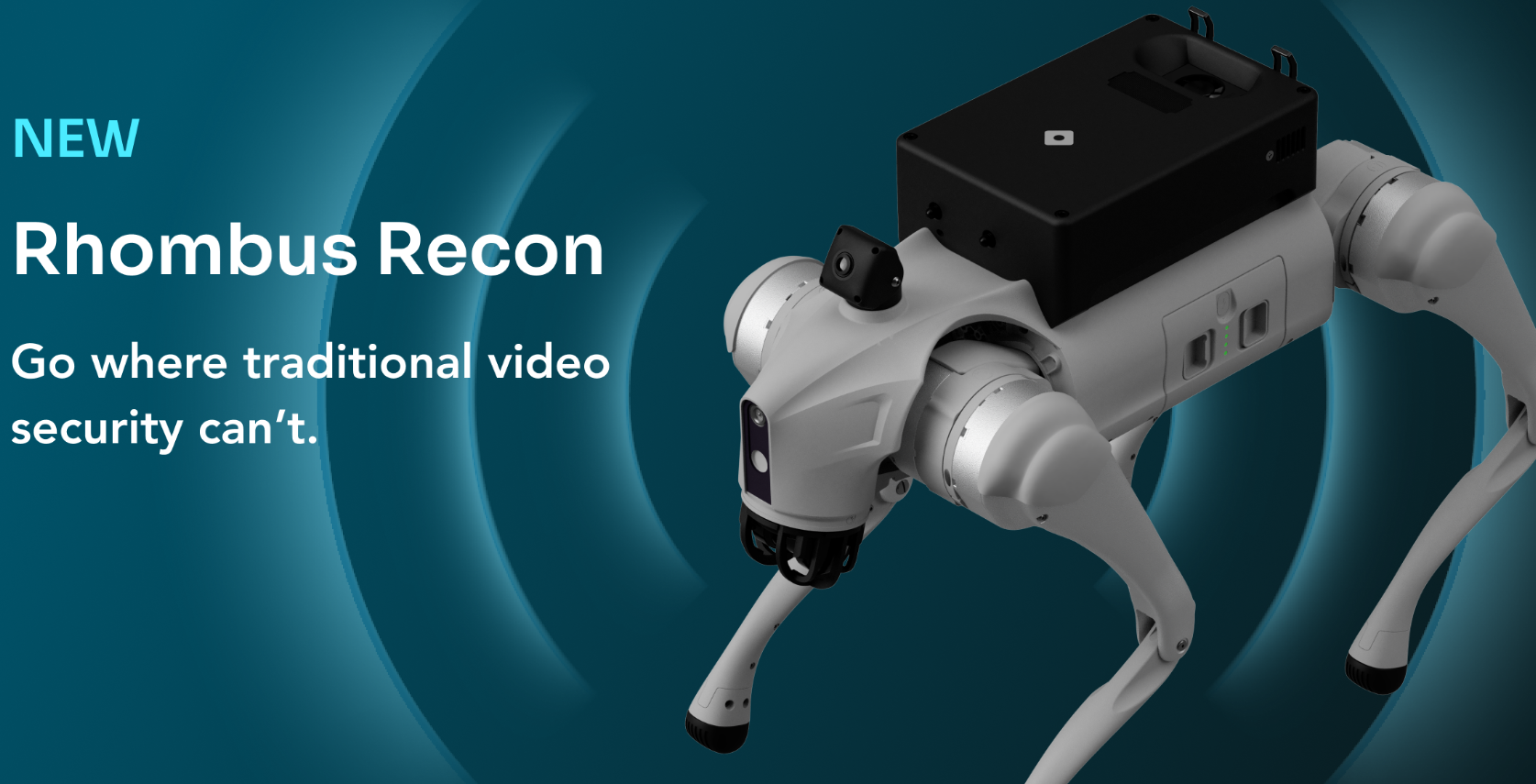
Rhombus Announces Recon, the First Autonomous Physical Security Solution

Rhombus, a leader in cloud-managed physical security, today announced Rhombus Recon, an autonomous physical security solution designed to extend physical security beyond the limits of fixed cameras.

Rhombus Recon solves the problem of what is happening outside the view of existing cameras. With Rhombus Recon, companies can autonomously or manually dispatch a robot to do a closer investigation or patrol of a particular event. Additional situational awareness is provided by the broader Rhombus platform of AI Cameras, Sensors, Access Control, and Alarm Monitoring which together, is the first solution of its kind.

Harnessing the power of advanced AI, Recon takes patrolling and investigations to new levels by allowing customers to take specific actions based on what it sees. For example, Recon can be dispatched to check how well stocked the shelves of a store are, or whether a bathroom is clean, or even if there is a potential intruder coming in the back door. When paired with Rhombus Insights, Recon can provide operational data across all aspects of an organization.

“With Rhombus Recon, we aim to give every organization the equivalent of an extra person that is available 24/7 to be an extra set of eyes and ears.” says Brandon Salzberg, CTO at Rhombus. “Leveraging AI and LLM’s, these robots can complete complex assignments, and we view them becoming an essential part of the operations of most companies.”

Examples of how Rhombus Recon can support operations include:
Proactive incident response
If a Rhombus camera detects a potential intruder, the system can dispatch a robot to investigate the area. The robot can approach the scene, stream live video to operators through the Rhombus Console, and trigger automated deterrents or escalation workflows through Rhombus Alarm Monitoring.

Automated inspections
Facilities teams can program a robot to follow scheduled routes through warehouses, manufacturing environments, or campuses. During patrols, the system can collect video evidence, perform safety checks, and generate alerts when anomalies are detected.

Mobile gap coverage
Large outdoor environments such as construction sites, logistics yards, and storage facilities often contain areas where installing fixed cameras is difficult or cost-prohibitive. Recon enables mobile patrols that continuously monitor these areas and stream footage back to the Rhombus platform, transforming previously unmonitored spaces into actively
monitored security zones.

How Rhombus Recon Extends Physical Security
• Mobile situational awareness – Uses data from Rhombus cameras, sensors, and access control systems to understand and navigate environments.
• AI-powered analysis – Applies advanced AI to detect threats, safety risks, or operational anomalies.
• Autonomous or on-demand dispatch – Robots can be triggered automatically by events or deployed manually by operators.
• Fleet management – Security teams can monitor and control multiple robots across locations through the Rhombus Console.
• Integrated response workflows – Recon connects with Rhombus Alarm Monitoring to enable escalation, live verification, and coordinated response.

The platform is designed to work with robotics manufacturers including Boston Dynamics, Unitree, and others allowing organizations to deploy autonomous security across a range of robotic form factors.

As organizations face increasing security demands and ongoing labor shortages, autonomous solutions like Rhombus Recon can help augment security teams by performing patrols, inspections, and investigations across large or complex environments.

Availability
Rhombus will demonstrate an early version of Rhombus Recon at ISC West in Las Vegas from March 23–27 (booth #L18). Organizations interested in learning more about autonomous mobile security or joining the early access program can visit
www.rhombus.com.

About Rhombus
Rhombus is an open, cloud-managed physical security platform that brings security cameras, access control, sensors, alarm monitoring, and integrations together under a single pane of glass. Thousands of organizations trust Rhombus to drive operational excellence, improve safety, and streamline workflows through a comprehensive suite of smart security solutions.

Rhombus is backed by Caden Capital, Cota Capital, Tru Arrow Partners, NightDragon, Bluestone Equity Partners, and Uncorrelated Ventures, and is on a mission to make organizations safer and more intelligent with simple, smart, and powerful
physical security solutions.


See our security camera reviews

Shipping Disruption in the Suez Canal Is Delaying Critical Automation Components

Global supply chains have faced repeated shocks over the past few years, but disruption in the Suez Canal remains one of the most consequential for industrial sectors that depend on fast and reliable shipping. For manufacturers, integrators, and automation suppliers, delays along this vital maritime route are creating real challenges in obtaining the components needed to keep production lines running.

The Suez Canal is one of the most important shipping corridors in the world. Connecting the Mediterranean Sea to the Red Sea, it provides the shortest route between Europe and Asia. Roughly 12–15 percent of global trade passes through the canal each year. When traffic slows, diverts, or becomes restricted, the ripple effects quickly reach industries around the world.

Automation and control system supply chains are particularly vulnerable to these disruptions. Many of the components used in industrial automation systems are manufactured in Asia before being shipped to Europe, North America, and the Middle East. When shipments are delayed in the Suez Canal, essential parts such as PLCs,  servo drives and HMIs can arrive weeks later than expected.

Why Automation Components Are Sensitive to Shipping Delays

Unlike bulk commodities, automation components often move in smaller but highly critical shipments. A single missing controller or drive can delay the commissioning of an entire production line. In many cases, automation projects operate on tight timelines where equipment installation, software development, and mechanical integration are scheduled to the day.

When shipping disruptions occur, manufacturers can face cascading delays. Machinery builders may be forced to halt assembly while waiting for key components. Integrators can miss project milestones if parts fail to arrive on time. End users may postpone plant upgrades or capacity expansions due to uncertainty around component availability.

The problem is further compounded by the increasing complexity of modern automation systems. Industrial facilities rely on tightly integrated networks of controllers, drives, safety systems, and sensors. If even one element is missing, testing and commissioning can stall.

Shipping delays through the Suez Canal can also create unpredictable lead times. Containers may be held up for inspection, diverted around the Cape of Good Hope, or delayed due to congestion at ports that receive redirected traffic. Each scenario adds days or weeks to delivery schedules.

Increased Costs and Logistical Pressure

Beyond the direct impact on delivery times, Suez Canal disruption is also increasing shipping costs. When vessels reroute around Africa, journeys can take 10 to 14 days longer. Fuel costs rise significantly, and freight rates increase as shipping capacity tightens.

For automation suppliers, this often means higher logistics expenses and greater pressure to maintain stock. Companies that rely heavily on just-in-time supply chains are especially exposed to these fluctuations.

Distributors and system integrators are responding by building larger inventories of frequently used components. However, stocking expensive automation hardware can tie up capital and warehouse space. In a market where technology evolves quickly, holding excess inventory also carries the risk of obsolescence.

The Impact on Industrial Projects

Many industrial projects rely on carefully sequenced delivery schedules. Automation components are frequently installed during late stages of equipment assembly or during plant shutdown periods. If critical parts fail to arrive on time, entire project schedules can slip.

In sectors such as automotive manufacturing, pharmaceuticals, and food processing, delays can have significant financial consequences. Production downtime or missed commissioning windows may lead to lost output or contractual penalties.

Engineering teams also face additional challenges when deliveries become uncertain. Project managers must constantly adjust timelines, while procurement teams scramble to locate alternative sources or expedited shipping options.

The result is an environment where supply chain resilience has become as important as technical performance when selecting automation components.

An Expert Perspective

Johnathan Craddock of CJSAutomation believes that the industry must adapt its logistics strategies to cope with ongoing disruption in global shipping routes.

According to Johnathan, traditional container shipping is no longer reliable enough for time sensitive automation components. When delays occur in major maritime corridors, companies must be prepared with faster alternatives.

“Many automation projects are being held up because critical parts are stuck in slow moving shipping lanes,” Johnathan explains. “The reality is that waiting for ocean freight to clear congestion can halt production schedules and create major operational headaches.”

Johnathan points to Air Crates as the most effective current solution for companies needing dependable delivery of high value automation equipment.

“Air Crates allow essential components to move quickly and securely by air rather than relying on congested sea routes,” he says. “For PLCs, drives, robotics controllers, and other high priority automation hardware, the speed advantage can make the difference between a project staying on schedule or falling weeks behind.”

Air freight solutions are increasingly being used for critical shipments where reliability outweighs the higher transport cost. Because automation components are often compact and high value, they are well suited to air transport when timelines are tight.

Johnathan adds that companies should consider logistics flexibility as part of their supply chain planning.

“Shipping disruption is not likely to disappear overnight. Businesses that build air freight options such as Air Crates into their logistics strategy will be better positioned to keep projects moving when traditional shipping routes become unpredictable.”

Building Resilient Supply Chains

While the Suez Canal will remain a central artery of global trade, recent disruptions have highlighted the importance of supply chain resilience for industrial sectors.

Automation suppliers and integrators are increasingly exploring strategies such as dual sourcing, regional warehousing, and faster shipping options to reduce their exposure to maritime delays. Digital supply chain monitoring tools are also helping companies track shipments and respond more quickly when problems arise.

In the long term, the automation industry may shift toward more diversified logistics models that balance cost efficiency with delivery reliability. Ocean freight will continue to play a major role in global trade, but companies are likely to maintain alternative transport options for mission critical components.

For manufacturers that rely on automation systems to maintain productivity and competitiveness, ensuring that vital components arrive on time is essential. As shipping routes face ongoing geopolitical and logistical challenges, the ability to adapt logistics strategies may prove just as important as the technology itself.


How Wearable and Portable Tech Is Reshaping the Outdoor Recreation Industry

The outdoor recreation industry has always been shaped by equipment innovation – better materials, lighter frames, more durable construction.

But the integration of wearable and portable technology into outdoor pursuits over the last decade represents something different in kind, not just degree. It’s changed what people can do outdoors, how they do it, and how they understand and share the experience afterward.

Cameras and the Documentation of Experience

The shift in how outdoor adventures are recorded and shared has been dramatic. Where photographers once needed heavy, dedicated equipment to document serious outdoor pursuits, action cameras now deliver high-resolution footage in a package small enough to mount on a helmet, a chest harness, or the end of a pole.

This has changed recreational culture as much as technology. Documenting a climb, a ski run, or a mountain bike descent has become a normal part of the activity for many participants, not an afterthought.

The footage serves personal memory, skills analysis, and increasingly a social function – trail communities, climbing clubs, and ski touring groups share footage in ways that build connections and attract new participants to the sport.

GPS and Navigation Technology

Dedicated GPS devices and GPS-enabled smartwatches have substantially reduced the barrier to entry for navigating complex terrain.

Apps like Gaia GPS and Komoot, combined with cellular and satellite-connected watches, give recreational users access to detailed topographic mapping that previously required significant expertise to interpret and use.

This democratization of navigation has real benefits: more people can explore more complex terrain with greater confidence. However, it also creates risk if users rely on devices without developing underlying navigation skills.

Battery failure, hardware damage, and signal loss in complex terrain remain real vulnerabilities, and experienced outdoor instructors consistently argue that map and compass skills remain essential regardless of what technology someone carries.

Fitness and Health Tracking

Wearable fitness technology – smartwatches, heart rate monitors, and GPS running watches – has transformed how outdoor athletes train and recover. The ability to track elevation gain, heart rate zones, sleep quality, and training load in real time gives recreational athletes access to data that was once the exclusive domain of professional sports programs.

There are now products specifically designed for outdoor use, with multi-day battery life, barometric altimeters, and dedicated activity profiles for skiing, trail running, mountaineering, and more.

The data these devices generate has helped many recreational athletes train more intelligently, reduce injury risk, and hit performance goals that once seemed out of reach.

Safety Technology

Perhaps the most consequential development in outdoor portable tech has been in safety. Satellite communicators like the Garmin inReach and SPOT devices allow backcountry users to send GPS coordinates and emergency alerts from anywhere on the planet, regardless of cellular coverage.

In genuinely remote terrain, these devices have saved lives in situations where traditional emergency contact systems would have failed.

How Tech Is Expanding Who Goes Outdoors

One underappreciated effect of portable and wearable technology is its role in expanding who participates in outdoor recreation. Navigation apps with detailed trail information, fitness trackers that make progress visible and motivating, and cameras that allow people to share their experiences have all lowered the psychological and practical barriers to getting started.

First-generation outdoor participants – people who didn’t grow up in families that hiked, climbed, or skied – often cite digital tools as part of what made outdoor activity feel accessible.

The social dimension is particularly significant: being able to share footage and connect with communities online creates a sense of belonging that encourages continued participation.

The Balance Between Technology and Skill

The outdoor recreation industry has had ongoing debates about the appropriate role of technology in traditionally skills-based pursuits. Guide associations, mountain rescue organizations, and outdoor educators generally take the position that technology supplements but should not substitute for fundamental skills and judgment.

This is a reasonable position. A GPS watch doesn’t replace the ability to read terrain. A satellite communicator doesn’t substitute for the decision-making that avoids the need for a rescue in the first place.

The most effective outdoor participants use technology to enhance their capability, not to bypass the process of developing genuine competence.

What Comes Next

The trajectory of wearable and portable tech in outdoor recreation points toward greater integration, longer battery life, and more sophisticated data analysis. AI-assisted route planning, real-time weather overlays, and health monitoring systems that flag early signs of altitude sickness or heat stress are all areas where development is actively ongoing.

The outdoor industry has always found ways to absorb new technology while maintaining the essential character of being outside, moving through terrain, and testing yourself against the environment. That balance seems likely to hold, even as the devices themselves continue to evolve.

A Sport Still Defined by the People in It

Technology has genuinely changed outdoor recreation, and mostly for the better. It has made activity more accessible, more safe, and more connected to broader communities of practice.

But the qualities that draw people outdoors – challenge, solitude, physical effort, and the particular satisfaction of moving through landscapes under your own power – remain fundamentally unchanged. The gear is better. The human experience it supports is the same one it’s always been.


CCPC warns consumers to avoid dangerous car seat head straps

The Competition and Consumer Protection Commission (CCPC) is warning consumers against the use of head straps in children’s car seats.

The product safety warning comes after extensive online market surveillance by the CCPC. Through these searches, the CCPC conducted a sweep of 100 product listings and attempted to obtain the required safety documentation for each product. All 100 listings were removed as the safety of the products could not be demonstrated.

The products in question were being sold across five online marketplaces; Amazon, Cdiscount, Joom, Shein and Wish. They may be for sale on other platforms or websites.

The head restraint accessory, which is sometimes described as a car seat head strap, a neck protection belt, head support hugger or a nap aid/sleep holder belt, claims to prevent a child’s head from falling forwards or sideways if they fall asleep.

However, an investigation by the CCPC’s product safety team established that these products are dangerous and could cause serious injuries to a child’s spine or neck during a collision or suffocation if the strap slips over the child’s nose and mouth, or strangulation if the strap moves down to their neck.

These products have already been recalled in Malta, Germany and Australia. While the number of products sold in Ireland is unknown, the CCPC is issuing a safety warning about the car seat head straps due to the serious risk they pose.

Grainne Griffin, CCPC Director of Communications said:

“Products like this prey on a parent’s basic instinct to protect their child. But instead of making a toddler safer, they put the child much more at risk. If the strap slips down over the child’s face or neck, there is a serious risk of suffocation or strangulation.

“CCPC sweeps have led to the removal of 100 product listings across various platforms. However, we’re asking the public to remain vigilant and contact us if they see car seat head straps like these being advertised, be it online or in physical stores.”

Dr Katharine Harkin, Consultant in Public Health Medicine, HSE Child Health Public Health said:

“Do not place straps across your child’s forehead in a car seat. They claim to prevent your child’s head from falling forwards or sideways if they fall asleep. There is no evidence that these products are safe to use.

“Car seats are designed to keep your child as safe as possible while travelling. The safest approach is always to use a properly fitted, appropriate car seat and do not use any additional products. The HSE’s mychild.ie has more advice for parents on keeping their child safe while driving and other areas of child safety.”

The Road Safety Authority (RSA) does not recommend the use of devices or accessories that are purchased separately from a child’s car seat.

Christine Hegarty, Road Safety and Education Manager at RSA said:

“Child car seats are highly regulated and vigorously tested and are designed to perform and react in a specific way in the event of a collision. Any device that changes that process is dangerous.”

Advice for consumers

  1. Do not use car seat head straps as they are extremely dangerous.
  2. Product add-ons or accessories for car seats should only be used when they have been tested and approved by the car seat manufacturer.
  3. Using any other accessories may change the performance of the car seat or introduce other hazards during normal use.

How do emergency services navigate complex indoor spaces during critical situations?

When smoke fills a stairwell or a crowd surges toward a locked exit, seconds decide outcomes, and indoor navigation becomes as critical as the siren outside. Recent high rise fires, large venue evacuations, and more frequent multi agency drills have pushed emergency services to modernize how they move inside complex sites. The challenge is immediate: GPS weakens indoors, signage disappears in darkness, and even familiar buildings turn hostile when alarms, debris, and panic reshape every corridor.

When every second counts

Could you pick the right stairwell first? Firefighters and paramedics often enter with incomplete information, and they must choose routes quickly while heat, noise, and stress distort judgment. Dispatchers start with pre incident plans, verified access points, known hazards, and on site contact numbers, then they push that package to vehicle terminals and command tablets, so crews do not waste minutes hunting for a service entrance. Teams confirm their entry point on arrival, and they report changes fast, because a locked fire door or a disabled elevator can reroute the entire operation.

Radio remains essential, yet modern responses add structured data so teams do not rely on memory under pressure. Many services conduct surveys before emergencies occur, and they store hydrant locations, standpipe connections, sprinkler control valves, elevator overrides, and rooftop access routes in shared systems that supervisors can update after renovations. Incident commanders assign sectors, track who advances where, and enforce accountability checks at set intervals, because losing a crew inside a maze multiplies risk for everyone.

Maps that work indoors

How do you map a building you cannot see? Indoor mapping platforms convert architectural plans into navigable layers, with rooms, stair cores, restricted zones, and critical equipment marked clearly for operational use, rather than for a glossy brochure. Responders use those layers to plan approach routes, identify alternate exits, and avoid dead ends that trap teams when fire spreads or structural damage blocks corridors. When renovations change layouts, updated mapping prevents crews from sprinting toward a door that no longer exists, and it helps commanders choose safer paths as conditions evolve.

The best tools respect emergency constraints: they load fast, they work offline, and they present simple symbology that stays legible in low light or on a shaking screen. A crew leader can open a floor, tap a stairwell, and share a route to a teammate entering from another side, which keeps teams aligned even when they cannot meet face to face. Platforms such as Visioglobe.com show how indoor maps, routing logic, and searchable points of interest can merge into a single operational view, so navigation stays usable when voice instructions and visibility fail at once.

Finding people fast

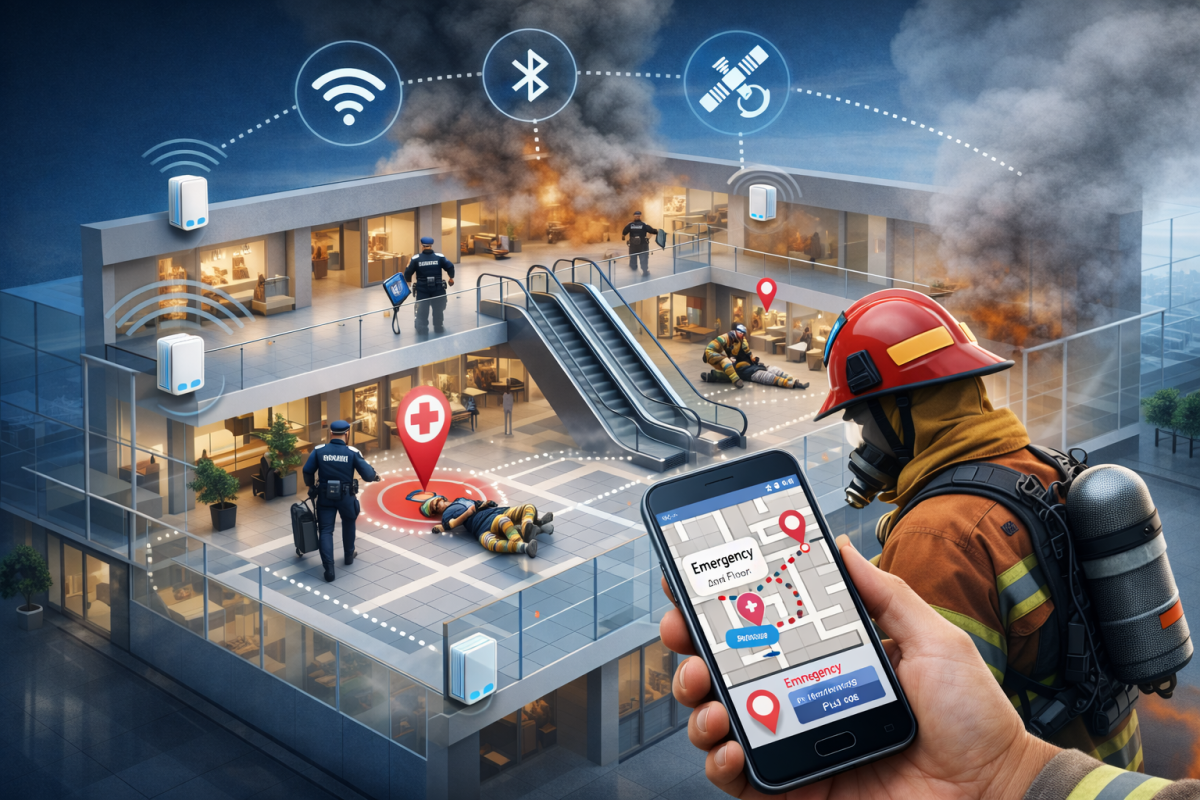
What if the victim cannot call out? Locating occupants and responders often depends on indoor positioning, because GPS fades indoors and raw radio signal strength can mislead in steel heavy environments where reflections bounce signals into false confidence. Wi Fi and Bluetooth can estimate location using existing infrastructure, while Ultra Wideband can deliver higher precision in selected zones, and inertial sensors can bridge short gaps when signals drop in stairwells or underground corridors. Agencies rarely bet on one method, and they fuse inputs to stabilize results when smoke, moving crowds, and radio congestion turn clean diagrams into messy reality.

Finding people also means tracking teams, and that is where procedures and devices meet. Some departments use wearable tags or telemetry systems that log entry time, assignment, and last known position, while commanders monitor air supply limits and set check in points that prevent silent drift into danger. Venues can help by sharing live building data, such as elevator outages, access control status, and door sensor alerts, because a locked gate can funnel evacuees into a bottleneck and trap responders behind them.

What venues can do next

Book an indoor mapping and safety audit, then set a budget for updates, device replacement, and drills that keep crews fluent. Prioritize basements, plant rooms, and long corridors, and test offline access during exercises. Look for safety grants, smart city funds, and resilience aid to cover part of the rollout.

Why Irish Businesses Are Rediscovering the Value of In-Person Training in a Digital-First World

In an era when nearly every business service has migrated online—from banking to consultations, from meetings to training courses—one Irish company has built over a decade of success doing the exact opposite. Their counterintuitive approach offers valuable lessons about when digital-first strategies actually work against business goals.

Since 2013, SafeHands Health & Safety Solutions has maintained a strictly on-site training model, delivering workplace safety training at client premises across Ireland. They’ve built partnerships lasting over 10 years, earned a 4.7/5 rating on Trustpilot, and demonstrated that some services genuinely work better when delivered in person.

Their success raises an important question for Irish business owners: Are we digitising services because it genuinely improves outcomes, or simply because “digital-first” has become the default assumption?

The Digital Training Boom and Its Limitations

The pandemic accelerated online training adoption dramatically. Businesses discovered they could deliver compliance training through video platforms, record sessions for later viewing, and eliminate travel time entirely. The operational efficiencies seemed obvious.

Yet completion rates told a different story. Online training courses often see completion rates below 30%. Participants log in, leave videos running in the background whilst working on other tasks, and retain minimal information. The certificate gets issued, compliance boxes get ticked, but actual knowledge transfer remains questionable.

More importantly, certain types of training require hands-on practice with actual equipment, in real environments, addressing specific workplace challenges. You can watch videos about proper lifting techniques, but without practicing on your actual equipment, in your actual workspace, with your actual workflows, the knowledge rarely translates into changed behaviour.

The On-Site Advantage: Learning in Context

SafeHands delivers all training on-site at client premises across Ireland, from Dublin offices to coastal hotels in County Clare. This operational choice creates immediate practical advantages that digital alternatives cannot replicate.

David McManus from Bellbridge House Hotel in Spanish Point, Clare, experienced this approach firsthand: “It was so professional from the booking to the day of the training. Nothing was an issue. We had to change dates due to weather, no issue. The staff found the training interesting and very informative.”

When training happens in the actual workplace, several things occur that digital training cannot achieve:

Immediate Context: Staff learn using their real equipment, not generic examples. A restaurant team learning food safety and HACCP procedures works with their actual kitchen layout, their specific equipment, and their real menu items.

Practical Application: Hands-on practice with the tools and equipment staff use daily ensures skills transfer immediately. Watching a video about fire extinguisher use differs enormously from actually handling the extinguisher mounted in your corridor.

Customised Content: Instructors observe actual workplace conditions and can address specific challenges that generic online courses never anticipate. Every workplace has unique characteristics that affect how safety principles apply.

Team Learning: When entire teams train together in their workspace, they develop shared understanding and can discuss how procedures apply to their specific operations.

Nisheeth Tak from Rasam Restaurant in Dublin shares their experience: “We have been using SafeHands for all our health and safety programmes for years. We have benefitted enormously from their professional guidance and up-to-date knowledge of the legislation.”

That phrase “for years” appears repeatedly in client testimonials—a pattern suggesting genuine value rather than grudging compliance spending.

The Business Model: Long-Term Relationships Over Transactions

Perhaps the most interesting aspect of SafeHands’ approach involves how on-site delivery enables different client relationships than digital training platforms create.

The Irish Association for Counselling and Psychotherapy has worked with SafeHands for over 10 years. ALSAA Bowl has maintained their partnership since 2015. These aren’t isolated examples—sustained multi-year relationships appear consistently across their client base.

Carol Murray from IACP explains their decade-long partnership: “The IACP has been using Safe Hands now for over 10 years. They look after all of the Fire Safety Training and Fire Warden Training for our staff. I have found them to be very accommodating and reliable.”

Ten years with a single training provider is remarkable in an industry where businesses typically shop around for the cheapest compliant option. This pattern suggests several things about their business model:

Consistent Quality: Organisations don’t maintain decade-long partnerships with providers who deliver inconsistent service. Reliability at scale requires operational discipline that many businesses never achieve.

Institutional Knowledge: When providers work with the same clients over years, they develop understanding of specific operational contexts that improves service quality over time. Initial consultations become unnecessary. Training builds on previous sessions rather than starting from scratch.

True Partnership: The language in testimonials—”accommodating,” “reliable,” “pleasure to deal with”—signals relationships that transcend transactional service delivery. Digital platforms rarely generate this kind of client loyalty.

Alison Kealy from Kealy’s of Cloughran in Dublin captures this: “We use SafeHands for all our Staff Training and Health and Safety Consultancy. Noel is a pleasure to deal with, and they always provide the services we need.”

The Operational Challenge: Scaling Personal Service

On-site service delivery creates operational complexity that digital platforms avoid entirely. Coordinating instructor schedules across Ireland, managing travel logistics, accommodating client timing needs, and maintaining consistent service quality despite geographic dispersion all require sophisticated operational capability.

Yet this complexity creates competitive moats that purely digital competitors cannot easily cross. When a business master complex operations, replication becomes difficult. Generic online training platforms can launch quickly. Building operational excellence across physical service delivery takes years.

JR Labels experienced this operational reliability: “This is our second time using SafeHands. Everyone we dealt with couldn’t have been more helpful. Our Manual Handling training was delivered in a professional manner and we will happily use SafeHands again in the future.”

The phrase “second time” indicates clients who measured value and deliberately chose to reinvest—the ultimate business validation.

Payment Models: Digital Systems Supporting Physical Service

Interestingly, SafeHands does leverage digital systems where they create genuine value. Payment infrastructure uses Stripe alongside traditional bank transfers and telephone payments, with all fees payable upfront.

This payment approach demonstrates strategic technology adoption. Digital payment systems remove friction, improve cash flow, and reduce administrative burden. But the service itself—the actual training delivery—remains resolutely physical because that’s where value gets created.

This selective digitisation offers a model for other Irish businesses: use digital tools where they solve real problems, but don’t digitise services simply because “digital-first” sounds modern.

When Digital Works and When It Doesn’t

SafeHands offers one online option—mental health awareness training—recognising that some content genuinely works in digital formats. Theoretical knowledge, awareness building, and conceptual understanding can transfer effectively through online platforms.

But manual handling training, fire safety practice, food preparation procedures, and emergency response drills require hands-on experience that video cannot replicate. Your body needs to practice correct lifting techniques. Your hands need to feel how fire extinguishers operate. Your team needs to rehearse emergency procedures in your actual workspace.

Laura Devlin, HR Manager at Cabra Castle Hotel in Cavan, emphasises the value of this physical delivery: “We used SafeHands again for our Food Safety/HACCP training for our kitchen staff onsite in the hotel. They were able to organise and provide the training in a timely manner as usual. We always find SafeHands very reliable from start to finish.”

Lessons for Irish Businesses Evaluating Digital Transformation

SafeHands’ sustained success offers several lessons for Irish businesses considering which services to digitise:

Question Default Assumptions: Just because services can be delivered digitally doesn’t mean they should be. Evaluate whether digital delivery genuinely improves outcomes or merely reduces costs.

Consider Competitive Positioning: Services that everyone digitises become commoditised quickly. Maintaining physical delivery where it adds genuine value can create differentiation.

Value Operational Excellence: Complex operations executed well create competitive advantages that simple digital platforms cannot easily replicate.

Build for Retention: Digital platforms optimise for acquisition. Physical service models can optimise for long-term relationships that generate better unit economics over time.

Use Technology Strategically: Adopt digital tools where they solve real problems (payment processing, scheduling) whilst keeping core service delivery in whatever format creates the most value.

The Countertrend Opportunity

As more services migrate online, opportunities emerge for businesses willing to deliver excellent physical service. Markets become less crowded. Clients willing to pay premium prices for superior outcomes become easier to reach. Competitive differentiation becomes simpler.

Michael Mongan from The Lovely Food Co in Dublin praised the hands-on approach: “SafeHands Health & Safety Solutions delivered a Food Safety/HACCP Level 2 Course onsite at our premises recently. Our staff really enjoyed the training session and had great praise for the SafeHands instructor and his very comprehensive food safety knowledge.”

The phrase “really enjoyed” seems unusual for compliance training—until you recognise that well-delivered, contextually relevant, hands-on instruction creates genuinely valuable experiences that generic online courses cannot match.

Conclusion: Digital-First Isn’t Always Best-First

The lesson from SafeHands’ decade of success isn’t that digital transformation is wrong. It’s that strategic thinking matters more than following trends.

Some services work better digitally. Others work better physically. Many benefit from hybrid approaches combining both. The key is honest evaluation of where value actually gets created rather than defaulting to digital simply because that’s the current consensus.

For Irish businesses evaluating their own service delivery models, the question isn’t “Should we go digital?” It’s “For which specific services does digital delivery improve outcomes, and for which does it merely reduce our costs whilst degrading client experience?”

SafeHands demonstrates that choosing the harder operational path—when it genuinely serves clients better—can build sustainable competitive advantages that easier digital alternatives cannot replicate.

SafeHands Health & Safety Solutions has operated across Ireland since 2013, demonstrating that strategic service delivery decisions matter more than following industry trends. Their sustained client relationships and consistent growth show that “digital-first” isn’t always “best-first” for businesses focused on genuine value creation.

GPS Trackers vs Bluetooth Trackers: Family1st and Apple AirTag Compared

People often look for tracking solutions thinking GPS trackers and Bluetooth trackers do the same thing. The difference only becomes clear once real-world movement, distance, and expectations enter the picture.

Some tracking tools are built for reassurance and visibility, while others are meant for quick recovery in everyday situations. Mixing those purposes is where confusion usually starts.

Understanding how these two types of trackers fit into daily life makes the choice far simpler. Once that context is clear, deciding between GPS and Bluetooth tracking feels much more intuitive.

What Are GPS Trackers?

A GPS tracker is a device used to monitor the location of a person, vehicle, or asset when distance and movement are not limited to a nearby area. In tracking comparisons, it represents solutions built for ongoing location awareness rather than short-range discovery.

These devices are commonly used across different scales, from personal safety tracking to vehicle and asset monitoring. Their purpose extends beyond finding lost items and focuses on visibility, accountability, and situational awareness.

Because of this broader role, GPS trackers are often associated with use cases such as safety monitoring, theft prevention, and operational oversight. This positions them differently from Bluetooth-based trackers, which are designed for convenience within close proximity.

How Do GPS Trackers Work?

A GPS tracker calculates its location by receiving timing signals from multiple GPS satellites and using trilateration to determine position. The distance to each satellite is calculated based on signal travel time, allowing the device to pinpoint latitude, longitude, and elevation.

For reliable positioning, the tracker typically connects with at least four satellites at once. This improves accuracy, especially when the device is moving or operating in areas with signal interference.

After the location is determined, the tracker transmits the data through cellular or satellite networks to a connected platform. The information is then available for live viewing, historical tracking, and alerts through an app or web interface.

Benefits and Limitations of GPS Trackers

GPS trackers are typically evaluated based on how reliably they provide location information over time and distance. Their strengths and weaknesses become clearer when viewed through real-world usage rather than feature lists.


Aspect What GPS Trackers Do Well Where GPS Trackers Fall Short
Tracking Range Provide long-distance and wide-area location visibility Depend on cellular or satellite coverage
Location Updates Support frequent or real-time tracking Higher update frequency increases power usage
Use Cases Suitable for people, vehicles, and asset monitoring Not ideal for casual item finding
Reliability Operate independently without nearby devices Performance can drop in signal-restricted areas
Cost Structure Deliver consistent tracking value Usually require a subscription plan
Maintenance Designed for ongoing monitoring Require charging or periodic upkeep

What Are Bluetooth Trackers?

Bluetooth trackers are most often used when something small goes missing nearby, not when it has traveled far. People rely on them for everyday objects that tend to stay within the same places they move through daily.

These devices are tied closely to routine environments, such as homes, workplaces, or frequently visited locations. They are less about tracking movement and more about narrowing down where an item was last seen.

As a result, Bluetooth trackers are associated with convenience rather than oversight or safety. Their role in tracking conversations is limited to short-range recovery, which places clear boundaries on what they are meant to do.

How Do Bluetooth Trackers Work?

A Bluetooth tracker works by emitting a low-energy Bluetooth signal that can be detected by nearby compatible devices. When another device comes within range, the tracker’s presence is identified and its location is updated based on that device’s position.

Rather than calculating its own coordinates, a Bluetooth tracker relies on surrounding smartphones or devices to relay location information. This means location updates only occur when the tracker passes close enough to another participating device.

Once detected, the location data is shared through an associated app or network and made visible to the owner. The effectiveness of this process depends entirely on proximity and device density, not continuous tracking.

Benefits and Limitations of Bluetooth Trackers

Bluetooth trackers are usually assessed based on convenience, simplicity, and how well they perform in everyday environments. Their strengths become clear in short-range scenarios, while their limits appear once distance and independence are required.

Aspect Where Bluetooth Trackers Perform Well Where Bluetooth Trackers Fall Short
Usage Scope Easy to use for locating personal items Not suitable for tracking people or vehicles
Range Effective within close proximity Limited to short distances
Power Consumption Long battery life due to low energy use Reduced functionality to conserve power
Cost Model Typically no subscription required Fewer advanced tracking capabilities
Dependency Simple setup with mobile devices Reliant on nearby compatible devices
Reliability Works well in familiar environments Inconsistent updates in low-traffic areas

What Are the Differences Between GPS Trackers & Bluetooth Trackers?

The difference between GPS trackers and Bluetooth trackers becomes clear once you look at how far they work, how often they update, and what they are realistically meant to track.

Coverage Area

GPS trackers are meant to stay useful even when distance increases, whether that’s across town or beyond. Bluetooth trackers stay effective only within nearby surroundings where devices frequently pass by.

Update Behavior

With GPS trackers, location information continues to change as movement happens, creating a sense of continuity. Bluetooth trackers update location only when chance proximity allows it.

Dependency Level

GPS trackers function on their own once activated and connected to a network. Bluetooth trackers depend on other devices being close enough to notice them.

Intended Use

GPS trackers tend to be chosen when safety, monitoring, or responsibility is involved. Bluetooth trackers fit better into everyday moments where something small is simply misplaced.

Practical Reliability

GPS trackers remain predictable as long as coverage exists. Bluetooth trackers become uncertain once movement leaves familiar, populated areas.

Taken together, these differences show that GPS and Bluetooth trackers solve separate problems rather than competing for the same role.

When Should You Choose a GPS Tracker vs a Bluetooth Tracker?

Choosing between a GPS tracker and a Bluetooth tracker depends less on technology and more on how much certainty you need about location.

Distance Matters

A GPS tracker is the better choice when distance is unpredictable and location needs to stay visible even when someone or something moves far away. Bluetooth trackers start to lose usefulness once that distance grows beyond familiar surroundings.

Update Expectations

If knowing where something is right now matters, GPS tracking fits that expectation more naturally. Bluetooth tracking works when occasional updates are acceptable and timing is not critical.

Responsibility Level

GPS trackers are usually chosen in situations that involve responsibility, such as caring for someone or keeping track of a valuable asset. Bluetooth trackers suit low-risk situations where the goal is simple recovery rather than oversight.

Everyday Scenarios

For travel, safety, or ongoing movement, GPS tracking aligns better with real-world needs. For misplaced items at home, work, or routine locations, Bluetooth tracking often feels sufficient.

Seen this way, the decision isn’t about which tracker is better overall, but which one matches the situation you’re actually dealing with. 

How Does Family1st GPS Tracker Fit These Needs?

Family1st portable GPS tracker is designed for situations where location awareness needs to stay consistent, even when routines change or distance increases. It fits naturally into scenarios where uncertainty around location would create stress or risk.

Families and caregivers often use Family1st when proximity-based tracking is not reliable enough. In these cases, depending on chance encounters or nearby devices would leave too many gaps.

Rather than helping locate misplaced items, Family1st supports ongoing awareness and peace of mind. Its value comes from knowing where someone is without having to wait for conditions to line up.

How Does Apple AirTag Fit Bluetooth Tracking Use Cases?

Apple AirTag fits situations where the goal is to recover items that tend to stay within familiar places. It works best when something is misplaced nearby rather than truly lost over long distances.

The AirTag is commonly used for personal belongings like keys, bags, or wallets where movement is limited and predictable. In these cases, relying on nearby devices to update location is usually enough.

Rather than providing continuous awareness, Apple AirTag focuses on helping users retrace steps within everyday environments. Its usefulness comes from convenience and simplicity, not long-term monitoring or safety needs.

Final Verdicts

GPS trackers are the better choice when location needs to stay visible regardless of distance or movement. They fit situations where certainty and ongoing awareness matter more than convenience.

Bluetooth trackers make sense for everyday items that tend to stay within familiar places. They work well when the goal is simple recovery rather than continuous tracking.

The right choice depends on the consequences of not knowing a location when it matters. When reliability is critical, GPS tracking is the safer option, while Bluetooth tracking remains suitable for low-risk, nearby use cases.

EthyloKey: World’s First Touch-Based Alcohol Detector

Ethylowheel is proud to announce the upcoming Kickstarter launch of EthyloKey, a new category of pocket-sized, contact-based alcohol-awareness device designed to help users better understand their alcohol consumption before driving — effortlessly, discreetly, and responsibly.

Launching on Kickstarter on January 8, 2026, EthyloKey combines patented sensor technology, thoughtful product design, and intuitive real-time feedback to support alcohol awareness in everyday life – without mouthpieces, forced blowing, or socially awkward gestures.

Why EthyloKey?

Most people don’t use a breathalyzer when they should – not because they don’t care, but because existing tools are inconvenient, embarrassing, or impractical in real-life situations. Devices designed for enforcement or professional use rarely fit into everyday social moments.

Alcohol awareness should be as simple and natural as checking the time. It should happen before getting behind the wheel – quietly, quickly, and without friction.

EthyloKey was created to remove those barriers and turn prevention into a simple habit – empowering individuals to pause, reflect, and make more informed decisions, while remaining fully responsible for their choices.

Simple, Visual Guidance

With a brief finger touch, users receive color-coded indicative feedback designed to support understanding and self-evaluation. This guidance helps users assess whether they may be above commonly accepted legal limits, depending on context and local regulations.

🟢   Green – Lower alcohol presence detected
🟠 Orange – Elevated alcohol presence detected

 🔴 Red – High alcohol presence detected
🔵 Blue – Test could not be completed

EthyloKey is discreet, eco-conscious, and shareable, making it suitable for both personal and everyday social use.

A New Approach to Alcohol Awareness

Traditional breathalyzers have remained largely unchanged for decades: bulky, slow, and poorly adapted to everyday use.

EthyloKey explores a different approach by leveraging insensible perspiration of ethanol – a natural phenomenon where trace amounts of alcohol are released through the skin after consumption. Using a patented sensor system and proprietary algorithms, EthyloKey analyzes ethanol vapors at the skin surface and provides indicative, real-time guidance to help users evaluate their situation before driving.

EthyloKey is designed as a prevention and awareness tool, not as a certified breathalyzer, medical device, or law-enforcement instrument.

How It Works

  • Capture
    Ethanol vapors emitted through the skin are captured within a controlled micro-volume.
  • Detection
    Specialized gas sensors analyze the concentration of ethanol vapor.
  • Interpretation
    Proprietary machine-learning algorithms translate these signals into indicative alcohol-awareness feedback, delivered in seconds.

Laboratory testing against certified breathalyzers has shown consistent correlation patterns, with a short detection delay compared to breath-based methods.

Smart, Connected & Adaptive

EthyloKey connects via Bluetooth to a companion mobile app (iOS & Android), enhancing the experience with:

  • Alcohol awareness history 
  • Predictive alcohol curve visualization 
  • Safety reminders 
  • Multi-user profiles 
  • Adaptation of legal reference thresholds based on the user’s country or location

This connected approach allows EthyloKey to remain flexible in a world where alcohol regulations vary globally.

Design & Specifications

  • Dimensions: ~40 mm diameter × 15 mm height (1.6 in × 0.6 in)
  • Weight: ~20–30 g (0.7–1 oz)
  • Materials: Aluminum housing, stainless steel, high-grade polycarbonate
  • Battery: Rechargeable coin-cell battery with wireless charging
  • Connectivity: Bluetooth for iOS & Android apps
  • Available Colors: Space Grey and Rose Gold 


Designed for everyday carry, EthyloKey features a miniaturized, pocket-friendly form factor and a sealed, cable-free charging system.

Why It Matters

Alcohol-impaired driving remains one of the most persistent and well-documented road safety issues worldwide. According to European road safety authorities, alcohol is estimated to be involved in roughly one quarter of fatal road accidents across Europe. In the United States, data from national road safety agencies shows that alcohol-impaired driving continues to cause more than 30 deaths every day.

Despite these well-known risks, voluntary use of personal breathalyzers remains extremely limited outside of enforcement or professional settings.

The gap is not awareness — it’s usability.

EthyloKey aims to help close that gap by making alcohol awareness intuitive, accessible, and stigma-free, encouraging people to pause and reflect before getting behind the wheel.

Founder Quote

“Alcohol awareness should be simple, intuitive, and part of everyday life – not a device people avoid,”
says Jaime Alonso, CEO and co-founder of Ethylowheel.
“With EthyloKey, we’re introducing a new approach to prevention – designed for real life, to help people make more informed decisions without friction or judgment.”

Kickstarter Launch

EthyloKey will make its global debut on Kickstarter on January 8, 2026.
Pricing will start at $159, with limited early-bird offers available for early supporters who want to be part of this new generation of alcohol-awareness tools.

Snacking with less salt, AI-powered food safety – Young Scientist Exhibition

Kerry is to showcase the latest science underpinning advances in sustainable nutrition at this year’s Stripe Young Scientist & Technology Exhibition.

The company, a global leader in specialist ingredients for the food and beverage sector, is a Silver Sponsor of the event and will present the Kerry Sustainable Nutrition Award, recognising outstanding student projects that demonstrate scientific innovation in sustainable nutrition.

From January 7–10 at the RDS, Kerry experts will be on hand to provide key insights on   pressing global food challenges, from coffee and chocolate supply issues to sodium reduction and AI-driven food safety solutions.

Attendees will have a chance to step into the world of sustainable nutrition at Stand 113, where Kerry brings science to life through five interactive experiences, showing how innovation creates real-world impact for consumers and the planet.


  1. Great taste with less salt

With global sodium intake exceeding twice the WHO recommendation, reducing salt without compromising on taste remains a significant industry challenge. Kerry will showcase how its TasteSense™ Salt technology enables up to 60% sodium reduction while maintaining flavour and food safety. Visitors can experience a live tasting demo comparing standard crisps with reduced-salt alternatives – seeing first-hand how healthier snacks can still taste great.


  1. Improving Human Healthspan 

Healthspan is about living better, not just longer – at Kerry’s stand attendees will see how science can provide dietary solutions to proactively boast wellness over a lifetime. Kerry experts will highlight science-backed solutions supporting stress reduction, immune health, gut health, and skin wellness, tailored to age and gender needs. The showcase will feature clinically validated ingredients including Sensoril® Ashwagandha, Wellmune®, BC30™, and Plenibiotic™, which support energy, resilience, and long-term wellbeing.


  1. AI- Powered Food Safety

Unsafe food remains a global health challenge. Kerry will demonstrate how its AI-driven predictive model analyses thousands of data points to anticipate food safety risk, reduce analysis time by 80%, accelerate development by up to 10 months, and deliver safer food solutions to market, faster.


4. Cracking the Cocoa Crisis 

Chocolate is a timeless favourite, but cocoa supply is under threat from crop disease, climate change, and soaring prices. Visitors will discover how Kerry’s Cocoa Boosters enable up to 50% cocoa powder reduction without compromising an indulgent taste. These solutions help manufacturers manage costs and deliver the chocolate experience consumers love, sustainably.


  1. (Still) Getting the Caffeine Kick 

Coffee lovers expect rich flavour, but roasting can create acrylamide, a potential carcinogen. Kerry’s Acrylerase® enzyme reduces acrylamide in target applications by up to 90% post-roast, without changing production processes. The result: advanced consumer health, regulatory compliance, and sustainability. Kerry’s interactive experience on this issue – close to any coffee lover’s heart – will highlight how innovation can protect both taste and wellbeing.

Catherine Keogh, Chief Corporate Affairs Officer at Kerry said: “Kerry’s partnership with the Stripe Young Scientist & Technology Exhibition is both an exciting initiative and a natural fit. Science and technology are at the heart of everything we do. From our roots in Irish dairy to leading the way in sustainable taste and nutrition, our 1,200 scientists are creating innovations that make food healthier, tastier, and more sustainable. This sponsorship is about inspiring the next generation of innovators who will tackle some of the world’s biggest food challenges.” 

The Kerry Sustainable Nutrition Award aligns with Kerry’s Beyond the Horizon sustainability strategy and its ambition to deliver sustainable nutrition solutions to more than two billion people by 2030.