ANELLO Photonics Launches Aerial INS at CES 2026

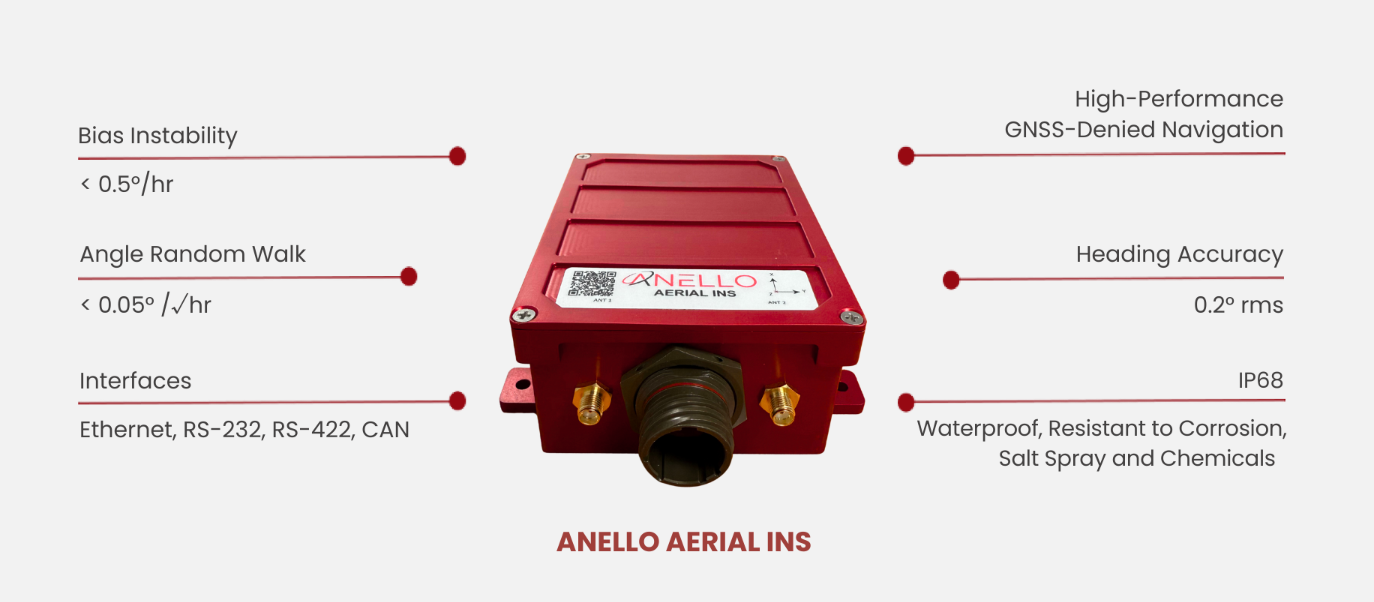
ANELLO Photonics, the creator of the Silicon Photonic Optical Gyroscope (SiPhOG™) and a leader in solid-state, high-precision inertial navigation systems, announces the launch of the ANELLO Aerial INS at CES 2026, a compact, high-performance inertial navigation system built around the company’s Silicon Photonics Optical Gyroscope technology and integrated with multi-band GNSS receivers.

The ANELLO Aerial INS is purpose-built for demanding aerial platforms – including BVLOS UAS, maritime/shipborne VTOL UAS, ISR/special-mission aircraft, heavy-lift and cargo drones and other autonomous aerial vehicles.  The system is powered by an advanced EKF-based sensor fusion engine and ANELLO flight-profile-tuned algorithms, consistently delivering >98% navigation accuracy without the need for cameras or fiber-optic cables.

The ANELLO Aerial INS delivers <0.5 deg/hr unaided heading drift, maintaining accurate navigation and control through high-dynamics and GNSS jamming, spoofing, or occlusion. ANELLO’s navigation solutions deliver assured performance in fully GNSS-denied environments – whether operating over water or desert corridors, in night or low-light missions, or through fog and cloud cover – maintaining precise guidance without GPS and enhancing the warfighter’s effectiveness and survivability.

“Customers flying real missions need resilient navigation when GPS isn’t reliable,” said Dr. Mario Paniccia, co-founder and CEO of ANELLO Photonics. “By combining our SiPhOGs with our airborne-optimized sensor-fusion algorithms and integrated multi-band GNSS, the ANELLO Aerial INS delivers accurate navigation solutions in a cost-effective SWaP-friendly package. This allows UAVs to hold course through GPS jamming, multipath, spoofing or outages using only ANELLO without the need for cameras or fiber-optic cables and allows the warfighter to complete their mission safely and successfully.”

ANELLO’s full product portfolio has been developed in close collaboration with customers and verified through comprehensive integration and mission-platform testing.

Key features of the ANELLO Aerial INS include:

  • High-precision 3-Axis SiPhOG™ optical gyros with < 0.5º/hr unaided heading drift for reliable dead-reckoning during GNSS outages
  • Dual triple-frequency all-constellation GNSS receivers with static heading capability; ready for RTK/PPP corrections
  • ANELLO Advanced Sensor Fusion Engine with GNSS spoofing detection; resilient holdover in GPS-denied or spoofed conditions
  • Flight-stack integration: PX4 and ArduPilot drivers; standard interfaces (Ethernet, RS-232, RS-422, CAN) and timing (PPS Out/PPS Sync In)
  • NMEA-Compliant GNSS Interface outputs NMEA navigation packets for seamless integration as a drop-in replacement for conventional GNSS receivers
  • Flight-Profile Optimization; Algorithms calibrated for BVLOS, ISR, VTOL and other autonomous aerial vehicles for accurate navigation
  • Rugged, Compact and Lightweight; Small footprint, low power consumption, vibration-tolerant design for multirotor, fixed-wing, and VTOL platforms.

“The ANELLO SiPhOG™ technology is a game changer for our warfighters. The ability to navigate in GPS-denied or spoofed environments without cameras or fiber-optic cables – in small, lightweight systems – is essential for future combat missions,” said Dan Magy, CEO at Firestorm. “The ANELLO team has developed an Aerial solution that seamlessly integrates into existing avionics with minimal effort. This type of capability is essential in today’s conflict areas where our adversaries actively disrupt GPS, making ANELLO a powerful upgrade for all modern aerial platforms.”

The launch of the ANELLO Aerial INS reinforces ANELLO’s focus on assured navigationin contested environments. By introducing a purpose-built airborne solution alongside its already proven ground and maritime inertial navigation systems, ANELLO Photonics extends its lead in GPS-denied navigation across land, air, and sea.  ANELLO products have been validated through multiple U.S. DoW operational test events and have been shipping to a vast array of customers.

The ANELLO Aerial INS is available for evaluation today with production shipments beginning Q2/2026. Evaluation kits include the ANELLO Aerial INS, cabling, drivers for PX4/ArduPilot, and a quick-start integration guide

Canada vs. Ireland: How the Tech Space Looks Either Side of the Atlantic

While the technological boom of the 21st century is a global phenomenon, it’s not evenly distributed across the globe. Some countries have much better developed tech scenes than others, and the situation is changing from decade to decade based on multiple factors. It’s not just the large nations that are leading the charge, as there are several medium-sized countries that punch far above their weight in this sector. Canada and Ireland are great examples, as both are home to numerous high-profile tech companies and have lots of native experts to perform crucial jobs.

We will take a closer look at these two countries located on the opposite sides of the Atlantic and compare their achievements in the technology domain. There are some obvious similarities but also many differences to explore, making this pairing very interesting.

Overview of the Canadian Technology Sector

From the earliest days of the IT revolution, Canada was on the forefront of innovation and business development. The population is highly educated and the nation has a well-regulated, business-friendly legal environment that benefits big technology firms. That has translated into a huge financial windfall – today the value of this industry exceeds $100 billion and it provides nearly 1.5 million jobs. Most of this is driven by the big players, including some globally known brands that many people don’t even know are Canadian. The list is headlined by names like Blackberry, Shopify, and Slack, but there are also brands such as Constellation Software Inc., CGI Inc., and many more.

Most of the tech industry is concentrated in large cities, with Ontario in particular being attractive to fast-growing start-ups due to great infrastructure and conscious efforts of the provincial leaders to attract investment. In recent years, the sector was invigorated by robust growth of the iGaming section with numerous Ontario online casino sites achieving international prominence. According to the available data, the growth is likely to continue into the foreseeable future and produce even more benefits for the local communities, although the competition is becoming stiffer. Canada has the foundation in place to remain a leader in the sector, but will have to adjust to new realities and continue supporting innovation and producing top talent to fill the key jobs.

Overview of the Irish Technology Sector

Ireland had a very different trajectory when it comes to the development of the technology sector. Back in the 1980’s when the industry first emerged as a global force, Ireland was still grappling with the complicated legacy of conflict and poverty. Things started changing for the better after the country successfully attracted international companies like Microsoft and Intel with a favourable tax regime, access to the common European market and other benefits. These and other blue chip companies opened their regional offices in Ireland, taking advantage of the tech-friendly legislation and turning the country into a vibrant hub. Smaller companies followed suit, while the influx of tech expertise also lead to development of some local success stories as well.

The industry accelerated in the 2010s, turning Ireland into a real force in the global market. The contributions of the technology sector to the nation’s finances today stand at 13% of the GDP, a much higher figure than in most countries of comparable size. Another incredible fact is that 16 out of 20 biggest tech companies in the world have an operating base in Ireland, with around 100,000 people employed in the sector. Some of the sub-fields with the strongest presence include FinTech and HealthTech, both of which are seen as extremely important in this period. That’s why it’s logical to expect Ireland to retain its unique position despite all the changes in the market.

Key Differences Between Europe and North America

There are certainly many parallels between Canada and Ireland when it comes to technology sector, but it would be naïve to assume that the situation is the same. As a North American country, the fortunes of Canada are closely tied to the United States and its powerful tech sector. It wouldn’t be fair to say that the Canadian tech industry lives in the shadow of the Silicon Valley, but the links are undeniable. Canada’s economy is also more diversified than Ireland’s, so the reliance on revenues from the tech sector is not nearly as dramatic. On the flip side, Canada’s location and climate may deter some of the most talented hardware and software engineers from joining companies based in the country.

Europe has its own set of issues that affect how Ireland conducts its tech business. The European Union consists of many nations, all of which have their local specificities. The regulations regarding fair competition and consumer protection are very strict, forcing tech companies to spend more to ensure compliance. Ireland has built a reputation as one of the most tech-friendly locations in Europe, yet it can’t truly be viewed outside of the broader EU context. It will be very interesting to see how the country navigates the changing political and economic climate and whether it will be able to leverage its experience with foreign corporations into a grassroots tech scene of its own.

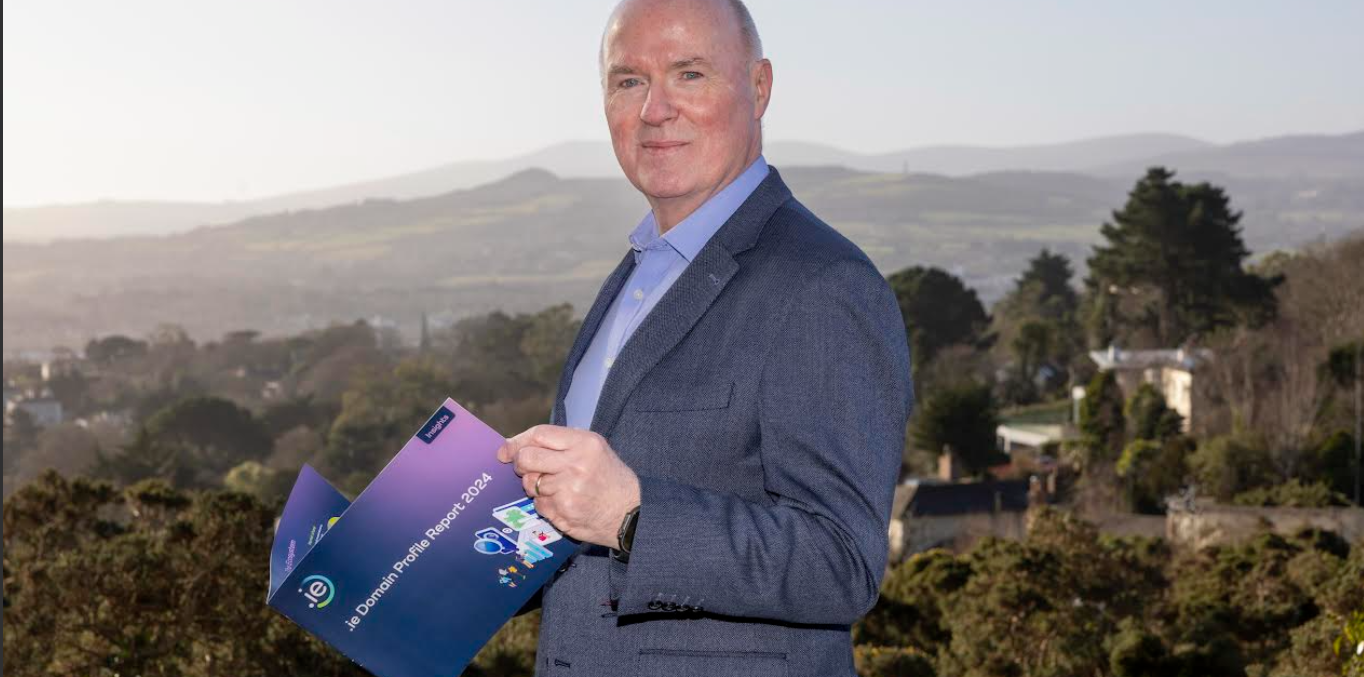
.ie Domain Profile Report 2024 shows appeal of owned websites remains strong

The latest .ie Domain Profile Report 2024, launched today, gives glimpse into future economic activity in Ireland, highlighting the value of a strong online presence in response the rapidly evolving digital landscape.
The report reveals that .ie continues to hold majority share of Ireland’s hosted domains (54.2%) followed by .com (29.43%) and .uk (7.33%) with a 16% increase in the total .ie database over the past five years, despite marginal decrease in total database vs. 2023 (0.5%).
Both nationally and globally, changes in the way consumers engage with eCommerce (for instance via social media platforms) highlights the importance of establishing a stable digital presence via a controlled and secure website.
Now in its tenth year, the report is an annual exploration of the .ie database and is published by .ie, the national registry for .ie domain names. It also highlights the challenges and opportunities faced by internet users, businesses and government within Ireland’s online ecosystem.
Digital Intention vs. Digital Growth
 
.ie’s flagship Digital Readiness Monitor report published last August revealed that one in three (36%) websites in Ireland have a low or very low level of sophistication. A website and the associated technologies it uses, serves as an indicator of how digitally advanced an organisation is. If the website is modern, functional, and user-friendly, it reflects that the overall approach to digital transformation and investment in technology. It is clear from .ie’s Domain Profile Report, and the Digital Readiness Monitor, that there is strong digital intention in Ireland; however websites are under-developed and digital growth is not yet possible.
In last year’s pre-budget submission, .ie called on government to invest in digital skills as an urgent requirement for SMEs and micro-businesses to compete on a global scale. Following the nomination of the current government it is the responsibility of Minister Jack Chambers, Public Expenditure, Infrastructure, Public Services, Reform and Digitalisation, to make grants and programmes more accessible to SMEs to boost export sales through digital marketing and improve productivity through digitalisation.
CEO of .ie David Curtin, emphasizing the importance of driving digital growth has said, ‘Since SMEs account for 99.8% of the number of companies in the Irish economy, supporting their growth and scaling efforts is crucial for a modern future-proofed Ireland.  The .ie Domain Profile Report shows that while there has been a lot of progress made in digital intent in Ireland, there is still a long way to go to convert this to real digital growth. The government must invest more in infrastructure and supports for SMEs to take them onto the next step of digitalisation.’
Overcoming the Digital Divide
The Domain Profile report also emphasises that digital technologies have the “potential to reduce the death of distance” and bridge the gap between rural and urban areas and unlock new opportunities for Irish businesses, regardless of location.  However, the report identifies evidence of an ongoing digital divide based on location, size and sector, in particular for micro-SMEs with fewer than 10 employees.
According to Eurostat, rural areas are falling behind when it comes to digital literacy across the European Union. In Ireland, 35% of people living in rural areas and 37% of people living in Irish towns and suburbs reported having above-basic overall digital skills, while 46.5% of the Irish population living cities reported having these skills.
The digital divide does appear to be lessening in commuter areas such as Kildare, Meath and Limerick where new .ie domain registrations continue to rise, however Connacht and Ulster largely recorded a decline in new registrations in 2024. .ie want to work with government to lessen this divide and ensure businesses can thrive and prosper online regardless of location.
Importance of a Website and Omni-Channel Approach
There has been a notable decline in domain creations on a global scale. CENTR, the association of European country code top-level domain (ccTLD) registries, has highlighted notable shifts in recent years, particularly post-Covid. One potential reason for domain registration decline may be due to a recent surge in social selling – where social media apps such as Facebook, Instagram and TikTok now have eCommerce capabilities on the app.
Reuters reported in December last year that TikTop Shop sales had reached $100million last Black Friday as bargain hunting American consumers spent big online.
While social media presents SMEs with an excellent opportunity to promote products and services, the recent US TikTok ban has revealed just how volatile it can be to use social selling as a business’ sole eCommerce platform.
.ie’s David Curtin advises ‘When it comes to building a credible, trustworthy digital presence, websites should be seen as ‘prime real estate’ for any business online. While social media is an excellent tool for increasing visibility and capturing audience interest, these platforms are limited in their ability to build lasting relationships with customers and, more importantly, convert them to sales. An “omni-channel” approach that offers customers more than one way to engage with business is best – where social media is used as a tool to drive traffic to a secure website. It is crucial that SMEs have control over their own eCommerce channels and are not solely reliant on third party selling platforms such as TikTok Shop which has been proven to be extremely volatile over the past few weeks’
A .ie website also provides reassurance for business owners that their main point of contact with consumers is safe from cyber threats as .ie websites boast significantly lower levels of spam and cyber threats, when compared to other top-level domains like .com.  .ie continuously works to reduce the impact of security threats to the .ie namespace. This includes manually reviewing .ie applications; continuous security scanning the .ie database; and ensuring consumer protection protocols are in line with national regulators and agencies.
Additional Domain Database Findings
 
Leitrim recorded the largest percentage growth (+51%) in new .ie domain registrations compared to 2023, followed by Tyrone (+20%) and Meath (+19%). Fermanagh has the smallest number of total .ie domain registrations in the country as just 191 total domains are registered there.
Keywords used in domain registrations continue to provide insight to public interest as Ireland, Dublin, Home, Design and House were among the top keywords used in registrations last year.
Cork pride appears to be strong as the longest .ie website address at 63 characters is corkcorkcorkcorkcorkcorkcorkcorkcorkcorkcorkcorkcorkcorkcork.ie; and the shortest web address with just 4 characters is 9.ie.
The .ie Domain Profile Report 2024 can be viewed here.
More tech news can be found here

How to write a profile essay

A profile essay can be the most interesting writing assignment. Some college students recognize this. Once you’ve chosen a theme idea, writing it shouldn’t be too difficult. However, if you find it challenging, an essay writing service will do the work for you.

What is a profile essay?

A profile essay is a short work in prose, an essay on a scientific problem in a non-scientific style. For students – independent, creative work. And it is also a separate literary, critical, historical, and prose genre, with the help of which the author:

  • treats a particular topic;
  • creates a free composition;
  • conveys personal impressions and thoughts;
  • argues arguments in a free and often paradoxical manner.

The essay is included in the group of scientific works but stands in this line very apart. A kind of genre, in which you will not say anything. This only makes it more interesting. 

The origin of the word will help to understand the concept. Such a beautiful sound – literally translated from French as an attempt, a test, an essay. And if you dig even deeper into the Latin roots – weighing. The essence is conveyed perfectly. An essay as a kind of “test of the pen” helps to weigh and express thoughts on the topic.

Profile essay structure

The profile essay has a three-component structure – introductory, main and final parts. Nothing new. But let’s focus on the content of these elements.

  • Introduction. It should arouse the reader’s interest, captivate, and demonstrate that further discussion will be about important and necessary. In the introduction, the author formulates the problem and conveys its essence, shows his own emotions, and convinces the reader of the importance of the issue.
  • Main part. The problem is considered from different points of view, including the historical aspect. The author argues, explains, gives examples, analyzes, makes a final judgment, and formulates conclusions. These tasks, as it were, conditionally divide the main part into subparagraphs. Of course, they must follow logically, one after the other.
  • Conclusion. The final part combines all the conclusions into one final thought and helps the reader to come to a logical conclusion of what they have read, comprehend the arguments, form their own judgment – yes or no, and maybe even encourage them to continue the discussion.

Note! If a student writes effectively, it is important to remember such a detail. The purpose of the introduction is to generate interest. The purpose of the main part is to argue. The purpose of the conclusion is to bring to the value and significance of the issue or issue raised and to encourage the author to reflect and rethink.

In fact, the requirements for writing an essay are minimal – open the topic and do not forget to put a title. But this is the main difficulty. Freedom of creativity can take you to the wrong steppe. By the way, the ability to write an essay is a very useful skill in adulthood.

How is a profile essay different from other types of written work?

An essay is a small free-form essay in which the author expresses personal impressions and thoughts on any occasion or issue. The text reveals the writer’s view of only one question (topic, problem) without claims for an exhaustive presentation.

With the help of an essay, the author’s ability to briefly and originally describe his vision of something is assessed. The minimum amount of essay text is 2 pages of printed text, the maximum is 10. The number of pages directly depends on the depth and complexity of the topic and the form of the presentation. An essay can be presented in the form of a letter, a note in a newspaper, a lyrical miniature, an entry in a personal diary, or a review.

Profile essay writing mistakes

The main mistakes in the essay are the vague thought of the author and the fuzzy topic. This refers to a text in which the scope of reasoning is so wide that the logical chain and connection are simply lost. Subjectivism is needed, but not enough to forget about the scientific problem. To avoid these mistakes, refer to an essay writer for help.

The failure rating includes non-uniqueness. Rewriting other people’s thoughts, even in your own words, is not comme il faut. You need to take an individual approach. In this genre, as in nowhere else, it is important to do just that. And do not be afraid, in the essay, there are almost unlimited possibilities for creativity.