Winners Of Top Consumer Tech Innovations Recognized #IFA2025

The inaugural IFA Innovation Awards winners were announced live on the Innovation Stage by Leif Lindner, CEO of IFA Management GmbH, at 14:30 during IFA 2025, the world’s largest event for home and consumer tech. The global awards program, which launched this year, has successfully identified and celebrated standout products shaping the future of consumer technology.

The announcement ceremony marked the culmination of a rigorous evaluation process conducted by an independent panel of international technology journalists and industry experts, who assessed submissions across multiple specialized categories. Over 200 members of the media were invited to attend the announcement.

Winners take center stage at IFA 2025

The winners represent a wide range of global technology leaders and innovative companies. Notable brands recognized in the inaugural program include Samsung, LG, Hisense, Miele, Anker, and TCL, alongside numerous other industry pioneers who are driving breakthrough innovations across consumer technology and home appliances.

‘Today marks a defining moment for recognising innovation in our industry,’ said Leif Lindner, CEO of IFA Management GmbH. ‘The IFA Innovation Awards have spotlighted technologies that are set to transform how we live, work and connect. Seeing these breakthrough products recognised on our Innovation Stage underlines IFA’s continued commitment to championing the innovations that matter most.’

‘The caliber of innovation we’ve seen in this inaugural program has been extraordinary. These winners represent the pinnacle of design excellence, engineering achievement, and market impact. They truly embody the spirit of innovation that has driven IFA for over a century,’ commented Helena Stone, Editor-in-chief at GEEKSPIN and judge at the IFA Innovation Awards.

See the award-winning innovations – live at IFA Next

Following the keynote announcement, attendees can experience many of the winning innovations firsthand at the Innovation Awards Zone at IFA Next, in Hall 25. This unique exhibition experience allows industry professionals, media, and technology enthusiasts to explore the winning innovations.

Recognition across the technology spectrum

The IFA Innovation Awards recognized excellence across multiple categories including Home Appliances, Sustainability & Environment, Next-Gen Technology, AI Innovation, Smart Home Technology, Health & Wellness, Audio Innovation, and many others. Winners were selected based on criteria focusing on engineering and functionality, design and aesthetics, and uniqueness and innovation.

In addition to category-specific recognition, three headline awards were presented:

  • Best of IFA – The most outstanding product overall
  • Best Tech Innovation – The most forward-thinking technological achievement
  • Best Brand – Overall excellence across innovation, impact, and design

Winners of the IFA Innovation Awards gain significant market advantages including official IFA certification, comprehensive media exposure through IFA’s extensive network, and full licensing rights to use the IFA Innovation Awards logo across all marketing materials.

About the IFA Innovation Awards

The IFA Innovation Awards, launched in 2025 in partnership with the Gadgety Awards, celebrate breakthrough design and engineering excellence across the global technology landscape. The program is open to companies of all sizes worldwide, from Fortune 500 corporations to innovative startups, recognizing products that demonstrate exceptional innovation, design excellence, and market impact.

The inaugural IFA Innovation Awards sets a strong foundation for the program’s future, with applications for the 2026 awards expected to open in early 2026.

For more information about the IFA Innovation Awards and complete 2025 winner listings, visit: https://www.ifa-berlin.com/innovation-awards

Nokia 5G solution for next-gen digital railway operations supporting FRMCS

Nokia today announced its new 5G radio solution, designed to deliver high-capacity, high-performance and resilient real-time communications to rail operators worldwide, setting the foundation for the Future Railway Mobile Communication System (FRMCS). As a cornerstone for smarter, safer and more efficient rail networks, the solution supports greater digitalization and automation, driving benefits for passengers, businesses and the environment. The launch features the industry’s first commercial 5G radio for the 1900 MHz (n101) band, along with Nokia’s Core Enterprise Solution for Railways, purpose-built to accelerate the sector’s digital transformation.

In the coming decade, FRMCS will upgrade the current 2G Global System for Mobile Communications – Railway (GSM-R) and become the next-generation global standard designed for all railways. Its 5G-based successor, with built-in security and high reliability, enables enhanced automation, new digital applications, improved passenger services, and secure cross-border communication.

Nokia is a global leader in railway communications with decades of experience in GSM-R deployments across more than 20 countries. The company has been at the forefront of FRMCS development, collaborating with rail operators, governments, industry, and standardization bodies to help shape the standard and enable its global deployment.

“The drive toward digitalization demands the kind of high-speed connectivity and data capabilities that legacy systems simply can’t provide, creating an urgent need for rail operators worldwide to modernize,” said Tommi Uitto, President of Mobile Networks at Nokia. “Our commercial 5G solution, backed by decades of proven rail industry expertise, reflects our commitment to laying the foundation for the next generation of railway operations. We offer a future-proof, flexible technology platform that supports a smooth transition to FRMCS while improving operational efficiency, safety and the overall passenger experience.”

Nokia’s new 5G radio is built for mission-critical communications and supports strategic coexistence, enabling railways to migrate to 5G alongside legacy systems like GSM-R with no disruption. In addition, its fully optimized, cloud-native 5G SA core supports the full suite of FRMCS functionalities for the transport stratum. Modular, flexible and scalable, the solution enables both regional and nationwide deployments. It will also be tested under the EU-funded FP2-MORANE-2 project, which builds on earlier FRMCS initiatives to advance the digitalization of rail operations across Europe.

The shift to a 5G solution introduces powerful capabilities that align perfectly with the operational needs of modern railways, particularly in border crossing scenarios. Here are some of the main benefits for rail operators and passengers:

  • Automated train operations: Enabling real-time control and monitoring of trains to improve safety and efficiency and decreasing energy consumption and emissions.
  • Passenger information systems: Providing real-time updates and information to passengers for a better travel experience.
  • Mission-critical voice communication: Integrating voice, video and data services in a single, standardized platform to enhance operations and infrastructure management.
  • Smart rail maintenance: Utilizing predictive maintenance and real-time monitoring to reduce downtime and maintenance costs.

Nokia is committed to driving the digital transformation of the railway sector through advanced, future-ready technologies. The new solution includes a commercial 5G radio for the 1900 MHz band from its industry-leading AirScale portfolio, paired with its railway-optimized Core Enterprise Solution. It is complemented by the company’s extensive portfolio of mission-critical IP, optical and data center networking products. Nokia’s solutions are also compliant with the highest standards and feature a best-in-class cybersecurity framework.

Multimedia, technical information and related news

Web Page: FRMCS

Web Page: FRMCS 5G RAN

Product Page: AirScale Radio Access

Product Page: Core Enterprise Solution for Railways

Product Page: Rail OT cloud

Product Page: Mission-critical railway backbone network

Next-Gen AI Test Tools: The Role of NLP in Automated Testing

AI test tools are changing the way organizations ensure quality for applications since software is getting too complex. Natural Language Processing (NLP) advancements have made automation testing much easier and friendly, as testers can interact with the automation tools in natural language. 

This innovation simplifies the creation of tests and fosters collaboration among technical and nontechnical stakeholders who discuss issues with the traditional approach of testing, which is often time-consuming and dependent on specific expertise

Cloud testing platforms such as LambdaTest amplify these benefits through robust infrastructure to execute automated tests across a variety of environments. By using AI and NLP, organizations can simplify their testing processes, enhance team collaboration, and deliver high-quality software products faster to respond to changing user requirements.

Overview of Next-Gen AI Test Tools

Next-generation AI test tools are ready to fight the challenges set by modern development teams. They have offered advanced features of using generative AI, self-healing scripts, and predictive analytics. These innovations together work to improve testing processes most efficiently and effectively, allowing organizations to deliver high-quality software faster.

Generative AI is playing a critical role in this evolution by automating such tasks as the generation of test cases, bug prediction, and the creation of test data. Automation increases the efficiency of testing and accuracy but reduces the manual effort of doing those mundane, repetitive tasks. For instance, the creation of scripts on its own by the system means that generative AI can accelerate tests. Thus, development cycles for the tests become shorter. 

Additionally, test coverage increases with generative AI since varied scenarios are produced, including those edge cases that would have gone undetected without this method. Generative AI reduces manual testing efforts, reducing hidden problems and human error, thereby enhancing cost efficiency in large-scale projects.

Another promising feature of the next-gen AI test tools is self-healing scripts that complement generative AI. Scripts can automatically adapt to changes made in the application under test with no manual interference. This helps minimize maintenance effort; tests remain updated with applications due to self-healing capabilities and dynamic adapting over time to keep the integrity of the testing process intact.

More importantly, predictive analytics revamps the whole testing approach by utilizing historical data to predict potential defects or performance failures in advance. Analytical tools for predictive analytics tools work out the trend in previous test results and point out the potential high-risk areas in the code base. This helps concentrate efforts where they are to be used effectively, making maximum usage of resources available and also improving the quality output.

Open-Source Next-Gen AI Test Tools and Frameworks

Here are some of the well-known open-source next-gen AI test tools to make your software testing processes much better:


  • Selenium

One of the widely used open-source testing frameworks is Selenium. This supports multiple programming languages and browsers. It’s very versatile, and one can run and execute tests with maximum flexibility, hence making it very popular among developers.


  • Robot Framework

This is an open-source automation framework that is keyword-driven and made easy for non-technical users. It supports web and desktop automation using different libraries and tools.


  • Appium

This is an open-source tool used in mobile applications to automate. It supports both native and hybrid apps across iOS and Android platforms and allows the writer to write tests in the preferred programming language.


  • Cypress

This open-source testing platform is known to have a very developer-friendly interface and runs the tests directly inside the browser. Debugging can be done relatively easily, especially in modern web applications.


  • iHarmony

An AI-powered, open-source tool meant to optimize automated testing for mobile and web applications. The test cases it generates are by the application of Machine Learning (ML) algorithms.


  • TestNG

Open-source testing framework derived from JUnit, with a set of functionalities that makes TestNG more powerful and easier to use, like annotations, flexible test configuration, and parallel test execution.


  • Watir

An open-source tool that uses Ruby for automation testing. Watir mimics the way a user works with a browser and has been pretty reliable in functional testing.


  • Cucumber

It is a tool that supports Behavior Driven Development (BDD) and lets users author tests in plain language using Gherkin syntax. This helps include non-technical stakeholders better in understanding test cases.


  • Jest

This is a testing framework mainly used for JavaScript applications. Jest is an open-source testing framework that lets users write unit tests with simple assertions and mocking capabilities.

Understanding NLP in Automated Testing

NLP refers to the ability of machines to understand and interpret human language. This has dramatically transformed software testing practices. The availability of NLP in automated testing allows for the creation and maintenance of tests without deep code so that nontechnical people, like analysts and product managers, can participate directly in the process. They will not need an extensive programming base to be able to contribute to the testing procedure. 

NLP can help automatically derive structured test cases from user stories and functional specifications to ensure that their application requirements indeed reflect. Other than that, NLP tools can update dynamically the test case as the change in requirements and ensure that their relevance and efficiency are maintained; this streamlines the testing, improves collaboration among the team members, enhances coverage of tests, and provides much more reliable results. Organizations can better meet user needs and deliver high-quality software products more efficiently.

Key Features of NLP in Test Automation

NLP is revolutionizing test automation by bringing features that make it more user-friendly and efficient. NLP allows testers to use natural language, which makes the testing process easier and promotes team collaboration. Here are some key features that describe the impact of NLP in test automation:


  • Simplified Test Creation

The feature of NLP allows the test team to devise test cases easily in simple language. Thus it means that whether technical or non-technical teams can understand, collaboration and the creation of tests can be handled. This again simplifies everything and gives diversification toward varied views on testing the application.


  • Maintaining Dynamic Test

NLP tools can automatically update tests with the changes in application requirements so that tests remain relevant and effective. This dynamic maintenance reduces the effort of keeping tests in line with the current state of the application, saving development teams time and resources.


  • Improved Test Coverage

NLP-driven tests cover a broad range of scenarios by emulating real interactions with users, which includes edge cases that might be able to be overlooked by traditional testing. It allows potentially problematic features to be found early and ensures robustness and reliability in the applications under a variety of conditions.

Benefits of Using NLP in Automated Testing

Using NLP in automated testing has several benefits that make the quality and efficiency of the testing process better:


  • Increased Accessibility

NLP makes it possible for nontechnical team members to be involved in test development using natural language. This is inclusive and creates a collaborative approach between departments, which leads to better testing strategies reflective of the real world.


  • Rapid Testing Cycles

NLP tools facilitate automated updates and provide real-time feedback on test results, which enables faster iterations. This efficiency reduces time-to-market, thus enabling organizations to respond quickly to user feedback and changing market demands.


  • Accuracy

By minimizing human errors through automated testing, NLP provides test results that are reliable and repeatable. Due to high accuracy, the quality of developed software is improved so that stakeholders and end-users have confidence in the produced software.

The Role of Cloud in Automated Testing with NLP Integration

Cloud-based testing can support modern-day software development, wherein it is very possible to let the organization carry out tests using numerous devices from many browsers using little infrastructure; hence, flexibility allows applications to execute well in changed environments and settings. Cloud provides the teams using cloud resources to effectively simulate different kinds of testing cases

Furthermore, NLP embedded into cloud-based testing enables testers to work with test case creation and even test case maintenance in natural languages. This is much easier to develop than with the traditional black box approach. 

Collaboration among teammates, regardless of technical background, promotes development and quickly adapts to all changes in application while still carrying full test coverage, ultimately leading to improved quality and faster times-to-market.

Linking NLP with Cloud Testing

The integration of NLP with cloud testing enhances the process by allowing rapid execution of NLP-driven tests across multiple configurations, saving time, and ensuring proper coverage of various user scenarios.

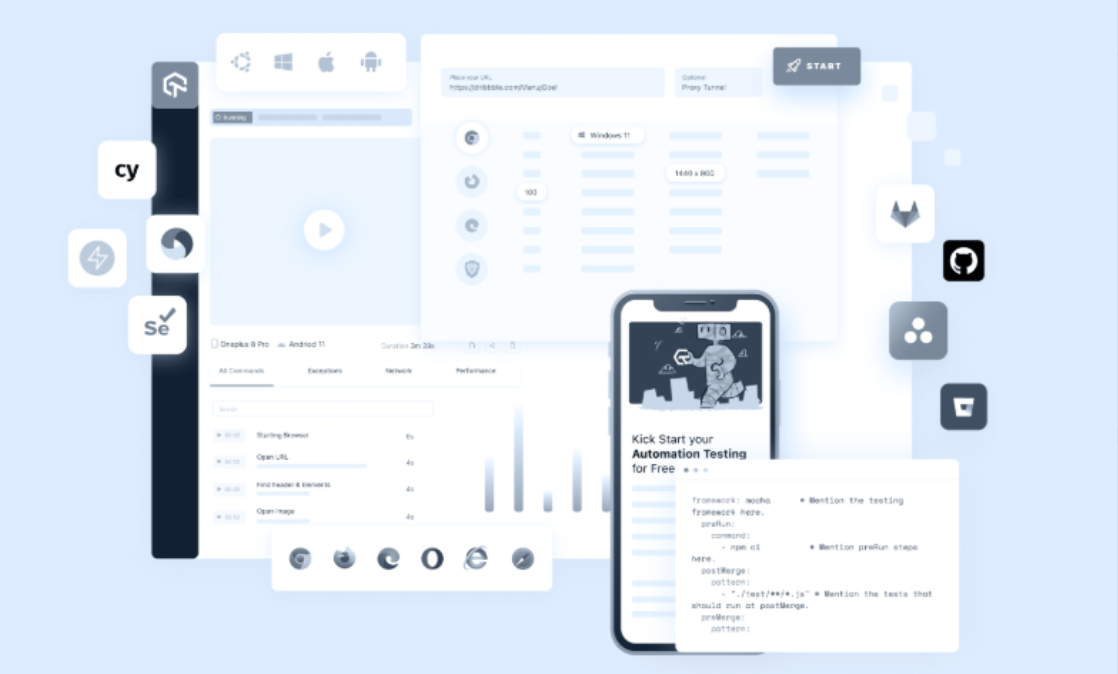
A powerful platform for automated testing is LambdaTest; it streamlines the testing process for developers and testers alike by providing a reliable infrastructure for running automation tests using frameworks such as Selenium, Cypress, and Appium. 

Such features that LambdaTest offers include blazing-fast automation for faster release cycles across 3000+ desktop and mobile environments, auto-healing in finding flaky tests without any human intervention, and robust security compliance through the SOC2 Type2 certification and GDPR adherence. 

Hence, it makes this organization reliable for delivering results with quality standards while improving testing efficiency significantly by leveraging NLP-driven automation tools in combination with LambdaTest. 

This synergy makes it possible for teams to design powerful, low-maintenance, and highly adaptive automated tests. The users can put forward the test scenario in plain language and will immediately receive real-time feedback regarding their test results.

Moreover, these platforms assure cross-browser compatibility. So, having a blend of AI QA tools like LambdaTest with NLP power makes the organization versatile and robust in its testing procedures to provide better software products quickly. 

The Future of AI Testing Tools

As we look ahead, the landscape of AI testing tools will continue evolving. Here are some trends that are shaping the future:


  • Increased Adoption of AI-Powered Tools

As organizations increasingly rely upon AI tools enhancing automation, hence use AI-powered ML algorithms in designing test cases, which can upgrade old test cases plus optimize their suit.


  • Enhanced Collaboration through Codeless Testing

A codeless solution is preferred with codeless testing, as this saves the hassle that a nono-coder must follow to prepare tests. Additionally, it improves efficiency as well as nontechnical collaborations for team members working on these two streams of professions.


  • Integration with Continuous Integration and Continuous Delivery or Deployment (CI/CD) Pipelines

AI solutions will be able to identify trends of test failure and, hence, optimize future test runs by focusing on the most failed areas. These tools based on data trend analysis in NLP models further suggest efficient paths without redundant cases during testing.


  • Smart Error Detection and Test Optimization

AI solutions will be able to identify trends of test failure and optimize future test runs by focusing on the most failed areas. These tools based on data trend analysis in NLP models further suggest efficient paths without redundant cases during testing.


  • Focus on User Experience (UX) Testing

Next-generation AI test tools will keep enhancing UX, a factor essential for software success. These test tools will simulate real user interactions for better testing phases. This trend will identify usability issues early in the development process of organizations.


  • Continuous Learning Capabilities

The future AI testing tools will include continuous learning, which will imply that it will change its tactics after knowing the previous results. These systems will learn from past mistakes and successes to improve future testing strategies automatically.

Conclusion

To conclude, NLP is changing the face of automation testing; it reduces the complex method of test creation and maintenance and allows teams to stay ahead of the growing complexity of software applications. 

With this, AI testing tools and methods such as NLP play a vital role in enhancing collaboration and efficiency for competing organizations. LambdaTest helps teams improve the quality of the product, the satisfaction of the users, and overall organizational success through rapid adaptation to change. Quicker release cycles and better-quality products enable the effective meeting of the changing expectations of the users.

Creative announces the latest Next-Gen audio profile with Super X-Fi Gen4

Building on the foundation of its award-winning Super X-Fi Headphone Holography, Creative Technology will be unveiling the all-new Super X-Fi Gen4 audio profile. This latest release boasts significant enhancements in dynamic range, clarity, and spatial awareness. The Super X-Fi Gen4 isn’t just raising the bar; it’s redefining the standard for immersive audio experiences. With this latest update, users can enjoy an expanded dynamic range, delivering richer, more detailed audio reproduction. Coupled with improved clarity, users can indulge in crystal-clear sound that captures every subtle nuance, while the refined sense of space offers a more expansive and lifelike soundstage.

Super X-Fi technology elevates the audio experience for users by recreating the immersive soundstage of high-end surround speaker systems within headphones, further personalized  by the power of Artificial Intelligence (AI) for a remarkably natural listening experience. Since its debut at CES 2019, users and critics have been impressed by the realism of personalized audio, which is tailored according to their anthropometric profiles. From immersing in the heart-pounding action of a blockbuster movie to feeling the raw energy of a live concert or delving into the captivating world of gaming, Super X-Fi can bring it all to life with breath-taking detail and precision.

Super X-Fi For Speakers

Originally engineered for headphones, Super X-Fi has elevated personal audio to new heights with its personalized spatial holographic experience. Now, this innovative technology is poised to transform the home entertainment landscape by bringing the same revolutionary experience to speaker systems. The debut of Super X-Fi for speakers brings a new dimension to home entertainment, effortlessly turning any living space into a vibrant concert hall or theatre. With every note, beat, and sound resonating with captivating realism and depth, users can expect an immersive listening journey, mirroring the satisfaction long enjoyed by Super X-Fi headphone users.

Super X-Fi Gen4 will be rolled out worldwide in June, with users simply needing to configure and download their new profiles through the SXFI APP.

Expanding Super X-Fi Ecosystem

Soon, Creative Technology will unveil the integration of Super X-Fi technology across its upcoming product line-up, spanning from True Wireless Stereo (TWS) earbuds to premium headphones and speakers. This expansion will enable users to seamlessly tap into the world of Super X-Fi across their preferred streaming platforms like Netflix, YouTube, and Spotify, even on compact earbuds and speakers—a pioneering feat for Super X-Fi technology.

“Our user community has played a pivotal role in shaping the evolution of Super X-Fi, providing valuable insights and data that have refined our AI engine. With Super X-Fi Gen4, we’re advancing further, delivering an even more immersive listening experience that breaks free from the limitations of flat and lacklustre audio. Moreover, we are also thrilled to announce the upcoming integration of Super X-Fi technology across our product line-up, offering users seamless access to spatial audio no matter where they are,” said Lee Teck Chee, Chief Technology Officer at Creative and inventor of Super X-Fi.

For more information on Super X-Fi technology and products, visit sxfi.com.