Mater Hospital Launches Ireland’s first AI Centre in a Clinical Setting to Transform Patient Care

The Mater Misericordiae University Hospital (MMUH) has become the first hospital in Ireland to establish a Centre for AI and Digital Health. The new hub, which will be based at the Pillar Centre for Transformative Healthcare, will utilise artificial intelligence (AI) to solve clinical problems across the hospital and, through research, develop AI-driven solutions to improve patient care and outcomes.

The Mater Hospital’s Centre for AI and Digital Health has been brought about through the collaboration of consultants, researchers and hospital leadership, and will make a tangible difference in patient care. From reducing emergency department waiting times, to assisting in diagnostics and automating time-consuming tasks, the Centre will place the Mater Hospital at the forefront of AI-driven healthcare innovation in Ireland.

“AI has the power to transform how we deliver healthcare,” said Erin Daly, Operations Manager for the Pillar Centre for Transformative Healthcare. “At the Mater Hospital, we are developing AI solutions that directly improve clinical processes, whether it’s streamlining workflows, assisting in medical research, or helping doctors make faster, data-driven decisions.”

The Mater Hospital’s new hub for AI-driven medical advancements is overseeing the adoption of AI and engaging in research across multiple medical specialties, including radiology, oncology, cardiology, and ophthalmology.

“This centre offers a unique opportunity to bring together clinical and technical expertise to adopt and innovate with AI in Irish healthcare,” says Paul Banahan, Senior AI Research Fellow at the Mater Hospital.

Among some of its pioneering research projects are:

  • AI-driven automation which will help to identify suitable patients for clinical trials in oncology. This will significantly reduce the 16 hours per week it currently takes a nurse to manually scan these lists, speeding up patient access to clinical trials.

  • The reduction in the number of cardiac fluoroscopy video x-ray images, and subsequently the radiation exposure to both the patients and clinical staff, through real-time AI generated images.

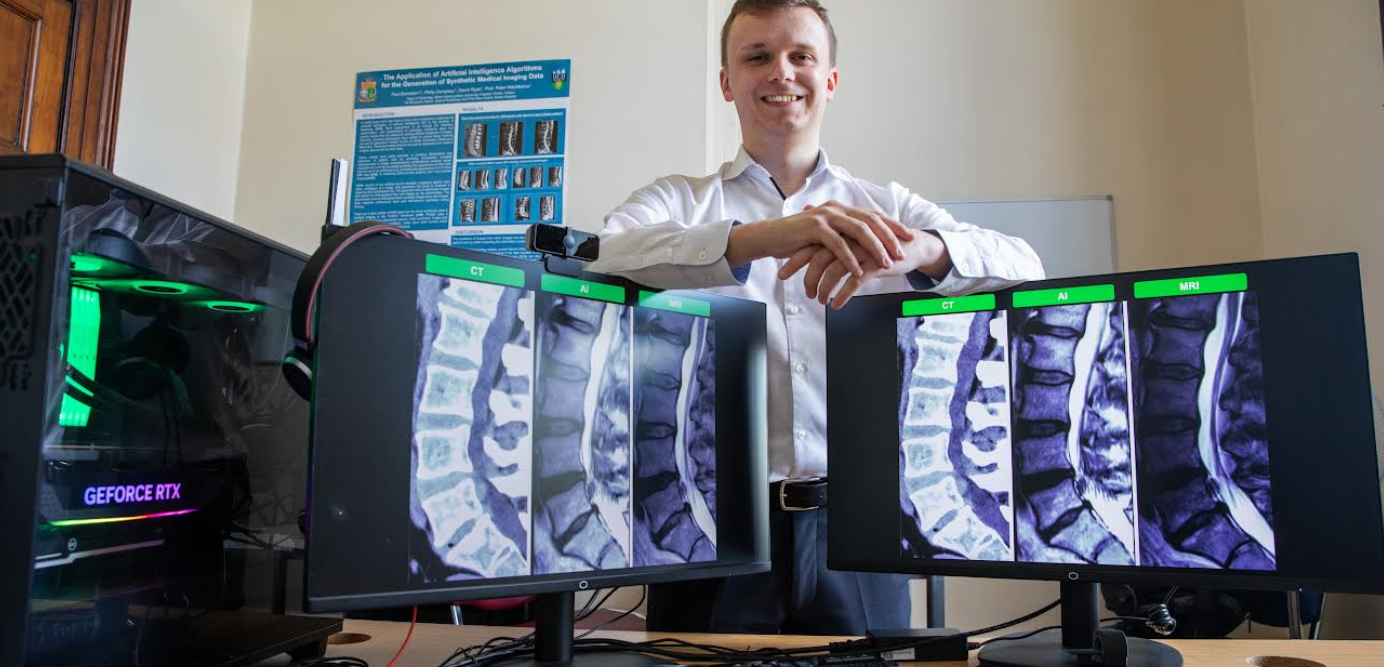
  • The synthetic spinal imaging project, which has developed a generative AI that can convert lumbar spine CT images into synthetic MRI images for Cauda Equina Syndrome presentations, allowing for better and more robust out-of-hour or emergency care planning and treatment.

Speaking on the potential applications of AI in cardiology, Prof. Joe Galvin, Consultant Cardiologist at the Mater Hospital said, “AI has the potential to enhance the accuracy of ECG and radiology scan analysis, reducing the time that a patient has to wait for the results of their diagnosis and, if required, starting their treatment sooner.  If a patient suffers from cardiovascular disease, stroke or cardiac arrest, every minute counts. AI’s ability to increase accuracy and speed may be life-saving.”

While AI promises significant benefits, the Centre is equally focused on its responsible and ethical implementation. Robust data protection and management frameworks are being developed to ensure patient safety and privacy, as well compliance with best practices.

“AI in healthcare must be implemented with care, accountability, and a clear focus on improving patient outcomes,” said Josephine Ryan Leacy, CEO of the Mater Hospital. “The Mater Hospital’s Centre for AI and Digital Health is focused on ensuring that AI is developed and deployed in a way that prioritises patient safety, transparency and real clinical benefits.”

The Centre’s work is already proving invaluable, with AI solutions contributing to the reduction of emergency department waiting times and optimising hospital workflows. In the Mater’s Radiology department, AI is assisting in the rapid notification of suspected pathologies, like stroke and fractures, which are being correctly flagged by AI within 2-3 minutes of the scan being completed, with an accuracy rate of over 90%. Mater Hospital Consultant Radiologist Prof. Peter MacMahon said, “Our experiences have underscored the tangible benefits of AI, notably in expediting critical diagnoses and reducing turnaround times by rapidly flagging anomalies detected in scans.”

“Bringing AI into clinical practice is not just about innovation, it’s about making healthcare more efficient, effective, and accessible,” said Prof Brendan Kinsley, Clinical Director of the Pillar Centre for Transformative Healthcare. “The Mater Hospital’s Centre for AI and Digital Health is laying the groundwork for a smarter, more responsive healthcare system, and I am incredibly proud to see this vision come to life.”

For more information visit the Centre for AI and Digital Health website here.

New Technologies That Can Help Improve The Life Expectancy Of The Irish

The downsides of the modern way of life are threatening the health of nations across the world. In Ireland alone, over 10,000 people died last year from cardiovascular-related diseases, and the most common cause of death was unpredictable strokes and heart failure. 

However, there are promising signs of improvement with the help of technological advances that can increase the life expectancy of the nation. Keep on reading as we’ll discuss some of the new technologies on the way.

This table by this comparison website reveals that the Irish life expectancy past 65 is significantly lacking behind other countries. Of course, like with every new technology, these revolutionary approaches are often not available to everyone. The availability is rather due to scarce medical supplies than to a lack of sufficient funds. Scientists are working on commercializing these new technologies, reducing the costs of production, and improving the chance for everyone to use them. If the new approaches and discoveries are successful, chances are these technologies will be more available to many. Until then, many hospitals still have to make selective decisions on which patients are a priority to receive treatment.

MRI and CT scans 

New improvements have been made in the field of CT and MRI scans. The new advancements are estimated to ease the diagnoses and discovery of hidden tumours and underlying issues. The standard scans came with flaws and establishing a correct diagnosis has been known to be an issue. Thankfully, the new advancements may allow for more precise and more accurate diagnoses, and with the early discovery of tumours and cancer cells, the treatments and their effectiveness will be increased. 

Biopharmaceuticals 

The number of prevalent diseases has risen over the years, despite the many advancements made, as simultaneously the number of factors contributing to the spreading of diseases has risen as well. 

As the statistics suggested, in Ireland alone, over 40,000 people are fighting these diseases each year. The biopharmaceutical industry has had an astonishing rise in the last decade. The technology behind it allows for more effective treatment of metabolic diseases and even cancer. These technologies rely on living cells, modified through cutting-edge methods. The range of diseases treatable with the technology is astonishingly broad. The modified organisms or cells are used in the treatment of cancerous cells, allergies, inflammatory tissue, and gene therapies. The treatment is specifically meant for rare disorders, but also represents an effective method of fighting cancer. 

Control and management 

We have so far listed the most common health concerns and issues such as cardiovascular problems, strokes, tumours, and genetic disorders. However, another common problem has become diabetes, which approximately 6% of the population of Ireland deal with. Thankfully, with sensors and insulin checkers, regulating your sugar levels has never been easier and more effective. 

Better control over the issues allows for a more effective treatment. And trackers and sensors are also available for other issues: respiratory monitoring, cardiac monitoring, and health monitoring of the body during invasive treatments, like chemo. Wearables now can allow people to track the pulse and overall condition of their body. 

The control and management of such serious conditions, and even the regular control of healthy individuals, will drastically reduce death outcomes and allow longer life and more productive ones. 

These bright numbers suggest a better future for the vast portion of the population. Over 200,000 individuals in Ireland have been successful in treating cancer and surviving after several sessions of chemo and radiation. Surviving a stroke or heart attack has become standard with checkers monitoring cardiac disease and with bypass operations having an almost 100% success rate. The future looks optimistic, and we can only hope the best is yet to come.