A Comprehensive Guide On Tech Used In Modern Recording Studios

When it comes to music production, the evolution of technology has transformed recording studios into sophisticated hubs where creativity and precision intersect. Today’s recording studios are a far cry from the humble beginnings of analogue equipment and tape machines. From digital audio workstations (DAWs) to cutting-edge soundproofing materials, technology has reshaped the way music is created, mixed, and mastered. This guide will explore the various tech used in modern recording studios, highlighting key tools and how they contribute to the music production process.


  1. Digital Audio Workstations (DAWs)


At the very core of every modern recording studio lies the DAW. DAWs are software platforms that allow musicians, producers, and sound engineers to record, edit, mix, and produce audio files. They serve as the digital equivalent of a traditional mixing console, with added benefits of flexibility, precision, and automation.


Popular DAWs such as Ableton Live, Pro Tools, Logic Pro, and Cubase are staples in professional studios like thelockup.ie. These platforms offer a wide array of features, including multi-track recording, MIDI functionality, advanced editing tools, virtual instruments, and effects plugins. DAWs can be paired with powerful audio interfaces and control surfaces to enhance the user experience, allowing for seamless integration with both hardware and software.


  1. Audio Interfaces and Preamps


An essential component of any studio setup is the audio interface, which acts as a bridge between the analogue world of microphones and instruments and the digital realm of your DAW. Audio interfaces convert sound signals into a format that a computer can process, typically through USB, 

Thunderbolt, or PCI connections.


Many audio interfaces come equipped with built-in preamps, which amplify weak audio signals (such as those from microphones) to a level suitable for recording. The quality of the preamp is crucial, as it directly influences the warmth and clarity of the recorded sound. The choice of audio interface and preamp can significantly impact the overall sound of a project. High-end preamps, such as those made by Universal Audio or Avalon, are prized for their transparent sound and ability to add character to recordings.


  1. Microphones


Microphones are the primary tools used to capture sound, and their selection depends on the type of sound being recorded. The most commonly used types of microphones in recording studios are dynamic and condenser microphones.


  • Dynamic Microphones: These are typically used for live sound and louder instruments such as electric guitars and drums. They are known for their durability and ability to take in extreme sound pressure levels. 


  • Condenser Microphones: Condenser mics are prized for their sensitivity and wide frequency response, making them ideal for recording vocals, acoustic guitars, and delicate instruments. They are powered by a phantom power supply, which provides the necessary charge to their internal circuitry. The Neumann U87 is an industry-standard condenser microphone, often used for both vocals and instrumental recordings due to its crisp and accurate sound.


The choice of microphone can have a massive impact on the tonal quality of a recording, with each type offering its own strengths and limitations. Many studios will have a selection of microphones on hand, allowing producers to choose the best option for each recording session.


  1. Studio Monitors and Headphones


Accurate monitoring is a vital aspect of music production, and for this, studio monitors and headphones are indispensable tools. Studio monitors are designed to provide a flat, neutral sound so that the producer or engineer can hear the recording as it truly sounds, without colouration or distortion. This ensures that mix decisions are based on accurate representation of the audio.

Some of the most respected studio monitors include the Genelec 8000 Series, Yamaha HS Series, and Adam Audio A7X. These monitors are known for their clarity, precise frequency response, and ability to reveal subtle details in a mix.


On the other hand, headphones such as the Beyerdynamic DT 770 Pro or Sennheiser HD 600 are used for more detailed listening during tracking, mixing, and mastering. They offer isolation from the surrounding environment, allowing engineers to make decisions without distractions.


  1. MIDI Controllers and Virtual Instruments


In the modern studio, MIDI controllers have replaced many traditional instruments, allowing producers to control virtual instruments and software synthesizers. MIDI (Musical Instrument Digital Interface) is a protocol that enables electronic devices to communicate with each other, transmitting data about pitch, velocity, and other performance aspects.


MIDI controllers come in various forms, from simple keyboard controllers to more complex devices with faders, knobs, and pads. By using MIDI controllers, producers can access a vast library of virtual instruments, ranging from synthesizers and drum machines to orchestral sounds and sampled instruments. 


  1. Mixing Consoles and Control Surfaces


While DAWs have largely replaced traditional mixing consoles in many studios, larger professional studios used by producers such DJ Benen Tierney still rely on analogue or digital mixing consoles for certain aspects of the production process. These consoles are used to route audio signals, adjust levels, and apply effects in real-time.


However, with the rise of digital technologies, many studios now use control surfaces — hardware interfaces that provide tactile control over the DAW. Control surfaces, such as the Avid S6 or SSL AWS, offer faders, knobs, and buttons that mimic the layout of a traditional mixing desk, giving producers and engineers greater control and precision when mixing and automating.


  1. Signal Processors and Effects


To shape the sound of individual tracks or the overall mix, signal processors and effects units are indispensable tools. These can be hardware-based (outboard gear) or software-based (plugins within the DAW).


Equalisers (EQ) allow producers to adjust the balance of different frequencies, compressors control the dynamics of a track, and reverb adds spatial depth to recordings. Classic pieces of hardware like the Universal Audio 1176 Compressor or the Lexicon PCM96 Reverb are often sought after for their character and warmth. However, with the advent of high-quality plugins, many producers now use software versions of these processors, such as the Waves or FabFilter plugins, which offer unparalleled flexibility and ease of use.


  1. Acoustic Treatment and Soundproofing


The environment in which a recording is made plays a significant role in the quality of the final product. In professional studios, acoustic treatment is used to control sound reflections, minimise reverberation, and eliminate unwanted noise. This may include the use of bass traps, diffusers, and absorptive panels to optimise the room’s acoustic properties.


Soundproofing is another essential element, ensuring that external noise doesn’t interfere with recording sessions. This is typically achieved by adding mass to walls, using soundproof doors and windows, and employing isolation booths for vocal or instrument recordings.


Final Word


The recording studio has come a long way from its analogue roots, and the array of technology used today enables artists and producers to push the boundaries of creativity. From DAWs and microphones to MIDI controllers and signal processors, each piece of technology plays a vital role in the recording process. As advancements continue to shape the industry, the tools available to modern producers and musicians will only become more sophisticated, allowing them to create ever more innovative and polished music.

JBL Unveils Exciting Innovations at #CES2024 JBL Live TWS 3 Series, Enhanced Portable Speakers, PartyBox Lineup, and Quantum Microphones

JBL has unveiled the new JBL Live TWS 3 Series of true wireless earphones at CES 2024 including the Live Buds 3, Live Beam 3 and Live Flex 3, all featuring the brand’s game changing Smart Charging Case with LED touch display as well as upgraded audio performance and connectivity.

JBL has also launched refreshed models of its award-winning range of portable speakers: the Xtreme 4, Clip 5 and Go 4. All the new products boast supercharged audio as well as upgraded design, new colourways and impressive portable playtime.

The audio leader is also showcasing new PartyBox speakers and a refreshed Quantum microphone lineup for content creators.


JBL Live TWS 3 Series


  • The JBL Live TWS Series, including Buds, Beam and Flex designs, features the game changing Smart Charging Case found in the JBL Tour Pro 2.
  • Taking the user experience beyond audio, the 1.45″ inch LED touch display provides listeners full control of almost all features and functions in real time.
  • Equipped with Hi-Res Audio Wirelessly and JBL Signature Sound, the newest true wireless lineup also features Bluetooth 5.3 with LE so users can enjoy stable multipoint connections.
  • Battery life is improved too, with the JBL Live Buds 3 carrying up to 40 hours of portable playtime, up to 48 hours with the JBL Live Beam 3 and up to 50 hours with the JBL Live Flex 3.
  • Available in four new colourways, Purple, Blue, Silver and Black, the JBL Live TWS 3 lineup offers users both style and durability with an IP55 waterproof rating.
  • Prices: £179.99/€199.99 from mid-June 2024.

JBL Xtreme 4, Clip 5 & Go 4

Introducing AuracastTM to JBL portables for the first time unlocks unlimited connectivity options for stereo or multi-speaker pairing across different speakers.

JBL Xtreme 4 and JBL Clip 5 now incorporate post-consumer recycled (PCR) materials for 70% of the plastic, and 80% PCR materials are used for the plastic in the JBL Go 4. All speakers use 100% PCR fabric for the speaker grille.

All three of the new speakers feature Bluetooth v5.3 with LE audio capabilities, IP67 waterproof and dustproof rating. All are available from mid-March.

 JBL Xtreme 4 – £329.99/€349.99 

  • Now enhanced with AI Sound Boost which analyses audio in real time with an AI algorithm to optimise the acoustic output level.
  • Two woofers, two powerful drivers and dual-pumping JBL Bass Radiators effortlessly deliver dynamic, immersive sound with deeper bass and plenty of detail.
  • Up to 24 hours of playtime and a power bank to charge your phone on the go. The battery is replaceable, to extend the lifespan of the speaker.

JBL Clip 5 – £59.99/€69.99

  • Redesigned carabiner has a bigger and more accessible opening, making it easier to clip on.
  • The stylish travel accessory continues to bring the sound with an increase in driver power that allows for more streamlined sound and consistent bass at every volume.
  • Up to 12 hours of playtime – the perfect travel companion.

JBL Go 4 – £39.99/€49.99

  • Boasts a more robust sound and punchier bass than its predecessor.
  • Features updated silhouette and wider and more durable strap, making it more hand-friendly.
  • Up to 7 hours of playtime and available in six colourways.

JBL PartyBox Category 2024

  • JBL PartyBox Club 120 – £349.99/€399.99

o    Powerful sound, and deeper bass, along with a dynamic light show all synced with your music.

o    Up to 12 hours of playtime and an easy-to-swap replaceable battery

o    Two mic inputs and one guitar input and is compatible with the JBL PartyBox App.

  • JBL PartyBox Stage 320 – £549.99/€599.99

o    With two high-sensitivity woofers and dual tweeters, users can listen to all the details of their favourite tracks, even at the loudest volumes.

o    Easily transported with telescopic handle and wide, sturdy wheels.

o    Up to 18 hours of playtime and an easy-to-swap-out replaceable battery, and FastCharge, a 10-minute charge boost that delivers 2 hours of playtime.

  • JBL PartyBox Wireless Mic –  £119.99/€129.99

o    Easy-to-use and compatible with all JBL PartyBox speakers.

o    Comes in a plug-and-play two-mic pack guaranteed to deliver clear voice and crisp sound.

o    Easy-to-use, plug-and-play, the new Mic comes with up to 20 hours of playtime and a rechargeable battery that can be charged while using.

  • All three products will be available to purchase from April 2024.

JBL Quantum Stream Microphones

  • JBL Quantum Stream Talk – £39.99/€49.99

o    Features built-in JBL QuantumENGINE PC software allowing users to adjust the microphone’s EQ.

o    Background noise-free recordings through a shock-absorbing base and a super cardioid pickup pattern.

  • JBL Quantum Stream Wireless – £79.99/€99.99

o    Versatile and wearable with an omnidirectional pattern that picks up high quality sound from every direction.

o    A dongle for automatic connectivity and lightweight, clip-on design delivers easy portability.

o    Environmental noise cancelling ensures recordings are captured without interruption from surrounding sound sources.

  • JBL Quantum Stream Studio – £129.99/€149.99

o    Levels up any recording to professional quality with its specially designed three condenser microphones and 192 kHz/24 bit broadcast quality sampling rate.

o    Optimal sound capture is also supported by the mic’s universal mounting solution, which allows users to mount the mic to their preference.

o    The JBL Quantum Stream Studio’s dynamic range compressor stops loud noises from getting distorted in recordings, calls or streams, and it amplifies quiet sound for a more enjoyable recording.

One For The Money, Two For The Show, Three (or Four) Iconic Microphones Used By Elvis

The new Baz Luhrmann film, “Elvis,” brings the story of Elvis Presley to the big screen. Warner Brothers was committed to ensuring as much historical accuracy as possible, and asked Shure to consult on the microphone models Elvis used. The Company was provided photos of Elvis performing, then identified the vintage mics, and offered suggestions on alternative models when appropriate. For decades, Shure has assisted film production companies in identifying and locating historically accurate microphones.

While there are a variety of Shure microphones used in the movie, here are three (or four) different types of Shure microphones Elvis used throughout his career:

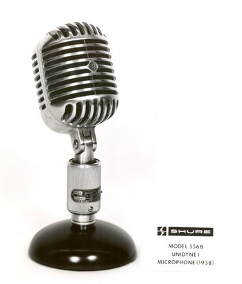
The Shure Unidyne I Model 556 – This variation of the Unidyne I is one of the more recognisable microphones that Elvis used in the prime of his career. According to the 1947 Shure Product Data Sheet, “The Model 556 is a Super-Cardioid type unidirectional moving-coil dynamic microphone providing wide-range high-quality reproduction of sound.

The true unidirectional characteristic of the ’Unidyne‘, obtained by the ’Uniphase‘ principle provides highly satisfactory operation under adverse acoustic conditions where a conventional microphone would be practically useless.

The microphone has a New Acousto-Mechanical circuit containing a moving-coil element, which operating in conjunction with a high flux magnet, provides high efficiency and smooth peak-free response from 40 to 15,000 cycles. The rear response is down approximately 15 decibels (dB) due to the ’uniphase‘ unidirectional acoustic network.

The new moving-coil unit comes with a double windscreen to ensure quiet outdoor operation. As a precaution against mechanical vibration pickup, the unit is spring-suspended inside the microphone case, which is, in turn, floated in live rubber in the stand connector.

The case is modern in design, with attractive streamlining and grille treatment. The swivel allows the microphone to be aimed at the source of sound for best pickup.”

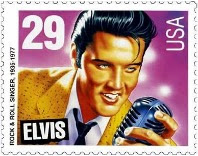
Shure’s iconic Unidyne microphone was featured on the special edition “Elvis” stamps issued in 1993.

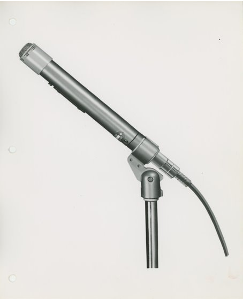
The Shure Model 525 omnidirectional moving coil dynamic – The 1954 Product Data Sheet describes this microphone as “a slender, moving-coil dynamic microphone, custom-built to provide high-fidelity reproduction of voice and music as well as features an omnidirectional pattern.

The microphone is versatile and reliable for both indoor and outdoor use. The extended, smooth frequency response and the attending faithful reproduction are largely due to a newly designed diaphragm attached to a sensitive coil suspended in a magnetic structure.

The use of high-efficiency magnetic materials and specially designed magnetic circuits has made it possible to develop this small microphone and still achieve maximum operating efficiency. The microphone is ruggedly built to withstand hard usage and is unaffected by temperature and humidity variations.”

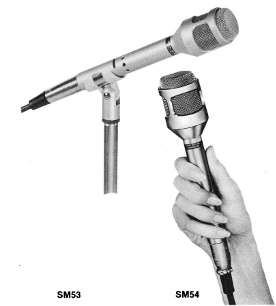
Shure SM53 and SM54 – The SM53 and SM54 were internally the same, with the SM54 having a larger grille.

According to the 1970 Product Data Sheet, “the reliable performance, outstanding features, and handsome appearance of the SM53 and SM54 make them extremely versatile and ideally suited for many demanding applications in television, radio, recording, motion pictures, and sound reinforcement. The performance and appearance of the two models are very similar; however, the SM54 is specifically designed for use in very difficult close-talking and hand-held situations because of its immunity to “pop” and breath blasts.” Elvis used these microphones in the 1970s, primarily because they had little bass build-up from the proximity effect. The deep voice of Elvis did not require “more bass.”