PMI National Project Awards, in association with PwC, celebrate Lidl for first net zero energy supermarket

The Ireland Chapter of the Project Management Institute (PMI) announces the winners of this year’s PMI National Project Awards, in association with PwC. Among the winners was Lidl for its first net zero energy supermarket in Ireland.

The annual awards recognise the contribution and excellence of project management in Ireland, showcasing the best innovation and talent in the profession. This year, 10 awards were presented at the black-tie event hosted at PwC’s Dublin office on Thursday 6 November.

From a workforce management transformation project in the retail sector to a telehealth programme, the event celebrated a variety of projects across numerous industries and demonstrates the growing influence and success of project management in Ireland.

Lidl was celebrated in the special “Future of Work Excellence” category for Ireland’s first net zero energy supermarket. Based in Maynooth, the store is net zero in both operational and embodied carbon. Furthermore, the supermarket’s design promotes wellbeing and productivity among employees by incorporating natural light, landscaped surroundings and low noise systems. Electric vehicle chargers, bike racks, and e-bike stations have also been installed to promote sustainable commuting.

Other organisations that were successful on the night included Primark, ESB and the HSE. Individuals were also celebrated, including three under-35 changemakers. These were Rachel Bothwell of GP Practice Ally, Sainath Vasantha of Deloitte, and David Garry of KSN Project Management.

The full list of winners for 2025, chosen by an independent judging panel*, can be found below.

  • PMO of the Year – National Broadband Ireland.
  • Project Professional of the Year – Niamh McAuliffe, NMA Consulting Ltd.
  • Private Sector Project of the Year – Primark: Workforce management transformation “myTime”.
  • Public Sector Project of the Year – ESB: PI Vision: Unlocking data, empowering decisions, transforming ESB.
  • Project Management for Social Good – AquaB Nanobubble Innovations Ltd: Nanobubble technology lifecycle project.
  • Under-35 Changemakers of the Year – Rachel Bothwell (GP Practice Ally), David Garry (KSN Project Management), and Sainath Vasantha (Deloitte).
  • eHealth Project of the Year – HSE: Community and primary care telehealth programme.
  • Special category: “Future of Work Excellence” – Lidl Ireland and Northern Ireland: Lidl Zero Maynooth Store.
  • Special category: “2025 awards submission most compliant with the 17 x UN Sustainable Development Goals (SDGs)” – AquaB Nanobubble Innovations Ltd: Nanobubble technology lifecycle project.
  • Ireland Chapter of the PMI Volunteer of the Year – Mariana Zanivan.

Speaking about the awards, Peter Glynne, President of the Ireland Chapter of the PMI, said: “The project profession in Ireland seems to go from strength to strength every year. This year was no different, with the quality and creativity of projects pushing the boundaries in terms of ambition and innovation. Not only that but these initiatives and individuals are driving real impact both within organisations and for society as a whole.”

John Dwyer, Partner in PwC Ireland, added: “As the landscape of business and work continues to evolve, project professionals are at the forefront, driving innovation and technology-led transformation across Irish and international organisations to prepare for the future. Both the Ireland Chapter of the PMI and PwC are deeply committed to the transformation agenda, and we at PwC are delighted to again be the headline sponsor of the Awards this year and support two specific awards – the Future of Work Excellence Award and the eHealth Project of the Year. This sponsorship highlights our dedication to advancing project management through a complex and fast-changing environment with resilience and optimism, to ensure that we are fit for the future. We commend each and every one of the finalists and a huge congratulations to the winners.”

Breaking Barriers in STEM: Over 5,000 Students Benefit from Inclusion Initiative

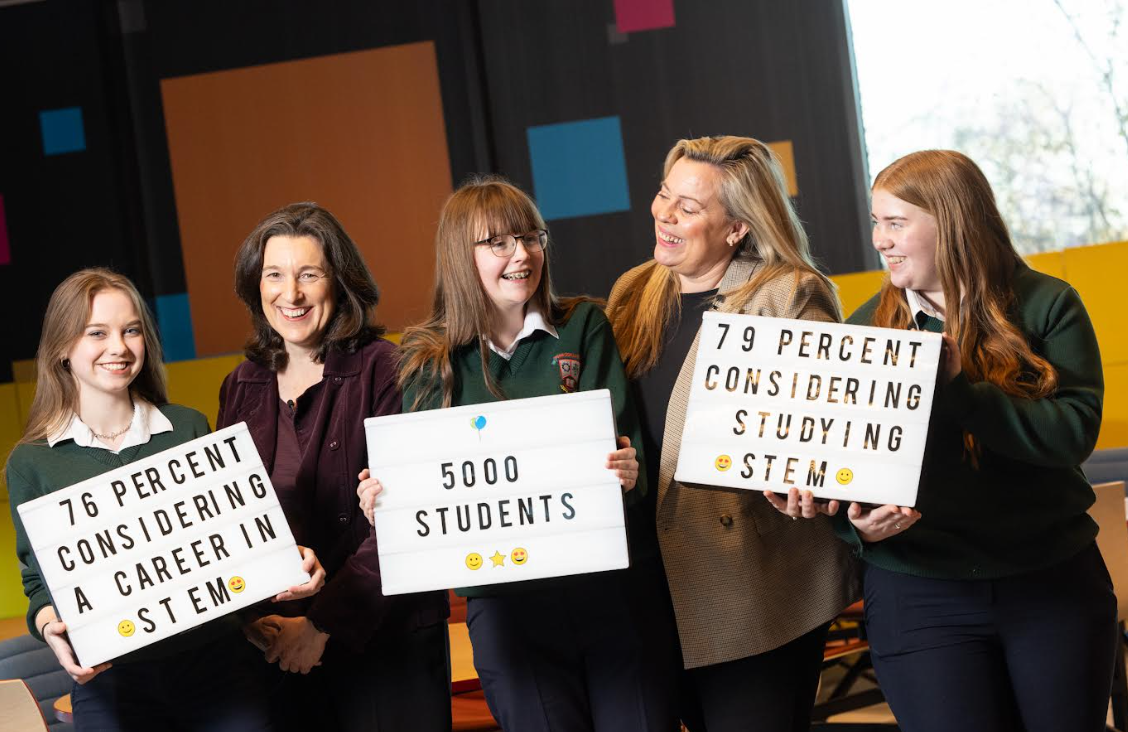
Today, Maynooth University, in partnership with Microsoft Ireland, Taighde Éireann – Research Ireland and the Department of Education, has published the STEM Passport for Inclusion Impact Report which reveals that over 5,000 students from disadvantaged backgrounds have participated in the initiative to date. Notably, 76% of these students are now considering a career in STEM.

The All-Ireland STEM Passport for Inclusion programme is a joint initiative by Maynooth University, Microsoft Ireland, Research Ireland and the Department of Education that addresses inequalities with access to STEM careers among post-primary school students in socially disadvantaged communities. Initially developed as a pilot in 2021, the programme was expanded nationwide in December 2023.

The programme’s innovative approach, which combines a recognised qualification (Level 6 NFQ), education supports, and mentoring from industry role models, provides a unique pathway for female students to progress to third level education and achieve a STEM qualification.

Since its launch, over 5,370 female students from DEIS schools in all four provinces have been engaged, with 50% of participants from rural areas. As part of the programme 1,100 industry mentors have delivered 2,524 mentoring hours. The outcome has been that students from 117 DEIS schools have been empowered to graduate with a university accredited STEM qualification while still in post-primary school.

A survey of programme participants revealed that STEM Passport for Inclusion has positively changed students’ view of STEM with 79% now considering applying to study STEM at third level while 76% are considering a career in STEM.

The programme has also increased students’ knowledge of, and familiarity with, STEM. Only 45% of students reported knowing what STEM was before participating in the programme. This increased to 95% once students completed the programme.

This has helped to reduce the STEM confidence gap between girls in DEIS and non-DEIS schools. Previously, only 3 in 10 girls from DEIS schools were confident they could study STEM in the future while close to 6 in 10 girls from non-DEIS were confident. Once girls took part in STEM Passport for Inclusion, the STEM confidence gap between girls in DEIS and non-DEIS schools was all but eliminated.

While the report details the significant impact of the programme to date, it also includes several informed recommendations to further STEM engagement and the impact of the programme across Ireland.

STEM Impact Recommendations

  • Expand the Programme Across All DEIS Schools: Secure funding to implement the programme in every DEIS school in Ireland – ensure nationwide access to STEM education for disadvantaged students.
  • Provide Necessary Resources to DEIS Schools: Many schools lacked the resources to fully participate in the programme. Supplying these institutions with loaned technology, mobile lab kits, and internet support would help bridge this resource gap.
  • Introduce Funded STEM Work Experience Programmes: Partner with industry to provide work experiences to enhance real-world learning and skill development. This initiative would be particularly valuable for DEIS students, who often lack exposure to STEM career pathways.
  • Fund Longitudinal Research on Programme Impact: Invest in further comprehensive research so stakeholders can gain insights into long-term outcomes, enabling data-driven improvements and enhancing the programme’s sustainability.

The National Skills Strategy identified a need to increase STEM participation to develop the talent and skills that are needed for the future of work. Despite female students accounting for more than half of third-level students, they only make up 35% of STEM students. Moreover, fewer than one in ten graduates in STEM fields are from socioeconomically disadvantaged backgrounds. STEM Passport for Inclusion seeks to address this by ensuring that every student, regardless of background, leaves school STEM prepared.

Speaking about her involvement in the initiative and the success of the programme so far, Dr. Katriona O’Sullivan, Digital Skills Lecturer at Maynooth University, said: “The publication of today’s report represents a milestone in the STEM Passport for Inclusion programme. Since its establishment, I have been lucky to see girls complete the programme with a renewed outlook on their potential and their thoughts about themselves have been transformed by the STEM Passport for Inclusion.

“When building out this initiative, we at Maynooth University set out to develop an evidence based, system solution, to address the underrepresentation of diverse women and girls in STEM. The success of the programme is evidenced by the roll out of the programme to over 5000 girls so far.

“We have been fortunate to receive support from our partners at Microsoft Ireland and Research Ireland throughout this journey. Looking forward, we are excited to work alongside third level colleagues around Ireland as the STEM Passport for Inclusion’s reach expands. With the support of philanthropy and our partners, we are expanding the project from 2025-2027, furthering the program’s positive impact.”

Microsoft is the STEM Passport for Inclusion’s lead industry partner, having contributed €600,000 in match funding to date. In addition, Microsoft’s Dream Space education team co-designed the Level 6-accredited (NFQ) STEM Passport module and has supported the delivery of the STEM Passport curriculum to participating students in Dream Space venues in both Dublin and Belfast. More than 300 of Microsoft’s employees are actively supporting the STEM Passport for Inclusion mentoring programme, alongside other educators and representatives from over 180 private and public sector organisations.

Speaking about Microsoft Ireland’s role in the initiative, James O’Connor, Microsoft Ireland Site Leader and Corporate Vice President Microsoft Global Operations Service Centre, said: “Microsoft Ireland has been involved in STEM Passport for Inclusion since its inception three years ago and we’re extremely proud of the role that the Microsoft Dream Space team has played in the co-design and delivery of the programme. In recent years, mass digitalisation and the era of AI have transformed professional expectations and elevated the importance of the next generation engaging in STEM and AI and pursuing a career in the technology sector.

“At Microsoft, we are passionate about ensuring that every young person, irrespective of their background, has the opportunity to engage in STEM and advancements in technology. STEM Passport for Inclusion does just that. Our involvement in the programme, both from a delivery and mentorship perspective, has been extremely rewarding and has allowed us to open our doors to students who traditionally would not have pursued STEM careers. We’re proud of the impact the initiative has had to date and look forward to working with the team at Maynooth University to continue to drive it forward and reach even more students.”

The project is co-funded by Microsoft Ireland and Research Ireland, the new national competitive research and innovation funding agency and the Department of Education. Dr Ruth Freeman, Director of Research for Society at Research Ireland welcomed the report, saying: “We are delighted to continue our support of this wonderfully successful initiative through our Discover Programme. Research Ireland is committed to empowering women from all backgrounds to access vital routes to STEM careers. I’m so excited to see how these students will contribute and thrive as STEM professionals in the future.”

STEM Passport for Inclusion graduate, Ava Kenny is now a third-year science student at Maynooth University. Commenting on her participation in the programme, Ava said: “Before taking part in the STEM Passport for Inclusion I was unsure if I wanted to pursue a college education, let alone pursue a career in STEM. The realm of science seemed distant and unfamiliar to me, and I didn’t know of anyone working in STEM. From my first day in the programme, I was captivated by the many doors a career in STEM could open for me.

“The STEM Passport for Inclusion guided my path into third level education as I am now studying science at Maynooth University. As I move on to the next stage of my life, I am excited about the prospect of a career in STEM and I know that the lessons I learned throughout the programme will stand to me.”

More details on the programme can be found at: STEM Passport for Inclusion | Maynooth University.

Leading supplier of IT solutions for public transport INIT to expand in Maynooth

INIT, worldwide leading supplier of integrated planning, dispatching, telematics and ticketing systems for buses and trains, have announced that they will increase their capacity in Maynooth, Co. Kildare.

Highly skilled software developers create applications for public transport projects around the world, including for ticketing and real-time passenger information systems for transport operators and authorities in cities including Honolulu, San Diego, Los Angeles, Seattle, Atlanta, Nottingham, Dublin, Hamburg, and New Zealand. INIT opened its first Irish office in 2018, their first software development centre outside Germany and employ 25 people. From today, the office capacity has increased with space to accommodate up to 60 employees and INIT is on the lookout for further talented Java and .Net cloud software engineers to continue their rapid growth. INIT is supported by the Irish Government through IDA Ireland.

Minister for Enterprise, Trade and Employment, Peter Burke TD said: “I very much welcome INIT’s announcement that they will increase the number of employees to 60 as part of an expansion at their Maynooth facility. Since their establishment in Ireland in 2018, INIT have been providing vital IT solutions for public transport, and it is great to see them continue to thrive and grow in Kildare. The expansion will provide fantastic employment opportunities in the IT sector. Great news for INIT, Kildare and the wider region, I wish them all the best with this new expansion.”

Matthias Kühn, INIT COO, underlines the importance of INIT’s Ireland branch: “In just over five years, our subsidiary in Ireland has exceeded expectations. We see this as confirmation that Maynooth is the right place to develop our innovative solutions for public transport. Doubling the staff and more than doubling their office capacity in Ireland will help INIT pave the way for continued success in the future. We are looking forward to receiving applications from qualified specialists for our development centre.”

Michael Lohan, CEO of IDA Ireland said: ‘’INIT’s plans to grow to up to 60 employees in their Maynooth office is great news for the region and indeed Ireland’s technology sector. IDA is very proud of Ireland’s reputation as a hub for technology. This expansion is a testament to the talent and skills that companies can find in Ireland and in Maynooth. ‘’

Even before establishing its subsidiary, INIT had strong ties with Ireland, including Dublin Bus (Bus Átha Cliath). In 2010, INIT implemented the first fleet management and real-time passenger information platform for the Greater Dublin Area.

Maynooth University’s Dr Patrick Kavanagh leads data and image processing of latest spectacular image taken by the James Webb Telescope

The NASA/ESA/CSA James Webb Space Telescope has released a new image of the well-known Ring Nebula with unprecedented detail. The new images show intricate details of structures and features, allowing scientists to understand both their chemistry and how they formed.

The observations were released today by an international team of scientists that includes Maynooth University’s Experimental Physics Lecturer Dr Patrick Kavanagh. Dr Kavanagh led the data reduction and processing of the image taken by a Mid-Infrared Instrument (MIRI), a camera and a spectrograph that sees light in the mid-infrared region of the electromagnetic spectrum, with wavelengths that are longer than our eyes can see.

Formed by a star throwing off its outer layers as it runs out of fuel, the Ring Nebula is an archetypal planetary nebula, and is relatively close to Earth at roughly 2,500 light-years away, making it an important object for scientists.

Commenting on the images, Dr Patrick Kavanagh, Department of Experimental Physics, said“There has never been mid-infrared images of the Ring Nebula like this before. The exquisite detail reveals previously unknown features in the molecular halo that tell us this dying star’s nebula was likely shaped by an unseen companion star. There simply has not been a telescope capable of seeing these features until JWST.

The new images provide unprecedented spatial resolution that show the intricate details of the filament structure of the inner ring (left) taken by NIRCam (Near-InfraRed Camera) and the concentric features of the outer regions of the nebulae’s ring (right) taken by MIRI (Mid-InfraRed Instrument). For context, it is the equivalent of distinguishing the details of a soccer ball at a distance of 550km.

Image credit: ESA/Webb, NASA, CSA, M. Barlow, N. Cox, R. Wesson


The images also provide insight on what the structures comprise and how they evolved. The images show some 20,000 dense globules in the nebula, which are rich in molecular hydrogen. In contrast, the inner region shows very hot gas. The main shell contains a thin ring of enhanced emission from carbon-based molecules known as polycyclic aromatic hydrocarbons (PAHs).

Approximately ten concentric arcs are located just beyond the outer edge of the main ring. The arcs are thought to originate from the interaction of the central star with a low-mass companion orbiting at a distance comparable to that between the Earth and the dwarf planet Pluto. In this way, nebulae like the Ring Nebula reveal a kind of astronomical archaeology, as astronomers study the nebula to learn about the star that created it.Image credit: ESA/Webb, NASA, CSA, M. Barlow, N. Cox, R. Wesson

The colourful main ring is composed of gas thrown off by a dying star at the centre of the nebula. This star is on its way to becoming a white dwarf — a very small, dense, and hot body that is the final evolutionary stage for a star like the Sun.

The Ring Nebula is one of the most notable objects in our skies. It was discovered in 1779 by astronomers Antoine Darquier de Pellepoix and Charles Messier, and was added to the Messier Catalogue. Both astronomers stumbled upon the nebula when trying to follow the path of a comet through the constellation of Lyra, passing very close to the Ring Nebula.

These observations were completed as part of the James Webb Space Telescope observing programme GO 1558. Webb is an international partnership between NASA, ESA and the Canadian Space Agency (CSA).


New state-of-the-art robotics lab to be created at Maynooth University

The Maynooth University Foundation is delighted to announce the creation of a state-of-the-art robotics lab, which will be supported by a donation from Intel Ireland. The lab will provide MU students with invaluable hands-on learning experiences using cutting-edge robotic technologies.

The establishment of the robotics lab at a total cost of €150,000 will equip Maynooth University students with access to innovative robotic technologies and equipment used by engineers from Intel and other companies. This hands-on experience will enable them to bridge the gap between classroom learning and real-world application, empowering them to develop and refine their skills in robotics.

The new robotics lab is set to become a hub of innovation, where students can explore and experiment with robotics, pushing the boundaries of technology and unlocking new possibilities. This new lab will support students in MU’s current degree programmes in Robotics and Intelligent Devices, Electronic Engineering and Computer Science.

The gift from Intel is coupled with an investment from the University, demonstrating the power of public-private partnerships to fuel innovation and improve student learning experiences.

The establishment of the robotics lab further strengthens the ties between Intel and Maynooth University.

Dave Selkirk, the Director of Advanced Analytics MSO Automation at Intel Ireland, said: “We are very proud of our close partnership with Maynooth University, a close neighbour of ours here in North Kildare. The development of key infrastructure in the area of robotics will provide an important opportunity for students to gain practical experience in an evolving technology field that has massive potential in Advanced High-Volume Manufacturing.”

Vice-President External Affairs at Maynooth University Rebecca Doolin said: “We are tremendously grateful to our neighbour and partner Intel for supporting the development of a new robotics lab, which will give Maynooth students hands-on learning opportunities to work with the same robots Intel engineers down the road are using, bringing their classroom learning to life.”

Doolin noted a Memorandum of Understanding (MOU) signed by Maynooth University and Intel in 2019, and its significance in creating a strategic research and innovation partnership.

“Over the years, Maynooth University has developed a strong partnership with Intel that has fostered collaboration in various areas, including student skills and experiences, research, innovation, and community engagement. As neighbours in a vibrant and fast-growing region of Ireland, today’s announcement not only deepens the ties between Intel and MU, but also demonstrates the positive impacts on student learning and innovation that such partnerships can yield.”

Prof Gerry Lacey, Head of Engineering at Maynooth University, said: “Robotics and AI are creating new industries, making agriculture more sustainable and revolutionising transportation. We are excited that Intel’s support will help our students to become leaders in creating this new future.”

New Maynooth University project supports communities in the green energy transition

Researchers at the School of Business, Maynooth University, have received Science Foundation Ireland (SFI) funding for an innovative citizen engagement project to harness business and community participation in the green energy transition.

SFI’s National Challenge Fund has awarded the researchers €250,000 to advance this innovative project, with a further two researchers to join the team as a result of this funding.

The team aims to drive change towards green energy and climate action by bringing the local community into the research process, making their needs central to the project, and facilitating knowledge sharing with key MU academics, particularly in the area of renewable and smart energy systems.

Over the next 18 months, the researchers will work with local organisations to identify and address their energy transition needs, creating a suite of tools and resources, including a targeted micro-credential course.

The MU project is one of 47 competing in the National Challenge Fund – receiving initial funding totaling more than €13 million to work on solutions to major environmental and societal issues.

Commenting on the ambitious goals of the projectProf Fabiano PallonettoSchool of Business and lead researcher said:

“We are delighted that our project RENEW has been selected by SFI for funding. We see huge potential for our local community to show leadership in the green energy transition. Our aim is to work closely with the local community, and together explore how Maynooth and Kildare can become an active node of the electrical grid through the co-creation of smart energy management systems.”

Dr Amy Fahy, School of Business and co-lead on the project, noted the unique methods employed by the project that involve the community:

“This is a perfect example of engaged research at Maynooth University. We are taking a community first approach, addressing the research needs of our local community of Kildare, and creating a process where we can build tools and resources that specifically address community needs, while also providing us with valuable knowledge that can be shared both nationally and internationally.”

Speaking at the launch of the National Challenge Fund, Minister for Further and Higher Education, Research, Innovation and Science Simon Harris TD said:

“These teams have presented ingenious ideas and committed their talents to working for the benefit of the people of Ireland. We see examples in the news most days of why Ireland needs to work at the green transition and digital transformation and ensure that our innovation and research prepare the country for the future. In fact, the solutions being worked on in all eight challenges in the National Challenge Fund have the potential not just to improve life here in Ireland, but across Europe and around the world.”

The National Challenge Fund is supported by the EU’s Recovery and Resilience Facility.

Martin Heydon launches €7m Sustainable Digital and Data Research Programmes

The Innovation Value Institute (IVI) at Maynooth University has been selected to lead the €7 million Digi+ and ENTRUST programmes that are focussed on sustainable digital transformation and data. The programmes are funded by the EC under the Marie Sklowdowska-Curie programme and Digi+ is also co-funded by Lero and Adapt; both world leading Science Foundation Ireland (SFI) Research Centres.

Data Driven technology is viewed by many as the next frontier for agriculture and a crucial component required to achieve a sustainable ecosystem, yet there remains a global challenge with a lack of skills and expertise in this space. ENTRUST tackles this challenge head on through the formation of a doctoral network that brings together 16 leading European research institutions. This will attract top tier doctoral candidates who will emerge as leading experts in addressing current challenges around data governance in agriculture and farming.

They will provide evidence based information in relation to the adoption of Data Technologies in order to allow farmers to unlock data potential while safeguarding their data. The ENTRUST programme will build towards a fair and trustworthy agri-data space that is aligned with the European Data Strategy and Green deal. This places Ireland at the forefront of agri-data driven technology on an international stage.

Speaking on the announcement of the awards, Martin Heydon, Minister of State for the Department of Agriculture, Food and the Marine with special responsibility for Research and Development, Farm Safety and New Market Development said: “I am delighted to announce Maynooth University has successfully been selected to lead the 7m €Digi+ and ENTRUST programmes in these two European  research initiatives. I commend the Irish researchers involved for their success in these highly competitive research calls.  The research will contribute to Digital innovation which is fundamental to achieving sustainability in all its forms. Ireland’s agri-food sector has been making good progress in embracing technology and innovation in recent years. These awards highlight Ireland has an innovative, competitive, and resilient agri-food sector, driven by technology and talent.”

The Digi+ programme complements the goals of ENTRUST through its multi-sector focus addressing the global challenges of sustainable digital and data ecosystems. Embedded within Ireland’s leading SFI-funded research centres, Lero and Adapt, and led by Maynooth University, it brings together a group of world-leading experts that will develop a new generation of creative, entrepreneurial and innovative research leaders, able to face current and future challenges aligned with EU’s Digital and Green Agenda.

Ireland will benefit significantly from this cohort of 20 highly skilled Postdoctoral Researchers that the programme will fund. They will work towards advancing digital transformation practices, addressing vital areas such as new and innovative business models, accelerating digital and data skills, developing forward looking data governance and business models while ensuring alignment to the EU sustainable development goals. Ireland is well positioned to be a leader in the digital and data economy and this €7m investment will contribute strongly to Ireland’s continued sustainability and progression towards world leading status both in the private and public sector.

Professor Markus Helfert, Director of the Innovation Value Institute and the Science Foundation Ireland EMPOWER Data Governance Programme explains: “The cross-disciplinary focus on sustainable digital transformation and data will deliver significant positive impact on multiple sectors including agriculture, health, climate, fintech, construction and manufacturing.

 “This investment will drive the co-creation of new ways of doing business, creating value and moving from ‘potential’ to ‘real’ benefits for companies and public sector organisations. At IVI, we are looking forward to working with our partners and prospective new partners to achieve these goals and advancing the digital and data research fields.”

Professor Eeva Leinonen, President of Maynooth University said: “At Maynooth University, we are delighted to play a world leading role towards achieving sustainable digital and data ecosystems. With a growing focus on Environmental, Social and Governance (ESG) factors, Digi+ and ENTRUST are timely initiatives that will address the challenges across the ESG spectrum through a highly collaborative engagement model that benefits from the Digital and Data expertise in IVI.”

FANUC opens first dedicated Irish robotics facility in Maynooth Co.Kildare

Leading robotics and automation company FANUC is officially opening its first ever dedicated facility in Ireland. Located in Maynooth, Co Kildare, the unveiling of the training centre and showroom and will be overseen by FANUC’s European President & CEO Shinichi Tanzawa in the presence of a select group of government officials, local dignitaries, academics, press, system integrator partners and valued customers.

The launch coincides with the implementation of the Irish Government’s wider industrial strategy, ‘Ireland’s Industry 4.0 Strategy 2020-2025’. Ireland currently lags behind the European average in robot penetration, with the second-lowest robot density in the EU15 in 2019. The Government’s strategy is that, by 2025, Ireland will be a competitive, innovation-driven manufacturing hub and at the forefront of Industry 4.0 development and adoption. 

The new facility at Maynooth means FANUC is ideally placed to help Irish manufacturers upscale their operations and compete on the international stage to make Ireland a European manufacturing powerhouse. In addition, the new facility will host five full-time employees, with this number expected to reach double figures within two years.

LIVE robotics demonstrations on the day will include:

  • The recently released LR-10iA

This lightweight, strong and compact robot series is perfect for use in confined workspaces, proving that today’s robots are suitable for SMEs, as well as large-scale manufacturers. 

  • The CRX cobot range

Boasting eight years zero maintenance, this series of lightweight collaborative robots shows how humans and robots can effectively co-work side by side.

  • The ROBODRILL vertical machining centre

A compact CNC machining centre delivering precision and repeatability – perfect for fully automated production runs.


FANUC opens first dedicated Irish robotics facility in response to growing manufacturing demand

In response to increased demand from its Irish customer base, leading robotics and automation company FANUC will officially open the doors to its first ever dedicated facility in Ireland on 11th October 2022. Located in Maynooth, Co Kildare, the unveiling of the 500m2 training centre and showroom will be overseen by FANUC’s European President & CEO Shinichi Tanzawa in the presence of a select group of local dignitaries, academics, government officials, press, system integrator partners and valued customers. 

“We are delighted to announce the opening of our first Irish facility,” states Tom Bouchier, Managing Director of FANUC UK & Ireland. “Not only does it demonstrate our long-term commitment to our growing customer base in the country, but it also enables us to support the government’s aim to place Ireland at the forefront of the Fourth Industrial Revolution by 2025.”

Live robot demonstrations

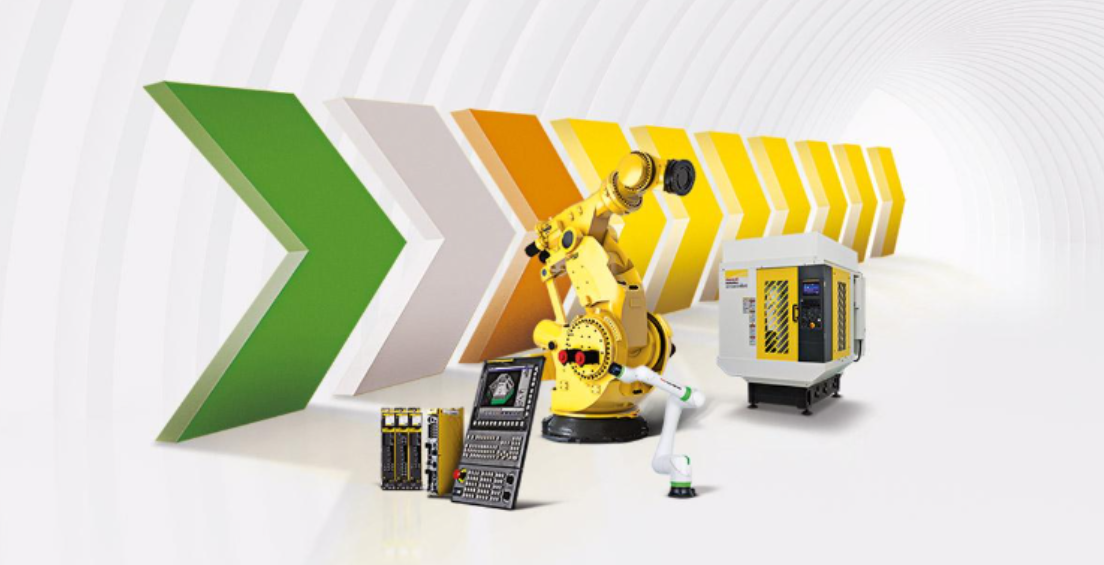
The official opening will provide the perfect platform for a live demonstration of the recently released LR-10iA; FANUC’s lightweight, strong and compact robot series. Perfect for use in confined workspaces, the LR-10iA is suitable for all types of material handling applications, such as loading/unloading directly in a machine tool, or high-speed picking and packaging directly on a conveyor belt. Visitors to the Maynooth facility opening in October will be able to witness its full range of benefits at close quarters.

As well as the LR-10iA, the new showroom will be stocked with a range of robotics and automation solutions for demonstration, evaluation and test purposes. Latest FANUC innovations on display will include the CRX cobot range, a series of lightweight collaborative robots that boast eight years zero maintenance; and the ROBODRILL vertical machining centre, delivering precision and repeatability making it perfect for fully automated production runs.

Local, on the ground support

The new Maynooth facility will be supported by a five-strong team of dedicated staff with the ability to provide local technical support and servicing, with a view to increasing this into double figures over the next two years. The site will also host organised, in-house training for FANUC’s larger customers and scheduled courses catering for smaller groups; previously, Irish clients would have had to travel to Coventry in England. In addition, the company will continue to develop its strong ties with Ireland’s higher education network, including the Technical Universities. 

The drive towards Industry 4.0

Located just 45 minutes’ drive from Dublin and within a 90-minute radius of many of FANUC’s Irish customers and partners, the Maynooth facility is accessible from most of the island in about three hours, making it the ideal location for FANUC’s Irish HQ. Its launch could not be timelier, coinciding with the implementation of the Irish Government’s wider industrial strategy, ‘Ireland’s Industry 4.0 Strategy 2020-2025’. Ireland currently lags behind the European average in robot penetration, with the second-lowest robot density in the EU15 in 2019. However, the Government’s strategy is that, by 2025, Ireland will be a competitive, innovation-driven manufacturing hub and at the forefront of Industry 4.0 development and adoption. With several hundred FANUC robots already installed in Ireland, the new facility at Maynooth means the company is ideally placed to help Irish businesses close the gap and profit from the new opportunities, supported by its network of expert integrator partners. 

“The indicators are very strongly pointing towards more investment in manufacturing equipment in Ireland,” says Tom Bouchier. “The country’s technologically advanced, efficient and competitive future manufacturing sector and its supply chain is one that FANUC Ireland will be at heart of.”