Electric Cars: The Lifeline of the Auto Industry. #EVs #Motoring #IDTechEx

In the past two decades, the car market has declined twice: first due to the 2008 economic crisis, and then due to falling sales in China. Most recently, the lockdowns implemented to combat the coronavirus pandemic, causing auto-production plants to close globally and a loss of consumer spending will lead to an unprecedented 23% decline in 2020 (IDTechEx prediction).

In the following decade (2030 – 2040), things will not improve: the global car market will be blindsided by the rise of autonomous vehicles, which greatly reduces the need for private car ownership. Within this scenario, it is electric cars which will remain a beacon of growth, satisfying both the governmental drive to clean air in cities whilst also working more readily with autonomous vehicle technology.


Source: IDTechEx with historic data from industry associations. For more information, please see the IDTechEx report, “Advanced Electric Cars 2020-2040”.

In their simplest form, an electric car consists of an energy storage device powering one electric traction motor, which spins wheels via a transmission. First invented in the 19th century, electric cars ultimately lost the battle to the internal combustion engine, unable to compete with the energy density of gasoline. Over one hundred years later, the Li-ion battery is enabling their meteoric rise as a solution for reducing local emissions and green-house gases.

Once derided as toys, today electric cars with barely 15 years of development offer cutting-edge automotive technology and performance, from sub 2.5 second 0 – 60 mph acceleration, to autonomous driving functionality and solar bodywork. Battery-electric vehicles (BEV) are the endgame: zero emissions at point of use and the focus of automotive start-ups (and China). On the other hand, Plug-in Hybrid Electric Vehicles (PHEV) provide a short/mid-term solution, soothing initial fears of range anxiety.

The brand new IDTechEx report, “Advanced Electric Cars 2020-2040”, provides a long-term outlook for the car market and enabling technologies in the wake of COVID-19. The key sections are summarized.

Forecasts and COVID-19 Impact

In the report, IDTechEx provide long-term forecasts to 2040 for electric passenger cars by region (China, US, UK, France, Germany, Norway, Netherlands, Denmark, RoW) and by powertrain (battery-electric, plug-in hybrid, fuel-cell). Forecasts are presented in number of vehicles, battery demand (GWh) and market size ($ billion), with historic data back to 2015.

All forecasts are adjusted to reflect the impact of the global COVID-19 pandemic: amid economic uncertainty and unemployment, the auto industry has been one of the hardest hit as car purchases, typically the second largest consumer purchase (the first is a house), are now more difficult to justify ­for millions of consumers worldwide.

Li-ion Batteries

The IDTechEx report identifies and explains trends in Li-ion batteries for electric cars. For example, nickel content is increasing while cobalt content is decreasing: why is this important for automakers and the overall sustainability of the industry? It also provides historic market data on the Li-ion technology mix based on our database of electric cars in top auto markets: China has phased-out LFP from over half its car market to less than 2% today; why will Tesla contradict this and adopt LFP for Model 3 sales in China?

Electric Traction Motors

All electric motors have the same purpose of converting electrical energy to mechanical energy, but there are many types of motors that derive their names from their construction, principles of operation, or even from the control technique employed on them. The IDTechEx report explores why automakers are converging on permanent magnet motors, multiple motors, provide a benchmarking analysis of the different motor types, and finally, an outlook for how IDTechEx expects the motor market to evolve over the next ten years.

Autonomous Vehicle Technology

IDTechEx predicts that the rise of autonomous vehicles will have a profound impact on the global car market as it enables mobility-as-a-service to become cheaper than private-car ownership. The report shows forecasts of autonomous passenger car miles, revealing how this will lead to a fundamental peak-car scenario. IDTechEx appraises the key underlying technologies such as LiDAR and camera-based systems: is the camera-only approach a high-risk gamble or a winning strategy that will be copied?

For more information on this report, please visit www.IDTechEx.com/Cars or for the full portfolio of Electric Vehicles research available from IDTechEx please visit www.IDTechEx.com/Research/EV.

5G Market is at the Tipping Point. #5G

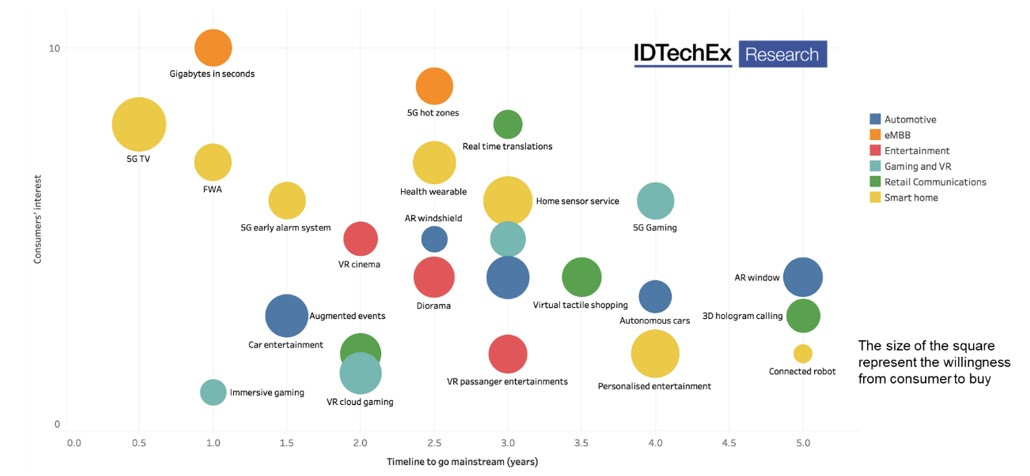
5G is considered as one of the largest market opportunities in the coming years, with large scale roll-out of infrastructures and rapid adoption of 5G devices and services. 5G will not only accelerate the growth and expansion of telecom; it will also redefine and accelerate industries such as automotive, entertainment, computing, and manufacturing. With high throughput and low latency, 5G is the most promising technique to tackle the high-value areas including 3D robotic control, virtual reality monitoring and remote medical control. Those are the problems that today’s technologies have not addressed yet.


First deployed in 2018, now over there are 80 operators in 42 countries/territories that have launched commercial 5G services. The 5G market is expected to be around $720 bn by 2030, mainly contributing from the mobile service, fixed wireless services and narrow-band IoT.


However, the enormous investment required to develop 5G and the unclear map of killing applications for 5G also put the future of 5G into a test. The IDTechEx report, “5G Technology, Market and Forecasts 2020-2030”, provides a holistic view of 5G technologies and vertical applications, which are essential to understanding the 5G market opportunity. 5G for smart manufacturing is considered as one of the key applications assisted with AI and intelligent cameras, such as autonomous mobile robot and remote real-time manufacturing. Due to the COVID-19 outbreak, healthcare applications have been adopted quickly, including telehealth, remote hospital operation, elderly care.

Source: IDTechEx Research, “5G Technology, Market and Forecasts 2020-2030


Many characteristic benefits promised by 5G will operate at high frequency (above 26 GHz), i.e. mmWave 5G. Such high frequency requires new materials and different device design. On one hand, high frequency leads to more significant transmission loss, which offers opportunities for low-loss materials with small dielectric constant and small tan loss.


Advanced packaging designs aims at reducing the signal loss by integrated passive components into the whole package. On the other hand, high frequency needs high power to drive and will generate more heat. Power amplifiers with higher power density and higher gain will be essential, as well as thermal management. We point out the unique niches for 5G materials and design and highlight the trends for technology innovations in the new IDTechEx report “5G Technology, Market and Forecasts 2020-2030”.


Source: IDTechEx Research, “5G Technology, Market and Forecasts 2020-2030


This report from IDTechEx identifies and analyses the critical trends in 5G in the following areas:

  • The base station architecture and the rise of small cells
  • Active antennas and beamforming ICs
  • Radiofrequency front-end modules components, such as high-frequency filter, power amplifiers, EMI shielding and optical transceivers
  • 5G thermal management for station and smartphone


The report includes comprehensive company profiles for more than 20 key global players from infrastructure suppliers to telecommunication operators. It also comes with a ten-year forecast for the 5G revenue and connection number based on five global regions (US, China, Korea & Japan, Europe and others), 5G infrastructure and 5G component & infrastructure.


Source: IDTechEx Research, “5G Technology, Market and Forecasts 2020-2030


For more information on this report, please visit www.IDTechex.com/5G or for the full portfolio of related research available from IDTechEx please visit www.IDTechEx.com/research.

New IDTechEx Report Addresses Key Questions About the $25bn Hearables Market. #Hearables

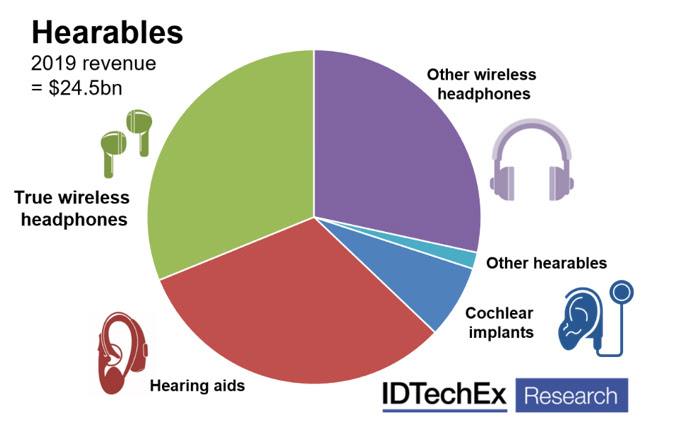
IDTechEx have released a new report covering the market, technology and players in hearables. It finds that the hearables market was worth $24.5bn in 2019 and will continue to grow at a forecasted 14% YoY from 2020-2025. This growth is driven primarily by the true wireless headphones category; led by Apple, this area has grown from nothing to be worth an expected $11bn in 2020.

Summary of the market share and major product types for hearables in 2019. Source: IDTechEx report, “Hearables 2020-2030: Technology, Players and Forecasts” (www.IDTechEx.com/Hearables)


Hearables are wireless electronic products worn in, on and around the ear, including products such as true wireless headphones, hearing aids, cochlear implants and a range of related and new product types. The report looks at each of these products in turn, assessing the key industry trends unfolding today, and providing a perspective on the key challenges facing the sector as it grows, for example:


  • How will the implementation of the 2017 Over-The-Counter Hearing Aid Act in the US impact the hearing assistance industry, including both traditional hearing aid players and any other players that may release OTC products?
  • After two years of frantic development to develop and release true wireless headphone products, how long can the aggressive growth in this industry continue, and can anybody challenge Apple’s dominance?
  • What impact will the adoption of new and existing technology options that can enable health monitoring via ear-worn products have on existing products in the sector and the wider product ecosystems around health monitoring (in both a fitness/wellness and medical context)?
  • Which areas of technology development are most likely to successfully shape the next generations of hearables products, and which are likely to have minimal impact or fail?


In order to answer these big questions, the report looks at a 20-year period for the industry, with historic data from 2010-2019 and then market forecasts from 2020-2030. It includes primary research in the form of interviews with more than 20 prominent companies in the space, ranging from leading players such as Bose, Starkey, Widex, Oticon and Sonova, through to leading technology players such as Valencell, Well Being Digital and RelaJet, to prominent startups such as Nuheara, Olive Union, and more. It is then backed up with secondary research covering a total of more than 60 companies from throughout the value chain in order to have a full representation of this industry.


For more information about the report “Hearables 2020-2030: Technology, Players and Forecasts” please visit www.IDTechEx.com/Hearables. To find out more about wearable technology research available from IDTechEx visit www.IDTechEx.com/Research/WT or to connect with others on this topic, IDTechEx Events is hosting: Wearables USA, November 18-19 2020, Santa Clara, USA www.IDTechEx.com/EVUSA.

New IDTechEx Research Reports Identify Technologies for the Future of Healthcare. #Health #IDTechEx

IDTechEx, market intelligence and events company focusing on emerging technologies, publish research reports that identify top future technologies in healthcare. With demographic changes such as the aging of the population, IDTechEx forecasts there to be strong growth in technologies that help healthcare providers manage the growing burden on the healthcare system while maintaining high quality care.


Wearable medical devices offer continuous health monitoring and provide deeper insight into a patient’s health status than non-wearable medical devices which only provide snapshots at fixed times. In IDTechEx’s new report, “Cardiovascular Disease 2020 – 2030”, wearables such as smart clothing and electronic skin patches are covered extensively. These soft and conformal devices provide medical-grade continuous health monitoring for cardiovascular disease patients. These comfortable devices provide monitoring over longer periods of time than traditional devices, allowing doctors to catch events that would previously have been missed. Overall, IDTechEx has forecast that the market for wearable medical devices (across all applications) to reach $19.7 billion by 2024.


Consumer electronics broadens health monitoring. While monitoring in consumer electronics has previously focused on fitness applications, companies are now entering the healthcare space. Devices such as smartwatches now broaden the access of continuous monitoring to a much larger audience. Consumers buy these devices for their primary function but benefit from background screening of hard-to-detect diseases such as atrial fibrillation and sleep apnea. In certain applications, the improvements of smartphone and tablet cameras means that a separate device is not even needed.


Technology development brings molecular diagnostics to the point-of-care. As evidenced by the COVID-19 outbreak that is currently ongoing around the world, there is a strong need for point-of-care diagnostics in the management of infectious disease outbreaks. Healthcare providers need to act quickly, but that is hampered when the testing takes multiple hours at a centralized facility. IDTechEx forecasts the market for point-of-care biomedical diagnostics to reach $43 billion by 2029. We have identified molecular diagnostics as the fastest growing segment, and our latest report “Molecular Diagnostics 2020-2030” forecasts the market (including but not limited to point-of-care) to reach $20 billion by 2030.


In addition to our market research reports, IDTechEx also hosts events on emerging technologies. For more information on wearables and sensors for point-of-care diagnostics and continuous monitoring, please refer to upcoming IDTechEx conference and table-top exhibition, Healthcare Sensor Innovations USA 2020, 17 – 18 March 2020 in San Jose


IDTechEx guides your strategic business decisions through its Research, Consultancy and Event products, helping you profit from emerging technologies. For more information on IDTechEx Research and Consultancy contact research@IDTechEx.com or visit www.IDTechEx.com.

Wearables Pivot to Healthcare, Printed Electronics Wins. #Health #Wearables #IDTechEx

One of the fastest growing segments within the $64 Bn wearable technology industry will be medical wearables, which will grow to $19.7 Billion in 2024, according to IDTechEx Research.

Healthcare Sensor Innovations 2020, hosted in San Jose on March 17-18, identifies and assesses the opportunities for printed and flexible electronics in healthcare as the technology enables a new wave of medical wearable devices.

Presenting on healthcare sensor innovations, IDTechEx, hosts of the event, are delighted to announce the keynote presentations will be from Medtronic, GE Research, Starkey Hearing Technologies, Google and Maxim Integrated.


The event explores how new form factors of electronics have unleashed medical device companies from mostly rigid electronics to be able to offer more comfortable flexible and even stretchable wearable sensor platforms, such as electronic skin patches that can provide continuous monitoring. By enabling this capability, printed electronics wins. The opportunity for electronic skin patches, including case studies and results from medical and commercial activities, will be covered by presentations from NextFlex, Lief Therapeutics, Berkeley Sensor & Actuator Center and Blue Spark Technologies.

The event features presentations and exhibits from organizations leveraging advanced materials – printed or otherwise – which are being used to create new capabilities of biosensors to enable point of care sensors.


Organizations presenting on new sensors designed for healthcare include Parker Hannifin, Hexoskin, Imec, Melexis, Hitronics, Reveal Biosensors and many others.


“Printed electronics is demonstrating its broad applicability in healthcare,” states Raghu Das, CEO of IDTechEx. “From being used to create flexible and stretchable electrodes, to creating flexible batteries and a broad range of bio sensors, healthcare sensors present a high growth opportunity for printed electronics with sustainable margins.”


Healthcare Sensor Innovations 2020 is strategically held in San Jose, California, because healthcare organizations have been establishing a presence in silicon valley as the two worlds of life sciences and electronics intersect, creating solutions to solve huge challenges and create opportunities in point-of-care sensors and continuous monitoring.


From medical device companies and pharmaceuticals to sensor and electronics companies: meet the leaders in the world of sensor innovations for healthcare. Learn more at www.HealthcareSensorInnovations.com/USA.

Global Production of Electric Light Commercial Vehicles to Exceed 2.4 Million Units Annually by 2030 Forecasts IDTechEx

The light commercial vehicle market is at the dawn of a revolution; the future is electric. The main discourse around on-road vehicle electrification has been primarily focused on environmental concerns about the automotive sector’s contribution to climate change and the damaging effect on human health of exhaust pollutants. For businesses keen to address the environmental impact of their vehicle fleets a degree of altruism has always been required. In the electric light commercial vehicle market, this is about to change. In the near future, the main motivation for businesses to transition to eLCV will not be environmental but economic.


To help companies plan for the changes in this market, the newly launched IDTechEx report “Electric Vans 2020-2030” provides a detailed ten-year outlook for the uptake of electric light commercial vehicles across key regions; China, Europe, North America and the rest of the world, outlining eLCV production, penetration, market revenue and battery requirement. This report will be of value to companies across the automotive industry including OEMs, battery manufacturers, electric drivetrain parts and systems suppliers, materials and research organisations, charging infrastructure developers, government agencies and companies with significant LCV fleets.


Left: Forecast eLCV share of total global LCV market revenue Source: IDTechEx “Electric Vans 2020-2030” Right: The first versions of Arrival’s Electric van. Source: Arrival


The light commercial vehicle market is uniquely positioned to rapidly transition to electric vehicles. LCV operators primarily base their purchase decisions on total cost of ownership calculations, and whilst the upfront cost of electric LCVs is currently greater than for a equivalent diesel model, the significant operational cost saving from using electricity as a fuel, in replacement of diesel, is increasingly being shown to offset the initial price difference.


Over the next decade, as battery pack prices decrease, electric drivetrain efficiencies improve and significant economy of scale savings are realised on the cost of electric components and vehicle manufacturing, it will become a competitive advantage for companies to operate electric vans as they will offer the lowest cost solution. The addition of road charges for diesel vehicles in low emission zones within urban centres will swing the TCO balance heavily in favour of electric LCV.


IDTechEx believe the next few years will see companies conducting large scale pilot projects to establish that eLCVs meet their operational range, load capacity, payload and reliability requirements. Once demonstrable evidence is there that eLCVs can meet the operational requirements without increased cost, then the widespread replacement of ageing diesel LCVs with eLCV will begin in earnest. For more information please visit www.IDTechEx.com/eVans.


To find out more about Electric Vehicle research available from IDTechEx visit www.IDTechEx.com/research/EV or to connect with others on this topic, IDTechEx is hosting: Electric Vehicle Materials, 13 – 14 May 2020, Estrel Convention Center, Berlin, Germany www.ElectricVehiclesEurope.Tech.