ABLIC launches the S-19193 Series of automotive battery monitoring protection ICs

ABLIC (President: Seiji Tanaka, Head Office: Minato-ku, Tokyo; hereinafter “ABLIC”), a group company of MinebeaMitsumi Inc., today launched the S-19193 Series of automotive 3 to 6-cell battery monitoring protection ICs.

BMS (Battery Management Systems) for EVs and e-Bikes, etc. require functional safety (*1) compliant with ISO26262 (*2), which is a standard for functional safety in road vehicles.

The acceptance criteria for functional safety are (1) fail-safe (the ability to return to a safe state in the event of a failure or malfunction), (2) fail-operational (the ability to continue operation even in the event of a failure or malfunction), and (3) fail-degraded (the ability to continue operation with decreased functionality). In the past, the conventional method of achieving (1) fail-safe functional safety was to use a microcontroller (MCU) together with a high performance IC called an “analog front-end” (AFE) to monitor automotive battery overcharge and over discharge conditions.

Under the conventional (1) fail-safe methodology, the safety of a driver is ensured by “returning to a safe state”, i.e. stopping the vehicle in the event of an actual failure or malfunction, and there was no requirement for continued monitoring of batteries after the vehicle had safely stopped.

However, with the evolution of automated driving technologies, it is expected that there will be an increase in the number of cases where the system, rather than the driver, handles any problems that occur, so the (2) fail-operational and (3) fail-degraded methodologies, which allow for continued operation even in the event of a failure or malfunction, are becoming increasingly important.

The S-19193 Series automotive 3 to 6 cell battery monitoring protection ICs launched today are products developed in ISO26262 compliant processes and are equipped with functions for monitoring automotive battery overcharge and overdischarge.

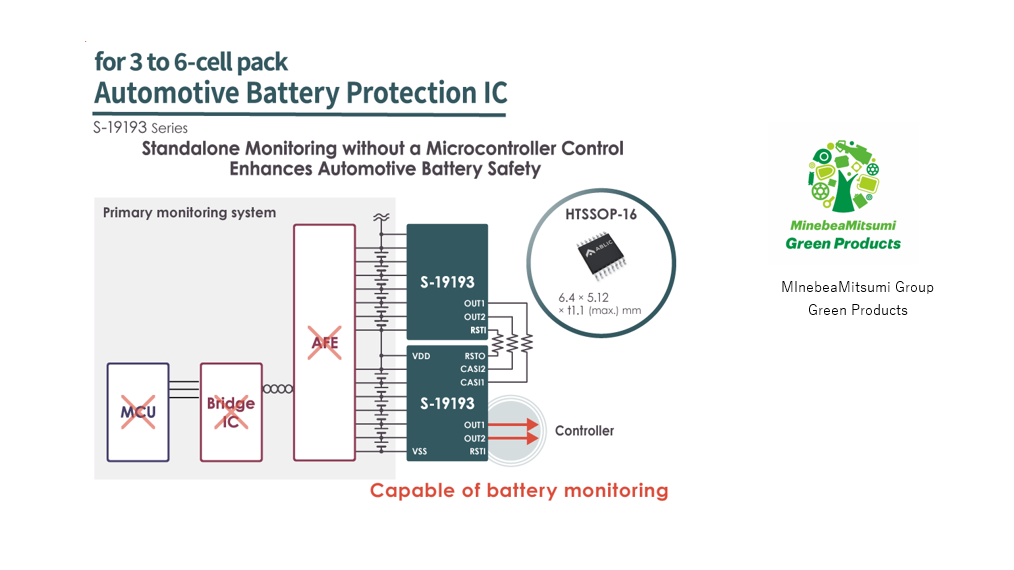
Utilizing the S-19193 Series makes it possible to continue battery monitoring as a secondary system even in the event the conventional monitoring system (primary) fails, and to achieve a safer BMS that is both (2) fail-operational and (3) fail-degraded compliant.

There are also examples with AFE and MCU internal monitoring functions configured as primary and secondary, but these are mainly for failure and fault detection through mutual monitoring and are insufficient for backup of functionality. In addition, internal redundancy also poses a risk of “joint failure”, where loss of functionality occurs simultaneous to the occurrence of a failure, however with the S-19193 Series, the secondary monitoring can be made completely independent from the primary monitoring to also mitigate the risk of joint failures occurring.

The S-19193 Series also makes it possible to configure a stand-alone operation secondary monitoring circuit which does not require MCU control, which can also contribute to a reduction in the number of design processes.

A Safety Manual is also available for download to support BMS functional safety design using the S-19193 Series. The product is also compliant with the PPAP (Production Part Approval Process) established by the U.S. Automotive Industry Action Group (AIAG), and is also planned to be made compliant with AEC(*)-Q100 Grade1 (*Automotive Electronics Council) quality standards for automotive IC.

Going forward, ABLIC will continue to strive to contribute to our customers’ success with high-quality products developed with the utmost consideration for safety and based on our many years of technological capability and knowhow.

(*1) Functional safety: The incorporation of functional innovations to maintain an acceptable level of safety
(Reference: https://www.ablic.com/en/semicon/products/automotive/asil/)

(*2) ISO26262:
An international standard for functional safety of automotive electronic control systems which was officially established in November 2011. It standardizes development processes aimed at achieving “functional safety” by calculating the risk of failure in automotive electronic control systems and devising measures to lower those risks and integrate those risk reduction measures into systems as functionality in advance. The standard covers the entire vehicle development life cycle from initial vehicle conceptualization to development, production, maintenance, and disposal of systems, ECU, embedded software, and devices.
ABLIC has received “ISO 26262” development process certification from a third-party certification organization in Germany.
(Reference: https://www.ablic.com/en/semicon/news/2024/01/10/iso26262/)


Major Features

1.Continued automotive battery monitoring functionality in the event of a failure when used as a secondary monitoring IC
The S-19193 Series is capable of maintaining continuous monitoring of battery overcharge and overdischarge through stand-alone operation which does not require microcontroller control. This makes it possible for battery monitoring to be maintained even in the event of a failure of the main monitoring system (primary), to achieve a fail-operational BMS.
In addition, the S-19193 Series is functional safety standard product developed in ISO26262 compliant processes which achieves ASIL-B(D) classification under expected use cases. This product enables to the achievement of safer BMS by configuring this IC as a secondary monitoring circuit while continuing to use existing circuits at the primary monitoring circuit.

2.Enable stand-alone monitoring and failure detection through self-testing with a simple structure
The product is equipped with a self-test function which makes it possible to detect internal IC failures by simply inputting an external start signal. This makes it possible to use the self-test function to allow the system to detect monitoring function failures even in the event monitoring functionality is lost due to overcharge or over discharge resulting from the random failures that can occur when ICs are used over long periods.

3.Cascade function makes it possible to configure simply monitoring circuits with a small number of components
The S-19193 Series is equipped with a cascade function. In addition to direction connection, the S-19193 Series also supports connection with adjacent S-19193 Series products through a photocoupler, making it possible to construct safe monitoring circuits even in high-voltage BMS with a large number of serially-connected batteries.

Major Specifications
•Overcharge detection voltage: 2.50V to 4.50V ±20mV
•Overdischarge detection voltage: 1.00V to 3.00V ±80mV
•Current consumption during operation: 20μ max.
•Max. rating: 28V
•Operating temperature: -40℃ to +125℃
•Package: HTSSOP-16
•Functional safety compliant (*3)
•AEC-Q100 compliant
•PPAP support available
(*3) Functional safety compliant: https://www.ablic.com/en/semicon/products/automotive/asil/fusa-compliance/?rf=asil

Application Examples
• 
Automotive devices
• Battery monitoring in EVs, HEVs, PHEVs, e-Bikes, etc.
• Industrial equipment
• Battery monitoring in capacitors, electric forklifts, etc.

ABLIC launches the S-82K5B/M5B Series; ABLIC’s first secondary protection ICs with cascade function for power tools and e-bikes

These ICs reduce voltage monitoring board size, provide the industry’s highest level of accuracy and contribute to improved safety

ABLIC a group company of MinebeaMitsumi Inc., has launched the S-82K5B/M5B Series secondary protection ICs for 3 to 5 serially connected cells, which are ABLIC’s first secondary protection ICs with an integrated cascade function that can reduce the number of components required for monitoring of batteries with 6 or more serially connected cells by approximately 30% compared to conventional products.
Secondary protection ICs are used in a wide range of applications which require high voltage such as power tools, vacuum cleaners, and e-bikes, and applications that require a high degree of safety.

Secondary protection ICs are used in combination with protection fuses which blow when an external signal is received. When an overcharge occurs, a signal from the secondary protection IC causes the fuse to blow and break the charging current path to protect connected devices. Conventional secondary protection ICs could monitor batteries with up to 5 serially connected cells but required a large number of external components to monitor larger numbers of serially connected cells.

The new S-82K5B/M5B Series launched today is a secondary protection IC for 3 to 5 serially connected cells with the following features: (1) A cascade function (a function which enables connection protection of more batteries than the maximum number of batteries that a single protection IC can protect) which makes it possible to carry out voltage monitoring of rechargeable batteries with 6 or more serially connected cells using far fewer components than conventional products; (2) an open detection circuit (*1) which detects communication failures between ICs to enable safer voltage monitoring; (3) a lineup of two products to ensure that we can flexibly respond to customer needs: the S-82K5B Series with ±20mV overcharge detection voltage accuracy, and the S-82M5B with the industry’s highest (*2) accuracy of ±15mV.

Going forward, ABLIC will continue to leverage our technology and knowhow to develop lithium-ion battery protection ICs with even greater accuracy and higher performance and to release products for applications in a wide range of fields.

(*1) An open detection circuit is a circuit which can detect failures such as component damage, poor pin contact, or disconnection caused by poor mounting.
(*2) Based on our research as of March 2024

Example protection circuit for 10 serially connected cells using the S-82K5B/M5B Series

[Major Features]

1.Ability to monitor voltage for 6 or more serially connected cells using 30% fewer parts than conventional products thanks to the integrated cascade function
A cascade function is provided to enable voltage monitoring for 6 or more serially connected cells. This function makes it possible to reduce the number of parts by 30% compared to conventional products to reduce board size and device size.

2. Circuit for detecting open failures in communication between ICs
An open failure in the wiring used to communicate between ICs is a potential failure mode when using the cascade function. The S-82K5B and the S-82M5B Series are equipped with an open failure detection circuit to detect open failures in communication circuits. This function helps improve the safety of used devices.

3. A lineup of two devices which provide the industry’s highest level of voltage detection accuracy
We offer a lineup of two devices: the S-82K5B Series with an extremely high overcharge detection voltage accuracy of ±20mV and the S-82M5B Series with an ultra-high detection voltage accuracy of ±15mV; to enable customers to select products with detection voltage accuracy that best suits their needs. In addition, both devices offer excellent temperature characteristics between -10°C to 60°C, and the S-82K5B Series’ ±25mV and S-82M5B Series’ ±20mV are the industry’s highest (*3) temperature characteristics and have helped to further improve both device safety and charging efficiency.

(*3) Based on our research as of March 2024

[Major Specifications]

A cascade function that allows for monitoring of 6 or more serially connected cells
Overcharge detection voltage: 3.50 to 4.70V,
S-82K5B Series: ±20mV (25°C), ±25mV (-10 to 60°C)
S-82M5B Series: ±15mV (25°C), ±20mV (-10 to 60°C)
Current consumption during operation: 5μA max.
The CO pin output voltage is 7.5V max. so a low gate withstand voltage FET can be used
Maximum rating: 28V
Operating temperature: -40 to +85°C
Packages: TMSOP-8, SNT-8A

[Application Examples]

Lithium-ion rechargeable battery packs, lithium polymer rechargeable battery packs

[Examples of products using these ICs]

Power tools, vacuum cleaners, e-bikes, etc.