The main unemployment rate was 4.1% in July on a seasonally adjusted basis, down from 4.2% in June and down from a level of 4.2% twelve months ago. The seasonally adjusted number of people unemployed fell by 3,600 in July but was up by 100 in the past 12 months.
Jack Kennedy, senior economist at global job site Indeed, comments on the latest CSO data:
“The labour market remains incredibly tight with the unemployment rate at 4.1% — the joint-record lowest since 2001 according to the latest revised figures— and is proving resilient amidst global challenges. The continuing low level of Ireland’s unemployment rate reflects the culmination of concerted efforts by both the public and private sectors to foster a robust and sustainable economy.
Recent data from Eurostat shows that the Eurozone economy returned to growth in the second quarter, as the euro area grew 0.3 per cent in the three months to July, after stagnating in the previous quarter. Unemployment in the eurozone also dipped to a new all-time low of 6.4%. This is an indication that the economy is stabilising; however, it is essential to remain cautious and vigilant.
Economic success is not without challenges, and as the labour market remains at near full employment, the coming months could reveal sector squeezes.
Pay pressures remain strong and workers will push for higher wages to compensate for high inflation. That said, wage pressures may be past their peak. The Indeed Wage Tracker, based on advertised pay for new hires, showed a further easing to 4.3% y/y in June, down from a peak of 5.5% in March.
This corresponds with a gradual softening in employers’ hiring appetite, though the latter remains strong. The latest figures from Indeed show that job postings on Indeed Ireland are 30% above the pre-pandemic baseline as of July 2023 (Fig. 1).
The country’s commitment to nurturing a highly skilled and educated workforce has bolstered productivity and competitiveness. As we remain at full employment, now is the time to future-proof the Irish economy. Prioritising various educational routes, including apprenticeships, and investing in sustainable career options for young people who might otherwise seek to emigrate, can ensure our highly talented workforce remains a key driver of economic growth.
Evolve IP, a leading service provider of Unified Communications, has welcomed GPS Telecom as its latest reselling partner across the EMEA region – to help fire-up further sales success.
GPS Telecom joins at an exciting point of their business journey, with plans of expansion and growth including new global collaboration services from Evolve IP.
Runcorn-based GPS Telecom has over 15 years’ industry experience in providing the latest unified communication products, designed to integrate and futureproof businesses. The company has built a reputation as an expert provider who recommend and implement the very latest, often complex systems, simply and seamlessly into any organisation.
Big targets
Managing Director, Chris Jones, explained: “Evolve IP are the service provider that can help with our growth plans. We have set ourselves some big targets and Evolve IP has the expertise and technologies that will help us get there.
“I am very proud to lead a team of dedicated and highly talented individuals who are all committed to delivering a professional and personal service to each and every one of our customers.
“We are embarking on an exciting journey of expansion, supported by our customers both old and new and by the trusted relationships we have built with our industry leading suppliers. Our business is our people and without their commitment none of the amazing things we achieve would be possible, I am honoured to work with such a fantastic team.”
Chris Jones, Managing Director, GPS Telecom
Thrilled
Jamie Hughes, UK Sales Director at Evolve IP, shared the enthusiasm, as he outlined: “We’re thrilled to have GPS Telecom join our reselling base; their expertise and skills are exactly what we look for within our partners. We’re very excited to see them grow and thrive by offering our solutions to their customer base which will inspire them on a new journey of success.”
Jamie Hughes, Evolve IP
GPS Telecom will be reselling a range of the Evolve IP enterprise-grade solutions that are available to all reselling partners These feature:
Anywhere Contact Centre – Delivers service excellence and supports teams in the hybrid world. Scales from 5 to 1000 plus agents, always allowing on-demand agent ‘bursting’. With Anywhere Contact Centre, new contact centres can be online within hours and new agents in just minutes.
Evolve Anywhere with Microsoft Teams – Natively integrated between the Microsoft Teams and Evolve IP’s carrier-grade voice solution. Users can work within a system they are familiar with (MS Teams) but integrate with sophisticated technologies that will allow them to scale up and improve their communications strategy effectively.
Evolve Anywhere with Cisco Webex – A decade-long partnership with Cisco for hosting Cisco telephony solutions enables Evolve IP to provide ‘unparalleled service, support and the latest features’.
Anywhere Value Add Solutions – Evolve IP’s Anywhere Product Suite offers partners an eco-system of technology partners from call recording with Voice AI to business analytics, integrations and receptionist console. All within a user-friendly management portal.
Hughes highlighted: “Evolve IP’s recent launch of Anywhere Portal and introduction of Anywhere Contact Centre has come at a great time for GPS Telecom – offering their customers simple provisioning and a complete unified communication technology stack for extensive growth in the future.”
Evolve IP has recently launched a summer sales campaign, teaming up with top technology partners to offer a range of offers and incentives.
Jones believes the company is ideally placed to help push GPS Telecom further forward, as he concluded: “Evolve IP’s scalable technology and flexibility is going to enable my team to flourish and support our customers seamlessly.”
In today’s fast-paced and technology-driven landscape, skilled IT professionals are the driving force behind companies’ success, transforming traditional approaches and revolutionizing industries. From crafting cutting-edge solutions to leveraging emerging technologies, these talented individuals are at the forefront of shaping business strategies, enhancing productivity, and fueling the relentless pursuit of advancement. Join us as we explore the invaluable impact of IT talents and how they are propelling innovation to unprecedented heights in the corporate world.
Adopt Strategic Technology
Pioneering the Path to Innovation and Growth In the ever-evolving landscape of modern businesses, strategic technology adoption stands as a driving force behind innovation and growth. IT talents play a pivotal role in meticulously assessing emerging technological trends and discerning their potential impact on the organization’s long-term objectives.
By carefully selecting and hiring the right employees, you will enjoy integrating cutting-edge technologies like AI, blockchain, cloud computing, and IoT. These experts empower businesses to optimize processes, enhance efficiency, and gain a competitive edge. You can find employees for IT departments through various channels such as online job portals, professional networking platforms like LinkedIn, tech-focused recruitment agencies, and by participating in industry-specific job fairs and conferences.
Through their foresight and expertise, strategic technology adoption sets the stage for businesses to embrace innovation, adapt to dynamic market demands, and forge a path towards sustained growth in the digital era.
Implement Digital Transformation Initiatives
In a rapidly digitizing world, IT talents take on the crucial responsibility of driving and executing digital transformation initiatives within organizations. Armed with their expertise, these professionals lead the charge in adopting digital tools, reimagining processes, and revolutionizing customer experiences. By spearheading the integration of advanced technologies, such as AI, automation, and data analytics, IT talents enable businesses to stay ahead of the curve.
Their strategic implementation of digital transformation not only enhances operational efficiency but also paves the way for innovative products and services that cater to evolving customer needs. Embracing this paradigm shift is paramount for unlocking sustainable business success in the digital age.
Enhance Data-Driven Decision Making
IT talents play a pivotal role in unlocking the potential of information to drive business decisions. By harnessing powerful data analytics tools and techniques, these experts distill vast amounts of data into actionable insights. They empower organizations to make informed decisions, optimize processes, and identify growth opportunities.
Through a deep understanding of data patterns and customer behavior, IT talents provide a foundation for innovation and agile response to market changes. Emphasizing data-driven decision-making not only ensures a competitive edge but also fosters a culture of continuous improvement, positioning businesses to thrive amidst evolving industry landscapes.
Implement Cybersecurity and Risk Management
As cyber threats become increasingly sophisticated, IT talents take on a critical role in fortifying modern businesses against potential risks. With an unwavering focus on cybersecurity, these experts design and implement robust defense mechanisms, proactively identifying vulnerabilities and orchestrating swift incident responses.
Through continuous risk assessments and compliance measures, IT talents establish a culture of proactive risk management, ensuring data confidentiality, integrity, and availability. By safeguarding business assets and customer trust, their diligent efforts bolster business resilience, allowing organizations to innovate and grow with confidence in an ever-changing digital landscape.
Agile Development and Continuous Innovation
IT talents champion the adoption of agile development methodologies, catalyzing a culture of continuous innovation within organizations. By embracing agility, these experts facilitate iterative, collaborative, and customer-centric approaches to product and service development. Through rapid prototyping, frequent feedback loops, and adaptive project management, IT talents enable businesses to respond swiftly to evolving customer needs and market trends.
Emphasizing continuous improvement and learning, their commitment to innovation ensures that businesses stay ahead of the competition, unleash creative potential, and deliver high-impact solutions that drive sustainable growth and success in the ever-accelerating digital era.
Collaboration and Cross-Functional Integration
IT talents act as catalysts for seamless collaboration and cross-functional integration within organizations. By bridging the gap between various departments, they facilitate a cohesive exchange of ideas, expertise, and resources. Leveraging their technical acumen, these professionals create platforms and systems that enhance communication and coordination among teams.
Through collaborative initiatives, IT talents promote a culture of knowledge-sharing and innovative problem-solving, yielding synergistic solutions that address complex business challenges. This harmonious integration of skills and perspectives not only enhances operational efficiency but also sparks new avenues for growth, unlocking the full potential of diverse talents and propelling the organization towards collective success.
IT talents play a transformative role in modern businesses, driving innovation and fostering growth. By strategically adopting technologies, implementing digital transformations, enhancing data-driven decision-making, fortifying cybersecurity, embracing agility, and promoting cross-functional collaboration, these experts enable organizations to thrive in the fast-paced digital landscape. Their expertise empowers businesses to stay ahead of the competition, respond to customer needs, and navigate dynamic market challenges with confidence. As technology continues to evolve, IT talents remain essential partners in propelling businesses towards success and shaping a prosperous future.
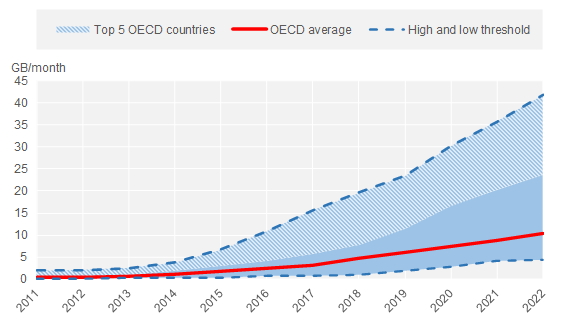
Mobile data usage continues to grow, but at a slower pace, according to new OECD broadband portal data released on 13 July. Data usage per mobile broadband subscription in OECD countries grew 17% in 2022, compared to an average annual growth rate of 29% between 2017 and 2021. Nonetheless, the volume of mobile data usage overall per subscription has doubled in four years, from 4.7 gigabytes per month to 10.4 GB in 2022.
Of note is the range of mobile data consumption volumes registered across OECD countries, spanning from 4.3 GB per user per month to 42 GB – a 10-fold difference between the lowest and highest volumes observed. The five countries with the highest data usage levels – Latvia (42 GB per month), Finland (40 GB), Austria (30 GB), Lithuania (28 GB) and Iceland (24 GB) – consume three times more data than the OECD average. This gap, between the leading countries and the OECD average, has continued to widen year on year.
Range of mobile data usage per month in OECD countries, 2022
In the fixed broadband segment, fibre is now firmly established as the leading connection technology, accounting for 38% of all fixed subscriptions at the end of 2022, up from 28% in December 2019, shortly before the start of the COVID-19 pandemic.
Belgium, Costa Rica, Austria and Israel increased their fibre connections by more than 40% in 2022. Fibre as a share of all fixed broadband now exceeds 80% in Iceland, Japan, Korea, Spain and Sweden, and is greater than 50% in a further 10 OECD countries (Chile, Finland, France, Latvia, Lithuania, Luxembourg, New Zealand, Norway, Portugal and Slovenia). By contrast, the DSL share of total fixed subscriptions has continued to fall, from 40% five years ago to 24% today, while cable has maintained a steady share over the last five years of around 33%.
Overall, fixed broadband subscriptions are still growing in almost all OECD countries, reaching a total of 481.6 million in December 2022 and averaging 35 subscriptions per 100 inhabitants. This compares to 433 million at the end of 2019 – an increase of 48.6 million, or 11.2%, in three years. Switzerland had the highest penetration rate of 48 subscriptions per 100 people, followed by France (47), Norway (46) and Korea (45).
Mobile broadband subscriptions also continue to expand, despite very high penetration rates, growing by 13% between 2019 and 2022. Total subscriptions reached 1.76 billion in December 2022, up from 1.56 billion three years earlier. Estonia and Japan top the ranking for mobile broadband penetration, with 204 and 197 subscriptions per 100 inhabitants, respectively. The United States and Finland, with 176 and 160, respectively, are not far behind.
The rollout of 5G continues apace. As of July 2023, it was available in 37 out of 38 OECD countries. For the 20 OECD countries able to provide relevant data, the share of 5G in total mobile broadband subscriptions averaged 21%, with the highest share in Denmark (54%), Korea (45%) and Japan (26%).
Machine-to-machine (M2M) SIM cards are once again experiencing the highest growth rates of all indicators, with a 14% increase in one year. The two leading countries are Sweden (222 M2M SIM cards per 100 inhabitants) and Iceland (191), followed by Austria (128), the Netherlands (86) and Norway (72). The issuing and registration of M2M SIM cards by national operators for international usage in Sweden and Iceland accounts for their elevated numbers.
Download broadband data, charts and penetration maps by country at http://oe.cd/broadband.
Evolve IP today announced the addition of a series of new reseller partners across the EMEA region – to fuel continued growth in its partner network and expansion of its cloud-based Unified Communications platform that reaches more than 73 countries.
The company’s successful partner model is built on a combination of a deep understanding of partner needs, customer use cases, training, co-sales, implementation, support resources, platform resiliency and geographic coverage, as well as support for important charitable causes.
Recently, Evolve IP kicked off its partner event schedule by hosting a successful golf day with key resellers, technology partners and the Evolve IP EMEA team, all in support of UNICEF, its chosen charity for 2023. A total of 32 players tee’d off at the Downs Course, Goodwood amidst a collaborative and competitive spirit helping to raise funds for the children’s charity.
Productive partnerships
The event, aimed at collaboration, brought together players from the partner and client community where relevant industry issues, priorities, and goals were a central theme. Sponsors included Akixi, Dubber, Enghouse Networks, Intelligent Billing, Green IP, Knight Corporate Finance, Mason Hayes & Curran, ProVu and Bandwidth.
Jamie Hughes, Evolve IP’s UK Sales Director, commented afterwards: “The Evolve IP success story continues to grow with the recent addition of 11 new reseller partners.
“Productive partnerships represent the cornerstone of our business and the golf day was a great use of everyone’s time. Needless to say, the course was quite tough, but the weather was warm and the conversation was lively. It was a brilliant way to have some fun, bring people together, network and discuss ways of working smarter and more efficiently. Plus, we did a good deed raising valuable funds for charity.”
Evolve IP EMEA is planning more events throughout 2023 to further develop its partner network, expansion of geographic coverage and solving client’s distributed communications challenges. To learn more about its solutions or to become a partner, visit https://www.evolveip.net/en-gb/partners
Katten’s 2023 Middle-Market Private Equity Report says that even though there are some hard times with money, private equity investors are still optimistic. They asked 100 people in the US to see how funds can make money and find growth opportunities in the next year.
Financial Services and Technology as Potential Opportunities for Private Equity Investors
The survey found that dealmakers had different views on the 2023 mergers and acquisitions market. 40% expected no change, 33% expected an increase, and 26% expected a slowdown. However, they all agreed on some potential areas for growth. 54% of people said that the financial services industry has the best chance for success this year. Technology was second with 47%.
In addition, survey participants expressed optimism about the effectiveness of all-equity deals in creating successful deals in the next year
They cited all-stock deals as the most important factor, and most predict an increase in the number of such deals in the future one of the investment is gaining popularity India online casino game among players from around the world and provides an opportunity to earn a return on investment
Benefits of All-Equity Deals for Private Equity Firms in 2023
Even though it has been a tough year, some investors are still finding good deals in the market. Our clients are also putting up a strong fight to secure deals, even with a cautious approach and outlook. Christopher Atkinson thinks investors are trying very hard even though the market is difficult right now.
Strategies to Unlock Value Amid Global Economic Headwinds
Today trying to gain an advantage in the limited credit market in any way possible. Before, buyers wanted to be special by getting insurance for their deals. Now almost everyone is doing this. Now, the main goal is to make sure the sale of your home goes through quickly and without any problems. This is even more important because the market isn’t as stable as it used to be.
The private equity market is having a hard time. It is difficult to get enough money for deals and prices for things are going up, which makes it even harder. Interest rates are also getting higher. These challenges are influenced by macroeconomic trends and government policies. Investors may not buy a home because of rules and laws, money worries, and extra research.
Considerations when Investing in Tech with Private Equity Funds in 2023
David Washburn, co-chair of Katten’s Mergers & Acquisitions/Private Equity practice, stated that although there are obstacles in the M&A industry, middle-market private equity firms have shown resilience in the past. He believes that even in a year of ups and downs, dealmakers with available funds can still find success and complete transactions. This is especially true for those who are willing to take risks by investing in companies with lower valuations, exploring new industries, or using different methods for acquisitions.
Private equity firms mostly have investments in financial services (58%), real estate (48%) and technology (43%)
Because of inflation, they are planning to put their money in more places. They want to invest in making things (50%), taking care of people’s health (46%), insurance (44%) and technology (43%).
How to Make the Most Out of Your Investments with a Professional Advisory Team
After signing an agreement, two out of three people are more sure that the deal will happen like it was supposed to. 18% of dealmakers are significantly more confident than they were at this time last year.
Most investors expect the same level of due diligence in the next 12 months as in the previous year
Most people who make deals said that buyers and sellers agree with important parts of the deal. When selling a home, make sure to check that no changes were made without permission. You should also get permission from the government. Double check everything is ready before it closes. This has stayed the same in the last year. This year, they have to do this even more.
Closing Thoughts on Private Equity Investment Opportunities in 2023
Kimberly Smith works at Katten. She said 2022 was a difficult year for companies who buy small businesses and invest in them. Despite economic, regulatory, and geopolitical challenges, investors still moved forward. To be successful in the future, people who make deals will need to consider different ways to finish them. This might involve exploring new deal terms, capital deployment methods, or investment sectors.
Opportunities for dealmaking still exist, no matter how sponsors decide to adjust to the rapidly changing M&A environment.
Minister for Enterprise, Trade and Employment Simon Coveney TD and IDA Ireland today announced the creation of 100 jobs in Dublin, Galway, and Cork across 5 high growth companies from Europe and the US.
The investments are supported by the Irish Government through IDA Ireland.
Making today’s announcement Minister Simon Coveney TDsaid “I warmly welcome IDA’s announcement today that 5 new companies will be coming to our shores, creating 100 new jobs. The positions will be spread across a range of sectors and indeed cities, demonstrating Ireland’s position as an excellent strategic choice for global business, both in terms of our geographic location and our wealth of diverse and highly skilled talent. I wish all involved the very best in their respective new ventures.”
Commenting on the announcement, Mary Buckley, Interim CEO, IDA Ireland said, “I am delighted to welcome these new companies to Ireland. I particularly welcome the locational spread of these investments which shows that the technology offering, availability of talent and attractive work life balance resonates with overseas investors.”
“Our pro-business environment remains competitive in attracting high growth companies to set up in Ireland. These companies choose Ireland as the location to serve and grow their customer base due to Ireland’s established track record. I wish all of these companies well and look forward to a long and successful partnership with each of them,” added Mary Buckley.
The new jobs will be spread across the technology, business services, medical technology and fintech sectors with a range of activities such as Sales and Marketing, Software Development, Engineering and Data Analytics.
Xenon arc, the tech and managed service innovator transforming the way materials producers go-to-market, announced today that the company will open a new office in Dublin, Ireland. These employees will work across sales, marketing, customer support and operations, product management and data analytics for EMEA. Headquartered in Bellevue, Washington, Xenon arc deploys advanced technical support and digital solutions to industrial manufacturers of chemical, industrial, food ingredients and more.
Total Processing (25 jobs) is an innovative payments solutions company that helps its clients navigate the complexities of payment processing. The UK headquartered company today announced plans to hire 25 new employees in Ireland under the leadership of Elaine Deehan as the new Managing Director for its expansion into the European Union market. Named as one of the Sunday Times 100 fastest growing UK companies, Total Processing has achieved considerable success in the UK and MENA regions.
Alliance Strategies (15 jobs) the umbrella entity that strategically and tactically serves the Alliance Abroad global footprint as a leading facilitator of global cultural exchange programs, today announced plans to hire 15 employees in Galway, Ireland over the next 5 years. The company headquartered in Texas, currently has 8 worldwide offices and an extensive network of partners to facilitate meaningful cultural exchanges. The hub in Galway will lead the company’s strategy in areas of global marketing, finance and corporate supports.
QbDVision (15 jobs) the creators of a first-of-its-kind Digital CMC platform, designed to accelerate the drug development lifecycle and help organisations swiftly and efficiently deliver the next generation of breakthrough therapies, has announced the opening of its first international office in Cork, Ireland. With a surging user base in the EU and thriving biopharma market, Ireland was a natural choice for QbDVision’s expanding global team. The company, headquartered in Austin, Texas plans to hire 15 employees in Ireland over 4 years.
Movano Health (20 jobs) a purpose-driven healthcare solutions company at the intersection of medical and consumer devices and makers of the Evie Ring, today announces its plan to grow its Irish subsidiary to more than 20 employees over the next four years or more. Opened in 2021, Movano Health’s Irish subsidiary currently employs 5 people with offices at the Rubicon Centre in Cork to cater for growth. Recruitment is underway with Movano Health looking to hire engineers specialising in integrated circuit design and firmware/embedded software to work towards the summer launch of the Evie Ring, its first commercial product.
The Morgan McKinley Quarterly Employment Monitor registered an overall 6.9% increase in the number of new professional job opportunities in Q3 2022 compared sequentially to the second quarter across all professional sectors. However, the monitor also recorded a decrease of -3.3% in the number of professionals actively seeking new job opportunities compared to the previous quarter.
The Morgan McKinley employment monitor measures the pulse of the Irish professional jobs market by tracking the number of new job vacancies and new candidates in the Republic of Ireland each quarter. In order to reflect the changing dynamics of the current employment market, Morgan McKinley are including both permanent and contract jobs in the employment monitor.
The latest monitor reveals that the housing and cost-of-living crises are having a major impact on hiring, with Dublin based companies particularly struggling to find talent due to limited accommodation. The market remains candidate driven as salaries continue to be under pressure across most sectors, pushed by inflation, skills shortages, and with candidates having multiple options to choose from. Flexible working remains a priority, with most candidates preferring a hybrid working model. Companies with fully onsite working models face deep challenges in staffing.
Trayc Keevans, Global FDI Director, Morgan McKinley Ireland, said:
“There has been a notable and sustained decline in the availability of emerging talent. The impact of this is being felt in the employment market with employers struggling to fill entry level and graduate positions as this talent cohort is emigrating due to the lack of housing and the cost-of-living crisis. Australia, UK, and Canada were the primary destinations for departing talent over the last quarter, followed by Singapore, Dubai, Bermuda, and the Cayman Islands. Continental European locations like Spain, France and Germany have also proven popular with new graduates.
“The remaining talent at this level are not compromising on salary demands of up to 20% higher than current norms for entry-level and early-career qualified roles. Furthermore, these entry level roles are now also being filled with more experienced talent on higher salaries resulting in higher overall employment costs for businesses.
“Employment permits are being processed at almost double the rate of last year due to a tripling of government staff to reduce the processing times to the current run rate of 2-3 weeks. There is evidence that the largest proportion of these employment permits are going to professionals already in Ireland as companies are more confident that acquiring accommodation won’t be a barrier to their taking up the position. In addition, local relocation’s from the regions to Dublin and from Dublin to regional cities have been proving difficult. Employers are becoming more hesitant to offer a position to someone situated outside of their core location where they have an on-site or a hybrid working model in place.
“The financial services sector has seen an overall uptick in roles in the past quarter, with demand outweighing supply as increasing volumes of young talent emigrate and experienced professionals are less inclined to migrate to new companies, particularly in funds and asset management. Significant numbers of financial services professionals have left Dublin due to the cost of housing and childcare, and their resulting distance from the city centre continues to be a factor in a preference for hybrid and remote work. The housing shortage within Dublin is causing companies to struggle with securing overseas talent, leading to a reduction in non-EU professionals and a narrowing of the talent pool.
“Employee retention has become a primary focus of financial services employers. Talent retention is successful where employees have remote working options and are granted salary rises within their current roles. Salary increases are being seen across the board; funds and asset management roles have seen up to 15% salary increases, banking and insurance on average 5% increases, and governance roles have seen up to 10% salary increases.
“While the job market in accounting slowed down slightly, candidate demand continues to outweigh candidate availability in many cases. This shortage is particularly present among newly qualified candidates as many young people emigrate to Australia, the UK, and Canada directly after gaining their qualification. There is an anticipated increase in emigration expected in January 2023 after qualifications are completed. The younger, newly qualified candidates present in Ireland frequently seek higher salaries, jobs with fewer demands, and remote work. Across age groups, it is typical for candidates to have 3-4 offers on the table while in the hiring process.
“Our young legal talent are also completing their qualifications in Ireland and leaving for overseas opportunities. Approximately 40% of legal jobs filled in the last quarter are from returning migrants from the UK and Australia, however these tend to be more mature talent, while 25 to 30-year-olds are emigrating. The young talent remaining have higher salary expectations than ever and a focus on hybrid working models. In exchange for lower salaries, young legal talent are now seeking to enter an employer funded pension scheme early, such as from the first day of work rather than after probation. Increasing numbers of small legal firms are offering pension plans in order to remain competitive. Banks and commercial organisations have been seen to respond to pressures to increase pension contribution percentages above 5%; in workplaces that employ legal talent, legal jobs are seeing this rise as well.
“In the technology sector we are seeing some hiring freezes and we are starting to see some redundancies. Overall, the sector is seeing less of a loss of young talent when compared to other sectors, as technology graduates in Ireland are often comfortable enough with their salary and job options not to feel the need to emigrate. However, international awareness of Ireland’s scarce housing options is leading to a decrease in the volume of overseas technology talent applying for jobs in Ireland over the last quarter. Many technology employment permits are for candidates already resident within Ireland and who have already secured accommodation, reducing employer options for technology hiring.
“Recent legislative changes in Ireland and the UK are also predicted to have an effect on the technology market. The newly announced budget measures improve fiscal options for contractors here in the form of the rent tax credit, household energy tax credit, and small benefit exemption scheme. This may cause a transition within Ireland where technology talent that formerly sought permanent work will consider a move towards contracting options. In the UK, we expect that the repeal of the IR35 tax regulations will increase opportunities for contractors, possibly leading to UK-based technology contractors in Ireland returning to the UK to work, though the effects of the IR35 change for Ireland remain to be seen.
“Meanwhile the Government’s recently announced 10% levy on concrete could cause further challenges for budgets in the construction sector, especially around pharma manufacturing, data centres, and housing growth plans. Consequently, there are early indicators that our construction talent are already looking at career opportunities outside of Ireland for the near future. Many young construction workers are working in Europe as Irish employers doing business in Europe are paying accommodation, travel, and leisure money; these workers may live in Ireland part-time but work on the mainland.”
Current most in-demand positions by discipline:
Technology: Full-Stack Developers, Cloud Engineers, Data Engineers, Security Engineers, SOC Analysts, Site Reliability Engineers, DevOps Engineers, Developers with Java, .Net, Python, PhP, and Ruby on Rails Skills
Life Sciences: Qualified Person, Process Engineer, Computer Systems Validation Specialist, Automation Engineer, Pharmaceutical manufacturing roles, goods manufacturers as well as Sterile Ops professionals with fill finish experience
Financial Services: Case Managers, Mortgage Arrears Specialists, AML Analysts, Fund Accountants, Transfer Agency Supervisors, Claims Consultants, Pensions Administrators
Accounting & Finance: Newly Qualified Accountants, Tax Accountants at all levels, Qualified Accountants with 1-3 years’ experience, Payroll Clerks, Accounts Receivable and Accounts Payable Specialists
Human Resources: HR Business Partner, Learning & Organisational Manager, Learning & Organisational Specialist, HR Generalist, Strategic People Partner, Talent & Attraction
Multilingual: Senior Technical Support Analyst, Tier 2 Support Specialist, Customer Support Specialist, Process Analyst, Sales Development Representative
Marketing: Communications Specialist, Communications Manager, Brand Manager, Digital Marketing Specialist, Digital Marketing Manager, Marketing Executive, Marketing Manager
Statistical methodology
Monthly new jobs and new candidates:
Monthly new jobs and new candidate figures are based on Morgan McKinley’s own monthly records of new permanent and contract job vacancies and new candidates registering with the firm for employment. Statistics for the full market are derived using Morgan McKinley’s own market share.
Job classification:
Job vacancies are professional level roles within the following sectors and functions: Legal, Funds, Technology, Admin/Office Support, Sales, Supply Chain & Procurement, Life Sciences, Executive Search, HR, Multilingual, Contract, Marketing, Banking & Insurance, Accounting & Finance, and Projects/Transformation/Consulting.
Geography:
The data is based on new job vacancies and new candidates registered with Morgan McKinley’s network of Irish offices in Cork, Dublin, Galway, Limerick, and Waterford.
Today, we all want to make the best use of our time and continuously learn and grow in the significant areas of life, which are family, career, health, social, spiritual, and financial. But a vision with consistent efforts distinguishes the successful person from the rest of the crowd.
Here we will discuss the four crucial elements of defining a champion of personal and professional growth:
Evaluate your life
Self-awareness is a critical element of personal growth. Hence it is crucial to understand yourself and your plans thoroughly before you get down to the execution process. Taking out time and writing your small and big goals in your diary with a Parker fountain pen in the form of a checklist will help you in navigating your plans.
According to CNBC, a psychology professor at the Dominican University of California reflects upon the power of writing down your goals. Citing, the study concludes that those participants who wrote their goals could achieve them at a remarkably higher level than those who didn’t. Amazingly, the study concluded that simply by writing your goals on a daily basis, you become 42% more likely to accomplish your pursuits.
Keep your Ambitions and Standards High:
Our choices and investments define our standards. Investment in quality products like Parker pen reflects your unique taste. Investing in relationships with people who help you grow instead of lowering your standards to fit in with others reflects your priorities.
Investing time to give good self-talk to inculcate self-discipline reflects your leadership quality. Your unique taste and your high standard for health, wealth, mindset, and things surrounding you contribute to reaching a better self personally and professionally.
Manage your time
Moving to next, management of time, now after setting your goals and vision. It is important to align them to your day-to-day routine and make the most out of your time. Today, the generation is investing more time in doom scrolling and less time in their personal and professional growth. We all are victims of mindless engagement with technology and missing out on the crucial activities of personal and professional development. SWOT Analysis:
Another element that contributes significantly to your personal and business growth is knowing your strengths and weaknesses. It helps you take advantage of the new business opportunities and jump on the trends bandwagon and implement new ideas by evaluating your weakness and counteracting your threats efficiently and strategically. Keep Learning: Regardless of vision and goals for life, it is essential to learn and evolve continuously. Today in the fast-paced life, we must adapt to newer and better options and improve and enrich ourselves. One crucial element of building a leader in you is continuous learning.
As a business owner, entrepreneur, or team leader, you should know how to manage unwarranted situations and issues on a daily basis. Henceforth, your skill set needs to consist of the latest and most advanced competencies in various fields. Your communication skills, cognitive capabilities, commercial and business know-how, and technical nitty-gritty should be updated with contemporary trends and practices.