Harnessing the power of AI: a new era for business productivity and efficiency

The technology landscape is undergoing a seismic shift, comparable in impact to the rise of smartphones in the mid-00’s. While we’ve had a constant stream of technological advancements since then, none have had the same transformative impact as the rise of Artificial Intelligence (AI). AI isn’t just another tech trend or ‘phase’; it’s a fundamental reshaping of the way in which we live and work. Tara Gale, Client Solutions Country Lead, Dell Technologies tells us more

The transformational impact of AI has been recognised by Government in its National AI Strategy and National Digital Strategy which aims to have 75% of enterprises in Ireland using AI by 2030.

For businesses, embracing AI is no longer optional and empowering workforces to adopt it into everyday practices is crucial. But success really hinges on providing them with the tools they need to harness its full potential. Refreshing PC estates across organisations is essential for achieving this and this promises multiple benefits from enhanced productivity and efficiency to ensuring competitive advantage.

Analysts are predicting that with an AI-enabled PC, workers can benefit from tools that are more responsive to their needs than ever before. Technology providers too are promising that these devices represent a significant leap beyond traditional computing, offering a potent blend of processing power and intelligent features that can redefine and improve processes across organisations. A refresh cycle of this nature can offer workers an immediate, tangible benefit from incorporating AI into daily processes – all while leaders plan for more comprehensive AI strategies to drive long-term growth.

But despite the significant benefits that the devices have to offer, there is still hesitation among business leaders to fully invest. Looking into this more closely, we understand that there are numerous barriers to more widespread adoption.

Cost and investment justification

According to Dell Technologies’ latest Innovation Catalysts Study, the main barriers to adoption are uncertainty, cost concerns and the fact that established use cases are still in development. This has resulted in one in two Irish businesses struggling to keep pace with advancements in Generative AI (GenAI).

The novelty and rapid evolution of the technology can make long-term planning difficult, especially in cases where AI’s benefits aren’t immediately clear. This makes it difficult to justify the potentially substantial upfront investment without a clear and immediate return on investment (ROI).

At the same time, our own research has revealed a widespread awareness  that AI will play a transformative role in industries with 62% investing in AI-optimised technology to enhance the work experience. Businesses are accepting that integration of AI tools is soon to become inevitable and largely unavoidable. It also became apparent in our research that businesses in Ireland are broadly positive about the ability of AI-powered machines to significantly augment human capabilities.

As we look towards a future defined by AI, businesses must embrace change and seriously consider the transformative power of AI PCs to empower their workforce.

Enhancing Human Potential

AI-enabled PCs are not just about raw computing power. They are designed to amplify human ingenuity.

These devices act as intelligent partners that can streamline workflows, automate repetitive processes, and provide instant access to information. This allows more time for strategic thinking and creative problem solving, which are crucial for driving innovation and achieving business success in today’s competitive landscape.

Professionals can explore new ideas, experiment with different approaches, and actively develop cutting-edge solutions that drive competitive advantage. Increased productivity and efficiencies in this way lead to faster turnaround times, improve project outcomes and a better utilisation of the available resources.

Similarly, features such as Copilot+ embedded within AI PCs also provide instant access to information and insights that can help humans to make more informed decisions. It can quickly gather relevant data, analyse it, and present it in a clear and concise manner.

This empowers professionals to make smarter, data-driven decisions while mitigating risks and optimise outcomes.

Unprecedented Productivity Gains

Automating repetitive tasks and streamlining work also has the benefit of reducing the cognitive load on the workforce. This can lead to a reduction in stress levels and improved engagement for enhanced productivity and innovative thinking.

The seamless multitasking enabled by AI- PCs further empowers professionals to effortlessly juggle multiple tasks for uninterrupted productivity and enhanced focus.

AI-intensive tasks, such as image recognition, natural language processing, and machine learning are particularly beneficial for professionals who need to work on multiple projects or applications simultaneously. For example, a designer can simultaneously edit high-resolution images, run 3D rendering software, and communicate with clients via video conferencing, all without experiencing any lag or performance issues.

Maximising ROI with Enhanced Services

Knowing that return on investment after an AI PC refresh is a major concern, it’s imperative to prioritise a seamless transition that maximises value and minimises disruption.

Partners that facilitate connection to a wider ecosystem of software and expertise can be a huge support through the transition. They can assist with strategic planning and deployment, using their deep understanding of AI technologies and best practices to help organisations avoid common pitfalls and minimize any costly downtime.

Similarly, proactive monitoring and maintenance services provided by partners ensure optimal performance at all times. These services include regular software updates, hardware diagnostics, and remote support, ensuring that AI PCs are always operating at peak efficiency.

Dell Tech Forum 2024

The future of business lies in embracing AI, and AI PCs are essential to unlocking this future. By partnering with Dell, organisation can empower their workforce and fully harness the potential of AI PCs to drive business success.

The upcoming Dell Technologies Forum on October 8th in the Convention Centre Dublin will explore the transformative power of AI PCs, offering important and practical insights for organisations aiming to unlock the power of AI and enhance growth. Featuring a range of AI expert speakers and innovation specialists, the conference promises to help businesses across the country advance their AI journey and position themselves for future success.

To learn more and register for Dell Tech Forum, click here.

TCS launches WisdomNext an industry-first GenAI Aggregation Platform

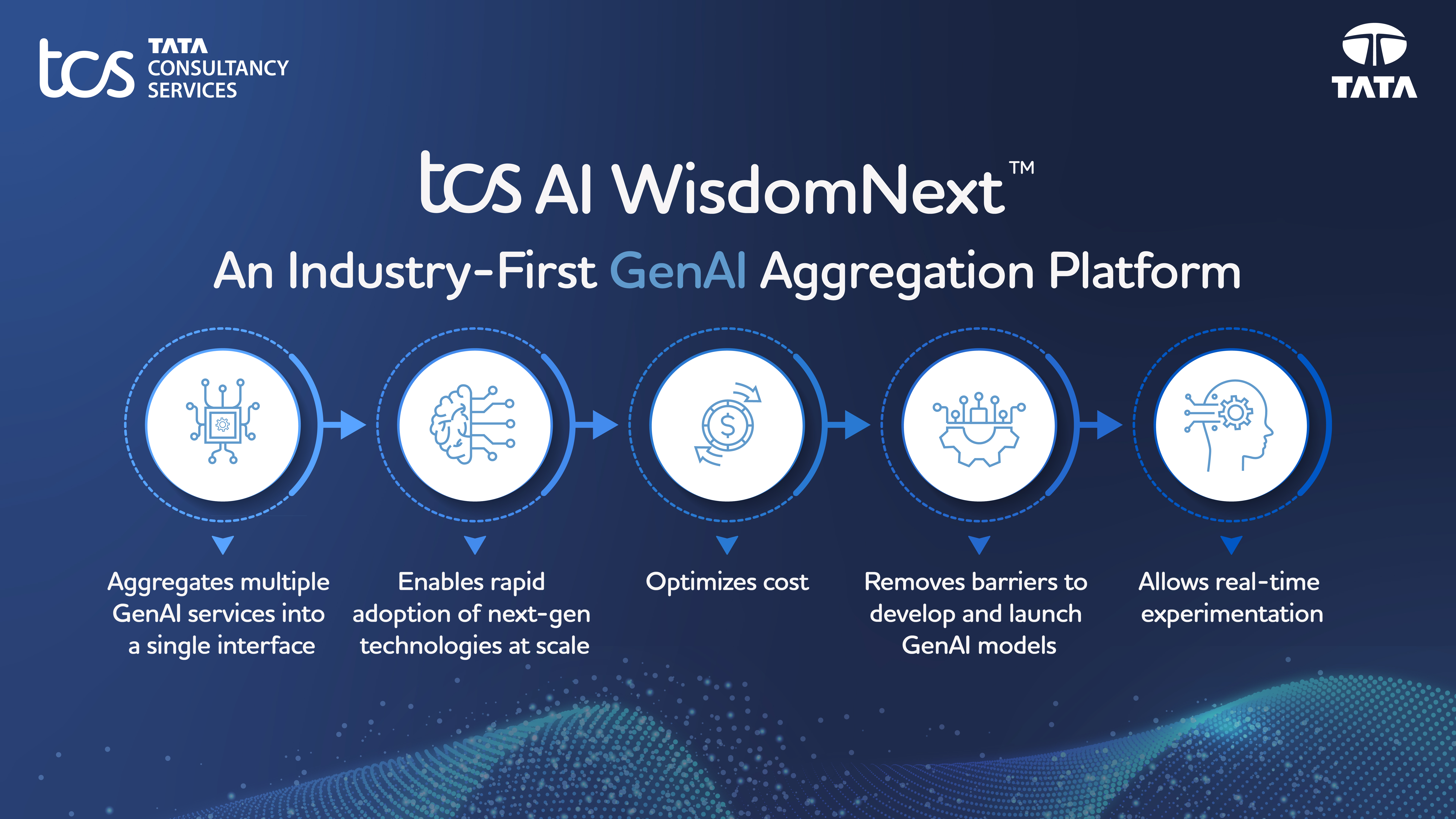
Tata Consultancy Services (TCS), a global leader in IT services, consulting, and business solutions, has launched TCS AI WisdomNext, a platform that aggregates multiple Generative Artificial Intelligence (GenAI) services into a single interface and enables organizations to rapidly adopt next-gen technologies at scale, lower costs and within regulatory frameworks. The industry-leading platform is designed to remove barriers for customers to develop and launch business solutions, allowing for real-time experimentation across vendor, internal, and open-source LLM models.

AI and GenAI have far-reaching applications across the value chain for businesses. However, solution designers around the world find it difficult to select, experiment and decide on the right foundational models to use. Foundational models are constantly evolving, and each model offers different capabilities in terms of mode of usage, cost, and effectiveness. TCS’ AI for Business Study, a comprehensive survey on the impact of AI on businesses, found that while business executives are generally positive about the impact of AI, they are less certain about the path to transformation. TCS AI WisdomNext helps businesses choose the right models and simplify the design of new business solutions using GenAI tools. It also enables businesses to reuse pre-existing components to accelerate the design.

Siva Ganesan, Head, AI.Cloud Unit, TCS, said, “TCS AI WisdomNext helps our customers take advantage of GenAI to unlock the full potential of their data, drive greater business innovation and efficiency, and gain a competitive edge. Customers appreciate the newly launched platform’s ability to help navigate a diverse and quickly evolving AI marketplace and rapidly compose ‘art-of-the-possible’ solutions. We are solving business problems and helping our customers redefine what it means to harness the power of GenAI. The rapid adoption of GenAI and experiencing what it means in terms of business outcomes is something our customers find very exciting.”

In the initial testing phase, TCS has already leveraged this powerful tool for many of its largest customers to create value for them and build prototypes. Examples include fast-tracking sales for an outdoor advertising company in the US, with real-time inventory availability and quote generation with maps Integration; enhancing productivity and efficiency across the application migration and modernization lifecycle for a leading American insurance provider; and enhancing customer experience through a smart mortgage-assistant for a leading bank in the UK.

Scott Kessler, Executive Vice President, Chief Information Officer, Northeast Shared Services, said, “GenAI presents us with the chance to elevate the value of our knowledge capital across multiple dimensions. Through access to the TCS AI WisdomNextTM platform, we can amplify our enterprise knowledge, orchestrating a seamless integration of data and insights to enhance the efficiency, innovation, and customer-centric focus of our grocery organization, thereby incrementing value at every turn.”

TCS AI WisdomNext is an integrated enterprise AI orchestration platform with features including:

  • Preconfigured industry solution blueprints
  • Intelligent ‘evaluator bots’, which enable organizations to compare available GenAI models and related technology stack choices, helping them to make more informed decisions
  • Scenarios to optimize GenAI running costs using the platform’s native intelligence
  • Centralized governance with in-built guardrails to ensure compliance with local regulations and best practices
  • Seamless portability feature across cloud platforms and GenAI ecosystems
  • Build hyper-personalized experiences, paving the way for higher customer satisfaction.

R “Ray” Wang, CEO and Principal Analyst at Constellation Research, said, “Customers seek an innovative GenAI platform that has a powerful combination of prefabricated industry blueprints, cutting-edge technologies, and orchestration capability to help businesses succeed in their future adoption strategies and innovation on GenAI. The service providers that thoughtfully make investments in GenAI and help clients transform, navigate, and experience the world of GenAI with security and ethical guardrails at its core will be the technology partners that customers will trust to deliver on the promises of GenAI. These AI-first technology partners can deliver on what customers seek – a new multi-model, multi-modal and multi-cloud platform.”

The AI.Cloud unit brings together TCS’ capabilities in cloud computing and artificial intelligence to cater to the contemporary needs of customers. The comprehensive portfolio of GenAI services and solutions includes consulting and advisory, solution design and prototyping, large language model training and fine-tuning, guardrail agent design, project delivery, and ongoing maintenance as well as a responsible AI framework to help enterprises navigate the ethical and safe uses of AI. With over 300,000 associates trained on the foundational skills of AI/ ML, including GenAI, TCS is also set to build one of the largest AI-ready workforces in the world. TCS AI WisdomNext is available to customers now. For more information, please visit https://on.tcs.com/TCS-AI-WisdomNext

Dell Technologies Research: GenAI a catalyst for innovation yet Irish firms struggle to keep pace with change

Generative AI (GenAI) and AI will significantly transform industries in Ireland, according to 70% of respondents to the Dell Technologies Innovation Catalyst Research.

Based on responses from 6,600 IT and business decision makers across 40 countries including 100 in Ireland, the research suggests that while there is broad optimism for AI and GenAI, the extent to which organisations are prepared for the rapid pace of change varies greatly.

71% say they are well positioned competitively and have a solid strategy in place to harness the power of AI. Moreover, nine in 10 (92%) think organisations can use GenAI responsibly.

At the same time, over half (56%) of the respondents are uncertain what their industry will look like in the next three to five years and forty-nine percent report struggling to keep pace with advancements in GenAI and other technologies. They cite the lack of the right talent (43%), lack of budget (33%) and an outdated technology environment (32%) as challenges they face in driving innovation.

To help overcome some of the challenges, fifty-nine percent of organisations are training or upskilling employees to use GenAI while six in 10 (62%) are providing AI-optimised technology to improve the work experience.

GenAI Moving from Ideation to Implementation

Respondents cite GenAI’s transformative or significant potential to deliver value in improving IT security posture (48%), enhancing the customer experience (47%) and unlocking productivity gains (42%).

More broadly, responses suggest that organisations are working through GenAI practicalities as they transition from ideation to implementation, with 75% saying they have begun implementing GenAI. As organisations increase adoption, concern centres around understanding where risks reside and who is responsible for them. Sixty-six percent agree that the organisation, rather than the machine, the user or the public, is responsible for any AI malfunction or undesired behaviour. 

Catherine Doyle, Managing Director at Dell Technologies Ireland, said: “In today’s rapidly evolving landscape, the power of Generative AI and other emerging technologies cannot be understated. Our research underscores the transformative potential of GenAI to drive innovation in every industry across Ireland. Businesses are now harnessing the power of AI to unlock the value hidden within their data, propelling growth and driving innovation forward.

“However, it’s clear that while optimism abounds, many organisations are struggling to keep pace with rapid advancements in technology. It’s vital for leaders to not only recognise the potential of GenAI but also to act swiftly in using its potential to turn ideas into tangible innovation. By leveraging the capabilities of Generative AI and investing in the right technology infrastructure, businesses can position themselves for success in this era of unprecedented change.”

The Right Technology Infrastructure will help Organisations to Succeed

The research also reveals modern data infrastructure’s critical role as technologies like GenAI gather pace and data volumes increase. Investing in a modern, scalable infrastructure was cited as the number one area of improvement for businesses to accelerate innovation. Most IT decision makers (66%) say they prefer an on-prem or hybrid model, to address the challenges they foresee with implementing GenAI.

The ability to share data across the business is also a key part of the innovation puzzle, with only 1 in 3 (33%) saying they can turn data into real-time insights today to support innovation efforts. Moreover, 95% face data management challenges. However, responses suggest organisations are acting on this challenge, with 64% saying that data is the differentiator and their GenAI strategy must involve using and protecting that data.

Harnessing the Potential of GenAI: Balancing Innovation and Security

Generative AI has taken centre stage this year as leaders move GenAI projects from theory into practice. Consumer-grade AI, like ChatGPT, has captured everyone’s imagination with its ability to generate content. Yet, GenAI’s impact on businesses and organisations promises to be more profound from heightened productivity and transforming how we work, to developing more personalised experiences and advancing medical diagnosis.

The emerging use of GenAI presents significant opportunities as well as challenges in the field of cybersecurity. While its deep learning techniques can be used by malicious actors to create new attack vectors, GenAI can be a powerful tool to protect data and IT systems.

But what should organisations here in Ireland do to unlock the value of GenAI in a responsible manner?

Addressing the risks of GenAI

Firstly, leaders need to confront the new risks linked to the development of GenAI. The boost in speed and easy automation that GenAI allows hackers to discover vulnerabilities faster, develop malware in real-time, and develop more credible phishing emails and digital spoofing methods.

That is why it is crucial that GenAI must be taken into account in the security measures of every organisation in Ireland from now on. Steps that prevent GenAI systems from becoming the target of attacks, and reduce the chances of falling victim to fraud or new attack surfaces due to the emergence of deepfakes.

As businesses embrace the transformative power of GenAI, a critical consideration emerges in balancing the security of sensitive data amid the ever-changing global regulatory frameworks. Businesses around Ireland must navigate the complex web of data privacy laws, all while ensuring their GenAI projects don’t inadvertently leak confidential information.

Responsible deployment of GenAI requires business and IT leaders to take a proactive approach including the development of robust governance practices, continuous monitoring of GenAI systems, and also addressing the talent gap. The Dell Digital Pulse Survey published last year revealed a lack of in-house cybersecurity skills as the second most common barrier to enhancing cybersecurity.

To secure GenAI effectively, organisations must roll out cutting-edge infrastructure built on trust, starting from the hardware level and extending all the way to the data and the user. The goal is to have robust access control measures that prevent malicious access and potential misuse of IT systems.

Above all, IT leaders need to consider GenAI data risks in the four stages of the GenAI data lifecycle: data sourcing, data preparation, model customisation and operations and scaling. For each stage, the focus needs to be on mappng potentail attack vectors and migiation actions that can be taken should that risk emerge.

However, the threat landscape is not one-sided. Gen AI systems themselves are susceptible to adversarial attacks, making them potential targets for exploitation. Securing these systems starts with the development of trusted devices and infrastructure, reinforced by rigorous access control to prevent unauthorised use. Given GenAI reliance on extensive datasets for learning and decision-making, safeguarding the privacy and integrity of data is paramount.

Therefore the next step is to ensure that data classification, encryption, and secure storage and transmission of data are made possible. Looking ahead, companies should also consider having a contingency plan. Developing a strong cyber recovery strategy ensures there’s a plan B in place should something unforeseen arise.

At Dell, we recommend that businesses use advanced security approaches including adopting a zero-trust framework to protect and contain AI systems, with these principles incorporated into the design and development of AI systems.

By laying this groundwork for trust and security, businesses can harness the potential of GenAI responsibly and unlock its value while safeguarding against potential risks.

GenAI strengthens cybersecurity

As the industry works to address these risks, GenAI has emerged as a powerful technology to help organisations better protect themselves from rapidly evolving cyber threats.

GenAI provides cybersecurity professionals with the ability to analyse vast amounts of security data, use that data to predict possible threats and implement measures to prevent such attacks.

Consider, for example, detecting anomalies in network traffic or discovering suspicious email content. GenAI can then predict future threats or identify vulnerabilities because it automatically learns from past incidents and threat information feeds.

GenAI’s advanced automation can change the way we look at security, especially in the areas of prevention and detection control. By automating threat detection, GenAI reduces the time to detect and respond to attack attempts, limiting potential damage. By automating routine cybersecurity tasks, such as incident reporting or threat sharing, security teams can focus on staying one step ahead of cyber criminals.

Content creation may not be the first function that comes to mind when you think of GenAI and cybersecurity, but it is also interesting for security awareness training. By using GenAI to personalise training modules, organisations can roll out cyber training that is based on the role of individual employee, their past behaviour, and common threats they encounter. That level of detail in training can reduce human error, which is a major factor in many security incidents.

Additionally, to fully harness the true power of GenAI, security teams must maintain constant vigilance and adaptability in the face of new and evolving cyber threats. This demands a sustained investment in sophisticated defense mechanisms, including adaptive behavioural analytics and machine learning technologies. Keeping a close eye on the shifting dynamics of the cyber attacker landscape, while proactively identifying vulnerabilities and reducing the risk of fraud, is crucial in this fast-paced digital era.

An optimistic look at the future

Without a doubt, GenAI is a transformative technology with a profound impact on the cybersecurity landscape in Ireland, presenting both challenges and opportunities that demand a strategic rethink of our cybersecurity strategies.

The real value will be in developing applications that identify and respond to security threats and at the same time also can forecast potential future dangers. Automating detection processes and enhancing forensic investigations can again add a security layer while also delivering customised security training for employees, which ensures that as security operations expand, the human element remains both informed and prepared.

Business and IT decision-makers in Ireland are aware of the need to enhance their cybersecurity posture amid these changes. According to our  Dell Digital Pulse survey, a remarkable 66 % of Irish businesses are gearing up to invest in their cybersecurity this year.

At Dell Technologies, using technology responsibly is the foundation of what we do. That is why we’re working with customers and partners to leverage the benefits of GenAI while proactively addressing its risks. We recommend robust security measures, continuous monitoring, and a flexible, evolving approach to data privacy and ethics. In this way, the relationship between AI and cybersecurity will become something to be optimistic about.

By: Ivor Buckley, Field CTO at Dell Technologies Ireland and Northern Ireland