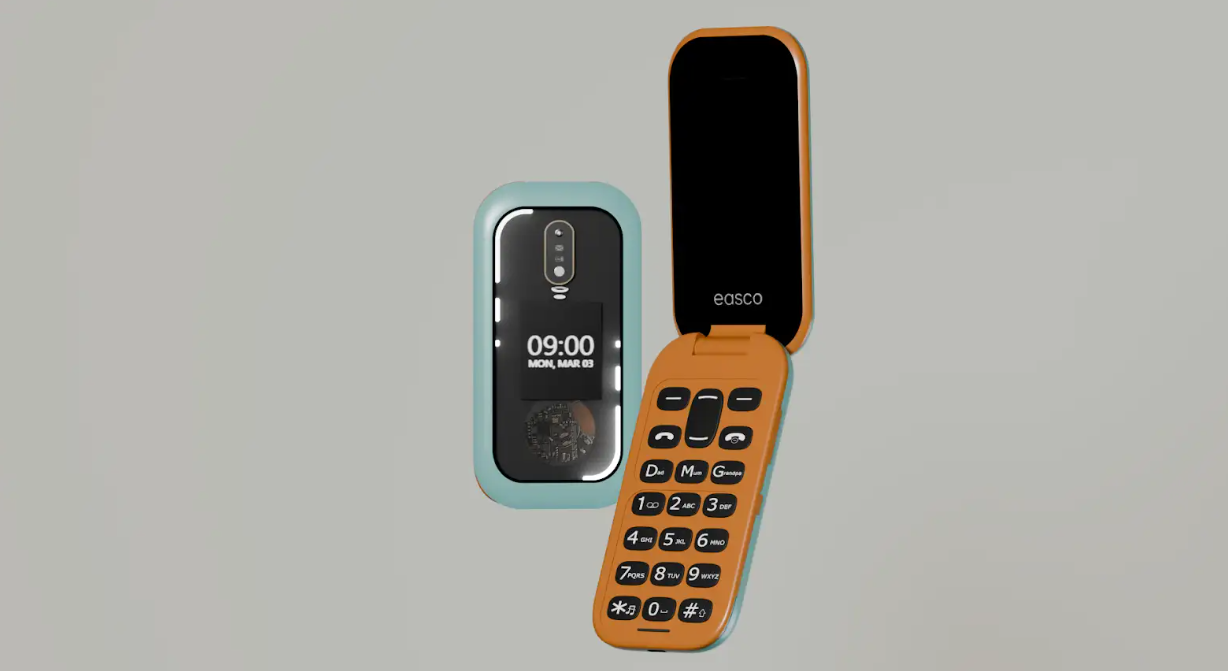
Easco, Ireland’s first homegrown mobile phone brand, will debut its latest product lineup at IFA Berlin 2025 this September. The company will reveal a brand-new Android smartphone, alongside its previously announced feature phone range, including a modern flip phone and bar device, both designed with accessibility, safety, and simplicity in mind.
Easco’s mission is to provide mobile devices that promote Ease of Communication while addressing the overexposure of children and vulnerable individuals to smartphones and social media. The phones are engineered specifically for young teens, elderly users, and those with special needs, making up over 20% of Ireland’s population.
Key features include:
Distinctive Irish design (green, black, and gold) inspired by heritage brands
4G calling and SMS without internet browsing or app stores (on feature phones)
Ultra-Wideband (UWB) tracking for safety—first in a global feature phone
Simplified UI, large tactile buttons, and an external display
New Android smartphone, offering parents and users more control with smart functions
“As the first mobile phone brand to be born in Ireland, we’re proud to build devices that reflect the Irish culture and meet the real communication needs of underserved users,” said Hao Lee, founder of Easco.
IFA Berlin 2025 runs from 5-9th of September, and Easco will be exhibiting in the MicFlip booth.
Nursing home abuse is a pervasive issue that impacts the most vulnerable members of our society. According to recent studies, approximately one in six older adults experience some form of abuse in care settings. This alarming statistic highlights the need for innovative solutions to protect residents and ensure their safety and well-being. Enter artificial intelligence (AI), a technology that has the potential to revolutionize how we identify and prevent nursing home abuse. By harnessing the power of AI, we can create a safer environment for elderly residents, empowering caregivers and families alike.
AI technologies have emerged as essential tools in various sectors, including healthcare. These intelligent systems can analyze vast amounts of data, identify patterns, and even predict potential risks. In the context of nursing homes, AI can be applied to monitor interactions between staff and residents, detect signs of abuse, and facilitate timely interventions. As we delve deeper into the role of AI in addressing nursing home abuse, it becomes clear that we are entering a new frontier in elder care—one that prioritizes safety, transparency, and accountability.
Understanding Nursing Home Abuse
According to the Law Office of Michael D. Waks, nursing home abuse manifests in several forms, including physical, emotional, financial, and neglect. Physical abuse involves inflicting harm or pain on a resident, while emotional abuse encompasses verbal assaults, threats, or humiliation. Financial abuse refers to the illegal or improper use of a resident’s funds, and neglect occurs when caregivers fail to meet the basic needs of residents. Recognizing these types of abuse is essential for developing effective prevention and intervention strategies.
The impact of nursing home abuse extends beyond the individual victim. Families endure emotional distress and often face significant financial burdens as they seek justice for their loved ones. In many cases, abuse goes unreported due to fear or lack of awareness. By leveraging AI technologies, we can enhance the detection of abuse and provide the necessary support to those affected, ultimately transforming the landscape of elder care.
The Emergence of AI in Healthcare
AI has already begun to reshape the healthcare industry, offering innovative solutions for improving patient outcomes and streamlining processes. Machine learning, natural language processing, and predictive analytics are just a few AI applications that have gained traction in recent years. These technologies enable healthcare providers to analyze patient data, predict potential health issues, and enhance decision-making.
In elder care, AI’s potential is particularly promising. For instance, AI can monitor residents’ health data in real-time, providing caregivers with valuable insights that inform care decisions. Furthermore, AI systems can streamline administrative tasks, allowing staff to focus more on resident care and less on paperwork. As the technology continues to advance, the integration of AI into nursing homes will become increasingly vital for ensuring the safety and well-being of residents.
How AI Can Identify Nursing Home Abuse
AI technologies play a crucial role in identifying nursing home abuse by monitoring interactions and analyzing data. For example, video surveillance systems equipped with AI can detect unusual behavior patterns, such as a caregiver exhibiting aggressive behavior towards a resident. These systems can alert management and initiate investigations, allowing for timely interventions that can prevent further abuse.
Moreover, AI can analyze communication patterns between residents and staff. By employing sentiment analysis, AI systems can assess the emotional tone of conversations, identifying potential signs of distress or fear among residents. This proactive approach enables nursing homes to address concerns before they escalate, fostering a culture of safety and trust.
AI’s Preventative Measures Against Abuse
In addition to identifying abuse, AI can implement preventative measures that enhance the safety of nursing home residents. For instance, AI-driven alert systems can notify caregivers when a resident exhibits signs of distress or if a caregiver’s behavior deviates from established norms. These alerts promote accountability and ensure that staff members remain vigilant in their interactions with residents.
Furthermore, AI can be instrumental in training and educating nursing home staff. By analyzing data on best practices and common pitfalls, AI systems can provide tailored training programs that improve caregiving techniques. Empowering staff with the knowledge and tools to deliver compassionate care not only reduces the risk of abuse but also enhances the overall quality of life for residents.
Ethical Considerations and Challenges
While the integration of AI in nursing homes offers significant benefits, it also raises ethical concerns that must be addressed. Privacy is a paramount consideration, as residents have the right to feel secure in their living environment. Implementing AI technologies requires careful planning to ensure that residents’ privacy is protected while still allowing for effective monitoring.
Additionally, the cost of implementing AI solutions can be a barrier for many nursing homes, particularly those with limited budgets. To overcome this challenge, collaboration among stakeholders—such as government agencies, technology providers, and care facilities—will be essential. By fostering partnerships and investing in AI technologies, we can create a more sustainable model for enhancing elder care while addressing the pressing issue of nursing home abuse.
Conclusion
The role of AI in identifying and preventing nursing home abuse represents a new frontier in elder care, one that prioritizes safety, transparency, and accountability. By leveraging AI technologies, nursing homes can enhance their ability to detect and address abuse, ultimately fostering a culture of care and respect for residents. As we move forward, it is crucial for stakeholders to embrace these innovations while addressing the ethical considerations and challenges that accompany them. Together, we can create a safer environment for our elderly population, ensuring that they receive the compassionate care they deserve. Through the integration of AI, we can pave the way for a future where nursing home abuse becomes a relic of the past, replaced by a commitment to dignity and respect for all residents.
The need to communicate does not lessen with age. If anything, older people need more communication with family, friends, support services and others. As modern technology continues to evolve, many retirees find themselves in danger of being left behind or even isolated by difficult technology.
emporia is delighted to today announce four new state-of-the-art 4G devices to the UK market that respond to this demographic’s needs, by offering connectivity in the form of simple and easy-to-use phones.
The new quad announcement sees one new smartphone, two feature phones, and a touch screen hybrid feature phone join the company’s portfolio of easy-to-use devices for the growing number of retirees. “We put ease of use first, because that’s what senior citizens want. There are still millions of people who type and don’t want to swipe, so we’re staying true to our philosophy and continuing to offer the popular feature phones in addition to the smartphones,” says Eveline Pupeter, owner and CEO of emporia telecom.
The new 4G VoLTE-compatible devices are available now through emporia’s UK distributor; Eurostar Global. The partnership started earlier this year when emporia launched in the UK market, and is strengthened with the addition of the four new devices in the distributor’s growing profile.
Millington says: “There are huge opportunities within the UK retiree category to provide handsets that mirror the needs of the users, at an accessible price point. Not one user in this demographic is the same when they reach retirement at 66. Quite simply, this means those in this demographic need mobile phones that give them each the ability to communicate easily with family and friends. I’m delighted to introduce these four new devices to retail and wholesale customers across the UK through our partnership with Eurostar Global, as I’m confident they fully understand our users and mission.”
Steve Hankey, Head of Commercial and Vendor Management at Eurostar Global adds: “An ageing global population has lead to a clearly growing market, where seniors are often left isolated and overwhelmed by technology. Eurostar Global is looking forward to being part of the solution by working closely with emporia to bring its excellent portfolio of products to UK consumers. This portfolio expansion will enable us to offer even more suitable devices to retirees around the UK.”
All four new handsets feature 4G and are VoLTE compatible, providing better connectivity and coverage, but also a crucial additional benefit for many of the retiree users; better sound quality on voice calls.
UK and Ireland MD Chris Millington comments: “4G and VoLTE are essential for us to offer this demographic the best in sound in their handsets as the technology allows us to push much wider spectrums of the call to the user and coupled with extra loud sound, this is the perfect combination for addressing age-related hearing loss (presbycusis). Ultimately, it also strengthens the senior proposition for mobile networks as our phones with VoLTE fulfil the technological requirements of the operators so that they can leverage their network connectivity.”
emporiaSMART.3mini is an easy-to-use smartphone with a stylish compact size, that fulfils all the main requirements of a smartphone but with a tailored, easy-to-use interface. Key features include: 8mp and 5mp cameras, long battery life, WiFi, Bluetooth and GPS. The 4.95-inch touchscreen has a large, clear screen for users to navigate easily and read from. This new smartphone is built with the end user in mind with; an intuitive interface, dust and splash-proofing exterior (IP54), hearing aid-compatibility, acoustic amplification, and an emergency call button.
The emporiaSMART.3mini comes with a unique training book designed to help users get the most from their smartphone, and at their own pace. It offers a point of reference so that they can independently learn more about their device without relying on family, friends or mobile stores.
SRP: £150
emporiaTOUCHsmart is a clever combination (or hybrid) of the best elements of a smartphone and feature phone. As one of the smartest clamshell phones on the market, it is operated by touchscreen but also has a well-spaced keypad for the best of both worlds. The device has a dedicated WhatsApp button for direct access to the popular messaging app. Like all emporia phones, it also has an emergency assistance call function, camera, radio and torch, and is dust and splash-proof thanks to its nano-coating (IP54).
SRP: £150
emporiaACTIVE is emporia’s latest bar phone. It has extra-large, illuminated keys, a large display with easy to read text and the optional high contrast. It is hearing aid compatible and has an emergency call function, a camera, and an alarm clock. This feature phone is ideal for users who have no need for smart features like the internet or WhatsApp, but do require a device with practical applications, geared towards their hearing and dexterity abilities.
SRP: £90
emporiaACTIVEglam is a clamshell, or flip, device, for users who are looking for a stylish yet simple to use feature phone. Like the emporiaACTIVE, the ACTIVEglam also runs on the AndroidGo operating system and offers the same essential features like illuminated keys, emergency call function, hearing aid compatibility and a camera; in a compact and secure design.
SRP: £100
Studies* commissioned by emporia have shown that older people want to retain independence in their lives – and this includes using the latest means of communication. “Retirees don’t want to have to ask someone how to send a photo via WhatsApp, email or SMS; they simply want to do it.”
“In our research, we found that more than 90% of those surveyed say that they value contact with relatives and friends. With the embedded WhatsApp button on our smart devices, they can be more involved in their families and friends’ lives – a simple picture share, or video call can strengthen that communication,” says Pupeter.
Millington adds: “For many in retirement, and facing retirement at the new state pension age of 66, they are taking daily decisions on spending and on the value they get from purchases. Their mobile phone is something they need to get maximum value from, not just in the cost of purchase, but in they way they can use it to do what they want. For many, who may have been given a device by someone else, the technology is not right for them and they will benefit from buying something which is designed specifically with them in mind.”
emporia is the European leader in easy-to-use devices for the growing number of retirees. Having recently appointed Chris Millington as UK and Ireland MD and officially launched in this market, these new feature and smartphones add to the portfolio of devices aimed at improving communication for this demographic in the form of a ‘simple to understand’ phone.