TechLabs, Ireland’s only expo dedicated to the latest in consumer tech, electronics, and lifestyle, has announced an exciting roster of additional household brand names and unmissable experiences for its upcoming event on Saturday, 18 October at Dublin’s RDS.
Dubbed as Ireland’s ultimate tech playground, the show will feature leading brands including Volvo, Dyson, Samsung, JBL and Tesla alongside additional interactive experiences such as the adrenaline-fuelled Formula 1 Sim Racing Competition and immersive roaming VR experiences.
TechLabs promises an immersive, future-forward showcase for anyone eager to discover the next big thing in technology and lifestyle. From an indoor drone display to the Tesla Optimus Gen 2 Robot, step into the future of technology under one roof.
Up to 10,000 tech enthusiasts are expected to explore cutting-edge innovations from these leading global brands in consumer electronics and smart technology. With Porsche and Harvey Norman already confirmed, TechLabs is thrilled to unveil even more highlights:
Lifestyle and Luxury – getup close with the latest speedboats and motorbikes, perfect for motoring and speed enthusiasts
Innovation Stage – live product reviews, interactive demos, and special guest speakers will share insider insights and unveil next-gen tech
What’s more – joining the already packed show floor of cutting-edge innovation are Hisense, the global leader in smart TVs and home entertainment showcasing Ireland’s largest TV; Eufy, known for its sleek smart-home gadgets from robotic vacuums to security cameras, Total Rethink, an Irish brand championing sustainable, low-waste tech and lifestyle products, and Telefunken, the legendary German name in premium audio and consumer electronics. TechLabs arrives just in time for visitors eager to test-drive the latest products ahead of Black Friday deals and the Christmas shopping season to spark some gift inspiration for the tech lover in your life.
TechLabs is created by the organisers of GamerFest, Ireland’s leading games convention which has welcomed over 35,000 gamers to the RDS, and the NEXUS Games Conference, a leading games industry conference bringing together global decision makers and industry leaders.
CEO of TechLabs, Stuart Dempsey, says: Techlabs is about bringing the future into the present and making it accessible for everyone. We’re creating Ireland’s tech playground – a space where families, enthusiasts and industry professionals can experience the latest innovations, explore world-class brands, and get hands on with the technology shaping tomorrow.”
The James Dyson Award, an international student design and engineering competition, opens for submissions today to its 2025 programme in 28 countries and regions. From everyday challenges to the world’s most pressing issues, the Award calls for current or recent students to submit problem-solving ideas that could make a real difference to people’s lives.
Since it was established in 2005, the James Dyson Award has supported more than 400 student inventions with €1m in prize money and a global platform. Those who progress to the final stages and are selected by James Dyson as the global winners will claim a prize of €36,000 and a chance to gain international media exposure, providing a springboard to commercialise their inventions.
Previous winners include mOm incubators, a low-cost, inflatable incubator to provide flexibility to caring for newborns in less developed areas. Invented by James Roberts, Product Design & Technology graduate from Loughborough University in the UK, mOm has gone on to support over 10,000 patients, and continues to expand its operations worldwide, including in conflict areas such as Ukraine. This year, James received an MBE for his services to engineering and entrepreneurship with mOm.
SoaPen, a previous runner-up in the US, continues to transform hand hygiene education. Invented by Parsons School of Design graduates Shubham Issar and Amanat Anand, SoaPen is a colourful pen made from soap, to teach young children handwashing in a fun way. After receiving recognition from the James Dyson Award, the team launched SoaPen in the US in 2018, and continues to pursue its mission to make hand hygiene fun and accessible, worldwide.
Sir James Dyson, Founder of Dyson, said: “I started the James Dyson Award 20 years ago with the mission to inspire and support the next generation of design engineers. The brilliant ideas we’ve seen since then prove that young people are passionate about providing solutions to the world’s most pressing problems, using design, engineering and technology – in medicine, the environment and much more. I look forward to discovering what inventions will be put forward this year – good luck!”
The deadline to apply is midnight on 16th July 2025. Shortlisted entries in each participating country or region will then be evaluated by national judging panels with expertise across design and engineering, based on functionality, design process, differentiation, and commercial viability.
The National Winners, selected by these judging panels and each winning a €6,000 prize, will be announced on 10th September, the Global Top 20 Shortlist, selected by Dyson Engineers, on 15th October, and the Global Winners, selected by James Dyson, on 5th November.
The international student design competition, which has now supported more than 400 problem-solving inventions from young engineers and scientists worldwide, received nearly 2,000 entries this year.
Speaking of the 2024 winners, James Dyson said: “We started the James Dyson Award nearly 20 years ago to encourage students at university to solve problems. And we’ve had thousands and thousands of entries since. It’s wonderfully encouraging to see how many students have solutions to severe global problems. Instead of sitting back and talking about it, they’re doing something about it – and that’s what the James Dyson Award encourages. We’ve got two brilliant winners this year which we’re thrilled to support, and I hope the Award will give them a springboard to future success.”
James Dyson surprised Olivia, Shane and Danial with the exciting news during an online video call.
Medical Winner – Athena, by Olivia Humphreys from Ireland.
The problem
Some 65-99% of patients going through chemotherapy will be affected by chemo-induced hair loss. Current hair-loss prevention techniques commonly use scalp cooling, a method which involves applying ice cold temperatures to the scalp before, during, and after chemotherapy, which can be very painful for patients. It mitigates hair loss by shrinking blood vessels and limiting blood flow to the scalp. After chemotherapy, cooling can also help hair grow back faster and stronger.
However, the availability of scalp cooling is limited due to its high costs. This year’s Medical Winner is from Ireland where the Minister for Health estimated the total cost of installing a scalp cooling machine at €216,000, with additional costs needed for staffing as the treatment requires additional help to operate the equipment.
Ensuring the equipment fits the patient properly and the extended time it means someone needs to be in hospital for are additional hurdles. There are cheaper, manual cooling alternatives available, yet these are less powerful, and they don’t provide long-lasting effects.
Not all hospitals offer scalp cooling for patients too. In fact, in Ireland, scalp cooling is only available in eight out of the country’s 86 hospitals.
The solution
Olivia Humphreys, a 24-year-old product design and technology graduate, invented Athena to tackle these issues after witnessing the impact of chemotherapy-induced hair loss when her mother was diagnosed with cancer in 2019. Having spent time with her mother during treatment, Olivia was inspired to reimagine hair-loss prevention technology.
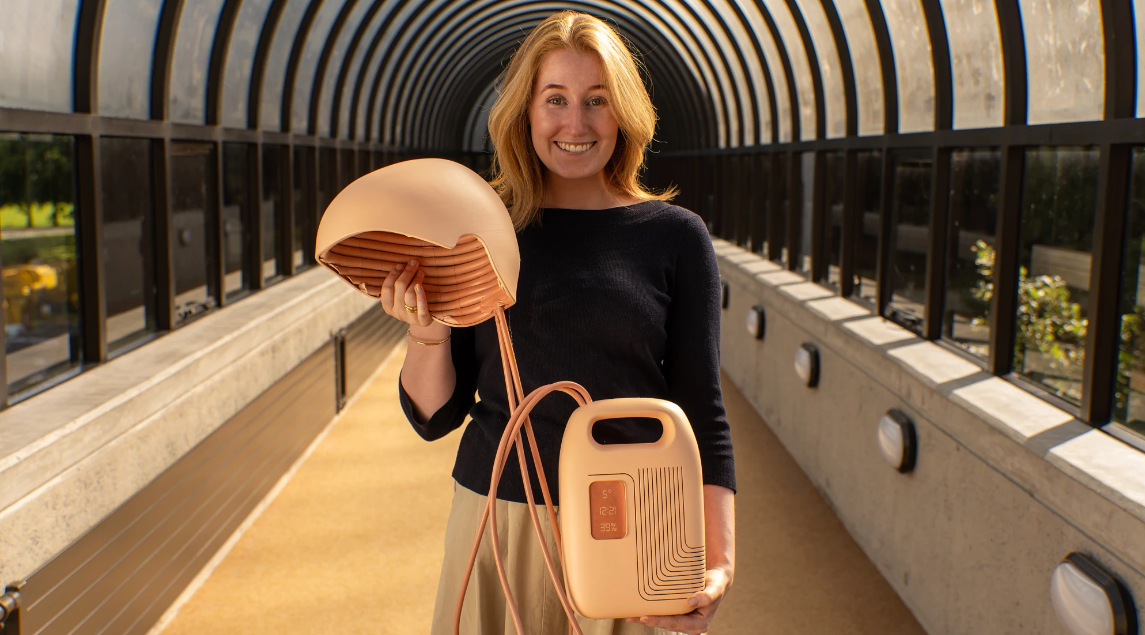
Athena is a portable, thermoelectric hair-loss prevention device that uses scalp cooling. It’s more cost effective and timesaving than current hospital models, without compromising on the quality of treatment. For those exploring advanced hair wellness solutions and scalp care.
Current scalp cooling products use refrigeration technology requiring constant plugged in power. The patient must arrive at hospital 30 minutes early and stay for 90 minutes after infusion for pre and post scalp cooling. Battery powered Athena, weighing around 3kg, consists of a carry case and a cooling headpiece, that fits to different head shapes, and enables people to spend less time in hospital on a chemotherapy infusion day. It works by using low-cost thermoelectric semiconductors called Peltiers, and these cool a tank of water, which circulates the cold water around the head with the smartly designed headpiece.
With Athena, patients can start and end the scalp-cooling process themselves from wherever they wish, such as the comfort of their own home. At full power, it can run for 3.5 hours, allowing the patient to commute to and from the hospital while cooling, and move around during infusion, such as for bathroom visits. Athena aims to give control back to patients during a time when they usually have little of it.
Athena is patient-centric and so Olivia also chose bright colours for the device’s materials as a change from conventional, clinical colours found in hospitals. Taking its name from the powerful Greek Goddess of wisdom and battle strategy, for Humphreys, Athena is a symbol of resilience, which is a quality often seen in those living with an illness as serious as cancer and going through the necessary treatments.
The estimated cost for Athena would be around €1,000, according to Olivia, which is significantly less than industry machines which start at around €20,000. Athena has the potential to make hair-loss prevention more accessible and affordable for both patients and healthcare providers – Olivia’s ideal scenario would involve partnering with hospitals and charities to offer Athena through a rental or loan scheme.
To take Athena to the next level, extensive research and development is required, and the James Dyson Award prize money will kickstart this. Long term, Olivia is exploring novel technologies for future hair loss prevention methods beyond scalp cooling.
James Dyson, Founder of Dyson, said: “I haven’t had cancer, but members of my family have had cancer and hair loss is a particularly depressing and debilitating part of chemotherapy treatment. You can freeze your scalp which you have to do in special facilities, but these aren’t always available, are costly and it’s very painful. This year’s Medical Winner, Olivia Humphreys, has tackled this problem by designing Athena, for portable scalp cooling. You can wear it while you travel, you can wear it in the car to and from hospital, you can use it at home – it’s a low-cost alternative available to everybody, with the potential to make a real difference.”
Speaking about the development of Athena, Olivia Humphreys said: “I decided to build a working prototype to test the capabilities of the Peltier semiconductors. Using a Peltier computer cooling fan system, a diaphragm pump, my mum’s old suitcase, and my dad’s plane battery, I was able to create a strong proof of concept to gather valuable feedback to develop the concept. Following this, I focused on the product’s form, creating cardboard and foam models and determining functionality aspects and touchpoints to ensure the best user experience. Ultimately, I arrived at my final model, Athena, which was crafted using SolidWorks 3D CAD modelling.”
On winning the James Dyson Award, Olivia said: “I’m incredibly proud of the hard work, ambition, and commitment that went into creating Athena. The recognition from the James Dyson Award validates not just my efforts, but also the stories and insights shared by people who’ve experienced cancer treatment. My mum inspired this journey, and it’s incredibly emotional and rewarding to have my project reach this level. The Award has motivated me to recognise my potential, and it opens up exciting opportunities for me as a young designer and innovator.”
Professor Mark Beresford, Consultant Oncologist at the Royal United Hospital Bath, said: “Hair loss is one of the most outward and distressing side effects of chemotherapy. Current scalp cooling techniques can reduce the risk or extent of hair loss, but need to be attached in the chemotherapy unit for a period of time before and after the chemotherapy infusion, committing patients to a long day in hospital. This new mobile version will allow patients more freedom, reclaiming some of their day, and also free-up valuable chemotherapy chair time for other patients to receive treatment.”
Liz Yeates, CEO of the Marie Keating Foundation, said:“I want to congratulate Olivia for creating the mobile scalp cooling device and being awarded this year’s global winner of the James Dyson Award. Any invention that can help prevent hair loss for cancer patients undergoing chemotherapy would be so positively received. When I went through cancer, there was no option for me to use a scalp cooling device, and losing your hair can be one of the most devastating impacts for most people. This device offers new hope, and it could make a real difference for those facing chemotherapy in the future. Any use of scalp cooling should always be under the guidance and direction of the patient’s oncology or cancer care team.”
Sustainability Winner – airXeed Radiosonde, by Shane Kyi Hla Win and Danial Sufiyan Bin Shaiful from Singapore.
The problem
Every day, weather stations worldwide launch devices via weather balloons that gather critical atmospheric data for accurate weather forecasting. These small devices, called radiosondes, measure air pressure, temperature, humidity, wind speed and direction and transmit this data back to ground stations, helping meteorologists track weather patterns and forecast conditions. However, current devices are single-use and contribute to tonnes of plastic and e-waste globally.
After reaching high altitudes, the balloon carrying the device bursts, and the sensor descends rapidly, often crashing in remote and costly-to-retrieve locations, without collecting further atmospheric data as it falls.
There are 1,300 weather stations around the world, and it’s predicted they release at least two single-use radiosondes per day. So, over a year, almost one million radiosondes are released, costing $190million and estimated to cause 48 tonnes of e-waste.
These devices are crucial to the rapidly growing weather forecasting industry, valued at over $2.25 billion in 2023 and projected to reach approximately $5.23 billion by 2032. This growth is driven by the rising demand for precise weather forecasting across sectors like agriculture, energy, transportation, and aviation. Extreme weather events have increased the demand for better forecasting systems too.
The solution
This year’s global Sustainability Winner aims to make weather forecasting more eco-friendly. AirXeed Radiosonde is a reusable device tackling the amount of e-waste created by single-use radiosondes on the market. It also aims to increase the amount of atmospheric data these devices collect, improving quality of forecasting.
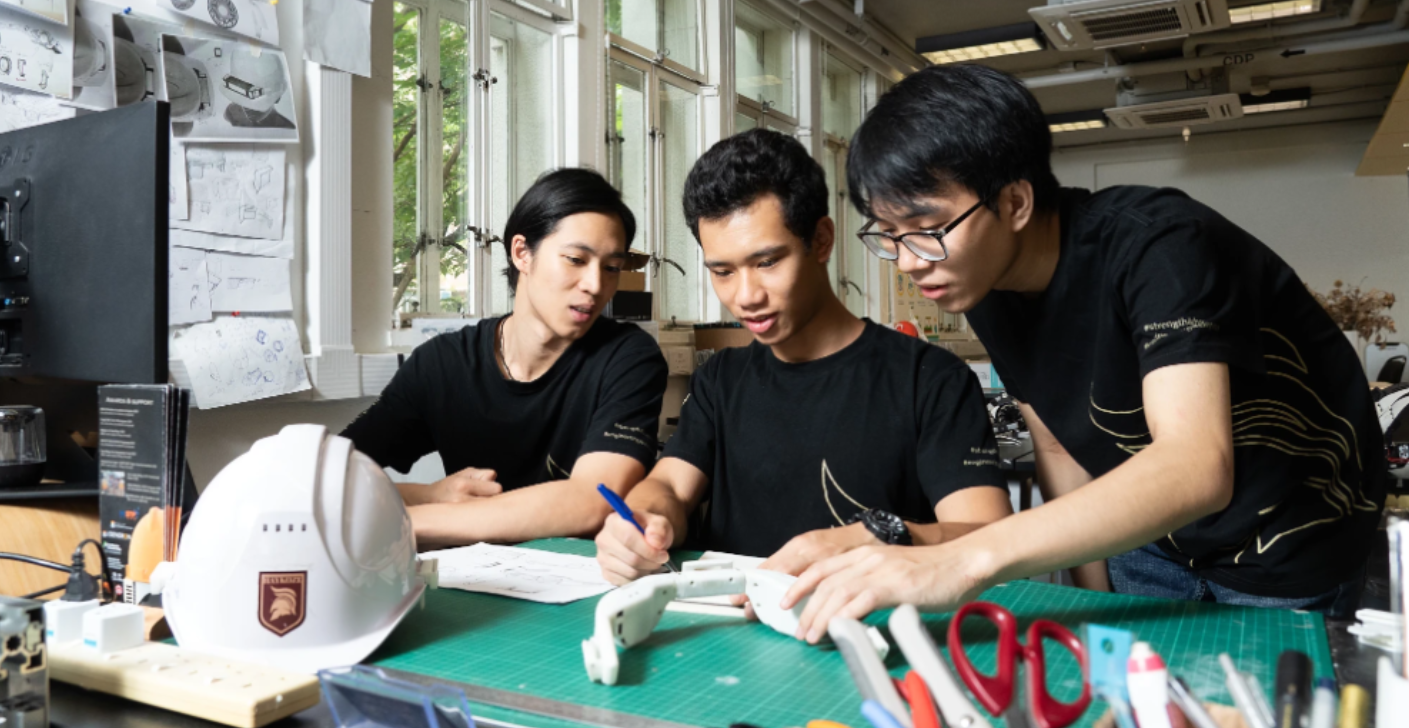
Young engineers Shane Kyi Hla Win and Danial Sufiyan Bin Shaiful, from the Singapore University of Technology and Design, drew inspiration from nature to create airXeed Radiosonde. Their focus was to improve the descent and end-of-life of a radiosonde to make them reusable, reducing e-waste and minimising pollution in remote areas.
The team used the autorotation of maple seeds in their solution. A maple seed’s asymmetrical shape creates lift and drag, allowing it to spin like a helicopter as it falls. Shane and Danial applied this principle to their radiosonde design, enabling it to spiral during descent. This not only slows the device, preventing damage upon impact with the ground, but also increases the likelihood of it landing in an accessible location, making retrieval and reuse easier. The team used machine learning to optimise this design for the best flight performance. AirXeed’s controlled descent allows it to collect and transmit more atmospheric data to weather stations, as traditional radiosondes cannot do this.
To avoid collision with aircraft, and very windy conditions that could deviate the descent, Shane and Danial’s device stops auto rotating when passing through aircraft cruise altitude. It enters a dive mode to increase its speed. The team have also added an onboard controller to manage the device’s stability and flight path to land without impact near the closest collection zone for reuse.
This controller is enhanced by machine learning to estimate wind speed and direction onboard, as well as select the best landing location. Collection zones would be established based on weather patterns and local government collaboration. Equipped with GPS and flight navigation, the radiosonde would select the optimal collection zone from multiple options at each weather station, ensuring a smooth return based on weather and flight trajectory.
Shane and Danial prioritised sustainability in their material choice, using balsa wood and foam for the lightweight wing and cowling. Modular components allow for easy replacement and recycling of worn parts, catering to industry needs.
After winning the James Dyson Award, Shane and Danial hope to collaborate with more weather stations and weather sensor manufacturers for real-world trials to gather data and feedback to improve their invention, to ultimately bring airXeed Radiosonde to market.
James Dyson, Founder of Dyson, said: “Weather balloons that collect atmospheric information fall back to Earth and pollute the environment with electronic waste. Shane and Danial, our Sustainability Winners, have found a way of returning these devices to Earth highly intelligently to where the operators want them to land. AirXeed Radiosonde uses the maple seed principle, helicoptering down gently but also plummeting in areas where there are likely to be planes. This is a reusable weather detector, saving environmental waste and saving money. I think it’s a very clever idea.”
On winning the James Dyson Award, Shane said: “Winning the James Dyson Award global sustainability prize is a huge step forward for us. It shows that our design has potential and gives us a platform to showcase how airXeed Radiosonde can positively improve the weather industry – hearing it from James Dyson himself makes it even more special. It’s incredibly motivating to see such a prominent figure in innovation take the time to encourage young inventors like us, developing solutions that are sustainable and address critical global challenges”.
On what’s next for the team, Danial said: “With the Award’s recognition, we hope to connect with experts in the weather industry, secure partnerships and attract funding to further test and develop our design. It’s a huge boost in our journey towards turning airXeed Radiosonde into a fully realised solution that can reduce electronic waste and make weather monitoring smarter
Today, the James Dyson Award celebrates the best inventions of 2024 by young engineers and designers around the world, as the competition’s Top 20 shortlist is unveiled and in four weeks’ time, on 13th November, someone from this shortlist will be crowned the global winners by Sir James Dyson and win €38,000/ £30,000 in prize money to accelerate their invention.
An Irish woman, Olivia Humphreys, has made the top 20 shortlist this year and is up against some genius inventions to win the top prize.
The Problem
“ Athena” which has been shortlisted for this year’sJames Dyson Award Global Top 20, tackles the problem of current scalp-cooling devices for chemotherapy patients which are not mobile and are scarce in Irish hospitals. Currently there are only a handful across the country meaning many chemo patients do not get the option of using one.
Athena is a portable, thermoelectric battery-operated scalp cooling device for people undergoing chemotherapy treatment which is more cost effective and timesaving than hospital models without compromising on the quality.
Patients can manage the scalp-cooling process themselves- Athena consists of a carry case and a cooling helmet and aims to provide a more accessible, yet effective option for scalp cooling and enables people to spend less time in the hospital on a chemotherapy infusion day.
The Invention
Limerick woman Olivia (24) who is a and recent graduate of the University of Limerick where she studied Product Design and Technology, is now working as a Research and Development Intern at Luminate Medical in Galway working on medical device tech. She was inspired to create Athena having seen her mum go through chemotherapy in hospital a few years ago. Olivia was taken aback by the limited number of scalp-cooling devices available in the hospital as well as the inconvenience of the time it took to commit to this, not being able to move around whilst using industry standard hospital devices, and the time that could be saved with an improved version. This inspired her to create Athena which would be mobile, light to carry and powerful.
Olivia Humphreysnowenters the final stage of the James Dyson Award 2024, with global winners to be selected by Sir James Dyson and announced on 13th November. The winning inventions will receive €38,000 to support their further development and commercialisation.
Speaking about Athena, inventor Olivia Humphreys says: “Being recognised by the James Dyson Award has been an incredibly fulfilling experience. It reflects the invaluable input I’ve received from patients and care staff that helped me, along with the passion and hard work I have put in to get it to this point. I am truly grateful to have my project acknowledged on such a big stage. It’s exciting to know that the work I’ve done has the potential to make a real impact, and I’m inspired to keep pushing forward.”
Talking about the design of Athena, Olivia says: “This initial prototype for Athena provided a strong foundation to build upon, and I received valuable feedback on things like how to make it more compact by optimising components like the water tank, pump, and battery. I began refining the design into a smaller, lightweight carry case. As I moved forward, the product designer in me started creating more usability-focused prototypes, experimenting with different headpiece configurations and forms to ensure user comfort. The most exciting aspect of Athena is its potential for further development. My early conversations with engineers have been very positive, filled with discussions about ideas and possible tweaks. It’s exciting, there is a lot to be done!”
OTHER NOTABLE ENTRIES WHO MADE THE TOP 20 INCLUDED:
Pyri (from the UK)
In 2023, wildfires caused over 300 deaths and cost $50bn globally. Pyri is a bio-inspired and bio-based early wildfire detection system for remote and low-cost widespread coverage. The heat from nascent wildfires activates Pyri’s novel organic electronics which emit a radio frequency signal to alert vulnerable communities. Designed for remote, unprepared, vulnerable communities, and beyond.
These young inventors of Pyri, are a team comprised of Richard Alexandre, Karina Gunadi, Blake Goodwyn and Tanghao Yu (aged between 24 and 33). They met while studying a double masters in Innovation Design Engineering at Imperial College and the Royal College of Art in London. The group came to their course from different backgrounds and with different experiences, making it a dynamic and diverse team.
Having applied for a patent in July 2024, the team at Pyri worked tirelessly to produce over 20 experimental prototypes, testing and re-creating continuously to produce the device they have today. Richard, Blake, Tanghao and Karina worked on numerous iterations of Pyri and spent months working on power and trigger concepts, as well as exploring over 46 material combinations to create this problem-solving invention.
PulpaTronics (from the UK)
Over 40bn RFID tags are produced annually with most ending up in landfills, wasting resources and energy, increasing CO2 emissions and e-waste. PulpaTronics unlocks more sustainable and accessible inventory management solutions utilizing chipless RFID technology featuring fully recyclable paper RFID tags for a more circular economy. Recent graduates and students Barna Soma Biro, Chloe So and Adonis Christodoulou invented PulpaTronics to solve this problem of waste in the fashion industry with a more sustainable solution. O
The novel technology replaces the metal antenna by laser-inducing a carbon-based conductive material onto paper. Using a chipless design, these tags store information in the geometric pattern of the conductor instead of a microchip. The team at PulpaTronics filed a US patent in October 2023 and a UK patent in March 2024 which are currently pending, and they are looking to internationalise them in the near future.
The team at PulpaTronics see their sustainable RFID tags as the vehicle to enable item-level tracking. They will be testing the performance of their tags in a real-world environment through two pilots early next year. Once the two pending patents are approved, they also look to license out the technology so that they can integrate the laser heads directly into the production line, streamlining manufacturing even more to scale up quickly. They are also working towards developing prototype tags to carry out initial trials with a few large retailers.
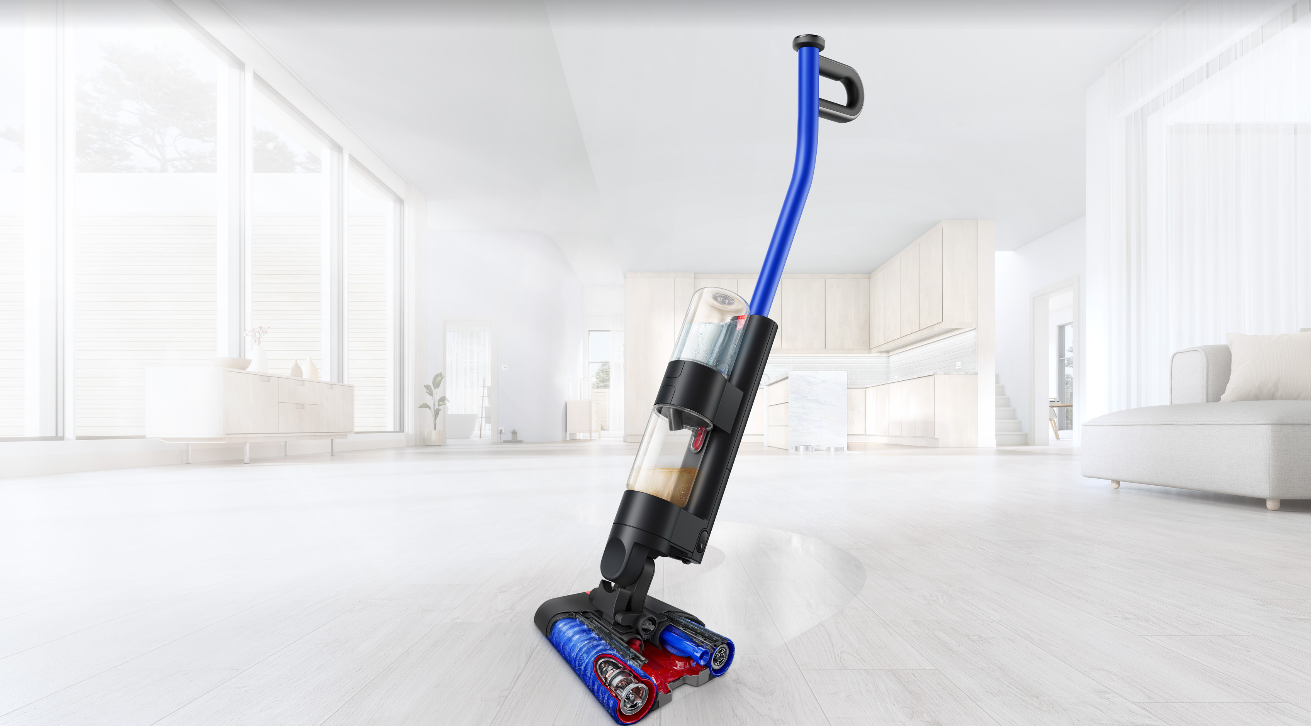
Dyson unveils its latest floorcare technology, designed to pick-up wet and dry debris in one go to deliver a hygienic clean on hard floors, across large spaces. With a 1 litre clean-water tank to cover flooring up to 290m2, the Dyson WashG1 uses a combination of hydration, absorption, and extraction technologies to remove wet and dry debris in one go – automatically separating it out, so maintenance is more hygienic.
Charlie Park, Vice President of Dyson Home Engineering at Dyson says;
“Wet cleaning is considered a necessary chore globally and the perceived burden has been the target of a vast array of wet floor cleaning formats. Despite this, users’ expectations are often left unfulfilled when it comes to stain removal, pick-up performance, and floor finish. Dyson engineers solve the problems others ignore and we thrive on the challenge of creating better technology. The Dyson WashG1 is the result of this; our first dedicated wet machine to wash hard floors, properly and hygienically.”
“Most of us vacuum our homes regularly. But whilst wet cleaning is considered a necessary chore globally, many of us don’t know why we do it beyond the vague notion of hygiene. In fact, cleaning with water is essential to rehydrate and remove tough, dried-on stains. Over the years, a vast array of wet floor cleaning formats have emerged to help us tackle this chore yet users’ expectations are often left unfulfilled when it comes to stain removal, pick-up performance and floor finish. Dyson engineers solve the problems others ignore and we thrive on the challenge of creating better technology. The Dyson WashG1 is the result of this; our first dedicated wet machine to wash hard floors, properly and hygienically.”
Highly absorbent, counter-rotating rollers
Two individually powered rollers counter-rotate whilst a pulse-modulated pump distributes water evenly across 26 precisely positioned hydration points, along the full width of each roller.
Each roller is made up of a highly absorbent microfibre, with 64,800 filaments per cm2. This combination of high density microfibre and consistent application of clean water ensures liquid spills are absorbed, whilst dry dirt, debris, and hair is enveloped by the millions of filaments. By positioning two rollers at the front and back of the machine, Dyson engineers also achieved longer dwell time on stains with each pass, for powerful and fast stain removal.
Pioneering separation technology for hygienic maintenance
Dyson’s unique separation technology divides debris and dirty water at source, for hygienic, no-touch disposal. Dirty water is extracted from the rollers by durable extraction plates, whilst secondary nylon-bristled inner brush bars remove dirt and debris from the microfibre rollers, flicking it straight into a removable debris tray.
A vacuum cleaner with a blue and red roller
Description automatically generated
The debris tray has been designed with a 500-micron mesh to separate dirty water from the large debris. Powered by an extraction pump, dirty water is immediately collected in a 0.8 litre capacity dirty water tank, without allowing large debris to pass through the machine. Keeping the dirt and debris in the head of the machine, and the dirty water in a separate tank allows for easy and hygienic disposal. To further support ease-of-maintenance for users, the Dyson WashG1 has been intricately designed without sharp internal surfaces or crevices, to help lessen dirt or grime build up inside the machine. Both water tanks have been designed with large openings to allow for easy maintenance and cleaning.
After use, the self-cleaning mode saturates both rollers with clean water on the highest boost setting, flushing the entire system in preparation for the next clean.
Customised hydration control for an optimum floor finish
A vacuum cleaner with a blue roll
Description automatically generated
The Dyson WashG1 has been designed with in-use hydration control, allowing owners to select the level of hydration required based on debris type, flooring, or personal preference. The low, medium, and high modes each run continuously once selected, to provide increased levels of hydration respectively. Each mode also features an additional three sensitivity settings, to allow owners to fine tune them to their individual cleaning needs. A separate boost mode button purges each roller with the maximum amount of hydration when pressed, for removal of stubborn dirt and dried on stains.
“Stain removal performance is dependent on the correlation of hydration of the floor and agitation applied. We’ve engineered our machine to allow owners full control, enabling them to deep clean their homes effectively.” – Charlie Park, VP of Dyson Home Engineering at Dyson.
Manoeuvrability and edge-to-edge cleaning
The rollers span the full width of the cleaner head to allow for edge-to-edge cleaning, right to the corners. The Dyson WashG1 has been designed with two motors that sit within each microfibre roller, spinning in opposite directions so they clean in both directions.
For optimised manoeuvrability, Dyson engineers fine-tuned each motor to spin at a consistent speed in accordance with the hydration mode selected, allowing the machine to glide effortlessly whilst cleaning is in process. Adopting technology from the Dyson Omni-glide, casters provide additional balance and weight support, whilst the low cleaner head height allows for easy reach underneath furniture.
Available from August 20th www.dyson.ie and Dyson stockists
Today, Dyson unveils its first high-fidelity, audio-only headphones: the Dyson OnTrac™ headphones. Offering best-in-class noise cancellation, these headphones deliver up to 55 hours² of immersive listening.
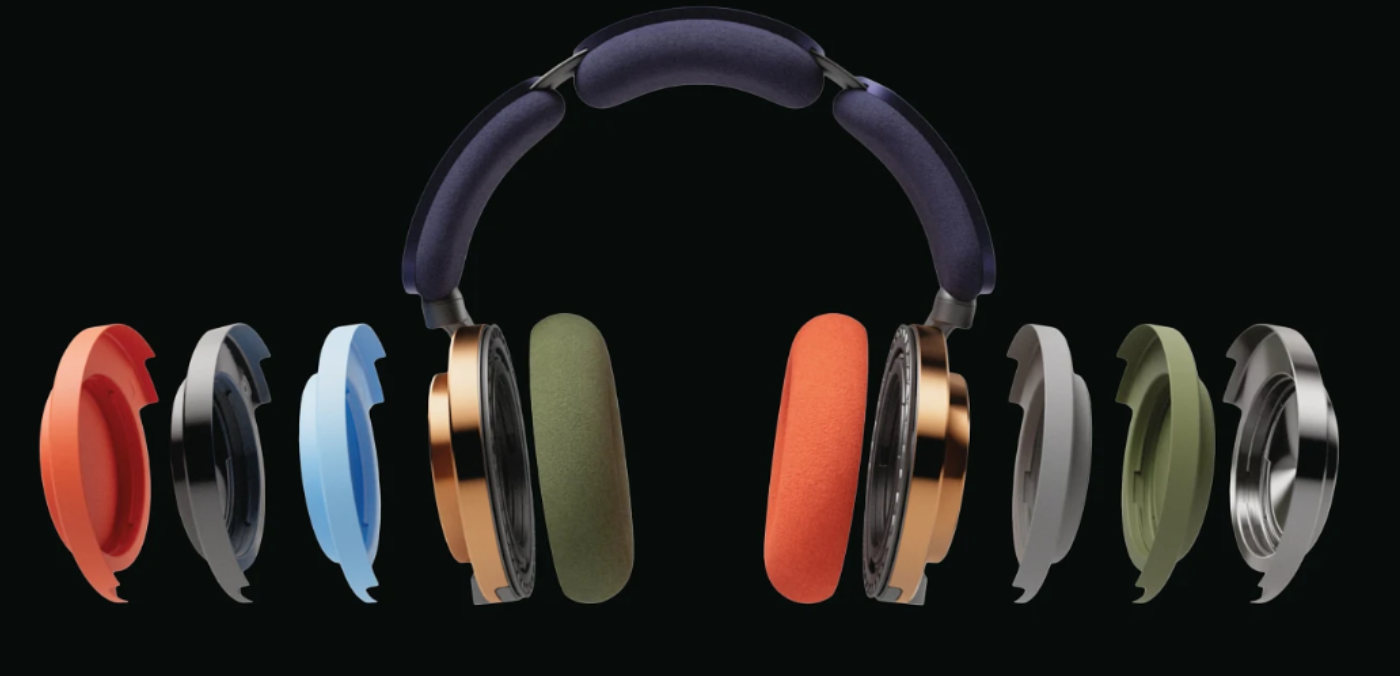
With over 2,000 customisable colour combinations for outer caps and ear cushions, each ear cushion is crafted from ultra-soft microfiber and high-grade foam for superior comfort and acoustic seal. Multi-pivot gimbal arms and a uniquely positioned battery in the headband ensure balanced weight distribution.
Jake Dyson, Chief Engineer: “Dyson’s audio engineering mission is to preserve the integrity of the artist’s sound wave, free from interference. We also wanted to create a set of headphones that people would cherish, be excited by, and be proud of. With over 30 years of experience in aeroacoustics, we’ve mastered sound physics. By reducing noise through in-house anechoic chambers and expert engineers, we’ve applied and further expanded our audio knowledge to develop the Dyson OnTrac™ headphones. Our first over-ear audio only headphones deliver best-in-class ANC, exceptional sound quality, and all-day comfort through unique materials, design and customisation.”
Best-in-Class Noise Cancellation
To create an optimal listening environment, the Dyson OnTrac™ features a custom Active Noise Cancellation (ANC) algorithm which uses 8 microphones, sampling external sound 384,000 times a second. This combines with superior materials and carefully designed internal geometry to cancel up to 40dB of unwanted noise.
Enhanced Sound Range
With 40mm, 16-ohm neodymium speaker drivers and advanced audio signal processing, the Dyson OnTrac™ ensures that every note or word is delivered with precision. The headphones reproduce frequencies from as low as 6 Hertz to as high as 21,000 Hertz, providing deep sub-bass that you can feel, and clear highs at the upper end of the frequency range. Meanwhile, the speaker housing tilted 13˚ towards the ear for a more direct audio response.
55-Hour Battery Life with ANC
With up to 55-hour battery life, Dyson OnTrac™ provides up to two weeks of listening even with ANC enabled. The two high-capacity lithium-ion battery cells are suspended in the headband for more even weight distribution. To switch between ANC on and off, simply double tap on either ear cup.
Engineered for All-Day Comfort and Acoustics
Certified comfortable by US Ergonomics, Dyson OnTrac™ unites comfort and acoustics with precision. Select materials and ergonomic design ensure a superior acoustic seal and lasting comfort. High-grade foam cushions and multi-pivot gimbal arms relieve ear pressure, while battery positioning in the headband evenly distributes weight. Soft micro-suede ear cushions and optimized clamp force provide a consistent fit across diverse head sizes.
Customisable with Durable Materials and Premium Finishes
The Dyson OnTrac™ comes in four colourways, each precision-crafted with unique, durable finishes designed by Jake Dyson and our CMF team. Inspired by the CNC manufacturing process, options include CNC Aluminium, Copper, and Nickel. The Ceramic Cinnabar variant has a ceramic-feel painted finish. In addition to these four colourways, you are able to customise your Dyson OnTrac™ with custom outer caps and ear cushions in various colours and finishes.
Launch Colourways – Available direct from www.dyson.ie Price €499.00 from 1st August.
CNC Black Nickel
Ceramic Cinnabar
CNC Aluminium
CNC Copper
Available caps and cushions for customisation – Available direct from www.dyson.ie from Aug 1st 2024.
The outer caps are machined from high-grade aluminium, for a lightweight, durable finish in a range of colours and finishes – ceramic or anodised. Each set is costed at €49.00
MyDyson™ App
The MyDyson™ app, includes real-time sound tracking that monitors in-ear and external volume, alerting users to potentially harmful levels. The MyDyson™ app³ also enables owners to choose between three custom EQ modes: Bass Boost, Neutral and Enhanced.
Additional Features –
Head Detect: Capacitive sensors detect when earcups are removed from the ears, signalling to pause your audio. Audio resumes automatically once replaced.
Intuitive Joystick: Easily play, pause, skip, fast forward, and rewind tracks, or hold down for voice commands.
Crystal-Clear Calls: Dual beam-forming microphones pick up your voice clearly, not outside noise.
Real-time sound tracking: Continuously monitors in-ear and external volume, and indicates potentially harmful levels through live reports in the MyDyson™ App.
Controlled by the MyDyson™ app: The MyDyson™ app gives you automatic software updates.
Check out our Dyson Air headphones review these are super cool
Cleaning can be a thankless task. As you head towards the Spring Clean finish line, you may think you can’t go wrong, yet amid navigating chair legs and under furniture, moving between rooms and sidestepping our furry friends, it’s easy to inadvertently miss areas, or repeatedly vacuum the same spot, reducing efficacy and wasting time.
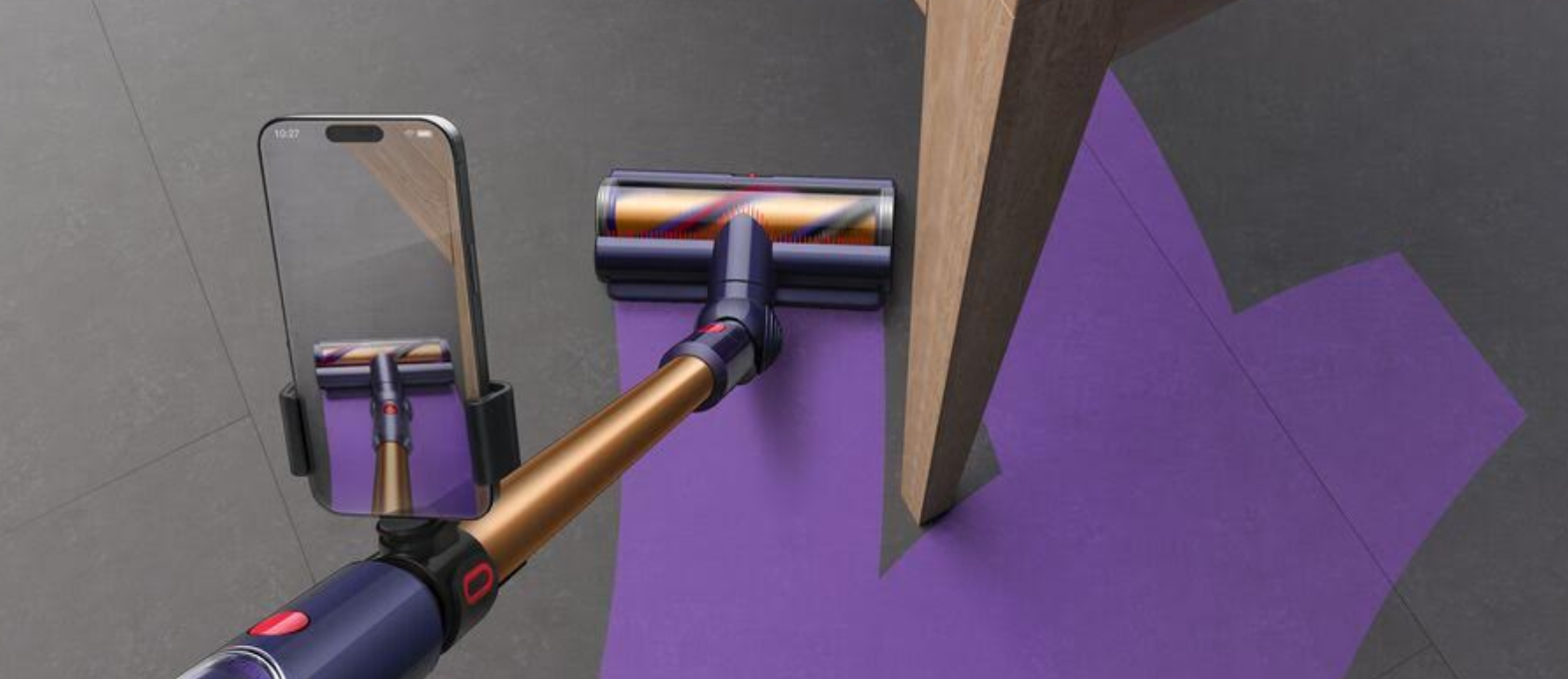
Taking inspiration from the systematic cleaning approach of the Dyson 360 Vis Nav robotic vacuum cleaner, the Dyson CleanTrace helps users to clean more methodically by providing real-time AR visualisations of where they have cleaned and the spots they have missed, removing the guesswork and solving the have-I-cleaned-there-yet quandary.
The Dyson CleanTrace brings together a combination of technologies for the most powerful, intelligent and thorough clean. LiDAR technology from a user’s phone allows the Dyson CleanTrace to map your room and overlays cleaning pathways using AR, showing you where you have cleaned and what you have missed. When you’ve finished cleaning, you can scan the room with your phone to identify gaps, so you never miss a spot. The existing technology within the Dyson Gen5detect then acoustically senses and counts the dust particles, showing proof of a deep clean.
“We realised that we could all learn a thing or two from the methodical cleaning approach of our robot vacuums. Unlike most humans doing the cleaning, Dyson robots know where they are in the room, where they have been, and where they have yet to go. With the Dyson CleanTrace™, we add this extra layer of cleaning intelligence to the Gen5detect vacuum. It gives you the ability to see where you have and haven’t cleaned, which, combined with our on-board particle sensing technology, gives proof that the floor is truly clean.” Charlie Park – VP of Engineering, Dyson Home
Inefficient cleaners
Dyson engineers are obsessive about engineering ways to improve how we clean. In addition to extensive in-lab testing, our engineers study human behaviours and cleaning habits, as well as frustrations, in the real world. They have spent hundreds of hours observing home cleaning around the world – studying how long each cleaning session lasts, effectiveness of cleaning, different vacuuming angles and patterns, even how many times a user puts down a machine during a session, all of which inform continuous innovation in floor care technology.
Research shows that consumers regularly overestimate the amount of time they clean – data shows that around 80% of cleaning sessions last less than 10 minutes, yet people claim they vacuum for an average of 24 minutes per session. Moreover, consumers are haphazard and inefficient – regularly covering the same areas multiple times and missing other spots altogether, demonstrating the need for the Dyson CleanTrace.
The Dyson CleanTrace will be available from June 2024.
Sign up to be notified when the product is available for purchase here.
Availability: The Dyson CleanTrace will be available globally from June, from Dyson.co.uk and Dyson Demo stores only.
Pricing: To be confirmed.
Weight: The Dyson CleanTrace phone clamp weighs 104g
App access: Owners will be able to open the Dyson CleanTrace software via the MyDyson app. It requires registering a Dyson Gen5detect vacuum cleaner for the module to become visible on the app home screen.
Dyson Gen5detect cordless vacuum cleaner: The most powerful HEPA cordless vacuum is powered by the new Dyson Gen5 Hyperdymium motor to deliver up to 280AW of suction power. It features our Fluffy Optic™ cleaner head that reveals twice the amount of invisible dust and traps 99.99% of particles down to 0.1 microns, the size of viruses. A piezo sensor counts and sizes particles 15,000 times per second – automatically increasing power when needed and showing proof of a deep clean
Dyson 360 Vis Nav robot vacuum: The most powerful robot vacuum with six times the suction of any other, armed with 360-degree vision and pioneering technology to know where it has been, see where to clean, detect walls to clean right to the edge, and is intelligent enough to respond to dust sensed in the home, ramping up suction power when needed
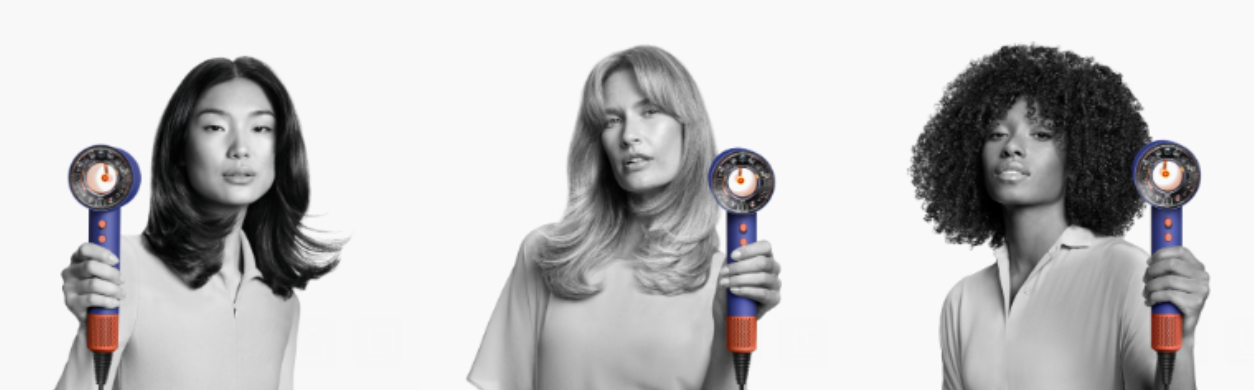
Yesterday at a global press event in Seoul, South Korea, James Dyson unveiled the Supersonic Nural™ hair dryer, its most intelligent hair dryer with new sensor technology.
“If you’re able to limit heat damage, you can get a healthier scalp; and healthier hair. Our new Supersonic NuralTM has a time of flight sensor which recognises your head and reduces the heat as it gets close to your hair, preventing heat damage to both your scalp and your hair. Innovation only comes from investing in research and development. Our obsession to truly understand the root of the problem continues, as we build up some of the most sophisticated hair laboratories in the world.”
James Dyson, Founder and Chief Engineer
Dyson’s latest styling tool comes equipped with a new Scalp protect mode which uses a network of Nural™ sensors, automatically reducing heat as it nears your head, helping protect your scalp from damage. These sensors also improve the styling experience, enhance hair shine, and prevent heat damage. New and improved attachments which cater to all hair types are equipped with attachment recognition, learning a user’s styling preferences, and simplifying their routine for fast healthy drying with no extreme heat.
Nural™ sensors for added intelligence
Dyson’s new Nural™ sensors activate Scalp protect mode, Attachment learning and Pause detect – all which help to make styling easier.
Scalp protect mode protects scalp health:In this mode, heat is automatically reduced to 55°C, the optimum temperature for scalp comfort and drying speed, as the hair dryer gets closer to hair and scalp. A time of flight sensor enables this, by projecting an invisible infrared beam to measure the distance between the machine and your hair.
Capsule illumination changes colour to show heat setting: When in Scalp protect mode, this feature ensures that the LED light colour will automatically change between yellow (low heat) to orange (medium heat) and red (high heat), depending on the distance the machine is from the head.
Attachment learning remembers your styling preferences: This simplifies styling routines as it adapts to a user’s go-to styling mode, remembering their last-used heat and airflow settings for each styling attachment, and automatically applying them the next time it is in use.
Pause detect for easier routines:The Dyson Supersonic Nural™ hair dryer also has a motion-sensing accelerometer which automatically deactivates the heater, decreasing airflow and noise, when you are in between styling passes.
“From our research into the science of hair, we know that there is a connection between the quality of hair and a healthy scalp. The scalp tissue comprises different layers, with the outermost layer serving as a barrier against external stressors. But when your scalp is damaged, moisture loss can occur, a key factor in our development of the Scalp protect mode feature. This helps to maintain scalp moisture levels, and allows for gentle drying.”
Shawn Lim, Head of Research, Dyson
Introducing new attachments
A new Wave+Curl diffuser has been engineered for waves, curls and coils. This helps define and shape natural hair patterns across two modes. In Dome mode, the large dome shape of the attachment draws airflow away from the scalp for smoother, elongated waves with rounded ends. In Diffuse mode, the pronged insert delivers air deep into the roots for defined, voluminous curls and coils.
*Recommended settings are the same as the bare attachment.
**Not equipped with Scalp Protect Mode.
Design and technology
Complementing the new embedded sensors is a differentiated visual appeal: a clear end cap to show the technology within, and bold new colour palettes – Ceramic Patina and Topaz or the Vinca Blue and Topaz.
The Supersonic Nural™ hair dryer will be available in 2024 in United Kingdom and Ireland from, priced at £399.99 and €449.99. It will come with five attachments[2] in box and other standalone accessories will be on offer. Timings will vary for other geographies. To buy, learn more and experience the Supersonic Nural™ hair dryer, visit Dyson Demo Store (Oxford Street, Bluewater, and Trafford Centre).
I am a huge headphone fan as my readers know and the same for earbuds applies to but just how huge can headphones get? The Dyson Zone would easily be the biggest pair of cans to test to date with with a premium build quality to boot so I did not really mind testing these out in the wild looking like something from a Marvel series and of course had people talking, even at home when first showing family and friends they were all like WTF are they and rightly so as they are not the usual type of headphones people see me with nor are they a common site on the streets today.
We wont go along with the “our testers” approach on this review and show you exactly how they work and what they look like for context like all our reviews and in the video review we go into that even more of this and an in depth look at the app that comes with them which gives you stats galore and most importantly what the air you breathe is like which for some today is a vital part of their daily life.
In the unboxing you will get a first glance at what is involved here and setting up after that is not a huge deal either apart from the ten minute software update I had to endure before getting them into action, you will be asked to insert the filters and mask first though then sit back and wait before you can get going, you will be asked for location however you can set it to a desired location but this will be inaccurate if you are travelling around and what the air condition is like. I suffer sometimes with asthma so for me it is an ideal product to have at my disposal.
Out of the box they are a tad heavy and cumbersome which I do not mind but once on the head they give great passive noise isolation and are comfortable, even the mask up front did not get in the way but it is not something I would sport all day long being honest but respect the purpose of it and why it is there and that works by the way with the fans keeping you cool which has different speed levels too.
OK so the purpose of these is not just for music it is to keep you filtered away from pollution and this works really well I felt better just using them and tested these in several locations around Ireland as I was travelling and you can really feel how clean the air is you breathe so to speak and it is something you need to experince for yourself to get what I mean and you can be confident about cleaner air.
There is a notification setting on the app should your filters need to be replaced too which is hand and these are simple to replace by simply twisting off the headphone cap and swapping them out and can be bought within the app itself these should last some time by the way unless you are one to be out daily using them.
The Dyson Zone solution
The Dyson Zone headphones are engineered to tackle the dual challenges of city noise and air pollution. Powered by advanced lithium-ion batteries and USB-C charging, the headphones offer 50 hours of audio-only run-time, or 4 hours of combined purification and audio run-time, charging to 100% in 3 hours.
Filters
Fan
The Dyson Zone headphones are born of Dyson’s 30 years of expertise in airflow, filtration and motors technologies and deep understanding of indoor and outdoor air quality. The compressors in each ear cup draw air through the dual-layer filters and project two streams of purified air to the wearer’s nose and mouth, channeled through the non-contact detachable visor. Electrostatic filters capture 99% of particle pollution as small as 0.1 microns², whilst K-Carbon, potassium-enriched carbon filters target prevalent acidic gases most associated with city pollution, including NO₂ and SO₂.
The App
Next up is the sound department which I am happy to report is superb as you can see above there is an app with EQ settings and this allows you customise them to and extent I would have like to see more in here however anyone that I let try them out in the family and friends circle where as impressed as I was here with how these sounded and from a person that does the most headphone and earphone reviews in Ireland these stood out with the clarity of the audio given here which is great considering the price on them, they are up there with the best in the game when it comes to the audio and hopefully their app gets better over time with new features.
Highs lows and mids all great nice bass and decently loud volume which is how I like it, no lag latency no distortion when maxed out on volume either and simply just great not missing a beat nor instrumentals and background noise in films and so on you will be happy with the audio experience trust me.
Dyson Zone headphone controls – techbuzzireland
The controls are also great with a navi pad type option here which allows to to manage just about everything on them like skip and reverse tracks play and pause higher and lower the volume and access your voice assistant, you can also double tap the cup to change the noise cancelling effects and so on and this also worked well aside all the tech that is on the cup itself.
Overall then my conclusion is these will not be for everyone but this also should be kept in mind as the saying goes “do not knock it until you try it” as for the face visor it might put people off but it can be removed which then takes away the purpose of buying them as a whole they sound is fantastic and that is important as well as breathing in clean air on the go, they are a tad cumbersome but you can forgive it when you look a the package as a whole.
Features on sound·
Fly the world twice: The Dyson Zone™ noise-cancelling headphones provides users up to 50 hours¹ of ultra-low distortion audio, advanced noise cancellation and faithful, full-spectrum audio reproduction.
· Advanced noise cancelling: 11 microphones feature within the product. The ANC system uses eight to reduce the sound of the city up to 38 dB these microphones monitor surrounding sounds 384,000 times a second.
· Faithful, full-spectrum audio: The Dyson Zone™ goes beyond the audible to reproduce frequencies from 6Hz-21kHz, ensuring every note or word is heard.
· Ultra-low distortion: The speaker driver and electronics, mechanical system, materials, and acoustics have been carefully designed to minimise distortion. The driver output is further equalised by intelligent signal processing 48,000 times a second which combines with the noise cancellation to neutralise harmonic distortion to inaudible levels across the full frequency range (0.08% @ 94dB @1kHz).
· Scientifically tuned to hear more detail: A unique EQ setting optimises the frequency curve for clear, pure audio across the full audible frequency range.
· High-efficiency filtration to tackle pollution on-the-go: A detachable visor projects purified air to the wearer’s nose and mouth. Electrostatic filters capture 99% of particle pollution as small as 0.1 microns², whilst K-Carbon, potassium-enriched carbon filters target prevalent acidic gases most associated with city pollution.
· Immersive listening, engineered for comfort: Through testing on diverse head sizes and geometries the headphones achieve the same immersive, audio for all.
· Telephony: Dual microphone beamforming and noise suppression technology enable clear voice calls, voice recording and voice control.