Revealed: The 12 Scams of Christmas – and how to avoid them

IT.ie, the Irish-owned IT services company, today reveals the “12 Scams of Christmas”, outlining the digital ruses consumers are most likely to fall for this festive season.

As consumers prepare for the festive season, it can be an opportunity for cybercriminals to take advantage of increased online activity to gain access to sensitive data. Last year, An Garda Síochána issued a warning to consumers, stating that online fraud was on the rise at Christmas time.

To help them to keep their personal information safe, IT.ie is encouraging consumers to “channel their inner Scrooge” by fiercely protecting their data and hard-earned money from criminals. This year, the message is clear: be a Scrooge with your private and financial data – or it might become a gift for criminals.

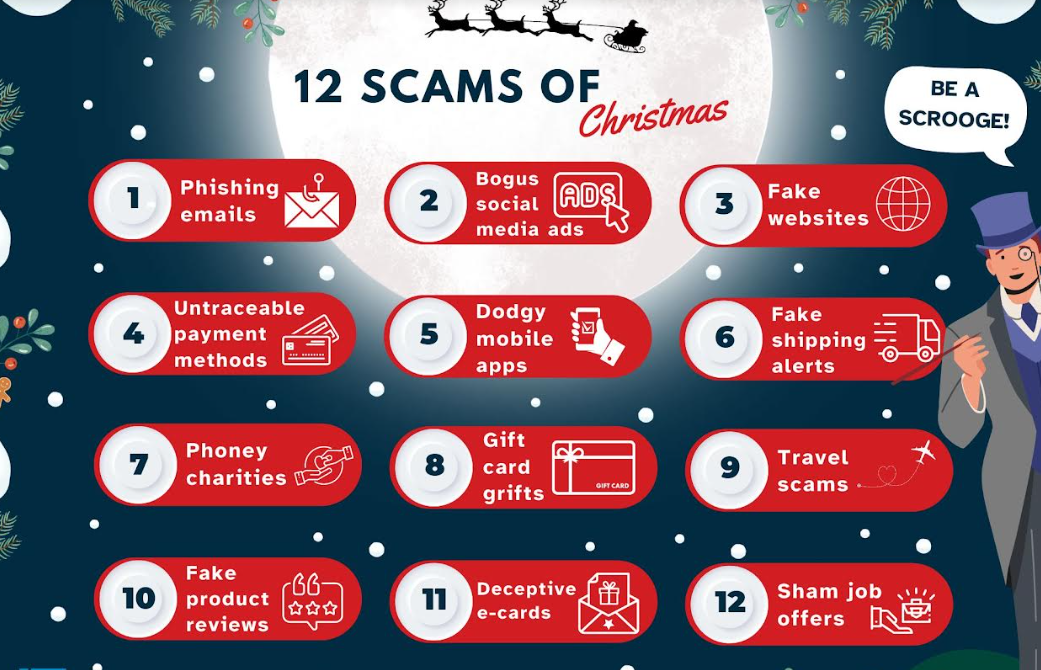
The 12 Scams of Christmas that consumers need to look out for are:

  1. Sophisticated phishing emails

These emails are crafted with advanced techniques such as artificial intelligence, making them look almost identical to those from reputable brands. They often lure victims with fake alerts or offers, leading to sites that steal personal information. IT.ie advises everyone to verify the email’s authenticity and avoid clicking on links or attachments from unknown sources. If in doubt, don’t click.

  1. Social media ad scams

Scammers use social media platforms to post ads for exclusive or hard-to-find items at very low prices. These ads often lead to fake websites where your payment information can be stolen. Always research the seller and look for reviews on independent platforms before making a purchase.

  1. Bogus websites and URL spoofing

Cybercriminals create fake websites that mimic legitimate online retailers, often using URLs that contain subtle misspellings or alterations that can easily go unnoticed. These websites can lure unsuspecting victims by offering high-demand goods at unbelievably low prices. Shoppers should always double check the URL for the correct spelling of the website’s domain name and ensure that it starts with “HTTPS”. A lock symbol should be visible before the URL.

  1. Untraceable payment methods

Scammers prefer payment methods that are difficult to trace and offer no fraud protection, such as cryptocurrencies, wire transfers, or gift cards. These methods make it almost impossible to recover lost funds. IT.ie recommends to always use secure and traceable payment methods such as credit and debit cards, or reputable money transfer services.

  1. Mobile app frauds

Fraudulent mobile apps, often disguised as legitimate shopping apps, can steal personal information or infect your device with malware. These apps might appear in official app stores but often have few downloads and negative reviews. Always verify the app’s legitimacy and read reviews before downloading.

  1. Delivery notification scams

These scams involve sending fake delivery notifications via email or text, which link to phishing websites designed to steal personal information. They often imply a sense of urgency, claiming a package is waiting. These scams are particularly successful at this time of year when people are expecting multiple deliveries. IT.ie recommends that shoppers always use the official tracking tools provided by the retailer and never click on links in unrelated email or text notifications.

  1. Charity donation frauds

Scammers set up fake charities, particularly during the holiday season when people are more likely to make donations. They often solicit donations through persuasive emails or social media campaigns. Always research the charity using official charity regulator websites before donating.

  1. Gift card grifts

Gift card scams involve selling discounted gift cards that are either fake or have been previously used. These offers are often found on unofficial websites or through social media ads. Always purchase gift cards directly from official retailers or authorised sellers.

  1. Travel scams

With holiday travel in high demand, scammers can offer unrealistically cheap travel deals through fake websites or phishing emails. These scams may involve fake airline tickets, hotel bookings, or holiday packages. Holiday-goers should always book travel through reputable agents or directly with airlines and hotels.

  1. Fake product reviews

Scammers will often post positive product reviews on substandard or non-existent products. These reviews create a false sense of trust and quality, making shoppers think that the product is legitimate. Shoppers should use well-known review platforms and be sceptical of overly-positive reviews for unknown brands or products.

  1. E-card scams

E-card scams involve sending electronic greeting cards that contain malware or links to phishing sites. These e-cards may appear to be from known contacts, but are instead from scammers. Open e-cards only if you are expecting them and you can verify the sender’s identity.

  1. Job offer scams

During the holiday season, fake job offers for seasonal positions are common. These scams often ask for personal information upfront or require payment for training or background checks. Legitimate employers will never ask for payment as part of the hiring process.

Eamon Gallagher, founder and MD, IT.ie, said: “This Christmas, we are telling everyone to emulate Scrooge’s cautious nature by guarding their personal and financial data against online fraud.

It is essential to approach holiday shopping and online interactions with a heightened sense of awareness. Take a moment to assess the legitimacy of an offer, whether it’s an amazing deal on a gift, a charity appeal, or a sudden job opportunity.

“Scammers prey on the urgency and emotion of the season, often creating scenarios that require immediate action or payment. It is important that everyone educates themselves and their loved ones about these scams as a crucial step in safeguarding their personal and financial information. Sharing this knowledge with friends and family, especially those who may be more vulnerable, can help to ensure scammers don’t get any early Christmas presents this year. Shop safe, shop secure and shop smart this Christmas!”

SEO Mistakes: Digital Marketing Disasters Your Business Should Avoid

In 2021, digital marketing is a must for virtually every business. But because this area evolves so rapidly, it can be hard to keep up with the best practices.

That’s especially true when it comes to search engine optimization, or SEO.

In order for your website to be readily found online, it needs to be optimized for search engines. But if you aren’t careful, you could easily make a mistake with your SEO strategy.

To help you avoid that frustration (and potentially a Google penalty!), we’re sharing just a few of  the most common mistakes business owners make with their SEO and also seo business from home

Expecting Immediate Results

If you’re constantly asking yourself why you aren’t seeing progress with your SEO strategy, you may need to examine your expectations first.

There are a number of reasons why your strategy may not be working. But it might also be that the strategy is working the way it’s supposed to.

In the latter scenario, the problem actually lies in your own realistic expectations.

With certain kinds of digital marketing, such as pay-per-click ads, you might start to see results within a few days.

But SEO is meant to be a long-term strategy. It’s not designed to pay off in a day, a week, or even a month.

Although some changes can help right some SEO wrongs rather quickly, you probably won’t start to see real movement with your keywords for at least a few months.

In other words, you need to stay the course. Don’t become discouraged if you don’t see improvements immediately. Keep the faith and remember that this is how SEO is intended to work.

If you let your unrealistic expectations get the best of you, you might be inclined to discontinue your SEO efforts or take steps that could undo all your hard work.

While you wait for your SEO strategy to take effect, focus on other aspects of your marketing. SEO works even better when you combine it with other promotional techniques.

You can also invest some time in educating yourself about the latest SEO trends and developments. Find a good Search Engine Optimisation Course, read blogs from trusted sources, and follow industry experts. This will not only help you stay informed, but it can also give you new ideas for your own SEO strategy.

As long as you put consistent effort into your SEO and are following Google’s best practices, your efforts will pay off. It just won’t happen overnight.

Targeting the Wrong Kinds of Keywords

Optimizing your site with relevant keywords can allow your brand to show up more readily in search results.

But just because a keyword accurately describes your business, products, or services, that doesn’t necessarily mean you should be targeting it as part of your strategy.

An overly broad keyword, for example, may simply be too competitive to give you the results you want. You’ll be going up against large, established companies with unlimited budgets. 

What’s more, the people searching for those keywords might not even be your target audience. Despite an impressive search volume, that keyword may not result in more conversions for your business. And that’s really the end goal of SEO – to help make your business more successful!

It may be wiser for you to target long-tail keywords that align with your location or what your ideal customers are actually searching for. Be sure to conduct thorough keyword research and figure out which terms your competitors are (and aren’t!) targeting.

It’s normal to switch up the keywords you target on a semi-regular basis. But if you’re simply guessing with your keyword optimizations, it’s time to gain some real insight into the terms that will result in quality traffic and sales. Otherwise, you’ll risk wasting your time and money with nothing to show for it.

Ignoring Website Issues

Believe it or not, existing issues with your website can hurt your ability to rank in search engine results.

Since Google wants to provide a positive experience for web users, search engines use a number of technical website features as ranking signals.

Issues like slow site speed, confusing navigation, page errors, broken links, poor site security, unexpected layout shifts, lack of mobile-friendliness, interactivity delays, and intrusive interstitials can all make it harder for your site to rank, even if you put a lot of effort into on-site optimization.

You’ll need to fix any website issues that exist if you want to improve your site rankings in SERPs. It’s best to run a website audit and assess whether a redesign is necessary.

Ultimately, it won’t matter if you write awesome content and optimize with the right keywords if your website drives customers away. You’ll need to address any website problems that exist in order to provide a great experience for visitors.

Doing Your SEO Yourself

As a business owner, you probably wear a number of hats. You might even think that if you don’t take care of something yourself, it’ll never get done.

But that attitude can be dangerous when it comes to SEO. Because trends change so quickly and this area of digital marketing is so vast, it’s easy to make a mistake that can hurt your business.

DIY might sound like a good way to save time and money. But this isn’t a simple home improvement project. It’s the future of your brand and your ability to compete.

For something with such high stakes, you really can’t afford to take a do-it-yourself approach. Instead, it’s best to work with a reputable white label SEO company that can devise, execute, and monitor your marketing strategy.

That way, you can concentrate on the business operations that really matter without sacrificing your ability to promote your brand.

While there’s nothing wrong with expanding your knowledge of SEO, it’s best to leave marketing  your business to the professionals. Choosing the DIY route will almost certainly result in disaster.


Avoid These SEO Mistakes For Long-Term Success

Unfortunately, it’s not hard to make an SEO mistake that can derail your marketing efforts. But once you know the most common mistakes to avoid, you can take the right preventive steps. Setting realistic expectations, targeting the right keywords, fixing website issues, and working with a professional firm can set you up for long-term success.

Author Bio: Jeff Shipman is the Director of Marketing Innovation at Semify, based in Rochester, New York. At Semify, we focus on scaling, are US-based, and offer a white label SEO solution that helps digital marketing agencies achieve their dreams through on-time delivery and SEO fulfillment. Before moving to Western New York, he earned a BA in History and a MBA at St. Bonaventure University. Go Bonnies!  https://www.linkedin.com/in/jeff-shipman-155b7073/