The boundless efficiency: how automated systems transform warehouses

In today’s ever-changing market, warehouse logistics face new challenges that demand increased efficiency and process optimization. Automation represents a key solution capable of radically transforming warehouse operations, speeding up processes, and reducing the likelihood of errors.

Key warehouse automation technologies

Experts from the consulting company Euristiq share with us the secrets of warehouse technology that make automation so attractive in modern business.

Robotic control systems. These systems use robots to perform warehouse tasks such as loading, sorting, and moving goods, reducing processing time, and minimizing errors. Robotic systems, such as Autonomous Mobile Robots (AMRs) and robotic manipulators, transform warehouse operations by offering flexibility and scalability for handling various tasks.

Warehouse management systems. WMS ensures precise inventory management, improving storage organization and optimizing the paths of goods movement in the warehouse. Modern systems provide centralized inventory management, improving data accuracy and transparency, which is crucial for effective warehouse planning and management.

Integration with IoT. The use of the Internet of Things allows warehouses to efficiently track processes and the condition of goods in real-time, increasing transparency and operational management. This makes it easy to collect real-time data on inventory status, equipment, and processes, thereby optimizing warehouse operations and management.

These technologies transform warehouse operations, making them more efficient, cost-effective, and adaptable to changing market demands.

The benefits of automation for warehouse efficiency

Automation in warehouse logistics plays a critical role in enhancing the competitiveness of modern enterprises. Implementing automated systems transforms traditional warehouses, making them more productive, economically efficient, and adaptable to changing market demands.

Increased productivity

Automation introduces technologies such as robotic management systems that significantly accelerate order processing and optimize warehouse operations. The result is increased productivity, allowing for the processing of more orders in less time.

Reduced operational costs

Automation reduces operational costs by decreasing the need for manual labor and minimizing errors. Inventory management systems and integration with the Internet of Things (IoT) provide accurate inventory tracking and management, reducing losses and excess inventory.

Improved accuracy and quality

Automated systems increase the accuracy of inventory and order processing, minimizing the likelihood of errors. Accurate inventory tracking and proper order management enhance overall operational quality.

Flexibility and scalability

Automation provides warehouses with the flexibility and scalability necessary to adapt to changing market conditions and customer requirements. This allows businesses to expand or modify operations without significant costs and restructuring.

Examples of successful automation in practice

Let’s look at specific examples of how companies are transforming their warehouse operations using advanced technologies.

First example: Autonomous Mobile Robots

One of the major retailers implemented robotic systems to manage its warehouse, speeding up the process of picking and delivering goods. With automated systems such as Autonomous Mobile Robots (AMRs), the company was able to significantly increase work productivity, minimize errors, and reduce order fulfillment time.

An efficiency analysis showed that thanks to automation, the cost of fulfilling one order decreased by 30%, and the picking accuracy increased to 99.5%. This led to a noticeable improvement in customer service and overall operational efficiency.

Second example: IoT and WMS integration

Another company specializing in wholesale trade used IoT integration and Warehouse Management Systems (WMS) to improve inventory management. Using IoT sensors and data analytics, the company could track the condition of goods in real time, preventing excess or shortage.

This integration resulted in a significant reduction in losses due to spoilage, improved inventory accuracy, and increased customer satisfaction through faster and more accurate delivery.

The future of warehouse automation

Warehouse automation is constantly evolving, with new technologies emerging each year to make processes more efficient and cost-effective. One important direction that experts at Euristiq company identify is the use of artificial intelligence and machine learning to optimize logistics processes.

Autonomous delivery systems, such as drones and unmanned ground vehicles, promise to revolutionize the delivery process, reducing time and costs. Smart warehouses that integrate AI for automatic sorting and packing can further increase efficiency and reduce the need for manually performed operations.

Augmented Reality (AR) and Virtual Reality (VR) are also beginning to find applications in warehouse logistics, providing innovative solutions for training and supporting staff, improving warehouse navigation, and assisting in high-precision order picking.

Warehouse automation has already proven its value, providing companies with the ability to improve efficiency, reduce costs, and increase customer satisfaction. As technology advances, the prospects for warehouse automation become even more extensive, promising to bring revolutionary changes to warehouse management and logistics as a whole. Companies that invest in automation today will lead tomorrow, ensuring a sustainable and efficient future in warehouse logistics.

Provizio Unveil 5D Perception platform at CES2023 to eliminate collisions and enable mass autonomous driving from 2025

Provizio, the leading vehicle perception company, today announces its plans to deliver its Radar and AI backboned perception stack for every road user by 2025. This mass adoption will be possible through the mass distribution and licensing of Provizio’s 5D Perception® technology.  Provizio’s 5D Perception® driving platform offers OEMs the fastest and most reliable path to Level 5 automation as part of Provizio’s mission to eliminate all road accidents and deliver a safe path to Autonomy.

Provizio will be unveiling and providing live demos of their new 5D Perception® driving platform at this year’s CES, in Las Vegas. This will be the first ever live demonstration of the driving platform and will be showcased on a Land Rover Defender. – Reply for demo.

5D Perception® technology:

The patented technology developed by Provizio utilises a five-dimensional perception system that can continually see, track and interpret road conditions and hazards enabling increased vehicular safety and ultimately providing a path to full autonomy . Provizio’s technology beats the resolution of next-gen incumbent Radar sensors by more than 30x and range by more than 3x – with no additional hardware.

AI is central to the system, Provizio uses machine-learning algorithms and a suite of in-build 5D Perception® Radar and vision sensors, continuously learning and processing the environment around the vehicle  to identify potential hazards with unprecedented accuracy and speed, slashing response times and delivering interventions which are 30–100x quicker than technology available for use in today’s vehicles.

Speaking on the launch of Provizio’s 5D Perception® driving platform, Barry Lunn, CEO of Provizio “Provizio are excited to launch a perception platform that is unprecedented in terms of performance, cost and scalability at the home of ground breaking innovations, CES. Our 5D Perception® driving platform will make driving safer and in partnership with our Tier 1 and OEM partners deliver the next generation Advanced Driver Assistance Systems and a true path to ubiquitous autonomy. 

Lunn adds: “This platform will revolutionise safety in the auto and mobility sectors by paving the way for the most advanced safety and autonomous driving systems and we firmly believe, in the near future, it will become as ludicrous to get in a vehicle without a 5D Perception® driving platform as it would be without seatbelts today. ”

LiDAR like point clouds but at 100x lower cost

The key to this technology for mass adoption is the ability for it to be implemented at scale, with Provizio working alongside Tier 1 and OEM partners to bring this to mass production by 2025.

The issue the industry faces today is that Autonomous Vehicle platforms use a combination of expensive sensors and computer resources to perceive the world. LiDAR allows these vehicles to succeed but, because it is needed in 360° all-round the vehicle, it is also a major scaling inhibitor. LiDAR is expensive and struggles to perform in bad weather. Radar doesn’t suffer from these issues which is why it is deployed in almost all vehicles on the road, but today’s Radars have lacked the resolution a LiDAR offers.

Provizio’s 5D Perception® driving platform is backboned by proprietary super-resolution imaging Radar. Our 5D Perception® Radar sees the world in a LiDAR like 3D point cloud, and also delivers precise range and velocity of every point. Uniquely, the entire Radar backend is built on a Graphics Processing Unit (GPU) which allows us to deliver AI perception on-the-edge, this is what we call the 5th D in our 5D Perception® solution. This offers multiple advantages to our partners and ultimately all road users.

With this Perception technology, Provizio is able to provide class leading systems for a fraction of the current cost. The cost associated with current geo-fenced LiDAR backed platforms means they remain a niche offering and cannot be mass deployed or impact the driving problem in the near term. Autonomous Vehicle systems today can cost upwards of $250,000,  impacting mass adoption. Provizio’s proprietary MIMSO® Radar delivers LiDAR like point clouds at 100x lower cost. This provides 500x more resolution than the Radar on vehicles today.

By leveraging this proprietary 5D Perception® technology and our partners technology in LiDAR and vision systems, Provizio supplies class leading systems for a fraction of the current cost with low integration complexity. Due to its high performance and low cost it is already being used in applications beyond traditional automotive such as micromobility, agriculture and mining.

Metaverse Operations Autonomous Electric Vehicles And The Digital Economy Set To Transform The Travel Industry

Several powerful megatrends – from young, highly connected travelers to the arrival of electric air taxis – will exert an immense influence on air travel over the next decade, forcing industry, governments, and technology to adapt rapidly. This is according to “Meet the Megatrends,” a new report from SITA that examines 12 emerging technological, societal, traveler, and economic trends that will significantly morph the travel landscape by 2033.

These megatrends do not exist in silos but operate in an evolving ecosystem where emerging technologies interconnect the trends and help drive them forward. Data is at the heart of this ecosystem. The increasing willingness of providers to share data across the wider travel industry will help further accelerate these trends and pave the way to the more connected, seamless travel experience that passengers want.

Ilkka Kivelä, VP Strategy and Innovation, SITA, said: “The air transport industry is at a post-pandemic crossroads, facing challenges from all sides. While the travel recovery accelerates globally, airports and airlines are scrambling to provide the seamless travel experience passengers expect, often with slashed workforces and squeezed budgets. The climate crisis demands swifter and more decisive industry action to make travel more sustainable. We now have an opportunity to reimagine the world of travel, connect the dots and transform travel with bold solutions that cross sectors and exploit the latest technologies.”

One of the key trends identified in the report is Gen Z and millennial travelers driving a digital transformation of the transport industry, demanding a more integrated digital journey, and accelerating the digital way of life. Privacy, digital identity rights, and controls for passengers will be a priority for passengers opening the door to a future where we can travel from everywhere to anywhere without the need for physical documents or being stopped for identification.

Another power trend is the automation and emergence of smart airports, which will reshape the workforce, give rise to a new flattened business organization, and streamline operations through technology. By 2030 metaverse operations will be commonplace at leading airports and play a vital role in optimizing processes, avoiding disruption, and facilitating intuitive, immersive control of intelligent airports. This in turn will require new skills and create new opportunities for employees in the industry.

Meanwhile, electric air vehicles are expected to be ubiquitous at major international airports by the end of the decade, operating as an effective auxiliary service and revenue stream for airports and airlines. This year alone, investment in the Urban Air Mobility industry has skyrocketed, with $4.7 billion committed to the development of eVTOL vehicles.

Ilkka Kivelä said: “These trends are shaping SITA’s own innovation agenda. We’re excited to be working across many of these areas and look forward to collaborating with partners to drive positive change across the industry.”

The report was spearheaded by the SITA Lab innovation team and draws upon insights from across the transport industry, SITA’s global research, and the latest cutting-edge proof of concepts to identify the most powerful shifts that will drive the travel industry’s evolution by 2033.

The Future of Autonomous Vehicles

Work on developing the technology behind autonomous vehicles began in the 1970s, and it continues apace. The idea behind these vehicles is that they can sense the environment around them and don’t require any human involvement to drive and control them. There are six stages to creating this type of autonomous vehicle. Read on to learn more about these stages, see which stage we’re currently at, and discover the positives, negatives, and challenges of developing autonomous vehicles.

How are autonomous vehicles being accepted by the public?

Public perception is one of the major challenges in developing autonomous vehicles. According to a 2021 American Automobile Association (AAA) survey, only 22% of respondents thought that manufacturers should focus on developing autonomous vehicles. The story is similar in the UK. A 2021 YouGov survey found that only 23% of respondents would be happy to sit in an autonomous vehicle, and 67% said they would be unhappy driving on the same roads as autonomous vehicles. People are also concerned about potential data protection issues and the probable high purchase costs of these vehicles.

It’s important to note that autonomous vehicles have several benefits, such as 360° vision, interconnection between vehicles, and enhanced access for people with disabilities. Despite these advantages, overcoming public mistrust is a significant obstacle that developers and manufacturers face.

The levels of autonomous vehicles

The autonomy of vehicles is categorised by six different levels as follows:

  • Level 0 – no automation present.
  • Level 1 – driver assistance present – hands on or shared control.
  • Level 2 – partial driving automation present – hands off.
  • Level 3 – conditional driving automation present – eyes off.
  • Level 4 – high level of driving automation present – mind off.
  • Level 5 – full driving automation present – optional steering wheel.

Currently, we are at level 2, with level 3 not far away. Level 4 is expected to be reached by the middle of the decade, and optimistic predictions suggest that level 5 will follow soon after. Once autonomous vehicles are at this level, it will be possible to do many other things while you are driving.

It will be possible to access entertainment which is a significant improvement on having to concentrate while navigating miles of long boring roads or motorways. For example, you could use your tablet or smartphone to watch a movie or play a game at Platincasino Ireland and keep yourself entertained during long journeys. Also, if you are travelling to an event, you could get ready during your journey, which is a big time saver.

Safer and reliable mobility

There’s still a long way to go before full vehicle automation is safe and reliable enough to be available on public roads. Technology is still evolving and testing is underway. The main problem with testing is getting enough mileage on roads to demonstrate the reliability of self-driving cars. So, other testing methods are being considered, such as simulation and closed courses. On-road testing has to be the last step for safety reasons.

Collaboration in the industry

There are substantial challenges facing automotive companies and tech companies looking to produce self-driving vehicles. In the case of automotive companies, these challenges are caused by the need for hardware and software, while tech companies face the challenge of producing safe and reliable vehicles. Companies will likely need to collaborate to benefit from their respective strengths and overcome these challenges.

Conclusion

Fully autonomous vehicles will allow us to play games, watch movies, and even get ready for a night out while travelling. However, these benefits are still a few years away. Full automation is categorised as level 5, and we’re currently at level 2. To progress further, developers and manufacturers must overcome public reluctance and ensure the safety and reliability of self-driving vehicles. Work is underway to do this.

image source

Bristol scientists develop insect-sized flying robots with flapping wings

A new drive system for flapping wing autonomous robots has been developed by a University of Bristol team, using a new method of electromechanical zipping that does away with the need for conventional motors and gears.

This new advance, published today in the journal Science Robotics, could pave the way for smaller, lighter and more effective micro flying robots for environmental monitoring, search and rescue, and deployment in hazardous environments.

Until now, typical micro flying robots have used motors, gears and other complex transmission systems to achieve the up-and-down motion of the wings. This has added complexity, weight and undesired dynamic effects.

Taking inspiration from bees and other flying insects, researchers from Bristol’s Faculty of Engineering, led by Professor of Robotics Jonathan Rossiter, have successfully demonstrated a direct-drive artificial muscle system, called the Liquid-amplified Zipping Actuator (LAZA), that achieves wing motion using no rotating parts or gears.

The LAZA system greatly simplifies the flapping mechanism, enabling future miniaturization of flapping robots down to the size of insects.

Flying insect sized robot. Credit Dr Tim Helps

In the paper, the team show how a pair of LAZA-powered flapping wings can provide more power compared with insect muscle of the same weight, enough to fly a robot across a room at 18 body lengths per second.

They also demonstrated how the LAZA can deliver consistent flapping over more than one million cycles, important for making flapping robots that can undertake long-haul flights.

The team expect the LAZA to be adopted as a fundamental building block for a range of autonomous insect-like flying robots.

Dr Tim Helps, lead author and developer of the LAZA system said “With the LAZA, we apply electrostatic forces directly on the wing, rather than through a complex, inefficient transmission system. This leads to better performance, simpler design, and will unlock a new class of low-cost, lightweight flapping micro-air vehicles for future applications, like autonomous inspection of off-shore wind turbines.”

Professor Rossiter added: “Making smaller and better performing flapping wing micro robots is a huge challenge. LAZA is an important step toward autonomous flying robots that could be as small as insects and perform environmentally critical tasks such as plant pollination and exciting emerging roles such as finding people in collapsed buildings.”

Electric Cars: The Lifeline of the Auto Industry. #EVs #Motoring #IDTechEx

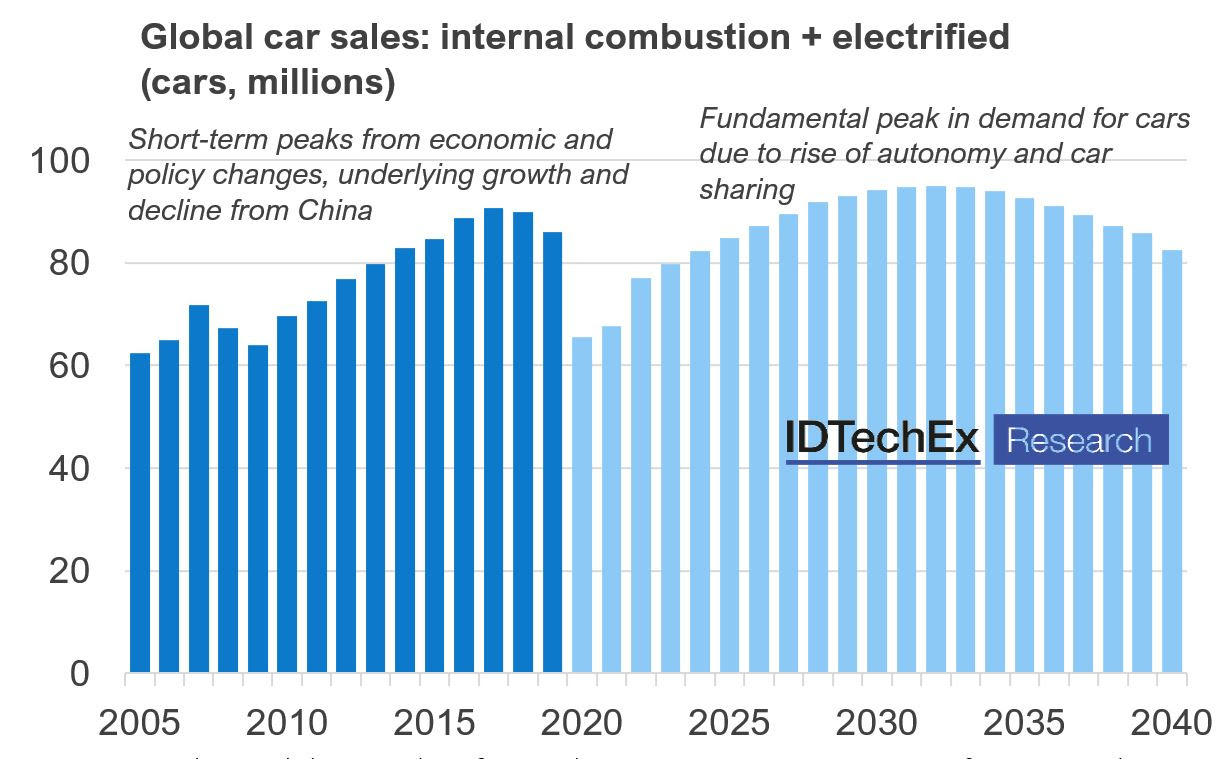
In the past two decades, the car market has declined twice: first due to the 2008 economic crisis, and then due to falling sales in China. Most recently, the lockdowns implemented to combat the coronavirus pandemic, causing auto-production plants to close globally and a loss of consumer spending will lead to an unprecedented 23% decline in 2020 (IDTechEx prediction).

In the following decade (2030 – 2040), things will not improve: the global car market will be blindsided by the rise of autonomous vehicles, which greatly reduces the need for private car ownership. Within this scenario, it is electric cars which will remain a beacon of growth, satisfying both the governmental drive to clean air in cities whilst also working more readily with autonomous vehicle technology.


Source: IDTechEx with historic data from industry associations. For more information, please see the IDTechEx report, “Advanced Electric Cars 2020-2040”.

In their simplest form, an electric car consists of an energy storage device powering one electric traction motor, which spins wheels via a transmission. First invented in the 19th century, electric cars ultimately lost the battle to the internal combustion engine, unable to compete with the energy density of gasoline. Over one hundred years later, the Li-ion battery is enabling their meteoric rise as a solution for reducing local emissions and green-house gases.

Once derided as toys, today electric cars with barely 15 years of development offer cutting-edge automotive technology and performance, from sub 2.5 second 0 – 60 mph acceleration, to autonomous driving functionality and solar bodywork. Battery-electric vehicles (BEV) are the endgame: zero emissions at point of use and the focus of automotive start-ups (and China). On the other hand, Plug-in Hybrid Electric Vehicles (PHEV) provide a short/mid-term solution, soothing initial fears of range anxiety.

The brand new IDTechEx report, “Advanced Electric Cars 2020-2040”, provides a long-term outlook for the car market and enabling technologies in the wake of COVID-19. The key sections are summarized.

Forecasts and COVID-19 Impact

In the report, IDTechEx provide long-term forecasts to 2040 for electric passenger cars by region (China, US, UK, France, Germany, Norway, Netherlands, Denmark, RoW) and by powertrain (battery-electric, plug-in hybrid, fuel-cell). Forecasts are presented in number of vehicles, battery demand (GWh) and market size ($ billion), with historic data back to 2015.

All forecasts are adjusted to reflect the impact of the global COVID-19 pandemic: amid economic uncertainty and unemployment, the auto industry has been one of the hardest hit as car purchases, typically the second largest consumer purchase (the first is a house), are now more difficult to justify ­for millions of consumers worldwide.

Li-ion Batteries

The IDTechEx report identifies and explains trends in Li-ion batteries for electric cars. For example, nickel content is increasing while cobalt content is decreasing: why is this important for automakers and the overall sustainability of the industry? It also provides historic market data on the Li-ion technology mix based on our database of electric cars in top auto markets: China has phased-out LFP from over half its car market to less than 2% today; why will Tesla contradict this and adopt LFP for Model 3 sales in China?

Electric Traction Motors

All electric motors have the same purpose of converting electrical energy to mechanical energy, but there are many types of motors that derive their names from their construction, principles of operation, or even from the control technique employed on them. The IDTechEx report explores why automakers are converging on permanent magnet motors, multiple motors, provide a benchmarking analysis of the different motor types, and finally, an outlook for how IDTechEx expects the motor market to evolve over the next ten years.

Autonomous Vehicle Technology

IDTechEx predicts that the rise of autonomous vehicles will have a profound impact on the global car market as it enables mobility-as-a-service to become cheaper than private-car ownership. The report shows forecasts of autonomous passenger car miles, revealing how this will lead to a fundamental peak-car scenario. IDTechEx appraises the key underlying technologies such as LiDAR and camera-based systems: is the camera-only approach a high-risk gamble or a winning strategy that will be copied?

For more information on this report, please visit www.IDTechEx.com/Cars or for the full portfolio of Electric Vehicles research available from IDTechEx please visit www.IDTechEx.com/Research/EV.