Revealed: The 12 Scams of Christmas – and how to avoid them

IT.ie, the Irish-owned IT services company, today reveals the “12 Scams of Christmas”, outlining the digital ruses consumers are most likely to fall for this festive season.

As consumers prepare for the festive season, it can be an opportunity for cybercriminals to take advantage of increased online activity to gain access to sensitive data. Last year, An Garda Síochána issued a warning to consumers, stating that online fraud was on the rise at Christmas time.

To help them to keep their personal information safe, IT.ie is encouraging consumers to “channel their inner Scrooge” by fiercely protecting their data and hard-earned money from criminals. This year, the message is clear: be a Scrooge with your private and financial data – or it might become a gift for criminals.

The 12 Scams of Christmas that consumers need to look out for are:

  1. Sophisticated phishing emails

These emails are crafted with advanced techniques such as artificial intelligence, making them look almost identical to those from reputable brands. They often lure victims with fake alerts or offers, leading to sites that steal personal information. IT.ie advises everyone to verify the email’s authenticity and avoid clicking on links or attachments from unknown sources. If in doubt, don’t click.

  1. Social media ad scams

Scammers use social media platforms to post ads for exclusive or hard-to-find items at very low prices. These ads often lead to fake websites where your payment information can be stolen. Always research the seller and look for reviews on independent platforms before making a purchase.

  1. Bogus websites and URL spoofing

Cybercriminals create fake websites that mimic legitimate online retailers, often using URLs that contain subtle misspellings or alterations that can easily go unnoticed. These websites can lure unsuspecting victims by offering high-demand goods at unbelievably low prices. Shoppers should always double check the URL for the correct spelling of the website’s domain name and ensure that it starts with “HTTPS”. A lock symbol should be visible before the URL.

  1. Untraceable payment methods

Scammers prefer payment methods that are difficult to trace and offer no fraud protection, such as cryptocurrencies, wire transfers, or gift cards. These methods make it almost impossible to recover lost funds. IT.ie recommends to always use secure and traceable payment methods such as credit and debit cards, or reputable money transfer services.

  1. Mobile app frauds

Fraudulent mobile apps, often disguised as legitimate shopping apps, can steal personal information or infect your device with malware. These apps might appear in official app stores but often have few downloads and negative reviews. Always verify the app’s legitimacy and read reviews before downloading.

  1. Delivery notification scams

These scams involve sending fake delivery notifications via email or text, which link to phishing websites designed to steal personal information. They often imply a sense of urgency, claiming a package is waiting. These scams are particularly successful at this time of year when people are expecting multiple deliveries. IT.ie recommends that shoppers always use the official tracking tools provided by the retailer and never click on links in unrelated email or text notifications.

  1. Charity donation frauds

Scammers set up fake charities, particularly during the holiday season when people are more likely to make donations. They often solicit donations through persuasive emails or social media campaigns. Always research the charity using official charity regulator websites before donating.

  1. Gift card grifts

Gift card scams involve selling discounted gift cards that are either fake or have been previously used. These offers are often found on unofficial websites or through social media ads. Always purchase gift cards directly from official retailers or authorised sellers.

  1. Travel scams

With holiday travel in high demand, scammers can offer unrealistically cheap travel deals through fake websites or phishing emails. These scams may involve fake airline tickets, hotel bookings, or holiday packages. Holiday-goers should always book travel through reputable agents or directly with airlines and hotels.

  1. Fake product reviews

Scammers will often post positive product reviews on substandard or non-existent products. These reviews create a false sense of trust and quality, making shoppers think that the product is legitimate. Shoppers should use well-known review platforms and be sceptical of overly-positive reviews for unknown brands or products.

  1. E-card scams

E-card scams involve sending electronic greeting cards that contain malware or links to phishing sites. These e-cards may appear to be from known contacts, but are instead from scammers. Open e-cards only if you are expecting them and you can verify the sender’s identity.

  1. Job offer scams

During the holiday season, fake job offers for seasonal positions are common. These scams often ask for personal information upfront or require payment for training or background checks. Legitimate employers will never ask for payment as part of the hiring process.

Eamon Gallagher, founder and MD, IT.ie, said: “This Christmas, we are telling everyone to emulate Scrooge’s cautious nature by guarding their personal and financial data against online fraud.

It is essential to approach holiday shopping and online interactions with a heightened sense of awareness. Take a moment to assess the legitimacy of an offer, whether it’s an amazing deal on a gift, a charity appeal, or a sudden job opportunity.

“Scammers prey on the urgency and emotion of the season, often creating scenarios that require immediate action or payment. It is important that everyone educates themselves and their loved ones about these scams as a crucial step in safeguarding their personal and financial information. Sharing this knowledge with friends and family, especially those who may be more vulnerable, can help to ensure scammers don’t get any early Christmas presents this year. Shop safe, shop secure and shop smart this Christmas!”

Servecentric supports “Orchards in the Community” to plant over 3,500 orchards across Ireland

To help protect bees, increase pollination and support bio-diversity, Servecentric is delighted to participate in Host in Ireland’s “Orchards in the Community” initiative. Servecentric is part of 73 pledging companies that have contributed to the planting of over 3587 mixed fruit orchards across the Island of Ireland. As part of the programme, 222 schools and colleges and 171 community groups from tidy towns, retirement homes, community centres, and local sports facilities have received and planted orchards in their communities.

Orchards provide vital green spaces in our cities and towns and with 33% of our 99 wild bee species at risk of extinction, these orchards provide bees with food as they struggle when emerging from winter.

Servecentric’s support is resulting in the planting of 10 orchards in the grounds of St. Finian’s National School, Clonard, Co. Meath.

“Orchards are a focal point for communities to connect people with nature. Growing orchards in the community helps raise awareness of our connection to our food sources and play an important role in biodiversity and the plight of bees in Ireland,” said Garry Connolly, founder, Host in Ireland. “That spirit of community is alive and well with ‘Orchards in the Community’ as organisations like Servecentric come together with biodiversity groups, schools, colleges, Tidy Towns and others across Ireland to tackle challenges like biodiversity loss to save Ireland’s pollinators.”

“It is important for us to support this creative initiative led by Host In Ireland. We all have a role to play in preserving our falling native Bee, Butterfly and other pollinator populations and we’re delighted to work with local communities in the campaign to reverse this trend.” added Brian Roe, CEO, Servecentric Ltd.

Dyson launch search for creators to produce content and test out their Zone headphones with rewards given

Having disrupted the audio category with the launch of the Dyson Zone™ noise-cancelling headphones in the UK and Ireland in May 2023, Dyson has announced a casting call for aspiring content creators across the UK and Ireland to join its first ever Dyson Field Testers program – a collaborative global community for music and technology fans.

With applications open between 30 November – 31 December 2023, people across Ireland can  Apply to become a Dyson Field Tester today to get hands on the high-fidelity headphones and create social content bringing to life their experience.

Successful applicants will form part of an exclusive network of creators across Great Britain and Ireland, Australia, New Zealand, and the US, that forms part of Dyson’s new global Instagram channel @dysonwear launching on 30 November 2023. After receiving a pair of Dyson Zone™ noise-cancelling headphones to road test the technology, Dyson Field Testers will curate social content based on a series of themed challenges. The most unique and inspiring social posts will be rewarded with music experiences, subscriptions, sporting tickets,  Dyson technologies and more.

Applicants who are selected to become a Dyson Field Tester will form part of an exclusive community and receive:

  • Seeding pack including Dyson Zone™ noise-cancelling headphones
  • Fortnightly themed challenges
  • Rewards for curating unique content.
  • Updates on upcoming Dyson audio technologies and experiences
  • The opportunity to be featured on Dyson’s global social media channels.

 Apply here  before 31 December 2023 to become a Dyson Field Tester .

Ørsted takes final investment decision on its first Irish solar farm

Ørsted has taken final investment decision (FID) on phase one of Garreenleen Solar Farm, which marks the company’s first solar investment in Ireland.   

Located 15km outside of Carlow town, this 81 MW solar development is expected to be operational by 2026 and will bring Ørsted’s operational capacity on the island of Ireland to almost 500MW.    

Today’s FID follows the project’s successful win under the Irish Government’s Renewable Electricity Support Scheme 3 (RESS 3) auction in September 2023. RESS 3 was a successful auction for Ørsted, with twoprojects (wind and solar) totalling 124MW clearing. The RESS 3 auction average strike price was EUR100.47 per MWh, which is consistent with similar regimes in other European markets.   

Commenting on the investment decision, Kieran White, Senior Vice President of Onshore in Region Europe at Ørsted, said: 

“Solar energy is an essential component for enabling the Irish power system to run entirely on green energy, and I’m delighted to confirm that Ørsted now will invest in our first Irish solar farm.“ 

He continued: “While this will be our first solar project in Ireland, our strong pipeline of other projects, which continue to progress through consenting and grid access, gives us the confidence that more will follow.” 

“Garreenleen is an attractive solar project because it has a short grid route to a strong meshed node in the existing national electricity network, in an area of the grid where constraints are forecast to be low. With this investment decision, the project will also install the necessary grid infrastructure to facilitate the connection of a second phase of the project, which we hope to commit to within the next year,” he concluded. 

Expleo successfully launches first ENSO nanosatellite into space

Expleo has announced the successful launch of its first nanosatellite, ENSO, developed in partnership with the Centre Spatial Universitaire de Montpellier (CSUM).

ENSO (Expleo Nanosat for Solar irradiance Observation) successfully launched on 1 December from California aboard the SpaceX Falcon 9 rocket, mission 425, flight 1, via ISISpace with first signal received shortly after 21:00 UTC. It will now begin its 4 years-long mission to monitor solar activity and its impact on Earth’s atmosphere.

ENSO is an in-house CubeSat project jointly developed by teams from Expleo and CSUM. It measures just 10x10x10cm and weighs just over 1kg– small enough to hold in your hands. It also incorporates a six-metre antenna, which deploys after launch, and a camera system to support secondary data collection missions.

Once ENSO’s antenna is deployed, it will officially begin its primary mission using a high-frequency beacon to support measurement of the ionosphere, a highly active part of Earth’s upper atmosphere used to support radio and satellite communications. Data from ENSO will be sent to SANSA ground stations located in Antarctica, with the data used to improve our understanding of the impact of solar activity on our atmosphere.

ENSO combines Expleo expertise across systems engineering, electronics and software space engineering, quality and assembly, integration and test (AIT), supported by CSUM’s knowledge and experience of nanosatellite launches. ENSO has been tested on the CSUM shaker and thermal vacuum chamber – resources specially adapted for environmental testing of nanosatellites.

Jeff Hoyle, EVP – Global Aero, Space and Defence of Expleo, said: “Nanosatellites are the embodiment of the NewSpace revolution – a cost-effective yet powerful way of putting the power of space exploration and monitoring into the hands of a far wider audience than ever before. Industries as wide-ranging as aerospace, automotive and energy & utilities all stand to benefit from their potential. With the launch of ENSO, we’ve built a team and perfected the skills needed for the successful development, integration and deployment of nanosatellite payloads.”

 “This is a huge milestone for us, but we’re already looking forward to building on this success and developing the skills to support nanosatellite launches and NewSpace activities for our partners, through R&D initiatives such as ExpleoLissa, a software-defined nanosatellite capable of in-orbit reconfiguration.”

 ENSO’s mission will last up to four years before starting its end-of-life process, expected in 2027.

Learn more about the ENSO project.

Learn more about Expleo’s services for the space industry.

DAACI Announces Natural Series: a highly anticipated product roadmap launching with their first editing tool ‘Natural Edits’

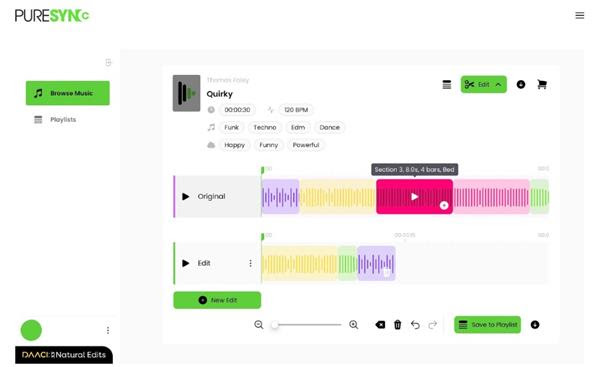
DAACI launches ‘Natural Series’, a comprehensive product portfolio, that will see the release of plugins, music tools and editing technology released over the next year, kicking off with ‘Natural Edits’, a powerful music editing tool for the global sync market to make any track instantly adaptive.

The Natural Series has evolved from DAACI’s development of patented AI and musician-led core technologies. Each element will satisfy the needs of different audiences and use cases, from creators who want to enhance their process, to Music Rights Holders looking for solutions that satisfy the rapidly growing demand for creating personalised music experiences.

The first element in the Natural Series is Natural Edits, now available to Rights Holders within the global sync market. Future elements of the series will include Natural Sync which will enable any type of user, with any ability to create new track edits against films, to supercharge the creative process. DAACI is also beta testing their first plugin for producers and composers.

DAACI’s CEO Rachel Lyske comments: “From the beginning of our journey, we have been on a mission, working on our core technology, the brain of DAACI, to build a solid, ambitious ecosystem. Our ethical, artist-led approach has been welcomed by our partners and the music industry and we’ve been eagerly asked when there will be products to test, ‘buttons to press’. Now we have them. The time is right to put these tools into the hands of users and introduce people to ‘the DAACI way’, and we can’t wait to hear what people will create with them.”

About Natural Edits

Natural Edits brings powerful, patented music editing technology to Rights Holders and their Licensees within the global sync market. By embedding Natural Edits into their entire catalogues within their existing web-based platforms, Rights Holders can enable internal and external users to engage with a track at a level of detail and control as never before. Natural Edits can also be added to web-based platforms incrementally with functionality initially added to a small number of test tracks, then smoothly scaled up. To support this, DAACI will provide a fast, simple API that Music Rights Holders’ web-based platforms can use to dynamically query which tracks are supported and place an ‘Edit’ button on them.

From the moment they begin considering a track, users will be exposed to the track’s latent potential to fit countless contexts from looping beds for background music, to topped-and-tailed snippets for adverts, extended pieces for arbitrary length videos, and precise edits matching specific narratives and music briefs.

Natural Edits enables any user of any skill level to create and deliver a personalised edit of any track in a few simple clicks, driving discoverability and, just as importantly, licence potential of a track.

Natural Edits has already been adopted by music platforms including Pure Sync. Julian Goodkind, CEO of Pure Sync says: “Pure Sync are delighted to be incorporating Natural Edits. We see this as a pivotal moment in our adoption and utilisation of Ethical AI tools. This elevates and amplifies our creative capabilities as Music Supervisors within the Sync world, to deliver more creatively, efficiently and cost effectively.”

DAACI invites Music Rights Holders to enquire about Natural Edits integration at hello@daaci.com.
To find out more, or to sign up for future beta testing visit: daaci.com

Dublin City wins the European Capital of Smart Tourism 2024

The European Commission has announced that Dublin City has won the Smart Tourism Capital Award designation for 2024.

The announcement was made today in Brussels.

“We are delighted that Dublin has been awarded the 2024 European Capital of Smart Tourism. This designation is a recognition of our commitment to deliver a greener, more accessible, inclusive and innovative Dublin, for both our visitors and locals. Our Smart Tourism programme, which was established in 2019 has been sharing, collaborating, and learning from some of the best cities in Europe and embedding this best practice in our own work through our new Tourism Strategy 2023-2023. We will proudly use this designation as a platform to deliver an innovative approach to tourism for Dublin.” – Richard Shakespeare, Chief Executive, Dublin City Council.

There were 30 candidates spanning 17 countries with six cities short-listed: Bremerhaven (Germany), Cork (Ireland), Dublin (Ireland), Genoa (Italy), Helsingborg (Sweden), and San Sebastián (Spain), all had their submissions evaluated by an expert judging panel. Following this competitive process, the judging panel recognised that Dublin has embedded best Smart Tourism practices from across Europe through its collaborations with other cities and the publication of its first five-year tourism strategy with a strong focus on innovation.

New experiences such as 14 Henrietta Street, EPIC the Irish Emigration Museum as well as digital innovations such as the Dublin Discovery Trails App separated Dublin from the other applicants. Dublin has also committed to sustainability by being the first Irish city to sign the Glasgow Declaration on Sustainable Tourism. Dublin also impressed the judges through its vision to become the world’s first autism friendly city by 2026.

“This city immersed in a rich tapestry of history, is a city full of culture and creativity. Now hailed for its commitment to sustainability and a strategic smart tourism vision and outstanding achievements, it has impressed the jury. Over the past year, this city has actively engaged people in decision-making, creating a destination that resonates with its people and embraces innovation at the same time. The city’s networking efforts with previous winners reflect a dedication to collaboration, leadership and innovation, and a beating European heart,” the European Commission judging panel said.

The new Dublin City Council Tourism Strategy 2023-2028 is due to be launched this Thursday 30th November 2023.

New partnership positions Equinix as a leader in Ireland’s quantum computing movement

Equinix, Inc. the world’s digital infrastructure company, has today announced its collaboration with Alice & Bob, a leading quantum computing company developing one of the most reliable quantum processors on the market. Through the collaboration with Alice & Bob, Equinix customers in Ireland and across the world will benefit from secure access to Alice & Bob’s cutting-edge quantum technology in France, therefore joining an ecosystem of businesses utilising quantum computing to unlock opportunities worth billions of dollars*. This positions Equinix as a leader in the provision of quantum computer access for businesses in Ireland.

Quantum computing is a transformative technology that supports computationally intensive tasks such as simulation, optimisation, machine learning and cryptography. Although still in its early stages, it has the potential to revolutionise industry processes, change our understanding of the universe, and even help slow down climate change by accelerating green innovations and discoveries. Quantum computers have the power and potential to solve problems that would take our best classical computers thousands of years.

Through this collaboration with Alice & Bob, enterprises in Ireland will be able to access Alice & Bob’s patented technology of self-correcting superconducting quantum bit: the cat qubit, the result of cutting-edge research carried out in French and international laboratories. The technology, located in Alice & Bob’s own data centre in France, is uniquely positioned to help businesses to accelerate innovation and futureproof their offerings.

While current quantum computers can suffer from computation errors which prevent them from fulfilling their theoretical promises, Alice & Bob cat qubit allows for a much simpler road to fault-tolerant and universal gate-based quantum computing, with the potential to transform the promise of quantum computing into a decisive commercial advantage.

Théau Peronnin, CEO of Alice & Bob, said: “We are proud that our technology is moving out of the laboratory and into the real world. Equinix is the ideal partner to bring the quantum revolution into society. We are looking forward to helping Equinix customers solve some of the world’s most challenging problems.”

Combining Equinix’s rigorous secure operations with Alice & Bob’s quantum expertise creates the ideal environment to design breakthrough innovations. This synergy will allow companies to discover the power of quantum computing with the peace of mind that their research will remain completely confidential.

Peter Lantry, Managing Director of Equinix Ireland, said: “Businesses, academics and policymakers in Ireland are excited about the promise of quantum computing and the seemingly limitless potential that it holds for our economy, society and the planet. This partnership with Alice & Bob provides a gateway to that technology and with it, opens doors to game-changing innovations.

“Our mission is to support businesses and give them access to the digital tools and ecosystems that will determine their success. This announcement is a shining reflection of that mission and we are immensely proud that through our partnerships with the scientific community, businesses in Ireland can now access quantum technologies more easily than ever before.

“This is where the colocation data centre market, of which Equinix is the global leader, is showing its value. By connecting businesses, people, and the latest technologies, we are at the heart of business innovation and the discoveries that can slow down climate change.”

Industries that rely on high intensity compute power such as sustainable energy, chemicals, pharmaceuticals and financial services are among those set to be radically changed by quantum computing by 2035, standing to potentially gain up to $1.3 trillion in value by this date.**

Quantum Technology Monitor – McKinsey & Company – Page 5

** Quantum Technology Monitor – McKinsey & Company – Page 4

How Telekopye Telegram scam toolkits onboard aspiring fraudsters – ESET

ESET researchers have recently discovered and analysed Telekopye, a toolkit that helps less tech-savvy people pull off online scams more easily, with the first part of the research being published in August. In this second part, ESET Research focuses on scammers’ internal onboarding process, a detailed view of the whole scamming operation, and analysis of the scam scenarios.

The capabilities of Telekopye include creating phishing websites, sending phishing SMS texts and emails, and creating fake screenshots. According to ESET telemetry, this tool is still in use and in active development,and is implemented as a Telegram bot. Victims of this scam operation are called Mammoths by the scammers. For the sake of clarity, and following the same logic, ESET refers in its findings to the scammers using Telekopye as Neanderthals.

Telekopye groups recruit new Neanderthals via advertisements across many different channels, including underground forums. These advertisements clearly state the purpose: to scam online marketplace users. Aspiring Neanderthals are required to fill out an application, answering basic questions like what experience they have in this line of “work.” If approved by existing group members with sufficiently high rank, the new Neanderthals can start using Telekopye to its full potential.

There are three main scam scenarios: seller, buyer, and refund. In the seller scam, attackers pose as sellers and try to lure unsuspecting victims into buying some nonexistent item. When the victim shows interest in the item, the “seller“ persuades him them to pay online rather than in person and provides a link to a phishing website posing as a legitimate payment site. Unlike the legitimate web page, though, this page asks for an online banking login, credit card details (sometimes including balance), or other sensitive information. The phishing website automatically steals it.

In the buyer scam, attackers pose as buyers, researching victims to target. They show interest in an item and claim they’ve already paid via the provided platform. Then they send the victim an email or SMS message (created via Telekopye) with a link to a carefully crafted phishing website, claiming that the victim needs to click this link in order to receive their money from the platform. The rest of the scenario is very similar to the “seller“ scam. In the refund scenario, attackers create a situation where the victim is expecting a refund and subsequently send them a phishing email with a link to the phishing website, once again serving the same purpose.

“In almost every group of Neanderthals, we can find references to manuals with online market research from which Neanderthals draw their strategies and conclusions,” says ESET researcher Radek Jizba, who investigated Telekopye. “For example, during the buyer scam scenario, Neanderthals choose their targets based on the type of items they are selling. For instance, some groups avoid electronics completely. The price of the item is also important. Manuals recommend that Neanderthals, in the buyer scam scenario, pick items with a price between €9.50 to €290,” he adds. Additionally, attackers using Telekopye utilize web scrapers to quickly go through many online marketplace listings and pick a “perfect victim” who will most likely fall for the scam.

Telekopye attackers believe that their groups are full of “rats” (for example, law enforcement or researchers). Thus, they religiously stick to the rules; mainly, no probing for information that could identify other members of the group. Breaking such rules may very well result in being banned. The golden rule is “Work more, talk less.”

Even though the main targets of scammers are online markets popular in Russia, such as OLX and YULA, ESET has also observed targets that are not native to Russia, such as BlaBlaCar and eBay, and even others that have nothing in common with Russia, like Jófogás and Sbazar.

For more information about how Telekopye attackers operate, check out the blogpost “Telekopye: Chamber of Neanderthal’s Secrets.”