TEKenable Invests €1.4 Million in Establishing a Data Analytics & AI Practice Creating 20 New Jobs

Irish digital services company TEKenable is creating 20 new jobs with the establishment of a Data Analytics & AI Practice.

The establishment of TEKenable’s Data Analytics & AI Practice is a key investment area for the company and a critical pillar of its growth strategy.  The Data Analytics & AI Practice will help TEKenable create more personalised experiences for its customers.

The Data Analytics & AI Practice will provide analytics services and solutions to help organisations grow and differentiate themselves against competition.   TEKenable’s Data Analytics & AI experts will identify use cases that can deliver against a company’s business priorities and create analytics solutions with the right talent and technologies to suit their needs allowing that data’s destiny be leveraged to lift performance, resilience and growth for years to come.

“We have developed TEKenable’s Data Analytics & AI services to help businesses leverage the very latest technology to boost revenues, deliver operational efficiency and improve security,” explains Nick Connors, Group CEO, TEKenable.  “By implementing Data Analytics & AI services into the business model means companies can help reduce costs by identifying more efficient ways of doing business.”

TEKenable recently achieved Microsoft Azure Advanced Specialisation in Migrate Enterprise Apps to Microsoft Azure and has two solution designations – Digital & App Innovation and Data & AI.  Migrate Enterprise Applications to Microsoft Azure specialization allows partners with an active Solutions Partner for Data & AI (Azure) or Digital & App Innovation (Azure) designation to further differentiate their organizations, demonstrate their capabilities, and build stronger connections with customers.  The recognition both validates TEKenable’s technical prowess and depth of experience in digital transformation initiatives using Azure and strengthens the company’s longstanding partnership with Microsoft.

“TEKenable’s App Modernisation on Azure Advanced Specialisation is no easy feat, and it underscores our ability to provide clients with unique value, insight, and innovation in some of today’s most advanced technologies,” adds Peter Rose, Group CTO, TEKenable.  “Obtaining this Advanced Specialisation with Microsoft is a meaningful milestone for our partnership and showcases our commitment to the growth and success of our people and our practice.”

The Data Analytics & AI Practice will be headed by a Data Analytics & AI industry expert with a long track record of handling the interests of clients, stakeholders, regulators and partners. The new positions include Cloud Engineering, AI Engineering, Data and Analytics and Consulting and will be fulfilled in 2024.

Bord Gáis Energy to recruit 300 staff including 70 apprentices

Bord Gáis Energy today announced plans to triple its services workforce by recruiting 300 staff including training 70 apprentices, and opening a bespoke Bord Gáis Energy Academy, over the next five years.

The company made the announcement as it opened its paid apprenticeship programme for applications. Upon completing the programme, run in conjunction with Solas, apprentices will become certified plumbers (Level 6 Craft Certificate). To apply before the deadline of September 15, visit the Bord Gáis Energy website here. 

The apprenticeship programme forms part of Bord Gáis Energy’s commitment to transitioning to Net Zero by 2045 and will support delivery of the Government’s Climate Action Plan targets.

By the end of 2023, Bord Gáis Energy will have recruited twenty apprentices with a further fifty to join over the next five years. While plumbing is the core focus of the apprenticeship programme initially, there are plans to develop a bespoke Bord Gáis Energy Academy which will develop smart energy experts, skilled to install and maintain carbon-efficient technologies including electric vehicle charging points, heat pumps, and provide essential energy efficiency advice to customers.

The company also announced its intent to expand its Home Services business by a further 230 positions over the next five years. These roles will include Plumbers, Electricians, Gas Service Engineers, Quality Assessor’s, Surveyors, Project Managers and a verity of Field and Customer Support positions. All positions will be advertised in the Careers Section of the Bord Gáis Energy webpage.

Commenting on the announcement Teresa Purtill, Director of Services & Solutions, Bord Gáis Energy said:

“Our apprenticeship programme is a key part of Bord Gáis Energy’s commitment to transform our business to become net zero by 2045 and to help our customers in Ireland reach net zero by 2050.

“At Bord Gáis Energy we recognise that to build a more sustainable future, we need the best team. That is why we plan to triple our workforce and open a bespoke Bord Gáis Energy Academy over the next five years. We want to lead the energy transition in this country by providing net zero solutions to decarbonise Ireland’s energy system and customers’ homes and businesses.

“As one of Ireland’s leading energy and services companies, Bord Gáis Energy has an important role to play in imagining a better way and supporting the Government in delivering a sustainable future for Ireland. Through this programme we are investing in the home solutions engineers of the future who will help our customers realise a sustainable future. If you want to be part of this journey with us, I would greatly encourage you to apply for our apprenticeship programme before the September 15th deadline.”

Ireland Tops Euro Poll for Working from Home Growth

Of the 27 EU member states, Ireland has come out on top when it comes to how its workforce has adopted remote working. Malta; the Netherlands, Germany and France also feature in the top five (See Appendix).

BNP Paribas Real Estate Ireland (BNPPRE) reports that its analysis of Eurostat data shows that, while the Netherlands has the highest percentage of its workforce engaged in remote working (over 50%), Ireland is leading the charge in terms of how rapidly remote working is taking the place of traditional office-based work.

In 2019, just 7% of Ireland’s workforce said they “usually” work from home – this figure soared to 25% in 2022, the biggest percentage point increase of any EU country.

Speaking to the analysis, John McCartney, BNPPRE’s Director of Research,

Ireland’s adaptability throughout the pandemic has been remarkable in many ways, not least the ease with which businesses and employees alike adjusted their working models.”

Of course this has had knock-on implications for commercial property. Over time remote working has enabled employers to adopt hot-desking and rostering systems which reduce the amount of office space they need to carry per employee.  In the absence of jobs growth this would subtract from the demand for office accommodation.  But Ireland is one of the EU’s most service-driven economies and, since the onset of Covid, we have created service sector jobs at more than twice the average rate in the EU.”

 The impact of remote working on office demand has also been somewhat mitigated by a shift in occupier preferences.

 “In line with a wider European trend, Irish organisations are typically now seeking less, but better quality office space.  This is driven by sustainability objectives and a need to optimise the employee experience in a tight labour market.”

The BNPPRE analysis shows that 27.9% of Ireland’s employees work in desk-based sectors compared with an EU average of 24.6%.   The number of desk based jobs in Ireland has risen by 15% since the onset of Covid-19 in Q1 2020, compared with an EU average of 6.9%.

Unemployment continues to fall to 4.1%, but wage pressures may be past their peak

The main unemployment rate was 4.1% in July on a seasonally adjusted basis, down from 4.2% in June and down from a level of 4.2% twelve months ago. The seasonally adjusted number of people unemployed fell by 3,600 in July but was up by 100 in the past 12 months.

Jack Kennedy, senior economist at global job site Indeed, comments on the latest CSO data:

“The labour market remains incredibly tight with the unemployment rate at 4.1%  the joint-record lowest since 2001 according to the latest revised figures and is proving resilient amidst global challenges. The continuing low level of Ireland’s unemployment rate reflects the culmination of concerted efforts by both the public and private sectors to foster a robust and sustainable economy.

Recent data from Eurostat shows that the Eurozone economy returned to growth in the second quarter, as the euro area grew 0.3 per cent in the three months to July, after stagnating in the previous quarter. Unemployment in the eurozone also dipped to a new all-time low of 6.4%. This is an indication that the economy is stabilising; however, it is essential to remain cautious and vigilant.

Economic success is not without challenges, and as the labour market remains at near full employment, the coming months could reveal sector squeezes.

Pay pressures remain strong and workers will push for higher wages to compensate for high inflation. That said, wage pressures may be past their peak. The Indeed Wage Tracker, based on advertised pay for new hires, showed a further easing to 4.3% y/y in June, down from a peak of 5.5% in March. 

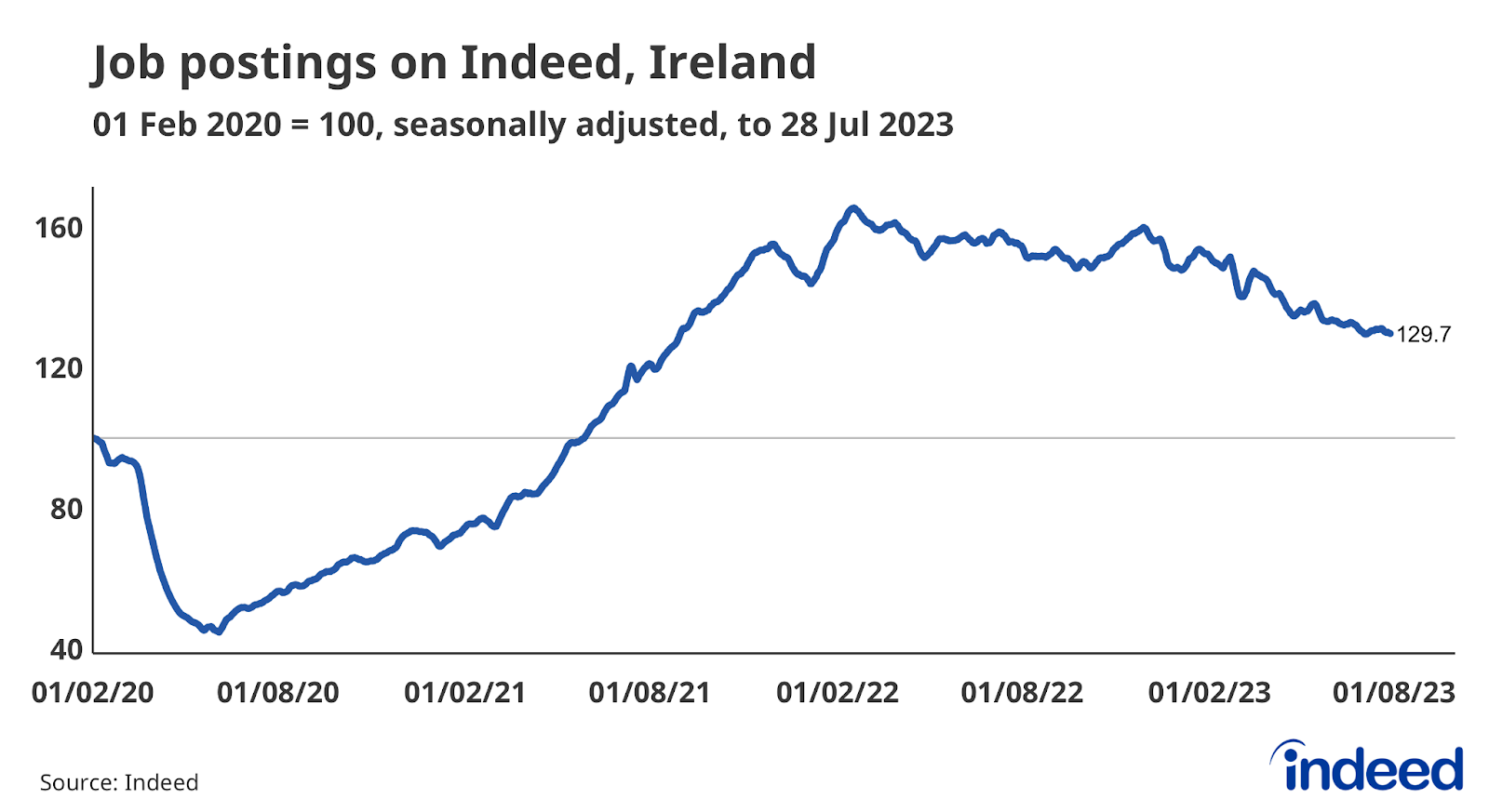
This corresponds with a gradual softening in employers’ hiring appetite, though the latter remains strong. The latest figures from Indeed show that job postings on Indeed Ireland are 30% above the pre-pandemic baseline as of July 2023 (Fig. 1).

The country’s commitment to nurturing a highly skilled and educated workforce has bolstered productivity and competitiveness. As we remain at full employment, now is the time to future-proof the Irish economy. Prioritising various educational routes, including apprenticeships, and investing in sustainable career options for young people who might otherwise seek to emigrate, can ensure our highly talented workforce remains a key driver of economic growth.

Catalyst Announces 100 New Jobs Across European Offices, Expands Presence in Ireland, UK, Italy, and Spain

Dublin-based Catalyst (formerly known as i3PT), a leading global provider of software and professional services to the construction and real estate industries,  today announced the creation of 100 new jobs across its European operations. 50% of the new jobs will be based in Ireland

With this expansion, Catalyst is committed to delivering cutting-edge services and fostering international growth in Ireland, the United Kingdom, Italy, and Spain. Furthermore, Catalyst has plans to establish additional locations in the United States for its obi®️ software business.

The creation of these new positions comes in response to Catalyst’s strong growth and increasing demand for its industry-leading services. The company’s expertise in ESG, technical advisory services and digital technologies has positioned Catalyst as a trusted partner for some of the world’s largest companies and real estate investors. The 100 new jobs will principally be distributed across Catalyst’s European offices, with significant employment opportunities arising across Ireland, London, Edinburgh, Milan, and Barcelona, amongst other new locations. These roles will span various departments, including engineering, software development, marketing, and sales.

Eoin Leonard, CEO of Catalyst, expressed his gratitude to Enterprise Ireland for their unwavering support and invaluable assistance in the company’s expansion. Leonard stated, “We are thrilled to announce the creation of 100 new jobs across our business. This expansion reflects our continued growth and the increasing demand for services and software. We want to extend our deep appreciation to Enterprise Ireland for their ongoing support, guidance, and assistance in our journey to develop a thriving international business.”.

Jenny Melia, Executive Director at Enterprise Ireland said: Catalyst is a great example of an Irish company that has gone from strength-to-strength, growing both at home and internationally. Today’s announcement of 100 new jobs at Catalyst is testament to the ambition and capabilities of the team. At Enterprise Ireland, we are committed to supporting Irish companies to compete and win in international markets, and we look forward to continuing to support Eoin and the team on their growth trajectory.” Catalyst’s expansion marks an exciting milestone in the company’s journey towards becoming a global leader in the real estate and construction sectors. As regulatory shifts drive change towards better practices, Catalyst aims to assist its clients in creating a greener, safer built environment.

Sharp Fall In Professional Job Vacancies In Ireland

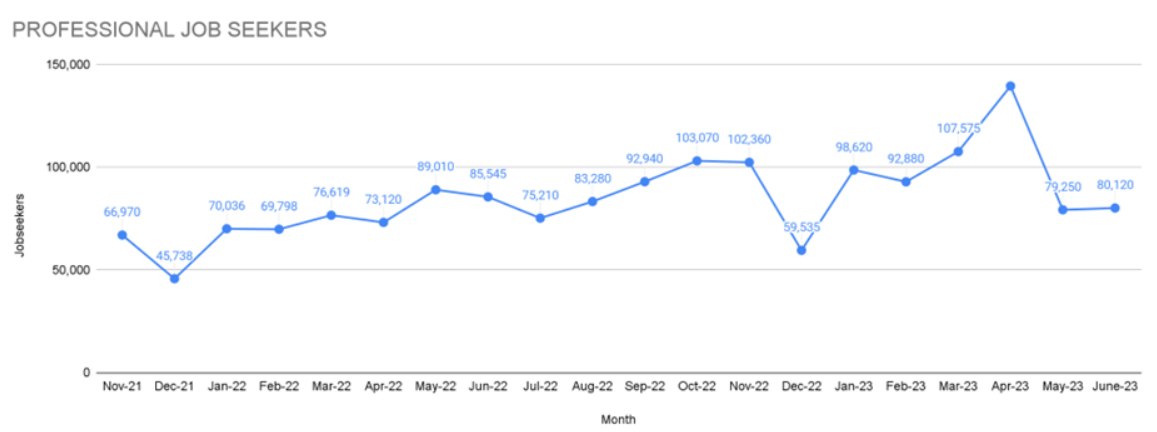
The Morgan McKinley Quarterly Employment Monitor registered a decrease of 15.4% in the number of new professional job opportunities in Q2 2023 compared to the previous quarter across all professional sectors.

The monitor also recorded a slight decrease of 0.8% in professional job seekers during the second quarter. Overall, there has not been a significant change in the number of job seekers from one quarter to another. However, compared to the same period in 2022, the number of applicants in Q2 2023 was 20% higher, primarily due to the tech sector downturn and an increase in business support professionals entering the job market.

Rising inflation, slower business growth, and challenges in the housing market have impacted the overall landscape. Additionally, changes in working models have become apparent, as employers are increasingly resisting remote working arrangements and emphasising the importance of physical presence in the office. However, employers who are flexible have greater access to skilled talent.

The Morgan McKinley employment monitor measures the pulse of the Irish professional jobs market by tracking the number of new job vacancies and new candidates in the Republic of Ireland each quarter. To reflect the changing dynamics of the current employment market, Morgan McKinley are including both permanent and contract jobs in the employment monitor.

Trayc Keevans, Global FDI Director, Morgan McKinley Ireland, said:

“Various sectors experienced a decrease in employment opportunities during Q2 including Accountancy and Finance (-17.3%) and Projects, Transformation and Change (-25%). The decline can be attributed to market cautiousness driven by inflation, sluggish business growth, and difficulties in the housing market. The Technology sector has shown some resilience with single digit declines in professional job opportunities (-7.8%) and an 11% growth in contract opportunities.

“More notably there was a 43% decrease in construction opportunities coming to market for this period due to the long lag time in filling prior positions due to the shortage of skills and difficulty in bringing overseas talent into the market to bridge the gap due to challenges in securing housing. The sector is currently facing a severe understaffing issue, with one in four construction jobs remaining unfilled.

“Despite the challenges, certain sectors continue to experience growth, while employers and candidates navigate the evolving landscape of employment in Ireland. Life Sciences and Engineering saw an increase of 6%, Supply Chain and Procurement experienced a 23% growth quarter on quarter, and Banking and Financial Services recorded a 16% increase. These sectors have been driven by continued investment and expansions of foreign direct investment (FDI) companies, as well as increased demands resulting from regulatory changes.

“In most sectors, salaries have remained steady, except for high-demand positions in Projects, Transformation and Change, Life Sciences, Technology, and Banking where salary increases have been observed. The Banking sector, in particular, has experienced a notable surge in demand for technology professionals due to the growing need for cybersecurity and software application upgrades. However, some sectors have seen a decline in salaries due to increased expenses. Individuals who were let go from technology companies, specifically those in the human resources and talent acquisition field, are now reevaluating their salary expectations as they seek new employment opportunities.

“Although counteroffers during negotiation processes were not as prevalent as in previous quarters, they remained evident in certain sectors. Employee retention has become a strong focus for disciplines and sectors such as Human Resources and Life Sciences, prompting employers to offer higher salary packages and incentives to retain valuable employees critical for business continuity.

“Negotiation dynamics have shifted in certain sectors such as Accountancy and Finance and Engineering, resulting in an increase in under-offering by employers during this quarter. Candidates in these sectors encountered challenges when negotiating modest salary increases, as employers became more conscious of budget limitations and stricter in adhering to hiring budgets.

“The cooling of hiring in the tech sector, which is recovering from widespread resizing of local operations, has led to a larger talent pool of candidates seeking tech sales positions. This has created an employer-led market with increased competition and lower salary offers for senior employees.

“Inflation has impacted hiring practices in certain disciplines, particularly for professionals from lower-cost international locations. The higher cost of living in Ireland has caused professionals to reconsider relocating, while locally based professionals expect higher salaries to offset the impact of inflation. Employers are struggling to meet these salary expectations, leading to the loss of highly skilled talent in certain sectors over the past quarter.

“Emerging technologies such as artificial intelligence have had minimal effects on hiring practices for the majority of sectors during this quarter. Companies are gradually adopting automation and technology advancements, which require skilled professionals to oversee and manage automated processes, rather than replacing jobs.”

Current most in-demand positions by discipline:

  • Technology: Full Stack Developers, Cybersecurity Engineers, Data Analysts, and Site Reliability Engineers (SREs).


  • Financial Services: Commercial Lines Broker, Claims Adjuster/Handler, Personal Lines Broker, Case Manager for mortgages and banking, Pension Administrators, Risk Assurance Analyst, Risk Assurance Manager, Compliance Analyst, Compliance Manager, Internal Audit Manager, Personal Lines Insurance Broker, Internal Auditor, Head of Function.

  • Accountancy & Financing: Newly Qualified Accountants (Big 4/Top 10 trained), Senior Accounts with 2-5 years of post-qualification experience, Tax Accountants, Tax Managers, Payroll, Accounts Payable Specialists, Credit Control, and Account Assistants.


  • Life Sciences & Engineering: Equipment Validation Engineer, Cleaning Validation Engineer, Process Validation Engineer, Computer Systems Validation Engineers, Qualified Persons, Process Engineers with Chemical Qualifications, Quality Control Specialists, Quality Control Engineers, Quality Assurance Analysts, Quality Assurance Engineers, Electrical Engineers, Mechanical Design Engineers, Health & Safety Engineers

  • Projects, Change & Transformation: Project managers, Program Managers, Business Analysts in consulting positions, Payment Roles, SAP Specialists and ERP Specialists.

  • Human Resources: HR Business Partners, HR Generalist and mid-level, HR Managers, HR Operations Specialists, HR Coordinators

  • Construction: Quantity Surveyors, Civil Engineers, Project Managers, Structural Engineers, Mechanical Engineers, and Electrical Engineers.

  • Business Support: Executive Assistants, Office Managers, Receptionists, Office Administrators, and Sales Administrators.

  • Supply Chain & Procurement:  Production Managers, Supervisors, and Operators in the food industry. In the pharmaceutical industry, there has been a need for Planners.

  • Multilingual: Sales, Content Reviewer/Content Moderation, Quality Analyst, Operations/Administration, and Customer Support.

  • Marketing: Communications Specialist, Digital Marketing Manager, Marketing Manager, Brand Manager, and Sustainability Manager.


  • Legal: Corporate Lawyers, Funds Lawyers, Capital Markets Lawyers, Company Secretaries, and Construction Lawyers.


  • Executive Search: Head of Risk, Head of Compliance, Head of Audit, CEO (Financial Services)

Statistical methodology

  • Monthly new jobs and new candidates:

Monthly new jobs and new candidate figures are based on Morgan McKinley’s monthly records of new permanent and contract job vacancies and new candidates registering with the firm for employment. Statistics for the full market are derived using Morgan McKinley’s market share.

  • Job classification:

Job vacancies are professional-level positions within the following sectors and functions: Legal, Funds, Technology, Admin/Office Support, Sales, Supply Chain & Procurement, Life Sciences, Executive Search, HR, Multilingual, Contract, Marketing, Banking & Insurance, Accounting & Finance, and Projects/Transformation/Consulting.

  • Geography:

The data is based on new job vacancies and new candidates registered with Morgan McKinley’s network of Irish offices in Cork, Dublin, Galway, Limerick, and Waterford.

AMD Plans to Invest $135 Million to Expand Adaptive Computing Research, Development and Engineering Operations in Ireland with up to 290 jobs

AMD (NASDAQ: AMD) today announced plans for continued growth in Ireland through an investment of up to $135 million over four years. The investment is intended to fund several strategic R&D projects through the addition of up to 290 highly skilled engineering and research positions, as well as a broad range of additional support roles.

The development is being formally announced in Dublin today by Minister for Enterprise, Trade and Employment, Simon Coveney TD, and Ruth Cotter, senior vice president, Marketing, Communications and Human Resources at AMD. The new investment is supported by the Irish government through IDA Ireland.

“I warmly welcome the ambitious plans of AMD to expand their advanced R&D and engineering operations in Ireland. This significant investment will not only bolster our thriving technology sector but also create long-term career opportunities for both highly experienced professionals and new graduates from engineering disciplines. The company’s plans to add up to 290 new positions and its funding of strategically important R&D projects demonstrate its confidence in Ireland’s supportive enterprise environment and infrastructure. The Irish government, through IDA Ireland, is delighted to support this expansion, further solidifying our commitment to nurturing a vibrant ecosystem for research, development, and engineering,” said Simon Coveney TD, Minister for Enterprise, Trade and Employment.

“From the cloud and PCs to communications and intelligent end points, AMD’s high-performance and adaptive computing solutions play an increasingly larger role in shaping the future of computing today. For nearly three decades, Ireland has been a flagship European R&D centre developing adaptive computing solutions, drawing from a strong and highly-skilled workforce. By further investing and expanding our presence in Dublin and Cork, we are committed to continuing to both drive innovation in Ireland and to support the European semiconductor ecosystem. Through this investment, our R&D teams in Ireland will design innovative high-performance and adaptive computing engines to accelerate data centre, networking, 6G communications and embedded solutions while taking a leadership position on artificial intelligence.” said Ruth Cotter, senior vice president, Marketing, Communications and Human Resources at AMD

Prior to the acquisition of Xilinx by AMD in 2022, Xilinx partnered with IDA Ireland on a number of occasions to advance semiconductor innovation in Ireland. Most recently, in 2017, Xilinx announced a $40 million investment to expand its research, development and engineering operations, as well as recruit over 100 new skilled employees.

“This investment will continue to push the boundaries of what is possible while contributing further to Ireland’s position as a global technology leader. This expansion further strengthens the company’s presence in Ireland as a leading centre of semiconductor innovation and puts Ireland at the heart of AMD’s European research and engineering operations. IDA Ireland has been proud to support AMD and previously Xilinx for nearly three decades and is committed to supporting investments of scale that impact positively on Europe’s semiconductor industry,” said Michael Lohan, chief executive officer, IDA Ireland.

The Irish site was first established in 1994 as the first purpose-built Xilinx site outside of the U.S. and began its operations a year later with a focus on manufacturing, operations support, engineering and administration services. Since the acquisition of Xilinx, Ireland is now home to one of the largest AMD R&D sites in Europe with a strong record of delivering products with significant commercial success, such as the AMD Zynq™ UltraScale+™ RFSoC semiconductor product family.

Envisage announces €1M investment and 12 new jobs alongside new partnership with Sage

Envisage, a leading Sage partner in Ireland and member of the Noledge Group, today announces that it will create 12 new jobs as part of a three year, €1M investment to support its appointment as the first Sage partner in the country that will resell Sage Intacct.

The partnership with Sage – the leader in accounting, financial, HR and payroll technology for small and mid-sized businesses (SMBs) – will support Envisage’s plans to grow its business and drive customer acquisition. The company, which currently has annual revenues of €3M and employs 22 people, expects to increase its annual revenues to €6M and grow to a team of 34 people.

As demand for cloud-based finance systems increases, this partnership will enhance Envisage’s ability to offer the highest level of service to its growing customer base across Ireland and the U.K. Envisage will be offering customers Sage’s award-winning accounting software, Sage Intacct. With this new partnership, Envisage customers will benefit from automation, cost savings, smooth integration, effortless data access across multiple systems, and real-time insights for informed decision-making.

Through Sage Intacct, Envisage can now deliver more automated solutions and controls for billing, accounting, and reporting, enabling finance teams to simplify complex processes and increase data accuracy. To support this growth, Envisage will hire 12 additional people over the next three years. The new roles will be in the areas of sales, marketing, implementation and support.

Sage Intacct provides comprehensive visibility into both operational and financial aspects of a business, leading to improved automation, increased profitability, and enhanced customer satisfaction. Sage Intacct is designed to serve a variety of industries, including, Business Services, Financial Services, Not for Profit, Software and Hospitality.

David Burke, Technical Director, Envisage, said“We are delighted to make this significant investment in our expansion and grow our team in Ireland. By adding Sage Intacct to our product portfolio, we can bring additional value to our customers and also open up new opportunities in the services sector.

 “As a leading Sage partner in Ireland, we are dedicated to providing the best products, training, and resources to help businesses achieve their growth goals. With the addition of Sage Intacct to our portfolio, we are now able to offer an even wider range of solutions and services to meet the evolving needs of our customers. We look forward to this next chapter of growth and success.”

Paul O’Riordan, Vice President, Partners & Alliances, Sage UK & Ireland, said: “Envisage has a proven track record in delivering creative, flexible, and long-lasting ERP solutions for some of Ireland’s leading companies. With Sage Intacct, we’re confident that we can help our joint customers drive their businesses forward. We are pleased to partner with an ambitious company that has the resources and capabilities to design and integrate exceptional customer solutions.”

Envisage, which was recently recognised as ‘Sage Partner of the Year for Ireland’, now offers Sage Intacct to customers in both the Republic of Ireland and Northern Ireland.

Ireland’s hardest jobs to fill.

Engineering and construction related jobs are some of the hardest positions for employers to fill, according to new data by hiring platform Indeed. The analysis looked at Irish job postings from January 1st through to the end of April this year to determine which positions were most likely to remain open for over 60 days – an indicator of it being ‘hard to fill’.

Junior engineer positions were particularly hard to fill, with 2 in 3 (67%) of these positions remaining open for over 60 days. Employers were also finding construction professionals of all types difficult to recruit for, with titles such as mechanical and electrical project manager, civil supervisor and construction manager also featuring heavily on the list.

When it comes to white collar jobs, positions such as tax senior and solicitor were both listed as some of the hardest to fill. Meanwhile some tech roles also remain difficult to find the right talent for with the gap in Ireland’s tech skills persisting for roles such as python developer and front-end developer. The increasing demand for moderators also seems to be causing a talent mismatch, with over half of these roles remaining open over 60 days.

Well documented shortages in healthcare workers were reflected in caregivers also being listed among the hardest to fill roles. Previous Indeed data has shown the top two job searches that saw the biggest increase on the Irish site in 2022 were “visa sponsorship, healthcare assistant” (up 532%) and “visa sponsorship, elderly care” (up 421%). The nature of these searches suggest that Ireland is highly reliant on foreign workers to fill this talent gap in healthcare.

 Jack Kennedy, Senior Economist at Indeed:

“Many of the roles listed are highly specialised and require extensive training or experience, which in itself can narrow the candidate pool. Coupled with the lowest unemployment rate on record since the early millennium boom, as well as the high cost of living driving youth emigration and making it increasingly difficult to attract overseas talent, some employers may feel talent bottlenecks in the coming months.”

“However this is good news for jobseekers in these professions, or someone looking to break into a new industry, as they will be in a good position to negotiate a better salary. This may also be good news for the Irish diaspora looking to return home after emigrating after the last recession, which we know deeply affected sectors like construction. Longer term, however, employers and policy makers will need to examine talent pipelines and find ways to address the persistent barriers to recruitment in the industries most affected.”

Source: Indeed Ireland data (1 Jan 2023 to 30 April 2023)

Rank Job Title % of postings open 60+ days
1 Junior engineer

66.9

2 Camp Leader

65.3

3 Python Developer

65

4 Tax Senior

63.6

5 Civil Supervisor

62.7

6 Mechanical and Electrical Project Manager

62.2

7 Solicitor

61.2

8 Junior Project Manager

60.7

9 Caregiver

60.3

10 Senior Design Engineer

59.8

11 Mechanical Designer

59.6

12 Lawyer

59.5

13 Senior Project Engineer

56.1

14 Front End Developer

55.6

15 Construction Manager

54.2

16 Moderator

53.8

17 Building Information Modelling Manager

53.7

18 Senior Engineer

53.4

19 Construction Project Manager

52.2

20 Resident Engineer

51.5