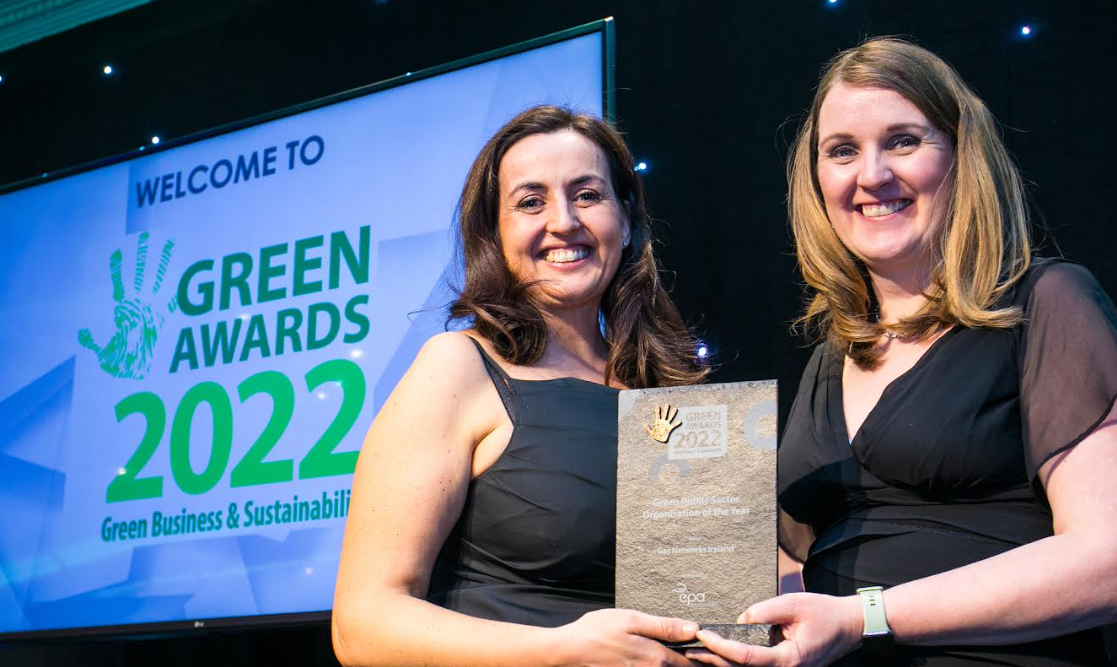
Gas Networks Ireland named Green Public Sector Organisation of the Year at Green Awards 2022

Following another successful year delivering on its holistic sustainability programme, Gas Networks Ireland was named Green Public Sector Organisation of the Year at the 2022 Green Awards at the Clayton Hotel on Burlington Road in Ballsbridge..

The semi-state utility was also shortlisted for the Green Energy Provider Award and to retain its Green Large Organisation of the Year Award for a third year, which were won by SSE Airtricity and An Post respectively.

Additionally, Gas Networks Ireland was selected by the judges to be one of six organisations shortlisted for the Green Business of the Year Award – an award it won last year, but was deservingly won this year by Hotel Doolin.

Gas Networks Ireland Sustainability Manager Anne Moore said winning a green award for the third year in a row was a testament to the whole organisation’s commitment to sustainability

“We are delighted to be recognised for our contribution to sustainability and our commitment to maintaining the highest standard of excellence in our operation of the gas network. We are extremely proud of all our staff for their hard work, passion and continued dedication,” Ms Moore said.

 “Sustainability is very important for Gas Networks Ireland and we aim to deliver our services in a sustainable manner that contributes to the protection of the environment while supporting the social and economic development of the communities we operate in, as well as the wider economy.”

One of only 46 companies in Ireland to hold a Business Working Responsibly Mark, Gas Networks Ireland was also recognised for “taking coordinated action on climate issues” and achieved a ‘B‘ in the Carbon Disclosure Platform (CDP) global emissions ratings, exceeding the global, European and sector averages to finish in the top quartile of all businesses assessed globally.

Ireland’s national gas network is considered one of the safest and most modern gas networks in the world and will play a crucial role in Ireland’s cleaner energy future.

The semi-state utility advanced its journey to a decarbonised gas network with approval from An Bord Pleanála for Ireland’s second renewable gas injection facility in Mitchelstown, the development of a hydrogen research and development facility in Citywest and the opening of its third and fourth public compressed natural gas (CNG) refueling stations in Limerick City and Clonshaugh.

“Climate change is one of the most urgent global challenges we face and as the operators of Ireland’s gas infrastructure, sustainability is a focal point of our plans to decarbonise the gas network in line with national and EU policy,” Ms Moore said. 

In a European first, the company partnered with environmental group, Leave No Trace Ireland, Coillte and the Burncourt Community Group to help restore Glengarra Wood in Co. Tipperary as part of the international “Hot Spot” programme.

The organisation also backed over 52,000 hours of social inclusion and environmental education initiatives within communities across Ireland, with staff completing over 890-hours of volunteering.

As a business, we are on a continuous journey to reduce our emissions and continue to support and promote biodiversity within our communities,” Ms Moore said.

Gas Networks Ireland’s fourth annual Sustainability Report, which is in line with the Global Reporting Initiative standard and includes more highlights from 2021, will be published later this quarter.


Irish businesses are most likely to be on the path to decarbonisation

Expleo, a global engineering, technology and consulting service provider, today announces the results of global research, which found that 90% of businesses in Ireland say that they have clear plans to meet their decarbonisation targets. The study found that organisations in Ireland are more likely than all other countries surveyed – the US, UK, Germany and France – to be pursuing their green agenda with a clear plan.

The research, which included a survey of 111 business and IT leaders in Ireland, found that despite having clear plans to meet their decarbonisation targets, businesses in Ireland are not there yet. Some 89% believe that their organisation could do more to make their IT infrastructure and projects more environmentally friendly. But with the accelerated uptake of new digital technologies, many are struggling to understand how digitalisation is impacting their environmental footprint. In fact, 90% of senior business and IT leaders say they need to do better to understand the environmental impact of using more digital systems.

Despite this significant knowledge gap, the research, published in Expleo’s Business Transformation Index 2022 Ireland Report, suggests that organisations are starting to realise how technology can be used to support their sustainability efforts. Almost one-third (30%) of businesses in Ireland will use digital transformation to become more sustainable and environmentally responsible.

Many businesses are prepared to dedicate a significant portion of their IT budgets to becoming more sustainable. Almost half (42%) of businesses in Ireland plan to spend more than 10% of their 2022 tech budgets making their IT more sustainable. Just 2% of organisations will not use any of their tech budgets to make their IT more sustainable.

Phil Codd, Managing Director, Expleo Ireland said: “Our research shows that Ireland’s business community recognises its role in tackling the climate crisis and there is now a hyper-focus on the need for action. It is promising to see that business leaders are making significant investments in improving the efficiency of their IT infrastructure. We are moving beyond lip service and are now seeing real, meaningful action.

“Digital transformation is proving to not only be good for business but good for the planet. Over the last two years, enterprises have embraced digital technologies to ensure business growth and survival. And while there are some concerns around the environmental footprint of embracing digital, we have seen how the adoption of cloud-based applications, or innovations that use energy more efficiently, have had a positive impact on reducing carbon outputs.

“Increasingly, we will see businesses turn to technology to innovate and improve efficiencies, with sustainability at the core. And while now, businesses are dedicating a proportion of their IT budgets to sustainability efforts, we will soon be at the point where IT and sustainability are intertwined.”

Citi creates 300 new jobs in Ireland

Citi today announced that it intends to create 300 new jobs for Ireland this year. Minister for Finance Paschal Donohoe T.D. and Cecilia Ronan, Citi Country Head Ireland, with Martin Shanahan, CEO, IDA Ireland made the announcement at Citi’s European Bank headquarters on North Wall Quay in Dublin.

The bank employs 2500 people in Ireland currently. It has a significant presence in Dublin with several of its global businesses operating here including Corporate Banking and Private Banking, Treasury and Trade Solutions, Markets, and Securities Services.

The new positions available in 2022 include Risk, Audit, Finance and Treasury; Technology roles including Cloud and Cyber specialists, Software Engineering and Architects, Developers, Blockchain specialists; Client facing roles in Citi’s Treasury and Trade Solutions business and Commercial Bank; Operations roles including Fund Accounting, Asset Servicing; and Credit Management.

Minister for Finance Paschal Donohoe TD said “I’m very pleased that Citi is announcing these new jobs today which comes at a time in Ireland when employment in the international financial services sector is at the highest level it has ever been at, boosted by Ireland’s highly educated and skilled workforce. Citi has a long history in Ireland, consistently evolving to keep pace with the rapid changes in the financial services sector and I congratulate them today on this important announcement.”

Cecilia Ronan, Citi Country Head Ireland, said: “This is an exciting announcement for Citi and for Ireland. Financial services has changed over the last ten years and more change is on the horizon as the pace of digitisation increases. Many of these new roles reflect this changing reality where skills like risk, software engineering, data analytics, cloud and cyber are of increasing importance to the growth and soundness of our business. We already employ 700 people in technology roles in Dublin and this is now set to increase.”She continued, “We also recently announced the sale of our building at North Wall Quay and plans to purchase a modern and sustainable building in Dublin, reaffirming our long-term commitment to Ireland. We have flourished here because of the talent pool, the open economy and integrated ecosystem, and the access to the EU and I am excited to see that continue into the future.”

Commenting on the announcement Martin Shanahan, CEO, IDA Ireland said “Citi’s considerable footprint and its growth across multiple and diverse business functions in Dublin, greatly adds to Ireland’s reputation as a global centre for Financial Services. IDA Ireland has supported the development of Citi in Ireland for many years and we wish the company continued success with this expansion.”

Citi has had a significant presence in Ireland for over 55 years. It was one of the first foreign banks to open an office in Dublin. Citi opened its first Global Innovation Lab in Dublin in 2009, which was supported by the Irish Government and IDA; Dublin is now also the home of Citi’s Global Centre of Excellence for Artificial Intelligence & Blockchain.

Every day in Dublin, Citi’s global teams interact with colleagues and clients in over 100 countries processing millions of transactions and supporting next-generation technology. With a firm focus on building careers, the team at Citi benefit from mentoring and excellent training, and the opportunity to build a global career from Dublin. Citi Ireland was recently named by LinkedIn as one of the Top 25 Employers in Ireland.

Citi champions diversity within the workforce, with 60 different nationalities working in the Dublin office.
Shape your Career with Citi in Dublin

Businesses struggling to monitor and report on key sustainability metrics

Businesses in Ireland are currently struggling to comprehensively measure, monitor and report on the range of metrics that they contribute to as part of the energy transition and in taking positive climate action.  According to new independent research* conducted on behalf of clean energy supplier, Pinergy, by iReach, 27 per cent of SME’s, employing less than 100 people, do not currently have any tools for effectively measuring, monitoring and reporting their consumption/contribution when it comes to energy, waste, water, air quality and carbon footprint.

The research also highlighted the top three actions businesses are citing to take in reducing their carbon footprint in 2022 are a focus on reducing electricity waste (43 per cent), reducing landfill waste and increasing recycling (40 per cent) and reducing water waste (34 per cent).

Despite a growing demand and trend among businesses to play their part to become more sustainable, without the tools to monitor and measure their contributions, many will continue to struggle to effectively manage and implement these stated actions and targets. 

In response, Pinergy has now developed a new measurement as a service proposition whose aim is to make measurement and reporting accessible to all businesses regardless of size with their simple to use technology.

Through this new service, Pinergy will give businesses the ability to measure the performance of their premises or buildings under various metrics.  The objective is to ensure that ‘what gets measured, gets managed’. Pinergy will install a series of meters and sensors in the building of its customer, that will enable the business to measure electricity & gas usage (regardless of supplier), water usage, waste usage (with select waste companies) and most timely of all, the quality of the air in their buildings.

In terms of measurable performance indicators, Pinergy will be able to offer businesses real time data, automated reporting, target and benchmark settings, carbon reporting and various other sustainability measurements across each of the categories covering energy, water, waste and air quality. For Property Management firms in particular this information can really help in delivering on key ESG goals.

Companies are already using Measurement as a Service to streamline their reporting; John O Donovan with the JLL Management Agent team at The Tio North Dock One & North Dock Two building in Dublin said: “This is a service that is very important to us, for monitoring energy and utility usage which reduces cost and saves time by bringing together a number of different reports into one portal.” 

Commenting on this latest development for Pinergy, Colm Foley, Channel Manager, Business, said: “At Pinergy, we are constantly looking for new ways that our customers can make the most of not only their energy usage but how they can most efficiently manage their buildings and premises. Not only can we now give our customers the ability to measure sustainability KPIs such as their carbon footprint, but we can also show how well utilities such as Electricity, Gas and Water are being used across their property portfolio.” 

“Delivering our Measurement as a Service offering is empowering our customers with data and insights to make more informed decisions that are better for the business and better for the environment.”

* Research was conducted nationwide as part of the iReach Business Decisions Omnibus Survey Q1 2022. Over 200 SME businesses responded to the survey, delivering a high level of statistical accuracy.

Employee engagement is the biggest challenge facing business leaders in 2022

Employee engagement is the top challenge for business leaders in 2022, according to a survey of senior managers by Fastnet Executive Search, one of Ireland’s leading executive recruitment and search firms. Of those surveyed, 88% cited employee engagement as the most critical challenge over other issues such as digitalisation, supply chain disruption and sustainability.

When asked what the key priorities are for developing employee engagement, responders — of which 80% are in the life sciences sector — listed the following in order of importance: connection to the organisation’s purpose (77%); autonomy and trust (67%); continuous learning (58%); and flexible working (57%).

Éimhín O’Driscoll, Managing Partner of Fastnet Executive Search, has been partnering with major employers in the life sciences sector for over 20 years, said: “In today’s dynamic environment, business leaders are facing unprecedented volatility in recruitment and retention, and we are not surprised that employee engagement is arising as the stand-out challenge. Jobs are more complex, organisations are transforming, and new talent models are emerging based on purpose and meaning.”

Éimhín added: “People want to work in organisations that are creative, empowering, purposeful, and passionate. In our experience, having the right leaders in place is crucial for the development and growth of high performing teams, elevating organisations from good to great. The right leaders create environments where learning is a priority, where ideas and feedback are shared authentically, and people feel a meaningful connection to the value they create during their workday.

“While job scope and reward packages continue to be key drivers for candidates making significant career choices, candidates are focusing more on the purpose and values of prospective employers and adopting a more thorough approach to understanding company culture from the earliest stages.”

The survey also found that 40% of respondents had worked in a different industry in their last role, highlighting a change in how companies value adaptable skills and culture fit over industry specific experience when hiring leaders.

“When conducting business critical searches for senior executives, our clients are increasingly seeing the benefits of attracting leaders from diverse backgrounds in improving employee engagement and trust and ensuring new perspectives and innovative thinking on their leadership teams.

Éimhín added it is widely accepted that the Workplace of the Future will be very different from what we have known, presenting both opportunities and challenges. “We have come through a period that has facilitated an exceptional chance for deep reflection and reassessment,” she said. “Rather than succumbing to the temptation of a ‘return to normal’, I feel it is an opportune time to be brave, innovative, and creative in defining our future way of working.”

Public understanding of 5G benefits remains low with just one in 10 making use of it

56% of people in Ireland don’t understand the benefits of 5G, compared to 64% the year previous, according to Deloitte Ireland’s Digital Consumer Trends Report, which looked at consumers’ attitudes towards 5G. With just one in 10 using 5G at the time of the survey – the majority aged 18-24 (17%) – more than half (54%) of consumers said that they can’t tell the difference between 4G and 5G.

Although 61% of people think they will have better network connectivity (faster, more reliable) on 5G than on 4G, consumer adoption is slow and there is complacency towards switching with 15% of respondents saying they would switch as soon as it’s available in their region, 13% would switch if they hear good things about it, 18% say they would switch if was the standard offering and there was no alternative and 30% noted they would probably switch eventually. When it comes to network offerings, over a third (36%) said they would change network operator based on 5G coverage.

There has also been ongoing debate around health concerns with 5G and while people are less concerned about the health risks associated with 5G than they were in 2020 (16% vs 20%), 38% still feel that they “don’t know” if there are health risks associated.

The Deloitte Digital Consumer Trends report is an annual survey of 1,000 consumers in Ireland, aged between 18 and 75, which explores their digital usage and attitudes towards technology.

Commenting on the report, John Kehoe, Audit Partner at Deloitte Ireland said: “While the concept of 5G has been talked about for some time, the benefits are still not clear to consumers. Education on these benefits and dispelling the myths around health concerns will be essential as the rollout picks up, particularly as work moves to a hybrid model, because the current wired broadband network is not built for a sustainable work from home scenario. The opportunity here is for 5G to complement the wired broadband network.

“The government’s Digital Ireland Framework published earlier this month set out a target to have 5G coverage in all populated areas by 2030. Collaboration of key stakeholders will be a critical factor in enabling successful deployment across the country. There needs to be a significant investment and capital injection to support the rollout, from cell towers to power consumption tracking. Until this investment is clear, it may be some time until consumers can fully reap the benefits of 5G including improved health and wellbeing, enhanced entertainment and smarter, connected cities.”

Practicalities driving purchasing decisions

Aside from price, battery life is the top feature that influences consumers’ purchasing decision on phones, followed by storage capacity and camera functionality and quality. Ease of use features as the second most important factor for the 55-64 and 65-75 age cohorts (39% and 43% respectively). 5G only ranks number 10 on the list of priorities and is of similar importance, or lack thereof, for all age brackets with the 45-54 cohort caring the most about it (13%) and 55-64 caring the least (6%).

“Currently, most devices in Ireland are not 5G compatible which is naturally a key barrier to adoption. However, as 5G isn’t high on the agenda for consumers, it further highlights the need for education on the benefits,” concluded Kehoe.

Xtremepush earns ‘top 50’ ranking in G2’s 2022 Best Software Awards for Marketing and Digital Products

Xtremepush, the Irish based, enterprise customer data and engagement platform, earns 36th place on G2’s 2022 Best Software Awards Marketing and Digital Advertising Products list. To feature on this list is to be among the world’s best software companies and products based on authentic, timely reviews from real users.

G2 is the world’s largest and most trusted software marketplace, helping more than 60 million people every year make smarter software decisions based on authentic peer reviews. Thousands of companies’ partner with G2 to build their reputation, manage their software spend and grow their business — including Salesforce, Hubspot, Zoom, Adobe and more so to feature on this list is to be among the world’s best software companies and products

This is Xtremepush’s debut on one of G2’s Best Software lists, earning its place this year thanks to the hard work and innovative spirit of the entire XP team. Tommy Kearns, Xtremepush CEO, commented: “This is a huge achievement for everyone at Xtremepush and a testament to how hard everyone has worked to turn our CDEP [Customer Data and Engagement Platform] into a world contender.

Inclusion in G2’s best software list for Marketing and Digital Advertising Products is proof that we’ve created something special, not just from a product perspective but as an organisation too. The thing that really excites me is the best is yet to come.”

242% surge in cyberattacks in Ireland

Check Point® Software Technologies Ltd. a leading provider of cybersecurity solutions globally, is warning organisations in Ireland of a 242% surge in cyberattacks when globally, the figure is 40% in 2021 compared to 2020. What can Irish companies do differently? Check Point Software says now is the time to adopt a prevent-first approach.

There have been several high-profile cyberattacks in Ireland this year alone. Most recently, the National University of Ireland Galway (NUI Galway) fell victim to an attempted attack, causing widespread disruption to students and staff. And while there are promising initiatives happening, such as the Cyber Ireland National Conference, the 242% increase in cybercrime is a stark reminder that there is still a long way to go.

Check Point’s Country Manager for Ireland, Hugh McGauran says, “Clearly, Irish companies are attractive to hackers right now. However, we can absolutely reduce the risk of unknown attacks by implementing a prevent-first approach. This essentially means moving away from detection and response only, and neutralising attacks and malwares prior to the execution stage. If you think of the kill chain, the first step that a malware will take is to try and propagate and move laterally across your network as soon as it’s executing. But, if you can prevent it from executing in the first place, then all the efforts to trace, contain and remediate that damage are dramatically reduced.

“This is something even more important now than ever due to the cyber skills gap we currently have here in Ireland. If you can reduce the burden and eliminate a lot of the noise, then you can allow your smaller teams to focus on the real threats. To bring this into the context of the pandemic, whether you agree or disagree with the decisions of government, it really was a prevent-first strategy. The first thing most governments did was to ask everyone to separate – work from home, don’t go out if you don’t need to.

“The vaccine rollout is another layer of prevention. If we were to go back and use a detection and response approach only, then it would have centred around handing out thermometers and testing everyone – which doesn’t prevent anything. That would definitely have had a very different impact in terms of the infection rate, the load on hospitals and ultimately, the mortality rate. So, in cybersecurity, yes detection is important but if you can prevent something, why wouldn’t you?”

Hugh’s five tips for Irish companies looking to adopt a prevent-first approach:

  1. Visibility: Know what is connected to your network.
  2. Use block/prevent mode on high fidelity signatures. Tune said signatures based on devices within each network segment being protected to reduce false positives.
  3. Automate threat detection and remediation.
  4. Put in place guardrails to ensure configurations are properly maintained.
  5. Train your staff to operate the technology properly and if that is not possible, work with a managed services partner to fill skill gaps.

Starting your own business in Ireland: What you need to know about payments

The idea of starting your own business can emanate a gamut of emotions in a person. These emotions are usually a mix of excitement and nervousness. You are digging deep to think of stellar ideas that can turn your start-up into a goldmine. Next in line, you would want your business model to be different from the crowd. Moreover, that idea should add value to someone’s life, and it should be called productive. Yet one of the most important factors which a business should never overlook is its payment gateway. How well is their payment infrastructure developed? Are credit card machines built with the latest technology integration? 

Why is a coherent payment solution important for businesses? 

If a venture possesses a robust payment gateway, then it would already keep the customers happy. Since a latent payment solution looks like a hustle for customers shopping from a store. 

This ineffective payment settlement system is more time-consuming and stressful for customers. 


Thus, they will hunt for stores and restaurants which can provide them with a seamless gateway. Thus, digital transformation should be adopted by merchants extensively to derive an edge against competitors. This transformation in businesses is via the newest technology in their payment solution. 

Building the business foundation 

When starting your own business a rock-solid payment infrastructure withering away customer’s hassles is incumbent. Some of the advancements to be incorporated by a business are:

Mobile Point of Sale  

The point of sale should be supported by mPOS technology. This liberates the stores from accepting in-store payments only. On top of this, payments-on-go will be the most desirable benefit rendered to the customers. Therefore, they will be able to initiate payments because the portability offered is unmatchable. Vendors can easily carry this handy instrument for accepting payments. Along with flexibility, these mPOS offer faster payment processing and faster-enhanced efficiency as well.  

E-wallets is the next big thing   

Exceptional flexibility proffered to the customers during the check-out process will always work in a business’s favor. Since the customers will not crib standing in long queues just to make the payment. This is why the concept of e-wallets is highly preferred because it eases the process of making payments. Our tech-savvy generation would always feel attracted towards efficient technical advancements. Thus, the use of Google and Apple pay has been on a surge. Since it has rendered impeccable convenience to the customer, plus the user interface has been comprehensible. QR code scanning has been another game-changer that eases the payment processing procedure.  

NFC enabled credit card machines

The era of contactless has been skyrocketing, thus card readers should impanel RFID technology. In this way, the effortless Near Field Communications product can be easily optimized by businesses. Therefore card readers used by businesses have to match up to the latest standards prevailing in the market. These card readers should support contactless payment solutions. Moreover, they should have an EMV compliant system i.e., these card readers support Euro, MasterCard, and Visa. NFC-enabled transactions will render more convenience to the clients and ease the workload of merchants too.