Failure to facilitate hybrid connections creating needless barrier to renewables in Ireland

Ireland’s failure to implement policies that facilitate so-called hybrid connections places unnecessary costs and delays on renewable providers. This warning comes from the Irish Solar Energy Association (ISEA) who want new policies to be expedited so they are implemented as soon as possible to help achieve the ambitious targets of the latest Climate Action Plan.

A hybrid connection is where more than one source of energy or storage is connected to the national grid on a single site. These are currently not permitted in Ireland, meaning that in sites where solar and storage or solar and wind are present together, there is a need for two separate connections. Each grid connection requires the construction of physical infrastructure with the associated costs, planning requirements and time.

While consultations are taking place in regard to increasing the over install limit of connection capacities and an additional consultation is expected to take place in regards to multiple legal entities behind connection points, there is a third, and more important topic, the dynamic sharing of MECs, that needs to be addressed urgently if we are to capitalise on the benefits of updating these policies for consumers and renewable providers.

Speaking about the need for new policies in this area ISEA CEO Conall Bolger said “We have been talking about hybrid sites for nearly a decade, with no output evident aside from on-going consultation processes. We have examples of locations that have two buildings side by side performing duplicate functions. This is extremely wasteful, increases the cost to energy providers and ultimately to consumers.

“There has been a general recognition amongst policymakers that change is required for several years.” But according to Bolger there has been very little action. “The 2019 Climate Action Plan committed to putting the right policies in place by Q3 2020. The latest iteration of Climate Action Plan now makes that same commitment but for Q4 2023. Despite an unexplained 39-month delay, the industry isn’t overly confident that we will see much movement this year.”

ISEA now want the Commission for Regulation of Utilities (CRU) to make a decision. “It feels as if the regulator isn’t focused on the big picture in relation to what needs to be done to expedite the updating of these dated policies with their lack of attention on the dynamic sharing of the maximum export capacity (MEC) by technologies behind the same connection an example of this. If adopted, this will allow for greater flexibility and variety in what can be achieved at hybrid connection points. We need to radically accelerate our deployment of renewables and hybrid connections will help keep costs for consumers lower and ensure faster implementation.

“If we were to place a solar farm on every renewable site already connected to the grid, we could ramp up our delivery of green power while minimising the construction of new network. Everyone knows what is required, so let us put that in place now, and not wait until the end of the year.”

Concluding Conall Bolger, CEO of ISEA said “We are in a climate crisis, everyone agrees that renewables are one of the most important solutions. We need the triumvirate of solar, storage and wind working together to combat Ireland’s reliance on fossil fuels. Allowing hybrid connections facilitates this in an efficient manner.”

Ireland Tops Energy Efficiency in Euromonitor’s first-ever Global Energy Vulnerability Index

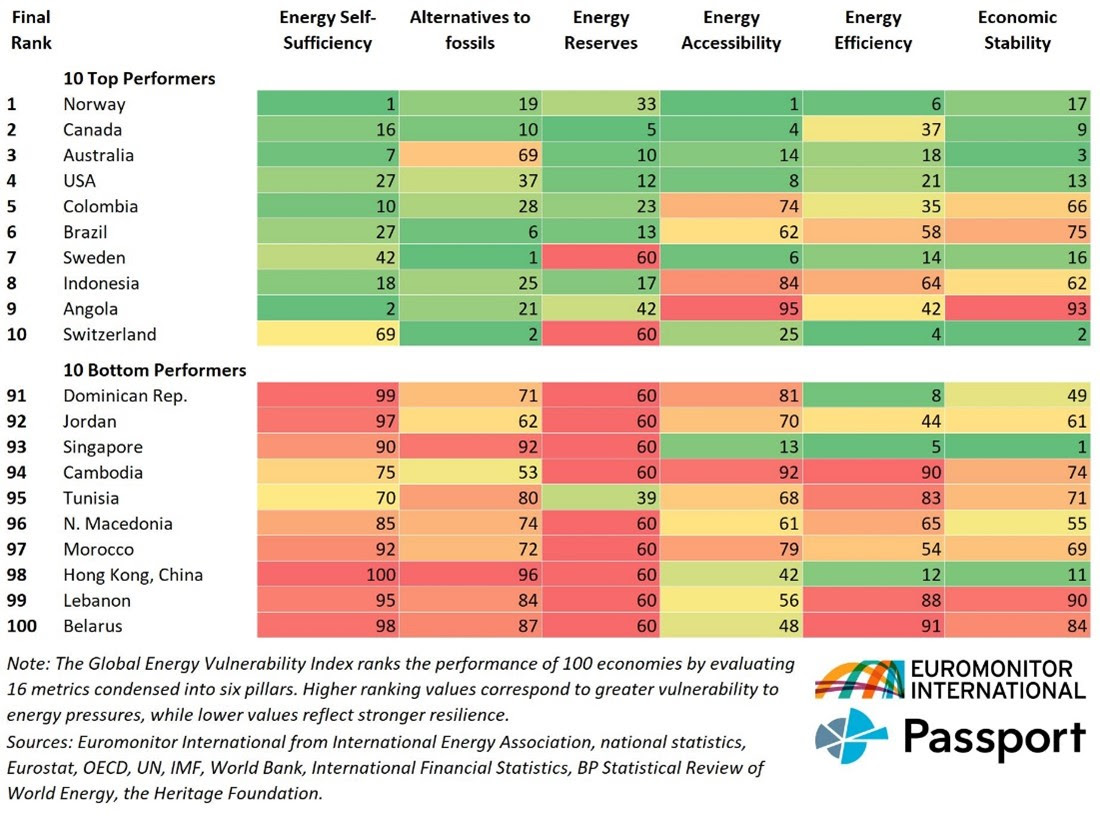
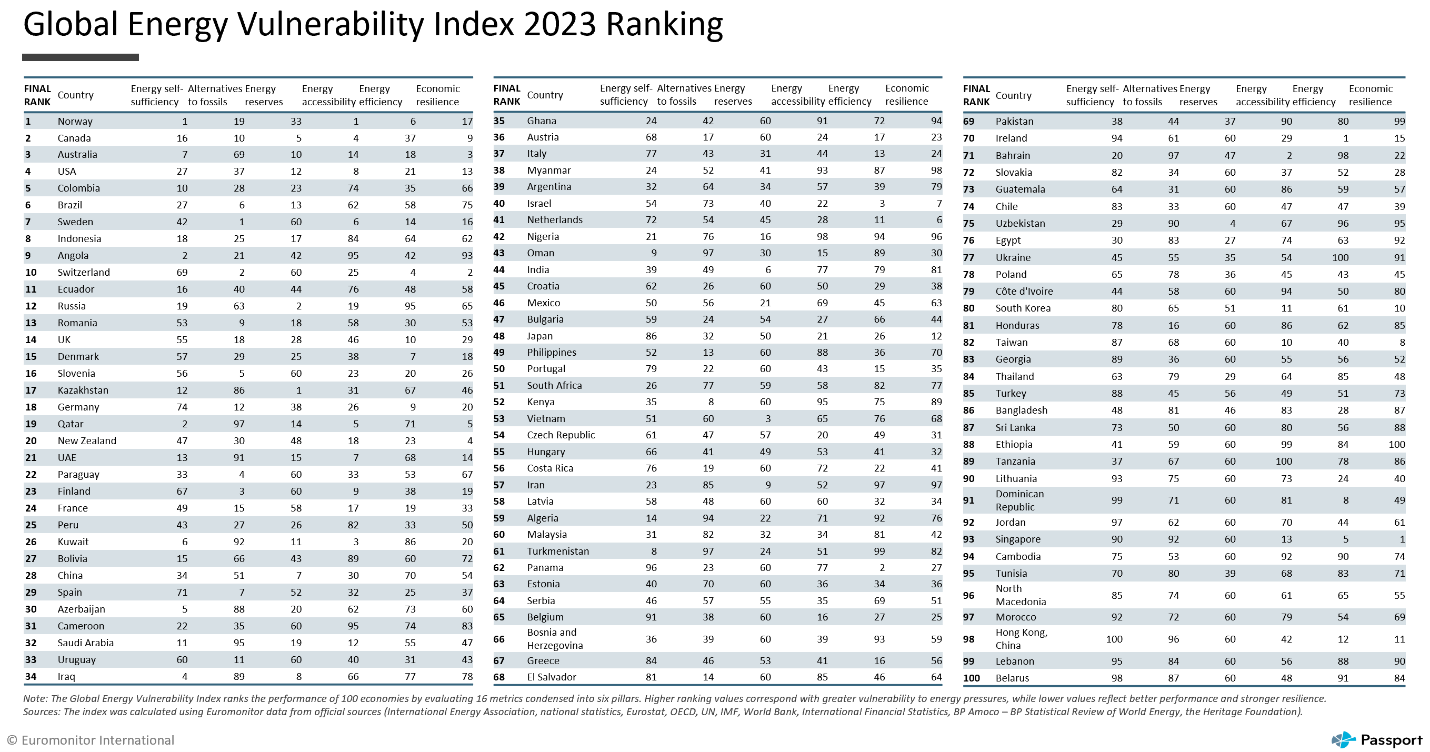
Market research company Euromonitor International has released its first-ever Global Energy Vulnerability Index, as part of its ‘New Economic Reality: Rising Energy Pressures’ report, revealing individual countries’ exposure to energy shocks.

The Global Energy Vulnerability Index 2023 is designed to help leaders and businesses assess and benchmark a country’s energy security, providing insights into potential risks, challenges and opportunities in the markets where they operate or plan to expand into in the future.

Euromonitor International used six groups of indicators to measure each country’s level of energy vulnerability:

  1. Energy self-sufficiency (30% of total score (TS)),
  2. Alternatives to fossils (35% TS),
  3. Energy reserves potential (10% TS),
  4. Energy accessibility (5% TS),
  5. Energy efficiency (10% TS), and
  6. Economic resilience (10% TS)

Ireland ranks highest globally in energy efficiency. Norway, Canada, Australia and the US rank at the top of the index due to their strong energy self-sufficiency, ample energy resources, diverse energy mix and high economic resilience.

At the other end of the table¸ Belarus and Lebanon rank at the bottom as both countries lack energy resources and struggle with poor energy efficiency and economic uncertainty.

Singapore and Hong Kong also rank among the bottom 10 performers because of heavy reliance on energy imports despite their good score in energy efficiency and economic stability. The smaller size of Singapore and Hong Kong also limits renewables capacity, adding to the city-states’ weaknesses.


Aleksandra Svidler, Consultant for Economies at Euromonitor International, said: “Understanding a country or a region’s vulnerability to energy shocks will inform business strategy and enable an optimal plan for energy sourcing, as well as help to identify the white spaces for investment.

“Overall, economies that are heavily reliant on imports, with low adoption of renewables, weak energy efficiency and economic instability are more vulnerable to energy risks.

“Many African countries continue to grapple with underdeveloped infrastructure, poor access to reliable and affordable energy and low investment while developing Asian economies continue to struggle with low self-sufficiency rates, high dependency on fossil fuels and limited access to capital.”

Svidler said that European countries also face challenges ahead. “Although many European countries are better positioned to weather disruptions due to the rising renewables adoption and better access to capital, the region’s high reliance on energy imports raises its exposure to energy shocks.”

Euromonitor International selected six groups of indicators to measure each country’s energy vulnerability known as pillars. Low energy self-sufficiency, due to the weak domestic energy production and high reliance on imports, raises the exposure of an economy to disruptions in energy supply, global price shocks and geopolitical risks. High reliance on a single external energy supplier particularly undermines an economy’s energy security.


Alternatives to fossils pillar reflects the diversification of an energy mix away from fossil fuels by investing in alternative sources, such as green renewables or nuclear power, which can help to raise energy security, reduce exposure to global energy price and supply shocks, and enhance sustainability.

Energy reserves potential helps to assess the future availability of energy resources at current production rates. Reserves of oil, gas and coal can play a key role in boosting energy self-sufficiency of a country. Yet, high resource potential does not necessarily guarantee sufficient future supply due to economical, technological and environmental constraints.

Energy accessibility pillar illustrates the reliability and adequacy of power supply in a country and points to the state of energy infrastructure. Lack of access to power and underdeveloped energy infrastructure can lead to significant social and economic challenges.

Energy efficiency indicates the amount of energy needed to provide goods and services. Higher energy efficiency can help to reduce energy consumption, and therefore reduce costs and reliance on imports, boost competitiveness and environmental benefits.

Countries with greater economic resilience are better equipped to withstand energy price and supply fluctuations, as available mechanisms and reserves allow them to manage energy market shocks. Meanwhile, higher economic freedom fosters investment in innovation and diversification.

For more information, please read the full Euromonitor International report ‘New Economic Reality: Rising Energy Pressures’.

Solar Power: What is it and How Does it Work?

We’ve all heard of solar power before but how many of us actually know what it is and how it works? Probably not quite as many of us. I mean, most of us know the basics: solar technology generates energy from the sun that we can then use as power. But let’s dig a little deeper into the subject…

Brief History

It could be argued that solar energy has been used by our ancestors for centuries, starting way back in the BC days. Remember when they’d use the sun to bring fire to life with magnifying materials? That’s what we mean. However, solar energy that we know today, collected via silicon panels, was brought to life in the 1950s. Since then, the urgency for humans to choose renewable energy over fossil fuels has accelerated massively, as many countries are aiming to achieve net zero CO2 emissions by the year of 2050. 

Therefore, solar technology has come on leaps and bounds in the past few decades, with the mounting pressure of climate change and environmental issues at new highs. People are starting to wake up to the need for change, and can now see the multitude of benefits to solar energy – it’s typically much better for the planet as well as the people, animals, and plants on it. Solar PPAs (Power Purchase Agreements) are something that have made renewable energy all the more accessible in recent times – wondering ‘what is PPA?” Click the link to find out. Now, using a premier solar company is more affordable and cost-effective long term than it ever was before, for the individual as well as businesses.

How Does Solar Power Work?

Solar power is generated by energy from sunlight being absorbed by photovoltaic (PV) technology. Electricity can then flow through cells producing a current. This works as solar cells have a semiconductor within them made from silicon – when sunlight hits this, an electric field is created through one of the two silicon layers becoming positively charged, the other negatively. Electrons become loose and subsequently create power that can be converted into electricity for us to make the most of. In addition to efficiency advancements, the physical design and durability of solar panels have significantly improved, allowing them to better withstand environmental factors such as inclement weather and temperature fluctuations. This has been pivotal in their widespread adoption in various climates and regions around the world.

Will All Countries Make the Switch to Solar?

As it stands, many affluent countries are trying to encourage and increase the usage of not just solar power, but renewable energy in general. However, Ireland is experiencing a slow transition to renewable energy for a number of reasons, including a lack of confidence in the implementation efficiency and affordability in current times. However, plenty of countries are going full steam ahead, with China the country that produces the most solar energy out of any other country in the world – which is relatively good news, as they’re the country with the highest carbon footprint and population. China is followed by the EU and the United States. Cost and infrastructure can be something that holds many nations back when it comes to solar, but as it becomes more affordable and commonly found over time, we are likely to see a large shift.


Kingspan launches PowerPanel solution allowing users to Insulate and Generate in a single product

High energy consuming businesses can reduce carbon emissions and cut energy costs with today’s launch of Kingspan’s latest PowerPanel™ renewable energy solution aimed at commercial and office buildings. PowerPanel provides operational efficiencies and is up to 74% lighter than traditional systems.

Kingspan PowerPanel is a new generation of roof solution, combining high-performance QuadCore insulation with efficient monocrystalline photovoltaic (PV) technology in a single, factory-engineered panel, creating roofs that are quicker to install, and that work to power the building’s needs.

In Ireland, the Government committed to a target of net-zero greenhouse gas emissions no later than 2050, and a reduction of 51% by 2030. The construction and building materials sectors have a key role to play in delivering these reductions given that the built environment contributes about 40% of global carbon emissions. PowerPanel™ meets Net Zero Energy building requirements and helps buildings to achieve an A+ energy rating.

PowerPanel is suitable for many existing roof structures without the need for additional structural works or aesthetic compromises. By combining its energy saving technology and lighter structure it is a perfect solution for commercial and office spaces looking for an efficient and effective renewable energy solution.

In 2019, Kingspan opened the doors to IKON, its new global innovation centre at its headquarters in Kingscourt, Co Cavan. PowerPanel is one of the first products developed at IKON and it is installed on its nearby manufacturing building to enhance its energy credentials, and is reflective of Kingspan’s commitment to quality, innovation and sustainability.

Gene Murtagh, Chief Executive at Kingspan said:

“The built environment is responsible for nearly 40% of global carbon emissions, and high-performance insulation is one of the most important ways to increase energy-efficiency in buildings. Radical changes in the materials the construction sector uses can play a significant part in helping to slow and mitigate the impacts of climate change. Through Kingspan’s Planet Passionate programme, we are putting knowledge and expertise to use through the creation of innovative, energy-saving products. Developing innovative new products like PowerPanel is all part of delivery on Kingspan’s mission to accelerate a net zero emissions future.”

Marci Bonham, Managing Director Kingspan Insulated Panels, Ireland said:

“For the commercial property sector to embrace renewable technologies, they need solutions that not only make sense from an environmental viewpoint, but ones that are viable and attractive from an economic and a business perspective too. The single unit nature of PowerPanel makes it an easy to install product, that takes less time. PowerPanel is a means to reduce carbon emissions of the built environment and help meet Government targets for office and commercial energy ratings. It is also putting its knowledge and expertise to use through the creation of innovative, energy-saving products.”

Kingspan’s funding solution ‘Rooftricity’ allows owners to install PowerPanel on their buildings with no upfront capital investment. The funding option offers building owners the opportunity to maximise roof space to generate power for their own use without any upfront capital outlay.

The push towards zero emission buildings is part of Kingspan’s Planet Passionate programme, an ambitious 10-year global sustainability strategy that aims to impact on three big global issues: climate change, circularity and protection of our natural world.  The insulation systems Kingspan sold during 2021 are projected to save 193 million tCO2e during their lifetime, and Powerpanel is another addition to this energy saving range.

For more information about the product, visit: https://www.kingspan.com/ie/en/products/insulated-panels/roof-panels/powerpanel-pitched/

Environmental Advantages of Using LNG Energy

Natural gas has numerous environmental benefits compared to oil, other gases, or coal-fired energy. There is a large reduction in CO2 emissions, but there are also other significant environmental benefits. Locally and globally, massive reductions in NOx and near-complete removal of sulfide, dust, and particles help a better climate.
Utility bidder will provide you with a deep insight into the topmost advantages of using LNG energy. They are as follows:

Efficient Storage Solution

LNG is a naturally occurring gas that has been cooled to roughly -162°C (-260°F), at which point it is liquid. As a result of the cooling, the volume of the gas is reduced by 6000 percent, allowing it to be carried and stored in vacuum insulated tanks on vehicles, containers, and ships. As a result, LNG is a more versatile and storage-friendly alternative to pipeline gas or compressed natural gas (CNG).

Less Risk

The risk of ignition is low in the event of a gas leak. Natural gas must have a gas/air ratio of roughly 5-15 percent to be combustible. If there is less than 5% natural gas in the mix, it is too thin to burn, and if there is more than 15% gas, it is too rich. Natural gas also requires a high-energy spark to ignite. The ignition temperature is 540 degrees Celsius (1004 degrees Fahrenheit).

If there is an LNG leak, the fluid/gas will be heavier than air as long as the temperature is below 100 degrees Celsius (212 degrees Fahrenheit). It will immediately vaporize to a gaseous state, rise to the surface, and combine with air to form a non-flammable combination.

In the incident of a leak or an LNG spill, there may be flammable areas above the leak or spill. Other, heavier gases are more likely to fall and remain close to the ground, where they can create a flammable zone. As a result, it’s critical to keep track of all ignition sources.

Lighter Chemical Composition

Other fuels, such as propane and oil products, are heavier and have more carbon atoms in their molecules. Propane (C3H8), for example, has three carbon atoms and eight hydrogen atoms. The more the carbon content of a molecule, the larger the CO2 emissions. Natural gas emits less CO2 than any other hydrocarbon since it is the lightest and simplest hydrocarbon. CO2 emissions will be decreased by about 25% in general.

Non-Toxic Gas

Natural gas is colorless, odorless, and non-toxic. A natural gas leak could still affect the amount of accessible oxygen in a contained space. If someone comes into close touch with the supercooled gas, it could be harmful. Natural gas is generally regarded as a very safe gas, and it is frequently utilized as a residential gas.

Leakage Impacts

With the exception of anything in direct touch with LNG/gas in a supercooled state, a natural gas or LNG leak will have a negligible impact on plant and animal life. Oil spills from shipping, transportation, or oil tanks, on the other hand, have a huge negative environmental impact and can result in significant expenses. Natural gas leaks, however, should be avoided.