SIRO Launches Broadband Product For Property Developers

Wholesale broadband operator SIRO has announced it is launching a bespoke broadband product  created for developers building new homes across Ireland. SIRO’s new product, OpenPort, will streamline the delivery of fibre broadband services to housing developments by instead providing a shared access broadband infrastructure onsite. This will avoid, as currently occurs, the costly over duplication of telecom infrastructures amongst multiple operators seeking to provide services to new housing estates.

Under forthcoming regulations, the Gigabit Infrastructure Act which will take effect in Ireland from February 2026, developers are required to provide a fibre broadband infrastructure onsite which is accessible to multiple telecoms network operators.

SIRO’s new product, OpenPort, responds to this requirement by providing developers with a shared access fibre broadband service for their new developments, which will be compliant with these regulations.

Currently, to enable multiple operators serve a housing development, developers have been required to accommodate multiple broadband infrastructures onsite.

The negative impact of this method of rolling out fibre broadband in new developments has been the unnecessary duplication of broadband infrastructure onsite. This can lead to not only excessive expenditure, but also the avoidable use of limited site space to facilitate these multiple infrastructures.

With SIRO’s OpenPort, developers will still be able to accommodate multiple fibre broadband operators on their developments but with the advantage of using a single network infrastructure, substantially reducing the cost of deploying fibre broadband networks to new homes across the country. A developer moving to SIRO’s OpenPort product will also enjoy environmental benefits by reducing the construction works needed to facilitate fibre broadband rollouts.

For homeowners and tenants, they will continue to enjoy choice and competition by maintaining access to multiple telecoms retailers.

SIRO has announced that its first OpenPort new development site will be at Monaleen in Limerick city. The development, known as The Orchard, is being constructed by one of Ireland’s leading developers, Homeland, and will see 131 new homes constructed at the site. These homes are expected have first occupancy by Spring 2026.

With Homeland Group’s The Orchard development, the first new development to adopt OpenPort, SIRO has confirmed that the product will be available to all developers from 2026 onwards.

Commenting on OpenPort, SIRO CEO John Keaney said: “Delivering fast and future proofed fibre broadband infrastructure and services to new homes is a small but essential part of the construction of new homes overall. A high-quality fibre to the home broadband connection is now a non-negotiable for all homes, supporting how we now live and work.

 “Like all the component parts of developing new homes, rolling out fibre broadband infrastructure comes at a cost – environmental, financial, resource and time – to broadband operators, developers and consumers.”

 “Initiatives, like OpenPort, which can streamline the delivery process, reduce the timelines, and maintain efficiency and effectiveness of building fibre broadband network in new developments are key. By reducing overduplication of broadband networks on new development sites, SIRO’s OpenPort will also give back much needed site space to developers and provide wider sustainability benefits.

 “SIRO is excited to bring this product to market for developers from next year. We have already had incredibly positive feedback from key stakeholders in the construction industry who understand the benefits it can offer,” added Mr. Keaney.

 Homeland Construction Director Mike Quaid added:

Homeland has worked with SIRO to deliver fibre broadband to our new homes across the country for several years now. The construction industry is constantly challenged to innovate, build more sustainability and efficiently, whilst maintaining affordability for home buyers. In terms of delivering fast, reliable and future proofed full fibre broadband for our home buyers and tenants, we see the huge potential of SIRO’s OpenPort to meet these objectives.”

SIRO is a wholesale network operator, rolling out a fibre to the premise network across Ireland now available to almost 700,000 premises in 143 cities and towns. It network is built on the ESB’s existing electricity network, utilising both its overhead and underground ducting infrastructure.

Imagine freezes broadband prices until 2030

Imagine – Ireland’s independent broadband provider – has announced a price freeze until 2030 on all fibre broadband plans, guaranteeing customers that their monthly bill won’t change between now and then.

The move directly challenges the industry trend of short-term deals followed by steep increases and annual inflation-linked price hikes. Imagine provides fibre and 5G mobile broadband throughout Ireland and promises one clear price until 2030 that can save households and businesses up to €1,247 over five years compared to competitors*.

Imagine is also offering leave anytime flexibility across all broadband packages, giving stability without being tied into 12 or 24-month contracts.

Recent national research by Ipsos B&A (2025) highlights widespread frustration among broadband users in Ireland:

  • 79% are tired of constant price hikes.
  • 71% say cost is their top reason for switching.
  • 54% believe all broadband providers are the same.
  • Nearly half have been with their provider less than two years.

Niall Tallon, Chief Executive Officer, Imagine, said: “We want to reimagine what broadband can be in Ireland and give customers a real alternative that is fair, honest, and free from the usual tricks. Nobody wants to deal with annual inflationary price hikes or switching when short-term offers expire. People want price stability and simple, no-nonsense high-speed connectivity”.

“Imagine has a long history of doing things differently. We were the first to bring high-speed broadband to rural communities when others didn’t. We’re still that independent company challenging the status quo. Our five-year price freeze, straightforward customer journey, and leave-anytime flexibility aren’t available anywhere else”, added Tallon.

“Why sign a contract for one price and end up paying double within a year? It doesn’t make sense. We are rewarding loyalty and are the only broadband provider that can look you in the eye and say: your fibre broadband bill won’t change until 2030.”

Imagine’s new fibre broadband packages include plans for €55 a month for 500MB, with speeds going up to 2GB, and they are available nationwide. All packages include leave-anytime flexibility, meaning no 12-month or 24-month contracts or hidden fees.

For more information, go to imagine.ie

SIRO and Ivertec have announced rollout 10 Gigabit broadband service in Killarney

Fibre broadband network operator, SIRO, and Kerry and Munster broadband retailer, Ivertec, have announced the rollout of a 10 Gigabit broadband service in Killarney. SIRO’s first 10 Gigabit connection in the region.

The service is designed to enhance Ivertec’s existing fibre broadband offering to its significant business customer base.  The 10 Gigabit service allows Ivertec to offer Dedicated Internet Access (DIA) services and improved capacity to local businesses, particularly those in the hospitality and retail sectors, where the need for fast and reliable connectivity is essential.

Critically, the circuit also serves as a resilient backup route for Ivertec’s national network.  This means that if an issue occurs on the network, there is a back-up connection in place to ensure that end user businesses do not experience disruption.

The foundation underpinning Ivertec expanded offering to Kerry and Munster businesses is SIRO’s 100% fibre network, delivering symmetrical speeds. The latter means that businesses can enjoy the same level of upload and downloads speeds, which can be essential for business-critical operations such as video conferencing or uploading data to the Cloud.

10 Gigabit fibre broadband will not only allow Ivertec to meet the needs of its customers today but will also ensure that they can seamlessly continue to provide greater bandwidth and speeds to local businesses, as the latter’s data demands grow into the future.

 Aoife O’Reilly, SIRO’s Head of Enterprise, commented:
“SIRO’s is pleased to partner with Ivertec on 10 Gigabit fibre broadband for its Kerry and Munster customers. The partnership supports growing demand from businesses for dependable, high-speed and future proofed connectivity. It reflects our shared focus on strengthening digital infrastructure in regional areas.”

Gerard O’Sullivan, Ivertec CEO, said:

“We’re delighted to enhance fibre connectivity in Killarney with the launch of a new 10Gb circuit from SIRO. This circuit provides a fully diverse fibre path into our network in the region, complementing our existing backhaul connection between Kerry and Dublin. In the event of any disruption to our primary fibre route, the SIRO circuit ensures uninterrupted service for our customers in the area. This additional layer of resilience is vital for delivering high-availability internet and VoIP services—particularly for the many local businesses that depend on Ivertec for reliable connectivity every day.”

1 in 7 Irish Workers have Felt Pressure to Act Unethically

About one in seven (15pc) Irish workers (on par with the global average) have felt pressure to act unethically and there has been a slight increase in the number of Irish employees who have felt pressured to compromise their organisation’s standards of behaviour over the last three years (up from 13pc in 2021 to 15pc in 2024).

Research released by the Institute of Business Ethics (IBE), in conjunction with Compliance Institute as a national partner, found some distinct differences between the experiences of men and women in Irish workplaces with twice as many men (16pc) as women (8pc) citing an unethical culture in their organisation as the main cause of pressure on them to bend the rules, while peer pressure is more likely to be a reason for women to act unethically than it is for men (27pc versus 19pc).

The Ethics at Work: 2024 International Survey of Employees was carried out by the Institute of IBE in conjunction with the Compliance Institute in Ireland, and polled 12,000 employees in 16 countries over four continents. A total of 750 of those surveyed were in Ireland.

Headline findings from the Ethics at Work: 2024 International Survey of Employees – Irish Edition reveal that:

  • The top five reasons people came under pressure to breach their organisation’s moral code were: following their boss’s orders (35pc), time pressure and unrealistic deadlines (27pc), under-resourcing at the workplace (26pc), a request to take shortcuts (25pc) and peer pressure (23pc). (See Table 3 below)
  • Women are more likely than men to feel swayed by their boss’s orders (42pc versus 29pc).
  • One in seven (14pc) Irish workers cited budgeting and financial pressures at the company as the main reason they came under pressure to act unethically.
  • Managers are twice as likely as non-managers to have come under pressure to breach their organisation’s standards of ethical conduct (23pc v 10pc).
  • More men (17pc) than woman (12pc) have felt compromised while younger staff were also more likely to have felt under pressure to bend the rules here with almost one in five (19pc) 18-34 year-olds admitting to this compared to 14pc of 35 -54 year-olds and 8pc of over-55s.
  • The research also found some geographic differences in feedback from workers when it comes to the likelihood to come under pressure to act unethically with Carlow (40pc), Donegal (30pc), Kilkenny (29pc), Cavan (25pc) and Kerry workers (23pc) being the most inclined to admit this. (See Table 2 below)

Commenting on the survey findings, Michael Kavanagh, CEO of the Compliance Institute, said,

“If an employee feels pressure in the workplace to act unethically, for whatever reason, then there is something fundamentally wrong. It seems, from this survey, that depending on your age, gender and role within an organisation, that one in seven (15pc) workers in Ireland have felt this way – and this is of course concerning.

Putting pressure on employees to act unethically so that short-term business goals are reached is unlikely to be in the best long-term interests of the company and its staff. A Machiavellian approach or culture in work is likely to backfire for bosses, management and staff alike. It could damage a company’s brand, land management and employees in trouble with corporate regulators, and also lead to poor staff morale.

The research today also reflects the extent to which so much of the Irish workforce is grappling with time pressure and unrealistic deadlines  – and it is concerning that almost three in ten find themselves under pressure to act unethically as a result of this.  Employee burnout is increasingly becoming a feature of the modern workplace and this is likely to continue – recent research  found that four in ten Irish workers had found that their workload has risen significantly in the last 12 months. Irish workers need to be supported so they can achieve their work goals and deadlines – without having to bend the rules or take shortcuts to do so.”

Tolerance of ethics breaches

  • More than half of workers think rule breaches at work are simply inevitable, but one in four (26pc) disagree with this way of thinking.
  • Three in ten workers say they wouldn’t worry about minor breaches so long as they delivered on what they needed to on time and within in budget – though four in ten disagree with this rationale. Men are more likely than women to be tolerant of minor infractions (36pc v 27pc).
  • While the majority (70pc) believe it is not acceptable to artificially increase a company’s profits, about one in seven (15pc) workers deem it acceptable to do so – with twice as many men (21pc) as women (10pc) holding this view.

Mr Kavanagh added,

“While ‘minor’ breaches might seem acceptable to some workers, the concern is that such breaches could foster an unscrupulous workplace – and furthermore, there is always a danger that a ‘minor’ breach could in fact be much more serious than thought or even be the precursor to be much more serious breach.

While it is encouraging that most workers believe it is not acceptable to artificially boost a company’s profits, it is worrying that one in seven think it’s okay. This is an illegal practice which could not only land a company in trouble with the law, it could also cause severe reputational damage for the company and undermine investor confidence.”

Fibre is now the dominant broadband access technology in half of all OECD countries

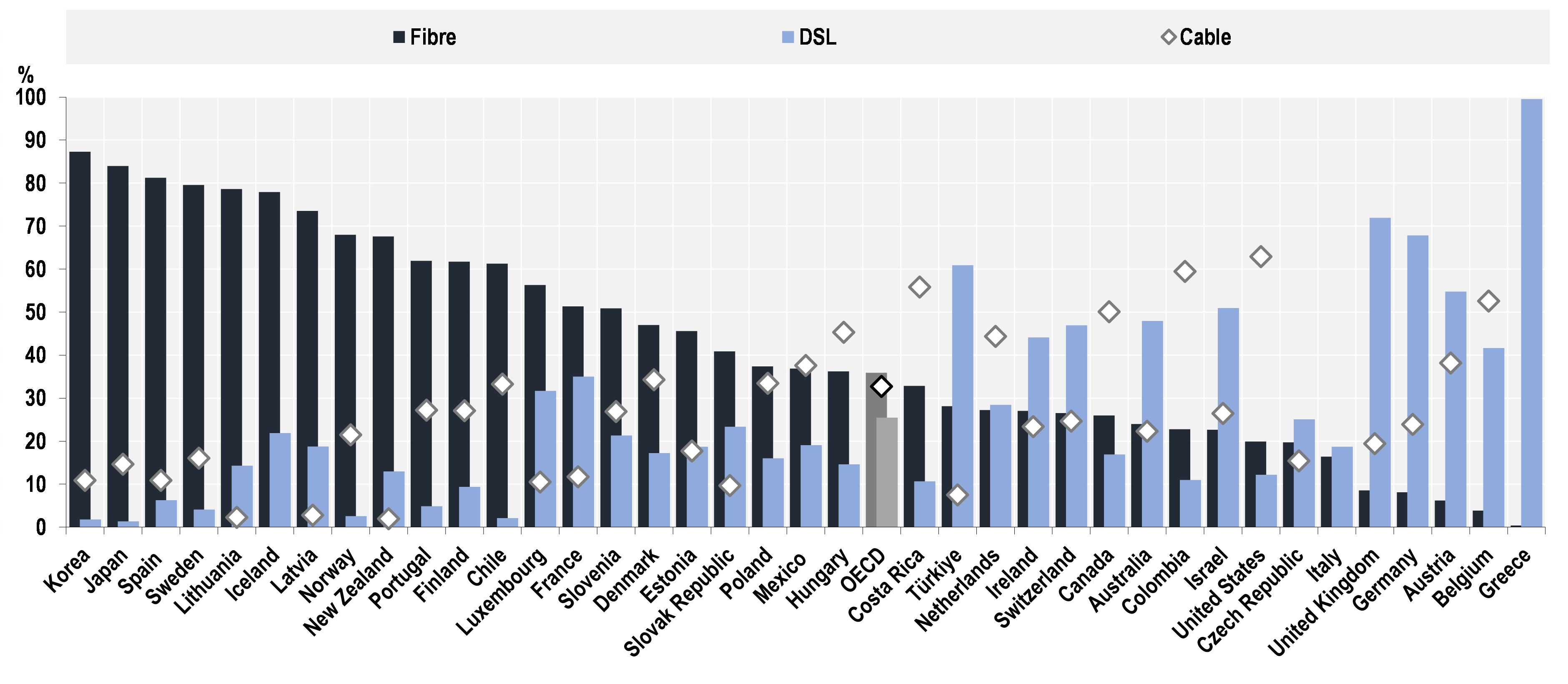
High-speed fibre is now the primary fixed broadband technology in 19 out of 38 OECD countries, according to the latest data. Among these countries, 15 have a share of fibre subscriptions of over 50%.

The latest update of the OECD Broadband Portal shows a 12.3% rise in fibre broadband subscriptions across OECD countries between June 2021 and June 2022, a slightly slower growth rate than the previous 12 months. The need to bolster remote working capacity has remained even as many workers physically returned to the office in 2022, driving demand for fibre connections that provide fast upload and download speeds. Overall, fibre now accounts for 36% of fixed broadband subscriptions in the 38 OECD member countries, up from 22% five years ago.

Korea, Japan and Spain have the highest fibre penetration rates in the OECD at 87%, 84% and 81%, respectively, being among the seven countries with a fibre share of total fixed broadband subscriptions of 70% or above. The highest fibre growth rates in Latin America were in Costa Rica, Chile and Colombia (51%, 35% and 32%, respectively), while in Europe they were Belgium, the United Kingdom and Ireland (87%, 47% and 40%, respectively).

The latest update of the Broadband Portal features 5G subscriptions for the first time, with 14 OECD countries now able to show 5G data as part of their overall mobile broadband data. Overall, of all 38 OECD countries, 5G services are available in 36, with the number of 5G subscriptions representing 17% of mobile broadband subscriptions (in countries with available data). Denmark (41%, 3.5 million subscriptions), Korea (28.5%, 24.6m) and Japan (21%, 51.5m) have seen the highest take-up. Mobile broadband continued to grow overall, with a 6% increase in subscriptions in the year to June 2022.

Cable grew by a more modest 2% in the year to June 2022 and is now declining in 18 countries. It remains the leading fixed broadband technology in eight OECD countries, and is dominant in North and South America, with subscriptions in the United States, Colombia and Costa Rica accounting for 63%, 59% and 56% of the total, respectively (although in Chile fibre has overtaken cable). In Europe, cable remains popular in Belgium, Hungary and the Netherlands, with 53%, 45% and 44%, respectively.

DSL subscriptions fell by 8.5% over the same period, with several OECD countries showing sharp declines. While DSL remains the main broadband technology in several countries, some saw sharp declines in subscriptions, notably Norway (-64%), Chile (-49%) and Sweden (-41%).

Fibre, DSL and cable in total fixed broadband subscriptions, June 2022

Overall, fixed broadband subscriptions in OECD countries totalled 476 million in June 2022, up from 463 million a year earlier, with an average of 34.7 subscriptions per 100 inhabitants. Mobile broadband subscriptions totalled 1.76 billion in June 2022, up from 1.66 billion a year earlier, with an average of 128 subscriptions per 100 inhabitants.

Download broadband data, charts, and penetration maps by country at http://oe.cd/broadband.