AR tool could give cyclists ‘sixth sense’ and improve self-driving vehicle safety

A new tool which can rapidly prototype augmented reality experiences has given researchers new insights which could allow cyclists to safely share the roads with self-driving cars.

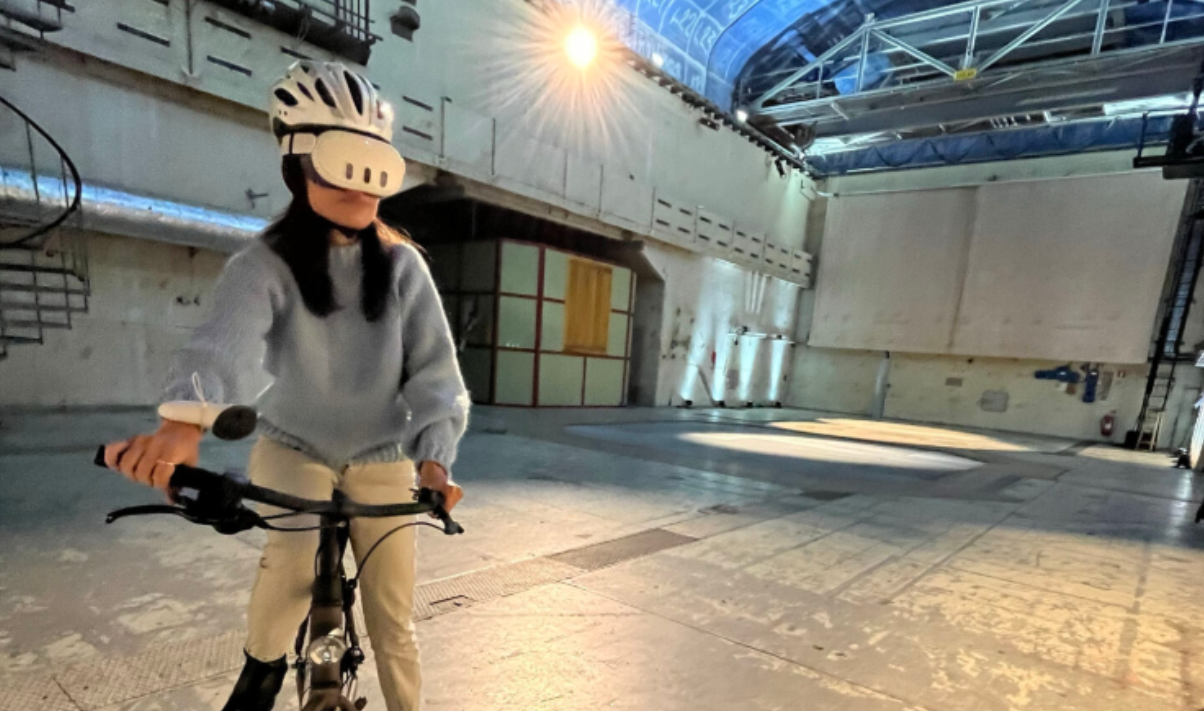
Researchers from the University of Glasgow developed the tool, called CycleARcade, which uses augmented reality headsets to enables cyclists to see and interact with simulated autonomous vehicles as they ride in real-world environments.

The team used CycleARcade to explore how new gear could equip cyclists with a ‘sixth sense’ to help them be more aware of self-driving cars’ intentions. They also examined how cyclists from different countries may expect different behaviours from autonomous vehicles on their local roads.

Unlike traditional simulators which use stationary bikes surrounded by computer screens to mimic real-world situations, CycleARcade enables a more realistic experience, where cyclists ride freely in open spaces with graphics of virtual vehicles displayed in their headsets. The system provides researchers with precise control over the virtual vehicles, allowing cyclists to safely test out immersive scenarios which could be dangerous on real roads with actual cars.

The team’s research builds on previous work they have conducted on how autonomous vehicles can communicate effectively with cyclists to replace the complex set of nods, waves and eye signals which human drivers and riders have developed to signal their intentions to each other. Their CycleARcade research will be presented as two papers later this month at the CHI Conference in Japan.

The first paper outlines how the Glasgow team used CycleARcade to test new designs for interfaces which could alert cyclists to nearby autonomous vehicles and provide information about the cars’ intentions.

With the help of a focus group of 20 cyclists, they developed and tested three virtual displays which would give riders information about vehicles around them in different road scenarios where some cars would yield to the cyclists while others would not.

One prototype, RoadAlert, displayed signals about the cars’ intentions directly onto the road surface and played spatial audio beeps which got louder as vehicles approached. A second, called reARview, gave riders a virtual rear-view mirror through augmented reality glasses. The third, named Gem, used handlebar-mounted displays to communicate the virtual vehicles’ movements.

Ammar Al-Taie, of the University of Glasgow’s School of Computing Science, is the paper’s lead author. He said: “Technology offers an opportunity to augment cyclists’ awareness of the roads around them, providing a kind of ‘sixth sense’ to help them navigate safely.

“What we found in this study is that you don’t need to alert cyclists about all vehicles equally. Cyclists need focused awareness of vehicles that pose the greatest risk, like those approaching from behind or vehicles that won’t yield, while being able to maintain attention on the road ahead. RoadAlert was the design that brought those qualities together most effectively for our study participants.

“It’s important to emphasise, though, that we’re not expecting cyclists to have to adopt this kind of technology in order to stay safe on the roads in the future. Instead, we’re expanding the toolbox for cyclists who want additional support or awareness, who could choose to buy devices specifically designed to do so.”

In the second paper, computing scientists and psychologists from the University of Glasgow and colleagues from the KTH Royal Institute of Technology in Sweden show how they used CycleARcade to probe the road safety expectations of cyclists in three different countries, with very different levels of cycling infrastructure.

They gave CycleARcade kits to cyclists in cities in Sweden, Oman and Scotland and asked them to ride in simulated road conditions with computer-controlled projections of autonomous vehicles displayed in their headsets.

In Stockholm, where cyclists are used to having their own space in dedicated cycle lanes, riders wanted to know exactly where the self-driving car was located around them. They preferred to take their time to judge its intentions by watching its driving behaviour.

In Muscat, where cyclists regularly navigate busy shared roads and make fast-paced decisions about their next move, riders were more likely to quickly trust direct signals from the vehicles.

Cyclists from Glasgow, which has a limited number of dedicated bike lanes, took a more balanced approach. They reported that they wanted to see both location information and clear signals about the vehicle’s intentions.

Mr Al-Taie added: “These findings clearly show that cyclists learn to share the roads with cars differently from country to country, which suggests that self-driving cars might need to adapt their communication methods to better speak the language of the local roads. Humans often do this naturally when driving abroad, but autonomous vehicles may need to have their programming tweaked to take local driving culture into account when they start rolling out around the world in the years to come.”

The paper has been selected by the conference for an Honorable Mention award, which are presented to the top 5% of papers submitted to CHI 2025.

CycleARcade is the latest development in research led by Professor Stephen Brewster, of the University of Glasgow’s School of Computing Science, which focuses on how cyclists can communicate with self-driving cars in the years ahead.

Professor Brewster said: “Ultimately, we’re aiming to thoroughly explore the ways in which cyclists and autonomous vehicles can speak the same language on the roads to keep both as safe as possible. Human drivers and riders have developed a sophisticated series of signals to help decide who has the right of way or who has priority in a change of lanes, for example, and it’s vital that cyclists can have the same level of trust and understanding with self-driving cars.

“CycleARcade is a powerful tool to help explore how that new language can be developed, using real bikes in real physical spaces, with virtual elements that can be tweaked or replaced in real-time. We’re continuing to work on research in this area, and we hope that our insights will help influence the design of future generations of autonomous vehicles.”

The team’s papers, titled ‘Around the World in 60 Cyclists: Evaluating Autonomous Vehicle-Cyclist Interfaces Across Cultures’ and evARything, evARywhere, all at once: Exploring Scalable Holistic Autonomous Vehicle-Cyclist Interfaces’, will be presented at the CHI Conference in Yokohama, Japan, on Monday 28th April and Wednesday 30th April respectively.

Video


Irish start-up Imvizar raises €1.5M to put augmented reality storytelling into the hands of millions of creators

An Irish start-up has raised a total of €1.5 million, including a significant investment from Delta Partners VC, to fuel the launch of new technology which has the power to put augmented reality (AR) storytelling into the hands of millions of worldwide creators.

The capital injection will fuel the launch and expansion of Imvizar’s groundbreaking no-code AR creation tool, Lureo, and support the company’s plans to broaden its operations into the United States, one of the world’s largest and most dynamic markets.

Lureo represents a significant leap forward in the digital storytelling landscape. Traditionally, creating AR content has been a complex process, requiring specialised skills in coding and development.

Imvizar’s new technology disrupts this paradigm by offering an intuitive, user-friendly interface that allows anyone, regardless of technical expertise, to craft high-quality AR experiences. The tool is poised to empower a diverse range of creators, from filmmakers and educators to marketers and brand strategists, to bring their stories to life in augmented reality.

Michael Guerin, CEO and Founder of Imvizar said: “Our mission is to make spatial storytelling as mainstream and accessible as possible.

“With Lureo, we’re breaking down the barriers to AR content creation, enabling anyone, anywhere, to produce immersive experiences. Just as the introduction of 4G and video streaming drove innovation and made content creation more accessible, Lureo will do the same for AR as we usher in a new era of spatial computing.

“We’re not just changing how stories are told, with Lureo, we are redefining the relationship between narrative, space, and audience engagement.

“The launch of Lureo and the expansion into the US market are key steps in our journey, positioning Imvizar as a driving force in the next wave of AR innovation.”

The investment includes continued support from prominent investors, Gareth Lambe, former Head of Meta (Ireland), Michael Dywer, founder of Pigsback and Nigel Byrne, former Group CTO of Ooredoo, as well as Enterprise Ireland.

The company has rapidly gained traction since founding in 2021, attracting high-profile clients such as Salesforce, Grant Thornton, and North Carolina State University.

Imvizar has been at the forefront of transforming real-world environments into immersive, interactive storytelling experiences, hosting over 80 AR experiences across eight countries. Now the highly innovative company has secured the support of one of Ireland’s leading VC investment companies.

Dermot Berkery, Partner at Delta Partners VC said: “Delta Partners VC is thrilled to support Imvizar as they continue to push the boundaries of what’s possible in the AR space.

“Lureo is an exciting innovation that offers a truly accessible platform, with the potential to transform how we create and engage with AR content. We believe in its enormous potential to open new avenues for creators and brands alike, and we’re excited to see how Imvizar will continue to evolve.”

Imvizar has successfully developed and launched a range of experiences that have captivated audiences across various sectors, including tourism, employee engagement, and sustainability.

These experiences have not only enhanced the way people interact with their surroundings but have also demonstrated the powerful potential of AR as a tool for storytelling and engagement.

One notable project includes the AR experience created for Salesforce at their Dublin Tower, which integrated immersive storytelling into the workplace, enriching the experience for employees and visitors alike.

Similarly, the ‘Planet vs. Plastics’ initiative for Grant Thornton highlighted the environmental impact of single-use coffee cups through a vivid, interactive AR display, engaging hundreds of employees and sparking meaningful conversations about sustainability.

For more information about Imvizar and Lureo, visit www.imvizar.com.

Dublin City Council Launch ‘DiscovAR Dublin’ – Ireland’s First Augmented Reality Map

Dublin City Council has today announced the launch of a new augmented-reality (AR) mapping feature that allows users of the Dublin Discovery Trails app to open up a 3D map of Dublin on their device and allow them to explore the city in a new, innovative way.

‘DiscovAR Dublin’ is a first for Ireland in utilising new open Google Maps technology to form an interactive 3D map where users can be transported into the city to interact with the map to uncover Dublin landmarks, museums and attractions. Users can also learn more about the history and significance of locations such as the Guinness Storehouse, EPIC – the Irish Emigration Museum and 14 Henrietta Street.

The project is a collaboration between the Dublin City Council, Smart Dublin and Virgin Media Business alongside Peel X, who developed the feature for the Dublin Discovery Trails app.

Launched last year, the app is a platform on which the Dublin local authorities can develop new and exciting immersive experiences combining the real-world history with smart technologies. Already there are unique experiences published including Doors into Docklands, Balbriggan and Castleknock heritage tours.

Lord Mayor of Dublin, Daithí de Róiste, launching this exciting new feature said, “This is first for Ireland, the user can ‘literally’ step into the city from anywhere in the world and explore Dublin in the palm of their hand. This innovative technology will help further position Dublin as a world-class destination with this new experience. I’m delighted to launch DiscovAR here today and I’d encourage everyone to download the app and try it today to explore the best of what Dublin has to offer.”

Tourists and locals alike can use the app before they visit the city, or while they are in the city with the vision that it will assist users to learn more about Dublin and its extensive history, sights, monuments and streets across the capital city.

Also commenting on the launch of ‘DiscovAR Dublin’, Jamie Cudden, Smart City Lead, Dublin City Council said, “DiscovAR offers a new way for visitors and locals to experience the capital city. Through our Smart Dublin programme, we are always thinking about how we can embrace new technologies to enhance how people engage with our Capital City. This app through its immersive AR technology is a new and fun way to explore the City’s culture and history and we see huge potential to expand this.”

The Dublin Discovery Trail app is part of a larger Smart Tourism strategy to invest in digital to transform Dublin’s tourism experience for how we tell the story and history of the city and was developed as part of the new Dublin City Council Tourism Strategy 2023-2028 – Innovation Pillar. Using new and immersive technologies, such as augmented reality, will help further position Dublin as a world-class tourism destination with this new digital experience and allow for further unique and tailored customer experiences that will keep the city relevant for tourists.

For more information on ‘DiscovAR’ and to download the app visit http://dublindiscoverytrails.com or search Dublin Discovery Trails on Apple App Store or Google Play..

Enhancing Reality with AR Development: Innovations and Use Case

Augmented Reality (AR) is a technology that allows users to enjoy an interactive experience by overlaying digital elements in the real world. AR is more commonly associated with the gaming industry, but you can also find it in many other industries nowadays, such as retail, healthcare, and education. By blending the physical and digital worlds, AR draws more attention and provides more desirable results.

In this article, you can read more about how AR development has brought innovation to multiple sectors. 

Innovations in AR Development

For as long as AR has existed, it has been evolving. Through advancements such as real-time object recognition, tracking and localisation, and SLAM technology, AR has provided an increasingly enhanced experience for users, with refined stability and improved interaction.

In addition to the overlay, the hardware has also seen significant enhancements. Many companies have started to invest in the development of optimised AR equipment. Smart glasses and headsets have features that make the AR experience even more unique, such as cameras, a precision current sensor, audio capabilities, motion tracking abilities, and high-resolution displays. 

AR can integrate other relevant and emerging technologies, like Artificial Intelligence and Machine Learning. These technologies have contributed to a quality increase of AR experiences by, for example, enabling accurate and seamless object recognition and tracking, understanding the context of the scene, and interpreting gestures and voice commands. 

Innovation becomes even clearer when looking at mobile apps. AR and the app development industry have gotten very close, which resulted in an interesting combination of mobile apps and AR features. Social media apps like Instagram and Snapchat are immediate examples of this relationship, as they are known to provide filters to add to photos. The retail industry also benefits from AR technology – for instance, IKEA’s app uses AR technology to allow users to try on furniture in their real-life environment.

Use Cases: AR in Different Sectors

AR in Retail and E-commerce

As mentioned previously, AR plays a relevant role in the retail and e-commerce transformation. As people increasingly turn to online shopping, the more necessary it is to find technologies that allow customers to benefit from the advantages of being in a physical store. AR has thus enabled virtual try-ons, which allow shoppers to virtually try on the products before purchasing, from makeup to furniture. 

AR in Education and Training

Thanks to Augmented Reality, education has become more interactive and enjoyable. AR technology can overlay digital elements such as 3D models and animations onto real-life objects, making the experience more interactive, immersive, and memorable, which helps keep students motivated. 

Besides providing a more entertaining learning experience, AR also helps learners acquire skills through simulations of the real world, in which the student can learn and practise in a controlled but realistic environment. This is especially helpful for skills related to aviation and healthcare, for example. 

AR in Healthcare

Augmented Reality can help medical staff perform tasks more safely. For instance, this technology can help surgeons during medical procedures by overlaying a 3D model of the patient’s anatomy onto their field of view, which helps guide them in the surgery, improving precision. Likewise, the same can be applied to students, who can practise performing medical procedures of different levels of difficulty in a realistic environment without the implications and risks of real-life training. 

AR in Manufacturing

AR can also transform the manufacturing industry and make the lives of assembly workers easier by overlaying visual instructions onto their environment, thus guiding them through the most complex assembly processes. Additionally, it can help them detect and reduce errors and display real-time metrics, which increases efficiency and productivity. 

Final Thoughts on the Expansive Realm of AR Development

The future of AR development holds promising advancements, as the realm of AR is constantly evolving. Technological progress makes AR more accessible, immersive, and integrated into our reality. And with the advent of emerging technologies that are bound to be part of our daily lives as well, such as 5G and Artificial Intelligence, Augmented Reality will only continue to grow and provide users with platforms that enhance their learning and skill development processes, their work duties, and their leisure moments.

Dublin Discovery Trails is a new first of its kind Augmented Reality app shows Dublin as you’ve never seen it before!

Dublin City Council (DCC) today launched Dublin Discovery Trails – ‘Doors into Docklands’, the first in a series of mobile application (app) based immersive discovery trails with innovative Augmented Reality (AR).  The App, which has been co funded by Dublin City Council and Fáilte Ireland through its Destination Town Investment Scheme, will help to further unlock the tourism potential of the Docklands by bringing the area and its story to life for visitors in a new and immersive way.

This App is an innovative way to see the history of the Docklands come to life through Augmented Reality which combines the real-world history with smart technology. This app merges the old and the new, combining history and technology, and will guide the user in their own time on a journey of discovery to some of the Docklands most loved sites and attractions, enabling them to uncover compelling stories of Dublin’s culture, heritage and history via Augmented Reality (AR) technology.

You can experience the Guinness barges sailing down the River Liffey, to the Crimean Banquet held in the CHQ and the story of the famine statues.  Along the trail you can see the ‘history come to life’ with a 360-degree view of the Custom House fires blazing in 1921, the Scherzer Bridges in 2d animation and Port workers in the Diving Bell toiling at the bottom of the sea. You will also meet many Augmented Reality characters telling their stories from Captain Bligh who surveyed Dublin Bay in the 1800’s to Maggie Doyle telling her tale as a Docker’s daughter.

Caroline Conroy, Lord Mayor of Dublin, launching this exciting new app, said: “This is amazing technology, bringing a part of Dublin alive that most of us have never seen! It’s really exciting innovation and as Lord Mayor, I’m proud to see Dublin at the forefront of smart tourism technology joining the past and the future together. I’d like to take the opportunity to encourage visitors and Dubliners alike to download the app and try out this immersive new experience.”

Dublin City Council directed the implementation of this exciting first trail on Dublin Discovery Trails App, ‘Doors into Docklands’ developed by Peel X . The development of the Docklands AR trail was in collaboration with representatives from Fáilte Ireland, Dublin Port Company, OPW, EPIC, Smart Dublin and Dublin City Council Culture Company.

The Dublin Discovery Trails app is a platform on which multiple Dublin tourism agencies and local authorities can develop new and exciting immersive experiences. The underlying tender framework facilitated by DCC has structured Dublin Discovery Trails as a centralised App to provide immersive experience development across Dublin. Members of this tender framework include Fáilte Ireland, Dublin Port Company, Waterways Ireland and the four Dublin Local Authorities.

The App is a first-of-its-kind development for Dublin City Council and further promotes the capital’s position as a leading ‘Smart City’. The app is aimed at locals and visitors to the City who want to know more about and experience the history of the Docklands from a new and unique perspective. It will transport the user back in time using 3D graphics, animations, and storytelling immersing them in historical scenes and shocking events from the Docklands’ past.

Karl Mitchell, Director of Service Area Management in Dublin City Council, said: The App was jointly funded by Dublin City Council and Fáilte Ireland and the innovative technology that was developed offers a new way for visitors and locals to experience the capital city like never before. This App through its immersive AR technology allows users to explore the City’s Docklands in an engaging and exciting way. You can find out more about Dublin’s maritime history, visit famous landmarks and heritage sites, uncover hidden wonders, and experience history and culture in a new fun way.”

Speaking at the launch, Paul Keeley, Director of Regional Development at Fáilte Ireland said: “Today’s tourists are looking for more unique and compelling ways to immerse themselves in the local culture, heritage and history of a destination, Fáilte Ireland was pleased to the support the development of the innovative Doors into Docklands heritage trail through our Destination Town Investment Scheme. Building on the work being done to date as part of the Docklands Destination Experience Development Plan, this interactive AR heritage trail will also help improve visitor flow to the area and will encourage visitors to stay longer both during the day and into the evening, further spreading the economic benefits of tourism to the local businesses.”

The App uses a Wi-Fi or data connection to download the initial content including the geo-enabled landmarks and map. These landmarks will be a prompt for visitors to point their phones where the images and videos will then appear. There is no need for a live data connection while using the app, as everything is stored on your phone after the initial content download, so users won’t be charged for expensive data roaming during their experience.

The digital trails app is part of a larger Smart Tourism strategy to invest in digital to transform Dublin’s tourism experience for how we tell the story and history of the city. This flagship project will help further position Dublin as a world class tourism destination with this new unforgettable digital experience and create the building blocks to deliver many more unique and tailored experiences.

For more information on ‘Doors into Docklands’ and to download the app visit https://doorsintodocklands.com/

How AI Will Affect the Future of Work

AI is revolutionizing the way that people work. Many industries are no longer hiring physical staff. Instead, they are using AI to complete administrative and even physical tasks. For many people, this is very problematic, The use of AI is resulting in millions of people losing their jobs. Millions more are also predicted to lose their jobs in the coming years. On the other hand, however, AI is helping businesses to save a lot of money, which allows them to then invest in other areas, and deliver more quality services.

This article will explore this topic in greater detail, explaining how AI will affect the future of work:


Accuracy

One of the main ways that AI will change the future of work is because it produces very reliable and accurate data. With more accurate data and information, companies are better able to target customers and tailor products to them. Many would argue that data accuracy is one of the main advantages of using artificial intelligence because it helps businesses to deliver better services. The data compilation and production skills of AI far exceed that of an ordinary human being. AI also compiles data a lot faster.

Unemployment

Unfortunately, the integration of AI will result in widespread unemployment. For individual workers, this is a big problem, but for companies this is good. The primary reason that the integration of AI will benefit companies is that it will result in them saving a lot of money. Companies will no longer have to pay the wages of full-time staff. For very large companies, removing staff and hiring AI could result in them saving millions of dollars. Massive unemployment, on the other hand, will be very bad for the global economy. The impact that AI will have is yet to be understood properly.

Productivity

AI is a lot more productive than physical workers because it is entirely automated and doesn’t get tired. This is a large reason why AI will take the jobs of normal people. AI can also work a lot faster. Because AI never gets tired, it can be left on to run 24/7. It is illegal to force one’s staff to work for such long hours. Businesses that have multiple AI bots working can then leave them running permanently, with no breaks, meaning that their productivity increases by over 100%.

Profitability

With greater productivity and data accuracy, businesses are able to increase their overall profitability. Profitability is the main metric by which businesses are measured. If a business is not profitable, then it can’t survive. AI can significantly boost profitability, in businesses from a variety of different industries. Greater profitability also means that businesses can invest in other areas of their businesses, improving and streamlining important functions. Because businesses will save a lot of money by integrating AI and will earn more money, there will be a lot more money to be invested, therefore significantly proving the way that businesses run and are managed.

Resources

By integrating AI into their daily operations, businesses are able to free up resources. If businesses choose to keep staff whose jobs have been taken over by AI, then they can move them to other departments and focus on streamlining tasks. Currently, the main tasks completed by AI are administrative in nature. Administrative tasks can be very time-consuming. Staff no longer having to complete administrative work can save the companies that they work for a lot of time (and therefore money). More disposable resources mean that businesses can improve the services that they offer.

Flexibility

The use of AI means businesses are able to be more flexible. Because staff will no longer be responsible for completing time-consuming administrative tasks, they will be able to be assigned to complete other more important tasks on short notice. Flexibility is a very important thing for businesses to cultivate. If a business isn’t flexible, then it won’t be able to adapt and change according to consumer demands. The business world is constantly evolving. With more and more technology being released, businesses need to stay ahead, which AI can help them to do. Improved flexibility means a better working culture, better company, and more profits.

Personalization

AI can be used to personalize the consumer journey. The main way that it does this is by anticipating what a customer’s next step is. By anticipating a customer’s next step, AI is able to deliver a high-quality and efficient service. When customers are shopping on your website, they sometimes need a small push to get them to complete a sale. AI can help to give them this push. AI can send them reminders, emails, and notifications, in addition to offering them discounts for shopping with you. AI personalization is one of the most popular trends in online sales, at the moment.

Skills

When you hire a person to complete a task, their skills are limited. This is not the case with AI. The reason for this is that AI can be customized, according to what needs to be done. All a programmer needs to do is to alter an AI’s code to change its function. This essentially gives you access to workers with infinite skills and capabilities. The possibilities of this are endless. Businesses can use AI for marketing, sales, and product development. The myriad skills of AI are in part why so many people are being made unemployed.


Occupations

While AI is causing people to lose jobs, it is also creating jobs. There is a huge demand for AI programmers and handlers, at the moment. If you are looking for a job in an emerging industry, then learning about the production and management of AI software is something that you might want to consider. Because AI is taking over administrative tasks, it is also creating jobs in more specialized fields. The jobs that AI is creating are usually offered as ‘home working’ positions, which is great for people that have children or just don’t want to commute into an office every day.

AI will (and already has) significantly change the way that we work. That’s not a bad thing, though. While people will be made unemployed, jobs will still be created. AI will save businesses millions and allow them to deliver better services.

How Tech’ Has Impacted Furniture – Infographic #AR #EZLiving #Tech #Furniture

Tech can be used in many ways today and it can be fun for the most part but now with AR it just enhances life and with mobile phones it is already happening.. Recently EZ Living launched their own AR app which you can read about HERE .

EZ Living uses AR technology on their websites to allow customers to see what a piece of furniture will look like in their home and they have received excellent feedback on the issue which is of great benefit to customers and have sent us this infographic on the Role of Tech in Furniture. Fancy some comfortable beds? Check out contemporary beds.


EZ Living Furniture (@EZLivingFurn) launches Augmented Reality App. #EZLiving #Apps #AR #Furniture

Shopping safely from the comfort of your own home has now become a reality, augmented reality in  fact. EZ Living Furniture is proud to announce the launch of its AR app (Augmented Reality), the first  of its kind in Ireland. With the magic of technology, you can now bring sofas, bed frames, wardrobes,  lighting and so much more directly and virtually into your own home. 

“There’s nothing normal about operating a business in a pandemic therefore instead of finding fault,  we decided to find a remedy”, informed EZ Living Furniture’s E-commerce Manager Robert Walsh. 

Teaming up with AR specialists Intiaro, EZ Living Furniture developed the first real Irish furniture AR  app for the retail sector. 

What can you do with the app? 

Simply pick an item from our collection available in the app. Once you have found your favourite, point  your phone or tablet at a flat surface and watch as the item appears before your eyes. Next, place the  item in the room and choose from all available colours and materials. 

Using your mobile phone or tablet, bring EZ Living Furniture’s catalogue of virtual furniture into your home with their new augmented reality app. 


Unleash the virtual interior designer in you and add multiple pieces of furniture to your scene at once.  See how your favourite sofa, table and lamp will look in any room setting and zoom in or walk towards  it for a more detailed view. Create virtual walls with the press of a button and hang virtual wall art  from them (perfect for new builds). 

Your personally designed space can be easily saved and returned to later for further changes. Or if you  are happy with your creation, take screenshots and share these with your family and friends. 

This is the future of retail and EZ Living are delighted to present this exciting app to you. It’s a more  immersive and convenient experience than browsing through countless online websites. The AR app  allows you to view life-sized pieces of furniture in your room and all products are available to purchase from their online store. Further information can be found by accessing the link below 

https://www.ezlivingfurniture.ie/view-at-home-augmented-reality-app 

Download the free app for Android or IOS 

New Augmented Reality Game Lets Players Buy and Sell Real World Properties. #AR #LandlordGo #Property #Gaming

Walking down the street you notice something has changed. You take out your phone hastily, to check the available properties around you. Yes! There they are! New shares and you’re the first one to get them. You don’t think twice, cause you know you must have them! It’s not the first time when on your way to work you come across such valuable finds. We’re all part of this virtual map. With more than 3 billion mobile devices on the planet today, trillions of data trails are left behind unused. Now you can enjoy this mixture of digital and real world in the Landlord GO game. 

Landlord Go is a brand new game by Reality – that leverages these digital “footprints” in a fun and exciting way, allowing players to buy, sell, and collect rent on some of the world’s most famous buildings and landmarks. With over 1 million players worldwide, it’s the first real-world augmented reality game that uses real buildings, real people, and real prices to turn your city into an action-packed strategy game. With more than 14 900 players already making deals for  virtual ownership of the more than 61 500 in Dublin already, there’s no shortage of fierce competition ready for action. 

You walk your neighborhood every day, seeing familiar landscapes and buildings. Now you can view those daily sights in a whole new way by owning a virtual piece of your community. Whether you’re starting small or have grand visions to own the Custom House in Dublin or the Empire State Building in New York City, they’re yours for the taking with Landlord Go. 

Do you have unique knowledge of a part of your city that few others know? That local intel can translate into big profits in Landlord Go. If a new coffee shop is opening in your neighborhood and you think it’s poised to become the next Starbucks, put in a bid for it, and start raking in the rent payments from the crowds lined up outside the door. 

Using a massive pool of data, including detailed information about more than half a billion real world properties, Landlord Go connects the user to their city in an exciting and innovative new way that no other game can offer. 

Players can start small and quickly create a vast real estate empire through savvy investing. Put properties on the market, or engage in furious bidding wars with other players, recreating the experience of competing in the thrilling real estate market right from their phone. 

Landlord Go is incredibly accurate, reflecting real-world values of properties using details like distance from the city center and building amenities. By using our own data set combined with NASA satellite scans showing nighttime light emissions, we’ve created one of the most realistic and data-driven property dealing games ever conceived. 

You can really get the feeling that the level of realism is truly what sets Landlord Go apart. Anytime another player visits your property in real life, they pay you rent in the game. The more visitors your property gets, the higher its value. Using a proprietary AI and data platform called Big Dots, we’re able to add real-world data to any desktop and mobile apps. 

The game is exciting as players see their fortunes grow and engage in sky-high value transactions, competing with other players for dominance in the real estate market. There’s nothing quite like it available today, and nothing that even comes close to the level of accuracy and detail found in Landlord Go. 

Google Play [Download for Android]  or on App Store [Download for iPhone]